

ASTM D7665-22
(Guide)Standard Guide for Evaluation of Biodegradable Heat Transfer Fluids
General Information
- Abstract
SIGNIFICANCE AND USE
4.1 The significance of each test method depends upon the system in use and the purpose of the test method as listed under Section 5. Use the most recent editions of ASTM test methods.
SCOPE
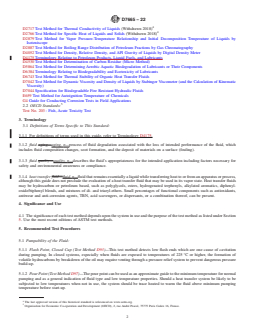
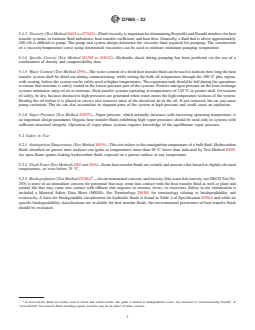
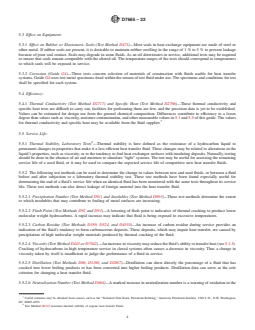
1.1 This guide2 covers general information, without specific limits, for selecting standard test methods for evaluating heat transfer fluids for quality and aging. These test methods are considered particularly useful in characterizing biodegradable water-free heat transfer fluids in closed systems.
1.2 The values stated in SI units are to be regarded as standard. No other units of measurement are included in this standard.
1.3 This international standard was developed in accordance with internationally recognized principles on standardization established in the Decision on Principles for the Development of International Standards, Guides and Recommendations issued by the World Trade Organization Technical Barriers to Trade (TBT) Committee.
- Status
- Published
- Publication Date
- 30-Jun-2022
- Technical Committee
- D02 - Petroleum Products, Liquid Fuels, and Lubricants
- Drafting Committee
- D02.L0.06 - Non-Lubricating Process Fluids

Overview
ASTM D7665-22 - Standard Guide for Evaluation of Biodegradable Heat Transfer Fluids - provides guidance on selecting and applying standard test methods for assessing the quality and aging of biodegradable, water-free heat transfer fluids, particularly in closed systems. Developed by ASTM International, this guide supports manufacturers, users, and regulators in evaluating fluid performance, ensuring system safety, and verifying environmental compatibility in accordance with international standardization principles.
This standard references multiple ASTM and OECD methods for comprehensive evaluation, focusing on critical properties including pumpability, safety, effects on equipment, efficiency, and service life. It emphasizes the use of SI units and highlights the environmental significance of biodegradable heat transfer fluids.
Key Topics
- Quality and Aging Assessment: The guide details procedures for monitoring properties such as viscosity, flash point, pour point, water content, vapor pressure, and others to ensure optimal heat transfer fluid quality.
- Pumpability: Methods for evaluating fluid movement under different temperature and pressure conditions, essential for reliable system operation.
- Safety in Use: Assessment of fire and environmental hazards using flash point, autoignition temperature, and biodegradation tests.
- Environmental Impact: Evaluation includes biodegradability and toxicity (e.g., acute fish toxicity) to address environmental and personnel safety.
- Equipment Compatibility: Focuses on effects of heat transfer fluids on system materials, especially rubber or elastomeric seals and corrosion potential.
- Efficiency: Recommends determining thermal conductivity, specific heat, and related fluid properties that impact heat transfer effectiveness.
- Service Life: Guidance on tests for monitoring changes in fluid properties over time, including thermal stability, formation of sediment, changes in viscosity and color, and contamination.
Applications
ASTM D7665-22 is instrumental in industries utilizing closed heat transfer systems, particularly where biodegradable heat transfer oils and fluids are required for environmental compliance and operational safety. Key application areas include:
- Industrial heating and cooling in chemical processing, manufacturing, solar thermal plants, and food production
- Power generation facilities aiming for environmentally responsible fluid management
- Maintenance and lifecycle management of heat transfer systems, enabling early detection of fluid degradation and system issues
- Regulatory compliance and environmental stewardship for sites sensitive to fluid leakage and accidental discharge
By standardizing how biodegradable heat transfer fluids are evaluated, organizations can improve operational safety, extend equipment life, and contribute to sustainability goals.
Related Standards
ASTM D7665-22 references several crucial standards for testing heat transfer fluids, including:
- ASTM D86: Distillation of Petroleum Products
- ASTM D92, D93: Flash and Fire Point Testing
- ASTM D95: Determination of Water Content
- ASTM D445, D7042: Kinematic and Dynamic Viscosity Testing
- ASTM D664: Acid Number by Potentiometric Titration
- ASTM D471: Rubber Property - Effect of Liquids
- ASTM D5864: Biodegradation of Lubricants
- OECD Test No. 203: Fish, Acute Toxicity Test
Adhering to these recognized test methods ensures reliable and repeatable results when evaluating biodegradable heat transfer fluids. For comprehensive assessment, users should reference the latest versions of all relevant test methods incorporated by ASTM D7665-22.
Keywords: biodegradable heat transfer fluid, ASTM D7665, fluid quality, aging, environmental compliance, heat transfer oil, test methods, safety, equipment compatibility, fluid efficiency.
Relations
- Effective Date
- 01-Apr-2024
- Effective Date
- 01-Mar-2024
- Refers
ASTM D4175-23a - Standard Terminology Relating to Petroleum Products, Liquid Fuels, and Lubricants - Effective Date
- 15-Dec-2023
- Effective Date
- 01-Dec-2023
- Effective Date
- 01-Dec-2023
- Effective Date
- 01-Dec-2023
- Effective Date
- 01-Nov-2023
- Effective Date
- 01-Nov-2023
- Effective Date
- 01-Oct-2023
- Refers
ASTM D4175-23e1 - Standard Terminology Relating to Petroleum Products, Liquid Fuels, and Lubricants - Effective Date
- 01-Jul-2023
- Effective Date
- 01-Jul-2023
- Effective Date
- 01-Aug-2020
- Effective Date
- 01-Jul-2019
- Effective Date
- 01-Dec-2018
- Effective Date
- 01-Oct-2018
Get Certified
Connect with accredited certification bodies for this standard

Element Materials Technology
Materials testing and product certification.

ABS Group Brazil
ABS Group certification services in Brazil.

ABS Quality Evaluations Inc.
American Bureau of Shipping quality certification.
Sponsored listings
Frequently Asked Questions
ASTM D7665-22 is a guide published by ASTM International. Its full title is "Standard Guide for Evaluation of Biodegradable Heat Transfer Fluids". This standard covers: SIGNIFICANCE AND USE 4.1 The significance of each test method depends upon the system in use and the purpose of the test method as listed under Section 5. Use the most recent editions of ASTM test methods. SCOPE 1.1 This guide2 covers general information, without specific limits, for selecting standard test methods for evaluating heat transfer fluids for quality and aging. These test methods are considered particularly useful in characterizing biodegradable water-free heat transfer fluids in closed systems. 1.2 The values stated in SI units are to be regarded as standard. No other units of measurement are included in this standard. 1.3 This international standard was developed in accordance with internationally recognized principles on standardization established in the Decision on Principles for the Development of International Standards, Guides and Recommendations issued by the World Trade Organization Technical Barriers to Trade (TBT) Committee.
SIGNIFICANCE AND USE 4.1 The significance of each test method depends upon the system in use and the purpose of the test method as listed under Section 5. Use the most recent editions of ASTM test methods. SCOPE 1.1 This guide2 covers general information, without specific limits, for selecting standard test methods for evaluating heat transfer fluids for quality and aging. These test methods are considered particularly useful in characterizing biodegradable water-free heat transfer fluids in closed systems. 1.2 The values stated in SI units are to be regarded as standard. No other units of measurement are included in this standard. 1.3 This international standard was developed in accordance with internationally recognized principles on standardization established in the Decision on Principles for the Development of International Standards, Guides and Recommendations issued by the World Trade Organization Technical Barriers to Trade (TBT) Committee.
ASTM D7665-22 is classified under the following ICS (International Classification for Standards) categories: 75.100 - Lubricants, industrial oils and related products; 75.120 - Hydraulic fluids. The ICS classification helps identify the subject area and facilitates finding related standards.
ASTM D7665-22 has the following relationships with other standards: It is inter standard links to ASTM D445-24, ASTM D1500-24, ASTM D4175-23a, ASTM D2879-23, ASTM D86-23ae1, ASTM D86-23a, ASTM D5864-23, ASTM D445-23, ASTM D95-23, ASTM D4175-23e1, ASTM D2887-23, ASTM D93-20, ASTM D2887-19, ASTM D2879-18, ASTM D893-14(2018). Understanding these relationships helps ensure you are using the most current and applicable version of the standard.
ASTM D7665-22 is available in PDF format for immediate download after purchase. The document can be added to your cart and obtained through the secure checkout process. Digital delivery ensures instant access to the complete standard document.
Standards Content (Sample)
This international standard was developed in accordance with internationally recognized principles on standardization established in the Decision on Principles for the
Development of International Standards, Guides and Recommendations issued by the World Trade Organization Technical Barriers to Trade (TBT) Committee.
Designation: D7665 − 22
Standard Guide for
Evaluation of Biodegradable Heat Transfer Fluids
This standard is issued under the fixed designation D7665; the number immediately following the designation indicates the year of
original adoption or, in the case of revision, the year of last revision. A number in parentheses indicates the year of last reapproval. A
superscript epsilon (´) indicates an editorial change since the last revision or reapproval.
1. Scope* D445 Test Method for Kinematic Viscosity of Transparent
and Opaque Liquids (and Calculation of Dynamic Viscos-
1.1 This guide covers general information, without specific
ity)
limits, for selecting standard test methods for evaluating heat
D471 Test Method for Rubber Property—Effect of Liquids
transfer fluids for quality and aging. These test methods are
D524 Test Method for Ramsbottom Carbon Residue of
considered particularly useful in characterizing biodegradable
Petroleum Products
water-free heat transfer fluids in closed systems.
D664 Test Method for Acid Number of Petroleum Products
1.2 The values stated in SI units are to be regarded as
by Potentiometric Titration
standard. No other units of measurement are included in this
D893 Test Method for Insolubles in Used Lubricating Oils
standard.
D1160 Test Method for Distillation of Petroleum Products at
1.3 This international standard was developed in accor-
Reduced Pressure
dance with internationally recognized principles on standard- D1298 Test Method for Density, Relative Density, or API
ization established in the Decision on Principles for the
Gravity of Crude Petroleum and Liquid Petroleum Prod-
Development of International Standards, Guides and Recom- ucts by Hydrometer Method
mendations issued by the World Trade Organization Technical
D1500 Test Method forASTM Color of Petroleum Products
Barriers to Trade (TBT) Committee. (ASTM Color Scale)
D2270 Practice for Calculating Viscosity Index from Kine-
2. Referenced Documents
matic Viscosity at 40 °C and 100 °C
D2717 Test Method for Thermal Conductivity of Liquids
2.1 ASTM Standards:
(Withdrawn 2018)
D86 Test Method for Distillation of Petroleum Products and
D2766 Test Method for Specific Heat of Liquids and Solids
Liquid Fuels at Atmospheric Pressure
(Withdrawn 2018)
D91 Test Method for Precipitation Number of Lubricating
D2879 Test Method for Vapor Pressure-Temperature Rela-
Oils
tionship and Initial Decomposition Temperature of Liq-
D92 Test Method for Flash and Fire Points by Cleveland
uids by Isoteniscope
Open Cup Tester
D2887 Test Method for Boiling Range Distribution of Pe-
D93 Test Methods for Flash Point by Pensky-Martens
troleum Fractions by Gas Chromatography
Closed Cup Tester
D4052 Test Method for Density, Relative Density, and API
D95 Test Method for Water in Petroleum Products and
Gravity of Liquids by Digital Density Meter
Bituminous Materials by Distillation
D4175 Terminology Relating to Petroleum Products, Liquid
D97 Test Method for Pour Point of Petroleum Products
Fuels, and Lubricants
D189 Test Method for Conradson Carbon Residue of Petro-
D4530 Test Method for Determination of Carbon Residue
leum Products
(Micro Method)
D5864 Test Method for Determining Aerobic Aquatic Bio-
This guide is under the jurisdiction of ASTM Committee D02 on Petroleum
degradation of Lubricants or Their Components
Products, Liquid Fuels, and Lubricants and is the direct responsibility of Subcom-
D6384 Terminology Relating to Biodegradability and Eco-
mittee D02.L0.06 on Non-Lubricating Process Fluids.
toxicity of Lubricants
Current edition approved July 1, 2022. Published August 2022. Originally
approved in 2010. Last previous edition approved in 2017 as D7665 – 17. DOI: D6743 Test Method for Thermal Stability of Organic Heat
10.1520/D7665-22.
Transfer Fluids
The background for this standard was developed by a questionnaire circulated
D7042 Test Method for Dynamic Viscosity and Density of
by ASTM-ASLE technical division L-VI-2 and reported in Lubrication
Liquids by Stabinger Viscometer (and the Calculation of
Engineering, Vol 32, No. 8, August 1976, pp. 411–416.
For referenced ASTM standards, visit the ASTM website, www.astm.org, or
contact ASTM Customer Service at service@astm.org. For Annual Book of ASTM
Standards volume information, refer to the standard’s Document Summary page on The last approved version of this historical standard is referenced on
the ASTM website. www.astm.org.
*A Summary of Changes section appears at the end of this standard
Copyright © ASTM International, 100 Barr Harbor Drive, PO Box C700, West Conshohocken, PA 19428-2959. United States
D7665 − 22
Kinematic Viscosity) 5.1.3 Viscosity (Test Method D445 or D7042)—Fluid vis-
D7044 Specification for Biodegradable Fire Resistant Hy- cosity is important for determining Reynolds and Prandtl
draulic Fluids numbers for heat transfer systems, to estimate fluid turbulence,
E659 Test Method for Autoignition Temperature of Chemi- heat transfer coefficient, and heat flow. Generally, a fluid that is
cals above approximately 200 cSt is difficult to pump. The pump
G4 Guide for Conducting Corrosion Tests in Field Applica- and system design determine the viscosity limit required for
tions pumping. The construction of a viscosity/temperature curve
using determined viscosities can be used to estimate minimum
2.2 OECD Standards:
pumping temperature.
Test No. 203 : Fish, Acute Toxicity Test
5.1.4 Specific Gravity (Test Method D1298 or D4052)—
3. Terminology Hydraulicshockduringpumpinghasbeenpredictedviatheuse
of a combination of density and compressibility data.
3.1 Definitions of Terms Specific to This Standard:
5.1.5 Water Content (Test Method D95)—The water content
3.1.1 For definitions of terms used in this guide, refer to
of a fresh heat transfer fluid can be used to indicate how long
Terminology D4175.
the heat transfer system shall be dried out during
3.1.2 fluid aging, n—process of fluid degradation associated
commissioning, while raising the bulk oil temperature through
with the loss of intended performance of the fluid, which
the 100 °C plus region, with venting, before the system can be
includes fluid composition changes, soot formation, and the
safely used at higher temperatures. The expansion tank should
deposit of materials on a surface (fouling).
be full during the operations to ensure that moisture is safely
3.1.3 fluid quality, n—describes the fluid’s appropriateness
vented in the lowest pressure part of the systems. Positive
for the intended application including factors necessary for
nitrogen pressure on the heat exchange systems minimizes
safety and environmental awareness or compliance.
entry of air or moisture. Heat transfer systems operating at
3.1.4 heat transfer fluid, n—fluid that remains essentially a
temperatures of 120 °C or greater shall, for reasons of safety,
liquid while transferring heat to or from an apparatus or
be dry, because destructive high pressures are generated when
process,althoughthisguidedoesnotprecludetheevaluationof
water enters the high temperature sections of the system.
a heat transfer fluid that may be used in its vapor state. Heat
Heating the oil before it is placed in service also removes most
transferfluidsmaybehydrocarbonorpetroleumbased,suchas
of the dissolved air in the oil. If not removed, the air can cause
polyglycols, esters, hydrogenated terphenyls, alkylated
pump cavitation. The air can also accumulate in stagnant parts
aromatics, diphenyl-oxide/biphenyl blends, and mixtures of di-
of the system at high pressure and could cause an explosion.
and triaryl-ethers. Small percentages of functional components
5.1.6 Vapor Pressure (Test Method D2879)—Vapor
such as antioxidants, antiwear and anti-corrosion agents, TBN,
pressure, which normally increases with increasing operating
acid scavengers, or dispersants, or a combination thereof, can
temperature, is an important design parameter. Organic heat
be present.
transfer fluids exhibiting high vapor pressures should be used
onlyinsystemswithsufficientstructuralintegrity.Operationof
4. Significance and Use
vapor phase systems requires knowledge of the equilibrium
vapor pressure.
4.1 The significance of each test method depends upon the
systeminuseandthepurposeofthetestmethodaslistedunder
5.2 Safety in Use:
Section 5. Use the most recent editions ofASTM test methods.
5.2.1 Autoignition Temperature (Test Method E659)—This
test relates to the autoignition temperature of a bulk fluid.
5. Recommended Test Procedures
Hydrocarbon fluids absorbed on porous inert surfaces can
5.1 Pumpability of the Fluid:
ignite at temperatures more than 50 °C lower than indicated by
5.1.1 FlashPoint,ClosedCup(TestMethodD93)—Thistest
Test Method E659.An open flame ignites leaking hydrocarbon
method detects low flash ends which are one cause of cavita-
fluids exposed on a porous surface at any temperature.
tion during pumping. In closed systems, es
...
This document is not an ASTM standard and is intended only to provide the user of an ASTM standard an indication of what changes have been made to the previous version. Because
it may not be technically possible to adequately depict all changes accurately, ASTM recommends that users consult prior editions as appropriate. In all cases only the current version
of the standard as published by ASTM is to be considered the official document.
Designation: D7665 − 17 D7665 − 22
Standard Guide for
Evaluation of Biodegradable Heat Transfer Fluids
This standard is issued under the fixed designation D7665; the number immediately following the designation indicates the year of
original adoption or, in the case of revision, the year of last revision. A number in parentheses indicates the year of last reapproval. A
superscript epsilon (´) indicates an editorial change since the last revision or reapproval.
1. Scope*
1.1 This guide covers general information, without specific limits, for selecting standard test methods for evaluating heat transfer
fluids for quality and aging. These test methods are considered particularly useful in characterizing biodegradable water-free heat
transfer fluids in closed systems.
1.2 The values stated in SI units are to be regarded as standard. No other units of measurement are included in this standard.
1.3 This international standard was developed in accordance with internationally recognized principles on standardization
established in the Decision on Principles for the Development of International Standards, Guides and Recommendations issued
by the World Trade Organization Technical Barriers to Trade (TBT) Committee.
2. Referenced Documents
2.1 ASTM Standards:
D86 Test Method for Distillation of Petroleum Products and Liquid Fuels at Atmospheric Pressure
D91 Test Method for Precipitation Number of Lubricating Oils
D92 Test Method for Flash and Fire Points by Cleveland Open Cup Tester
D93 Test Methods for Flash Point by Pensky-Martens Closed Cup Tester
D95 Test Method for Water in Petroleum Products and Bituminous Materials by Distillation
D97 Test Method for Pour Point of Petroleum Products
D189 Test Method for Conradson Carbon Residue of Petroleum Products
D445 Test Method for Kinematic Viscosity of Transparent and Opaque Liquids (and Calculation of Dynamic Viscosity)
D471 Test Method for Rubber Property—Effect of Liquids
D524 Test Method for Ramsbottom Carbon Residue of Petroleum Products
D664 Test Method for Acid Number of Petroleum Products by Potentiometric Titration
D893 Test Method for Insolubles in Used Lubricating Oils
D1160 Test Method for Distillation of Petroleum Products at Reduced Pressure
D1298 Test Method for Density, Relative Density, or API Gravity of Crude Petroleum and Liquid Petroleum Products by
Hydrometer Method
D1500 Test Method for ASTM Color of Petroleum Products (ASTM Color Scale)
D2270 Practice for Calculating Viscosity Index from Kinematic Viscosity at 40 °C and 100 °C
This guide is under the jurisdiction of ASTM Committee D02 on Petroleum Products, Liquid Fuels, and Lubricants and is the direct responsibility of Subcommittee
D02.L0.06 on Non-Lubricating Process Fluids.
Current edition approved Aug. 1, 2017July 1, 2022. Published August 2017August 2022. Originally approved in 2010. Last previous edition approved in 20142017 as
D7665 – 10 (2014).D7665 – 17. DOI: 10.1520/D7665-17.10.1520/D7665-22.
The background for this standard was developed by a questionnaire circulated by ASTM-ASLE technical division L-VI-2 and reported in Lubrication Engineering, Vol
32, No. 8, August 1976, pp. 411–416.
For referenced ASTM standards, visit the ASTM website, www.astm.org, or contact ASTM Customer Service at service@astm.org. For Annual Book of ASTM Standards
volume information, refer to the standard’s Document Summary page on the ASTM website.
*A Summary of Changes section appears at the end of this standard
Copyright © ASTM International, 100 Barr Harbor Drive, PO Box C700, West Conshohocken, PA 19428-2959. United States
D7665 − 22
D2717 Test Method for Thermal Conductivity of Liquids (Withdrawn 2018)
D2766 Test Method for Specific Heat of Liquids and Solids (Withdrawn 2018)
D2879 Test Method for Vapor Pressure-Temperature Relationship and Initial Decomposition Temperature of Liquids by
Isoteniscope
D2887 Test Method for Boiling Range Distribution of Petroleum Fractions by Gas Chromatography
D4052 Test Method for Density, Relative Density, and API Gravity of Liquids by Digital Density Meter
D4175 Terminology Relating to Petroleum Products, Liquid Fuels, and Lubricants
D4530 Test Method for Determination of Carbon Residue (Micro Method)
D5864 Test Method for Determining Aerobic Aquatic Biodegradation of Lubricants or Their Components
D6384 Terminology Relating to Biodegradability and Ecotoxicity of Lubricants
D6743 Test Method for Thermal Stability of Organic Heat Transfer Fluids
D7042 Test Method for Dynamic Viscosity and Density of Liquids by Stabinger Viscometer (and the Calculation of Kinematic
Viscosity)
D7044 Specification for Biodegradable Fire Resistant Hydraulic Fluids
E659 Test Method for Autoignition Temperature of Chemicals
G4 Guide for Conducting Corrosion Tests in Field Applications
2.2 OECD Standards:
Test No. 203 : Fish, Acute Toxicity Test
3. Terminology
3.1 Definitions of Terms Specific to This Standard:
3.1.1 For definitions of terms used in this guide, refer to Terminology D4175.
3.1.2 fluid aging—aging, n—process of fluid degradation associated with the loss of intended performance of the fluid, which
includes fluid composition changes, soot formation, and the deposit of materials on a surface (fouling).
3.1.3 fluid quality—quality, n—describes the fluid’s appropriateness for the intended application including factors necessary for
safety and environmental awareness or compliance.
3.1.4 heat transfer fluid—fluid, n—fluid that remains essentially a liquid while transferring heat to or from an apparatus or process,
although this guide does not preclude the evaluation of a heat transfer fluid that may be used in its vapor state. Heat transfer fluids
may be hydrocarbon or petroleum based, such as polyglycols, esters, hydrogenated terphenyls, alkylated aromatics, diphenyl-
oxide/biphenyl blends, and mixtures of di- and triaryl-ethers. Small percentages of functional components such as antioxidants,
antiwear and anti-corrosion agents, TBN, acid scavengers, or dispersants, or a combination thereof, can be present.
4. Significance and Use
4.1 The significance of each test method depends upon the system in use and the purpose of the test method as listed under Section
5. Use the most recent editions of ASTM test methods.
5. Recommended Test Procedures
5.1 Pumpability of the Fluid:
5.1.1 Flash Point, Closed Cup (Test Method D93)—This test method detects low flash ends which are one cause of cavitation
during pumping. In closed systems, especially when fluids are exposed to temperatures of 225 °C or higher, the formation of
volatile hydrocarbons by breakdown of the oil may require venting through a pressure relief system to prevent dangerous pressure
build-up.
5.1.2 Pour Point (Test Method D97)—The pour point can be used as an approximate guide to the minimum temperature for normal
pumping and as a general indication of fluid type and low temperature properties. Should a heat transfer system be likely to be
subjected to low temperatures when not in use, the system should be trace heated to warm the fluid above minimum pumping
temperature before start-up.
The last approved version of this historical standard is referenced on www.astm.org.
Organisation for Economic Co-operation and Development (OECD), 2, rue André Pascal, 75775 Paris Cedex 16, France.
D7665 − 22
5.1.3 Viscosity (Test Method D445 or D7042)—Fluid viscosity is important for determining Reynolds and Prandtl numbers for heat
transfer systems, to estimate fluid turbulence, heat transfer coefficient, and heat flow. Generally, a fluid that is above approximately
200 cSt is difficult to pump. The pump and system design determine the viscosity limit required for pumping. The construction
of a viscosity/temperature curve using determined viscosities can be used to estimate minimum pumping temperature.
5.1.4 Specific Gravity (Test Method D1298 or D4052)—Hydraulic shock during pumping has been predicted via the use of a
combination of density and compressibility data.
5.1.5 Water Content (Test Method D95)—The water content of a fresh heat transfer fluid can be used to indicate how long the heat
transfer system shall be dried out during commissioning, while raising the bulk oil temperature through the 100 °C plus region,
with venting, before the system can be safely used at higher temperatures. The expansion tank should be full during the operations
to ensure that moisture is safely vented in the lowest pressure part of the systems. Positive nitrogen pressure on the heat exchange
systems minimizes entry of air or moisture. Heat transfer systems operating at temperatures of 120 °C or greater shall, for reasons
of safety, be dry, because destructive high pressures are generated when water enters the high temperature sections of the system.
Heating the oil before it is placed in service also removes most of the dissolved air in the oil. If not removed, the air can cause
pump cavitation. The air can also accumulate in sta
...