

ASTM C1111-10(2020)
(Test Method)Standard Test Method for Determining Elements in Waste Streams by Inductively Coupled Plasma-Atomic Emission Spectroscopy
General Information
- Abstract
SIGNIFICANCE AND USE
5.1 This test method is useful for the determination of concentrations of metals in many waste streams from various nuclear and non-nuclear manufacturing processes. The test method is useful for characterizing liquid wastes and liquid wastes containing undissolved solids prior to treatment, storage, or stabilization. It has the capability for the simultaneous determination of up to 26 elements.
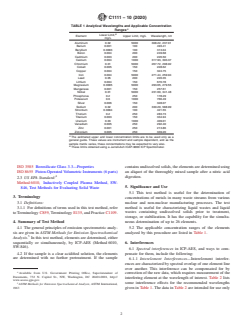
5.2 The applicable concentration ranges of the elements analyzed by this procedure are listed in Table 1.
SCOPE
1.1 This test method covers the determination of trace, minor, and major elements in waste streams by inductively coupled plasma-atomic emission spectroscopy (ICP-AES) following an acid digestion of the sample. Waste streams from manufacturing processes of nuclear and non-nuclear materials can be analyzed. This test method is applicable to the determination of total metals. Results from this test method can be used to characterize waste received by treatment facilities and to formulate appropriate treatment recipes. The results are also usable in process control within waste treatment facilities.
1.2 This test method is applicable only to waste streams that contain radioactivity levels that do not require special personnel or environmental protection.
1.3 A list of the elements determined in waste streams and the corresponding lower reporting limit is found in Table 1.
1.4 This test method has been used successfully for treatment of a large variety of waste solutions and industrial process liquids. The composition of such samples is highly variable, both between waste stream types and within a single waste stream. As a result of this variability, a single acid digestion scheme may not be expected to succeed with all sample matrices. Certain elements may be recovered on a semi-quantitative basis, while most results will be highly quantitative.
1.5 This test method should be used by analysts experienced in the use of ICP-AES, the interpretation of spectral and non-spectral interferences, and procedures for their correction.
1.6 No detailed operating instructions are provided because of differences among various makes and models of suitable ICP-AES instruments. Instead, the analyst shall follow the instructions provided by the manufacturer of the particular instrument. This test method does not address comparative accuracy of different devices or the precision between instruments of the same make and model.
1.7 This test method contains notes that are explanatory and are not part of the mandatory requirements of the method.
1.8 The values stated in SI units are to be regarded as standard. No other units of measurement are included in this standard.
1.9 This standard does not purport to address all of the safety concerns, if any, associated with its use. It is the responsibility of the user of this standard to establish appropriate safety, health, and environmental practices and determine the applicability of regulatory limitations prior to use.
1.10 This international standard was developed in accordance with internationally recognized principles on standardization established in the Decision on Principles for the Development of International Standards, Guides and Recommendations issued by the World Trade Organization Technical Barriers to Trade (TBT) Committee.
- Status
- Published
- Publication Date
- 30-Nov-2020
- Technical Committee
- C26 - Nuclear Fuel Cycle
- Drafting Committee
- C26.05 - Methods of Test
Overview
ASTM C1111-10(2020): Standard Test Method for Determining Elements in Waste Streams by Inductively Coupled Plasma-Atomic Emission Spectroscopy (ICP-AES) provides an internationally recognized approach for quantifying trace, minor, and major elements in waste streams. Developed by ASTM International, this test method is widely used for both nuclear and non-nuclear manufacturing processes to assess total metal content following acid digestion.
The procedure is especially significant for waste characterization before treatment, storage, or stabilization. It allows for the simultaneous determination of up to 26 elements and is primarily applicable to liquid waste-both with and without undissolved solids-in situations where radioactivity levels do not require special protective measures.
Key Topics
- ICP-AES Analysis: Utilizes inductively coupled plasma-atomic emission spectroscopy technology for accurate element measurement.
- Sample Types: Suitable for clear liquid wastes and liquid wastes with solids after acid digestion. Oils and oily wastes require additional preparation.
- Element Coverage: Can determine a wide range of elements, including but not limited to aluminum, barium, cadmium, calcium, iron, lead, uranium, and zinc.
- Concentration Ranges: Applicable for trace to major concentrations, typically from low microgram per liter (µg/L) to several thousand milligrams per liter (mg/L), depending on element and instrument setup.
- Interferences: Addresses both spectral and non-spectral interferences (e.g., high solids or acid content), with recommendations for mitigation via calibration, blanks, and control samples.
- Quality Assurance: Requires experienced analysts and routine checks with standard verification samples and duplicates to ensure data reliability.
Applications
This ASTM standard delivers practical value across various sectors and scenarios, including:
- Waste Treatment Facility Management: Enables precise characterization of incoming liquid wastes, ensuring correct formulation of treatment, storage, and stabilization strategies.
- Regulatory Compliance: Facilitates documentation for regulatory agencies by providing reliable data on total metals in waste streams, aiding in environmental and health safety reporting.
- Process Control: Supports real-time process adjustments in waste treatment by monitoring element concentrations, ensuring ongoing compliance and operational optimization.
- Industrial Laboratories: Employed in research and quality control laboratories for monitoring industrial process liquids and waste solutions with varying matrices.
- Quality Assurance: Ensures that control measures such as field duplicates, reagent blanks, and interference checks are met for robust results.
- Environmental Monitoring: Helps track potential contaminants in industrial and nuclear waste streams to minimize the environmental impact.
Related Standards
Several other ASTM and international standards complement or reference ASTM C1111-10(2020), supporting broader waste analysis and laboratory procedures:
- ASTM C859: Terminology Relating to Nuclear Materials
- ASTM C1109: Practice for Analysis of Aqueous Leachates from Nuclear Waste Materials Using ICP-AES
- ASTM C1234: Practice for Preparation of Oils and Oily Waste Samples by High-Pressure, High-Temperature Digestion for Trace Element Determinations
- ASTM D1193: Specification for Reagent Water
- ISO 1042: Laboratory glassware - One-mark volumetric flasks
- ISO 3585: Borosilicate glass 3.3 - Properties
- ISO 8655: Piston-operated volumetric instruments
- US EPA Method 6010: Inductively Coupled Plasma Method for evaluating solid waste
Conclusion
ASTM C1111-10(2020) is a critical standard for the precise and reliable analysis of elements in waste streams using ICP-AES. By offering robust methods for trace to major element determination, this standard helps assure analytical consistency, regulatory compliance, and safe waste management for a wide range of industries.
Keywords: ASTM C1111, ICP-AES, waste stream analysis, inductively coupled plasma, atomic emission spectroscopy, total metals determination, waste characterization, environmental monitoring, laboratory standards, waste treatment.
Relations
- Effective Date
- 01-Jan-2024
- Effective Date
- 01-Dec-2023
- Effective Date
- 01-Jan-2020
- Effective Date
- 15-May-2019
- Effective Date
- 01-May-2019
- Effective Date
- 15-May-2016
- Effective Date
- 01-Apr-2016
- Effective Date
- 01-Jul-2015
- Effective Date
- 01-Jun-2015
- Effective Date
- 15-May-2015
- Effective Date
- 15-Aug-2014
- Effective Date
- 15-Jun-2014
- Effective Date
- 01-May-2014
- Effective Date
- 01-Apr-2014
- Effective Date
- 15-Feb-2014
Get Certified
Connect with accredited certification bodies for this standard

ECOCERT
Organic and sustainability certification.

CIS Institut d.o.o.
Personal Protective Equipment (PPE) certification body. Notified Body NB-2890 for EU Regulation 2016/425 PPE.

Eurofins Food Testing Global
Global leader in food, environment, and pharmaceutical product testing.
Sponsored listings
Frequently Asked Questions
ASTM C1111-10(2020) is a standard published by ASTM International. Its full title is "Standard Test Method for Determining Elements in Waste Streams by Inductively Coupled Plasma-Atomic Emission Spectroscopy". This standard covers: SIGNIFICANCE AND USE 5.1 This test method is useful for the determination of concentrations of metals in many waste streams from various nuclear and non-nuclear manufacturing processes. The test method is useful for characterizing liquid wastes and liquid wastes containing undissolved solids prior to treatment, storage, or stabilization. It has the capability for the simultaneous determination of up to 26 elements. 5.2 The applicable concentration ranges of the elements analyzed by this procedure are listed in Table 1. SCOPE 1.1 This test method covers the determination of trace, minor, and major elements in waste streams by inductively coupled plasma-atomic emission spectroscopy (ICP-AES) following an acid digestion of the sample. Waste streams from manufacturing processes of nuclear and non-nuclear materials can be analyzed. This test method is applicable to the determination of total metals. Results from this test method can be used to characterize waste received by treatment facilities and to formulate appropriate treatment recipes. The results are also usable in process control within waste treatment facilities. 1.2 This test method is applicable only to waste streams that contain radioactivity levels that do not require special personnel or environmental protection. 1.3 A list of the elements determined in waste streams and the corresponding lower reporting limit is found in Table 1. 1.4 This test method has been used successfully for treatment of a large variety of waste solutions and industrial process liquids. The composition of such samples is highly variable, both between waste stream types and within a single waste stream. As a result of this variability, a single acid digestion scheme may not be expected to succeed with all sample matrices. Certain elements may be recovered on a semi-quantitative basis, while most results will be highly quantitative. 1.5 This test method should be used by analysts experienced in the use of ICP-AES, the interpretation of spectral and non-spectral interferences, and procedures for their correction. 1.6 No detailed operating instructions are provided because of differences among various makes and models of suitable ICP-AES instruments. Instead, the analyst shall follow the instructions provided by the manufacturer of the particular instrument. This test method does not address comparative accuracy of different devices or the precision between instruments of the same make and model. 1.7 This test method contains notes that are explanatory and are not part of the mandatory requirements of the method. 1.8 The values stated in SI units are to be regarded as standard. No other units of measurement are included in this standard. 1.9 This standard does not purport to address all of the safety concerns, if any, associated with its use. It is the responsibility of the user of this standard to establish appropriate safety, health, and environmental practices and determine the applicability of regulatory limitations prior to use. 1.10 This international standard was developed in accordance with internationally recognized principles on standardization established in the Decision on Principles for the Development of International Standards, Guides and Recommendations issued by the World Trade Organization Technical Barriers to Trade (TBT) Committee.
SIGNIFICANCE AND USE 5.1 This test method is useful for the determination of concentrations of metals in many waste streams from various nuclear and non-nuclear manufacturing processes. The test method is useful for characterizing liquid wastes and liquid wastes containing undissolved solids prior to treatment, storage, or stabilization. It has the capability for the simultaneous determination of up to 26 elements. 5.2 The applicable concentration ranges of the elements analyzed by this procedure are listed in Table 1. SCOPE 1.1 This test method covers the determination of trace, minor, and major elements in waste streams by inductively coupled plasma-atomic emission spectroscopy (ICP-AES) following an acid digestion of the sample. Waste streams from manufacturing processes of nuclear and non-nuclear materials can be analyzed. This test method is applicable to the determination of total metals. Results from this test method can be used to characterize waste received by treatment facilities and to formulate appropriate treatment recipes. The results are also usable in process control within waste treatment facilities. 1.2 This test method is applicable only to waste streams that contain radioactivity levels that do not require special personnel or environmental protection. 1.3 A list of the elements determined in waste streams and the corresponding lower reporting limit is found in Table 1. 1.4 This test method has been used successfully for treatment of a large variety of waste solutions and industrial process liquids. The composition of such samples is highly variable, both between waste stream types and within a single waste stream. As a result of this variability, a single acid digestion scheme may not be expected to succeed with all sample matrices. Certain elements may be recovered on a semi-quantitative basis, while most results will be highly quantitative. 1.5 This test method should be used by analysts experienced in the use of ICP-AES, the interpretation of spectral and non-spectral interferences, and procedures for their correction. 1.6 No detailed operating instructions are provided because of differences among various makes and models of suitable ICP-AES instruments. Instead, the analyst shall follow the instructions provided by the manufacturer of the particular instrument. This test method does not address comparative accuracy of different devices or the precision between instruments of the same make and model. 1.7 This test method contains notes that are explanatory and are not part of the mandatory requirements of the method. 1.8 The values stated in SI units are to be regarded as standard. No other units of measurement are included in this standard. 1.9 This standard does not purport to address all of the safety concerns, if any, associated with its use. It is the responsibility of the user of this standard to establish appropriate safety, health, and environmental practices and determine the applicability of regulatory limitations prior to use. 1.10 This international standard was developed in accordance with internationally recognized principles on standardization established in the Decision on Principles for the Development of International Standards, Guides and Recommendations issued by the World Trade Organization Technical Barriers to Trade (TBT) Committee.
ASTM C1111-10(2020) is classified under the following ICS (International Classification for Standards) categories: 13.030.30 - Special wastes; 71.040.50 - Physicochemical methods of analysis. The ICS classification helps identify the subject area and facilitates finding related standards.
ASTM C1111-10(2020) has the following relationships with other standards: It is inter standard links to ASTM C859-24, ASTM C1109-23, ASTM E135-20, ASTM E135-19, ASTM C1234-11(2019), ASTM E135-16, ASTM C1234-11(2016), ASTM E135-15a, ASTM C1109-10(2015), ASTM E135-15, ASTM E135-14b, ASTM C859-14a, ASTM E177-14, ASTM E135-14a, ASTM E135-14. Understanding these relationships helps ensure you are using the most current and applicable version of the standard.
ASTM C1111-10(2020) is available in PDF format for immediate download after purchase. The document can be added to your cart and obtained through the secure checkout process. Digital delivery ensures instant access to the complete standard document.
Standards Content (Sample)
This international standard was developed in accordance with internationally recognized principles on standardization established in the Decision on Principles for the
Development of International Standards, Guides and Recommendations issued by the World Trade Organization Technical Barriers to Trade (TBT) Committee.
Designation: C1111 − 10 (Reapproved 2020)
Standard Test Method for
Determining Elements in Waste Streams by Inductively
Coupled Plasma-Atomic Emission Spectroscopy
This standard is issued under the fixed designation C1111; the number immediately following the designation indicates the year of
original adoption or, in the case of revision, the year of last revision. A number in parentheses indicates the year of last reapproval. A
superscript epsilon (´) indicates an editorial change since the last revision or reapproval.
1. Scope accuracy of different devices or the precision between instru-
ments of the same make and model.
1.1 This test method covers the determination of trace,
1.7 This test method contains notes that are explanatory and
minor, and major elements in waste streams by inductively
are not part of the mandatory requirements of the method.
coupled plasma-atomic emission spectroscopy (ICP-AES) fol-
lowing an acid digestion of the sample. Waste streams from
1.8 The values stated in SI units are to be regarded as
manufacturing processes of nuclear and non-nuclear materials
standard. No other units of measurement are included in this
can be analyzed. This test method is applicable to the deter-
standard.
mination of total metals. Results from this test method can be
1.9 This standard does not purport to address all of the
used to characterize waste received by treatment facilities and
safety concerns, if any, associated with its use. It is the
to formulate appropriate treatment recipes. The results are also
responsibility of the user of this standard to establish appro-
usable in process control within waste treatment facilities.
priate safety, health, and environmental practices and deter-
1.2 This test method is applicable only to waste streams that
mine the applicability of regulatory limitations prior to use.
contain radioactivity levels that do not require special person-
1.10 This international standard was developed in accor-
nel or environmental protection.
dance with internationally recognized principles on standard-
ization established in the Decision on Principles for the
1.3 A list of the elements determined in waste streams and
Development of International Standards, Guides and Recom-
the corresponding lower reporting limit is found in Table 1.
mendations issued by the World Trade Organization Technical
1.4 This test method has been used successfully for treat-
Barriers to Trade (TBT) Committee.
mentofalargevarietyofwastesolutionsandindustrialprocess
2. Referenced Documents
liquids. The composition of such samples is highly variable,
both between waste stream types and within a single waste
2.1 ASTM Standards:
stream. As a result of this variability, a single acid digestion
C859 Terminology Relating to Nuclear Materials
scheme may not be expected to succeed with all sample
C1109 Practice for Analysis of Aqueous Leachates from
matrices. Certain elements may be recovered on a semi-
Nuclear Waste Materials Using Inductively Coupled
quantitative basis, while most results will be highly quantita-
Plasma-Atomic Emission Spectroscopy
tive.
C1234 Practice for Preparation of Oils and Oily Waste
Samples by High-Pressure, High-Temperature Digestion
1.5 Thistestmethodshouldbeusedbyanalystsexperienced
for Trace Element Determinations
in the use of ICP-AES, the interpretation of spectral and
D1193 Specification for Reagent Water
non-spectral interferences, and procedures for their correction.
E135 Terminology Relating to Analytical Chemistry for
1.6 No detailed operating instructions are provided because
Metals, Ores, and Related Materials
of differences among various makes and models of suitable
E177 Practice for Use of the Terms Precision and Bias in
ICP-AES instruments. Instead, the analyst shall follow the
ASTM Test Methods
instructions provided by the manufacturer of the particular
2.2 ISO and European Standards:
instrument. This test method does not address comparative
ISO 1042 Laboratory Glassware—One-mark Volumetric
Flasks
1 2
This test method is under the jurisdiction ofASTM Committee C26 on Nuclear For referenced ASTM standards, visit the ASTM website, www.astm.org, or
Fuel Cycle and is the direct responsibility of Subcommittee C26.05 on Methods of contact ASTM Customer Service at service@astm.org. For Annual Book of ASTM
Test. Standards volume information, refer to the standard’s Document Summary page on
Current edition approved Dec. 1, 2020. Published January 2021. Originally the ASTM website.
approved in 1988. Last previous edition approved in 2015 as C1111 – 10 (2015). Available fromAmerican National Standards Institute (ANSI), 25 W. 43rd St.,
DOI: 10.1520/C1111-10R20. 4th Floor, New York, NY 10036, http://www.ansi.org.
Copyright © ASTM International, 100 Barr Harbor Drive, PO Box C700, West Conshohocken, PA 19428-2959. United States
C1111 − 10 (2020)
TABLE 1 Analytical Wavelengths and Applicable Concentration
A
Ranges
B
Lower Limit,
Element Upper Limit, mg/L Wavelength, nm
mg/L
Aluminum 0.02 5000 308.22, 237.01
Barium 0.001 100 493.41
Beryllium 0.0003 100 313.04
Boron 0.004 200 249.68
Cadmium 0.003 200 226.50
Calcium 0.004 1000 317.93, 393.37
Chromium 0.01 5000 267.72, 298.92
Cobalt 0.005 150 228.62
Copper 0.004 150 324.75
Iron 0.004 5000 271.44, 259.94
Lead 0.05 200 220.35
Lithium 0.004 150 670.78
Magnesium 0.0005 5000 293.65, 279.55
Manganese 0.001 150 257.61
Nickel 0.01 5000 231.60, 341.48
Phosphorus 0.2 250 178.29
Potassium 0.6 1000 766.49
Silver 0.006 150 328.07
Sodium 0.02 200 330.29, 588.99
Strontium 0.0004 100 421.55
Thorium 0.2 250 283.73
Titanium 0.003 150 334.94
Uranium 0.03 1000 409.01
Vanadium 0.005 250 292.40
Zinc 0.001 250 213.86
Zirconium 0.005 250 339.20
A
The estimated upper and lower concentration limits are to be used only as a
general guide. These values are instrument and sample dependent, and as the
sample matrix varies, these concentrations may be expected to vary also.
B
These limits obtained using a Jarrell-Ash ICAP-9000 ICP Spectrometer.
ISO 3585 Borosilicate Glass 3.3—Properties contains undissolved solids, the elements are determined using
ISO 8655 Piston-Operated Volumetric Instruments (6 parts) an aliquot of the thoroughly mixed sample after a nitric acid
digestion.
2.3 US EPA Standard:
Method 6010, Inductively Coupled Plasma Method, SW-
5. Significance and Use
846, Test Methods for Evaluating Solid Waste
5.1 This test method is useful for the determination of
3. Terminology
concentrations of metals in many waste streams from various
3.1 Definitions: nuclear and non-nuclear manufacturing processes. The test
method is useful for characterizing liquid wastes and liquid
3.1.1 For definitions of terms used in this test method, refer
to Terminology C859, Terminology E135, and Practice C1109. wastes containing undissolved solids prior to treatment,
storage, or stabilization. It has the capability for the simulta-
4. Summary of Test Method neous determination of up to 26 elements.
4.1 The general principles of emission spectrometric analy- 5.2 The applicable concentration ranges of the elements
sis are given in ASTM Methods for Emission Spectrochemical
analyzed by this procedure are listed in Table 1.
Analysis. In this test method, elements are determined, either
sequentially or simultaneously, by ICP-AES (Method 6010,
6. Interferences
SW-846).
6.1 Spectral interferences in ICP-AES, and ways to com-
4.2 If the sample is a clear acidified solution, the elements
pensate for them, include the following:
are determined with no further pretreatment. If the sample
6.1.1 Interelement Interferences—Interelement interfer-
ences are characterized by spectral overlap of one element line
over another. This interference can be compensated for by
Available from U.S. Government Printing Office, Superintendent of
correction of the raw data, which requires measurement of the
Documents, 732 N. Capitol St., NW, Washington, DC 20401-0001, http://
interfering element at the wavelength of interest. Table 2 lists
www.access.gpo.gov.
5 some interference effects for the recommended wavelengths
ASTM Methods for Emission Spectrochemical Analysis, ASTM International,
1967. given in Table 1. The data in Table 2 are intended for use only
C1111 − 10 (2020)
TABLE 2 Analyte Concentration Equivalents Arising from Interferents at 1000 mg/L Level
Wave-
Interferent, mg/L
Analyte lengths,
Aluminum Chromium Copper Iron Nickel Antimony Silicon Tin Uranium Vanadium
nm
Aluminum 308.22 0.0020 0.0044 0.0199
Aluminum 237.21 −0.0022 −0.0084 0.0350
Barium 493.41
Beryllium 313.04 0.0013
Boron 249.68 0.0015
Cadmium 226.50 0.0002 −0.0004
Calcium 317.93 −0.0018
Calcium 393.37 0.0002
Chromium 267.72 0.0025 0.0018
Chromium 298.92 0.0560
Cobalt 228.62 0.0001 0.0001
Copper 324.75
Iron 259.94 0.0001 −0.0001 −0.0002
Iron 271.44 0.0039 −0.0015 0.0220
Lead 220.35 −0.0012 −0.0028 0.0002 0.0006 0.0016
Lithium 670.78 0.0003
Magnesium 279.55
Magnesium 293.65 −0.0270 −0.1390 0.0350
Manganese 257.61 0.0002
Nickel 231.60 −0.0002 0.0003 0.0001 0.0003
Nickel 341.48 0.0027
Phosphorus 178.29 0.0002 −0.0079 0.0120 0.0004 0.0044
Potassium 766.49 0.0010 −0.0005 0.0014
Silver 328.07 0.0003
Sodium 330.29 0.0035 −0.0220 −0.0145 −0.1580
Sodium 588.99 0.0006 0.0017 0.0002
Strontium 421.55
Thorium 283.73 0.0007 0.0005 0.0049 0.0500
Titanium 334.94 0.0003
Vanadium 292.40 −0.0029 −0.0014
Zinc 213.85 0.0034 0.0001 0.0038
Zirconium 339.20 −0.0003 −0.0002 −0.0005
as a rudimentary guide for indicating potential spectral inter- cleaned before use by soaking in nitric acid and then rinsing
ferences. Various analytical systems may exhibit somewhat thoroughly with water.
different levels of interferences. Therefore, the interference
7.3 Filters, inert membrane, having pore size of 2.5 µm.
effects must be evaluated for each individual system.
7.4 Piston-operated Volumetric Pipettors and Dispensers,
6.1.2 Molecular Band Interference—Molecular band inter-
complying with the requirements of ISO 8655, for pipetting
ference arising from overlap of molecular band spectra at the
and dispensing of solutions, acids, and so forth.
wavelengthofinterestcanbeeliminatedbycarefulselectionof
wavelength.
7.5 Bottles, tetrafluoroethylene or polyethylene, for storage
6.1.3 High Background—High background effects from
of calibration and check solutions.
scattered light, etc., can be compensated for by background
7.6 Disposable Gloves, impermeable, for protection from
correction adjacent to the analyte line.
corrosive substances. Polyvinyl chloride (PVC) gloves are
6.2 Non-spectral Interferences—These include physical or
suitable.
chemical effects, such as high solids content or high acid
7.7 Inductively Coupled Plasma—Atomic Emission
concentration, that affect nebulization or the transport of the
Spectrometer, computer controlled, with a spectral bandpass of
sample to the plasma and its vaporization, atomization, or
0.05 nm or less.
excitation in the plasma. Effects due to high solids content or
high acid concentration can be reduced by a tenfold dilution of
NOTE 1—A bandpass of 0.05 nm or less is required to provide the
necessary spectral resolution.
the sample and the use of a peristaltic pump in conjunction
NOTE 2—The spectrometer may be of the simultaneous multielement or
with a high-solids nebulizer.
sequential scanning type. The spectrometer may be of the air path, inert
gaspath,orvacuumtype,withspectrallinesselectedappropriatelyforuse
7. Apparatus
with the specific instrument.
7.1 Ordinary laboratory apparatus are not listed, but are NOTE 3—An autosampler having a flowing rinse is recommended.
assumed to be present.
8. Reagents
7.2 Glassware, volumetric flasks comp
...