

ASTM C374-14(2018)
(Test Method)Standard Test Methods for Fusion Flow of Porcelain Enamel Frits (Flow-Button Methods)
General Information
- Abstract
ABSTRACT
These test methods cover evaluation of the relative fusion flow characteristics of samples of a given porcelain enamel by comparison with an established standard for that frit. Two test methods are included, differing only in certain details of the samples and in the apparatus and procedure for preparation of test specimens. Both test methods give equally reproducible results and provide a satisfactory basis for comparison of fusion flow of the sample with that of the established standard. Test Method A employs granular particles of frit to which a bonding agent has been added. Button specimens are formed under high pressure in a hydraulic press. Test Method B employs crushed, sized particles of frit to which a bonding agent has been added. Button specimens are formed in a steel mold by hand. Both Test Methods use a hard steel mortar that is resistant to abrasion by the porcelain enamel frit, a hydraulic press, and a fusion flow rack. The test methods use sieves of different specifications. The steel mold assembly of both test methods consists of a die and plunger, however, Test Method B has an additional back-up disk.
SCOPE
1.1 These test methods cover evaluation of the relative fusion flow characteristics of samples of a given porcelain enamel frit by comparison with an established standard for that frit.
1.2 Two test methods are included, differing only in certain details of the samples and in the apparatus and procedure for preparation of test specimens. Both test methods give equally reproducible results and provide a satisfactory basis for comparison of fusion flow of the sample with that of the established standard.
1.2.1 Test Method A employs granular particles of frit to which a bonding agent has been added. Button specimens are formed under high pressure in a hydraulic press.
1.2.2 Test Method B employs crushed, sized particles of frit to which a bonding agent has been added. Button specimens are formed in a steel mold by hand.
1.3 The values stated in inch-pound units are to be regarded as standard. The values given in parentheses are mathematical conversions to SI units that are provided for information only and are not considered standard.
1.4 This standard does not purport to address all of the safety concerns, if any, associated with its use. It is the responsibility of the user of this standard to establish appropriate safety, health, and environmental practices and determine the applicability of regulatory limitations prior to use.
1.5 This international standard was developed in accordance with internationally recognized principles on standardization established in the Decision on Principles for the Development of International Standards, Guides and Recommendations issued by the World Trade Organization Technical Barriers to Trade (TBT) Committee.
- Status
- Published
- Publication Date
- 30-Sep-2018
- Technical Committee
- B08 - Metallic and Inorganic Coatings
- Drafting Committee
- B08.12 - Materials for Porcelain Enamel and Ceramic-Metal Systems
Overview
ASTM C374-14(2018): Standard Test Methods for Fusion Flow of Porcelain Enamel Frits (Flow-Button Methods) provides standardized procedures for evaluating the relative fusion flow characteristics of porcelain enamel frits. Developed by ASTM International, this standard outlines two reliable laboratory test methods to compare the molten flow behavior of test samples against established frit standards. Widely recognized in the ceramic coatings and glass industries, these methods play a crucial role in quality assurance, product development, and material verification for porcelain enamel applications.
Key Topics
Purpose of the Standard
- Defines procedures to measure the flow characteristics of porcelain enamel frits under high temperature.
- Focuses on the comparative analysis between a test sample and a standard reference material.
Test Method A
- Utilizes granular frit particles mixed with a bonding agent.
- Formation of fusion button specimens under high pressure using a hydraulic press.
Test Method B
- Uses crushed, sized frit particles combined with a bonding agent.
- Button specimens are hand-molded using a steel mold assembly with a die, plunger, and backup disk.
Apparatus and Sample Preparation
- Hard steel mortars, hydraulic press, fusion flow rack, and wire sieves as specified by ASTM E11.
- Preparation includes thorough mixing, measured addition of binding agent, forming, drying, and controlled firing.
Result Reporting
- Measures and reports the fused flow length of test and standard specimens for comparison.
- Results indicate the relative fluidity and performance characteristics of porcelain enamel frits.
Safety and Compliance
- Users are responsible for implementing appropriate safety, health, and environmental practices.
- Adheres to international standardization principles as recognized by WTO TBT Committee.
Applications
Quality Control for Porcelain Enamels
- Manufacturers rely on these test methods to verify the consistency and suitability of frit batches before application in enamel coatings.
Material Comparison and Selection
- Facilitates the selection of appropriate frits for specific product or process requirements by providing a standardized comparison of fusion flow properties.
Research and Development
- Supports development and optimization of new enamel frit formulations by offering a reproducible basis for fusion flow assessment.
Process Validation
- Assists in establishing and validating process parameters such as firing temperatures and application techniques in porcelain enameling operations.
Regulatory and Industry Compliance
- Ensures conformance with industry standards and facilitates acceptance in global markets by using internationally recognized testing protocols.
Related Standards
ASTM E11
Specification for Woven Wire Test Sieve Cloth and Test Sieves. Used for particle sizing in sample preparation.Other Relevant ASTM Standards
- ASTM B08.12: Standards related to materials for porcelain enamel and ceramic-metal systems.
- Standards addressing metallic and inorganic coatings, ceramic coatings, and quality testing procedures.
International Best Practices
- The standard aligns with the principles set by the World Trade Organization (WTO) Technical Barriers to Trade (TBT) Committee for the development of harmonized international test methods.
By following the procedures outlined in ASTM C374-14(2018), laboratories and manufacturers can achieve accurate, reproducible comparisons of porcelain enamel frits’ fusion flow properties, supporting quality assurance and innovation in glass coatings and ceramic enameling industries.
Relations
- Effective Date
- 01-Oct-2018
- Effective Date
- 01-Oct-2013
- Effective Date
- 01-May-2009
- Effective Date
- 01-May-2004
- Effective Date
- 10-May-2001
- Effective Date
- 10-May-2001
- Referred By
ASTM C286-22 - Standard Terminology Relating to Porcelain Enamel and Ceramic-Metal Systems - Effective Date
- 01-Oct-2018
Get Certified
Connect with accredited certification bodies for this standard

DVS-ZERT GmbH
German welding certification society.
CARES (UK Certification Authority for Reinforcing Steels)
UK certification for reinforcing steels and construction.
EWF/IIW (European/International Welding Federation)
International welding personnel certification.
Sponsored listings
Frequently Asked Questions
ASTM C374-14(2018) is a standard published by ASTM International. Its full title is "Standard Test Methods for Fusion Flow of Porcelain Enamel Frits (Flow-Button Methods)". This standard covers: ABSTRACT These test methods cover evaluation of the relative fusion flow characteristics of samples of a given porcelain enamel by comparison with an established standard for that frit. Two test methods are included, differing only in certain details of the samples and in the apparatus and procedure for preparation of test specimens. Both test methods give equally reproducible results and provide a satisfactory basis for comparison of fusion flow of the sample with that of the established standard. Test Method A employs granular particles of frit to which a bonding agent has been added. Button specimens are formed under high pressure in a hydraulic press. Test Method B employs crushed, sized particles of frit to which a bonding agent has been added. Button specimens are formed in a steel mold by hand. Both Test Methods use a hard steel mortar that is resistant to abrasion by the porcelain enamel frit, a hydraulic press, and a fusion flow rack. The test methods use sieves of different specifications. The steel mold assembly of both test methods consists of a die and plunger, however, Test Method B has an additional back-up disk. SCOPE 1.1 These test methods cover evaluation of the relative fusion flow characteristics of samples of a given porcelain enamel frit by comparison with an established standard for that frit. 1.2 Two test methods are included, differing only in certain details of the samples and in the apparatus and procedure for preparation of test specimens. Both test methods give equally reproducible results and provide a satisfactory basis for comparison of fusion flow of the sample with that of the established standard. 1.2.1 Test Method A employs granular particles of frit to which a bonding agent has been added. Button specimens are formed under high pressure in a hydraulic press. 1.2.2 Test Method B employs crushed, sized particles of frit to which a bonding agent has been added. Button specimens are formed in a steel mold by hand. 1.3 The values stated in inch-pound units are to be regarded as standard. The values given in parentheses are mathematical conversions to SI units that are provided for information only and are not considered standard. 1.4 This standard does not purport to address all of the safety concerns, if any, associated with its use. It is the responsibility of the user of this standard to establish appropriate safety, health, and environmental practices and determine the applicability of regulatory limitations prior to use. 1.5 This international standard was developed in accordance with internationally recognized principles on standardization established in the Decision on Principles for the Development of International Standards, Guides and Recommendations issued by the World Trade Organization Technical Barriers to Trade (TBT) Committee.
ABSTRACT These test methods cover evaluation of the relative fusion flow characteristics of samples of a given porcelain enamel by comparison with an established standard for that frit. Two test methods are included, differing only in certain details of the samples and in the apparatus and procedure for preparation of test specimens. Both test methods give equally reproducible results and provide a satisfactory basis for comparison of fusion flow of the sample with that of the established standard. Test Method A employs granular particles of frit to which a bonding agent has been added. Button specimens are formed under high pressure in a hydraulic press. Test Method B employs crushed, sized particles of frit to which a bonding agent has been added. Button specimens are formed in a steel mold by hand. Both Test Methods use a hard steel mortar that is resistant to abrasion by the porcelain enamel frit, a hydraulic press, and a fusion flow rack. The test methods use sieves of different specifications. The steel mold assembly of both test methods consists of a die and plunger, however, Test Method B has an additional back-up disk. SCOPE 1.1 These test methods cover evaluation of the relative fusion flow characteristics of samples of a given porcelain enamel frit by comparison with an established standard for that frit. 1.2 Two test methods are included, differing only in certain details of the samples and in the apparatus and procedure for preparation of test specimens. Both test methods give equally reproducible results and provide a satisfactory basis for comparison of fusion flow of the sample with that of the established standard. 1.2.1 Test Method A employs granular particles of frit to which a bonding agent has been added. Button specimens are formed under high pressure in a hydraulic press. 1.2.2 Test Method B employs crushed, sized particles of frit to which a bonding agent has been added. Button specimens are formed in a steel mold by hand. 1.3 The values stated in inch-pound units are to be regarded as standard. The values given in parentheses are mathematical conversions to SI units that are provided for information only and are not considered standard. 1.4 This standard does not purport to address all of the safety concerns, if any, associated with its use. It is the responsibility of the user of this standard to establish appropriate safety, health, and environmental practices and determine the applicability of regulatory limitations prior to use. 1.5 This international standard was developed in accordance with internationally recognized principles on standardization established in the Decision on Principles for the Development of International Standards, Guides and Recommendations issued by the World Trade Organization Technical Barriers to Trade (TBT) Committee.
ASTM C374-14(2018) is classified under the following ICS (International Classification for Standards) categories: 25.220.50 - Enamels. The ICS classification helps identify the subject area and facilitates finding related standards.
ASTM C374-14(2018) has the following relationships with other standards: It is inter standard links to ASTM C374-14(2015)e1, ASTM E11-13, ASTM E11-09e1, ASTM E11-04, ASTM E11-95, ASTM E11-01, ASTM C286-22. Understanding these relationships helps ensure you are using the most current and applicable version of the standard.
ASTM C374-14(2018) is available in PDF format for immediate download after purchase. The document can be added to your cart and obtained through the secure checkout process. Digital delivery ensures instant access to the complete standard document.
Standards Content (Sample)
This international standard was developed in accordance with internationally recognized principles on standardization established in the Decision on Principles for the
Development of International Standards, Guides and Recommendations issued by the World Trade Organization Technical Barriers to Trade (TBT) Committee.
Designation: C374 − 14 (Reapproved 2018)
Standard Test Methods for
Fusion Flow of Porcelain Enamel Frits (Flow-Button
Methods)
This standard is issued under the fixed designation C374; the number immediately following the designation indicates the year of
original adoption or, in the case of revision, the year of last revision. A number in parentheses indicates the year of last reapproval. A
superscript epsilon (´) indicates an editorial change since the last revision or reapproval.
INTRODUCTION
This test provides a procedure to compare the fluidity of a glass frit or a porcelain enamel powder
to a standard reference material at a fixed temperature above the sample’s glass temperature.
1. Scope mendations issued by the World Trade Organization Technical
Barriers to Trade (TBT) Committee.
1.1 These test methods cover evaluation of the relative
fusion flow characteristics of samples of a given porcelain
2. Referenced Document
enamel frit by comparison with an established standard for that
frit. 2.1 ASTM Standards:
E11 Specification for Woven Wire Test Sieve Cloth and Test
1.2 Two test methods are included, differing only in certain
Sieves
details of the samples and in the apparatus and procedure for
preparation of test specimens. Both test methods give equally
TEST METHOD A
reproducible results and provide a satisfactory basis for com-
parisonoffusionflowofthesamplewiththatoftheestablished
3. Apparatus
standard.
3.1 Mortar, of hard steel, resistant to abrasion by the
1.2.1 Test Method A employs granular particles of frit to
porcelainenamelfrit,andconformingtothedimensionsshown
which a bonding agent has been added. Button specimens are
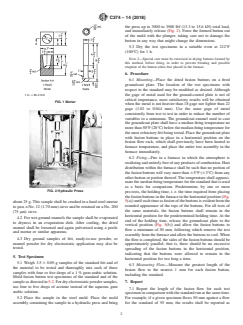
in Fig. 1.
formed under high pressure in a hydraulic press.
1.2.2 Test Method B employs crushed, sized particles of frit
NOTE 1—Suitable mortars are available commercially under the desig-
to which a bonding agent has been added. Button specimens nation “tool steel crushing mortar.”
are formed in a steel mold by hand.
3.2 Sieves—No. 12 (1.70-mm) and No. 200 (75-µm) sieves
conforming to Specification E11.
1.3 The values stated in inch-pound units are to be regarded
as standard. The values given in parentheses are mathematical
3.3 Hydraulic Press, capable of developing 3500-lbf
conversions to SI units that are provided for information only
(15 600 N) force (Fig. 2).
and are not considered standard.
3.4 Steel Mold Assembly, consisting of a die and plunger,
1.4 This standard does not purport to address all of the
and having an inside diameter of ⁄2 in. (12.7 mm) over its
safety concerns, if any, associated with its use. It is the
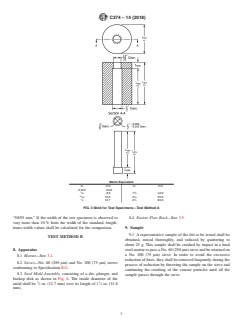
length of 2 ⁄8 in. (54 mm) as illustrated in Fig. 3.
responsibility of the user of this standard to establish appro-
3.5 Fusion Flow Rack, preferably constructed of heat-
priate safety, health, and environmental practices and deter-
resisting alloy and conforming to the detailed requirements
mine the applicability of regulatory limitations prior to use.
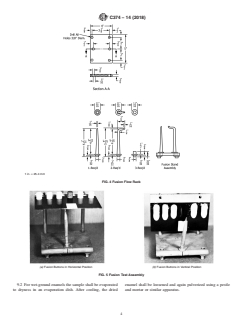
shown in Fig. 4.
1.5 This international standard was developed in accor-
dance with internationally recognized principles on standard-
4. Sample
ization established in the Decision on Principles for the
Development of International Standards, Guides and Recom-
4.1 A representative sample of the frit to be tested shall be
obtained, mixed thoroughly, and reduced by quartering to
These test methods are under the jurisdiction of ASTM Committee B08 on
Metallic and Inorganic Coatings and are the direct responsibility of Subcommittee
B08.12 on Materials for Porcelain Enamel and Ceramic-Metal Systems. For referenced ASTM standards, visit the ASTM website, www.astm.org, or
Current edition approved Oct. 1, 2018. Published October 2018. Originally contact ASTM Customer Service at service@astm.org. For Annual Book of ASTM
ɛ1
approved in 1955. Last previous edition approved in 2015 as C374 – 14 (2015) . Standards volume information, refer to the standard’s Document Summary page on
DOI: 10.1520/C0374-14R18. the ASTM website.
Copyright © ASTM International, 100 Barr Harbor Drive, PO Box C700, West Conshohocken, PA 19428-2959. United States
C374 − 14 (2018)
the press up to 3000 to 3500 lbf (13.3 to 15.6 kN) total load,
and immediately release (Fig. 2). Force the formed button out
of the mold with the plunger, taking care not to damage the
button in any way that might change the dimensions.
5.3 Dry the test specimens in a suitable oven at 212°F
(100°C) for 1 h.
NOTE 2—Special care must be exercised in drying buttons formed by
this method, before firing, in order to prevent bloating and possible
eruption of the button when first placed in the furnace.
6. Procedure
6.1 Mounting—Place the dried fusion buttons on a fired
groundcoat plate. The location of the test specimens with
respect to the standard may be modified as desired. Although
1 in. = 25.4 mm the gage of metal used for the ground-coated plate is not of
critical importance, most satisfactory results will be obtained
FIG. 1 Mortar
when the metal is not heavier than 18 gage nor lighter than 22
gage (1.02 to 0.044 mm). Use the same gage of metal
consistently from test to test in order to reduce the number of
variables to a minimum. The groundcoat enamel used to coat
the groundcoat plate shall have a median firing temperature no
morethan50°F(28°C)belowthemedianfiringtemperaturefor
the most refractory frit being tested. Place the groundcoat plate
with fusion buttons in place in a horizontal position on the
fusion flow rack, which shall previously have been heated to
furnace temperature, and place the entire test assembly in the
furnace immediately.
6.2 Firing—Fire in a furnace in which the atmosphere is
oxidizingandentirelyfreeofanyproductsofcombustion.Heat
distribution within the furnace shall be such that no portion of
the fusion buttons will vary more than 65°F (63°C) from any
other button or portion thereof. The temperature shall approxi-
mate the median firing temperature for the standard that is used
as a basis for comparison. Predetermine, by one or more
FIG. 2 Hydraulic Press
pre-tests, the holding time, i. e. the time required from placing
the fusion buttons in the furnace in the horizontal position (Fig.
5(a))untilsuchtimeasfusionofthebuttonsisevidentfromthe
about 25 g. This sample shall be crushed in a hard steel mortar
rounded appearance of the tops of the buttons. For all tests of
to pass a No. 12 (1.70 mm) sieve and be retained on a No. 200
the same materials, the fusion buttons shall remain in the
(75 µm) sieve.
horizontal position for the predetermined holding ti
...