

ASTM C283-13(2021)
(Test Method)Standard Test Methods for Resistance of Porcelain Enameled Utensils to Boiling Acid
General Information
- Abstract
SIGNIFICANCE AND USE
2.1 Test Method A provides the producers of porcelain enameled utensils with a quality control method of testing for resistance to boiling acid for parts randomly selected from the production line.
2.2 Test Method B provides the supplier of porcelain enamel raw materials with a laboratory method for testing the resistance of different coatings (intended for use on utensils) to boiling acid.
SCOPE
1.1 These test methods cover the determination of the resistance of porcelain enamel coatings used on utensils to attack by boiling acid.
1.2 The values stated in inch-pound units are to be regarded as standard. The values given in parentheses are mathematical conversions to SI units that are provided for information only and are not considered standard.
1.3 This standard does not purport to address all of the safety concerns, if any, associated with its use. It is the responsibility of the user of this standard to establish appropriate safety, health, and environmental practices and determine the applicability of regulatory limitations prior to use.
1.4 This international standard was developed in accordance with internationally recognized principles on standardization established in the Decision on Principles for the Development of International Standards, Guides and Recommendations issued by the World Trade Organization Technical Barriers to Trade (TBT) Committee.
- Status
- Published
- Publication Date
- 30-Sep-2021
- Technical Committee
- B08 - Metallic and Inorganic Coatings
- Drafting Committee
- B08.12 - Materials for Porcelain Enamel and Ceramic-Metal Systems

Overview
ASTM C283-13(2021): Standard Test Methods for Resistance of Porcelain Enameled Utensils to Boiling Acid is an internationally recognized ASTM standard that specifies test methods to determine how well porcelain enamel coatings, used primarily on utensils, withstand attack from boiling acid-most notably citric acid. This standard is crucial for both manufacturers and raw material suppliers involved in porcelain enamel products, providing clear, repeatable methods to evaluate acid resistance as part of quality control and product development.
Key Topics
- Quality Control for Manufacturers: Test Method A in ASTM C283-13(2021) enables producers of porcelain enameled utensils to randomly test products from the production line for resistance to boiling acid. This helps ensure product durability and safe practical use.
- Raw Material Assessment: Test Method B is designed for vendors of porcelain enamel materials, offering a laboratory-based process for benchmarking how proposed coatings perform against boiling acid attacks.
- Consistent Units and Procedures: The standard uses inch-pound units as standard, with SI conversions provided for reference. Specific apparatus and preparatory steps are detailed to ensure test consistency and repeatability.
- Safety and Compliance: ASTM C283-13(2021) also emphasizes the responsibility of users to establish and follow appropriate health, safety, and environmental practices, highlighting that the standard does not cover all regulatory concerns.
- Standardization Principles: Developed according to global principles established by the WTO Technical Barriers to Trade Committee, the standard facilitates international acceptance and comparability.
Applications
- Porcelain Enameled Utensils Testing: The primary application is for manufacturers and quality control labs to verify the acid resistance of finished utensils-such as cookware, bakeware, and food service items-that rely on porcelain enamel coatings.
- Evaluation of Enamel Raw Materials: Suppliers use the methods to test and compare different enamel formulations, supporting R&D and assurance that materials meet required acid resistance specifications before use in production.
- Corrosion Resistance Assurance: Ensures that end-user products can withstand aggressive environments, such as frequent exposure to acidic foods, thereby reducing warranty claims and enhancing customer satisfaction.
- Product Certification and Standard Compliance: Demonstrates compliance with ASTM standards for international markets, often required for regulatory approvals and market entry.
Related Standards
- ASTM B08 Standards: ASTM C283-13(2021) operates under the jurisdiction of ASTM Committee B08 on Metallic and Inorganic Coatings, aligning with other standards focused on coating performance.
- CS100-47, Porcelain Enameled Steel Utensils: This commercial standard is referenced for related testing methods and background.
- International Standardization Rules: The standard is consistent with the World Trade Organization TBT Committee’s principles, ensuring global recognition and harmonization.
- Other Corrosion and Acid Resistance Standards: While ASTM C283-13(2021) targets porcelain enamel, manufacturers may refer to additional ASTM and ISO standards for assessing chemical resistance in related materials.
Keywords: ASTM C283, boiling acid resistance, porcelain enamel, corrosion resistance, cookware testing, enamel coating standards, acid resistance testing, quality control, ASTM standards, kitchen utensils, vitreous enamel
By adhering to ASTM C283-13(2021), manufacturers and suppliers uphold quality and safety, ensuring porcelain enameled products provide reliable resistance to acidic conditions in both domestic and commercial applications.
Get Certified
Connect with accredited certification bodies for this standard

DVS-ZERT GmbH
German welding certification society.
CARES (UK Certification Authority for Reinforcing Steels)
UK certification for reinforcing steels and construction.
EWF/IIW (European/International Welding Federation)
International welding personnel certification.
Sponsored listings
Frequently Asked Questions
ASTM C283-13(2021) is a standard published by ASTM International. Its full title is "Standard Test Methods for Resistance of Porcelain Enameled Utensils to Boiling Acid". This standard covers: SIGNIFICANCE AND USE 2.1 Test Method A provides the producers of porcelain enameled utensils with a quality control method of testing for resistance to boiling acid for parts randomly selected from the production line. 2.2 Test Method B provides the supplier of porcelain enamel raw materials with a laboratory method for testing the resistance of different coatings (intended for use on utensils) to boiling acid. SCOPE 1.1 These test methods cover the determination of the resistance of porcelain enamel coatings used on utensils to attack by boiling acid. 1.2 The values stated in inch-pound units are to be regarded as standard. The values given in parentheses are mathematical conversions to SI units that are provided for information only and are not considered standard. 1.3 This standard does not purport to address all of the safety concerns, if any, associated with its use. It is the responsibility of the user of this standard to establish appropriate safety, health, and environmental practices and determine the applicability of regulatory limitations prior to use. 1.4 This international standard was developed in accordance with internationally recognized principles on standardization established in the Decision on Principles for the Development of International Standards, Guides and Recommendations issued by the World Trade Organization Technical Barriers to Trade (TBT) Committee.
SIGNIFICANCE AND USE 2.1 Test Method A provides the producers of porcelain enameled utensils with a quality control method of testing for resistance to boiling acid for parts randomly selected from the production line. 2.2 Test Method B provides the supplier of porcelain enamel raw materials with a laboratory method for testing the resistance of different coatings (intended for use on utensils) to boiling acid. SCOPE 1.1 These test methods cover the determination of the resistance of porcelain enamel coatings used on utensils to attack by boiling acid. 1.2 The values stated in inch-pound units are to be regarded as standard. The values given in parentheses are mathematical conversions to SI units that are provided for information only and are not considered standard. 1.3 This standard does not purport to address all of the safety concerns, if any, associated with its use. It is the responsibility of the user of this standard to establish appropriate safety, health, and environmental practices and determine the applicability of regulatory limitations prior to use. 1.4 This international standard was developed in accordance with internationally recognized principles on standardization established in the Decision on Principles for the Development of International Standards, Guides and Recommendations issued by the World Trade Organization Technical Barriers to Trade (TBT) Committee.
ASTM C283-13(2021) is classified under the following ICS (International Classification for Standards) categories: 25.220.50 - Enamels. The ICS classification helps identify the subject area and facilitates finding related standards.
ASTM C283-13(2021) is available in PDF format for immediate download after purchase. The document can be added to your cart and obtained through the secure checkout process. Digital delivery ensures instant access to the complete standard document.
Standards Content (Sample)
This international standard was developed in accordance with internationally recognized principles on standardization established in the Decision on Principles for the
Development of International Standards, Guides and Recommendations issued by the World Trade Organization Technical Barriers to Trade (TBT) Committee.
Designation: C283 − 13 (Reapproved 2021)
Standard Test Methods for
Resistance of Porcelain Enameled Utensils to Boiling Acid
This standard is issued under the fixed designation C283; the number immediately following the designation indicates the year of
original adoption or, in the case of revision, the year of last revision. A number in parentheses indicates the year of last reapproval. A
superscript epsilon (´) indicates an editorial change since the last revision or reapproval.
INTRODUCTION
The described method furnishes a means of quantitatively testing and grading glossy porcelain
enamels with respect to their resistance to boiling citric acid at room temperature. Citric acid has been
selected because it is the most common and one of the more severe of the food acids in its action on
conventional porcelain enamels.
1. Scope 2.2 Test Method B provides the supplier of porcelain
enamel raw materials with a laboratory method for testing the
1.1 These test methods cover the determination of the
resistance of different coatings (intended for use on utensils) to
resistance of porcelain enamel coatings used on utensils to
boiling acid.
attack by boiling acid.
TEST METHOD A
1.2 The values stated in inch-pound units are to be regarded
as standard. The values given in parentheses are mathematical
3. Apparatus
conversions to SI units that are provided for information only
3.1 Hot Plate, capable of maintaining over its entire surface
and are not considered standard.
a uniform temperature that will keep the test solution at a
1.3 This standard does not purport to address all of the
rolling boil (see section 7.5). The heating element should
safety concerns, if any, associated with its use. It is the
occupy an area at least 8 in. (203 mm) in diameter.
responsibility of the user of this standard to establish appro-
3.2 Chemical Glassware—Beakers, a desiccator, and a
priate safety, health, and environmental practices and deter-
500-mL graduated cylinder.
mine the applicability of regulatory limitations prior to use.
3.3 Drier, capable of maintaining a temperature of at least
1.4 This international standard was developed in accor-
220 °F (104 °C).
dance with internationally recognized principles on standard-
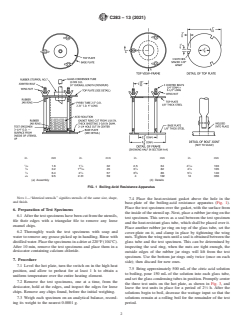
3.4 Boiling Acid Resistance Apparatus, as shown in Fig. 1.
ization established in the Decision on Principles for the
Three sets will be required.
Development of International Standards, Guides and Recom-
mendations issued by the World Trade Organization Technical
3.5 Cutting Equipment, suitable for cutting a 3 ⁄4-in. (82-
Barriers to Trade (TBT) Committee.
mm) diameter plate from the bottom of a porcelain-enameled
steel utensil, as follows:
2. Significance and Use
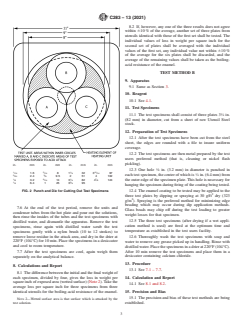
3.5.1 Punch and Die (Fig. 2),
3.5.2 Shears,
2.1 Test Method A provides the producers of porcelain
3.5.3 Abrasive Cut-off Wheel,
enameled utensils with a quality control method of testing for
3.5.4 Cutting Torch, or
resistance to boiling acid for parts randomly selected from the
3.5.5 Any Other Suitable Equipment
production line.
3.6 Analytical Balance, having a sensitivity of 0.0001 g.
4. Reagent
These test methods are under the jurisdiction of ASTM Committee B08 on
4.1 The test solution shall contain6gofACS grade citric
Metallic and Inorganic Coatings and are the direct responsibility of Subcommittee
acid per 94 g of distilled water and shall be prepared fresh for
B08.12 on Materials for Porcelain Enamel and Ceramic-Metal Systems.
each test.
Current edition approved Oct. 1, 2021. Published November 2021. Originally
approvedin1951.Lastpreviouseditionapprovedin2017asC283 – 13(2017).DOI:
5. Test Specimens
10.1520/C0283-13R21.
Test Method A is based on the boiling acid resistance test developed by the
5.1 The test specimens shall consist of three plates, 3 ⁄4 in.
Enameled Utensil Manufacturers’ Council; see Section 16 of Commercial Standard
(82 mm) in diameter, cut from the bottoms of three identical
CS100-47, Porcelain Enameled Steel Utensils, United States Department of Com-
merce. utensils.
Copyright © ASTM International, 100 Barr Harbor Drive, PO Box C700, West Conshohocken, PA 19428-2959. United States
C283 − 13 (2021)
in. mm in. mm in. mm in. mm
1 1 1
⁄16 1.6 1 ⁄4 32 2.5 64 4 ⁄16 103
1 25 1 1
⁄8 3.2 1 ⁄32 45 3 ⁄4 82 4 ⁄8 105
1 1 3 1
⁄4 6.4 2 ⁄4 57 3 ⁄8 86 5 ⁄2 140
⁄8 9.5 2.31 59 4 102 14 356
(a) Assembly (b) Details
FIG. 1 Boiling-Acid Resistance Apparatus
NOTE 1—“Identical utensils” signifies utensils of the same size, shape,
7.4 Place the heat-resistant gasket above the hole in the
and finish.
base-plate of the boiling-acid resistance apparatus (Fig. 1).
Place the test specimen over the gasket, with the surface from
6. Preparation of Test Specimens
the inside of the utensil up. Next, place a rubber jar ring on the
6.1 After the test specimens have been cut from the utensils,
test specimen. This serves as a seal between the test specimen
file their edges with a triangular file to remove any loose
and the heat-resistant glass tube, which shall be placed over it.
enamel chips.
Place another rubber jar ring on top of the glass tube, set the
6.2 Thoroughly wash the test specimens with soap and cover-plate on it, and clamp in place by tightening the wing
water to remove any grease picked up in handling. Rinse with
nuts. Tighten the wing nuts until a seal is obtained between the
distilledwater.Placethespecimensinadrierat220°F(104°C).
glass tube and the test specimen. This can be determined by
After 10 min, remove the test specimens and place them in a
inspecting the seal ring, when the nuts are tight enough, the
desiccator containing calcium chloride.
outside edges of the rubber jar rings will lift from the test
specimen. Use the bottom jar rings only twice (once on each
7. Procedure
side); then discard for new ones.
7.1 Level the hot plate, turn the switch on in the high heat
7.5 Bring approximately
...