

ASTM C375-22
(Classification)Standard Classification of Water Used in Milling of Porcelain Enamel
General Information
- Abstract
ABSTRACT
This classification covers water used in the milling of porcelain enamel frit. Three classes of water are covered: For porcelain enamel frits, Class A water should cause no difficulties in the production of a high quality finish. Class B water may be used by slight compensations in processing. Mill addition water falling into Class C should be treated before use in order to preclude faulty enamel production. For analysis, the following elements and properties shall be determined: sampling, bicarbonate, calcium & magnesium, chloride, hardness, iron, manganese, pH, sulfate, and total solids.
SCOPE
1.1 This classification covers water used in the milling of porcelain enamel frit.
1.2 This standard does not purport to address all of the safety concerns, if any, associated with its use. It is the responsibility of the user of this standard to establish appropriate safety, health, and environmental practices and determine the applicability of regulatory limitations prior to use.
1.3 This international standard was developed in accordance with internationally recognized principles on standardization established in the Decision on Principles for the Development of International Standards, Guides and Recommendations issued by the World Trade Organization Technical Barriers to Trade (TBT) Committee.
- Status
- Published
- Publication Date
- 30-Apr-2022
- Technical Committee
- B08 - Metallic and Inorganic Coatings
- Drafting Committee
- B08.12 - Materials for Porcelain Enamel and Ceramic-Metal Systems




Overview
ASTM C375-22: Standard Classification of Water Used in Milling of Porcelain Enamel provides a systematic approach for evaluating the quality of water utilized in the milling process of porcelain enamel frits. This classification ensures consistent production quality by categorizing water based on its chemical composition and applicability in porcelain enamel manufacturing. Developed by ASTM International, the standard helps manufacturers prevent defects and optimize finishes by classifying water into three grades-Class A, B, and C-according to impurity levels and operational impact.
Key Topics
- Water Classification: The standard defines three classes of water, each with specified maximum permissible levels of various components such as calcium, magnesium, iron, manganese, sulfate, chloride, hardness, bicarbonate, total solids, and pH.
- Class A: Suitable for producing high-quality porcelain enamel finishes without issues.
- Class B: May require minor adjustments during processing to maintain quality.
- Class C: Must be treated before use to avoid potential defects in enamel production.
- Chemical Analysis: To determine water class, the standard lists key properties for analysis, including:
- Sampling procedures
- Bicarbonate content
- Calcium and magnesium levels
- Chloride concentration
- Water hardness
- Iron and manganese quantities
- pH value
- Sulfate and total solids content
- Testing Methods: References ASTM procedures for precise measurement, ensuring consistency across laboratories and production facilities.
Applications
ASTM C375-22 is essential wherever high-quality porcelain enamel finishes are produced, such as:
- Porcelain Enamel Manufacturing: Ensures reliable, high-quality finishes on kitchen appliances, sanitary ware, architectural panels, and industrial equipment.
- Quality Control: Enables manufacturers to standardize water quality in production, reducing the risk of surface defects like pitting or discoloration.
- Process Optimization: Guides plant operators in monitoring and adjusting water quality, leading to improved efficiency, lower rejection rates, and optimized resource usage.
- Laboratory Validation: Provides testing laboratories with a clear reference for analyzing water suitability, supporting process audits, vendor qualification, and troubleshooting.
By adhering to ASTM C375-22, companies ensure compliance with best practices and international expectations, supporting product safety, process reliability, and cost-effective operations.
Related Standards
Several ASTM standards are referenced within ASTM C375-22 to guide testing and analysis methodologies:
- ASTM D511 - Test Methods for Calcium and Magnesium in Water
- ASTM D513 - Test Methods for Total and Dissolved Carbon Dioxide in Water (for bicarbonate analysis)
- ASTM D516 - Test Method for Sulfate Ion in Water
- ASTM D858 - Test Methods for Manganese in Water
- ASTM D1068 - Test Methods for Iron in Water
- ASTM D1126 - Test Method for Hardness in Water
- ASTM D1293 - Test Methods for pH of Water
- ASTM D3370 - Practices for Sampling Water from Flowing Process Streams
ASTM C375-22 also aligns with global standardization principles as defined by the WTO TBT Committee, ensuring international applicability and recognition.
By applying ASTM C375-22, manufacturers and laboratories can classify and control water quality in porcelain enamel milling, directly supporting high standards of product excellence and process integrity within the ceramics and enameling industries.
Relations
- Effective Date
- 01-Sep-2012
- Effective Date
- 01-Mar-2012
- Effective Date
- 06-Feb-2012
- Effective Date
- 01-Jan-2012
- Effective Date
- 01-Sep-2011
- Effective Date
- 01-Dec-2010
- Effective Date
- 15-Sep-2010
- Effective Date
- 01-Sep-2010
- Effective Date
- 01-May-2009
- Effective Date
- 01-Oct-2008
- Effective Date
- 01-Oct-2008
- Effective Date
- 01-Dec-2007
- Effective Date
- 01-Aug-2007
- Effective Date
- 01-Aug-2007
- Effective Date
- 01-Aug-2007
Get Certified
Connect with accredited certification bodies for this standard

DVS-ZERT GmbH
German welding certification society.
CARES (UK Certification Authority for Reinforcing Steels)
UK certification for reinforcing steels and construction.
EWF/IIW (European/International Welding Federation)
International welding personnel certification.
Sponsored listings
Frequently Asked Questions
ASTM C375-22 is a standard published by ASTM International. Its full title is "Standard Classification of Water Used in Milling of Porcelain Enamel". This standard covers: ABSTRACT This classification covers water used in the milling of porcelain enamel frit. Three classes of water are covered: For porcelain enamel frits, Class A water should cause no difficulties in the production of a high quality finish. Class B water may be used by slight compensations in processing. Mill addition water falling into Class C should be treated before use in order to preclude faulty enamel production. For analysis, the following elements and properties shall be determined: sampling, bicarbonate, calcium & magnesium, chloride, hardness, iron, manganese, pH, sulfate, and total solids. SCOPE 1.1 This classification covers water used in the milling of porcelain enamel frit. 1.2 This standard does not purport to address all of the safety concerns, if any, associated with its use. It is the responsibility of the user of this standard to establish appropriate safety, health, and environmental practices and determine the applicability of regulatory limitations prior to use. 1.3 This international standard was developed in accordance with internationally recognized principles on standardization established in the Decision on Principles for the Development of International Standards, Guides and Recommendations issued by the World Trade Organization Technical Barriers to Trade (TBT) Committee.
ABSTRACT This classification covers water used in the milling of porcelain enamel frit. Three classes of water are covered: For porcelain enamel frits, Class A water should cause no difficulties in the production of a high quality finish. Class B water may be used by slight compensations in processing. Mill addition water falling into Class C should be treated before use in order to preclude faulty enamel production. For analysis, the following elements and properties shall be determined: sampling, bicarbonate, calcium & magnesium, chloride, hardness, iron, manganese, pH, sulfate, and total solids. SCOPE 1.1 This classification covers water used in the milling of porcelain enamel frit. 1.2 This standard does not purport to address all of the safety concerns, if any, associated with its use. It is the responsibility of the user of this standard to establish appropriate safety, health, and environmental practices and determine the applicability of regulatory limitations prior to use. 1.3 This international standard was developed in accordance with internationally recognized principles on standardization established in the Decision on Principles for the Development of International Standards, Guides and Recommendations issued by the World Trade Organization Technical Barriers to Trade (TBT) Committee.
ASTM C375-22 is classified under the following ICS (International Classification for Standards) categories: 25.220.50 - Enamels. The ICS classification helps identify the subject area and facilitates finding related standards.
ASTM C375-22 has the following relationships with other standards: It is inter standard links to ASTM D858-12, ASTM D1126-12, ASTM D513-11e1, ASTM D1293-12, ASTM D516-11, ASTM D3370-10, ASTM D512-10, ASTM D1068-10, ASTM D511-09, ASTM D3370-08, ASTM D511-08, ASTM D3370-07, ASTM D516-07, ASTM D858-07, ASTM D1126-02(2007)e1. Understanding these relationships helps ensure you are using the most current and applicable version of the standard.
ASTM C375-22 is available in PDF format for immediate download after purchase. The document can be added to your cart and obtained through the secure checkout process. Digital delivery ensures instant access to the complete standard document.
Standards Content (Sample)
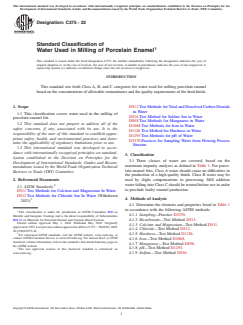
This international standard was developed in accordance with internationally recognized principles on standardization established in the Decision on Principles for the
Development of International Standards, Guides and Recommendations issued by the World Trade Organization Technical Barriers to Trade (TBT) Committee.
Designation:C375 −22
Standard Classification of
Water Used in Milling of Porcelain Enamel
This standard is issued under the fixed designation C375; the number immediately following the designation indicates the year of
original adoption or, in the case of revision, the year of last revision. A number in parentheses indicates the year of last reapproval. A
superscript epsilon (´) indicates an editorial change since the last revision or reapproval.
INTRODUCTION
This standard sets forth Class A, B, and C categories for water used for milling porcelain enamel
based on the concentrations of allowable contaminates and the quality requirements of the fired finish.
1. Scope D513 Test Methods for Total and Dissolved Carbon Dioxide
in Water
1.1 This classification covers water used in the milling of
D516 Test Method for Sulfate Ion in Water
porcelain enamel frit.
D858 Test Methods for Manganese in Water
1.2 This standard does not purport to address all of the
D1068 Test Methods for Iron in Water
safety concerns, if any, associated with its use. It is the
D1126 Test Method for Hardness in Water
responsibility of the user of this standard to establish appro-
D1293 Test Methods for pH of Water
priate safety, health, and environmental practices and deter-
D3370 Practices for Sampling Water from Flowing Process
mine the applicability of regulatory limitations prior to use.
Streams
1.3 This international standard was developed in accor-
dance with internationally recognized principles on standard-
3. Classification
ization established in the Decision on Principles for the
3.1 Three classes of water are covered, based on the
Development of International Standards, Guides and Recom-
maximum impurity analyses as defined in Table 1. For porce-
mendations issued by the World Trade Organization Technical
lain enamel frits, Class A water should cause no difficulties in
Barriers to Trade (TBT) Committee.
the production of a high quality finish. Class B water may be
2. Referenced Documents used by slight compensations in processing. Mill addition
water falling into Class C should be treated before use in order
2.1 ASTM Standards:
to preclude faulty enamel production.
D511 Test Methods for Calcium and Magnesium In Water
D512 Test Methods for Chloride Ion In Water (Withdrawn
3 4. Methods of Analysis
2021)
4.1 Determine the elements and properties listed in Table 1
in accordance with the following ASTM methods:
This classification is under the jurisdiction of ASTM Committee B08 on
4.1.1 Sampling—Practice D3370.
Metallic and Inorganic Coatings and is the direc
...
This document is not an ASTM standard and is intended only to provide the user of an ASTM standard an indication of what changes have been made to the previous version. Because
it may not be technically possible to adequately depict all changes accurately, ASTM recommends that users consult prior editions as appropriate. In all cases only the current version
of the standard as published by ASTM is to be considered the official document.
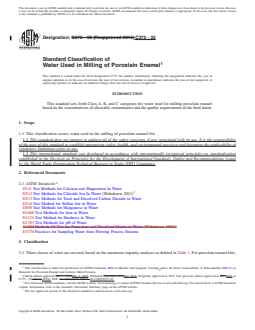
Designation: C375 − 58 (Reapproved 2016) C375 − 22
Standard Classification of
Water Used in Milling of Porcelain Enamel
This standard is issued under the fixed designation C375; the number immediately following the designation indicates the year of
original adoption or, in the case of revision, the year of last revision. A number in parentheses indicates the year of last reapproval. A
superscript epsilon (´) indicates an editorial change since the last revision or reapproval.
INTRODUCTION
This standard sets forth Class A, B, and C categories for water used for milling porcelain enamel
based on the concentrations of allowable contaminates and the quality requirements of the fired finish.
1. Scope
1.1 This classification covers water used in the milling of porcelain enamel frit.
1.2 This standard does not purport to address all of the safety concerns, if any, associated with its use. It is the responsibility
of the user of this standard to establish appropriate safety, health, and environmental practices and determine the applicability of
regulatory limitations prior to use.
1.3 This international standard was developed in accordance with internationally recognized principles on standardization
established in the Decision on Principles for the Development of International Standards, Guides and Recommendations issued
by the World Trade Organization Technical Barriers to Trade (TBT) Committee.
2. Referenced Documents
2.1 ASTM Standards:
D511 Test Methods for Calcium and Magnesium In Water
D512 Test Methods for Chloride Ion In Water (Withdrawn 2021)
D513 Test Methods for Total and Dissolved Carbon Dioxide in Water
D516 Test Method for Sulfate Ion in Water
D858 Test Methods for Manganese in Water
D1068 Test Methods for Iron in Water
D1126 Test Method for Hardness in Water
D1293 Test Methods for pH of Water
D1888 Methods Of Test for Particulate and Dissolved Matter in Water (Withdrawn 1989)
D3370 Practices for Sampling Water from Flowing Process Streams
3. Classification
3.1 Three classes of water are covered, based on the maximum impurity analyses as defined in Table 1. For porcelain enamel frits,
This classification is under the jurisdiction of ASTM Committee B08 on Metallic and Inorganic Coatings and is the direct responsibility of Subcommittee B08.12 on
Materials for Porcelain Enamel and Ceramic-Metal Systems.
Current edition approved Nov. 1, 2016May 1, 2022. Published November 2016May 2022. Originally approved in 1955. Last previous edition approved in 20112016 as
C375 – 58 (2011).(2016). DOI: 10.1520/C0375-58R16. 10.1520/C0375-22.
For referenced ASTM standards, visit the ASTM website, www.astm.org, or contact ASTM Customer Service at service@astm.org. For Annual Book of ASTM Standards
volume information, refer to the standard’s Document
...