

ASTM C537-87(2023)
(Test Method)Standard Test Method for Reliability of Glass Coatings on Glassed Steel Reaction Equipment by High Voltage
General Information
- Abstract
SIGNIFICANCE AND USE
4.1 The widespread use of glassed-steel equipment in highly corrosive chemical processes has made it necessary to detect weak spots in the coating and repair them before catastrophic failure occurs in service. This test is intended to detect discontinuities and thin areas in a glass coating on metal to ensure that the coating is defect free and has sufficient thickness to withstand the prescribed service conditions. A test voltage may be selected at any desired value up to 20k V, thus making the test applicable to a wide range of thickness requirements. When, because of bubbles or defects, the thickness of glass at any spot is less than enough to withstand the applied voltage, a puncture results with an accompanying indication of a defect. Remedial action is then required to repair the defect before the equipment can be used for corrosive service. (When such defects are found before the equipment leaves the manufacturer's plant another application of glass can usually be applied and fired to become an integral part of the coating.)
SCOPE
1.1 This test method covers the determination of the reliability of glass coating on metal and is intended for use by manufacturers of equipment that is designed to withstand highly corrosive conditions where a failure of the coating in service would cause extreme damage to the exposed metal. Its use outside the manufacturer's plant is discouraged because improper or indiscriminate testing can cause punctures that are difficult to repair without returning the equipment to the manufacturer's plant. This test method detects not only existing discontinuities in the glass coating, but also areas where the glass may be thin enough to be likely to result in premature failure in service.
1.2 The values stated in SI units are to be regarded as standard. No other units of measurement are included in this standard.
1.3 This standard does not purport to address all of the safety concerns, if any, associated with its use. It is the responsibility of the user of this standard to establish appropriate safety, health, and environmental practices and determine the applicability of regulatory limitations prior to use. For specific precautionary statements, see Section 7.
1.4 This international standard was developed in accordance with internationally recognized principles on standardization established in the Decision on Principles for the Development of International Standards, Guides and Recommendations issued by the World Trade Organization Technical Barriers to Trade (TBT) Committee.
- Status
- Published
- Publication Date
- 30-Apr-2023
- Technical Committee
- B08 - Metallic and Inorganic Coatings
- Drafting Committee
- B08.12 - Materials for Porcelain Enamel and Ceramic-Metal Systems


Overview
ASTM C537-87(2023) - Standard Test Method for Reliability of Glass Coatings on Glassed Steel Reaction Equipment by High Voltage - is a key international standard developed by ASTM International. This standard outlines a test method designed specifically to assess the integrity and reliability of glass coatings applied to steel equipment, particularly equipment used in highly corrosive chemical processes. The purpose of this high voltage testing is to identify any weak spots, discontinuities, or thin areas in the glass coating that could lead to premature failure and exposure of the underlying steel.
The method is primarily intended for use by equipment manufacturers in controlled environments, such as the manufacturing plant, to ensure each vessel’s coating quality before it is put into service. Improper testing outside the plant is discouraged due to the risk of causing damage that may require professional repair.
Key Topics
- Glass Coated (Glassed) Steel Inspection: The standard focuses on glass-lined steel, commonly known as glass-coated or porcelain enameled steel, valued for its superior chemical and corrosion resistance at elevated temperatures and pressures.
- High Voltage Testing: The test involves the application of a variable high-voltage (up to 20kV) to the glass-coated surface using specialized probes. This detects any coating defects by producing a visible and audible discharge where the dielectric strength is insufficient.
- Detection of Discontinuities and Thin Areas: The method is effective in identifying inherent flaws, such as bubbles or inclusions, and ensures adequate coating thickness to meet service requirements.
- Repair and Remediation Guidance: When weaknesses are detected during testing, the standard guides immediate remediation, such as reapplication and firing of glass to restore integrity before equipment leaves the manufacturer.
- Safety Procedures: Ensures the use of proper grounding, operator safety, and avoidance of hazardous testing practices, especially outside controlled production environments.
Applications
The reliability test outlined in ASTM C537-87(2023) is widely used in industries where glassed steel equipment is exposed to aggressive chemical environments. Key application areas include:
- Chemical Processing: Reactors, storage tanks, and pipelines that process corrosive chemicals benefit from verified glass coatings, preventing catastrophic failures caused by coating breaches.
- Pharmaceutical Production: Ensures vessel coatings can withstand frequent cleaning and sterilization cycles in harsh chemical contexts.
- Food and Beverage Manufacturing: Used to certify equipment where high resistance to acid- and alkali-based cleaning chemicals is essential.
- Industrial Equipment Manufacturing: Quality control in production of high-reliability vessels and components for critical industrial processes.
By detecting flaws before equipment deployment, manufacturers can remediate issues, reducing the risk of operational downtime, product contamination, and costly repairs in the field.
Related Standards
ASTM C537-87(2023) references established international principles and is part of a broader set of standards governing glass coatings and metallic substrates. Related standards include:
- ASTM C282 - Standard Test Method for Acid Resistance of Porcelain Enamels
- ASTM C700 - Standard Specification for Industrial Glass-Encased Steel Equipment
- ISO Standards on Glass-Lined Equipment and Process Vessels
- Guidelines from the World Trade Organization (WTO) Technical Barriers to Trade (TBT) Committee
Adhering to ASTM C537-87(2023) helps manufacturers comply with rigorous international expectations for quality control and safety in glassed steel equipment, ensuring reliable performance in corrosive service environments.
Get Certified
Connect with accredited certification bodies for this standard

DVS-ZERT GmbH
German welding certification society.
CARES (UK Certification Authority for Reinforcing Steels)
UK certification for reinforcing steels and construction.
EWF/IIW (European/International Welding Federation)
International welding personnel certification.
Sponsored listings
Frequently Asked Questions
ASTM C537-87(2023) is a standard published by ASTM International. Its full title is "Standard Test Method for Reliability of Glass Coatings on Glassed Steel Reaction Equipment by High Voltage". This standard covers: SIGNIFICANCE AND USE 4.1 The widespread use of glassed-steel equipment in highly corrosive chemical processes has made it necessary to detect weak spots in the coating and repair them before catastrophic failure occurs in service. This test is intended to detect discontinuities and thin areas in a glass coating on metal to ensure that the coating is defect free and has sufficient thickness to withstand the prescribed service conditions. A test voltage may be selected at any desired value up to 20k V, thus making the test applicable to a wide range of thickness requirements. When, because of bubbles or defects, the thickness of glass at any spot is less than enough to withstand the applied voltage, a puncture results with an accompanying indication of a defect. Remedial action is then required to repair the defect before the equipment can be used for corrosive service. (When such defects are found before the equipment leaves the manufacturer's plant another application of glass can usually be applied and fired to become an integral part of the coating.) SCOPE 1.1 This test method covers the determination of the reliability of glass coating on metal and is intended for use by manufacturers of equipment that is designed to withstand highly corrosive conditions where a failure of the coating in service would cause extreme damage to the exposed metal. Its use outside the manufacturer's plant is discouraged because improper or indiscriminate testing can cause punctures that are difficult to repair without returning the equipment to the manufacturer's plant. This test method detects not only existing discontinuities in the glass coating, but also areas where the glass may be thin enough to be likely to result in premature failure in service. 1.2 The values stated in SI units are to be regarded as standard. No other units of measurement are included in this standard. 1.3 This standard does not purport to address all of the safety concerns, if any, associated with its use. It is the responsibility of the user of this standard to establish appropriate safety, health, and environmental practices and determine the applicability of regulatory limitations prior to use. For specific precautionary statements, see Section 7. 1.4 This international standard was developed in accordance with internationally recognized principles on standardization established in the Decision on Principles for the Development of International Standards, Guides and Recommendations issued by the World Trade Organization Technical Barriers to Trade (TBT) Committee.
SIGNIFICANCE AND USE 4.1 The widespread use of glassed-steel equipment in highly corrosive chemical processes has made it necessary to detect weak spots in the coating and repair them before catastrophic failure occurs in service. This test is intended to detect discontinuities and thin areas in a glass coating on metal to ensure that the coating is defect free and has sufficient thickness to withstand the prescribed service conditions. A test voltage may be selected at any desired value up to 20k V, thus making the test applicable to a wide range of thickness requirements. When, because of bubbles or defects, the thickness of glass at any spot is less than enough to withstand the applied voltage, a puncture results with an accompanying indication of a defect. Remedial action is then required to repair the defect before the equipment can be used for corrosive service. (When such defects are found before the equipment leaves the manufacturer's plant another application of glass can usually be applied and fired to become an integral part of the coating.) SCOPE 1.1 This test method covers the determination of the reliability of glass coating on metal and is intended for use by manufacturers of equipment that is designed to withstand highly corrosive conditions where a failure of the coating in service would cause extreme damage to the exposed metal. Its use outside the manufacturer's plant is discouraged because improper or indiscriminate testing can cause punctures that are difficult to repair without returning the equipment to the manufacturer's plant. This test method detects not only existing discontinuities in the glass coating, but also areas where the glass may be thin enough to be likely to result in premature failure in service. 1.2 The values stated in SI units are to be regarded as standard. No other units of measurement are included in this standard. 1.3 This standard does not purport to address all of the safety concerns, if any, associated with its use. It is the responsibility of the user of this standard to establish appropriate safety, health, and environmental practices and determine the applicability of regulatory limitations prior to use. For specific precautionary statements, see Section 7. 1.4 This international standard was developed in accordance with internationally recognized principles on standardization established in the Decision on Principles for the Development of International Standards, Guides and Recommendations issued by the World Trade Organization Technical Barriers to Trade (TBT) Committee.
ASTM C537-87(2023) is classified under the following ICS (International Classification for Standards) categories: 25.220.50 - Enamels. The ICS classification helps identify the subject area and facilitates finding related standards.
ASTM C537-87(2023) is available in PDF format for immediate download after purchase. The document can be added to your cart and obtained through the secure checkout process. Digital delivery ensures instant access to the complete standard document.
Standards Content (Sample)
This international standard was developed in accordance with internationally recognized principles on standardization established in the Decision on Principles for the
Development of International Standards, Guides and Recommendations issued by the World Trade Organization Technical Barriers to Trade (TBT) Committee.
Designation: C537 − 87 (Reapproved 2023)
Standard Test Method for
Reliability of Glass Coatings on Glassed Steel Reaction
Equipment by High Voltage
This standard is issued under the fixed designation C537; the number immediately following the designation indicates the year of
original adoption or, in the case of revision, the year of last revision. A number in parentheses indicates the year of last reapproval. A
superscript epsilon (´) indicates an editorial change since the last revision or reapproval.
INTRODUCTION
This test method covers the determination of the reliability of glass coating on metal using high
voltage. It is intended for use by manufacturers of equipment that is designed to withstand highly
corrosive conditions where a failure of the coating in service would cause extreme damage to the
exposed metal. The test method detects not only existing discontinuities in the glass coating, but also
areas where the glass coating may be thin enough to be likely to result in premature failure in service.
1. Scope 2. Terminology
1.1 This test method covers the determination of the reli- 2.1 Definitions:
ability of glass coating on metal and is intended for use by 2.1.1 glassed steel, glass-lined steel, or glass-coated steel,
manufacturers of equipment that is designed to withstand n—designations generally applied to a class of porcelain
highly corrosive conditions where a failure of the coating in enamels that have high resistance to chemical attack at elevated
service would cause extreme damage to the exposed metal. Its temperatures and pressures.
use outside the manufacturer’s plant is discouraged because
improper or indiscriminate testing can cause punctures that are 3. Summary of Test Method
difficult to repair without returning the equipment to the
3.1 This test method consists essentially of grounding the
manufacturer’s plant. This test method detects not only exist-
metal structure of the equipment to the ground side of a
ing discontinuities in the glass coating, but also areas where the
direct-current high-voltage generator and sweeping the glass
glass may be thin enough to be likely to result in premature
surface with a high-potential probe on the end of an insulated
failure in service.
handle and cable. Wherever a discontinuity exists or the
1.2 The values stated in SI units are to be regarded as coating is thin enough (by reason of a concealed bubble or
conducting inclusion, etc.) so that the dielectric strength of the
standard. No other units of measurement are included in this
standard. remaining glass is less than some preset desired amount, the
dielectric strength of air-plus-remaining-glass breaks down and
1.3 This standard does not purport to address all of the
a discharge occurs. Built-in current-limiting devices ensure
safety concerns, if any, associated with its use. It is the
electrical safety to the operator. A variable voltage control
responsibility of the user of this standard to establish appro-
allows selection of a voltage which assures a predetermined
priate safety, health, and environmental practices and deter-
minimum thickness of glass.
mine the applicability of regulatory limitations prior to use.
For specific precautionary statements, see Section 7.
4. Significance and Use
1.4 This international standard was developed in accor-
dance with internationally recognized principles on standard- 4.1 The widespread use of glassed-steel equipment in highly
ization established in the Decision on Principles for the
corrosive chemical processes has made it necessary to detect
Development of International Standards, Guides and Recom- weak spots in the coating and repair them before catastrophic
mendations issued by the World Trade Organization Technical
failure occurs in service. This test is intended to detect
Barriers to Trade (TBT) Committee. discontinuities and thin areas in a glass coating on metal to
ensure that the coating is defect free and has sufficient
thickness to withstand the prescribed service conditions. A test
This test method is under the jurisdiction of ASTM Committee B08 on Metallic
and Inorganic Coatings and is the direct responsibility of Subcommittee B08.12 on
voltage may be selected at any desired value up to 20k V, thus
Materials for Porcelain Enamel and Ceramic-Metal Systems.
making the test applicable to a wide range of thickness
Current edition approved May 1, 2023. Published June 2023. Originally
requirements. When, because of bubbles or defects, the thick-
approved in 1964. Last previous edition approved in 2018 as C537 – 87 (2018).
DOI: 10.1520/C0537-87R23. ness of glass at any spot is less than enough to withstand the
Copyright © ASTM International, 100 Barr Harbor Drive, PO Box C700, West Conshohocken, PA 19428-2959. United States
C537 − 87 (2023)
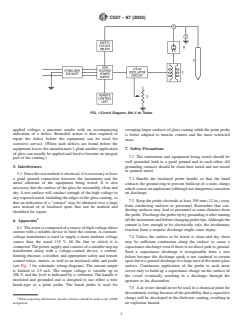
FIG. 1 Circuit Diagram, 20k V dc Tester
applied voltage, a puncture results with an accompanying sweeping larger surfaces of glass coating while the point probe
indication of a defect. Remedial action is then required to
is better adapted to interior corners and the more restricted
repair the defect before the equipment can be used for
areas.
corrosive service. (When such defects are found before the
equipment leaves the manufacturer’s plant another application
7. Safety Precautions
of glass can usually be applied and fired to become an integral
7.1 The instrument and equipment being tested should be
part of the coating.)
well grounded both to a good ground and to each other. All
grounding contacts should be clean bare metal and not rusted
5. Interferences
or painted metal.
5.1 Since the test method is electrical, it is necessary to have
a good ground connection between the instrument and the 7.2 Handle the insulated probe handle so that the hand
metal substrate of the equipment being tested. It is also
contacts the ground ring to prevent build-up of a static charge
necessary that the surface of the glass be reasonably clean and which causes an unpleasant (although not dangerous) sensation
dry. A wet surface will conduct enough of the high voltage to
on discharge.
any exposed metal, including the edges of the glass coating, so
7.3 Keep the probe electrode at least 305 mm (12 in.) away
that an indication of a “contact” may be obtained over a large
from condu
...