

ASTM B916-01(2021)
(Test Method)Standard Test Method for Adherence of Porcelain Enamel Coatings to Sheet Metal
General Information
- Abstract
SIGNIFICANCE AND USE
2.1 The measurement of adherence in porcelain enamel systems, such as ground coat, ground coat/cover coat, and direct-on cover-coat enamels, is an important procedure for monitoring process variables in metal preparation, enamel application thickness, steel selection, and enamel selection, as well as assuring the ultimate quality of the finished product.
SCOPE
1.1 The scope of this test method is:
1.1.1 To determine quantitatively the amount of enamel remaining after the porcelain enamel coating specimen has been deformed;
1.1.2 To standardize the deformation parameters for testing adherence of porcelain enamel to sheet metal; and,
1.1.3 To provide a quantitative adherence rating scale for comparison to reference standards.
1.2 This adherence test method is applicable to porcelain enamel coatings on substrates from 18 to 24 gauge (0.0478 to 0.025 in. or from 1.214 to 0.654 mm).
1.3 The values stated in inch-pound units are to be regarded as standard. The values given in parentheses are mathematical conversions to SI units that are provided for information only and are not considered standard.
1.4 This standard does not purport to address all of the safety concerns, if any, associated with its use. It is the responsibility of the user of this standard to establish appropriate safety, health, and environmental practices and determine the applicability of regulatory limitations prior to use.
1.5 This international standard was developed in accordance with internationally recognized principles on standardization established in the Decision on Principles for the Development of International Standards, Guides and Recommendations issued by the World Trade Organization Technical Barriers to Trade (TBT) Committee.
- Status
- Published
- Publication Date
- 30-Sep-2021
- Technical Committee
- B08 - Metallic and Inorganic Coatings
- Drafting Committee
- B08.12 - Materials for Porcelain Enamel and Ceramic-Metal Systems
Overview
ASTM B916-01(2021): Standard Test Method for Adherence of Porcelain Enamel Coatings to Sheet Metal specifies a quantitative method for evaluating the adhesion of porcelain enamel coatings on sheet metal substrates. Developed by ASTM International, this test method ensures consistent assessment of enamel adherence, which is critical for maintaining the quality and durability of finished products in industries using porcelain-enameled steel. The standard applies to coatings on sheet metal ranging from 18 to 24 gauge and offers a procedure for monitoring key process variables such as metal preparation, coating thickness, steel selection, and enamel selection.
Key Topics
Purpose and Importance
- Provides a reliable, repeatable method to assess the ability of porcelain enamel coatings to adhere to steel substrates.
- Supports process monitoring and quality assurance by identifying process variables that can impact adherence.
- Ensures products meet industry requirements for durability and longevity.
Test Method Scope
- Quantitative determination of remaining enamel after specimen deformation.
- Standardization of deformation parameters for consistency across different labs and operations.
- Implementation of a rating scale for clear, comparative adherence assessment.
Applicable Substrate Range
- Suitable for porcelain enamel coatings applied to sheet metal from 18 to 24 gauge (1.214 to 0.654 mm thick).
Adherence Evaluation
- Utilizes a drop weight impact test with standardized parameters to deform coated specimens.
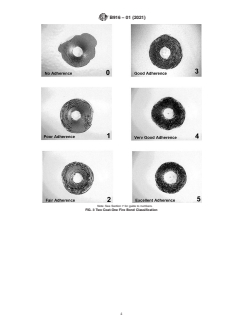
- Adherence rated visually against referenced standards on a 0-5 scale, allowing for objective comparison.
Safety and Units
- Emphasizes adherence to safety practices during testing due to potential for released enamel chips.
- Inch-pound units are standard; SI units are provided for information only.
Applications
ASTM B916-01(2021) is practical for a wide range of sectors that require porcelain enameled steel components, including:
- Appliance Manufacturing
- Ensures long-lasting finish on ovens, ranges, washing machines, and other household or industrial appliances.
- Architectural Panels
- Assures consistent quality and weather resistance for porcelain-enameled exterior cladding.
- Sanitaryware and Fixtures
- Verifies adherence for products such as bathtubs, sinks, and hospital equipment where hygiene and appearance are critical.
- Industrial Equipment
- Supports quality assurance in the production of chemical vessel linings and components exposed to corrosive environments.
By applying this standard, manufacturers can avoid failures related to poor coating adhesion, such as chipping, flaking, or corrosion, assuring end-users of product reliability.
Related Standards
- ASTM B532 - Test Method for Determining the Adhesion of Porcelain Enamel Coatings
- ISO 28764 - Vitreous and Porcelain Enamels-Production of Specimens and Test Pieces for Testing
- ASTM B537 - Standard Practice for Rating Adhesion of Metallic and Inorganic Coatings
- ASTM B604 - Standard Specification for Decorative Electroplated Coatings of Nickel Plus Chromium on Plastic Substrates
These related standards provide complementary testing and quality control methods for coatings, further supporting robust process control and international product acceptance.
Keywords: ASTM B916, porcelain enamel coating adhesion, sheet metal testing, enamel adherence, industrial standards, adherence rating scale, enamel quality control, ASTM International.
Get Certified
Connect with accredited certification bodies for this standard

DVS-ZERT GmbH
German welding certification society.
CARES (UK Certification Authority for Reinforcing Steels)
UK certification for reinforcing steels and construction.
EWF/IIW (European/International Welding Federation)
International welding personnel certification.
Sponsored listings
Frequently Asked Questions
ASTM B916-01(2021) is a standard published by ASTM International. Its full title is "Standard Test Method for Adherence of Porcelain Enamel Coatings to Sheet Metal". This standard covers: SIGNIFICANCE AND USE 2.1 The measurement of adherence in porcelain enamel systems, such as ground coat, ground coat/cover coat, and direct-on cover-coat enamels, is an important procedure for monitoring process variables in metal preparation, enamel application thickness, steel selection, and enamel selection, as well as assuring the ultimate quality of the finished product. SCOPE 1.1 The scope of this test method is: 1.1.1 To determine quantitatively the amount of enamel remaining after the porcelain enamel coating specimen has been deformed; 1.1.2 To standardize the deformation parameters for testing adherence of porcelain enamel to sheet metal; and, 1.1.3 To provide a quantitative adherence rating scale for comparison to reference standards. 1.2 This adherence test method is applicable to porcelain enamel coatings on substrates from 18 to 24 gauge (0.0478 to 0.025 in. or from 1.214 to 0.654 mm). 1.3 The values stated in inch-pound units are to be regarded as standard. The values given in parentheses are mathematical conversions to SI units that are provided for information only and are not considered standard. 1.4 This standard does not purport to address all of the safety concerns, if any, associated with its use. It is the responsibility of the user of this standard to establish appropriate safety, health, and environmental practices and determine the applicability of regulatory limitations prior to use. 1.5 This international standard was developed in accordance with internationally recognized principles on standardization established in the Decision on Principles for the Development of International Standards, Guides and Recommendations issued by the World Trade Organization Technical Barriers to Trade (TBT) Committee.
SIGNIFICANCE AND USE 2.1 The measurement of adherence in porcelain enamel systems, such as ground coat, ground coat/cover coat, and direct-on cover-coat enamels, is an important procedure for monitoring process variables in metal preparation, enamel application thickness, steel selection, and enamel selection, as well as assuring the ultimate quality of the finished product. SCOPE 1.1 The scope of this test method is: 1.1.1 To determine quantitatively the amount of enamel remaining after the porcelain enamel coating specimen has been deformed; 1.1.2 To standardize the deformation parameters for testing adherence of porcelain enamel to sheet metal; and, 1.1.3 To provide a quantitative adherence rating scale for comparison to reference standards. 1.2 This adherence test method is applicable to porcelain enamel coatings on substrates from 18 to 24 gauge (0.0478 to 0.025 in. or from 1.214 to 0.654 mm). 1.3 The values stated in inch-pound units are to be regarded as standard. The values given in parentheses are mathematical conversions to SI units that are provided for information only and are not considered standard. 1.4 This standard does not purport to address all of the safety concerns, if any, associated with its use. It is the responsibility of the user of this standard to establish appropriate safety, health, and environmental practices and determine the applicability of regulatory limitations prior to use. 1.5 This international standard was developed in accordance with internationally recognized principles on standardization established in the Decision on Principles for the Development of International Standards, Guides and Recommendations issued by the World Trade Organization Technical Barriers to Trade (TBT) Committee.
ASTM B916-01(2021) is classified under the following ICS (International Classification for Standards) categories: 25.220.50 - Enamels. The ICS classification helps identify the subject area and facilitates finding related standards.
ASTM B916-01(2021) is available in PDF format for immediate download after purchase. The document can be added to your cart and obtained through the secure checkout process. Digital delivery ensures instant access to the complete standard document.
Standards Content (Sample)
This international standard was developed in accordance with internationally recognized principles on standardization established in the Decision on Principles for the
Development of International Standards, Guides and Recommendations issued by the World Trade Organization Technical Barriers to Trade (TBT) Committee.
Designation: B916 − 01 (Reapproved 2021)
Standard Test Method for
Adherence of Porcelain Enamel Coatings to Sheet Metal
This standard is issued under the fixed designation B916; the number immediately following the designation indicates the year of
original adoption or, in the case of revision, the year of last revision. A number in parentheses indicates the year of last reapproval. A
superscript epsilon (´) indicates an editorial change since the last revision or reapproval.
INTRODUCTION
The purpose of this test is to provide a standardized procedure to determine and rate the impact
adhesion of porcelain enamels on sheet steel.
1. Scope direct-on cover-coat enamels, is an important procedure for
monitoring process variables in metal preparation, enamel
1.1 The scope of this test method is:
application thickness, steel selection, and enamel selection, as
1.1.1 To determine quantitatively the amount of enamel
well as assuring the ultimate quality of the finished product.
remaining after the porcelain enamel coating specimen has
been deformed;
3. Apparatus
1.1.2 To standardize the deformation parameters for testing
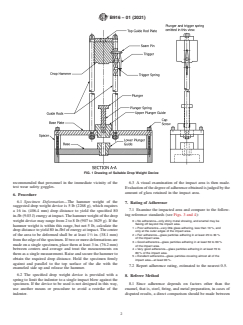
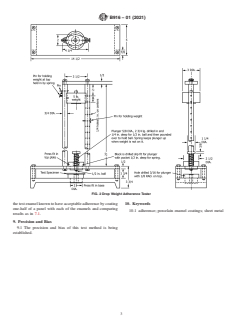
adherence of porcelain enamel to sheet metal; and, 3.1 Drop Weight Deformation Device , see Figs. 1 and 2.
1.1.3 To provide a quantitative adherence rating scale for
3.2 The drop weight deformation device as shown in Fig. 1
comparison to reference standards.
shall impart a single impact blow from a hemispherical
1.2 This adherence test method is applicable to porcelain indenter to a coated specimen supported over a sharp-edged
enamel coatings on substrates from 18 to 24 gauge (0.0478 to
bottomless die. The area of the deformation and the concomi-
0.025 in. or from 1.214 to 0.654 mm). cant damage to the coating is largely influenced by the size of
the hemispherical indenter; the die opening size and edge
1.3 The values stated in inch-pound units are to be regarded
sharpness; and, the energy of the blow at impact.
as standard. The values given in parentheses are mathematical
conversions to SI units that are provided for information only 3.3 A satisfactory degree of deformation and damage are
and are not considered standard. obtained if the conditions in 3.2 use the following parameters:
0.50 in. (12.7 mm) diameter hemispherical indenter, 0.75 in.
1.4 This standard does not purport to address all of the
(19.1 mm) diameter bottomless die (lower plunger guide in
safety concerns, if any, associated with its use. It is the
Fig. 1) with sharp edge, and 80 in./lb (9.03 J) energy at impact.
responsibility of the user of this standard to establish appro-
priate safety, health, and environmental practices and deter-
3.4 Deformation Devices, of other designs may be used
mine the applicability of regulatory limitations prior to use.
provided that the parameters in 3.3 are used.
1.5 This international standard was developed in accor-
3.5 Adherence Reference Standards, see 7.1.
dance with internationally recognized principles on standard-
ization established in the Decision on Principles for the
4. Test Specimens
Development of International Standards, Guides and Recom-
4.1 The test specimens shall be flat enameled panels not less
mendations issued by the World Trade Organization Technical
2 2
in size than 4 in. (101.6 mm ). Larger sizes and shapes may be
Barriers to Trade (TBT) Committee.
used provided that a flat surface can be held firmly against and
parallel to the lower plunger guide during deformation.
2. Significance and Use
2.1 The measurement of adherence in porcelain enamel
5. Safety Precautions
systems, such as ground coat, ground coat/cover coat, and
5.1 During the procedure in 6.1, fine enameled chips may be
released with some force from the steel surface; therefore, it is
This test method is under the jurisdiction ofASTM Committee B08 on Metallic
and Inorganic Coatings and is the direct responsibility of Subcommittee B08.12 on
Materials for Porcelain Enamel and Ceramic-Metal Systems.
Current edition approved Oct. 1, 2021. Published November 2021. Originally A drop weight device that has been found suitable is available from Pacific
approvedin2001.Lastpreviouseditionapprovedin2017asB916 – 01(2017).DOI: Scientific Co., Gardner/Neotech Instrument Div., 2431 Linden Lane, Silver Spring,
10.1520/B0916-01R21. MD 20910.
Copyright © ASTM International, 100 Barr Harbor Drive, PO Box C700, West Conshohocken, PA 19428-2959. United States
----------------
...