

ASTM B234-17
(Specification)Standard Specification for Aluminum and Aluminum-Alloy Drawn Seamless Tubes for Surface Condensers, Evaporators, and Heat Exchangers
General Information
- Abstract
ABSTRACT
This specification covers drawn seamless aluminum-alloy tube of specified tensile properties for use in surface condensers, evaporators, and heat exchangers. The tube shall be produced by drawing an extruded tube made from hollow extrusion ingot (cast in hollow form or pierced) and extruded by use of the die and mandrel method. The tube shall be subjected to tension, leak, and expansion tests.
SCOPE
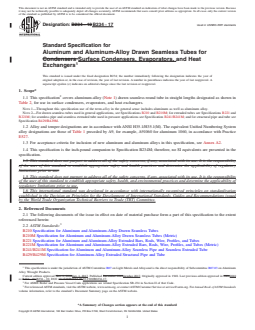
1.1 This specification2 covers aluminum-alloy (Note 1) drawn seamless round tube in straight lengths designated as shown in Table 2, for use in surface condensers, evaporators, and heat exchangers.
Note 1: Throughout this specification use of the term alloy in the general sense includes aluminum as well as aluminum alloy.
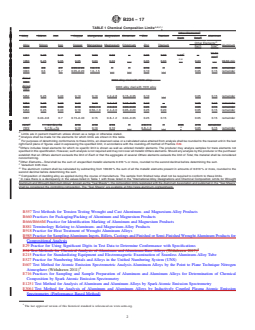
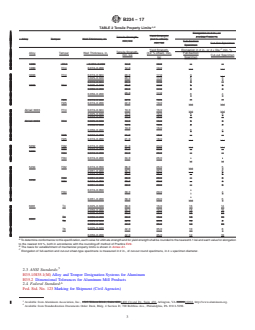
Note 2: For drawn seamless tubes used in general applications, see Specifications B210 and B210M; for extruded tubes see Specifications B221 and B221M; for seamless pipe and seamless extruded tube used in pressure applications see Specification B241/B241M; and for structural pipe and tube see Specification B429/B429M. (A) Limits are in percent maximum unless shown as a range or otherwise stated.(B) Analysis shall be made for the elements for which limits are shown in this table.(C) For purposes of determining conformance to these limits, an observed value or a calculated value attained from analysis shall be rounded to the nearest unit in the last right-hand place of figures used in expressing the specified limit, in accordance with the rounding-off method of Practice E29.(D) Others includes listed elements for which no specific limit is shown as well as unlisted metallic elements. The producer may analyze samples for trace elements not specified in this specification. However, such analysis is not required and may not cover all metallic Others elements. Should any analysis by the producer or the purchaser establish that an Others element exceeds the limit of Each or that the aggregate of several Others elements exceeds the limit of Total, the material shall be considered nonconforming.(E) Other Elements—Total shall be the sum of unspecified metallic elements 0.010 % or more, rounded to the second decimal before determining the sum.(F) Vanadium 0.05 max.(G) The aluminum content shall be calculated by subtracting from 100.00 % the sum of all the metallic elements present in amounts of 0.010 % or more, rounded to the second decimal before determining the sum.(H) Composition of cladding alloy as applied during the course of manufacture. The sample from finished tube shall not be required to conform to these limits.(I) In case there is a discrepancy in the values listed in Table 1 with those listed in the “International Alloy Designations and Chemical Composition Limits for Wrought Aluminum and Wrought Aluminum Alloys” (known as the “Teal Sheets”), the composition limits registered with the Aluminum Association and published in the “Teal Sheets” shall be considered the controlling composition. The “Teal Sheets” are available at http://www.aluminum.org/tealsheets. (A) To determine conformance to this specification, each value for ultimate strength and for yield strength shall be rounded to the nearest 0.1 ksi and each value for elongation to the nearest 0.5 %, both in accordance with the rounding-off method of Practice E29.(B) The basis for establishment of mechanical property limits is shown in Annex A1.(C) Elongation of full-section and cut-out sheet-type specimens is measured in 2 in., of cut-out round specimens, in 4 × specimen diameter.
1.2 Alloy and temper designations are in accordance with ANSI H35.1/H35.1(M). The equivalent Unified Numbering System alloy designations are those of Table 1 preceded by A9, for example, A91060 for aluminum 1060, in accordance with Practice E527.
1.3 For acceptance criteria for inclusion of new aluminum and aluminum alloys in this specification, see Annex A2.
1.4 This specification is the inch-pound companion to Specification B234M; ther...
- Status
- Published
- Publication Date
- 30-Sep-2017
- Technical Committee
- B07 - Light Metals and Alloys
- Drafting Committee
- B07.03 - Aluminum Alloy Wrought Products
Buy Documents
ASTM B234-17 - Standard Specification for Aluminum and Aluminum-Alloy Drawn Seamless Tubes for Surface Condensers, Evaporators, and Heat Exchangers
REDLINE ASTM B234-17 - Standard Specification for Aluminum and Aluminum-Alloy Drawn Seamless Tubes for Surface Condensers, Evaporators, and Heat Exchangers
Overview
ASTM B234-17, published by ASTM International, specifies the requirements for aluminum and aluminum-alloy drawn seamless tubes designed for use in surface condensers, evaporators, and heat exchangers. This standard covers round tubes in straight lengths with specified tensile properties, produced by drawing extruded tube material made from hollow extrusion ingots using the die and mandrel method. The standard ensures that the tubes meet strict chemical composition, mechanical property, and quality assurance requirements, making them suitable for demanding heat transfer applications.
Key Topics
- Material Requirements: Covers a range of aluminum and aluminum-alloy grades, including pure and alloyed materials, with chemical composition limits following internationally recognized systems (ANSI H35.1/H35.1(M)).
- Mechanical Properties: Specifies minimum tensile and yield strengths, and elongation requirements according to tube alloy and temper, with clear testing provisions to ensure reliability in service.
- Manufacturing Process: Tubes are drawn from extruded, hollow aluminum ingots, using the die and mandrel method for optimal strength, dimensional control, and integrity.
- Testing and Inspection:
- Tension Testing: Required to verify mechanical properties.
- Leak Testing: Tubes undergo air pressure or eddy current methods to detect leaks, ensuring tube integrity for fluid handling.
- Expansion Test: Ensures the material can withstand forming and flaring operations without cracking or rupturing.
- Cladding Specifications: Alclad tubes with corrosion-resistant layers can be required for enhanced performance in corrosive environments.
- Dimensional Tolerances: Requires conformance to dimensional tolerances in wall thickness, diameter, length, and straightness per ANSI H35.2.
- Ordering Information: Details requirements for specifying alloy, temper, size, quantity, and any special conditions such as heat treatment or quality documentation.
Applications
The ASTM B234-17 standard is widely used in industries that require high-performance tubing for heat transfer systems, including:
- Power Generation: Used in surface condensers to maximize heat transfer efficiency and longevity.
- HVAC and Refrigeration: Ideal for evaporators and condensers due to aluminum’s excellent thermal conductivity.
- Petrochemical Processing: Suitable for corrosive environments where equipment reliability is critical.
- Industrial Heat Exchangers: Preferred for applications requiring seamless, high-strength, corrosion-resistant tubing.
The standard's focus on quality assurance, mechanical strength, and chemical resistance makes it an essential specification for manufacturers and engineers designing systems where fluid-to-fluid or fluid-to-air heat exchange is vital.
Related Standards
Several other ASTM specifications are closely related to ASTM B234-17 and may be referenced for broader or alternate applications:
- ASTM B210 / B210M: Drawn seamless tubes for general applications.
- ASTM B221 / B221M: Extruded bars, rods, wire, profiles, and tubes.
- ASTM B241/B241M: Seamless pipe and seamless extruded tube for pressure applications.
- ASTM B429/B429M: Structural aluminum-alloy extruded pipe and tube.
- ANSI H35.1/H35.1(M): Designation systems for alloys and tempers.
- AMS 2772: Heat treatment of aluminum alloy raw materials.
- EN 14242: Chemical analysis of aluminum alloys.
These standards collectively form the basis for specifying and sourcing aluminum tubing in a wide variety of industrial and engineering applications, and ensure compatibility and quality across international supply chains.
Keywords: ASTM B234-17, aluminum drawn seamless tube, aluminum-alloy heat exchanger tube, surface condenser tube, evaporator tube standard, aluminum tube mechanical properties, seamless aluminum tube specification, heat exchanger industry standards
Relations
- Effective Date
- 01-Oct-2017
- Effective Date
- 01-Nov-2023
- Effective Date
- 01-Oct-2017
- Effective Date
- 15-Sep-2017
- Effective Date
- 15-Jan-2017
- Effective Date
- 01-Nov-2016
- Effective Date
- 15-May-2014
- Effective Date
- 01-Apr-2013
- Effective Date
- 01-Dec-2012
- Effective Date
- 15-Nov-2012
- Effective Date
- 15-Nov-2012
- Effective Date
- 01-Nov-2012
- Effective Date
- 01-Nov-2012
- Effective Date
- 15-May-2012
- Effective Date
- 15-May-2012
Buy Documents
ASTM B234-17 - Standard Specification for Aluminum and Aluminum-Alloy Drawn Seamless Tubes for Surface Condensers, Evaporators, and Heat Exchangers
REDLINE ASTM B234-17 - Standard Specification for Aluminum and Aluminum-Alloy Drawn Seamless Tubes for Surface Condensers, Evaporators, and Heat Exchangers
Get Certified
Connect with accredited certification bodies for this standard

Element Materials Technology
Materials testing and product certification.

Inštitut za kovinske materiale in tehnologije
Institute of Metals and Technology. Materials testing, metallurgical analysis, NDT.
Sponsored listings
Frequently Asked Questions
ASTM B234-17 is a technical specification published by ASTM International. Its full title is "Standard Specification for Aluminum and Aluminum-Alloy Drawn Seamless Tubes for Surface Condensers, Evaporators, and Heat Exchangers". This standard covers: ABSTRACT This specification covers drawn seamless aluminum-alloy tube of specified tensile properties for use in surface condensers, evaporators, and heat exchangers. The tube shall be produced by drawing an extruded tube made from hollow extrusion ingot (cast in hollow form or pierced) and extruded by use of the die and mandrel method. The tube shall be subjected to tension, leak, and expansion tests. SCOPE 1.1 This specification2 covers aluminum-alloy (Note 1) drawn seamless round tube in straight lengths designated as shown in Table 2, for use in surface condensers, evaporators, and heat exchangers. Note 1: Throughout this specification use of the term alloy in the general sense includes aluminum as well as aluminum alloy. Note 2: For drawn seamless tubes used in general applications, see Specifications B210 and B210M; for extruded tubes see Specifications B221 and B221M; for seamless pipe and seamless extruded tube used in pressure applications see Specification B241/B241M; and for structural pipe and tube see Specification B429/B429M. (A) Limits are in percent maximum unless shown as a range or otherwise stated.(B) Analysis shall be made for the elements for which limits are shown in this table.(C) For purposes of determining conformance to these limits, an observed value or a calculated value attained from analysis shall be rounded to the nearest unit in the last right-hand place of figures used in expressing the specified limit, in accordance with the rounding-off method of Practice E29.(D) Others includes listed elements for which no specific limit is shown as well as unlisted metallic elements. The producer may analyze samples for trace elements not specified in this specification. However, such analysis is not required and may not cover all metallic Others elements. Should any analysis by the producer or the purchaser establish that an Others element exceeds the limit of Each or that the aggregate of several Others elements exceeds the limit of Total, the material shall be considered nonconforming.(E) Other Elements—Total shall be the sum of unspecified metallic elements 0.010 % or more, rounded to the second decimal before determining the sum.(F) Vanadium 0.05 max.(G) The aluminum content shall be calculated by subtracting from 100.00 % the sum of all the metallic elements present in amounts of 0.010 % or more, rounded to the second decimal before determining the sum.(H) Composition of cladding alloy as applied during the course of manufacture. The sample from finished tube shall not be required to conform to these limits.(I) In case there is a discrepancy in the values listed in Table 1 with those listed in the “International Alloy Designations and Chemical Composition Limits for Wrought Aluminum and Wrought Aluminum Alloys” (known as the “Teal Sheets”), the composition limits registered with the Aluminum Association and published in the “Teal Sheets” shall be considered the controlling composition. The “Teal Sheets” are available at http://www.aluminum.org/tealsheets. (A) To determine conformance to this specification, each value for ultimate strength and for yield strength shall be rounded to the nearest 0.1 ksi and each value for elongation to the nearest 0.5 %, both in accordance with the rounding-off method of Practice E29.(B) The basis for establishment of mechanical property limits is shown in Annex A1.(C) Elongation of full-section and cut-out sheet-type specimens is measured in 2 in., of cut-out round specimens, in 4 × specimen diameter. 1.2 Alloy and temper designations are in accordance with ANSI H35.1/H35.1(M). The equivalent Unified Numbering System alloy designations are those of Table 1 preceded by A9, for example, A91060 for aluminum 1060, in accordance with Practice E527. 1.3 For acceptance criteria for inclusion of new aluminum and aluminum alloys in this specification, see Annex A2. 1.4 This specification is the inch-pound companion to Specification B234M; ther...
ABSTRACT This specification covers drawn seamless aluminum-alloy tube of specified tensile properties for use in surface condensers, evaporators, and heat exchangers. The tube shall be produced by drawing an extruded tube made from hollow extrusion ingot (cast in hollow form or pierced) and extruded by use of the die and mandrel method. The tube shall be subjected to tension, leak, and expansion tests. SCOPE 1.1 This specification2 covers aluminum-alloy (Note 1) drawn seamless round tube in straight lengths designated as shown in Table 2, for use in surface condensers, evaporators, and heat exchangers. Note 1: Throughout this specification use of the term alloy in the general sense includes aluminum as well as aluminum alloy. Note 2: For drawn seamless tubes used in general applications, see Specifications B210 and B210M; for extruded tubes see Specifications B221 and B221M; for seamless pipe and seamless extruded tube used in pressure applications see Specification B241/B241M; and for structural pipe and tube see Specification B429/B429M. (A) Limits are in percent maximum unless shown as a range or otherwise stated.(B) Analysis shall be made for the elements for which limits are shown in this table.(C) For purposes of determining conformance to these limits, an observed value or a calculated value attained from analysis shall be rounded to the nearest unit in the last right-hand place of figures used in expressing the specified limit, in accordance with the rounding-off method of Practice E29.(D) Others includes listed elements for which no specific limit is shown as well as unlisted metallic elements. The producer may analyze samples for trace elements not specified in this specification. However, such analysis is not required and may not cover all metallic Others elements. Should any analysis by the producer or the purchaser establish that an Others element exceeds the limit of Each or that the aggregate of several Others elements exceeds the limit of Total, the material shall be considered nonconforming.(E) Other Elements—Total shall be the sum of unspecified metallic elements 0.010 % or more, rounded to the second decimal before determining the sum.(F) Vanadium 0.05 max.(G) The aluminum content shall be calculated by subtracting from 100.00 % the sum of all the metallic elements present in amounts of 0.010 % or more, rounded to the second decimal before determining the sum.(H) Composition of cladding alloy as applied during the course of manufacture. The sample from finished tube shall not be required to conform to these limits.(I) In case there is a discrepancy in the values listed in Table 1 with those listed in the “International Alloy Designations and Chemical Composition Limits for Wrought Aluminum and Wrought Aluminum Alloys” (known as the “Teal Sheets”), the composition limits registered with the Aluminum Association and published in the “Teal Sheets” shall be considered the controlling composition. The “Teal Sheets” are available at http://www.aluminum.org/tealsheets. (A) To determine conformance to this specification, each value for ultimate strength and for yield strength shall be rounded to the nearest 0.1 ksi and each value for elongation to the nearest 0.5 %, both in accordance with the rounding-off method of Practice E29.(B) The basis for establishment of mechanical property limits is shown in Annex A1.(C) Elongation of full-section and cut-out sheet-type specimens is measured in 2 in., of cut-out round specimens, in 4 × specimen diameter. 1.2 Alloy and temper designations are in accordance with ANSI H35.1/H35.1(M). The equivalent Unified Numbering System alloy designations are those of Table 1 preceded by A9, for example, A91060 for aluminum 1060, in accordance with Practice E527. 1.3 For acceptance criteria for inclusion of new aluminum and aluminum alloys in this specification, see Annex A2. 1.4 This specification is the inch-pound companion to Specification B234M; ther...
ASTM B234-17 is classified under the following ICS (International Classification for Standards) categories: 77.150.10 - Aluminium products. The ICS classification helps identify the subject area and facilitates finding related standards.
ASTM B234-17 has the following relationships with other standards: It is inter standard links to ASTM B234-10, ASTM B660-23, ASTM E1251-17a, ASTM E1251-17, ASTM E3061-17, ASTM B985-12(2016), ASTM B557-14, ASTM B221-13, ASTM B985-12, ASTM B221-12a, ASTM B221M-12a, ASTM B241/B241M-12e1, ASTM B241/B241M-12, ASTM B210M-12, ASTM B210-12. Understanding these relationships helps ensure you are using the most current and applicable version of the standard.
ASTM B234-17 is available in PDF format for immediate download after purchase. The document can be added to your cart and obtained through the secure checkout process. Digital delivery ensures instant access to the complete standard document.
Standards Content (Sample)
This international standard was developed in accordance with internationally recognized principles on standardization established in the Decision on Principles for the
Development of International Standards, Guides and Recommendations issued by the World Trade Organization Technical Barriers to Trade (TBT) Committee.
Designation: B234 −17 Used in USNRC-RDT standards
Standard Specification for
Aluminum and Aluminum-Alloy Drawn Seamless Tubes for
Surface Condensers, Evaporators, and Heat Exchangers
This standard is issued under the fixed designation B234; the number immediately following the designation indicates the year of
original adoption or, in the case of revision, the year of last revision.Anumber in parentheses indicates the year of last reapproval.A
superscript epsilon (´) indicates an editorial change since the last revision or reapproval.
1. Scope* 2. Referenced Documents
1.1 This specification covers aluminum-alloy (Note 1) 2.1 The following documents of the issue in effect on date
drawn seamless round tube in straight lengths designated as of material purchase form a part of this specification to the
shown in Table 2, for use in surface condensers, evaporators, extent referenced herein:
and heat exchangers. 3
2.2 ASTM Standards:
B210Specification for Aluminum and Aluminum-Alloy
NOTE 1—Throughout this specification use of the term alloy in the
general sense includes aluminum as well as aluminum alloy.
Drawn Seamless Tubes
NOTE 2—For drawn seamless tubes used in general applications, see
B210MSpecification for Aluminum and Aluminum-Alloy
Specifications B210 and B210M; for extruded tubes see Specifications
Drawn Seamless Tubes (Metric)
B221 and B221M; for seamless pipe and seamless extruded tube used in
B221Specification forAluminum andAluminum-Alloy Ex-
pressure applications see Specification B241/B241M; and for structural
truded Bars, Rods, Wire, Profiles, and Tubes
pipe and tube see Specification B429/B429M.
B221MSpecification for Aluminum and Aluminum-Alloy
1.2 Alloy and temper designations are in accordance with
Extruded Bars, Rods, Wire, Profiles, and Tubes (Metric)
ANSI H35.1/H35.1(M). The equivalent Unified Numbering
B241/B241MSpecification for Aluminum and Aluminum-
SystemalloydesignationsarethoseofTable1precededbyA9,
Alloy Seamless Pipe and Seamless Extruded Tube
for example, A91060 for aluminum 1060, in accordance with
B429/B429MSpecification for Aluminum-Alloy Extruded
Practice E527.
Structural Pipe and Tube
1.3 For acceptance criteria for inclusion of new aluminum
B557Test Methods for Tension Testing Wrought and Cast
and aluminum alloys in this specification, see Annex A2.
Aluminum- and Magnesium-Alloy Products
B660Practices for Packaging/Packing of Aluminum and
1.4 This specification is the inch-pound companion to
Magnesium Products
Specification B234M; therefore, no SI equivalents are pre-
B666/B666MPractice for Identification Marking of Alumi-
sented in the specification.
num and Magnesium Products
1.5 This standard does not purport to address all of the
B881Terminology Relating toAluminum- and Magnesium-
safety concerns, if any, associated with its use. It is the
Alloy Products
responsibility of the user of this standard to establish appro-
B918Practice for Heat Treatment of Wrought Aluminum
priate safety, health, and environmental practices and deter-
Alloys
mine the applicability of regulatory limitations prior to use.
B985Practice for SamplingAluminum Ingots, Billets, Cast-
1.6 This international standard was developed in accor-
ings and Finished or Semi-Finished Wrought Aluminum
dance with internationally recognized principles on standard-
Products for Compositional Analysis
ization established in the Decision on Principles for the
E29Practice for Using Significant Digits in Test Data to
Development of International Standards, Guides and Recom-
Determine Conformance with Specifications
mendations issued by the World Trade Organization Technical
E215PracticeforStandardizingEquipmentandElectromag-
Barriers to Trade (TBT) Committee.
netic Examination of Seamless Aluminum-Alloy Tube
E527Practice for Numbering Metals and Alloys in the
Unified Numbering System (UNS)
This specification is under the jurisdiction ofASTM Committee B07 on Light
E607Test Method for Atomic Emission Spectrometric
Metals and Alloysand is the direct responsibility of Subcommittee B07.03 on
Aluminum Alloy Wrought Products.
Current edition approved Oct. 1, 2017. Published October 2017. Originally
approved in 1948. Last previous edition approved in 2010 as B234–10. DOI: For referenced ASTM standards, visit the ASTM website, www.astm.org, or
10.1520/B0234-17. contact ASTM Customer Service at service@astm.org. For Annual Book of ASTM
For ASME Boiler and Pressure Vessel Code applications see related Specifi- Standards volume information, refer to the standard’s Document Summary page on
cation SB-234 in Section II of that Code. the ASTM website.
*A Summary of Changes section appears at the end of this standard
Copyright © ASTM International, 100 Barr Harbor Drive, PO Box C700, West Conshohocken, PA 19428-2959. United States
B234 − 17
A,B,C,I
TABLE 1 Chemical Composition Limits
D
Other Elements
Alloy Silicon Iron Copper Manganese Magnesium Chromium Zinc Titanium Aluminum
E
Each Total
F,G
1060 0.25 0.35 0.05 0.03 0.03 . . . 0.05 0.03 0.03 . . . 99.60 min
3003 0.6 0.7 0.05–0.20 1.0–1.5 . . . . . . 0.10 . . . 0.05 0.15 remainder
Alclad
3003 alloy clad with 7072 alloy
5052 0.25 0.40 0.10 0.10 2.2–2.8 0.15–0.35 0.10 . . . 0.05 0.15 remainder
5454 0.25 0.40 0.10 0.50–1.0 2.4–3.0 0.05–0.20 0.25 0.20 0.05 0.15 remainder
6061 0.40–0.8 0.7 0.15–0.40 0.15 0.8–1.2 0.04–0.35 0.25 0.15 0.05 0.15 remainder
H
7072 0.7 Si + Fe 0.10 0.10 0.10 . . . 0.8–1.3 . . . 0.05 0.15 remainder
A
Limits are in percent maximum unless shown as a range or otherwise stated.
B
Analysis shall be made for the elements for which limits are shown in this table.
C
For purposes of determining conformance to these limits, an observed value or a calculated value attained from analysis shall be rounded to the nearest unit in the last
right-hand place of figures used in expressing the specified limit, in accordance with the rounding-off method of Practice E29.
D
Others includes listed elements for which no specific limit is shown as well as unlisted metallic elements. The producer may analyze samples for trace elements not
specified in this specification. However, such analysis is not required and may not cover all metallicOthers elements. Should any analysis by the producer or the purchaser
establish that an Others element exceeds the limit of Each or that the aggregate of several Others elements exceeds the limit of Total, the material shall be considered
nonconforming.
E
Other Elements—Total shall be the sum of unspecified metallic elements 0.010 % or more, rounded to the second decimal before determining the sum.
F
Vanadium 0.05 max.
G
The aluminum content shall be calculated by subtracting from 100.00 % the sum of all the metallic elements present in amounts of 0.010 % or more, rounded to the
second decimal before determining the sum.
H
Composition of cladding alloy as applied during the course of manufacture. The sample from finished tube shall not be required to conform to these limits.
I
In case there is a discrepancy in the values listed in Table 1 with those listed in the “International Alloy Designations and Chemical Composition Limits for Wrought
Aluminum and Wrought Aluminum Alloys” (known as the “Teal Sheets”), the composition limits registered with the Aluminum Association and published in the “Teal Sheets”
shall be considered the controlling composition. The “Teal Sheets” are available at http://www.aluminum.org/tealsheets.
A,B
TABLE 2 Tensile Property Limits
C
Yield Strength, Elongation in 2 in., or 4 × Dia, min, %
Tensile Strength,
Alloy Temper Wall Thickness, in. (0.2 % offset), min, Full-Section
min, ksi Cut-out Specimen
ksi Specimen
1060 H14 0.010–0.200 12.0 10.0 . . . . . .
3003 H14 0.010–0.024 20.0 17.0 3 . . .
0.025–0.049 20.0 17.0 5 3
0.050–0.200 20.0 17.0 8 4
H25 0.010–0.200 22.0 19.0 . . . . . .
Alclad 3003 H14 0.010–0.024 19.0 16.0 . . . . . .
0.025–0.049 19.0 16.0 5 3
0.050–0.200 19.0 16.0 8 4
H25 0.010–0.200 21.0 18.0 . . . . . .
5052 H32 0.010–0.200 31.0 23.0 . . . . . .
H34 0.010–0.200 34.0 26.0 . . . . . .
5454 H32 0.010–0.050 36.0 26.0 . . . 5
0.051–0.200 36.0 26.0 . . . 8
H34 0.010–0.050 39.0 29.0 . . . 4
0.051–0.200 39.0 29.0 . . . 6
6061 T4 0.025–0.049 30.0 16.0 16 14
0.050–0.200 30.0 16.0 18 16
T6 0.025–0.049 42.0 35.0 10 8
0.050–0.200 42.0 35.0 12 10
A
To determine conformance to this specification, each value for ultimate strength and for yield strength shall be rounded to the nearest 0.1 ksi and each value for elongation
to the nearest 0.5 %, both in accordance with the rounding-off method of Practice E29.
B
The basis for establishment of mechanical property limits is shown in Annex A1.
C
Elongation of full-section and cut-out sheet-type specimens is measured in 2 in., of cut-out round specimens, in 4 × specimen diameter.
B234 − 17
Analysis Aluminum Alloys by the Point to Plane Tech- 4.2 Additionally, orders for material to this specification
nique Nitrogen Atmosphere (Withdrawn 2011) shall include the following information when required by the
E716Practices for Sampling and Sample Preparation of purchaser:
Aluminum and Aluminum Alloys for Determination of 4.2.1 Whether heat treatment in accordance with Practice
Chemical Composition by Spark Atomic Emission Spec- B918 is required (9.2),
trometry 4.2.2 Whether cut ends of tube are to be deburred (Section
E1251Test Method for Analysis of Aluminum and Alumi- 14),
num Alloys by Spark Atomic Emission Spectrometry 4.2.3 Whether inspection or witness of inspection and tests
E3061Test Method for Analysis of Aluminum and Alumi- by the purchaser’s representative is required prior to material
numAlloysbyInductivelyCoupledPlasmaAtomicEmis- shipment (Section 15),
sion Spectrometry (Performance Based Method) 4.2.4 Whether certification of the material is required (Sec-
tion 17),
2.3 ANSI Standards:
4.2.5 Whether marking for identification is required (Sec-
H35.1/H35.1(M)AlloyandTemperDesignationSystemsfor
tion 18), and
Aluminum
4.2.6 WhetherPracticesB660appliesand,ifso,thelevelof
H35.2 DimensionalTolerancesforAluminumMillProducts
preservation, packaging, and packing required (19.3).
2.4 Federal Standard:
Fed. Std. No. 123Marking for Shipment (Civil Agencies)
5. Manufacture
2.5 Military Standard:
5.1 Thetubeshallbeproducedbydrawinganextrudedtube
MIL-STD-129Marking for Shipment and Storage
7 made from hollow extrusion ingot (cast in hollow form or
2.6 AMS Specification:
pierced) and extruded by use of the die and mandrel method.
AMS 2772Heat Treatment of Aluminum Alloy Raw Mate-
rials
6. Responsibility for Quality Assurance
2.7 EN Standard:
6.1 Responsibility for Inspection and Tests—Unless other-
CENEN14242AluminumandAluminumAlloys,Chemical
wisespecifiedinthecontractorpurchaseorder,theproduceris
Analysis, Inductively Coupled Plasma Optical Emission
responsible for the performance of all inspection and test
Spectral Analysis
requirements specified herein. The producer may use his own
or any other suitable facilities for the performance of the
3. Terminology
inspection and test requirements specified herein, unless dis-
3.1 Refer to Terminology B881 for definitions of product
approvedbythepurchaserintheorderoratthetimeofcontract
terms used in this specification.
signing. The purchaser shall have the right to perform any of
3.2 Definitions of Terms Specific to This Standard:
the inspections and tests set forth in this specification where
3.2.1 capable of—the term capable of as used in this
such inspections are deemed necessary to assure that material
specification means that the test need not be performed by the
conforms to prescribed requirements.
producer of the material. However, should testing by the
6.2 Lot Definition—An inspection lot shall be defined as
purchaser establish that the material does not meet these
follows:
requirements, the material shall be subject to rejection.
6.2.1 For heat-treated tempers, an inspection lot shall con-
sist of an identifiable quantity of material of the same mill
4. Ordering Information
form, alloy, temper, and thickness traceable to a heat-treat lot
4.1 Ordersformaterialtothisspecificationshallincludethe
or lots, and subjected to inspection at one time.
following information:
6.2.2 For nonheat-treated tempers, an inspection lot shall
4.1.1 This specification designation (which includes the
consist of an identifiable quantity of material of the same mill
number, the year, and the revision letter, if applicable),
form, alloy, temper, and thickness subjected to inspection at
4.1.2 Quantity in pieces or pounds,
one time.
4.1.3 Alloy (Section 7),
4.1.4 Temper (Section 8), 7. Chemical Composition
4.1.5 Outsideorinsidediameter,wallthickness,andlength,
7.1 Limits—The tube shall conform to the chemical compo-
4.1.6 For alloy Alclad 3003, state clad inside or outside
sition limits in Table 1. Conformance shall be determined by
(12.1).
the producer by taking samples in accordance with E716 when
the ingots are poured and analyzing those samples in accor-
dance with in accordance with Test Methods E607, E1251,
The last approved version of this historical standard is referenced on
E3061, or EN14242. At least one sample shall be taken for
www.astm.org.
Available from Aluminum Association, Inc., 1400 Crystal Dr., Suite 430,
each group of ingots poured simultaneously from the same
Arlington, VA 22202, http://www.aluminum.org.
source of molten metal. If the producer has determined the
AvailablefromStandardizationDocumentsOrderDesk,Bldg.4SectionD,700
chemical composition of the material during the course of
Robbins Ave., Philadelphia, PA 19111-5098.
manufacture,heshallnotberequiredtosampleandanalyzethe
Available from Society of Automotive Engineers (SAE), 400 Commonwealth
Dr., Warrendale, PA 15096-0001.
finished product.
Available from European Committee for Standardization Central Secretariat
(CEN), rue de Stassart 36, B1050 Brussels, Belgium, http: //www.cen.eu/esearch. NOTE 3—It is standard practice in the United States aluminum industry
B234 − 17
to determine conformance to the chemical composition limits prior to
procedures described in Practice E215. Reference standards
further processing of ingots into wrought products. Due to the continuous
described in Annex A1 and Annex A2 shall be used to
nature of the process, it is not practical to keep a specific ingot analysis
standardize the equipment. These same reference standards or
identified with a specific quantity of finished material.
secondary standards having equivalent eddy current response
7.2 If it becomes necessary to analyze the finished or
shall also serve to define acceptance-rejection limits. Tubes
semifinishedproductforconformancetochemicalcomposition
that produce eddy current indications less than those from the
limits, the methods of sampling and methods of analysis shall
2A holes of the applicable reference standard or an equivalent
be as provided in the following:
secondary standard shall be acceptable. Any tube having a
7.2.1 Methods of Sampling—Samples for chemical analysis
discontinuity that produces an eddy current indication equal to
shall be taken in accordance with B985.
or greater than those from the 2A holes of the applicable
7.2.2 Methods of Analysis—Analysis shall be performed in
referencestandardoranequivalentsecondarystandardshallbe
accordance with Test Methods E607, E1251, E3061,orEN
rejected.
14242.
11. Expansion Test
7.3 Other methods of analysis or in the case of dispute may
be by agreement between the producer an
...
This document is not an ASTM standard and is intended only to provide the user of an ASTM standard an indication of what changes have been made to the previous version. Because
it may not be technically possible to adequately depict all changes accurately, ASTM recommends that users consult prior editions as appropriate. In all cases only the current version
of the standard as published by ASTM is to be considered the official document.
Designation: B234 − 10 B234 − 17 Used in USNRC-RDT standards
Standard Specification for
Aluminum and Aluminum-Alloy Drawn Seamless Tubes for
Condensers Surface Condensers, Evaporators, and Heat
Exchangers
This standard is issued under the fixed designation B234; the number immediately following the designation indicates the year of
original adoption or, in the case of revision, the year of last revision. A number in parentheses indicates the year of last reapproval. A
superscript epsilon (´) indicates an editorial change since the last revision or reapproval.
1. Scope*
1.1 This specification covers aluminum-alloy (Note 1) drawn seamless round tube in straight lengths designated as shown in
Table 2, for use in surface condensers, evaporators, and heat exchangers.
NOTE 1—Throughout this specification use of the term alloy in the general sense includes aluminum as well as aluminum alloy.
NOTE 2—For drawn seamless tubes used in general applications, see Specifications B210 and B210M; for extruded tubes see Specifications B221 and
B221M; for seamless pipe and seamless extruded tube used in pressure applications see Specification B241/B241M; and for structural pipe and tube see
Specification B429/B429M.
1.2 Alloy and temper designations are in accordance with ANSI H35.1/H35.1(M). The equivalent Unified Numbering System
alloy designations are those of Table 1 preceded by A9, for example, A91060 for aluminum 1060, in accordance with Practice
E527.
1.3 For acceptance criteria for inclusion of new aluminum and aluminum alloys in this specification, see Annex A2.
1.4 This specification is the inch-pound companion to Specification B234M; therefore, no SI equivalents are presented in the
specification.
1.5 This standard does not purport to address all of the safety concerns, if any, associated with its use. It is the responsibility
of the user of this standard to establish appropriate safety and health practices and determine the applicability of regulatory
limitations prior to use.
1.5 This standard does not purport to address all of the safety concerns, if any, associated with its use. It is the responsibility
of the user of this standard to establish appropriate safety, health, and environmental practices and determine the applicability of
regulatory limitations prior to use.
1.6 This international standard was developed in accordance with internationally recognized principles on standardization
established in the Decision on Principles for the Development of International Standards, Guides and Recommendations issued
by the World Trade Organization Technical Barriers to Trade (TBT) Committee.
2. Referenced Documents
2.1 The following documents of the issue in effect on date of material purchase form a part of this specification to the extent
referenced herein:
2.2 ASTM Standards:
B210 Specification for Aluminum and Aluminum-Alloy Drawn Seamless Tubes
B210M Specification for Aluminum and Aluminum-Alloy Drawn Seamless Tubes (Metric)
B221 Specification for Aluminum and Aluminum-Alloy Extruded Bars, Rods, Wire, Profiles, and Tubes
B221M Specification for Aluminum and Aluminum-Alloy Extruded Bars, Rods, Wire, Profiles, and Tubes (Metric)
B241/B241M Specification for Aluminum and Aluminum-Alloy Seamless Pipe and Seamless Extruded Tube
B429/B429M Specification for Aluminum-Alloy Extruded Structural Pipe and Tube
This specification is under the jurisdiction of ASTM Committee B07 on Light Metals and Alloysand is the direct responsibility of Subcommittee B07.03 on Aluminum
Alloy Wrought Products.
Current edition approved Nov. 1, 2010Oct. 1, 2017. Published December 2010October 2017. Originally approved in 1948. Last previous edition approved in 20042010
as B234 – 04.B234 – 10. DOI: 10.1520/B0234-10.10.1520/B0234-17.
For ASME Boiler and Pressure Vessel Code applications see related Specification SB-234 in Section II of that Code.
For referenced ASTM standards, visit the ASTM website, www.astm.org, or contact ASTM Customer Service at service@astm.org. For Annual Book of ASTM Standards
volume information, refer to the standard’s Document Summary page on the ASTM website.
*A Summary of Changes section appears at the end of this standard
Copyright © ASTM International, 100 Barr Harbor Drive, PO Box C700, West Conshohocken, PA 19428-2959. United States
B234 − 17
A,B,C,I
TABLE 1 Chemical Composition Limits
D
Other Elements
Alloy Silicon Iron Copper Manganese Magnesium Chromium Zinc Titanium Aluminum
E
Each Total
D
Other Elements
Alloy Silicon Iron Copper Manganese Magnesium Chromium Zinc Titanium Aluminum
E
Each Total
99.60
F
1060 0.25 0.35 0.05 0.03 0.03 . 0.05 0.03 0.03 .
G
min
F,G
1060 0.25 0.35 0.05 0.03 0.03 . . . 0.05 0.03 0.03 . . . 99.60 min
3003 0.6 0.7 0.05–0.20 1.0–1.5 . . 0.10 . 0.05 0.15 remainder
3003 0.6 0.7 0.05–0.20 1.0–1.5 . . . . . . 0.10 . . . 0.05 0.15 remainder
Alclad
3003 alloy clad with 7072 alloy
Alclad
3003 alloy clad with 7072 alloy
5052 0.25 0.40 0.10 0.10 2.2–2.8 0.15–0.35 0.10 . . . 0.05 0.15 remainder
5052 0.25 0.40 0.10 0.10 2.2–2.8 0.15–0.35 0.10 . 0.05 0.15 remainder
5454 0.25 0.40 0.10 0.50–1.0 2.4–3.0 0.05–0.20 0.25 0.20 0.05 0.15 remainder
5454 0.25 0.40 0.10 0.50–1.0 2.4–3.0 0.05–0.20 0.25 0.20 0.05 0.15 remainder
6061 0.40–0.8 0.7 0.15–0.40 0.15 0.8–1.2 0.04–0.35 0.25 0.15 0.05 0.15 remainder
H
7072 0.7 Si + Fe 0.10 0.10 0.10 . 0.8–1.3 . 0.05 0.15 remainder
H
7072 0.7 Si + Fe 0.10 0.10 0.10 . . . 0.8–1.3 . . . 0.05 0.15 remainder
A
Limits are in percent maximum unless shown as a range or otherwise stated.
B
Analysis shall be made for the elements for which limits are shown in this table.
C
For purposes of determining conformance to these limits, an observed value or a calculated value attained from analysis shall be rounded to the nearest unit in the last
right-hand place of figures used in expressing the specified limit, in accordance with the rounding-off method of Practice E29.
D
Others includes listed elements for which no specific limit is shown as well as unlisted metallic elements. The producer may analyze samples for trace elements not
specified in this specification. However, such analysis is not required and may not cover all metallic Others elements. Should any analysis by the producer or the purchaser
establish that an Others element exceeds the limit of Each or that the aggregate of several Others elements exceeds the limit of Total, the material shall be considered
nonconforming.
E
Other Elements—Total shall be the sum of unspecified metallic elements 0.010 % or more, rounded to the second decimal before determining the sum.
F
Vanadium 0.05 max.
G
The aluminum content shall be calculated by subtracting from 100.00 % the sum of all the metallic elements present in amounts of 0.010 % or more, rounded to the
second decimal before determining the sum.
H
Composition of cladding alloy as applied during the course of manufacture. The sample from finished tube shall not be required to conform to these limits.
I
In case there is a discrepancy in the values listed in Table 1 with those listed in the “International Alloy Designations and Chemical Composition Limits for Wrought
Aluminum and Wrought Aluminum Alloys” (known as the “Teal Sheets”), the composition limits registered with the Aluminum Association and published in the “Teal Sheets”
shall be considered the controlling composition. The “Teal Sheets” are available at http://www.aluminum.org/tealsheets.
B557 Test Methods for Tension Testing Wrought and Cast Aluminum- and Magnesium-Alloy Products
B660 Practices for Packaging/Packing of Aluminum and Magnesium Products
B666/B666M Practice for Identification Marking of Aluminum and Magnesium Products
B881 Terminology Relating to Aluminum- and Magnesium-Alloy Products
B918 Practice for Heat Treatment of Wrought Aluminum Alloys
B985 Practice for Sampling Aluminum Ingots, Billets, Castings and Finished or Semi-Finished Wrought Aluminum Products for
Compositional Analysis
E29 Practice for Using Significant Digits in Test Data to Determine Conformance with Specifications
E34 Test Methods for Chemical Analysis of Aluminum and Aluminum-Base Alloys (Withdrawn 2017)
E215 Practice for Standardizing Equipment and Electromagnetic Examination of Seamless Aluminum-Alloy Tube
E527 Practice for Numbering Metals and Alloys in the Unified Numbering System (UNS)
E607 Test Method for Atomic Emission Spectrometric Analysis Aluminum Alloys by the Point to Plane Technique Nitrogen
Atmosphere (Withdrawn 2011)
E716 Practices for Sampling and Sample Preparation of Aluminum and Aluminum Alloys for Determination of Chemical
Composition by Spark Atomic Emission Spectrometry
E1251 Test Method for Analysis of Aluminum and Aluminum Alloys by Spark Atomic Emission Spectrometry
E3061 Test Method for Analysis of Aluminum and Aluminum Alloys by Inductively Coupled Plasma Atomic Emission
Spectrometry (Performance Based Method)
The last approved version of this historical standard is referenced on www.astm.org.
B234 − 17
A,B
TABLE 2 Tensile Property Limits
Elongation in 2 in., or
Yield Strength, C
4 × Dia, min, %
Tensile Strength,
Alloy Temper Wall Thickness, in. (0.2 % offset),
min, ksi
Full-Section
min, ksi
Cut-Out Specimen
Specimen
C
Yield Strength, Elongation in 2 in., or 4 × Dia, min, %
Tensile Strength,
Alloy Temper Wall Thickness, in. (0.2 % offset), min, Full-Section
min, ksi Cut-out Specimen
ksi Specimen
1060 H14 0.010–0.200 12.0 10.0 . .
1060 H14 0.010–0.200 12.0 10.0 . . . . . .
3003 H14 0.010–0.024 20.0 17.0 3 . . .
0.025–0.049 20.0 17.0 5 3
0.010–0.024 20.0 17.0 3 .
3003 H14 0.025–0.049 20.0 17.0 5 3
0.050–0.200 20.0 17.0 8 4
20.0 17.0
0.050–0.200 8 4
H25 0.010–0.200 22.0 19.0 . .
H25 0.010–0.200 22.0 19.0 . . . . . .
Alclad 3003 H14 0.010–0.024 19.0 16.0 . . . . . .
0.025–0.049 19.0 16.0 5 3
0.010–0.024 19.0 16.0 . .
Alclad 3003 H14 0.025–0.049 19.0 16.0 5 3
0.050–0.200 19.0 16.0 8 4
19.0 16.0
0.050–0.200 8 4
H25 0.010–0.200 21.0 18.0 . .
H25 0.010–0.200 21.0 18.0 . . . . . .
5052 H32 0.010–0.200 31.0 23.0 . . . . . .
H32 0.010–0.200 31.0 23.0 . .
H34 0.010–0.200 34.0 26.0 . .
. .
H34 0.010–0.200 34.0 26.0
. . . .
5454 H32 0.010–0.050 36.0 26.0 . . . 5
0.051–0.200 36.0 26.0 . . . 8
0.010–0.050 36.0 26.0 . 5
H32 0.051–0.200 36.0 26.0 . 8
H34 0.010–0.050 39.0 29.0 . 4
0.051–0.200 39.0 29.0 . 6
.
0.010–0.050
H34 39.0 29.0 . 4
.
0.051–0.200 39.0 29.0 . . . 6
6061 T4 0.025–0.049 30.0 16.0 16 14
0.050–0.200 30.0 16.0 18 16
0.025–0.049 30.0 16.0 16 14
T4 0.050–0.200 30.0 16.0 18 16
T6 0.025–0.049 42.0 35.0 10 8
0.050–0.200 42.0 35.0 12 10
0.025–0.049
T6 42.0 35.0 10 8
0.050–0.200 42.0 35.0 12 10
A
To determine conformance to this specification, each value for ultimate strength and for yield strength shall be rounded to the nearest 0.1 ksi and each value for elongation
to the nearest 0.5 %, both in accordance with the rounding-off method of Practice E29.
B
The basis for establishment of mechanical property limits is shown in Annex A1.
C
Elongation of full-section and cut-out sheet-type specimens is measured in 2 in., of cut-out round specimens, in 4 × specimen diameter.
2.3 ANSI Standards:
H35.1/H35.1(M) Alloy and Temper Designation Systems for Aluminum
H35.2 Dimensional Tolerances for Aluminum Mill Products
2.4 Federal Standard:
Fed. Std. No. 123 Marking for Shipment (Civil Agencies)
Available from Aluminum Association, Inc., 1525 Wilson Blvd., Suite 600,1400 Crystal Dr., Suite 430, Arlington, VA 22209,22202, http://www.aluminum.org.
Available from Standardization Documents Order Desk, Bldg. 4 Section D, 700 Robbins Ave., Philadelphia, PA 19111-5098.
B234 − 17
2.5 Military Standard:
MIL-STD-129 Marking for Shipment and Storage
2.6 AMS Specification:
AMS 2772 Heat Treatment of Aluminum Alloy Raw Materials
2.7 EN Standard:
CEN EN 14242 Aluminum and Aluminum Alloys, Chemical Analysis, Inductively Coupled Plasma Optical Emission Spectral
Analysis
3. Terminology
3.1 Refer to Terminology B881 for definitions of product terms used in this specification.
3.2 Definitions of Terms Specific to This Standard:
3.2.1 capable of—the term capable of as used in this specification means that the test need not be performed by the producer
of the material. However, should testing by the purchaser establish that the material does not meet these requirements, the material
shall be subject to rejection.
4. Ordering Information
4.1 Orders for material to this specification shall include the following information:
4.1.1 This specification designation (which includes the number, the year, and the revision letter, if applicable),
4.1.2 Quantity in pieces or pounds,
4.1.3 Alloy (Section 7),
4.1.4 Temper (Section 8),
4.1.5 Outside or inside diameter, wall thickness, and length,
4.1.6 For alloy Alclad 3003, state clad inside or outside (12.1).
4.2 Additionally, orders for material to this specification shall include the following information when required by the
purchaser:
4.2.1 Whether heat treatment in accordance with Practice B918 is required (9.2),
4.2.2 Whether cut ends of tube are to be deburred (Section 14),
4.2.3 Whether inspection or witness of inspection and tests by the purchaser’s representative is required prior to material
shipment (Section 15),
4.2.4 Whether certification of the material is required (Section 17),
4.2.5 Whether marking for identification is required (Section 18), and
4.2.6 Whether Practices B660 applies and, if so, the level of preservation, packaging, and packing required (19.3).
5. Manufacture
5.1 The tube shall be produced by drawing an extruded tube made from hollow extrusion ingot (cast in hollow form or pierced)
and extruded by use of the die and mandrel method.
6. Responsibility for Quality Assurance
6.1 Responsibility for Inspection and Tests—Unless otherwise specified in the contract or purchase order, the producer is
responsible for the performance of all inspection and test requirements specified herein. The producer may use his own or any other
suitable facilities for the performance of the inspection and test requirements specified herein, unless disapproved by the purchaser
in the order or at the time of contract signing. The purchaser shall have the right to perform any of the inspections and tests set
forth in this specification where such inspections are deemed necessary to assure that material conforms to prescribed requirements.
6.2 Lot Definition—An inspection lot shall be defined as follows:
6.2.1 For heat-treated tempers, an inspection lot shall consist of an identifiable quantity of material of the same mill form, alloy,
temper, and thickness traceable to a heat-treat lot or lots, and subjected to inspection at one time.
6.2.2 For nonheat-treated tempers, an inspection lot shall consist of an identifiable quantity of material of the same mill form,
alloy, temper, and thickness subjected to inspection at one time.
7. Chemical Composition
7.1 Limits—The tube shall conform to the chemical composition limits in Table 1. Conformance shall be determined by the
producer by analyzing samples taken at the timetaking samples in accordance with E716 the ingots are poured in accordance with
when the ingots are poured E716and analyzed analyzing those samples in accordance with in accordance with Test Methods E607,
E1251, E34E3061, or EN 14242. At least one sample shall be taken for each group of ingots poured simultaneously from the same
Available from Society of Automotive Engineers (SAE), 400 Commonwealth Dr., Warrendale, PA 15096-0001.
Available from European Committee for Standardization Central Secretariat (CEN), rue de Stassart 36, B1050 Brussels, Belgium, http: //www.cen.eu/esearch.
B234 − 17
source of molten metal. If the producer has determined the chemical composition of the material during the course of manufacture,
he shall not be required to sample and analyze the finished product.
NOTE 3—It is standard practice in the United States aluminum industry to determine conformance to the chemical composition limits prior to further
processing of ingots into wrought products. Due to the continuous nature of the process, it is not practical to keep a specific ingot analysis identified with
a specific quantity of finished material.
7.2 If it becomes necessary to analyze the finished or semifinished product for conformance to chemical composition limits, the
method used to sample the finished or semifinished product for the determination of chemical composition methods of sampling
and methods of analysis shall be as agreed between the buyer and seller. Analysis shall be performed in accordance with provided
in the following:E716, E607, E1251, E34, or EN 14242 (ICP method). The number of samples shall be as follows:
7.2.1 Methods of Sampling—When samples are taken from the finished or semifinished product, a sample Samples for chemical
analysis shall be taken to represent each 4000 lb or fraction thereof, of materal in the lot,in accordance with B985except that not
more than one sample shall be required per piece.
7.2.2 Methods of Analysis—Other methods of analysis, in the case of dispute,Analysis shall be performed in accordance with
Test Methods E607may, E1251be, E3061used by agreement between the producer and purchaser., or EN 14242.
NOTE 4—It is difficult to obtain a reliable analysis of each of the components of clad materials using
...