

ASTM F2575-23e2
(Practice)Standard Practice for Language Translation
General Information
- Abstract
SIGNIFICANCE AND USE
4.1 This practice is intended to apply to all translation projects regardless of the translation service provider selected (see Section 7). This practice does not apply to spoken or signed interpreting services. For interpreting, please consult Practice F2089, Practice for Language Interpreting.
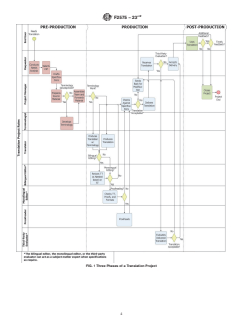
4.2 Every translation project consists of three phases: pre-production, production, and post-production (see Section 6). Needs and requirements vary from project to project, hence not all roles listed in the swim lane diagram provided in Section 6 or all of the processes outlined in Sections 9 and 10 will be required necessarily in every project. Requesters should conduct a Needs Analysis (see Section 5) to determine what type of translation is needed and to select a translation grade.
4.3 A translation project applying this practice shall develop specifications according to Section 8 in the pre-production phase, follow those specifications during the production phase, and evaluate the translation project according to those specifications in the post-production phase.
4.4 The process of translation begins with source content in one language and results in the creation of a target text in another language. The aim of the process is to produce a target text (called the translation) that corresponds to the source content, according to specifications agreed upon in advance following the steps provided in Section 8.
4.5 This practice provides a list of parameters in Section 8 that shall be addressed and documented in writing to obtain a set of specifications used to create and evaluate the translation. Specifications are defined in terms of the purpose of the translation and the needs and expectations of the requester and end user. There can be many correct translations, depending on the specifications defined for a given product and the choices made by the translation service provider.
SCOPE
1.1 This practice addresses only language translation and excludes language interpreting. (See Practice F2089, Practice for Language Interpreting.)
1.2 This practice identifies factors relevant to each phase of a translation project (pre-production, production, and post-production). It is intended for use by all stakeholders who may have varying levels of knowledge in the field of translation.
1.3 This practice is designed to provide a framework for agreement on specifications for translation projects that will meet the needs and expectations of the end user.
1.4 This practice addresses the processes involved in professional translation services and does not provide specific translation quality metrics.
1.5 This practice covers various types of translation, including conventional translation and translation in localization and transcreation (see Section 3).
1.6 This international standard was developed in accordance with internationally recognized principles on standardization established in the Decision on Principles for the Development of International Standards, Guides and Recommendations issued by the World Trade Organization Technical Barriers to Trade (TBT) Committee.
- Status
- Published
- Publication Date
- 31-Dec-2022
- Technical Committee
- F43 - Language Services and Products
- Drafting Committee
- F43.03 - Language Translation
Overview
ASTM F2575-23e2: Standard Practice for Language Translation provides a comprehensive framework for performing written language translation, offering guidance suitable for all translation projects regardless of the provider selected. Developed by ASTM International in line with globally recognized standardization principles, this document outlines factors relevant to each phase of a translation project, from pre-production through post-production. The standard is designed to align the needs and expectations of end users through clear specification, and is intended for use by a diverse audience-including requesters, translation service providers, translators, editors, and other stakeholders in language services. It strictly addresses written language translation and does not cover spoken or signed interpreting (see ASTM Practice F2089 for interpreting).
Key Topics
- Translation Project Phases: The standard divides projects into pre-production, production, and post-production phases. Each phase involves distinct roles, tasks, and deliverables.
- Needs Analysis: Early in the process, requesters conduct a needs analysis to determine the purpose, audience, subject field, and minimum required translation grade (high, medium, or low). This step also includes risk assessment regarding translation errors or confidentiality.
- Specification Agreement: Clear, written specifications are essential prior to commencing the actual translation. Specifications are based on the needs analysis and outline requirements such as language, locale, audience, text type, terminology, formatting, and deliverables.
- Team Roles and Competencies: The standard identifies essential roles, including translators, bilingual or monolingual editors, proofreaders, subject matter experts, and third-party evaluators. Criteria for selecting skilled providers cover language proficiency, subject matter expertise, and technological competence.
- Type of Translations: ASTM F2575 covers various translation types: conventional translation, localization (adaptation for different geographic or cultural contexts), and transcreation (creative adaptation, common in marketing).
- Process Parameters: The practice provides practical guidance on steps such as glossary and terminology management, use of reference materials, file preparation, appropriate software tools, and style guides.
- Confidentiality and Security: The standard highlights considerations for data security, confidentiality agreements, and worksite or transmission security, especially for sensitive projects.
- Output Formats and Delivery: Guidance is provided for specifying output formats (e.g., Word, HTML, InDesign), delivery methods, and deadlines.
Applications
ASTM F2575-23e2 is widely applicable across industries where accurate, reliable written translation is critical, such as:
- Legal: For contracts, litigation materials, and compliance documents requiring precise correspondence to the source.
- Technical and Scientific: For manuals, patents, user guides, and scientific papers targeting specialized audiences.
- Healthcare: Ensures clarity and correctness in patient information, consent forms, and medical records.
- Business and Finance: For annual reports, financial statements, and internal communications.
- Marketing and Localization: Supports website, application, and advertising content tailored for diverse cultural and regional audiences, ensuring both accuracy and cultural resonance.
- Government and Public Sector: For policy documents, public notices, and regulatory compliance materials.
Organizations benefit from the standard by enhancing quality, mitigating risks, supporting proper vendor selection, and establishing clear project expectations and deliverables.
Related Standards
When implementing ASTM F2575-23e2, consider referencing the following complementary standards:
- ASTM F2089 - Practice for Language Interpreting (for spoken or signed communication requirements)
- ASTM F3130 - Practice for Language Service Companies (guidance on organizational best practices)
- ISO 1087:2019 - Terminology Work and Terminology Science (for glossary and termbase development)
- ISO/IEC 17024:2012 - Conformity Assessment - General Requirements for Certification of Persons (relevant to certification of translators and language professionals)
Together, these standards promote consistency, reliability, and best practices in language services, supporting effective international and cross-cultural communication.
For more guidance, visit ASTM International or consult with language services professionals certified under recognized industry principles.
Relations
- Effective Date
- 01-Jan-2023
- Effective Date
- 15-Mar-2015
- Effective Date
- 01-Jan-2023
- Effective Date
- 01-Jan-2023
Get Certified
Connect with accredited certification bodies for this standard

Great Wall Tianjin Quality Assurance Center
Established 1993, first batch to receive national accreditation with IAF recognition.
Hong Kong Quality Assurance Agency (HKQAA)
Hong Kong's leading certification body.

Innovative Quality Certifications Pvt. Ltd. (IQCPL)
Known for integrity, providing ethical & impartial Assessment & Certification. CMMI Institute Partner.
Sponsored listings
Frequently Asked Questions
ASTM F2575-23e2 is a standard published by ASTM International. Its full title is "Standard Practice for Language Translation". This standard covers: SIGNIFICANCE AND USE 4.1 This practice is intended to apply to all translation projects regardless of the translation service provider selected (see Section 7). This practice does not apply to spoken or signed interpreting services. For interpreting, please consult Practice F2089, Practice for Language Interpreting. 4.2 Every translation project consists of three phases: pre-production, production, and post-production (see Section 6). Needs and requirements vary from project to project, hence not all roles listed in the swim lane diagram provided in Section 6 or all of the processes outlined in Sections 9 and 10 will be required necessarily in every project. Requesters should conduct a Needs Analysis (see Section 5) to determine what type of translation is needed and to select a translation grade. 4.3 A translation project applying this practice shall develop specifications according to Section 8 in the pre-production phase, follow those specifications during the production phase, and evaluate the translation project according to those specifications in the post-production phase. 4.4 The process of translation begins with source content in one language and results in the creation of a target text in another language. The aim of the process is to produce a target text (called the translation) that corresponds to the source content, according to specifications agreed upon in advance following the steps provided in Section 8. 4.5 This practice provides a list of parameters in Section 8 that shall be addressed and documented in writing to obtain a set of specifications used to create and evaluate the translation. Specifications are defined in terms of the purpose of the translation and the needs and expectations of the requester and end user. There can be many correct translations, depending on the specifications defined for a given product and the choices made by the translation service provider. SCOPE 1.1 This practice addresses only language translation and excludes language interpreting. (See Practice F2089, Practice for Language Interpreting.) 1.2 This practice identifies factors relevant to each phase of a translation project (pre-production, production, and post-production). It is intended for use by all stakeholders who may have varying levels of knowledge in the field of translation. 1.3 This practice is designed to provide a framework for agreement on specifications for translation projects that will meet the needs and expectations of the end user. 1.4 This practice addresses the processes involved in professional translation services and does not provide specific translation quality metrics. 1.5 This practice covers various types of translation, including conventional translation and translation in localization and transcreation (see Section 3). 1.6 This international standard was developed in accordance with internationally recognized principles on standardization established in the Decision on Principles for the Development of International Standards, Guides and Recommendations issued by the World Trade Organization Technical Barriers to Trade (TBT) Committee.
SIGNIFICANCE AND USE 4.1 This practice is intended to apply to all translation projects regardless of the translation service provider selected (see Section 7). This practice does not apply to spoken or signed interpreting services. For interpreting, please consult Practice F2089, Practice for Language Interpreting. 4.2 Every translation project consists of three phases: pre-production, production, and post-production (see Section 6). Needs and requirements vary from project to project, hence not all roles listed in the swim lane diagram provided in Section 6 or all of the processes outlined in Sections 9 and 10 will be required necessarily in every project. Requesters should conduct a Needs Analysis (see Section 5) to determine what type of translation is needed and to select a translation grade. 4.3 A translation project applying this practice shall develop specifications according to Section 8 in the pre-production phase, follow those specifications during the production phase, and evaluate the translation project according to those specifications in the post-production phase. 4.4 The process of translation begins with source content in one language and results in the creation of a target text in another language. The aim of the process is to produce a target text (called the translation) that corresponds to the source content, according to specifications agreed upon in advance following the steps provided in Section 8. 4.5 This practice provides a list of parameters in Section 8 that shall be addressed and documented in writing to obtain a set of specifications used to create and evaluate the translation. Specifications are defined in terms of the purpose of the translation and the needs and expectations of the requester and end user. There can be many correct translations, depending on the specifications defined for a given product and the choices made by the translation service provider. SCOPE 1.1 This practice addresses only language translation and excludes language interpreting. (See Practice F2089, Practice for Language Interpreting.) 1.2 This practice identifies factors relevant to each phase of a translation project (pre-production, production, and post-production). It is intended for use by all stakeholders who may have varying levels of knowledge in the field of translation. 1.3 This practice is designed to provide a framework for agreement on specifications for translation projects that will meet the needs and expectations of the end user. 1.4 This practice addresses the processes involved in professional translation services and does not provide specific translation quality metrics. 1.5 This practice covers various types of translation, including conventional translation and translation in localization and transcreation (see Section 3). 1.6 This international standard was developed in accordance with internationally recognized principles on standardization established in the Decision on Principles for the Development of International Standards, Guides and Recommendations issued by the World Trade Organization Technical Barriers to Trade (TBT) Committee.
ASTM F2575-23e2 is classified under the following ICS (International Classification for Standards) categories: 03.080.20 - Services for companies. The ICS classification helps identify the subject area and facilitates finding related standards.
ASTM F2575-23e2 has the following relationships with other standards: It is inter standard links to ASTM F2575-23e1, ASTM F2089-15, ASTM F3130-18, ASTM F2889-11(2020). Understanding these relationships helps ensure you are using the most current and applicable version of the standard.
ASTM F2575-23e2 is available in PDF format for immediate download after purchase. The document can be added to your cart and obtained through the secure checkout process. Digital delivery ensures instant access to the complete standard document.
Standards Content (Sample)
This international standard was developed in accordance with internationally recognized principles on standardization established in the Decision on Principles for the
Development of International Standards, Guides and Recommendations issued by the World Trade Organization Technical Barriers to Trade (TBT) Committee.
´2
Designation: F2575 − 23
Standard Practice for
Language Translation
This standard is issued under the fixed designation F2575; the number immediately following the designation indicates the year of
original adoption or, in the case of revision, the year of last revision. A number in parentheses indicates the year of last reapproval. A
superscript epsilon (´) indicates an editorial change since the last revision or reapproval.
ε NOTE—Fig. 1 was editorially updated in April 2023.
ε NOTE—Fig. 1 was editorially updated in November 2023.
1. Scope 2.2 ISO Standards:
ISO 1087: 2019 Terminology Work and Terminology Sci-
1.1 This practice addresses only language translation and
ence
excludes language interpreting. (See Practice F2089, Practice
ISO 17024/IEC 17024: 2012 Conformity Assessment—
for Language Interpreting.)
General Requirements for Bodies Operating Certification
1.2 This practice identifies factors relevant to each phase of
of Persons
a translation project (pre-production, production, and post-
3. Terminology
production). It is intended for use by all stakeholders who may
have varying levels of knowledge in the field of translation.
3.1 Definitions:
3.1.1 audience, n—person or group of people to whom
1.3 This practice is designed to provide a framework for
content is directed.
agreement on specifications for translation projects that will
meet the needs and expectations of the end user.
3.1.2 audio translation, n—the process of rendering re-
corded speech in one language into a written text in another
1.4 This practice addresses the processes involved in pro-
language.
fessional translation services and does not provide specific
translation quality metrics.
3.1.3 bilingual editing, n—process of comparing the initial
translation to the source language content to verify that the
1.5 This practice covers various types of translation, includ-
translation fully conveys the source content in adherence to
ing conventional translation and translation in localization and
project specifications and generally accepted standards of
transcreation (see Section 3).
professional practices.
1.6 This international standard was developed in accor-
3.1.4 bilingual editor, n—translator different from the origi-
dance with internationally recognized principles on standard-
nal translator, proficient in the same language pair, who
ization established in the Decision on Principles for the
performs bilingual editing.
Development of International Standards, Guides and Recom-
mendations issued by the World Trade Organization Technical 3.1.5 client review, n—see third-party evaluation.
Barriers to Trade (TBT) Committee.
3.1.6 client reviewer, n—see third-party evaluator.
3.1.7 content, n—written or spoken material and associated
2. Referenced Documents
non-linguistic material, such as images and video.
2.1 ASTM Standards:
3.1.8 correspondence, n—the extent to which a translation
F2089 Practice for Language Interpreting
conveys the intended meaning of the source text.
F3130 Practice for Language Service Companies
3.1.9 desktop publishing, n—see formatting.
3.1.10 end user, n—person or entity perceived to have a
need or desire for the completed translation.
1 3.1.11 fluency, n—property of a text that is cohesive,
This practice is under the jurisdiction of ASTM Committee F43 on Language
Services and Products and is the direct responsibility of Subcommittee F43.03 on
coherent, comprehensible, idiomatic, and uses syntax and
Language Translation.
vocabulary that appears natural to the intended recipient.
Current edition approved Jan. 1, 2023. Published February 2023. Originally
approved in 2006. Last previous edition approved in 2014 as F2575 – 14. DOI: 3.1.12 formatting, n—process of reviewing and modifying,
10.1520/F2575-23E02.
as necessary, the typography and layout of content.
For referenced ASTM standards, visit the ASTM website, www.astm.org, or
contact ASTM Customer Service at service@astm.org. For Annual Book of ASTM
Standards volume information, refer to the standard’s Document Summary page on Available from American National Standards Institute (ANSI), 25 W. 43rd St.,
the ASTM website. 4th Floor, New York, NY 10036.
Copyright © ASTM International, 100 Barr Harbor Drive, PO Box C700, West Conshohocken, PA 19428-2959. United States
´2
F2575 − 23
3.1.12.1 Discussion—Examples of elements that could be 3.1.26 third-party evaluation, n—process of verifying that
changed include font (color, size, and style), margins, target content meets specifications conducted by a person or
pagination, and spacing. group of people that did not perform the translation, bilingual
editing, monolingual editing, or proofreading tasks.
3.1.13 glossary, n—terminological list of designations from
a subject field, frequently with equivalents in one or more 3.1.27 third-party evaluator, n—content expert consulted for
languages (see ISO 1087). their feedback on the finalized translation.
3.1.27.1 Discussion—Third-party evaluators should have
3.1.14 integration, n—process of setting translated content
similar credentials to the translator.
into its environment.
3.1.14.1 Discussion—Examples of integration environments
3.1.28 transcreation, n—translation approach that often
may be documents, videos, applications, and websites.
adds, subtracts, or adapts textual and nontextual content to
produce a particular effect on the target audience.
3.1.15 locale, n—geographic region of a given target audi-
3.1.28.1 Discussion—Transcreation is often used for mar-
ence.
keting content.
3.1.15.1 Discussion—Locale often accompanies the lan-
guage(s) of that locale relevant for the translation project, for
3.1.29 transcription/translation, TT, n—process of writing
example, Spanish for Colombia or French for Canada. The
down recorded speech in one language (transcription) and then
locale for translated content may also require changes in
transferring the resulting written content into another language
non-linguistic content, such as images, time and date formats,
(translation).
units of measurements, currencies, methods of payment, le-
3.1.30 translation, n—process of transferring content from
gally binding format restrictions, and international telephone
one language into another in written form; also, the product of
codes.
this process.
3.1.16 localization, n—translation approach that follows
3.1.31 translation error, n—lack of correspondence between
conventions of the target-language locale and adapts textual
the source text and the target text or failures in use of the target
and non-textual content to meet the cultural, technical, and
language according to standard norms.
regulatory requirements of that locale.
3.1.32 translation grade, n—level of correspondence and
3.1.16.1 Discussion—Localization is often used when
fluency.
adapting web content and software applications.
3.1.33 translation service provider, n—person or organiza-
3.1.17 monolingual editing, n—process of conducting a
tion that specifically manages the provision of translation
monolingual review of a translation without reference to the
services, regardless of organizational form.
source to ensure fluency of expression, including style,
3.1.33.1 Discussion—Businesses providing such services
cohesiveness, coherence, adherence to text type conventions,
are known as language service companies (LSC) (see Practice
and accepted usage in the target language.
F3130).
3.1.18 monolingual editor, n—person with high-level profi-
3.1.34 translator, n—person who performs the translation of
ciency in the target language responsible for performing
the source content into a target text written in another language,
monolingual editing.
according to the agreed-on specifications and generally ac-
3.1.19 proofreader, n—person responsible for conducting a
cepted standards of professional practice.
final monolingual check of the target text to detect and correct
any typographical and formatting errors.
4. Significance and Use
3.1.20 requester, n—person or entity placing the order for
4.1 This practice is intended to apply to all translation
translation services.
projects regardless of the translation service provider selected
3.1.21 subject matter expert, n—person responsible for
(see Section 7). This practice does not apply to spoken or
conducting a monolingual review of the target text to ensure
signed interpreting services. For interpreting, please consult
domain accuracy and appropriateness of terminology and
Practice F2089, Practice for Language Interpreting.
cultural nuances in the target language.
4.2 Every translation project consists of three phases: pre-
3.1.22 subtitling, n—process of transferring recorded speech
production, production, and post-production (see Section 6).
or signs from one language into another in written format for
Needs and requirements vary from project to project, hence not
the purpose of projecting on a screen.
all roles listed in the swim lane diagram provided in Section 6
3.1.23 summary translation, n—process of understanding,
or all of the processes outlined in Sections 9 and 10 will be
analyzing, and condensing content in one language to produce
required necessarily in every project. Requesters should con-
a concise version in a written format in another language.
duct a Needs Analysis (see Section 5) to determine what type
of translation is needed and to select a translation grade.
3.1.24 termbase, n—terminology database containing data
related to concepts or their designations or both (see ISO
4.3 A translation project applying this practice shall develop
1087).
specifications according to Section 8 in the pre-production
3.1.25 testing, n—process of evaluating the functionality, phase, follow those specifications during the production phase,
linguistic appropriateness, and cosmetic aspects of target and evaluate the translation project according to those specifi-
content. cations in the post-production phase.
´2
F2575 − 23
4.4 The process of translation begins with source content in only the general topic of the text can be understood. However,
one language and results in the creation of a target text in even low-grade translation must support the use case.
another language. The aim of the process is to produce a target
NOTE 1—Grade selection is made independently of the means by which
text (called the translation) that corresponds to the source
the translation is produced.
content, according to specifications agreed upon in advance
5.4 Risk Analysis:
following the steps provided in Section 8.
5.4.1 What risks are associated with the selected grade for a
4.5 This practice provides a list of parameters in Section 8
given use case? Selecting a grade also involves considering
that shall be addressed and documented in writing to obtain a
risk of damage to people, reputation, or equipment caused by
set of specifications used to create and evaluate the translation.
translation errors. Potential distribution of confidential data is
Specifications are defined in terms of the purpose of the
also an aspect of risk. Low-grade translation, by definition, is
translation and the needs and expectations of the requester and
much more likely than medium-grade or high-grade translation
end user. There can be many correct translations, depending on
to contain significant correspondence and fluency errors.
the specifications defined for a given product and the choices
5.4.2 The following are examples of types and levels of risk:
made by the translation service provider.
high legal risk: a translation error in a legal document changing
the ownership of an asset, which company bears liability, etc.,
5. Needs Analysis
or a translation error in a user manual causing potential
personal injury or property damage; high reputation risk: a
5.1 This section describes the initial factors that a requester
translated text intended for prominent advertising in a wide-
of translation services should consider when planning a trans-
spread medium; low legal risk: translated online software
lation project. The involvement of a translation service pro-
help).
vider in selecting a translation grade is strongly recommended,
except in the case of a seasoned requester.
NOTE 2—The parameters laid out in this standard assume high-grade
translation.
5.2 Identifying the Use Case:
5.2.1 First, the use case, also known as the scenario, is
6. Overview of a Translation Project
identified, which is necessary to select the minimum translation
6.1 Three Phases of a Translation Project:
grade required. A use case is comprised of subject field, type of
6.1.1 Pre-Production Phase—The requester and the service
text, topic, audience, and purpose.
provider discuss requirements and expectations to ultimately
5.2.2 Source Content and Format:
agree on specifications for the translation project (see Section
5.2.2.1 What are the subject field, type of text, and topic of
8).
the source content (for example, a chemical engineering
6.1.2 Production Phase—Translation project team members
journal article about fertilizers or a financial report about
carry out the work according to the specifications agreed upon
company status)?
during the pre-production phase (see Section 9).
5.2.2.2 Is the source content machine-processable text (for
6.1.3 Post-Production Phase—Translation project team
example, a Word, Excel, or HTML file)? If not, what is it (for
members review and evaluate the translation against updated
example, a paper document, such as a fax or a scanned image,
specifications (see Section 10).
an audio or video recording, etc.)? Text that is not machine-
processable may require pre-processing, such as transcription.
6.2 Translation Project Process:
5.2.3 Audience and Purpose:
6.2.1 The swim lane diagram shown as Fig. 1 is a graphic
5.2.3.1 Who is the intended audience of the translated text?
representation of the typical flow of a translation project,
5.2.3.2 What is the intended purpose of the translated text?
including the typical roles that may be needed in the order of
This can differ from the purpose of the source content (for
typical process flow.
example, a translation may be intended to help students learn
NOTE 3—Some roles may not be necessary depending on the complex-
about a topic even though the source was written for an
ity of the translation project. Not all roles are mutually exclusive, and, in
entertainment purpose.).
some cases, the same individual may perform multiple roles.
5.3 Translation Grades:
6.2.2 The following is a description of the swim lane
5.3.1 This standard suggests using three grades of transla- diagram in narrative form:
tion: high, medium, and low, and is focused on high-grade
(1) The end user and the requester (who may be the same
translation. A translation grade is selected in terms of required individual) determine that there is a need for translation.
levels of correspondence (consisting of accuracy and terminol-
(2) The requester conducts a needs analysis (see Section 5).
ogy) between the source and target text and fluency of the (3) The requester selects a translation service provider (see
target text (conformity with target-language writing standards),
Section 7).
relative to the use case identified.
(4) The requester provides source content and works in
5.3.2 High-grade translation is defined as a target text that
consultation with the translation service provider to draw up
completely corresponds to the source text or has no significant specifications for the translation project (see Section 8).
translation errors and is fully fluent or at least highly readable.
(5) The project manager prepares the source content for
5.3.3 Low-grade translation is defined as a target text where translation (see 8.4.1.1). In the course of this preparation, the
either there are significant deficiencies in correspondence, or decision is made whether terminology development is neces-
the fluency of target-language expression is so deficient that sary.
´2
F2575 − 23
FIG. 1 Three Phases of a Translation Project
´2
F2575 − 23
(6) If terminology development is necessary, the project 7.3.5 Does the requester wish to perform some of the
manager sends the source content to the terminologist for activities related to the translation project (for example, termi-
development of terminology (see 8.3.8). nology management, translation memory management, inter-
(7) The project manager assembles the project team and nal review, formatting)?
forwards the content to the translator. This may include the 7.3.6 Are there any special security and confidentiality
terminology work from the terminologist, if specified. requirements (for example, background checks on translation
(8) The forwarded content will specify whether or not the team members, a specific work location)?
translator will also produce terminology in the course of the 7.3.7 Is your source content correctly written in the source
translation.
language, compliant with grammatical and spelling rules with-
(9) The translator receives the forwarded content and out slang, regionalisms, or dialect? (See 8.2.11.)
produces the translation with terminology work (see 9.3) or
7.3.8 Does the translation service provider have the speci-
without terminology work (see 9.6), according to specifica- fied competencies? (See 7.4.)
tions.
7.4 Translator’s Competencies:
(10) If bilingual editing is specified, the translated content
NOTE 6—If you choose to work with a language service company
is forwarded to the bilingual editor.
(LSC) rather than an individual service provider, the LSC may be
(11) The bilingual editor revises the target text as needed
responsible for verifying the qualifications of translators for your project,
based on the source content (see 9.7).
so you do not have to manage it (see Practice F3130, Practice for
(12) If monolingual editing is specified, the content is
Language Service Companies).
forwarded to the monolingual editor.
7.4.1 Translation Competence, also known as congruity
(13) The monolingual editor checks, proofreads, and for-
judgment, is the ability to comprehend source language content
mats the target text (see 9.8).
and then choose an equivalent expression in the target language
(14) After translation and any specified editing, the target
that both fully conveys and best matches the meaning intended
text is delivered to the project manager.
in the source language for the audience and purpose of the
(15) The project manager checks the target text against the
translation. Not all individuals who exhibit language profi-
specifications (see 9.14) and decides whether it is acceptable.
ciency skills in two languages have the ability to do this.
(16) If the target text is unacceptable, the project manager
Indicators of translation competence may include one or more
returns the target text to the bilingual editor or the monolingual
of the following:
editor, or both, for revision. In this case, the process repeats
7.4.1.1 Years of experience translating in the requested
starting at point 11.
language combination and direction.
(17) If the target text is acceptable, the project manager
NOTE 7—It is generally recommended (with some exceptions) that
delivers the translation to the requester.
translators translate into their language of habitual use.
7. Selecting a Translation Service Provider
7.4.1.2 Number of years studying translation.
NOTE 4—If you have already chosen a translation service provider, 7.4.1.3 A degree in translation from a recognized institution
please go to Section 8.
of higher learning.
7.4.1.4 Competency-based certification in the spirit of ISO
7.1 The most important factor in ensuring success of your
17024 from a government agency or nonprofit professional
translation projects consists of selecting the appropriate trans-
association (for example, American Translators Association)
lator service provider(s) and tools for the job.
ideally belonging to the Fédération Internationale des Traduc-
NOTE 5—A translation service provider can be either an individual or a
teurs (International Federation of Translators).
company (aka language service company [LSC]), and the selection of the
tools will depend largely on the type of project.
NOTE 8—Unfortunately, translator certifications are available in only a
limited number of language pairs. While certifications cover the most
7.2 Translation is a team effort. The first task for the
common language pairs, they are not available for many languages of
requester is to select a translation service provider.
limited diffusion.
7.3 Factors to Consider when Selecting a Translation Ser- 7.4.1.5 Translation skills testing by a government agency or
vice Provider: testing company.
7.3.1 Are the requester’s translation needs ongoing or spo- 7.4.1.6 References from someone in a position to attest to
the quality of the translator’s work.
radic?
7.4.1.7 Sample translations produced previously by the
7.3.2 Can the translation service provider handle the type
translator.
and size of translation project in question (for example,
7.4.1.8 Test translations assigned by the requester.
multiple language pairs as opposed to one, content requiring
specialized expertise)?
NOTE 9—To prevent abuses, it is recommended that the text to be
7.3.3 Does the translation service provider have the neces- translated be short and that the translator be compensated for the
translation.
sary human resources (for example, bilingual editor, monolin-
gual editor, subject matter expert)?
7.4.2 Linguistic Competence—If none of the indicators
7.3.4 Does the translation service provider have the neces- above are available, linguistic competence may be used as a
sary technical resources (for example, required tools, ability to proxy for translation competence, with the caveat that linguis-
output to specified formats)? tic competence does not always imply translation skills.
´2
F2575 − 23
NOTE 10—Individuals may show great variability in specific language
7.4.6.2 Word processing with appropriate fonts and
skills (for example, an individual may have a strong reading proficiency in
formatting,
the source language, but not be able to speak it well). Indicators of source
7.4.6.3 Computer-assisted translation (CAT) tools (transla-
language and target-language competence may include any of the follow-
tion memory, terminology databases, etc.),
ing:
7.4.6.4 Electronic data transfer (for example, e-mail, FTP
7.4.2.1 Language proficiency test scores, such as the fol-
(file transfer protocol), etc.).
lowing:
(1) American Council on the Teaching of Foreign Lan-
8. Pre-Production/Specifications Phase
guage Writing Proficiency Test (ACTFL WPT) and Reading
8.1 Translation Parameters:
Proficiency Test (ACTFL RPT). If the project involves audio
8.1.1 This section provides parameters that may be used to
translation or transcription/translation, a score from the
develop checklists and templates to facilitate the negotiation of
ACTFL Listening Proficiency Test (ACTFL LPT) should be
specifications. Before a translation project starts, the requester
considered an indicator of source language competence.
and the translation service provider should agree on relevant
(2) United States Defense Language Proficiency Test
information about the content to be translated, specifications
(DLPT) or similar language proficiency tests (including those
for project deliverables, and other aspects of the project. A set
administered by foreign governments or international organi-
of specifications is not a metric but could be used as the basis
zations). If the project involves audio translation or
for defining a metric.
transcription/translation, a listening proficiency score should
be considered an indicator of source language competence.
NOTE 13—Even if the requester provides initial requirements to the
(3) Test of English as a Foreign Language (TOEFL), or translation service provider, the requester is encouraged to work with the
provider to develop mutually agreed-upon, clear specifications in order to
similar English proficiency test.
avoid a mismatch of expectations concerning the final product.
NOTE 11—It is important to keep in mind that language competence
8.2 Source Content Parameters—The requester should pro-
diminishes over time with little or no use. Old test scores may no longer
vide the content to be translated. If not available during the
be an accurate reflection of current competence in the source or targ
...