

ASTM C282-20
(Test Method)Standard Test Method for Acid Resistance of Porcelain Enamels(Citric Acid Spot Test)
General Information
- Abstract
SIGNIFICANCE AND USE
3.1 This test method is intended specifically for testing the porcelain enamel finish on stoves, table tops, sinks, and other sanitary ware, laundry appliances, architectural units, etc., where the surface may come in contact with food acids at room temperature.
3.2 Citric acid has been chosen as the test medium because it is one of the most common of the food acids and will generally provide a measurable result in its action on porcelain enamel.
SCOPE
1.1 This test method covers a procedure for evaluating porcelain enamels in their resistance to citric acid exposure at room temperature. No attempt is made to categorize porcelain enamels as to their acid-resistance or non acid-resistance properties, since the requirements in the several branches of the industry differ.
1.2 The test method is applicable for ware of various shapes providing they contain a substantially flat area approximately 50 mm in diameter.
1.3 The test method is not applicable to finishes on chemical and hospital ware, which may come in contact with strong mineral acids, nor to cooking utensils, which may come in prolonged contact with hot acid solutions.
1.4 This standard does not purport to address all of the safety concerns, if any, associated with its use. It is the responsibility of the user of this standard to establish appropriate safety, health, and environmental practices and determine the applicability of regulatory limitations prior to use.
1.5 This international standard was developed in accordance with internationally recognized principles on standardization established in the Decision on Principles for the Development of International Standards, Guides and Recommendations issued by the World Trade Organization Technical Barriers to Trade (TBT) Committee.
- Status
- Published
- Publication Date
- 31-Oct-2020
- Technical Committee
- B08 - Metallic and Inorganic Coatings
- Drafting Committee
- B08.12 - Materials for Porcelain Enamel and Ceramic-Metal Systems
Buy Documents


ASTM C282-20 - Standard Test Method for Acid Resistance of Porcelain Enamels<brk/>(Citric Acid Spot Test)
REDLINE ASTM C282-20 - Standard Test Method for Acid Resistance of Porcelain Enamels<brk/>(Citric Acid Spot Test)
Overview
ASTM C282-20: Standard Test Method for Acid Resistance of Porcelain Enamels (Citric Acid Spot Test) is an internationally recognized procedure developed by ASTM International. This standard provides a reliable test method to evaluate the resistance of porcelain enamel finishes, such as those on stoves, sinks, refrigerators, table tops, laundry appliances, and architectural units, to the effects of citric acid at room temperature. Citric acid was selected due to its prevalence as a common food acid and its ability to provide measurable and practical results for determining the durability of porcelain enamel surfaces in everyday use.
Key Topics
- Purpose: The primary goal is to assess the resistance of porcelain enamels to citric acid, simulating contact with food acids commonly encountered in household and architectural environments.
- Scope:
- Applicable to products with a flat area approximately 50 mm in diameter.
- Not suitable for finishes on chemical or hospital ware exposed to strong mineral acids, nor for cookware subject to prolonged hot acid exposure.
- Test Method:
- Exposes a test area on the enamel surface to a 10% citric acid solution for 15 minutes at room temperature.
- Grading is based on visual and physical examination of the treated area, using both dry and wet cleaning tests and visual aspects, such as highlights and surface clarity.
- Classifications are assigned from AA (most resistant) to D (least resistant), based on surface changes and cleanability post-exposure.
Applications
- Sanitary Ware and Appliances: The ASTM C282-20 standard is widely utilized to assure the acid resistance of porcelain enamels on kitchen appliances, bathroom fixtures, and laundry equipment. This helps manufacturers guarantee that products can withstand common food acids without surface degradation.
- Architectural Units: Used in testing enamel surfaces on architectural components that may come into contact with food acids, contributing to longer-lasting and aesthetically pleasing finishes in public and private buildings.
- Quality Assurance: Integrating this standard into production ensures consistent acid resistance across batches, aiding in product certification and customer satisfaction.
- Market Compliance: Adhering to C282-20 supports compliance with international quality benchmarks, facilitating trade and acceptance in global markets.
Related Standards
For comprehensive quality assurance and product testing involving porcelain enamels and similar materials, the following standards may also be relevant:
- ASTM B117 - Standard Practice for Operating Salt Spray (Fog) Apparatus, for corrosion resistance testing of coatings.
- ASTM C700 - Standard Specification for Industrial Porcelain Enamels on Steel.
- ISO 28706 - Vitreous and porcelain enamels - Determination of resistance to chemical corrosion.
- ASTM D1308 - Standard Test Method for Effect of Household Chemicals on Clear and Pigmented Organic Finishes.
- Porcelain Enamel Institute (PEI) T-21 - Referenced as the basis for the citric acid spot test.
By following ASTM C282-20, manufacturers and laboratories ensure that porcelain enamel finishes on consumer and architectural products maintain their integrity and resistance to acidic substances, resulting in safer, more durable, and high-performing surfaces where food acid exposure is common. This standard is essential for maintaining product quality, safety, and compliance in the porcelain enamel industry.
Buy Documents
ASTM C282-20 - Standard Test Method for Acid Resistance of Porcelain Enamels<brk/>(Citric Acid Spot Test)
REDLINE ASTM C282-20 - Standard Test Method for Acid Resistance of Porcelain Enamels<brk/>(Citric Acid Spot Test)
Get Certified
Connect with accredited certification bodies for this standard

DVS-ZERT GmbH
German welding certification society.
CARES (UK Certification Authority for Reinforcing Steels)
UK certification for reinforcing steels and construction.
EWF/IIW (European/International Welding Federation)
International welding personnel certification.
Sponsored listings
Frequently Asked Questions
ASTM C282-20 is a standard published by ASTM International. Its full title is "Standard Test Method for Acid Resistance of Porcelain Enamels<brk/>(Citric Acid Spot Test)". This standard covers: SIGNIFICANCE AND USE 3.1 This test method is intended specifically for testing the porcelain enamel finish on stoves, table tops, sinks, and other sanitary ware, laundry appliances, architectural units, etc., where the surface may come in contact with food acids at room temperature. 3.2 Citric acid has been chosen as the test medium because it is one of the most common of the food acids and will generally provide a measurable result in its action on porcelain enamel. SCOPE 1.1 This test method covers a procedure for evaluating porcelain enamels in their resistance to citric acid exposure at room temperature. No attempt is made to categorize porcelain enamels as to their acid-resistance or non acid-resistance properties, since the requirements in the several branches of the industry differ. 1.2 The test method is applicable for ware of various shapes providing they contain a substantially flat area approximately 50 mm in diameter. 1.3 The test method is not applicable to finishes on chemical and hospital ware, which may come in contact with strong mineral acids, nor to cooking utensils, which may come in prolonged contact with hot acid solutions. 1.4 This standard does not purport to address all of the safety concerns, if any, associated with its use. It is the responsibility of the user of this standard to establish appropriate safety, health, and environmental practices and determine the applicability of regulatory limitations prior to use. 1.5 This international standard was developed in accordance with internationally recognized principles on standardization established in the Decision on Principles for the Development of International Standards, Guides and Recommendations issued by the World Trade Organization Technical Barriers to Trade (TBT) Committee.
SIGNIFICANCE AND USE 3.1 This test method is intended specifically for testing the porcelain enamel finish on stoves, table tops, sinks, and other sanitary ware, laundry appliances, architectural units, etc., where the surface may come in contact with food acids at room temperature. 3.2 Citric acid has been chosen as the test medium because it is one of the most common of the food acids and will generally provide a measurable result in its action on porcelain enamel. SCOPE 1.1 This test method covers a procedure for evaluating porcelain enamels in their resistance to citric acid exposure at room temperature. No attempt is made to categorize porcelain enamels as to their acid-resistance or non acid-resistance properties, since the requirements in the several branches of the industry differ. 1.2 The test method is applicable for ware of various shapes providing they contain a substantially flat area approximately 50 mm in diameter. 1.3 The test method is not applicable to finishes on chemical and hospital ware, which may come in contact with strong mineral acids, nor to cooking utensils, which may come in prolonged contact with hot acid solutions. 1.4 This standard does not purport to address all of the safety concerns, if any, associated with its use. It is the responsibility of the user of this standard to establish appropriate safety, health, and environmental practices and determine the applicability of regulatory limitations prior to use. 1.5 This international standard was developed in accordance with internationally recognized principles on standardization established in the Decision on Principles for the Development of International Standards, Guides and Recommendations issued by the World Trade Organization Technical Barriers to Trade (TBT) Committee.
ASTM C282-20 is classified under the following ICS (International Classification for Standards) categories: 25.220.50 - Enamels. The ICS classification helps identify the subject area and facilitates finding related standards.
ASTM C282-20 is available in PDF format for immediate download after purchase. The document can be added to your cart and obtained through the secure checkout process. Digital delivery ensures instant access to the complete standard document.
Standards Content (Sample)
This international standard was developed in accordance with internationally recognized principles on standardization established in the Decision on Principles for the
Development of International Standards, Guides and Recommendations issued by the World Trade Organization Technical Barriers to Trade (TBT) Committee.
Designation:C282 −20
Standard Test Method for
Acid Resistance of Porcelain Enamels
(Citric Acid Spot Test)
This standard is issued under the fixed designation C282; the number immediately following the designation indicates the year of
original adoption or, in the case of revision, the year of last revision. A number in parentheses indicates the year of last reapproval. A
superscript epsilon (´) indicates an editorial change since the last revision or reapproval.
This standard has been approved for use by agencies of the U.S. Department of Defense.
INTRODUCTION
The described method furnishes a means of testing and grading glossy porcelain enamels with
respect to their resistance to citric acid at room temperature. Citric acid has been selected because it
is the most common and one of the more severe of the food acids in its action on conventional
porcelain enamels. The degree of etching by a citric acid solution provides a good indication of the
susceptibility of attack of a porcelain enamel coating to common food-based acids.
1. Scope mendations issued by the World Trade Organization Technical
Barriers to Trade (TBT) Committee.
1.1 This test method covers a procedure for evaluating
porcelain enamels in their resistance to citric acid exposure at
2. Summary of Test Method
room temperature. No attempt is made to categorize porcelain
2.1 Thetestmethodconsistsofa15minexposureofthetest
enamels as to their acid-resistance or non acid-resistance
surface to a small pool of 10 % citric acid, and an evaluation of
properties,sincetherequirementsintheseveralbranchesofthe
theeffectintermsofthechangeinappearanceandthe“relative
industry differ.
cleanability” of the surface resulting from the treatment.
1.2 The test method is applicable for ware of various shapes
providing they contain a substantially flat area approximately
3. Significance and Use
50 mm in diameter.
3.1 This test method is intended specifically for testing the
1.3 Thetestmethodisnotapplicabletofinishesonchemical
porcelain enamel finish on stoves, table tops, sinks, and other
and hospital ware, which may come in contact with strong
sanitary ware, laundry appliances, architectural units, etc.,
mineral acids, nor to cooking utensils, which may come in
where the surface may come in contact with food acids at room
prolonged contact with hot acid solutions.
temperature.
1.4 This standard does not purport to address all of the
3.2 Citric acid has been chosen as the test medium because
safety concerns, if any, associated with its use. It is the
it is one of the most common of the food acids and will
responsibility of the user of this standard to establish appro-
generally provide a measurable result in its action on porcelain
priate safety, health, and environmental practices and deter-
enamel.
mine the applicability of regulatory limitations prior to use.
1.5 This international standard was developed in accor-
4. Apparatus
dance with internationally recognized principles on standard-
4.1 Dropper Bottle, or medicine dropper,
ization established in the Decision on Principles for the
4.2 WatchGlass,25mmindiameterwithfirepolishededge,
Development of International Standards, Guides and Recom-
4.3 Towel, soft cotton, and
4.4 Drafting Pencil, conventional graphite, degree 3B.
This test method is under the jurisdiction ofASTM Committee B08 on Metallic
and Inorganic Coatings and is the direct responsibility of Subcommittee B08.12 on
5. Reagents and Materials
Materials for Porcelain Enamel and Ceramic-Metal Systems.
Current edition approved Nov. 1, 2020. Published December 2020. Originally
5.1 Citric Acid Solution—Dissolve 10 g of anhydrous citric
approvedin1951.Lastpreviouseditionapprovedin2015asC282 – 10(2015).DOI:
acidcrystals(H C H O )in100mLofdistilledwaterorwater
3 6 5 7
10.1520/C0282-20.
of equivalent purity. Solution shall be prepared not more than
This test method is based on the Test for Acid Resistance of Porcelain Enamels
(Citric Acid Spot Test) Bulletin T-21, of the Porcelain Enamel Institute. 48 h prior to use.
Copyright © ASTM International, 100 Barr Harbor Drive, PO Box C700, West Conshohocken, PA 19428-2959. United States
C282−20
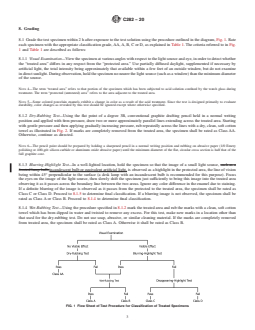
5.2 CleanerSolution—Dissolve10goftrisodiumphosphate 1.Rateeachspecimenwiththeappropriateclassificationgrade,
(Na PO ) in 1 L of tap water. AA,A, B, C or D, as explained in Table 1.The criteria referred
3 4
to in Fig. 1 and Table 1 are described as follows:
6. Sampling
8.1.1 Visual Examination—View the specimen at various
6.1 The test specimens may be articles of commerce, pieces
angles with respect to the light source and eye, in order to
cut from articles of commerce, or laboratory specimens pre-
detectwhetherthe“treatedarea”differsinanyrespectfromthe
pared especially for this test.
“protected area.” Use partially diffused daylight, supplemented
if necessary by artificial light, the total intensity being approxi-
NOTE 1—Processing variables in the application and drying and firing
mately that available within a few feet of an outside window,
operations materially affect the degree of attack by the acid on the surface
of porcelain enamels. Sample specimens used for classification of acid but do not examine in direct sunlight. During observation, hold
resistance must be processed under identical conditions to the commercial
the specimen no nearer the light source (such as a window)
ware they represent.
than the minimum diameter of the source.
7. Procedure
NOTE 4—The term “treated area” refers to that portion of the specimen
which has been subjected to acid solution confined by the watch glass
7.1 Thoroughly wash area to be tested using a soft cotton
during treatment. The term “protected (untreated) area” refers to the area
towel moistened with a warm, 1 % solution of trisodium
adjacent to the treated area.
phosphate. Rinse in warm, running tap water, and dry with a
NOTE 5—Some colored porcelain enamels exhibit a change in color as
soft towel by blotting. Store the specimen at a temperature of
a result of the acid treatment. Since the test is designed primarily to
26 6 1 °C (79 6 2 °F) for a time sufficient to bring it within
evaluate durability, color changes as revealed by this test should be
ignored except where otherwise specified.
this range prior to and during the test.
8.1.2 Dry-Rubbing Test—Using the flat point of a degree
NO
...
This document is not an ASTM standard and is intended only to provide the user of an ASTM standard an indication of what changes have been made to the previous version. Because
it may not be technically possible to adequately depict all changes accurately, ASTM recommends that users consult prior editions as appropriate. In all cases only the current version
of the standard as published by ASTM is to be considered the official document.
Designation: C282 − 10 (Reapproved 2015) C282 − 20
Standard Test Method for
Acid Resistance of Porcelain Enamels
(Citric Acid Spot Test)
This standard is issued under the fixed designation C282; the number immediately following the designation indicates the year of
original adoption or, in the case of revision, the year of last revision. A number in parentheses indicates the year of last reapproval. A
superscript epsilon (´) indicates an editorial change since the last revision or reapproval.
This standard has been approved for use by agencies of the U.S. Department of Defense.
INTRODUCTION
The described method furnishes a means of testing and grading glossy porcelain enamels with
respect to their resistance to citric acid at room temperature. Citric acid has been selected because it
is the most common and one of the more severe of the food acids in its action on conventional
porcelain enamels. The degree of etching by a citric acid solution provides a good indication of the
susceptibility of attack of a porcelain enamel coating to common food-based acids.
1. Scope
1.1 This test method covers a procedure for evaluating porcelain enamels in their resistance to citric acid exposure at room
temperature. No attempt is made to categorize porcelain enamels as to their acid-resistance or non acid-resistance properties, since
the requirements in the several branches of the industry differ.
1.2 The test method is applicable for ware of various shapes providing they contain a substantially flat area approximately 50 mm
in diameter.
1.3 The test method is not applicable to finishes on chemical and hospital ware, which may come in contact with strong mineral
acids, nor to cooking utensils, which may come in prolonged contact with hot acid solutions.
1.4 This standard does not purport to address all of the safety concerns, if any, associated with its use. It is the responsibility
of the user of this standard to establish appropriate safety safety, health, and healthenvironmental practices and determine the
applicability of regulatory limitations prior to use.
1.5 This international standard was developed in accordance with internationally recognized principles on standardization
established in the Decision on Principles for the Development of International Standards, Guides and Recommendations issued
by the World Trade Organization Technical Barriers to Trade (TBT) Committee.
2. Summary of Test Method
2.1 The test method consists of a 15 min exposure of the test surface to a small pool of 10 % citric acid, and an evaluation of the
effect in terms of the change in appearance and the “relative cleanability” of the surface resulting from the treatment.
This test method is under the jurisdiction of ASTM Committee B08 on Metallic and Inorganic Coatings and is the direct responsibility of Subcommittee B08.12 on
Materials for Porcelain Enamel and Ceramic-Metal Systems.
Current edition approved May 1, 2015Nov. 1, 2020. Published May 2015December 2020. Originally approved in 1951. Last previous edition approved in 20102015 as
C282 – 10.C282 – 10(2015). DOI: 10.1520/C0282-10R15.10.1520/C0282-20.
This test method is based on the Test for Acid Resistance of Porcelain Enamels (Citric Acid Spot Test) Bulletin T-21, of the Porcelain Enamel Institute.
Copyright © ASTM International, 100 Barr Harbor Drive, PO Box C700, West Conshohocken, PA 19428-2959. United States
C282 − 20
3. Significance and Use
3.1 This test method is intended specifically for testing the porcelain enamel finish on stoves, refrigerators, table tops, sinks, and
other sanitary ware, laundry appliances, architectural units, etc., where the surface may come in contact with food acids at room
temperature.
3.2 Citric acid has been chosen as the test medium because it is one of the most common of the food acids and will generally
provide a measurable result in its action on porcelain enamel.
4. Apparatus
4.1 Dropper Bottle, or medicine dropper,
4.2 Watch Glass, 25 mm in diameter with fire polished edge,
4.3 Towel, soft cotton, and
4.4 Drafting Pencil, conventional graphite, degree 3B.
5. Reagents and Materials
5.1 Citric Acid Solution—Dissolve 10 g of anhydrous citric acid crystals (H C H O ) in 100 mL of water. distilled water or water
3 6 5 7
of equivalent purity. Solution shall be prepared not more than 48 h prior to use.
5.2 Cleaner Solution—Dissolve 10 g of trisodium phosphate (Na PO ) in 1 L of tap water.
3 4
6. Sampling
6.1 The test specimens may be articles of commerce, pieces cut from articles of commerce, or laboratory specimens prepared
especially for this test.
NOTE 1—Processing variables in the application and drying and firing operations materially affect the degree of attack by the acid on the surface of
porcelain enamels. Sample specimens used for classification of acid resistance must be processed under identical conditions to the commercial ware they
represent.
7. Procedure
7.1 Thoroughly wash area to be tested using a soft cotton towel moistened with a warm, 1 % solution of trisodium phosphate.
Rinse in warm, running tap water, and dry with a soft towel by blotting. Store the specimen at a temperature of 26 6 1°C1 °C (79
6 2°F)2 °F) for a time sufficient to bring it within this range prior to and during the test.
NOTE 2—If, when rinsing, the water gathers in drops on the surface, repeat washing treatment until water spreads evenly.
7.2 On articles of commerce, select areas that are horizontal or nearly horizontal in service. Place the specimen in a position such
that a flat area at least 38.1 mm in diameter is horizontal. With the specimen and the citric acid solution at 26 6 1°C1 °C (79 6
2°F),2 °F), place several drops of the solution on the test area to form a pool, and immediately cover with a clean watch glass in
the inverted position. Use a quantity of solution that is just sufficient to fill the inverted watch glass except for a small air bubble
(three to six drops are usually required, depending upon the dropper and the curvature of the watch glass). After 15 min15 min
630 s of treatment, remove the watch glass and immediately rinse the spot of solution from the surface. Dry the specimen with
a dry, clean, soft cotton towel by blotting (not rubbing).
NOTE 3—The test surface must be thoroughly dry before grading. The presence of a slight film of water on the surface may change the rating of specimens
near the borderline between classes.
C28
...