

ASTM D8462-22
(Test Method)Standard Test Method for Cyclic Plate Load Tests to Evaluate the Structural Performance of Roadway Test Sections with Geosynthetics
General Information
- Abstract
SIGNIFICANCE AND USE
5.1 The CPL test is intended as a performance test to quantify the benefits of geosynthetics in pavement structures, as recommended by AASHTO R 50-09. Performance is predominantly defined in terms of S-TBR.
5.2 The CPL test is a laboratory test used to accelerate rutting in a roadway cross section using a stationary cyclic plate. While the application of load differs from actual roads, the results from similarly constructed CPL tests are useful to evaluate and compare the performance of various products or designs. The results from these tests are most relevant to roads having similar design characteristics (material strengths and thicknesses).
Note 1: The extrapolation of cyclic plate results to designs that deviate significantly from the parameters tested may not be accurate, and performance calculations made at significantly different load cycle levels than the expected service life of an actual pavement may not provide an accurate estimate of the benefits actually realized.
5.3 The number of load cycles applied by the CPL device corresponds to the number of equivalent single-axle loads (ESALs) used in the AASHTO 1993 pavement design equation.
5.4 The test method is applicable to geosynthetics and soils used in typical pavement applications.
5.5 This test method produces test data that can be used to compare geosynthetic products, construction methods, and cross section configurations used in design of roads.
5.6 This test can be used to characterize specific behaviors of the geosynthetic under the conditions tested by including sensors to measure stresses and strains within the pavement cross section or on the geosynthetic itself. Sensors should be appropriately sized and installed to minimize their influence on the results of the test.
5.7 The relationship between load cycles and deformation is a function of the composite stiffness of the constructed system and the interdependence between the individual components of the design.
SCOPE
1.1 This standard test method outlines the procedure used to determine the performance of unpaved and paved roadway cross sections, with and without geosynthetics, that are built in a controlled manner and tested using a stationary, cyclic load applied to the surface to simulate traffic.
1.2 Test section performance from these tests is normally calculated as a function of life extension, but can also be determined based on structural improvement. Life extension is related to the number of load cycles that can be accommodated by a particular configuration when compared to a similarly constructed control. Structural improvements are based on elemental or system-wide stiffness increases.
1.3 The cyclic plate load (CPL) test is intended to be a performance test conducted as closely as possible to as-built unpaved and paved roadway cross sections. It has been used as a tool to compare different geosynthetics; soil types, strengths, and thicknesses; and construction procedures for a variety of pavement applications.
1.4 Units—The values stated in SI units are to be regarded as standard. Values in parentheses are for information only.
1.5 This standard does not purport to address all of the safety concerns, if any, associated with its use. It is the responsibility of the user of this standard to establish appropriate safety, health, and environmental practices and determine the applicability of regulatory limitations prior to use.
1.6 This international standard was developed in accordance with internationally recognized principles on standardization established in the Decision on Principles for the Development of International Standards, Guides and Recommendations issued by the World Trade Organization Technical Barriers to Trade (TBT) Committee.
- Status
- Published
- Publication Date
- 30-Jun-2022
- Technical Committee
- D35 - Geosynthetics
- Drafting Committee
- D35.01 - Mechanical Properties
Overview
ASTM D8462-22: Standard Test Method for Cyclic Plate Load Tests to Evaluate the Structural Performance of Roadway Test Sections with Geosynthetics is an internationally recognized method for assessing the benefits of geosynthetics in pavement design. Issued by ASTM International, this standard provides laboratory procedures to simulate traffic-induced rutting and evaluate structural improvements in both paved and unpaved roadway cross sections incorporating geosynthetics. Performance is assessed primarily through the stationary traffic benefit ratio (S-TBR) and comparative life extension or stiffness increases. This method aligns with AASHTO and World Trade Organization guidelines for reliable, comparable pavement performance testing.
Key Topics
- Cyclic Plate Load (CPL) Testing: Applying a stationary, cyclic load to laboratory-constructed roadway sections to accelerate rutting and simulate repeated truck traffic. This method provides a controlled environment for direct comparison of different geosynthetic materials, soil types, and design configurations.
- Evaluation Metrics: Primary performance metrics include life extension (increased number of load cycles accommodated) and structural improvement (system-wide stiffness increases).
- Stationary Traffic Benefit Ratio (S-TBR): A core metric defined as the ratio of load cycles endured by reinforced (with geosynthetic) versus unreinforced sections to a specified rutting threshold.
- Data Collection: The test generates repeatable data on surface deformation, layer thickness, material properties, and sensor-based stress or strain analysis to characterize structural behavior under cyclic loading.
- Applicability: The CPL test is suitable for typical pavement construction materials, including subgrade soils, aggregates, asphalt, and various geosynthetics.
- Comparative Analysis: Enables objective comparison of geosynthetic performance under similar construction and loading conditions.
Applications
- Pavement Design Optimization: ASTM D8462-22 supports pavement designers and engineers in selecting geosynthetic products and configurations that maximize traffic benefit and extend service life.
- Product and Construction Method Comparison: Laboratories, manufacturers, and agencies use this method to compare and validate geosynthetic materials, soil properties, and construction techniques for road building.
- Evaluation of Structural Improvements: By measuring stress, strain, and deformation, the method helps in understanding the specific behaviors and reinforcement mechanisms of geosynthetics under simulated traffic conditions.
- Quality Assurance in Laboratory Settings: Ensures that test sections are constructed and conditioned to mirror expected real-world conditions as closely as possible, reducing variability and increasing reliability of results.
- Support for Regulatory and Funding Decisions: Objective, standardized data from CPL tests aid transportation authorities in justifying investments in reinforced pavement structures and in meeting regulatory requirements.
Related Standards
- ASTM D4439: Terminology for Geosynthetics - Provides definitions of terms used in this test method and across geosynthetics applications.
- AASHTO R 50-09: Standard Practice for Geosynthetic Reinforcement of the Aggregate Base Course of Flexible Pavement Structures - Recommends performance testing and design practices involving geosynthetics.
- AASHTO 1993 Pavement Design Equation: Provides the basis for relating cyclic load cycles to equivalent single-axle loads (ESALs) in pavement engineering.
Practical Value
Implementing ASTM D8462-22 ensures scientifically rigorous, comparable evaluation of how geosynthetics can enhance pavement structure, boost durability, and reduce lifecycle costs. Contractors, engineers, and agencies gain actionable insights from cyclic plate load testing, supporting better decision-making in roadway and infrastructure projects. By adhering to this standard, stakeholders ensure alignment with industry best practices and regulatory expectations, and benefit from more robust, longer-lasting roadway designs using geosynthetic materials.
Keywords: cyclic plate load test, geosynthetics, pavement testing, S-TBR, performance evaluation, road construction, ASTM D8462, roadway reinforcement, structural improvement, rutting simulation.
Relations
- Effective Date
- 01-Feb-2024
- Effective Date
- 15-Apr-2018
- Effective Date
- 01-Aug-2017
- Effective Date
- 01-Sep-2015
- Effective Date
- 01-Jul-2015
- Effective Date
- 01-Mar-2014
- Effective Date
- 01-Oct-2011
- Effective Date
- 01-Jun-2004
- Effective Date
- 10-Aug-2002
- Effective Date
- 10-Sep-2001
- Effective Date
- 10-Sep-2001
Get Certified
Connect with accredited certification bodies for this standard

Control Union Certifications
Global certification for agriculture and sustainability.

Hohenstein Institut
Textile testing and certification.

Bureau Veritas Bangladesh
Bureau Veritas certification services in Bangladesh.
Sponsored listings
Frequently Asked Questions
ASTM D8462-22 is a standard published by ASTM International. Its full title is "Standard Test Method for Cyclic Plate Load Tests to Evaluate the Structural Performance of Roadway Test Sections with Geosynthetics". This standard covers: SIGNIFICANCE AND USE 5.1 The CPL test is intended as a performance test to quantify the benefits of geosynthetics in pavement structures, as recommended by AASHTO R 50-09. Performance is predominantly defined in terms of S-TBR. 5.2 The CPL test is a laboratory test used to accelerate rutting in a roadway cross section using a stationary cyclic plate. While the application of load differs from actual roads, the results from similarly constructed CPL tests are useful to evaluate and compare the performance of various products or designs. The results from these tests are most relevant to roads having similar design characteristics (material strengths and thicknesses). Note 1: The extrapolation of cyclic plate results to designs that deviate significantly from the parameters tested may not be accurate, and performance calculations made at significantly different load cycle levels than the expected service life of an actual pavement may not provide an accurate estimate of the benefits actually realized. 5.3 The number of load cycles applied by the CPL device corresponds to the number of equivalent single-axle loads (ESALs) used in the AASHTO 1993 pavement design equation. 5.4 The test method is applicable to geosynthetics and soils used in typical pavement applications. 5.5 This test method produces test data that can be used to compare geosynthetic products, construction methods, and cross section configurations used in design of roads. 5.6 This test can be used to characterize specific behaviors of the geosynthetic under the conditions tested by including sensors to measure stresses and strains within the pavement cross section or on the geosynthetic itself. Sensors should be appropriately sized and installed to minimize their influence on the results of the test. 5.7 The relationship between load cycles and deformation is a function of the composite stiffness of the constructed system and the interdependence between the individual components of the design. SCOPE 1.1 This standard test method outlines the procedure used to determine the performance of unpaved and paved roadway cross sections, with and without geosynthetics, that are built in a controlled manner and tested using a stationary, cyclic load applied to the surface to simulate traffic. 1.2 Test section performance from these tests is normally calculated as a function of life extension, but can also be determined based on structural improvement. Life extension is related to the number of load cycles that can be accommodated by a particular configuration when compared to a similarly constructed control. Structural improvements are based on elemental or system-wide stiffness increases. 1.3 The cyclic plate load (CPL) test is intended to be a performance test conducted as closely as possible to as-built unpaved and paved roadway cross sections. It has been used as a tool to compare different geosynthetics; soil types, strengths, and thicknesses; and construction procedures for a variety of pavement applications. 1.4 Units—The values stated in SI units are to be regarded as standard. Values in parentheses are for information only. 1.5 This standard does not purport to address all of the safety concerns, if any, associated with its use. It is the responsibility of the user of this standard to establish appropriate safety, health, and environmental practices and determine the applicability of regulatory limitations prior to use. 1.6 This international standard was developed in accordance with internationally recognized principles on standardization established in the Decision on Principles for the Development of International Standards, Guides and Recommendations issued by the World Trade Organization Technical Barriers to Trade (TBT) Committee.
SIGNIFICANCE AND USE 5.1 The CPL test is intended as a performance test to quantify the benefits of geosynthetics in pavement structures, as recommended by AASHTO R 50-09. Performance is predominantly defined in terms of S-TBR. 5.2 The CPL test is a laboratory test used to accelerate rutting in a roadway cross section using a stationary cyclic plate. While the application of load differs from actual roads, the results from similarly constructed CPL tests are useful to evaluate and compare the performance of various products or designs. The results from these tests are most relevant to roads having similar design characteristics (material strengths and thicknesses). Note 1: The extrapolation of cyclic plate results to designs that deviate significantly from the parameters tested may not be accurate, and performance calculations made at significantly different load cycle levels than the expected service life of an actual pavement may not provide an accurate estimate of the benefits actually realized. 5.3 The number of load cycles applied by the CPL device corresponds to the number of equivalent single-axle loads (ESALs) used in the AASHTO 1993 pavement design equation. 5.4 The test method is applicable to geosynthetics and soils used in typical pavement applications. 5.5 This test method produces test data that can be used to compare geosynthetic products, construction methods, and cross section configurations used in design of roads. 5.6 This test can be used to characterize specific behaviors of the geosynthetic under the conditions tested by including sensors to measure stresses and strains within the pavement cross section or on the geosynthetic itself. Sensors should be appropriately sized and installed to minimize their influence on the results of the test. 5.7 The relationship between load cycles and deformation is a function of the composite stiffness of the constructed system and the interdependence between the individual components of the design. SCOPE 1.1 This standard test method outlines the procedure used to determine the performance of unpaved and paved roadway cross sections, with and without geosynthetics, that are built in a controlled manner and tested using a stationary, cyclic load applied to the surface to simulate traffic. 1.2 Test section performance from these tests is normally calculated as a function of life extension, but can also be determined based on structural improvement. Life extension is related to the number of load cycles that can be accommodated by a particular configuration when compared to a similarly constructed control. Structural improvements are based on elemental or system-wide stiffness increases. 1.3 The cyclic plate load (CPL) test is intended to be a performance test conducted as closely as possible to as-built unpaved and paved roadway cross sections. It has been used as a tool to compare different geosynthetics; soil types, strengths, and thicknesses; and construction procedures for a variety of pavement applications. 1.4 Units—The values stated in SI units are to be regarded as standard. Values in parentheses are for information only. 1.5 This standard does not purport to address all of the safety concerns, if any, associated with its use. It is the responsibility of the user of this standard to establish appropriate safety, health, and environmental practices and determine the applicability of regulatory limitations prior to use. 1.6 This international standard was developed in accordance with internationally recognized principles on standardization established in the Decision on Principles for the Development of International Standards, Guides and Recommendations issued by the World Trade Organization Technical Barriers to Trade (TBT) Committee.
ASTM D8462-22 is classified under the following ICS (International Classification for Standards) categories: 59.080.70 - Geotextiles; 93.080.20 - Road construction materials. The ICS classification helps identify the subject area and facilitates finding related standards.
ASTM D8462-22 has the following relationships with other standards: It is inter standard links to ASTM D4439-24, ASTM D4439-18, ASTM D4439-17, ASTM D4439-15a, ASTM D4439-15, ASTM D4439-14, ASTM D4439-11, ASTM D4439-04, ASTM D4439-02, ASTM D4439-00, ASTM D4439-01. Understanding these relationships helps ensure you are using the most current and applicable version of the standard.
ASTM D8462-22 is available in PDF format for immediate download after purchase. The document can be added to your cart and obtained through the secure checkout process. Digital delivery ensures instant access to the complete standard document.
Standards Content (Sample)
This international standard was developed in accordance with internationally recognized principles on standardization established in the Decision on Principles for the
Development of International Standards, Guides and Recommendations issued by the World Trade Organization Technical Barriers to Trade (TBT) Committee.
Designation: D8462 − 22
Standard Test Method for
Cyclic Plate Load Tests to Evaluate the Structural
Performance of Roadway Test Sections with Geosynthetics
This standard is issued under the fixed designation D8462; the number immediately following the designation indicates the year of
original adoption or, in the case of revision, the year of last revision. A number in parentheses indicates the year of last reapproval. A
superscript epsilon (´) indicates an editorial change since the last revision or reapproval.
1. Scope 2. Referenced Documents
2.1 ASTM Standards:
1.1 This standard test method outlines the procedure used to
determine the performance of unpaved and paved roadway D4439 Terminology for Geosynthetics
2.2 AASHTO Standards:
cross sections, with and without geosynthetics, that are built in
a controlled manner and tested using a stationary, cyclic load AASHTO R 50-09 Standard Practice for Geosynthetic Re-
inforcement of the Aggregate Base Course of Flexible
applied to the surface to simulate traffic.
Pavement Structures
1.2 Test section performance from these tests is normally
calculated as a function of life extension, but can also be
3. Terminology
determined based on structural improvement. Life extension is
3.1 Definitions—For definitions of common geosynthetic
related to the number of load cycles that can be accommodated
terms used in this test method, refer to Terminology D4439.
by a particular configuration when compared to a similarly
constructed control. Structural improvements are based on 3.2 Definitions of Terms Specific to This Standard:
elemental or system-wide stiffness increases. 3.2.1 equivalent single-axle load (ESAL), n—the total num-
ber of repetitions of a standard design load of 80 kN (18 kips)
1.3 The cyclic plate load (CPL) test is intended to be a
applied to a single axle having two sets of dual wheels.
performance test conducted as closely as possible to as-built
3.2.2 stationary traffıc benefit ratio (S-TBR), n—the ratio of
unpaved and paved roadway cross sections. It has been used as
the number of load cycles of a pavement structure with
a tool to compare different geosynthetics; soil types, strengths,
geosynthetics to the number of load cycles for the same test
and thicknesses; and construction procedures for a variety of
section without geosynthetics to reach the same defined failure
pavement applications.
state, where the cyclic load is applied using a stationary plate.
1.4 Units—The values stated in SI units are to be regarded
3.2.3 traffıc benefit ratio (TBR), n—the ratio of the number
as standard. Values in parentheses are for information only.
ofloadcyclesofapavementstructurewithgeosyntheticstothe
1.5 This standard does not purport to address all of the
number of load cycles for the same test section without
safety concerns, if any, associated with its use. It is the
geosynthetics to reach the same defined failure state.
responsibility of the user of this standard to establish appro-
priate safety, health, and environmental practices and deter-
4. Summary of Test Method
mine the applicability of regulatory limitations prior to use.
4.1 This test method covers the major considerations asso-
1.6 This international standard was developed in accor-
ciated with cyclic plate load tests conducted on laboratory-
dance with internationally recognized principles on standard-
constructed pavement test sections that are built inside a large,
ization established in the Decision on Principles for the
rigid test vessel and cyclically loaded to simulate traffic.
Development of International Standards, Guides and Recom-
Common configurations include paved and unpaved roads and
mendations issued by the World Trade Organization Technical
other load support applications that include geosynthetics.
Barriers to Trade (TBT) Committee.
For referenced ASTM standards, visit the ASTM website, www.astm.org, or
contact ASTM Customer Service at service@astm.org. For Annual Book of ASTM
This test method is under the jurisdiction of ASTM Committee D35 on Standards volume information, refer to the standard’s Document Summary page on
Geosynthetics and is the direct responsibility of Subcommittee D35.01 on Mechani- the ASTM website.
cal Properties. Available from American Association of State Highway and Transportation
Current edition approved July 1, 2022. Published July 2022. DOI: 10.1520/ Officials (AASHTO), 444 N. Capitol St., NW, Suite 249, Washington, DC 20001,
D8462-22. http://www.transportation.org.
Copyright © ASTM International, 100 Barr Harbor Drive, PO Box C700, West Conshohocken, PA 19428-2959. United States
D8462 − 22
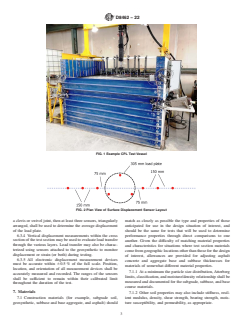
4.2 Design and construction of individual test sections are forces from compaction equipment. If a square or rectangular
intended to match as closely as possible the type and properties shape is used, front and back walls can be designed to be
of those anticipated for use in the design situation of interest, incrementally added to account for the cumulative change in
and to be the same for tests that will be used to determine height as construction advances (refer to example box in Fig.
performance properties through direct comparisons to one 1). Many existing test tanks are rectangular, but can also be
another. made in other shapes.
6.1.1 Placement of vertical boundaries should be more than
4.3 Testing is performed by loading the surface of the
75 cm(29.5 in.)fromtheperimeteroftheplatetominimizethe
roadway using a stationary cyclic load representative of a
influence of the boundary walls on the test results. The
typical truck to induce progressive vertical displacement of the
thickness of the subgrade shall be no less than 90 cm (35.5 in.)
surface (rut).
to minimize the influence of the floor.
4.4 Benefit from the geosynthetic is determined by calcu-
6.1.2 The sidewalls should be sufficiently smooth to allow
lating the stationary traffic benefit ratio (S-TBR).
for vertical movements from consolidation or settlement (or
both) during testing.
5. Significance and Use
NOTE 2—A high-density polyethylene (HDPE) geomembrane can be
5.1 The CPL test is intended as a performance test to
bonded to the inside surfaces of the test tank to reduce or prevent sidewall
quantify the benefits of geosynthetics in pavement structures,
friction. The sidewalls may also be covered with a layer of silk fabric,
as recommended by AASHTO R 50-09. Performance is pre-
which has been shown to eliminate adhesion and has a very low friction
value.Alternatively, a lubricant can be spread on the sidewalls of the box
dominantly defined in terms of S-TBR.
and thin sheets of polyethylene film used to minimize sidewall friction.
5.2 The CPL test is a laboratory test used to accelerate
6.1.3 The height of the tank should be large enough to
rutting in a roadway cross section using a stationary cyclic
accommodate the minimum height for a roadway cross section
plate. While the application of load differs from actual roads,
subjected to typical axle loads.
the results from similarly constructed CPL tests are useful to
evaluate and compare the performance of various products or
6.2 Cyclic Loading Apparatus—The cyclic load system
designs. The results from these tests are most relevant to roads should be able to apply multiple load repetitions for extended
having similar design characteristics (material strengths and
periods of time (often several days). The loading system shall
thicknesses).
not significantly distort or otherwise displace the test tank
during loading.
NOTE1—Theextrapolationofcyclicplateresultstodesignsthatdeviate
6.2.1 Surface loads shall be applied through a rigid 305 mm
significantly from the parameters tested may not be accurate, and
performance calculations made at significantly different load cycle levels (12 in.) diameter steel plate. This size plate represents the
than the expected service life of an actual pavement may not provide an
dual-wheel footprint of a loaded truck.
accurate estimate of the benefits actually realized.
6.2.2 A 6.4 mm (0.25 in.) thick nitrile rubber pad (40A
5.3 The number of load cycles applied by the CPL device
durometer) shall be used beneath the load plate to reduce
corresponds to the number of equivalent single-axle loads
concentrated stresses from minor surface irregularities.
(ESALs) used in the AASHTO 1993 pavement design equa-
6.2.3 Maximum and minimum applied loads shall be con-
tion.
sistent throughout the duration of the test.
5.4 The test method is applicable to geosynthetics and soils
6.3 Measurements—The maximum and minimum applied
used in typical pavement applications.
load and accumulated surface deformation as a function of the
number of applied load pulses shall be measured to character-
5.5 This test method produces test data that can be used to
ize performance. The displacement of other positions within
compare geosynthetic products, construction methods, and
the cross section may be used to ensure proper performance
cross section configurations used in design of roads.
and behaviors.
5.6 This test can be used to characterize specific behaviors
6.3.1 The maximum and minimum applied load shall be
of the geosynthetic under the conditions tested by including
measured and confirmed throughout the duration of the test to
sensors to measure stresses and strains within the pavement
ensure that it remains constant. The load measurement device
cross section or on the geosynthetic itself. Sensors should be
must be accurate within 60.5 % of the maximum applied load.
appropriately sized and installed to minimize their influence on
6.3.2 Displacement can be monitored using extensometers,
the results of the test.
linear variable differential transducers (LVDTs), or other elec-
5.7 The relationship between load cycles and deformation is
tronic displacement transducers. The datum for the displace-
a function of the composite stiffness of the constructed system
ment measurements shall be stable and unaffected by move-
and the interdependence between the individual components of
ments caused by loading system.
the design.
6.3.3 Displacement measurements shall be used to charac-
terize the shape of the depression bowl caused by the applied
6. Apparatus
load at the test surface. Multiple sensors shall be positioned
6.1 Test Vessel—The containment vessel or rigid box should along a line extending through the center and on both sides of
be designed and constructed to encapsulate the constructed the load plate, as illustrated in Fig. 2. If displacement of the
roadway test section without adversely affecting its response load plate is made using sensors external to the loading system
under load, and should be sufficiently strong to withstand and the load plate is attached to the end of the actuator using
D8462 − 22
FIG. 1 Example CPL Test Vessel
FIG. 2 Plan View of Surface Displacement Sensor Layout
a clevis or swivel joint, then at least three sensors, triangularly match as closely as possible the type and properties of those
arranged, shall be used to determine the average displacement anticipated for use in the design situation of interest, and
of the load plate.
should be the same for tests that will be used to determine
6.3.4 Vertical displacement measurements within the cross
performance properties through direct comparisons to one
section of the test section may be used to evaluate load transfer
another. Given the difficulty of matching material properties
through the various layers. Load transfer may also be charac-
and characteristics for situations where test section materials
terized using sensors attached to the geosynthetic to monitor
come from geographic locations other than those for the design
displacement or strain (or both) during testing.
of interest, allowances are provided for adjusting asphalt
6.3.5 All electronic displacement measurement devices
concrete and aggregate base and subbase thicknesses for
must be accurate within 60.5 % of the full scale. Position,
materials of somewhat different material properties.
location, and orientation of all measurement devices shall be
7.1.1 At a minimum the particle size distribution,Atterberg
accurately measured and recorded. The ranges of the sensors
limits, classification, and moisture/density relationship shall be
shall be sufficient to remain within their calibrated limit
measured and documented for the subgrade, subbase, and base
throughout the duration of the test.
course materials.
7. Materials
7.1.2 Other soil properties may also include stiffness, resil-
ient modulus, density, shear strength, bearing strength, mois-
7.1 Construction materials (for example, subgrade soil,
geosynthetic, subbase and base aggregate,
...