

ASTM G143-23
(Test Method)Standard Test Method for Measurement of Web/Roller Friction Characteristics
General Information
- Abstract
SIGNIFICANCE AND USE
5.1 This test method is intended to simulate the slip of a flexible web on a roller in a machine or tribosystem that conveys web materials. Flexible webs such as plastic sheeting, paper, elastomers, metal foils, and cloth are often transported in manufacturing processes by combinations of driving and idler rollers. The friction characteristics of the web/roller interface often affects the web transport process. If the web/roller friction is too low, the web can slip on the rollers and be damaged or damage the roller. High friction on the other hand, can lead to steering problems and overloading of driving motors.
5.2 This test method can be used to rank rollers for their ability to resist slip versus a particular web material (high friction). Conversely this test method can assess web materials or web surface coatings such as waxes and lubricants. In this latter case, the goal may be a low-friction product made from a web (film, magnetic media, paper, and so forth).
5.3 If a tribosystem involves transport of a flexible web on a roller, this is an appropriate test to use to measure the friction characteristics of the roller/web couple.
SCOPE
1.1 This test method covers the simulation of a roller/web transport tribosystem and the measurement of the static and kinetic coefficient of friction of the web/roller couple when sliding occurs between the two. The objective of this test method is to provide users with web/roller friction information that can be used for process control, design calculations, and for any other function where web/roller friction needs to be known.
1.2 The values stated in SI units are to be regarded as standard. No other units of measurement are included in this standard.
1.3 This standard does not purport to address all of the safety concerns, if any, associated with its use. It is the responsibility of the user of this standard to establish appropriate safety, health, and environmental practices and determine the applicability of regulatory limitations prior to use.
1.4 This international standard was developed in accordance with internationally recognized principles on standardization established in the Decision on Principles for the Development of International Standards, Guides and Recommendations issued by the World Trade Organization Technical Barriers to Trade (TBT) Committee.
- Status
- Published
- Publication Date
- 31-Oct-2023
- Technical Committee
- G02 - Wear and Erosion
- Drafting Committee
- G02.50 - Friction
Overview
ASTM G143-23: Standard Test Method for Measurement of Web/Roller Friction Characteristics provides a consistent methodology for simulating and measuring the static and kinetic coefficients of friction at the interface between a flexible web and a roller. This standard, developed by ASTM International, is crucial for industries handling materials such as plastic sheeting, paper, elastomers, metal foils, and cloth, where web conveyance over rollers is a fundamental process.
Friction at the web/roller interface significantly impacts the reliability, quality, and efficiency of material transport mechanisms. If friction is too low, slippage can occur, potentially damaging both the web and rollers. Excessively high friction can cause steering issues and place undue strain on drive systems. Therefore, accurate friction measurements aid in process control, equipment design, and the development of enhanced web materials or surface treatments.
Key Topics
- Friction Measurement: The standard details procedures for determining both static and kinetic coefficients of friction using controlled test configurations. Accurately simulating roller/web tribosystems is essential to achieve relevant results.
- Test Apparatus: Includes a stationary cylindrical roller, a force measuring device, a mechanism for moving the web, and appropriate tensioning masses.
- Test Procedure: Steps include specimen preparation, mounting, setting sliding parameters (velocity, distance, tension), and conducting observations on friction behavior, surface transfer, and potential damage.
- Variables Affecting Results: Environmental conditions (temperature, humidity), specimen preparation (surface condition, edge quality), and test apparatus alignment are crucial for reproducibility.
- Calculation and Reporting: Specifies the formula for calculating coefficients of friction, data recording protocols, and necessary reporting parameters, such as web tension, sliding velocity, wrap angle, and environmental conditions.
Applications
The ASTM G143-23 standard method is widely used in:
- Manufacturing process optimization: Ensures efficient transport of flexible web materials by selecting appropriate roller and web combinations to control friction.
- Quality control: Evaluates batch-to-batch consistency of web materials and identifies potential for slippage or excess drag.
- Material and coating development: Assesses the effects of surface treatments such as lubricants, coatings, or texturing on friction properties, supporting the design of low- or high-friction products as needed.
- Equipment specification: Guides engineers and designers in selecting or specifying rollers and tensioning systems for web-handling machinery.
- Benchmarking and comparative analysis: Enables ranking of rollers or web materials based on their friction behavior, assisting material selection and performance improvement programs.
Related Standards
The following ASTM standards are frequently referenced or utilized in conjunction with ASTM G143-23:
- ASTM D3108/D3108M: Test method for coefficient of friction, yarn to solid material
- ASTM G40: Terminology relating to wear and erosion
- ASTM G115: Guide for measuring and reporting friction coefficients
- ASTM E8/E8M: Test methods for tension testing of metallic materials
- ASTM E177: Practice for use of precision and bias terms in ASTM methods
- ASTM E691: Practice for conducting interlaboratory studies
- ASTM D883: Terminology relating to plastics
Utilizing ASTM G143-23 in combination with these and other relevant standards ensures comprehensive, reliable evaluation of web/roller friction characteristics, supporting best practices in material processing, product development, and quality assurance.
Keywords: web/roller friction, coefficient of friction, flexible web materials, friction testing, process control, manufacturing, ASTM G143-23, static friction, kinetic friction, tribosystem, quality control, roller selection, material coatings, industrial standards.
Relations
- Replaces
ASTM G143-03(2018) - Standard Test Method for Measurement of Web/Roller Friction Characteristics - Effective Date
- 01-Nov-2023
- Effective Date
- 01-Feb-2024
- Effective Date
- 01-Jan-2024
- Effective Date
- 01-Nov-2023
- Effective Date
- 01-May-2022
- Effective Date
- 01-Nov-2023
- Effective Date
- 01-Nov-2023
- Effective Date
- 01-Nov-2023
Frequently Asked Questions
ASTM G143-23 is a standard published by ASTM International. Its full title is "Standard Test Method for Measurement of Web/Roller Friction Characteristics". This standard covers: SIGNIFICANCE AND USE 5.1 This test method is intended to simulate the slip of a flexible web on a roller in a machine or tribosystem that conveys web materials. Flexible webs such as plastic sheeting, paper, elastomers, metal foils, and cloth are often transported in manufacturing processes by combinations of driving and idler rollers. The friction characteristics of the web/roller interface often affects the web transport process. If the web/roller friction is too low, the web can slip on the rollers and be damaged or damage the roller. High friction on the other hand, can lead to steering problems and overloading of driving motors. 5.2 This test method can be used to rank rollers for their ability to resist slip versus a particular web material (high friction). Conversely this test method can assess web materials or web surface coatings such as waxes and lubricants. In this latter case, the goal may be a low-friction product made from a web (film, magnetic media, paper, and so forth). 5.3 If a tribosystem involves transport of a flexible web on a roller, this is an appropriate test to use to measure the friction characteristics of the roller/web couple. SCOPE 1.1 This test method covers the simulation of a roller/web transport tribosystem and the measurement of the static and kinetic coefficient of friction of the web/roller couple when sliding occurs between the two. The objective of this test method is to provide users with web/roller friction information that can be used for process control, design calculations, and for any other function where web/roller friction needs to be known. 1.2 The values stated in SI units are to be regarded as standard. No other units of measurement are included in this standard. 1.3 This standard does not purport to address all of the safety concerns, if any, associated with its use. It is the responsibility of the user of this standard to establish appropriate safety, health, and environmental practices and determine the applicability of regulatory limitations prior to use. 1.4 This international standard was developed in accordance with internationally recognized principles on standardization established in the Decision on Principles for the Development of International Standards, Guides and Recommendations issued by the World Trade Organization Technical Barriers to Trade (TBT) Committee.
SIGNIFICANCE AND USE 5.1 This test method is intended to simulate the slip of a flexible web on a roller in a machine or tribosystem that conveys web materials. Flexible webs such as plastic sheeting, paper, elastomers, metal foils, and cloth are often transported in manufacturing processes by combinations of driving and idler rollers. The friction characteristics of the web/roller interface often affects the web transport process. If the web/roller friction is too low, the web can slip on the rollers and be damaged or damage the roller. High friction on the other hand, can lead to steering problems and overloading of driving motors. 5.2 This test method can be used to rank rollers for their ability to resist slip versus a particular web material (high friction). Conversely this test method can assess web materials or web surface coatings such as waxes and lubricants. In this latter case, the goal may be a low-friction product made from a web (film, magnetic media, paper, and so forth). 5.3 If a tribosystem involves transport of a flexible web on a roller, this is an appropriate test to use to measure the friction characteristics of the roller/web couple. SCOPE 1.1 This test method covers the simulation of a roller/web transport tribosystem and the measurement of the static and kinetic coefficient of friction of the web/roller couple when sliding occurs between the two. The objective of this test method is to provide users with web/roller friction information that can be used for process control, design calculations, and for any other function where web/roller friction needs to be known. 1.2 The values stated in SI units are to be regarded as standard. No other units of measurement are included in this standard. 1.3 This standard does not purport to address all of the safety concerns, if any, associated with its use. It is the responsibility of the user of this standard to establish appropriate safety, health, and environmental practices and determine the applicability of regulatory limitations prior to use. 1.4 This international standard was developed in accordance with internationally recognized principles on standardization established in the Decision on Principles for the Development of International Standards, Guides and Recommendations issued by the World Trade Organization Technical Barriers to Trade (TBT) Committee.
ASTM G143-23 is classified under the following ICS (International Classification for Standards) categories: 53.040.20 - Components for conveyors. The ICS classification helps identify the subject area and facilitates finding related standards.
ASTM G143-23 has the following relationships with other standards: It is inter standard links to ASTM G143-03(2018), ASTM D883-24, ASTM E8/E8M-24, ASTM D883-23, ASTM E8/E8M-22, ASTM G194-08(2018), ASTM G182-13(2018), ASTM G115-10(2018). Understanding these relationships helps ensure you are using the most current and applicable version of the standard.
ASTM G143-23 is available in PDF format for immediate download after purchase. The document can be added to your cart and obtained through the secure checkout process. Digital delivery ensures instant access to the complete standard document.
Standards Content (Sample)
This international standard was developed in accordance with internationally recognized principles on standardization established in the Decision on Principles for the
Development of International Standards, Guides and Recommendations issued by the World Trade Organization Technical Barriers to Trade (TBT) Committee.
Designation: G143 − 23
Standard Test Method for
Measurement of Web/Roller Friction Characteristics
This standard is issued under the fixed designation G143; the number immediately following the designation indicates the year of
original adoption or, in the case of revision, the year of last revision. A number in parentheses indicates the year of last reapproval. A
superscript epsilon (´) indicates an editorial change since the last revision or reapproval.
1. Scope E122 Practice for Calculating Sample Size to Estimate, With
Specified Precision, the Average for a Characteristic of a
1.1 This test method covers the simulation of a roller/web
Lot or Process
transport tribosystem and the measurement of the static and
E177 Practice for Use of the Terms Precision and Bias in
kinetic coefficient of friction of the web/roller couple when
ASTM Test Methods
sliding occurs between the two. The objective of this test
E691 Practice for Conducting an Interlaboratory Study to
method is to provide users with web/roller friction information
Determine the Precision of a Test Method
that can be used for process control, design calculations, and
G40 Terminology Relating to Wear and Erosion
for any other function where web/roller friction needs to be
G115 Guide for Measuring and Reporting Friction Coeffi-
known.
cients
1.2 The values stated in SI units are to be regarded as
G117 Guide for Calculating and Reporting Measures of
standard. No other units of measurement are included in this
Precision Using Data from Interlaboratory Wear or Ero-
standard. 3
sion Tests (Withdrawn 2016)
1.3 This standard does not purport to address all of the G163 Guide for Digital Data Acquisition in Wear and
safety concerns, if any, associated with its use. It is the
Friction Measurements (Withdrawn 2016)
responsibility of the user of this standard to establish appro-
priate safety, health, and environmental practices and deter- 3. Terminology
mine the applicability of regulatory limitations prior to use.
3.1 Definitions of Terms Specific to This Standard:
1.4 This international standard was developed in accor-
3.1.1 blocking, n—unintentional adhesion between plastic
dance with internationally recognized principles on standard-
films or between a film and another surface. D883
ization established in the Decision on Principles for the
3.1.2 coeffıcient of friction, μ, n—in tribology, the dimen-
Development of International Standards, Guides and Recom-
sionless ratio of the friction force (F) between two bodies to the
mendations issued by the World Trade Organization Technical
normal force (N) pressing these bodies together. G40
Barriers to Trade (TBT) Committee.
3.1.3 friction force, n—the resisting force tangential to the
2. Referenced Documents
interface between two bodies when, under the action of
external force, one body moves or tends to move relative to the
2.1 ASTM Standards:
other. G40
D883 Terminology Relating to Plastics
D1894 Test Method for Static and Kinetic Coefficients of 3.1.4 kinetic coeffıcient of friction, n—the coefficient of
Friction of Plastic Film and Sheeting (Withdrawn 2023) friction under conditions of macroscopic relative motion be-
D3108/D3108M Test Method for Coefficient of Friction, tween two bodies. G40
Yarn to Solid Material
3.1.5 stick-slip, n—a cyclic fluctuation in the magnitudes of
E8/E8M Test Methods for Tension Testing of Metallic Ma-
friction force and relative velocity between two elements in
terials
sliding contact, usually associated with a relaxation oscillation
dependent on elasticity in the tribosystem and on a decrease of
1 the coefficient of friction with onset of sliding or with increase
This test method is under the jurisdiction of ASTM Committee G02 on Wear
and Erosion and is the direct responsibility of Subcommittee G02.50 on Friction.
of sliding velocity. G40
Current edition approved Nov. 1, 2023. Published November 2023. Originally
3.1.5.1 Discussion—Classical or true stick-slip, in which
approved in 1996. Last previous edition approved in 2018 as G143 – 03 (2018).
each cycle consists of a stage of actual stick followed by a
DOI: 10.1520/G0143-23.
stage of overshoot slip, requires that the kinetic coefficient is
For referenced ASTM standards, visit the ASTM website, www.astm.org, or
contact ASTM Customer Service at service@astm.org. For Annual Book of ASTM
lower than the static coefficient. A modified form of relaxation
Standards volume information, refer to the standard’s Document Summary page on
oscillation, with near-harmonic fluctuation in motion, can
the ASTM website.
occur when the kinetic coefficient of friction decreases gradu-
The last approved version of this historical standard is referenced on
www.astm.org. ally with increasing velocity within a certain velocity range. A
Copyright © ASTM International, 100 Barr Harbor Drive, PO Box C700, West Conshohocken, PA 19428-2959. United States
G143 − 23
third type of stick-slip can be due to spatial periodicity of the
friction coefficient along the path of contact. Random varia-
tions in friction force measurement do not constitute stick-slip.
3.1.6 triboelement, n—one of two or more solid bodies
which comprise a sliding, rolling, or abrasive contact, or a
body subjected to impingement or cavitation. G40
3.1.6.1 Discussion—Contacting triboelements may be in
direct contact, or may be separated by an intervening lubricant,
oxide, or other film that affects tribological interactions be-
tween them.
3.1.7 tribosystem, n—any system that contains one or more
triboelements, including all mechanical, chemical, and envi-
ronmental factors relevant to tribological behavior. G40
4. Summary of Test Method
4.1 This test method can be used to measure the friction
FIG. 1 Schematic of Capstan Friction Test
characteristics of a flexible web as it slides on a cylindrical
surface. The web conforms to the cylindrical surface in the area
of wrap.
4.2 The test method is conducted on a narrow web or strip
taken from a web of interest. One end of the strip is draped
over a stationary cylinder and the other end is affixed to a force
measuring device. A mass is applied to the free end of the strip
and the strip is pulled by a mechanism that moves the force
transducer perpendicular to the long axis of the cylindrical
surface. The force encountered in pulling the strip in contact
with the stationary cylinder (roller) is continuously measured
and recorded. The static and kinetic coefficients of friction are
calculated from the force measured by the force transducer.
5. Significance and Use
5.1 This test method is intended to simulate the slip of a
flexible web on a roller in a machine or tribosystem that
conveys web materials. Flexible webs such as plastic sheeting,
paper, elastomers, metal foils, and cloth are often transported in
manufacturing processes by combinations of driving and idler
rollers. The friction characteristics of the web/roller interface
often affects the web transport process. If the web/roller
FIG. 2 Use of Tensile Test Machine to Perform the Capstan Fric-
tion Test
friction is too low, the web can slip on the rollers and be
damaged or damage the roller. High friction on the other hand,
can lead to steering problems and overloading of driving
motors.
6.1.2 A stationary cylindrical surface to be used as one
5.2 This test method can be used to rank rollers for their
member of the friction couple,
ability to resist slip versus a particular web material (high
6.1.3 A system to move the flexible strip (web) member of
friction). Conversely this test method can assess web materials
the friction couple, and
or web surface coatings such as waxes and lubricants. In this
6.1.4 Masses to be used to tension the free end of the test
latter case, the goal may be a low-friction product made from
strip.
a web (film, magnetic media, paper, and so forth).
6.2 Force Measurement—Commercially available or home-
5.3 If a tribosystem involves transport of a flexible web on
made strain gage or similar force transducers are acceptable.
a roller, this is an appropriate test to use to measure the friction
The device should be linear in the force range anticipated in
characteristics of the roller/web couple.
testing and the transducer shall be calibrated with known
masses or a similar system for each use.
6. Apparatus
6.2.1 Force transducers shall be accurate within 1 % of the
6.1 Two possible configurations of the test are shown in rated scale of the device and should have overload protection.
Figs. 1 and 2. The essential features of the apparatus are: The friction force during the entire test should be recorded.
6.1.1 A force measuring device attached to one member of (Warning—Digital filters can alter the force data to the point
the friction couple, where the data are not valid. Analog strip chart recorders have
G143 − 23
been shown to be acceptable recording devices for this test simply apply a series of known weights on the transducer with
method. (See Guide G163 for details on digital data acquisi- the force recording device running. Make sure that the output
tion.)) of the force transducer is linearly proportional to the applied
force over the range of forces to be measured. Calibrate using
6.3 Cylindrical Surface—The recommended diameter of the
weights that produce force comparable in magnitude to the
test cylinder should be the same diameter as the rollers or
forces anticipated in the friction test.
curved surface that is simulated in the friction test. The
cylinder surface texture and material of construction should be
7. Test Procedure
the same as the tribosystem of interest. If materials are being
7.1 Specimen Preparation:
evaluated without simulating a particular tribosystem, the test
7.1.1 Clean the roller surface in a manner that is consistent
roller can be the same as the roller used in the interlaboratory
with the application that is under simulation. Cut virgin strips
tests of this test method: 100 mm diameter (100 mm long),
from the test web as the other friction member. Take care not
50 μm thick hard coated (thick hard anodize) 6061-T6 alumi-
to fingerprint or alter the test surface in handling the web.
num with a surface roughness of 0.75 μm Ra to 1 μm Ra
Convenient sample dimensions are 25 mm wide with a length
(measured parallel to the cylinder’s axis; surface was lathe
of about 500 mm. Practice E122 or other statistical methods
generated).
can be used to determine the necessary number of test
6.4 Sliding Motion—The device shown schematically in
replicates. Three is the minimum.
Fig. 1 uses a linear motor to pull the test strip. The cylinder is
7.1.2 Do not clean the web specimen unless that is part of
stationary. Any device with controlled acceleration and veloc-
the study. If paper or plastic sheets are being tested, they should
ity is acceptable. A ball screw driven by a variable speed motor
be tested with untouched as-manufactured surfaces. Cut the
is suitable as is the crosshead on a tensile testing machine. In
web specimen in such a fashion that there is no edge burr on
the latter case, it may be necessary to use a sheave with a
the side that contacts the roller. This is extremely important.
free-wheeling rolling element bearing to transfer the motion
Ensure that the edges of the strip are parallel and in the desired
from a vertical to horizontal plane (see Fig. 2).
orientation with respect to the long axis of the host web. A
NOTE 1—Some devices rotate the cylinder and hold the web with a useful tool for sample preparation is to affix two single-edged
force transducer. This was done in interlaboratory tests and produced the
razor blades to a block of wood spaced at the desired strip
same results as pulling the web over a stationary cylinder.
width. This device can be used to cut samples from thin plastic,
6.5 Tensioning Mass—Ordinary masses from balances and
cloth, and paper webs. The interlaboratory tests were con-
similar laboratory equipment are suitable for tensioning. It is
ducted with web strips that were 25 mm in width and 500 mm
imperative to attach the masses and the friction transducers
long.
with a device that prevents lateral motion of the test strip.
7.2 Mounting the Specimen—Affix one end of the web strip
Bridle devices such as the one shown in Fig. 3 allow a straight
to the bridle end of the force transducer; drape the strip over the
pull of the test strip. If lateral slip occurs in a particular test, the
test roller (cylindrical surface), and apply the desired tension-
results will probably be different from a test in which this
ing mass. Avoid clamp systems that have significant elasticity.
unwanted slip does not occur.
If a tensile-testing machine is used to produce motion, flexible
6.6 Test Environment—The friction characteristics of some
steel cable can be used to pull the strip. Ensure that the strip is
web/roller couples can be affected by the ambient temperature
pulled straight (aligned with the web tension) within 61 mm.
and relative humidity. Both friction and temperature at the time
Markers can be used on the test roller to determine if tracking
of testing shall be recorded and, if the tribosystem that is to be
is within the 1 mm limit.
simulated involves some special environment, then this should
7.3 Setting the Sliding Parameters:
be simulated. Test samples should be incubated for an adequate
7.3.1 Velocity—The capstan friction tester allows selection
time to reach equilibrium in the intended test environment prior
of sliding velocity, sliding distance, and f
...
This document is not an ASTM standard and is intended only to provide the user of an ASTM standard an indication of what changes have been made to the previous version. Because
it may not be technically possible to adequately depict all changes accurately, ASTM recommends that users consult prior editions as appropriate. In all cases only the current version
of the standard as published by ASTM is to be considered the official document.
Designation: G143 − 03 (Reapproved 2018) G143 − 23
Standard Test Method for
Measurement of Web/Roller Friction Characteristics
This standard is issued under the fixed designation G143; the number immediately following the designation indicates the year of
original adoption or, in the case of revision, the year of last revision. A number in parentheses indicates the year of last reapproval. A
superscript epsilon (´) indicates an editorial change since the last revision or reapproval.
1. Scope
1.1 This test method covers the simulation of a roller/web transport tribosystem and the measurement of the static and kinetic
coefficient of friction of the web/roller couple when sliding occurs between the two. The objective of this test method is to provide
users with web/roller friction information that can be used for process control, design calculations, and for any other function
where web/roller friction needs to be known.
1.2 The values stated in SI units are to be regarded as standard. No other units of measurement are included in this standard.
1.3 This standard does not purport to address all of the safety concerns, if any, associated with its use. It is the responsibility
of the user of this standard to establish appropriate safety, health, and environmental practices and determine the applicability of
regulatory limitations prior to use.
1.4 This international standard was developed in accordance with internationally recognized principles on standardization
established in the Decision on Principles for the Development of International Standards, Guides and Recommendations issued
by the World Trade Organization Technical Barriers to Trade (TBT) Committee.
2. Referenced Documents
2.1 ASTM Standards:
D883 Terminology Relating to Plastics
D1894 Test Method for Static and Kinetic Coefficients of Friction of Plastic Film and Sheeting (Withdrawn 2023)
D3108/D3108M Test Method for Coefficient of Friction, Yarn to Solid Material
E8/E8M Test Methods for Tension Testing of Metallic Materials
E122 Practice for Calculating Sample Size to Estimate, With Specified Precision, the Average for a Characteristic of a Lot or
Process
E177 Practice for Use of the Terms Precision and Bias in ASTM Test Methods
E691 Practice for Conducting an Interlaboratory Study to Determine the Precision of a Test Method
G40 Terminology Relating to Wear and Erosion
G115 Guide for Measuring and Reporting Friction Coefficients
G117 Guide for Calculating and Reporting Measures of Precision Using Data from Interlaboratory Wear or Erosion Tests
(Withdrawn 2016)
G163 Guide for Digital Data Acquisition in Wear and Friction Measurements (Withdrawn 2016)
3. Terminology
3.1 Definitions of Terms Specific to This Standard:
This test method is under the jurisdiction of ASTM Committee G02 on Wear and Erosion and is the direct responsibility of Subcommittee G02.50 on Friction.
Current edition approved June 1, 2018Nov. 1, 2023. Published July 2018November 2023. Originally approved in 1996. Last previous edition approved in 20132018 as
G143 – 03 (2013).(2018). DOI: 10.1520/G0143-03R18.10.1520/G0143-23.
For referenced ASTM standards, visit the ASTM website, www.astm.org, or contact ASTM Customer Service at service@astm.org. For Annual Book of ASTM Standards
volume information, refer to the standard’s Document Summary page on the ASTM website.
The last approved version of this historical standard is referenced on www.astm.org.
Copyright © ASTM International, 100 Barr Harbor Drive, PO Box C700, West Conshohocken, PA 19428-2959. United States
G143 − 23
3.1.1 blocking, n—unintentional adhesion between plastic films or between a film and another surface. D883
3.1.2 coeffıcient of friction, μ, n—in tribology,—the the dimensionless ratio of the friction force (F) between two bodies to the
normal force (N) pressing these bodies together. G40
3.1.3 friction force, n—the resisting force tangential to the interface between two bodies when, under the action of external force,
one body moves or tends to move relative to the other. G40
3.1.4 kinetic coeffıcient of friction, n—the coefficient of friction under conditions of macroscopic relative motion between two
bodies. G40
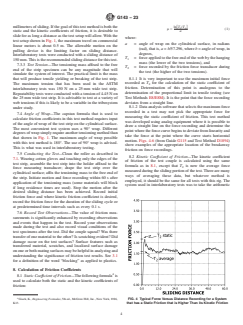
3.1.5 stick-slip, n—a cyclic fluctuation in the magnitudes of friction force and relative velocity between two elements in sliding
contact, usually associated with a relaxation oscillation dependent on elasticity in the tribosystem and on a decrease of the
coefficient of friction with onset of sliding or with increase of sliding velocity. G40
3.1.5.1 Discussion—
Classical or true stick-slip, in which each cycle consists of a stage of actual stick followed by a stage of overshoot slip, requires
that the kinetic coefficient is lower than the static coefficient. A modified form of relaxation oscillation, with near-harmonic
fluctuation in motion, can occur when the kinetic coefficient of friction decreases gradually with increasing velocity within a certain
velocity range. A third type of stick-slip can be due to spatial periodicity of the friction coefficient along the path of contact.
Random variations in friction force measurement do not constitute stick-slip.
3.1.6 triboelement, n—one of two or more solid bodies which comprise a sliding, rolling, or abrasive contact, or a body subjected
to impingement or cavitation. G40
3.1.6.1 Discussion—
Contacting triboelements may be in direct contact, or may be separated by an intervening lubricant, oxide, or other film that affects
tribological interactions between them.
3.1.7 tribosystem, n—any system that contains one or more triboelements, including all mechanical, chemical, and environmental
factors relevant to tribological behavior. G40
4. Summary of Test Method
4.1 This test method can be used to measure the friction characteristics of a flexible web as it slides on a cylindrical surface. The
web conforms to the cylindrical surface in the area of wrap.
4.2 The test method is conducted on a narrow web or strip taken from a web of interest. One end of the strip is draped over a
stationary cylinder and the other end is affixed to a force measuring device. A mass is applied to the free end of the strip and the
strip is pulled by a mechanism that moves the force transducer perpendicular to the long axis of the cylindrical surface. The force
encountered in pulling the strip in contact with the stationary cylinder (roller) is continuously measured and recorded. The static
and kinetic coefficients of friction are calculated from the force measured by the force transducer.
5. Significance and Use
5.1 This test method is intended to simulate the slip of a flexible web on a roller in a machine or tribosystem that conveys web
materials. Flexible webs such as plastic sheeting, paper, elastomers, metal foils, and cloth are often transported in manufacturing
processes by combinations of driving and idler rollers. The friction characteristics of the web/roller interface often affects the web
transport process. If the web/roller friction is too low, the web can slip on the rollers and be damaged or damage the roller. High
friction on the other hand, can lead to steering problems and overloading of driving motors.
5.2 This test method can be used to rank rollers for their ability to resist slip versus a particular web material (high friction).
Conversely this test method can assess web materials or web surface coatings such as waxes and lubricants. In this latter case, the
goal may be a low-friction product made from a web (film, magnetic media, paper, and so forth).
5.3 If a tribosystem involves transport of a flexible web on a roller, this is an appropriate test to use to measure the friction
characteristics of the roller/web couple.
G143 − 23
6. Apparatus
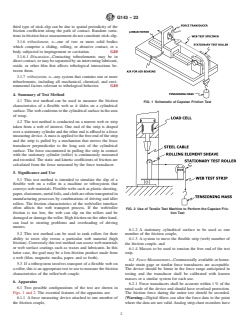
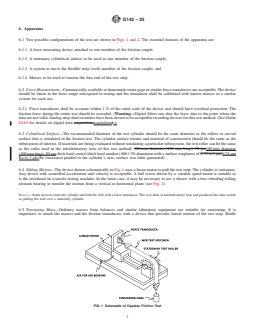
6.1 Two possible configurations of the test are shown in Figs. 1 and 2. The essential features of the apparatus are:
6.1.1 A force measuring device attached to one member of the friction couple,
6.1.2 A stationary cylindrical surface to be used as one member of the friction couple,
6.1.3 A system to move the flexible strip (web) member of the friction couple, and
6.1.4 Masses to be used to tension the free end of the test strip.
6.2 Force Measurement—Commercially available or homemade strain gage or similar force transducers are acceptable. The device
should be linear in the force range anticipated in testing and the transducer shall be calibrated with known masses or a similar
system for each use.
6.2.1 Force transducers shall be accurate within 1 % of the rated scale of the device and should have overload protection. The
friction force during the entire test should be recorded. (Warning—Digital filters can alter the force data to the point where the
data are not valid. Analog strip chart recorders have been shown to be acceptable recording devices for this test method. (See Guide
G163 for details on digital data acquisition)acquisition).))
6.3 Cylindrical Surface—The recommended diameter of the test cylinder should be the same diameter as the rollers or curved
surface that is simulated in the friction test. The cylinder surface texture and material of construction should be the same as the
tribosystem of interest. If materials are being evaluated without simulating a particular tribosystem, the test roller can be the same
as the roller used in the interlaboratory tests of this test method: 100-mm diameter (100 mm long), 50-μm100 mm diameter
(100 mm long), 50 μm thick hard coated (thick hard anodize) 6061-T6 aluminum with a surface roughness of 0.75 to 1 μm 0.75 μm
Ra to 1 μm Ra (measured parallel to the cylinder’s axis; surface was lathe generated).
6.4 Sliding Motion—The device shown schematically in Fig. 1 uses a linear motor to pull the test strip. The cylinder is stationary.
Any device with controlled acceleration and velocity is acceptable. A ball screw driven by a variable speed motor is suitable as
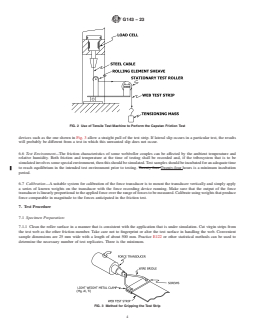
is the crosshead on a tensile testing machine. In the latter case, it may be necessary to use a sheave with a free-wheeling rolling
element bearing to transfer the motion from a vertical to horizontal plane (see Fig. 2).
NOTE 1—Some devices rotate the cylinder and hold the web with a force transducer. This was done in interlaboratory tests and produced the same results
as pulling the web over a stationary cylinder.
6.5 Tensioning Mass—Ordinary masses from balances and similar laboratory equipment are suitable for tensioning. It is
imperative to attach the masses and the friction transducers with a device that prevents lateral motion of the test strip. Bridle
FIG. 1 Schematic of Capstan Friction Test
G143 − 23
FIG. 2 Use of Tensile Test Machine to Perform the Capstan Friction Test
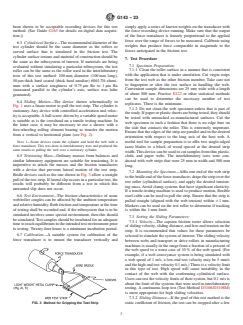
devices such as the one shown in Fig. 3 allow a straight pull of the test strip. If lateral slip occurs in a particular test, the results
will probably be different from a test in which this unwanted slip does not occur.
6.6 Test Environment—The friction characteristics of some web/roller couples can be affected by the ambient temperature and
relative humidity. Both friction and temperature at the time of testing shall be recorded and, if the tribosystem that is to be
simulated involves some special environment, then this should be simulated. Test samples should be incubated for an adequate time
to reach equilibrium in the intended test environment prior to testing. Twenty four Twenty-four hours is a minimum incubation
period.
6.7 Calibration—A suitable system for calibration of the force transducer is to mount the transducer vertically and simply apply
a series of known weights on the transducer with the force recording device running. Make sure that the output of the force
transducer is linearly proportional to the applied force over the range of forces to be measured. Calibrate using weights that produce
force comparable in magnitude to the forces anticipated in the friction test.
7. Test Procedure
7.1 Specimen Preparation:
7.1.1 Clean the roller surface in a manner that is consistent with the application that is under simulation. Cut virgin strips from
the test web as the other friction member. Take care not to fingerprint or alter the test surface in handling the web. Convenient
sample dimensions are 25 mm wide with a length of about 500 mm. Practice E122 or other statistical methods can be used to
determine the necessary number of test replicates. Three is the minimum.
FIG. 3 Method for Gripping the Test Strip
G143 − 23
7.1.2 Do not clean the web specimen unless that is part of the study. If paper or plastic sheets are being tested, they should be tested
with untouched as-manufactured surfaces. Cut the web specimen in such a fashion that there is no edge burr on the side that
contacts the roller. This is extremely important. Ensure that the edges of the strip are parallel and in the desired orientation with
respect to the long axis of the host web. A useful tool for sample preparation is to affix two single-edged razor blades to a block
of wood spaced at the desired strip width. This device can be used to cut samples from thin plastic, cloth, and paper webs. The
interlaboratory tests were conducted with web strips that were 25 mm in width and 500 mm long.
7.2 Mounting the Specimen—Affix one end of the web strip to the bridle end of the force transducer; drape the strip over the test
roller (cylindrical surface), and apply the desired tensioning mass. Avoid clamp systems that have significant elasticity. If a
tensile-testing machine is used to produce motion, flexible steel cable
...