

SIST ISO 17995:2020
Water quality - Detection and enumeration of thermotolerant Campylobacter species
General Information
- Abstract
This document specifies a method for the detection, semi-quantitative and quantitative (MPN) enumeration of thermotolerant Campylobacter species.
The method can be applied to all kinds of waters including: drinking water, ground water and well water, fresh, brackish and saline surface water, swimming pools, spa and hydrotherapy pools, recreational waters, agricultural waters and runoff, untreated and treated wastewater and also sand and other sediments.
This method can be used for the detection of Campylobacter species in a specified sample volume. Clean water samples with low turbidity can be membrane filtered for either a qualitative method, semi-quantitative or quantitative (MPN) method. Water samples with higher turbidity, such as primary and secondary wastewater effluents and sediments, are analysed using the same qualitative, semi-quantitative or quantitative MPN method by direct inoculation of material into bottles or tubes. Sediments can be suspended in a suitable diluent or inoculated directly into enrichment broths.
Users wishing to employ this method are expected to verify its performance for the particular matrix under their own laboratory conditions.
- Status
- Published
- Public Enquiry End Date
- 03-Nov-2019
- Publication Date
- 09-Jan-2020
- Technical Committee
- KAV - Water quality
- Current Stage
- 6060 - National Implementation/Publication (Adopted Project)
- Start Date
- 04-Nov-2019
- Due Date
- 09-Jan-2020
- Completion Date
- 10-Jan-2020
Buy Documents






ISO 17995:2019 - Water quality -- Detection and enumeration of thermotolerant Campylobacter spp

ISO 17995:2019 - Water quality — Detection and enumeration of thermotolerant Campylobacter spp/18/2019
Overview
SIST ISO 17995:2020 - Water quality: Detection and enumeration of thermotolerant Campylobacter spp. specifies a standardized microbiological method for detecting, semi‑quantitatively and quantitatively (MPN) enumerating thermotolerant Campylobacter species in a wide range of water and sediment matrices. The method covers sample processing (membrane filtration or direct inoculation), selective enrichment, isolation on modified charcoal cefoperazone deoxycholate agar (mCCDA), and confirmation/optional speciation steps.
Key technical topics and requirements
- Scope: Applicable to drinking water, groundwater, surface waters (fresh, brackish, saline), recreational waters (pools, spas), agricultural runoff, treated/untreated wastewater, sand and sediments.
- Sample processing:
- Low‑turbidity (clean) waters: membrane filtration for qualitative, semi‑quantitative or MPN methods.
- High‑turbidity waters and sediments: direct inoculation into enrichment broths or suspension of sediments in diluent prior to enrichment.
- Enrichment media:
- Bolton broth for cleaner samples.
- Preston broth for heavily contaminated samples.
- Incubation microaerobically at (37 ± 1) °C for (44 ± 4) h; sample:broth ratio ≤ 10% for single‑strength broths.
- Isolation and enumeration:
- Isolation on mCCDA incubated at (41.5 ± 1) °C for (44 ± 4) h in a microaerobic atmosphere.
- Semi‑quantitative uses at least three 10‑fold volumes (e.g., 10 ml, 100 ml, 1000 ml).
- Quantitative enumeration uses a Most Probable Number (MPN) approach (e.g., 500 ml, 5×100 ml, 5×10 ml).
- Confirmation and optional speciation:
- Presumptive colonies confirmed by morphology, motility, inability to grow aerobically at 25 °C and biochemical tests.
- Optional species identification tests include catalase, hippurate and indoxyl acetate reactions.
- Quality assurance: Users must verify method performance for their specific matrix and laboratory conditions.
Practical applications - who uses SIST ISO 17995:2020
- Public health and environmental microbiology laboratories monitoring waterborne pathogens.
- Drinking water regulators and utilities assessing source water and distribution safety.
- Wastewater treatment operators and agricultural monitoring programs tracking contamination and risk.
- Recreational water managers (pools, spas, beaches) investigating outbreaks or compliance.
- Research institutions studying Campylobacter ecology, survival, and transmission in aquatic environments.
Related standards
- ISO 8199 - General requirements and guidance for microbiological examinations by culture.
- ISO 11133 - Preparation, production, storage and performance testing of culture media.
- ISO 19458 - Water quality - Sampling for microbiological analysis.
SIST ISO 17995:2020 provides a harmonized, defensible approach for detecting and enumerating thermotolerant Campylobacter spp. in diverse water matrices, supporting surveillance, outbreak investigation and regulatory compliance.
Relations
- Effective Date
- 01-Feb-2020
Buy Documents
ISO 17995:2019 - Water quality -- Detection and enumeration of thermotolerant Campylobacter spp
ISO 17995:2019 - Water quality — Detection and enumeration of thermotolerant Campylobacter spp/18/2019
Get Certified
Connect with accredited certification bodies for this standard

CIS Institut d.o.o.
Personal Protective Equipment (PPE) certification body. Notified Body NB-2890 for EU Regulation 2016/425 PPE.

Kiwa BDA Testing
Building and construction product certification.
Kmetijski inštitut Slovenije
Agricultural Institute of Slovenia. Soil testing, plant health, agricultural product analysis.
Sponsored listings
Frequently Asked Questions
SIST ISO 17995:2020 is a standard published by the Slovenian Institute for Standardization (SIST). Its full title is "Water quality - Detection and enumeration of thermotolerant Campylobacter species". This standard covers: This document specifies a method for the detection, semi-quantitative and quantitative (MPN) enumeration of thermotolerant Campylobacter species. The method can be applied to all kinds of waters including: drinking water, ground water and well water, fresh, brackish and saline surface water, swimming pools, spa and hydrotherapy pools, recreational waters, agricultural waters and runoff, untreated and treated wastewater and also sand and other sediments. This method can be used for the detection of Campylobacter species in a specified sample volume. Clean water samples with low turbidity can be membrane filtered for either a qualitative method, semi-quantitative or quantitative (MPN) method. Water samples with higher turbidity, such as primary and secondary wastewater effluents and sediments, are analysed using the same qualitative, semi-quantitative or quantitative MPN method by direct inoculation of material into bottles or tubes. Sediments can be suspended in a suitable diluent or inoculated directly into enrichment broths. Users wishing to employ this method are expected to verify its performance for the particular matrix under their own laboratory conditions.
This document specifies a method for the detection, semi-quantitative and quantitative (MPN) enumeration of thermotolerant Campylobacter species. The method can be applied to all kinds of waters including: drinking water, ground water and well water, fresh, brackish and saline surface water, swimming pools, spa and hydrotherapy pools, recreational waters, agricultural waters and runoff, untreated and treated wastewater and also sand and other sediments. This method can be used for the detection of Campylobacter species in a specified sample volume. Clean water samples with low turbidity can be membrane filtered for either a qualitative method, semi-quantitative or quantitative (MPN) method. Water samples with higher turbidity, such as primary and secondary wastewater effluents and sediments, are analysed using the same qualitative, semi-quantitative or quantitative MPN method by direct inoculation of material into bottles or tubes. Sediments can be suspended in a suitable diluent or inoculated directly into enrichment broths. Users wishing to employ this method are expected to verify its performance for the particular matrix under their own laboratory conditions.
SIST ISO 17995:2020 is classified under the following ICS (International Classification for Standards) categories: 07.100.20 - Microbiology of water; 13.060.70 - Examination of biological properties of water. The ICS classification helps identify the subject area and facilitates finding related standards.
SIST ISO 17995:2020 has the following relationships with other standards: It is inter standard links to SIST ISO 17995:2007. Understanding these relationships helps ensure you are using the most current and applicable version of the standard.
SIST ISO 17995:2020 is available in PDF format for immediate download after purchase. The document can be added to your cart and obtained through the secure checkout process. Digital delivery ensures instant access to the complete standard document.
Standards Content (Sample)
SLOVENSKI STANDARD
01-februar-2020
Nadomešča:
SIST ISO 17995:2007
Kakovost vode - Ugotavljanje prisotnosti in števila termotolerantnih vrst
Campylobacter
Water quality - Detection and enumeration of thermotolerant Campylobacter species
Qualité de l'eau - Recherche et dénombrement d'espèces thermotolérantes du genre
Campylobacter
Ta slovenski standard je istoveten z: ISO 17995:2019
ICS:
07.100.20 Mikrobiologija vode Microbiology of water
13.060.70 Preiskava bioloških lastnosti Examination of biological
vode properties of water
2003-01.Slovenski inštitut za standardizacijo. Razmnoževanje celote ali delov tega standarda ni dovoljeno.
INTERNATIONAL ISO
STANDARD 17995
Second edition
2019-11
Water quality — Detection and
enumeration of thermotolerant
Campylobacter spp
Qualité de l'eau — Recherche et dénombrement d'espèces
thermotolérantes du genre Campylobacter
Reference number
©
ISO 2019
© ISO 2019
All rights reserved. Unless otherwise specified, or required in the context of its implementation, no part of this publication may
be reproduced or utilized otherwise in any form or by any means, electronic or mechanical, including photocopying, or posting
on the internet or an intranet, without prior written permission. Permission can be requested from either ISO at the address
below or ISO’s member body in the country of the requester.
ISO copyright office
CP 401 • Ch. de Blandonnet 8
CH-1214 Vernier, Geneva
Phone: +41 22 749 01 11
Fax: +41 22 749 09 47
Email: copyright@iso.org
Website: www.iso.org
Published in Switzerland
ii © ISO 2019 – All rights reserved
Contents Page
Foreword .iv
Introduction .v
1 Scope . 1
2 Normative references . 1
3 Terms and definitions . 1
4 Principle . 2
4.1 General . 2
4.2 Inoculation and enrichment in selective liquid medium . 2
4.3 Isolation and selection for confirmation . 2
4.4 Confirmation . 2
5 Culture media and reagents . 3
6 Apparatus . 3
7 Sampling, transport and storage . 4
8 Sample processing . 4
8.1 General . 4
8.2 Direct inoculation into enrichment broth . 4
8.3 Membrane filtration . 4
9 Procedure. 5
9.1 Enrichment . 5
9.2 Plating on solid, selective medium. 6
9.3 Reading of presumptive results . 6
9.4 Confirmation . 6
9.4.1 General. 6
9.4.2 Selection of colonies for confirmation . 6
9.4.3 Absence of growth on non-selective agar plates . 7
9.4.4 Motility and cell morphology . 7
9.4.5 Detection of oxidase activity . 7
9.4.6 Interpretation . 7
9.4.7 Further verification . 8
9.5 Identification of Campylobacter species (optional). 8
9.5.1 General. 8
9.5.2 Detection of catalase . . 8
9.5.3 Detection of hippurate hydrolysis . 8
9.5.4 Detection of indoxyl acetate hydrolysis . 9
9.5.5 Interpretation . 9
10 Quality assurance . 9
11 Expression of results . 9
12 Test report .10
Annex A (normative) Flow diagram of the method .11
Annex B (normative) Semi‑quantitative analysis .12
Annex C (normative) Composition and preparation of culture media and reagents .13
Annex D (normative) Performance testing for the quality assurance of the culture media .22
Annex E (informative) Performance characteristics .23
Annex F (informative) Additional information about campylobacters .24
Bibliography .25
Foreword
ISO (the International Organization for Standardization) is a worldwide federation of national standards
bodies (ISO member bodies). The work of preparing International Standards is normally carried out
through ISO technical committees. Each member body interested in a subject for which a technical
committee has been established has the right to be represented on that committee. International
organizations, governmental and non-governmental, in liaison with ISO, also take part in the work.
ISO collaborates closely with the International Electrotechnical Commission (IEC) on all matters of
electrotechnical standardization.
The procedures used to develop this document and those intended for its further maintenance are
described in the ISO/IEC Directives, Part 1. In particular, the different approval criteria needed for the
different types of ISO documents should be noted. This document was drafted in accordance with the
editorial rules of the ISO/IEC Directives, Part 2 (see www .iso .org/ directives).
Attention is drawn to the possibility that some of the elements of this document may be the subject of
patent rights. ISO shall not be held responsible for identifying any or all such patent rights. Details of
any patent rights identified during the development of the document will be in the Introduction and/or
on the ISO list of patent declarations received (see www .iso .org/ patents).
Any trade name used in this document is information given for the convenience of users and does not
constitute an endorsement.
For an explanation of the voluntary nature of standards, the meaning of ISO specific terms and
expressions related to conformity assessment, as well as information about ISO's adherence to the
World Trade Organization (WTO) principles in the Technical Barriers to Trade (TBT) see www .iso .org/
iso/ foreword .html.
This document was prepared by Technical Committee ISO/TC 147, Water quality, Subcommittee SC 4,
Microbiological methods.
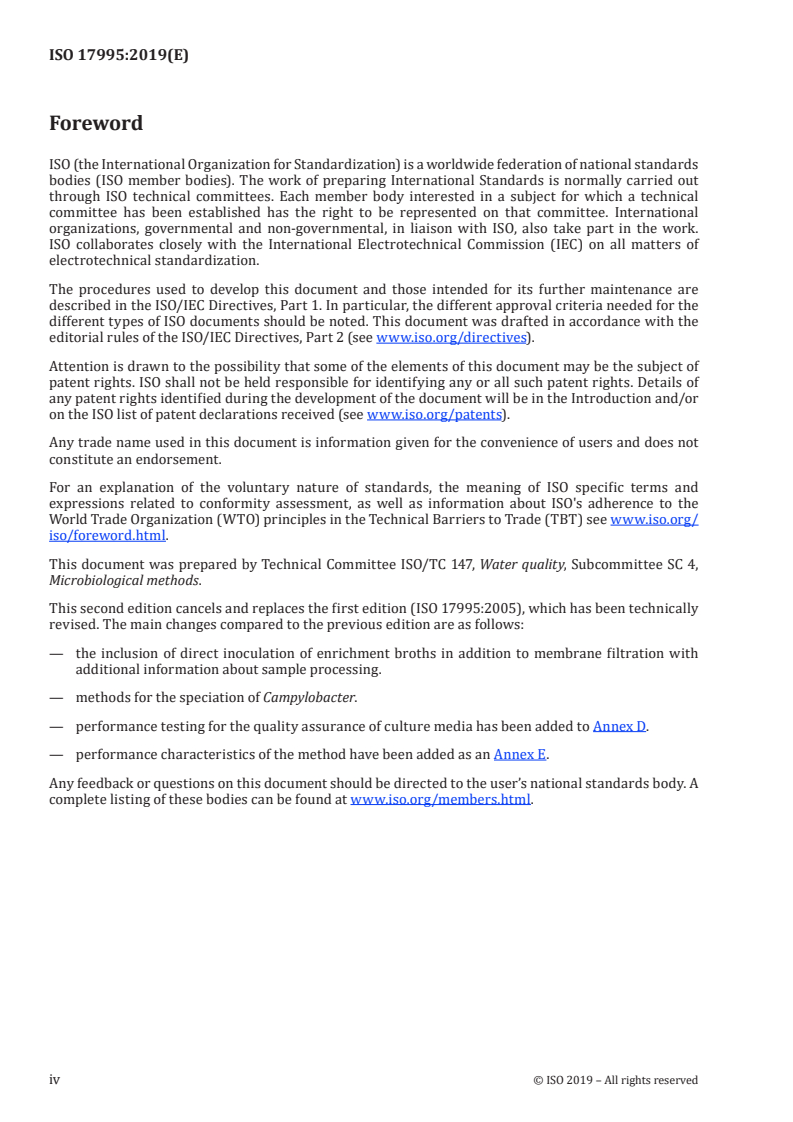
This second edition cancels and replaces the first edition (ISO 17995:2005), which has been technically
revised. The main changes compared to the previous edition are as follows:
— the inclusion of direct inoculation of enrichment broths in addition to membrane filtration with
additional information about sample processing.
— methods for the speciation of Campylobacter.
— performance testing for the quality assurance of culture media has been added to Annex D.
— performance characteristics of the method have been added as an Annex E.
Any feedback or questions on this document should be directed to the user’s national standards body. A
complete listing of these bodies can be found at www .iso .org/ members .html.
iv © ISO 2019 – All rights reserved
Introduction
The thermotolerant Campylobacter species are not thought to propagate as free living but are zoonotic
pathogenic bacteria of mammals and birds and which cause disease in humans. Campylobacter
jejuni subsp. jejuni and Campylobacter coli are common causes of intestinal infections in humans.
Campylobacter upsaliensis is found mainly in cats and dogs and is of minor importance for human
infections. Campylobacter lari is less frequently associated with human infections. Campylobacter
infections give rise to a flu-like illness with malaise, fever and myalgia followed by diarrhoea. The
vehicles for Campylobacter infections are usually food, farm animals, pets and person-to-person
contact; water is also important. They can be isolated from waters contaminated with human or animal
faeces such as wastewater and surface waters. The bacteria have been demonstrated to survive within
amoebae. Outbreaks of campylobacteriosis have been reported in relation to the use of contaminated
drinking water and sporadic cases from recreational water use.
INTERNATIONAL STANDARD ISO 17995:2019(E)
Water quality — Detection and enumeration of
thermotolerant Campylobacter spp
WARNING — Persons using this document should be familiar with normal laboratory practice.
This document does not purport to address all of the safety problems, if any, associated with its
use. It is the responsibility of the user to establish appropriate safety and health practices.
IMPORTANT — It is absolutely essential that tests conducted in accordance with this document
be carried out by suitably trained staff.
1 Scope
This document specifies a method for the detection, semi-quantitative and quantitative (MPN)
enumeration of thermotolerant Campylobacter species.
The method can be applied to all kinds of waters including: drinking water, ground water and well
water, fresh, brackish and saline surface water, swimming pools, spa and hydrotherapy pools,
recreational waters, agricultural waters and runoff, untreated and treated wastewater and also sand
and other sediments.
This method can be used for the detection of Campylobacter species in a specified sample volume. Clean
water samples with low turbidity can be membrane filtered for either a qualitative method, semi-
quantitative or quantitative (MPN) method. Water samples with higher turbidity, such as primary
and secondary wastewater effluents and sediments, are analysed using the same qualitative, semi-
quantitative or quantitative MPN method by direct inoculation of material into bottles or tubes.
Sediments can be suspended in a suitable diluent or inoculated directly into enrichment broths.
Users wishing to employ this method are expected to verify its performance for the particular matrix
under their own laboratory conditions.
2 Normative references
The following documents are referred to in the text in such a way that some or all of their content
constitutes requirements of this document. For dated references, only the edition cited applies. For
undated references, the latest edition of the referenced document (including any amendments) applies.
ISO 8199, Water quality — General requirements and guidance for microbiological examinations by culture
ISO 11133, Microbiology of food, animal feed and water — Preparation, production, storage and
performance testing of culture media
ISO 19458, Water quality — Sampling for microbiological analysis
3 Terms and definitions
For the purposes of this document, the following terms and definitions apply.
ISO and IEC maintain terminological databases for use in standardization at the following addresses:
— ISO Online browsing platform: available at https:// www .iso .org ./ obp
— IEC Electropedia: available at http:// www .electropedia .org/
3.1
Campylobacter
microorganisms forming characteristic colonies on solid selective media when incubated in a
microaerobic atmosphere at 41,5 °C and which possess the characteristic morphology, motility,
biochemical and growth properties described when tests are conducted in accordance with ISO 17995
Note 1 to entry: Thermotolerant Campylobacter species of relevance in human infections include Campylobacter
jejuni subsp. jejuni (hereafter referred to as Campylobacter jejuni), Campylobacter coli, Campylobacter lari and
possibly Campylobacter upsaliensis. Campylobacter upsaliensis is found mainly in cats and dogs and is of minor
importance for human infection.
3.2
detection of Campylobacter
determination of the presence or absence, semi-quantitative enumeration or quantitative enumeration
using a most probable number (MPN) system of Campylobacter in water and solid materials when the
test is conducted in accordance with ISO 17995
4 Principle
4.1 General
In general, the detection of Campylobacter requires enrichment followed by isolation of colonies and
their confirmation. The flow diagram of the procedure in Annex A shall be applied.
4.2 Inoculation and enrichment in selective liquid medium
Samples are inoculated either directly or after concentration using membrane filtration into one of two
selective enrichment broths depending on the expected level of background microorganisms: Bolton
broth for clean water and Preston broth for more heavily contaminated water. A single sample volume
is processed for Campylobacter detection and, where necessary, at least three 10-fold volumes (for
example 10 ml, 100 ml and 1 000 ml) are used for a semi-quantitative determination (Annex B shall
be applied). For a quantitative (MPN) determination, volumes of 500 ml, 5 × 100 ml, 5 × 10 ml and,
where counts may be high, smaller volumes are used or the initial sample is diluted. The broths are
then incubated microaerobically at (37 ± 1) °C for (44 ± 4) h.
The ratio of sample to enrichment broth shall be 10 % or less if single strength broth is used.
4.3 Isolation and selection for confirmation
From the enrichment broth cultures in 4.2, liquid selective media are inoculated onto modified charcoal
cefoperazone deoxycholate agar (mCCDA).
The mCCDA plates are then incubated at (41,5 ± 1) °C for (44 ± 4) h in a microaerobic atmosphere
and examined for characteristic colonies after incubation. Colonies with typical characteristics are
presumed to be Campylobacter (see 9.3). It is necessary to confirm at least one colony from each plate to
demonstrate that the corresponding enrichment culture is positive for the presence of Campylobacter
species.
4.4 Confirmation
Confirmation of suspect colonies of Campylobacter species involves biochemical, morphological and
physiological tests. See flow diagram in Annex A.
The colonies presumed to be Campylobacter are inoculated on the non-selective Columbia agar or other
appropriate solid non-selective media, and are then confirmed by means of microscopic examination,
failure to grow aerobically at 25 °C and appropriate biochemical tests. Optionally, Campylobacter
species are further identified by specific biochemical tests.
2 © ISO 2019 – All rights reserved
For species identification, it is recommended that more than one isolate per enrichment culture is tested.
If typical Campylobacter species are confirmed or identified, the result is given as the qualitative,
semi-quantitative or quantitative (MPN) estimate per volume of sample.
5 Culture media and reagents
For current laboratory practice see ISO 8199 and ISO 11133.
The composition and preparation of the culture media and reagents given in Annex C shall be used. The
performance testing requirements given in Annex D shall be applied.
6 Apparatus
Usual microbiological laboratory equipment (as specified in ISO 8199) and, in particular, the following:
6.1 Water baths or incubators, capable of operating at (37 ± 1) °C and (41,5 ± 1) °C.
6.2 Water bath, capable of operating between 47 °C and 50 °C.
6.3 Membrane filtration equipment, as specified in ISO 8199.
6.4 Membrane filters, sterile membrane filters made of cellulose ester with a diameter of 45 mm to
50 mm and a pore size of 0,45 µm. Larger diameter membranes may be used with suitable filter holders
provided they have a pore size of 0,45 µm.
6.5 pH‑meter, accurate to within 0,2 pH units at 25 °C.
6.6 Apparatus suitable for achieving a microaerobic atmosphere, with oxygen content of (5 ± 2) %,
carbon dioxide (10 ± 3) %, optional hydrogen at ≤10 %, with the balance being nitrogen.
Appropriate gastight containers of, for example, 3,5 l capacity are used to hold Petri dishes and/
or flasks or bottles for the enrichment broth, such as bacteriological anaerobic jars. The appropriate
microaerobic atmosphere can be obtained using commercially available gas-generating kits, following
precisely the manufacturer's instructions, particularly those relating to the volume of the jar and the
capacity of the gas-generating kit. The jar may be flushed and filled with an appropriate gas mixture
prior to incubation. Alternatively, an incubator with appropriately modified atmosphere (approximately
5 % oxygen and 10 % carbon dioxide) can also be used.
Gas-generating pouches can be used if they are able to maintain an atmosphere with approximately 5 %
oxygen and approximately 10 % carbon dioxide.
6.7 Microscope, preferably with phase contrast or differential interference contrast. Dark ground
illumination can also be used.
6.8 Bottles, 100 ml to 250 ml, with screw caps for the selective enrichments.
6.9 Vented Petri dishes, sterile, 90 mm.
6.10 Disinfected forceps, for handling membrane filters.
6.11 Refrigerator, capable of operating at (5 ± 3) °C.
7 Sampling, transport and storage
It is important that the laboratory receive a sample which is truly representative and has not been
damaged or changed during transport or storage. Be aware that campylobacters are very sensitive
to adverse conditions. Keep samples cool (5 ± 3) °C and in the dark until they are processed. The
temperature should not be above that at which the sample was taken, nor should the sample be allowed
to freeze. Avoid unnecessary mixing with air. Process the samples as soon as possible after collection,
but within a maximum of 30 h. In all other aspects of sampling, transport and storage, follow the
instructions given in ISO 19458.
NOTE 1 Campylobacters survive well in clean water at (3 ± 2) °C. At higher temperatures or in other media,
they can quickly deteriorate.
NOTE 2 It is important that sample bottles are filled to the rim. This avoids air spaces in the container and
helps to ensure Campylobacter survival.
8 Sample processing
8.1 General
Depending on the sample properties and expected level of faecal contamination, use direct
inoculation (see 8.2) or membrane filtration (see 8.3) for sample processing. Direct inoculation is
suitable for samples with a high contamination level such as wastewater, whereas membrane filtration
is suitable for surface water, groundwater and drinking water samples. Direct inoculation is only
suitable for relatively small volumes, for example 100 ml or less and membrane filtration is suitable for
larger volumes.
The ratio of a maximum of 10% of sample to enrichment broth is used (for example 100 ml of sample
to 1 L of broth) to avoid significant change to the composition of the medium. In addition, background
microorganisms present in the sample are diluted sufficiently to avoid their inhibition of the growth of
campylobacters during enrichment.
Throughout the processing steps, care should be taken to minimise the risk of cross-contamination
of enrichment broths. The use of pipette tips with sterile filters is essential if automated pipettes are
used. In addition any positive controls should be processed separately.
8.2 Direct inoculation into enrichment broth
Samples with expected high contamination levels are inoculated directly into Preston broth (see C.2).
Where the expected level of background microorganisms is low and samples cannot be processed by
membrane filtration, Bolton broth (see C.3) may be used. If no information about the contamination
level is available, both broths should be used.
Double strength broth should be used for large volumes. Single strength broth should be used for
relatively small volumes of water where the ratio of sample to enrichment broth shall be 10 % or less.
Generally, volumes of 100 ml, 50 ml and 10 ml are inoculated into an equal volume of double strength
broth. Volumes of 1 ml and 0,1 ml if required are inoculated into 10 ml of single strength broth.
Solid material can be weighed directly into single strength enrichment broths. Aliquots of 10 g can
be weighed into 100 ml of enrichment broth, 1 g and smaller aliquots should be weighed into 10 ml of
enrichment broth.
NOTE When high numbers of campylobacters are expected, the sample can also additionally be streaked
directly onto mCCDA (see C.4) without prior selective enrichment.
8.3 Membrane filtration
Samples with expected low levels of contamination are filtered using membrane filters with a pore size of
0,45 µm (see 6.4). Select one of the two enrichment broths depending on the expected level of background
4 © ISO 2019 – All rights reserved
microorganisms and use 100 ml of single strength broth for the enrichment of each sample volume.
Bolton broth (see C.3) is used for clean samples and Preston broth (see C.2) for heavily contaminated
water. If no information about the contamination level is available, both broths should be used.
For detection of campylobacters in drinking water, other treated waters and clean surface waters, a
1 000 ml sample is filtered. If required, larger volumes may be processed using more filters or, where
necessary, larger diameter filters may be used. Alternative concentration methods may be used, for
example ultra-filtration or centrifugation providing that they are verified for recovery by the user. For
more contaminated water, smaller volumes should be used and, for samples containing more particulate
material, several membrane filters may be used to filter the required volume. All membrane filters from
one sample volume shall be placed in the same container of enrichment broth.
For a semi-quantitative determination, volumes of 10 ml, 100 ml and 1 000 ml are filtered (see Annex B).
The smaller volumes of 10 ml can also be pipetted directly into 100 ml of single strength medium or
10 ml of double strength medium.
For quantitative estimates, an MPN series can be used. In an MPN series, 100 ml and larger volumes
can be filtered and membrane filters from different volumes are placed into 100 ml of separate single
strength broth. Smaller volumes of 10 ml can be pipetted into 100 ml of single strength medium or
10 ml of double strength medium, and 1 ml can be pipetted into 10 ml of single strength medium. For
example, volumes of 5 × 100 ml and 500 ml can be filtered and membranes placed into 100 ml of single
strength broth. Volumes of 10 ml can be directly inoculated into 5 × 100 ml of single strength medium
or 5 × 10 ml of double strength medium. Volumes of 5 × 1 ml can be inoculated directly into 10 ml of
single strength broth.
After filtration, the membranes are transferred using disinfected forceps (see 6.10) into enrichment
broths.
9 Procedure
9.1 Enrichment
For samples known to have low concentrations of background microorganisms, use the less selective
Bolton broth for enrichment and for samples expected to have a high concentration of background
microorganisms use the highly selective Preston broth. For samples where the background microbial
concentration is unknown, enrich parts of each sample in both Preston and Bolton broths. Preston broth
may be too selective to allow the recovery of some strains of C. coli. Bolton broth may not be selective
enough to counteract the growth of non-campylobacters in some samples. If the available sample size is
limited, chose one of the enrichment broths which is considered to be the most appropriate.
NOTE 1 The amount of sample (volume or weight) to be analysed can vary with the sample material and the
scope of the investigation.
Bring enrichment broths to room temperature prior to inoculation.
Transfer the samples (see 8.2 and 8.3) to bottles with the appropriate volumes of enrichment broth(s).
Put the inoculated broths in jars (6.6) or in an incubator with modified atmosphere. Leave the caps
loosely placed on the inoculated broths during incubation to allow the modified atmosphere to reach
the broths. Apply the modified atmosphere to the jars (6.6) and incubate at (37 ± 1) °C for (44 ± 4) h.
NOTE 2 The Preston campylobacter-selective supplement (see C.2.2) contains antibiotics (polymyxin B and
rifampicin) known to be rather toxic towards C. coli and towards sub-lethally injured C. jejuni. Accordingly,
pre-enrichment for 4 h in Preston broth without the selective supplement prior to the enrichment in the complete
Preston broth (see C.2) has been found by some laboratories to increase the recovery of campylobacters from
waters with low numbers of other microorganisms. The Bolton broth selective supplement (see C.3.2) does not
include antibiotics known to be toxic towards campylobacters.
NOTE 3 Some campylobacters can die or grow too slowly if the incubation temperature is below 36 °C.
9.2 Plating on solid, selective medium
After incubation for (44 ± 4) h, remove the broths carefully from the jars to avoid re-suspension of
sedimented material including background microorganisms. With a sterile loop, transfer approximately
10 µl of enrichment culture onto the surface of an mCCDA (C.4) plate. Draw the inocula from just
below the surface of the broths and streak onto the surface of the plates. Without delay, incubate the
inoculated plates in jars with a modified atmosphere (see 6.6) at (41,5 ± 1) °C for (44 ± 4) h.
NOTE 1 Bolton broth (see C.3) contains cefoperazone. The use of a second plating medium with selective
agents different from those in mCCDA (see C.4) could improve Campylobacter detection, especially in the presence
of background microflora resistant to third generation β-lactams like cefoperazone.
NOTE 2 The use of additional mCCDA plates for spread-plating 100 µl of enrichment broths can enhance the
detection of low counts or injured Campylobacter.
9.3 Reading of presumptive results
Examine the inoculated mCCDA plates for visible growth after incubation.
Typical colonies of campylobacters are small, flat or convex with a greyish glossy surface often with
a metallic sheen. They have a tendency to spread along the inoculation tracks. Well-spaced colonies
resemble droplets of fluid. On moist agar, a thin, spreading film may be seen. Colony mass collected on a
loop has a tan or creamy colour. See Annex F for additional guidance. Images of Campylobacter colonies
on mCCDA are available at https:// standards .iso .org/ iso/ 17995/ ed -2/ en.
In cases of doubt, collect colony material from the surface of the plates and check under the microscope
for typical appearance (see 9.4.4).
With continued incubation, colonies become flat or convex with a dull surface. A metallic sheen may
develop. The colour of the colonies varies from transparent to greyish or whitish.
NOTE After the first examination of plates, the prolonged incubation of negative plates for up to 92 h might
enhance the detection of injured Campylobacter, for example, from disinfected waters.
9.4 Confirmation
9.4.1 General
Throughout all tests, be aware that cultures may deteriorate quickly in light and air and follow the
procedures in 9.4 without delay. At least one colony from each plate needs to be confirmed to say the
corresponding enrichment broth was positive.
If speciation is required, several colonies should be subcultured and, if necessary, the cultures sent to
an appropriate reference laboratory.
Alternative methods for confirmation and species identification such as commercially available
biochemical test kits, gene amplification using genus and species specific PCR assays or matrix-assisted
laser desorption/ionisation time-of-flight mass spectrometry (MALDI-TOF MS) may be used provided
they have been verified by the user.
9.4.2 Selection of colonies for confirmation
For confirmation, take from each plate of mCCDA (see 9.3) at least one colony considered to be typical
or suspected of being Campylobacter. One confirmed isolate per sample is sufficient. If the first colony is
negative, select up to four more colonies.
If needed, store the original isolation plates (see 9.3) under microaerobic conditions at (5 ± 3) °C for use
in further confirmation and /or identification. Campylobacter isolates can loose their culturability when
stored aerobically at 5 °C.
6 © ISO 2019 – All rights reserved
Streak each of the suspected colonies onto a blood agar plate (see C.5), mCCDA basal medium without
supplements (see C.4.1), Columbia agar (see C.5), or other non-selective agar plates which have been
demonstrated to support the growth of campylobacters, in order to allow the development of well-
isolated colonies. Incubate the plates in a microaerobic atmosphere at 41,5 °C from (24 ± 2) h to
(44 ± 4) h. Use well-isolated freshly grown colonies for the examination of growth aerobically at 25 °C
(see 9.4.3), morphology and motility (see 9.4.4), oxidase (see 9.4.5) and also for identification (see 9.5).
9.4.3 Absence of growth on non‑selective agar plates
Using the cultures obtained in 9.4.2, inoculate a rich, non-selective agar plate, blood agar (see C.5),
mCCDA basal medium without supplements (see C.4.1), Columbia agar (see C.5), or other non-selective
agar plates which have been demonstrated to support the growth of campylobacters. Incubate the
plates aerobically at 25 °C for (44 ± 4) h.
Campylobacters do not grow aerobically at 25 °C. Arcobacter spp. will grow at 25 °C aerobically and
resemble Campylobacter in colony appearance, morphology and motility, and reaction to the oxidase test.
Positive and negative controls should be analysed alongside to confirm the results. Examples of suitable
control strains are Campylobacter jejuni WDCM 00005 (positive control, no growth) and Escherichia coli
WDCM 00012 (negative control, good growth).
9.4.4 Motility and cell morphology
Suspend material from a suspect colony in a suitable nutrient broth like Preston basal broth (see C.2.1)
on a slide. Cover with a cover slip and examine immediately under the microscope, preferably using
phase contrast or differential interference contrast. Alternatively, motility may be demonstrated by
similar microscopy using a hanging drop (see Reference [1]).
Campylobacters are highly motile, slender rods with a spiral appearance. Motility is characterized
by darting or corkscrew-like movements. Campylobacters can be immobilized prior to microscopy
for typical morphology by suspending in water instead of a nutrient broth. As an alternative to phase
contrast microscopy techniques for examining the appearance, campylobacters can be studied by
dark-field microscopy or after staining a smear for 5 min with 20 g/l carbolfuchsin. Gram staining often
gives unsatisfactory results with campylobacters.
Confirm the results using positive and negative controls. Examples of suitable control strains are
Campylobacter jejuni WDCM 00005 (positive control) and Escherichia coli WDCM 00012 (negative
control).
9.4.5 Detection of oxidase activity
Perform the test using fresh colony material from a non-selective agar (see C.5 or C.4.1) and oxidase
reagent (see C.6) on a filter paper in a Petri dish. With a platinum (not Ni chrome) wire loop, plastic
loop, wooden stick or glass rod, smear some of the growth onto the prepared filter paper. Regard the
appearance of a deep blue-purple colour within 10 s as a positive reaction. Commercial oxidase strips
should be read in accordance with the manufacturer’s instructions.
Campylobacters are oxidase-positive, but the reaction may be delayed by up to 10 s. Positive and negative
controls should be analysed alongside to confirm the results. Examples of suitable control strains are
Campylobacter jejuni WDCM 00005 (oxidase positive control) and Escherichia coli WDCM 00012 (oxidase
negative control).
9.4.6 Interpretation
Campylobacter gives results in accordance with Table 1. If typical campylobacters are present, report
this as indicated in Clause 11.
Table 1 — Characteristics of Campylobacter
Aerobic growth (9.4.3) −
Motility (9.4.4) Characteristic darting, often rotating, motility
a
Morphology (9.4.4) Curved or spiral shaped rods
Oxidase (9.4.5) +
+ = positive.
− = negative.
a
Older cultures may rapidly lose their characteristic shape and motility and turn into less motile coccoid-like forms.
9.4.7 Further verification
If further verification is necessary isolates may be speciated (see 9.5) or, alternatively, isolates could be
sent to a reference laboratory for species identification and typing by phenotypic or molecular methods.
Be sure to adhere strictly to the instructions for transport given by this laboratory in order to avoid the
campylobacters dying due to adverse conditions during transport.
9.5 Identification of Campylobacter species (optional)
9.5.1 General
Among the Campylobacter spp. growing at 41,5 °C, the most frequently encountered species are
Campylobacter jejuni and Campylobacter coli. Campylobacter lari and Campylobacter upsaliensis have also
been described. The characteristics given in Table 2 permit their differentiation. The isolation of other
Campylobacter species is unlikely under the culturing conditions described in this document.
9.5.2 Detection of catalase
From each subculture of selected colonies in 9.4.2, deposit a loop of culture into a drop of hydrogen
peroxide (see C.7.1) on a clean microscope slide.
The test is positive if bubbles appear within 30 s.
Positive and negative controls should be analysed alongside to confirm the results. Examples of suitable
control strains are Campylobacter jejuni WDCM 00005 (positive control) and Enterococcus faecalis
WDCM 00085 or WDCM 00087 (negative control).
9.5.3 Detection of hippurate hydrolysis
For each colony selected in 9.4.2, prepare a heavy suspension in a tube of appropriate size containing
0,4 ml of a sodium hippurate solution (see C.8.1), taking care not to incorporate any agar.
Shake in order to mix thoroughly and incubate for 2 h in a water bath (6.1) set at 37 °C or 4 h in an
incubator (6.1) set at 37 °C.
After incubation, carefully add 0,2 ml of a ninhydrin solution (C.8.2) on top of the sodium hippurate
solution. Do not shake.
Interpret after incubation of an additional 10 min at 37 °C. A dark violet colour indicates a positive
reaction and a pale violet colour or no change in colour indicates a negative reaction.
Positive and negative controls should be analysed alongside to confirm the results. Examples of
suitable control strains are Campylobacter jejuni WDCM 00005 (positive control) and Campylobacter
coli WDCM 00004 (negative control).
NOTE Different inoculum levels can cause false positive/negative results.
8 © ISO 2019 – All rights reserved
9.5.4 Detection of indoxyl acetate hydrolysis
Place a loop full (1 µl) of colony material selected in 9.4.2 on an indoxyl acetate disc (C.9) and add a drop
of sterile distilled water. A loopful of colony material is required for a clear reaction.
If the indoxyl acetate is hydrolysed, a colour change to dark blue occurs within 5 min to 10 min. No
colour change indicates that hydrolysis has not taken place.
Positive and negative controls should be analysed alongside to confirm the results. Examples of
suitable control strains are Campylobacter jejuni WDCM 00005 (positive control) and Campylobacter
lari WDCM 00204 (negative control).
9.5.5 Interpretation
Campylobacter species growing at 41,5 °C may be identified at a species level in accordance with Table 2.
Table 2 — Characteristics of Campylobacter species
Characteristics C. jejuni C. coli C. lari C. upsaliensis
Catalase (9.5.2) + + + − or weak +
a
Hydrolysis of hippurate (9.5.3) + − − −
Indoxyl acetate (9.5.4) + + − +
+ = positive.
− = negative.
a
Some hippurate-negative C. jejuni strains have been reported.
10 Quality assurance
The laboratory shall have a clearly defined quality control system to ensure that the apparatus, culture
media, reagents and techniques are suitable for the test. The use of positive and negative controls is
part of this system.
Campylobacter jejuni WDCM 00005 or WDCM 00156, Campylobacter coli WDCM 00004 or WDCM 00072
and Campylobacter lari WDCM 00204 are suitable positive controls for this method. Suitable negative
controls include Escherichia coli WDCM 00012 or WDCM 00013, or Staphylococcus aureus WDCM 00032
or WDCM 00034 (see Table D.1).
11 Expression of results
If the presence of typical campylobacters or defined species of Campylobacter genus are confirmed (see
9.4), report the result as thermotolerant Campylobacter or a defined species of the genus Campylobacter
detected in the sample volume examined.
A semi-quantitative estimate of the numbers present in the sample is made from results with different
test volumes (see Annex B).
The proportion of positive and negative enrichment broths obtained from an MPN analysis can be used
to derive an MPN count for the volume of sample examined. A calculator that fulfils these requirements
is available at https:// standards .iso .org/ iso/ 8199.
For example, in an eleven tube series using 1 × 500 ml, 5 × 100 ml and 5 × 10 ml where the 500 ml
is positive, the 5 × 100 ml are positive and only 2 of the 10 ml are positive, the count is calculated as
54 campylobacters per litre.
It is important that sufficient dilutions are used such that some of the enrichment broths are negative
to obtain an MPN count.
12 Test report
The test report shall include at least the following information:
a) the test method used, together with a reference to this document, i.e. ISO 17995:2019;
b) all details necessary for the complete identification of the sample;
c) the result of the test, as specified in Clause 11;
d) details of any particul
...
INTERNATIONAL ISO
STANDARD 17995
Second edition
2019-11
Water quality — Detection and
enumeration of thermotolerant
Campylobacter spp
Qualité de l'eau — Recherche et dénombrement d'espèces
thermotolérantes du genre Campylobacter
Reference number
©
ISO 2019
© ISO 2019
All rights reserved. Unless otherwise specified, or required in the context of its implementation, no part of this publication may
be reproduced or utilized otherwise in any form or by any means, electronic or mechanical, including photocopying, or posting
on the internet or an intranet, without prior written permission. Permission can be requested from either ISO at the address
below or ISO’s member body in the country of the requester.
ISO copyright office
CP 401 • Ch. de Blandonnet 8
CH-1214 Vernier, Geneva
Phone: +41 22 749 01 11
Fax: +41 22 749 09 47
Email: copyright@iso.org
Website: www.iso.org
Published in Switzerland
ii © ISO 2019 – All rights reserved
Contents Page
Foreword .iv
Introduction .v
1 Scope . 1
2 Normative references . 1
3 Terms and definitions . 1
4 Principle . 2
4.1 General . 2
4.2 Inoculation and enrichment in selective liquid medium . 2
4.3 Isolation and selection for confirmation . 2
4.4 Confirmation . 2
5 Culture media and reagents . 3
6 Apparatus . 3
7 Sampling, transport and storage . 4
8 Sample processing . 4
8.1 General . 4
8.2 Direct inoculation into enrichment broth . 4
8.3 Membrane filtration . 4
9 Procedure. 5
9.1 Enrichment . 5
9.2 Plating on solid, selective medium. 6
9.3 Reading of presumptive results . 6
9.4 Confirmation . 6
9.4.1 General. 6
9.4.2 Selection of colonies for confirmation . 6
9.4.3 Absence of growth on non-selective agar plates . 7
9.4.4 Motility and cell morphology . 7
9.4.5 Detection of oxidase activity . 7
9.4.6 Interpretation . 7
9.4.7 Further verification . 8
9.5 Identification of Campylobacter species (optional). 8
9.5.1 General. 8
9.5.2 Detection of catalase . . 8
9.5.3 Detection of hippurate hydrolysis . 8
9.5.4 Detection of indoxyl acetate hydrolysis . 9
9.5.5 Interpretation . 9
10 Quality assurance . 9
11 Expression of results . 9
12 Test report .10
Annex A (normative) Flow diagram of the method .11
Annex B (normative) Semi‑quantitative analysis .12
Annex C (normative) Composition and preparation of culture media and reagents .13
Annex D (normative) Performance testing for the quality assurance of the culture media .22
Annex E (informative) Performance characteristics .23
Annex F (informative) Additional information about campylobacters .24
Bibliography .25
Foreword
ISO (the International Organization for Standardization) is a worldwide federation of national standards
bodies (ISO member bodies). The work of preparing International Standards is normally carried out
through ISO technical committees. Each member body interested in a subject for which a technical
committee has been established has the right to be represented on that committee. International
organizations, governmental and non-governmental, in liaison with ISO, also take part in the work.
ISO collaborates closely with the International Electrotechnical Commission (IEC) on all matters of
electrotechnical standardization.
The procedures used to develop this document and those intended for its further maintenance are
described in the ISO/IEC Directives, Part 1. In particular, the different approval criteria needed for the
different types of ISO documents should be noted. This document was drafted in accordance with the
editorial rules of the ISO/IEC Directives, Part 2 (see www .iso .org/ directives).
Attention is drawn to the possibility that some of the elements of this document may be the subject of
patent rights. ISO shall not be held responsible for identifying any or all such patent rights. Details of
any patent rights identified during the development of the document will be in the Introduction and/or
on the ISO list of patent declarations received (see www .iso .org/ patents).
Any trade name used in this document is information given for the convenience of users and does not
constitute an endorsement.
For an explanation of the voluntary nature of standards, the meaning of ISO specific terms and
expressions related to conformity assessment, as well as information about ISO's adherence to the
World Trade Organization (WTO) principles in the Technical Barriers to Trade (TBT) see www .iso .org/
iso/ foreword .html.
This document was prepared by Technical Committee ISO/TC 147, Water quality, Subcommittee SC 4,
Microbiological methods.
This second edition cancels and replaces the first edition (ISO 17995:2005), which has been technically
revised. The main changes compared to the previous edition are as follows:
— the inclusion of direct inoculation of enrichment broths in addition to membrane filtration with
additional information about sample processing.
— methods for the speciation of Campylobacter.
— performance testing for the quality assurance of culture media has been added to Annex D.
— performance characteristics of the method have been added as an Annex E.
Any feedback or questions on this document should be directed to the user’s national standards body. A
complete listing of these bodies can be found at www .iso .org/ members .html.
iv © ISO 2019 – All rights reserved
Introduction
The thermotolerant Campylobacter species are not thought to propagate as free living but are zoonotic
pathogenic bacteria of mammals and birds and which cause disease in humans. Campylobacter
jejuni subsp. jejuni and Campylobacter coli are common causes of intestinal infections in humans.
Campylobacter upsaliensis is found mainly in cats and dogs and is of minor importance for human
infections. Campylobacter lari is less frequently associated with human infections. Campylobacter
infections give rise to a flu-like illness with malaise, fever and myalgia followed by diarrhoea. The
vehicles for Campylobacter infections are usually food, farm animals, pets and person-to-person
contact; water is also important. They can be isolated from waters contaminated with human or animal
faeces such as wastewater and surface waters. The bacteria have been demonstrated to survive within
amoebae. Outbreaks of campylobacteriosis have been reported in relation to the use of contaminated
drinking water and sporadic cases from recreational water use.
INTERNATIONAL STANDARD ISO 17995:2019(E)
Water quality — Detection and enumeration of
thermotolerant Campylobacter spp
WARNING — Persons using this document should be familiar with normal laboratory practice.
This document does not purport to address all of the safety problems, if any, associated with its
use. It is the responsibility of the user to establish appropriate safety and health practices.
IMPORTANT — It is absolutely essential that tests conducted in accordance with this document
be carried out by suitably trained staff.
1 Scope
This document specifies a method for the detection, semi-quantitative and quantitative (MPN)
enumeration of thermotolerant Campylobacter species.
The method can be applied to all kinds of waters including: drinking water, ground water and well
water, fresh, brackish and saline surface water, swimming pools, spa and hydrotherapy pools,
recreational waters, agricultural waters and runoff, untreated and treated wastewater and also sand
and other sediments.
This method can be used for the detection of Campylobacter species in a specified sample volume. Clean
water samples with low turbidity can be membrane filtered for either a qualitative method, semi-
quantitative or quantitative (MPN) method. Water samples with higher turbidity, such as primary
and secondary wastewater effluents and sediments, are analysed using the same qualitative, semi-
quantitative or quantitative MPN method by direct inoculation of material into bottles or tubes.
Sediments can be suspended in a suitable diluent or inoculated directly into enrichment broths.
Users wishing to employ this method are expected to verify its performance for the particular matrix
under their own laboratory conditions.
2 Normative references
The following documents are referred to in the text in such a way that some or all of their content
constitutes requirements of this document. For dated references, only the edition cited applies. For
undated references, the latest edition of the referenced document (including any amendments) applies.
ISO 8199, Water quality — General requirements and guidance for microbiological examinations by culture
ISO 11133, Microbiology of food, animal feed and water — Preparation, production, storage and
performance testing of culture media
ISO 19458, Water quality — Sampling for microbiological analysis
3 Terms and definitions
For the purposes of this document, the following terms and definitions apply.
ISO and IEC maintain terminological databases for use in standardization at the following addresses:
— ISO Online browsing platform: available at https:// www .iso .org ./ obp
— IEC Electropedia: available at http:// www .electropedia .org/
3.1
Campylobacter
microorganisms forming characteristic colonies on solid selective media when incubated in a
microaerobic atmosphere at 41,5 °C and which possess the characteristic morphology, motility,
biochemical and growth properties described when tests are conducted in accordance with ISO 17995
Note 1 to entry: Thermotolerant Campylobacter species of relevance in human infections include Campylobacter
jejuni subsp. jejuni (hereafter referred to as Campylobacter jejuni), Campylobacter coli, Campylobacter lari and
possibly Campylobacter upsaliensis. Campylobacter upsaliensis is found mainly in cats and dogs and is of minor
importance for human infection.
3.2
detection of Campylobacter
determination of the presence or absence, semi-quantitative enumeration or quantitative enumeration
using a most probable number (MPN) system of Campylobacter in water and solid materials when the
test is conducted in accordance with ISO 17995
4 Principle
4.1 General
In general, the detection of Campylobacter requires enrichment followed by isolation of colonies and
their confirmation. The flow diagram of the procedure in Annex A shall be applied.
4.2 Inoculation and enrichment in selective liquid medium
Samples are inoculated either directly or after concentration using membrane filtration into one of two
selective enrichment broths depending on the expected level of background microorganisms: Bolton
broth for clean water and Preston broth for more heavily contaminated water. A single sample volume
is processed for Campylobacter detection and, where necessary, at least three 10-fold volumes (for
example 10 ml, 100 ml and 1 000 ml) are used for a semi-quantitative determination (Annex B shall
be applied). For a quantitative (MPN) determination, volumes of 500 ml, 5 × 100 ml, 5 × 10 ml and,
where counts may be high, smaller volumes are used or the initial sample is diluted. The broths are
then incubated microaerobically at (37 ± 1) °C for (44 ± 4) h.
The ratio of sample to enrichment broth shall be 10 % or less if single strength broth is used.
4.3 Isolation and selection for confirmation
From the enrichment broth cultures in 4.2, liquid selective media are inoculated onto modified charcoal
cefoperazone deoxycholate agar (mCCDA).
The mCCDA plates are then incubated at (41,5 ± 1) °C for (44 ± 4) h in a microaerobic atmosphere
and examined for characteristic colonies after incubation. Colonies with typical characteristics are
presumed to be Campylobacter (see 9.3). It is necessary to confirm at least one colony from each plate to
demonstrate that the corresponding enrichment culture is positive for the presence of Campylobacter
species.
4.4 Confirmation
Confirmation of suspect colonies of Campylobacter species involves biochemical, morphological and
physiological tests. See flow diagram in Annex A.
The colonies presumed to be Campylobacter are inoculated on the non-selective Columbia agar or other
appropriate solid non-selective media, and are then confirmed by means of microscopic examination,
failure to grow aerobically at 25 °C and appropriate biochemical tests. Optionally, Campylobacter
species are further identified by specific biochemical tests.
2 © ISO 2019 – All rights reserved
For species identification, it is recommended that more than one isolate per enrichment culture is tested.
If typical Campylobacter species are confirmed or identified, the result is given as the qualitative,
semi-quantitative or quantitative (MPN) estimate per volume of sample.
5 Culture media and reagents
For current laboratory practice see ISO 8199 and ISO 11133.
The composition and preparation of the culture media and reagents given in Annex C shall be used. The
performance testing requirements given in Annex D shall be applied.
6 Apparatus
Usual microbiological laboratory equipment (as specified in ISO 8199) and, in particular, the following:
6.1 Water baths or incubators, capable of operating at (37 ± 1) °C and (41,5 ± 1) °C.
6.2 Water bath, capable of operating between 47 °C and 50 °C.
6.3 Membrane filtration equipment, as specified in ISO 8199.
6.4 Membrane filters, sterile membrane filters made of cellulose ester with a diameter of 45 mm to
50 mm and a pore size of 0,45 µm. Larger diameter membranes may be used with suitable filter holders
provided they have a pore size of 0,45 µm.
6.5 pH‑meter, accurate to within 0,2 pH units at 25 °C.
6.6 Apparatus suitable for achieving a microaerobic atmosphere, with oxygen content of (5 ± 2) %,
carbon dioxide (10 ± 3) %, optional hydrogen at ≤10 %, with the balance being nitrogen.
Appropriate gastight containers of, for example, 3,5 l capacity are used to hold Petri dishes and/
or flasks or bottles for the enrichment broth, such as bacteriological anaerobic jars. The appropriate
microaerobic atmosphere can be obtained using commercially available gas-generating kits, following
precisely the manufacturer's instructions, particularly those relating to the volume of the jar and the
capacity of the gas-generating kit. The jar may be flushed and filled with an appropriate gas mixture
prior to incubation. Alternatively, an incubator with appropriately modified atmosphere (approximately
5 % oxygen and 10 % carbon dioxide) can also be used.
Gas-generating pouches can be used if they are able to maintain an atmosphere with approximately 5 %
oxygen and approximately 10 % carbon dioxide.
6.7 Microscope, preferably with phase contrast or differential interference contrast. Dark ground
illumination can also be used.
6.8 Bottles, 100 ml to 250 ml, with screw caps for the selective enrichments.
6.9 Vented Petri dishes, sterile, 90 mm.
6.10 Disinfected forceps, for handling membrane filters.
6.11 Refrigerator, capable of operating at (5 ± 3) °C.
7 Sampling, transport and storage
It is important that the laboratory receive a sample which is truly representative and has not been
damaged or changed during transport or storage. Be aware that campylobacters are very sensitive
to adverse conditions. Keep samples cool (5 ± 3) °C and in the dark until they are processed. The
temperature should not be above that at which the sample was taken, nor should the sample be allowed
to freeze. Avoid unnecessary mixing with air. Process the samples as soon as possible after collection,
but within a maximum of 30 h. In all other aspects of sampling, transport and storage, follow the
instructions given in ISO 19458.
NOTE 1 Campylobacters survive well in clean water at (3 ± 2) °C. At higher temperatures or in other media,
they can quickly deteriorate.
NOTE 2 It is important that sample bottles are filled to the rim. This avoids air spaces in the container and
helps to ensure Campylobacter survival.
8 Sample processing
8.1 General
Depending on the sample properties and expected level of faecal contamination, use direct
inoculation (see 8.2) or membrane filtration (see 8.3) for sample processing. Direct inoculation is
suitable for samples with a high contamination level such as wastewater, whereas membrane filtration
is suitable for surface water, groundwater and drinking water samples. Direct inoculation is only
suitable for relatively small volumes, for example 100 ml or less and membrane filtration is suitable for
larger volumes.
The ratio of a maximum of 10% of sample to enrichment broth is used (for example 100 ml of sample
to 1 L of broth) to avoid significant change to the composition of the medium. In addition, background
microorganisms present in the sample are diluted sufficiently to avoid their inhibition of the growth of
campylobacters during enrichment.
Throughout the processing steps, care should be taken to minimise the risk of cross-contamination
of enrichment broths. The use of pipette tips with sterile filters is essential if automated pipettes are
used. In addition any positive controls should be processed separately.
8.2 Direct inoculation into enrichment broth
Samples with expected high contamination levels are inoculated directly into Preston broth (see C.2).
Where the expected level of background microorganisms is low and samples cannot be processed by
membrane filtration, Bolton broth (see C.3) may be used. If no information about the contamination
level is available, both broths should be used.
Double strength broth should be used for large volumes. Single strength broth should be used for
relatively small volumes of water where the ratio of sample to enrichment broth shall be 10 % or less.
Generally, volumes of 100 ml, 50 ml and 10 ml are inoculated into an equal volume of double strength
broth. Volumes of 1 ml and 0,1 ml if required are inoculated into 10 ml of single strength broth.
Solid material can be weighed directly into single strength enrichment broths. Aliquots of 10 g can
be weighed into 100 ml of enrichment broth, 1 g and smaller aliquots should be weighed into 10 ml of
enrichment broth.
NOTE When high numbers of campylobacters are expected, the sample can also additionally be streaked
directly onto mCCDA (see C.4) without prior selective enrichment.
8.3 Membrane filtration
Samples with expected low levels of contamination are filtered using membrane filters with a pore size of
0,45 µm (see 6.4). Select one of the two enrichment broths depending on the expected level of background
4 © ISO 2019 – All rights reserved
microorganisms and use 100 ml of single strength broth for the enrichment of each sample volume.
Bolton broth (see C.3) is used for clean samples and Preston broth (see C.2) for heavily contaminated
water. If no information about the contamination level is available, both broths should be used.
For detection of campylobacters in drinking water, other treated waters and clean surface waters, a
1 000 ml sample is filtered. If required, larger volumes may be processed using more filters or, where
necessary, larger diameter filters may be used. Alternative concentration methods may be used, for
example ultra-filtration or centrifugation providing that they are verified for recovery by the user. For
more contaminated water, smaller volumes should be used and, for samples containing more particulate
material, several membrane filters may be used to filter the required volume. All membrane filters from
one sample volume shall be placed in the same container of enrichment broth.
For a semi-quantitative determination, volumes of 10 ml, 100 ml and 1 000 ml are filtered (see Annex B).
The smaller volumes of 10 ml can also be pipetted directly into 100 ml of single strength medium or
10 ml of double strength medium.
For quantitative estimates, an MPN series can be used. In an MPN series, 100 ml and larger volumes
can be filtered and membrane filters from different volumes are placed into 100 ml of separate single
strength broth. Smaller volumes of 10 ml can be pipetted into 100 ml of single strength medium or
10 ml of double strength medium, and 1 ml can be pipetted into 10 ml of single strength medium. For
example, volumes of 5 × 100 ml and 500 ml can be filtered and membranes placed into 100 ml of single
strength broth. Volumes of 10 ml can be directly inoculated into 5 × 100 ml of single strength medium
or 5 × 10 ml of double strength medium. Volumes of 5 × 1 ml can be inoculated directly into 10 ml of
single strength broth.
After filtration, the membranes are transferred using disinfected forceps (see 6.10) into enrichment
broths.
9 Procedure
9.1 Enrichment
For samples known to have low concentrations of background microorganisms, use the less selective
Bolton broth for enrichment and for samples expected to have a high concentration of background
microorganisms use the highly selective Preston broth. For samples where the background microbial
concentration is unknown, enrich parts of each sample in both Preston and Bolton broths. Preston broth
may be too selective to allow the recovery of some strains of C. coli. Bolton broth may not be selective
enough to counteract the growth of non-campylobacters in some samples. If the available sample size is
limited, chose one of the enrichment broths which is considered to be the most appropriate.
NOTE 1 The amount of sample (volume or weight) to be analysed can vary with the sample material and the
scope of the investigation.
Bring enrichment broths to room temperature prior to inoculation.
Transfer the samples (see 8.2 and 8.3) to bottles with the appropriate volumes of enrichment broth(s).
Put the inoculated broths in jars (6.6) or in an incubator with modified atmosphere. Leave the caps
loosely placed on the inoculated broths during incubation to allow the modified atmosphere to reach
the broths. Apply the modified atmosphere to the jars (6.6) and incubate at (37 ± 1) °C for (44 ± 4) h.
NOTE 2 The Preston campylobacter-selective supplement (see C.2.2) contains antibiotics (polymyxin B and
rifampicin) known to be rather toxic towards C. coli and towards sub-lethally injured C. jejuni. Accordingly,
pre-enrichment for 4 h in Preston broth without the selective supplement prior to the enrichment in the complete
Preston broth (see C.2) has been found by some laboratories to increase the recovery of campylobacters from
waters with low numbers of other microorganisms. The Bolton broth selective supplement (see C.3.2) does not
include antibiotics known to be toxic towards campylobacters.
NOTE 3 Some campylobacters can die or grow too slowly if the incubation temperature is below 36 °C.
9.2 Plating on solid, selective medium
After incubation for (44 ± 4) h, remove the broths carefully from the jars to avoid re-suspension of
sedimented material including background microorganisms. With a sterile loop, transfer approximately
10 µl of enrichment culture onto the surface of an mCCDA (C.4) plate. Draw the inocula from just
below the surface of the broths and streak onto the surface of the plates. Without delay, incubate the
inoculated plates in jars with a modified atmosphere (see 6.6) at (41,5 ± 1) °C for (44 ± 4) h.
NOTE 1 Bolton broth (see C.3) contains cefoperazone. The use of a second plating medium with selective
agents different from those in mCCDA (see C.4) could improve Campylobacter detection, especially in the presence
of background microflora resistant to third generation β-lactams like cefoperazone.
NOTE 2 The use of additional mCCDA plates for spread-plating 100 µl of enrichment broths can enhance the
detection of low counts or injured Campylobacter.
9.3 Reading of presumptive results
Examine the inoculated mCCDA plates for visible growth after incubation.
Typical colonies of campylobacters are small, flat or convex with a greyish glossy surface often with
a metallic sheen. They have a tendency to spread along the inoculation tracks. Well-spaced colonies
resemble droplets of fluid. On moist agar, a thin, spreading film may be seen. Colony mass collected on a
loop has a tan or creamy colour. See Annex F for additional guidance. Images of Campylobacter colonies
on mCCDA are available at https:// standards .iso .org/ iso/ 17995/ ed -2/ en.
In cases of doubt, collect colony material from the surface of the plates and check under the microscope
for typical appearance (see 9.4.4).
With continued incubation, colonies become flat or convex with a dull surface. A metallic sheen may
develop. The colour of the colonies varies from transparent to greyish or whitish.
NOTE After the first examination of plates, the prolonged incubation of negative plates for up to 92 h might
enhance the detection of injured Campylobacter, for example, from disinfected waters.
9.4 Confirmation
9.4.1 General
Throughout all tests, be aware that cultures may deteriorate quickly in light and air and follow the
procedures in 9.4 without delay. At least one colony from each plate needs to be confirmed to say the
corresponding enrichment broth was positive.
If speciation is required, several colonies should be subcultured and, if necessary, the cultures sent to
an appropriate reference laboratory.
Alternative methods for confirmation and species identification such as commercially available
biochemical test kits, gene amplification using genus and species specific PCR assays or matrix-assisted
laser desorption/ionisation time-of-flight mass spectrometry (MALDI-TOF MS) may be used provided
they have been verified by the user.
9.4.2 Selection of colonies for confirmation
For confirmation, take from each plate of mCCDA (see 9.3) at least one colony considered to be typical
or suspected of being Campylobacter. One confirmed isolate per sample is sufficient. If the first colony is
negative, select up to four more colonies.
If needed, store the original isolation plates (see 9.3) under microaerobic conditions at (5 ± 3) °C for use
in further confirmation and /or identification. Campylobacter isolates can loose their culturability when
stored aerobically at 5 °C.
6 © ISO 2019 – All rights reserved
Streak each of the suspected colonies onto a blood agar plate (see C.5), mCCDA basal medium without
supplements (see C.4.1), Columbia agar (see C.5), or other non-selective agar plates which have been
demonstrated to support the growth of campylobacters, in order to allow the development of well-
isolated colonies. Incubate the plates in a microaerobic atmosphere at 41,5 °C from (24 ± 2) h to
(44 ± 4) h. Use well-isolated freshly grown colonies for the examination of growth aerobically at 25 °C
(see 9.4.3), morphology and motility (see 9.4.4), oxidase (see 9.4.5) and also for identification (see 9.5).
9.4.3 Absence of growth on non‑selective agar plates
Using the cultures obtained in 9.4.2, inoculate a rich, non-selective agar plate, blood agar (see C.5),
mCCDA basal medium without supplements (see C.4.1), Columbia agar (see C.5), or other non-selective
agar plates which have been demonstrated to support the growth of campylobacters. Incubate the
plates aerobically at 25 °C for (44 ± 4) h.
Campylobacters do not grow aerobically at 25 °C. Arcobacter spp. will grow at 25 °C aerobically and
resemble Campylobacter in colony appearance, morphology and motility, and reaction to the oxidase test.
Positive and negative controls should be analysed alongside to confirm the results. Examples of suitable
control strains are Campylobacter jejuni WDCM 00005 (positive control, no growth) and Escherichia coli
WDCM 00012 (negative control, good growth).
9.4.4 Motility and cell morphology
Suspend material from a suspect colony in a suitable nutrient broth like Preston basal broth (see C.2.1)
on a slide. Cover with a cover slip and examine immediately under the microscope, preferably using
phase contrast or differential interference contrast. Alternatively, motility may be demonstrated by
similar microscopy using a hanging drop (see Reference [1]).
Campylobacters are highly motile, slender rods with a spiral appearance. Motility is characterized
by darting or corkscrew-like movements. Campylobacters can be immobilized prior to microscopy
for typical morphology by suspending in water instead of a nutrient broth. As an alternative to phase
contrast microscopy techniques for examining the appearance, campylobacters can be studied by
dark-field microscopy or after staining a smear for 5 min with 20 g/l carbolfuchsin. Gram staining often
gives unsatisfactory results with campylobacters.
Confirm the results using positive and negative controls. Examples of suitable control strains are
Campylobacter jejuni WDCM 00005 (positive control) and Escherichia coli WDCM 00012 (negative
control).
9.4.5 Detection of oxidase activity
Perform the test using fresh colony material from a non-selective agar (see C.5 or C.4.1) and oxidase
reagent (see C.6) on a filter paper in a Petri dish. With a platinum (not Ni chrome) wire loop, plastic
loop, wooden stick or glass rod, smear some of the growth onto the prepared filter paper. Regard the
appearance of a deep blue-purple colour within 10 s as a positive reaction. Commercial oxidase strips
should be read in accordance with the manufacturer’s instructions.
Campylobacters are oxidase-positive, but the reaction may be delayed by up to 10 s. Positive and negative
controls should be analysed alongside to confirm the results. Examples of suitable control strains are
Campylobacter jejuni WDCM 00005 (oxidase positive control) and Escherichia coli WDCM 00012 (oxidase
negative control).
9.4.6 Interpretation
Campylobacter gives results in accordance with Table 1. If typical campylobacters are present, report
this as indicated in Clause 11.
Table 1 — Characteristics of Campylobacter
Aerobic growth (9.4.3) −
Motility (9.4.4) Characteristic darting, often rotating, motility
a
Morphology (9.4.4) Curved or spiral shaped rods
Oxidase (9.4.5) +
+ = positive.
− = negative.
a
Older cultures may rapidly lose their characteristic shape and motility and turn into less motile coccoid-like forms.
9.4.7 Further verification
If further verification is necessary isolates may be speciated (see 9.5) or, alternatively, isolates could be
sent to a reference laboratory for species identification and typing by phenotypic or molecular methods.
Be sure to adhere strictly to the instructions for transport given by this laboratory in order to avoid the
campylobacters dying due to adverse conditions during transport.
9.5 Identification of Campylobacter species (optional)
9.5.1 General
Among the Campylobacter spp. growing at 41,5 °C, the most frequently encountered species are
Campylobacter jejuni and Campylobacter coli. Campylobacter lari and Campylobacter upsaliensis have also
been described. The characteristics given in Table 2 permit their differentiation. The isolation of other
Campylobacter species is unlikely under the culturing conditions described in this document.
9.5.2 Detection of catalase
From each subculture of selected colonies in 9.4.2, deposit a loop of culture into a drop of hydrogen
peroxide (see C.7.1) on a clean microscope slide.
The test is positive if bubbles appear within 30 s.
Positive and negative controls should be analysed alongside to confirm the results. Examples of suitable
control strains are Campylobacter jejuni WDCM 00005 (positive control) and Enterococcus faecalis
WDCM 00085 or WDCM 00087 (negative control).
9.5.3 Detection of hippurate hydrolysis
For each colony selected in 9.4.2, prepare a heavy suspension in a tube of appropriate size containing
0,4 ml of a sodium hippurate solution (see C.8.1), taking care not to incorporate any agar.
Shake in order to mix thoroughly and incubate for 2 h in a water bath (6.1) set at 37 °C or 4 h in an
incubator (6.1) set at 37 °C.
After incubation, carefully add 0,2 ml of a ninhydrin solution (C.8.2) on top of the sodium hippurate
solution. Do not shake.
Interpret after incubation of an additional 10 min at 37 °C. A dark violet colour indicates a positive
reaction and a pale violet colour or no change in colour indicates a negative reaction.
Positive and negative controls should be analysed alongside to confirm the results. Examples of
suitable control strains are Campylobacter jejuni WDCM 00005 (positive control) and Campylobacter
coli WDCM 00004 (negative control).
NOTE Different inoculum levels can cause false positive/negative results.
8 © ISO 2019 – All rights reserved
9.5.4 Detection of indoxyl acetate hydrolysis
Place a loop full (1 µl) of colony material selected in 9.4.2 on an indoxyl acetate disc (C.9) and add a drop
of sterile distilled water. A loopful of colony material is required for a clear reaction.
If the indoxyl acetate is hydrolysed, a colour change to dark blue occurs within 5 min to 10 min. No
colour change indicates that hydrolysis has not taken place.
Positive and negative controls should be analysed alongside to confirm the results. Examples of
suitable control strains are Campylobacter jejuni WDCM 00005 (positive control) and Campylobacter
lari WDCM 00204 (negative control).
9.5.5 Interpretation
Campylobacter species growing at 41,5 °C may be identified at a species level in accordance with Table 2.
Table 2 — Characteristics of Campylobacter species
Characteristics C. jejuni C. coli C. lari C. upsaliensis
Catalase (9.5.2) + + + − or weak +
a
Hydrolysis of hippurate (9.5.3) + − − −
Indoxyl acetate (9.5.4) + + − +
+ = positive.
− = negative.
a
Some hippurate-negative C. jejuni strains have been reported.
10 Quality assurance
The laboratory shall have a clearly defined quality control system to ensure that the apparatus, culture
media, reagents and techniques are suitable for the test. The use of positive and negative controls is
part of this system.
Campylobacter jejuni WDCM 00005 or WDCM 00156, Campylobacter coli WDCM 00004 or WDCM 00072
and Campylobacter lari WDCM 00204 are suitable positive controls for this method. Suitable negative
controls include Escherichia coli WDCM 00012 or WDCM 00013, or Staphylococcus aureus WDCM 00032
or WDCM 00034 (see Table D.1).
11 Expression of results
If the presence of typical campylobacters or defined species of Campylobacter genus are confirmed (see
9.4), report the result as thermotolerant Campylobacter or a defined species of the genus Campylobacter
detected in the sample volume examined.
A semi-quantitative estimate of the numbers present in the sample is made from results with different
test volumes (see Annex B).
The proportion of positive and negative enrichment broths obtained from an MPN analysis can be used
to derive an MPN count for the volume of sample examined. A calculator that fulfils these requirements
is available at https:// standards .iso .org/ iso/ 8199.
For example, in an eleven tube series using 1 × 500 ml, 5 × 100 ml and 5 × 10 ml where the 500 ml
is positive, the 5 × 100 ml are positive and only 2 of the 10 ml are positive, the count is calculated as
54 campylobacters per litre.
It is important that sufficient dilutions are used such that some of the enrichment broths are negative
to obtain an MPN count.
12 Test report
The test report shall include at least the following information:
a) the test method used, together with a reference to this document, i.e. ISO 17995:2019;
b) all details necessary for the complete identification of the sample;
c) the result of the test, as specified in Clause 11;
d) details of any particular phenomena observed during the analysis and any operation not specified
in the method, or considered optional, that could have modified the results.
10 © ISO 2019 – All rights reserved
Annex A
(normative)
Flow diagram of the method
Annex B
(normative)
Semi‑quantitative analysis
The volume of sample filtered will depend on the number of campylobacters expected in the water.
For drinking water, volumes of 10 ml, 100 ml and 1 000 ml are recommended. The smallest volume is
filtered first.
For water thus analysed, the result is given as a semi-quantitative estimate per 1 000 ml. Campylobacter
counts in larger volumes, for example, 5 000 ml can be determined by testing sample volumes of
50 ml, 500 ml and 5 000 ml. Count as positive any test volume which results in the demonstration
of campylobacters present in at least one of the two enrichments where both enrichments are used.
Estimate the number of campylobacters present in the sample material from Table B.1. An atypical
outcome
...
INTERNATIONAL ISO
STANDARD 17995
Second edition
2019-11
Water quality — Detection and
enumeration of thermotolerant
Campylobacter spp
Qualité de l'eau — Recherche et dénombrement d'espèces
thermotolérantes du genre Campylobacter
Reference number
©
ISO 2019
© ISO 2019
All rights reserved. Unless otherwise specified, or required in the context of its implementation, no part of this publication may
be reproduced or utilized otherwise in any form or by any means, electronic or mechanical, including photocopying, or posting
on the internet or an intranet, without prior written permission. Permission can be requested from either ISO at the address
below or ISO’s member body in the country of the requester.
ISO copyright office
CP 401 • Ch. de Blandonnet 8
CH-1214 Vernier, Geneva
Phone: +41 22 749 01 11
Fax: +41 22 749 09 47
Email: copyright@iso.org
Website: www.iso.org
Published in Switzerland
ii © ISO 2019 – All rights reserved
Contents Page
Foreword .iv
Introduction .v
1 Scope . 1
2 Normative references . 1
3 Terms and definitions . 1
4 Principle . 2
4.1 General . 2
4.2 Inoculation and enrichment in selective liquid medium . 2
4.3 Isolation and selection for confirmation . 2
4.4 Confirmation . 2
5 Culture media and reagents . 3
6 Apparatus . 3
7 Sampling, transport and storage . 4
8 Sample processing . 4
8.1 General . 4
8.2 Direct inoculation into enrichment broth . 4
8.3 Membrane filtration . 4
9 Procedure. 5
9.1 Enrichment . 5
9.2 Plating on solid, selective medium. 6
9.3 Reading of presumptive results . 6
9.4 Confirmation . 6
9.4.1 General. 6
9.4.2 Selection of colonies for confirmation . 6
9.4.3 Absence of growth on non-selective agar plates . 7
9.4.4 Motility and cell morphology . 7
9.4.5 Detection of oxidase activity . 7
9.4.6 Interpretation . 7
9.4.7 Further verification . 8
9.5 Identification of Campylobacter species (optional). 8
9.5.1 General. 8
9.5.2 Detection of catalase . . 8
9.5.3 Detection of hippurate hydrolysis . 8
9.5.4 Detection of indoxyl acetate hydrolysis . 9
9.5.5 Interpretation . 9
10 Quality assurance . 9
11 Expression of results . 9
12 Test report .10
Annex A (normative) Flow diagram of the method .11
Annex B (normative) Semi‑quantitative analysis .12
Annex C (normative) Composition and preparation of culture media and reagents .13
Annex D (normative) Performance testing for the quality assurance of the culture media .22
Annex E (informative) Performance characteristics .23
Annex F (informative) Additional information about campylobacters .24
Bibliography .25
Foreword
ISO (the International Organization for Standardization) is a worldwide federation of national standards
bodies (ISO member bodies). The work of preparing International Standards is normally carried out
through ISO technical committees. Each member body interested in a subject for which a technical
committee has been established has the right to be represented on that committee. International
organizations, governmental and non-governmental, in liaison with ISO, also take part in the work.
ISO collaborates closely with the International Electrotechnical Commission (IEC) on all matters of
electrotechnical standardization.
The procedures used to develop this document and those intended for its further maintenance are
described in the ISO/IEC Directives, Part 1. In particular, the different approval criteria needed for the
different types of ISO documents should be noted. This document was drafted in accordance with the
editorial rules of the ISO/IEC Directives, Part 2 (see www .iso .org/ directives).
Attention is drawn to the possibility that some of the elements of this document may be the subject of
patent rights. ISO shall not be held responsible for identifying any or all such patent rights. Details of
any patent rights identified during the development of the document will be in the Introduction and/or
on the ISO list of patent declarations received (see www .iso .org/ patents).
Any trade name used in this document is information given for the convenience of users and does not
constitute an endorsement.
For an explanation of the voluntary nature of standards, the meaning of ISO specific terms and
expressions related to conformity assessment, as well as information about ISO's adherence to the
World Trade Organization (WTO) principles in the Technical Barriers to Trade (TBT) see www .iso .org/
iso/ foreword .html.
This document was prepared by Technical Committee ISO/TC 147, Water quality, Subcommittee SC 4,
Microbiological methods.
This second edition cancels and replaces the first edition (ISO 17995:2005), which has been technically
revised. The main changes compared to the previous edition are as follows:
— the inclusion of direct inoculation of enrichment broths in addition to membrane filtration with
additional information about sample processing.
— methods for the speciation of Campylobacter.
— performance testing for the quality assurance of culture media has been added to Annex D.
— performance characteristics of the method have been added as an Annex E.
Any feedback or questions on this document should be directed to the user’s national standards body. A
complete listing of these bodies can be found at www .iso .org/ members .html.
iv © ISO 2019 – All rights reserved
Introduction
The thermotolerant Campylobacter species are not thought to propagate as free living but are zoonotic
pathogenic bacteria of mammals and birds and which cause disease in humans. Campylobacter
jejuni subsp. jejuni and Campylobacter coli are common causes of intestinal infections in humans.
Campylobacter upsaliensis is found mainly in cats and dogs and is of minor importance for human
infections. Campylobacter lari is less frequently associated with human infections. Campylobacter
infections give rise to a flu-like illness with malaise, fever and myalgia followed by diarrhoea. The
vehicles for Campylobacter infections are usually food, farm animals, pets and person-to-person
contact; water is also important. They can be isolated from waters contaminated with human or animal
faeces such as wastewater and surface waters. The bacteria have been demonstrated to survive within
amoebae. Outbreaks of campylobacteriosis have been reported in relation to the use of contaminated
drinking water and sporadic cases from recreational water use.
INTERNATIONAL STANDARD ISO 17995:2019(E)
Water quality — Detection and enumeration of
thermotolerant Campylobacter spp
WARNING — Persons using this document should be familiar with normal laboratory practice.
This document does not purport to address all of the safety problems, if any, associated with its
use. It is the responsibility of the user to establish appropriate safety and health practices.
IMPORTANT — It is absolutely essential that tests conducted in accordance with this document
be carried out by suitably trained staff.
1 Scope
This document specifies a method for the detection, semi-quantitative and quantitative (MPN)
enumeration of thermotolerant Campylobacter species.
The method can be applied to all kinds of waters including: drinking water, ground water and well
water, fresh, brackish and saline surface water, swimming pools, spa and hydrotherapy pools,
recreational waters, agricultural waters and runoff, untreated and treated wastewater and also sand
and other sediments.
This method can be used for the detection of Campylobacter species in a specified sample volume. Clean
water samples with low turbidity can be membrane filtered for either a qualitative method, semi-
quantitative or quantitative (MPN) method. Water samples with higher turbidity, such as primary
and secondary wastewater effluents and sediments, are analysed using the same qualitative, semi-
quantitative or quantitative MPN method by direct inoculation of material into bottles or tubes.
Sediments can be suspended in a suitable diluent or inoculated directly into enrichment broths.
Users wishing to employ this method are expected to verify its performance for the particular matrix
under their own laboratory conditions.
2 Normative references
The following documents are referred to in the text in such a way that some or all of their content
constitutes requirements of this document. For dated references, only the edition cited applies. For
undated references, the latest edition of the referenced document (including any amendments) applies.
ISO 8199, Water quality — General requirements and guidance for microbiological examinations by culture
ISO 11133, Microbiology of food, animal feed and water — Preparation, production, storage and
performance testing of culture media
ISO 19458, Water quality — Sampling for microbiological analysis
3 Terms and definitions
For the purposes of this document, the following terms and definitions apply.
ISO and IEC maintain terminological databases for use in standardization at the following addresses:
— ISO Online browsing platform: available at https:// www .iso .org ./ obp
— IEC Electropedia: available at http:// www .electropedia .org/
3.1
Campylobacter
microorganisms forming characteristic colonies on solid selective media when incubated in a
microaerobic atmosphere at 41,5 °C and which possess the characteristic morphology, motility,
biochemical and growth properties described when tests are conducted in accordance with ISO 17995
Note 1 to entry: Thermotolerant Campylobacter species of relevance in human infections include Campylobacter
jejuni subsp. jejuni (hereafter referred to as Campylobacter jejuni), Campylobacter coli, Campylobacter lari and
possibly Campylobacter upsaliensis. Campylobacter upsaliensis is found mainly in cats and dogs and is of minor
importance for human infection.
3.2
detection of Campylobacter
determination of the presence or absence, semi-quantitative enumeration or quantitative enumeration
using a most probable number (MPN) system of Campylobacter in water and solid materials when the
test is conducted in accordance with ISO 17995
4 Principle
4.1 General
In general, the detection of Campylobacter requires enrichment followed by isolation of colonies and
their confirmation. The flow diagram of the procedure in Annex A shall be applied.
4.2 Inoculation and enrichment in selective liquid medium
Samples are inoculated either directly or after concentration using membrane filtration into one of two
selective enrichment broths depending on the expected level of background microorganisms: Bolton
broth for clean water and Preston broth for more heavily contaminated water. A single sample volume
is processed for Campylobacter detection and, where necessary, at least three 10-fold volumes (for
example 10 ml, 100 ml and 1 000 ml) are used for a semi-quantitative determination (Annex B shall
be applied). For a quantitative (MPN) determination, volumes of 500 ml, 5 × 100 ml, 5 × 10 ml and,
where counts may be high, smaller volumes are used or the initial sample is diluted. The broths are
then incubated microaerobically at (37 ± 1) °C for (44 ± 4) h.
The ratio of sample to enrichment broth shall be 10 % or less if single strength broth is used.
4.3 Isolation and selection for confirmation
From the enrichment broth cultures in 4.2, liquid selective media are inoculated onto modified charcoal
cefoperazone deoxycholate agar (mCCDA).
The mCCDA plates are then incubated at (41,5 ± 1) °C for (44 ± 4) h in a microaerobic atmosphere
and examined for characteristic colonies after incubation. Colonies with typical characteristics are
presumed to be Campylobacter (see 9.3). It is necessary to confirm at least one colony from each plate to
demonstrate that the corresponding enrichment culture is positive for the presence of Campylobacter
species.
4.4 Confirmation
Confirmation of suspect colonies of Campylobacter species involves biochemical, morphological and
physiological tests. See flow diagram in Annex A.
The colonies presumed to be Campylobacter are inoculated on the non-selective Columbia agar or other
appropriate solid non-selective media, and are then confirmed by means of microscopic examination,
failure to grow aerobically at 25 °C and appropriate biochemical tests. Optionally, Campylobacter
species are further identified by specific biochemical tests.
2 © ISO 2019 – All rights reserved
For species identification, it is recommended that more than one isolate per enrichment culture is tested.
If typical Campylobacter species are confirmed or identified, the result is given as the qualitative,
semi-quantitative or quantitative (MPN) estimate per volume of sample.
5 Culture media and reagents
For current laboratory practice see ISO 8199 and ISO 11133.
The composition and preparation of the culture media and reagents given in Annex C shall be used. The
performance testing requirements given in Annex D shall be applied.
6 Apparatus
Usual microbiological laboratory equipment (as specified in ISO 8199) and, in particular, the following:
6.1 Water baths or incubators, capable of operating at (37 ± 1) °C and (41,5 ± 1) °C.
6.2 Water bath, capable of operating between 47 °C and 50 °C.
6.3 Membrane filtration equipment, as specified in ISO 8199.
6.4 Membrane filters, sterile membrane filters made of cellulose ester with a diameter of 45 mm to
50 mm and a pore size of 0,45 µm. Larger diameter membranes may be used with suitable filter holders
provided they have a pore size of 0,45 µm.
6.5 pH‑meter, accurate to within 0,2 pH units at 25 °C.
6.6 Apparatus suitable for achieving a microaerobic atmosphere, with oxygen content of (5 ± 2) %,
carbon dioxide (10 ± 3) %, optional hydrogen at ≤10 %, with the balance being nitrogen.
Appropriate gastight containers of, for example, 3,5 l capacity are used to hold Petri dishes and/
or flasks or bottles for the enrichment broth, such as bacteriological anaerobic jars. The appropriate
microaerobic atmosphere can be obtained using commercially available gas-generating kits, following
precisely the manufacturer's instructions, particularly those relating to the volume of the jar and the
capacity of the gas-generating kit. The jar may be flushed and filled with an appropriate gas mixture
prior to incubation. Alternatively, an incubator with appropriately modified atmosphere (approximately
5 % oxygen and 10 % carbon dioxide) can also be used.
Gas-generating pouches can be used if they are able to maintain an atmosphere with approximately 5 %
oxygen and approximately 10 % carbon dioxide.
6.7 Microscope, preferably with phase contrast or differential interference contrast. Dark ground
illumination can also be used.
6.8 Bottles, 100 ml to 250 ml, with screw caps for the selective enrichments.
6.9 Vented Petri dishes, sterile, 90 mm.
6.10 Disinfected forceps, for handling membrane filters.
6.11 Refrigerator, capable of operating at (5 ± 3) °C.
7 Sampling, transport and storage
It is important that the laboratory receive a sample which is truly representative and has not been
damaged or changed during transport or storage. Be aware that campylobacters are very sensitive
to adverse conditions. Keep samples cool (5 ± 3) °C and in the dark until they are processed. The
temperature should not be above that at which the sample was taken, nor should the sample be allowed
to freeze. Avoid unnecessary mixing with air. Process the samples as soon as possible after collection,
but within a maximum of 30 h. In all other aspects of sampling, transport and storage, follow the
instructions given in ISO 19458.
NOTE 1 Campylobacters survive well in clean water at (3 ± 2) °C. At higher temperatures or in other media,
they can quickly deteriorate.
NOTE 2 It is important that sample bottles are filled to the rim. This avoids air spaces in the container and
helps to ensure Campylobacter survival.
8 Sample processing
8.1 General
Depending on the sample properties and expected level of faecal contamination, use direct
inoculation (see 8.2) or membrane filtration (see 8.3) for sample processing. Direct inoculation is
suitable for samples with a high contamination level such as wastewater, whereas membrane filtration
is suitable for surface water, groundwater and drinking water samples. Direct inoculation is only
suitable for relatively small volumes, for example 100 ml or less and membrane filtration is suitable for
larger volumes.
The ratio of a maximum of 10% of sample to enrichment broth is used (for example 100 ml of sample
to 1 L of broth) to avoid significant change to the composition of the medium. In addition, background
microorganisms present in the sample are diluted sufficiently to avoid their inhibition of the growth of
campylobacters during enrichment.
Throughout the processing steps, care should be taken to minimise the risk of cross-contamination
of enrichment broths. The use of pipette tips with sterile filters is essential if automated pipettes are
used. In addition any positive controls should be processed separately.
8.2 Direct inoculation into enrichment broth
Samples with expected high contamination levels are inoculated directly into Preston broth (see C.2).
Where the expected level of background microorganisms is low and samples cannot be processed by
membrane filtration, Bolton broth (see C.3) may be used. If no information about the contamination
level is available, both broths should be used.
Double strength broth should be used for large volumes. Single strength broth should be used for
relatively small volumes of water where the ratio of sample to enrichment broth shall be 10 % or less.
Generally, volumes of 100 ml, 50 ml and 10 ml are inoculated into an equal volume of double strength
broth. Volumes of 1 ml and 0,1 ml if required are inoculated into 10 ml of single strength broth.
Solid material can be weighed directly into single strength enrichment broths. Aliquots of 10 g can
be weighed into 100 ml of enrichment broth, 1 g and smaller aliquots should be weighed into 10 ml of
enrichment broth.
NOTE When high numbers of campylobacters are expected, the sample can also additionally be streaked
directly onto mCCDA (see C.4) without prior selective enrichment.
8.3 Membrane filtration
Samples with expected low levels of contamination are filtered using membrane filters with a pore size of
0,45 µm (see 6.4). Select one of the two enrichment broths depending on the expected level of background
4 © ISO 2019 – All rights reserved
microorganisms and use 100 ml of single strength broth for the enrichment of each sample volume.
Bolton broth (see C.3) is used for clean samples and Preston broth (see C.2) for heavily contaminated
water. If no information about the contamination level is available, both broths should be used.
For detection of campylobacters in drinking water, other treated waters and clean surface waters, a
1 000 ml sample is filtered. If required, larger volumes may be processed using more filters or, where
necessary, larger diameter filters may be used. Alternative concentration methods may be used, for
example ultra-filtration or centrifugation providing that they are verified for recovery by the user. For
more contaminated water, smaller volumes should be used and, for samples containing more particulate
material, several membrane filters may be used to filter the required volume. All membrane filters from
one sample volume shall be placed in the same container of enrichment broth.
For a semi-quantitative determination, volumes of 10 ml, 100 ml and 1 000 ml are filtered (see Annex B).
The smaller volumes of 10 ml can also be pipetted directly into 100 ml of single strength medium or
10 ml of double strength medium.
For quantitative estimates, an MPN series can be used. In an MPN series, 100 ml and larger volumes
can be filtered and membrane filters from different volumes are placed into 100 ml of separate single
strength broth. Smaller volumes of 10 ml can be pipetted into 100 ml of single strength medium or
10 ml of double strength medium, and 1 ml can be pipetted into 10 ml of single strength medium. For
example, volumes of 5 × 100 ml and 500 ml can be filtered and membranes placed into 100 ml of single
strength broth. Volumes of 10 ml can be directly inoculated into 5 × 100 ml of single strength medium
or 5 × 10 ml of double strength medium. Volumes of 5 × 1 ml can be inoculated directly into 10 ml of
single strength broth.
After filtration, the membranes are transferred using disinfected forceps (see 6.10) into enrichment
broths.
9 Procedure
9.1 Enrichment
For samples known to have low concentrations of background microorganisms, use the less selective
Bolton broth for enrichment and for samples expected to have a high concentration of background
microorganisms use the highly selective Preston broth. For samples where the background microbial
concentration is unknown, enrich parts of each sample in both Preston and Bolton broths. Preston broth
may be too selective to allow the recovery of some strains of C. coli. Bolton broth may not be selective
enough to counteract the growth of non-campylobacters in some samples. If the available sample size is
limited, chose one of the enrichment broths which is considered to be the most appropriate.
NOTE 1 The amount of sample (volume or weight) to be analysed can vary with the sample material and the
scope of the investigation.
Bring enrichment broths to room temperature prior to inoculation.
Transfer the samples (see 8.2 and 8.3) to bottles with the appropriate volumes of enrichment broth(s).
Put the inoculated broths in jars (6.6) or in an incubator with modified atmosphere. Leave the caps
loosely placed on the inoculated broths during incubation to allow the modified atmosphere to reach
the broths. Apply the modified atmosphere to the jars (6.6) and incubate at (37 ± 1) °C for (44 ± 4) h.
NOTE 2 The Preston campylobacter-selective supplement (see C.2.2) contains antibiotics (polymyxin B and
rifampicin) known to be rather toxic towards C. coli and towards sub-lethally injured C. jejuni. Accordingly,
pre-enrichment for 4 h in Preston broth without the selective supplement prior to the enrichment in the complete
Preston broth (see C.2) has been found by some laboratories to increase the recovery of campylobacters from
waters with low numbers of other microorganisms. The Bolton broth selective supplement (see C.3.2) does not
include antibiotics known to be toxic towards campylobacters.
NOTE 3 Some campylobacters can die or grow too slowly if the incubation temperature is below 36 °C.
9.2 Plating on solid, selective medium
After incubation for (44 ± 4) h, remove the broths carefully from the jars to avoid re-suspension of
sedimented material including background microorganisms. With a sterile loop, transfer approximately
10 µl of enrichment culture onto the surface of an mCCDA (C.4) plate. Draw the inocula from just
below the surface of the broths and streak onto the surface of the plates. Without delay, incubate the
inoculated plates in jars with a modified atmosphere (see 6.6) at (41,5 ± 1) °C for (44 ± 4) h.
NOTE 1 Bolton broth (see C.3) contains cefoperazone. The use of a second plating medium with selective
agents different from those in mCCDA (see C.4) could improve Campylobacter detection, especially in the presence
of background microflora resistant to third generation β-lactams like cefoperazone.
NOTE 2 The use of additional mCCDA plates for spread-plating 100 µl of enrichment broths can enhance the
detection of low counts or injured Campylobacter.
9.3 Reading of presumptive results
Examine the inoculated mCCDA plates for visible growth after incubation.
Typical colonies of campylobacters are small, flat or convex with a greyish glossy surface often with
a metallic sheen. They have a tendency to spread along the inoculation tracks. Well-spaced colonies
resemble droplets of fluid. On moist agar, a thin, spreading film may be seen. Colony mass collected on a
loop has a tan or creamy colour. See Annex F for additional guidance. Images of Campylobacter colonies
on mCCDA are available at https:// standards .iso .org/ iso/ 17995/ ed -2/ en.
In cases of doubt, collect colony material from the surface of the plates and check under the microscope
for typical appearance (see 9.4.4).
With continued incubation, colonies become flat or convex with a dull surface. A metallic sheen may
develop. The colour of the colonies varies from transparent to greyish or whitish.
NOTE After the first examination of plates, the prolonged incubation of negative plates for up to 92 h might
enhance the detection of injured Campylobacter, for example, from disinfected waters.
9.4 Confirmation
9.4.1 General
Throughout all tests, be aware that cultures may deteriorate quickly in light and air and follow the
procedures in 9.4 without delay. At least one colony from each plate needs to be confirmed to say the
corresponding enrichment broth was positive.
If speciation is required, several colonies should be subcultured and, if necessary, the cultures sent to
an appropriate reference laboratory.
Alternative methods for confirmation and species identification such as commercially available
biochemical test kits, gene amplification using genus and species specific PCR assays or matrix-assisted
laser desorption/ionisation time-of-flight mass spectrometry (MALDI-TOF MS) may be used provided
they have been verified by the user.
9.4.2 Selection of colonies for confirmation
For confirmation, take from each plate of mCCDA (see 9.3) at least one colony considered to be typical
or suspected of being Campylobacter. One confirmed isolate per sample is sufficient. If the first colony is
negative, select up to four more colonies.
If needed, store the original isolation plates (see 9.3) under microaerobic conditions at (5 ± 3) °C for use
in further confirmation and /or identification. Campylobacter isolates can loose their culturability when
stored aerobically at 5 °C.
6 © ISO 2019 – All rights reserved
Streak each of the suspected colonies onto a blood agar plate (see C.5), mCCDA basal medium without
supplements (see C.4.1), Columbia agar (see C.5), or other non-selective agar plates which have been
demonstrated to support the growth of campylobacters, in order to allow the development of well-
isolated colonies. Incubate the plates in a microaerobic atmosphere at 41,5 °C from (24 ± 2) h to
(44 ± 4) h. Use well-isolated freshly grown colonies for the examination of growth aerobically at 25 °C
(see 9.4.3), morphology and motility (see 9.4.4), oxidase (see 9.4.5) and also for identification (see 9.5).
9.4.3 Absence of growth on non‑selective agar plates
Using the cultures obtained in 9.4.2, inoculate a rich, non-selective agar plate, blood agar (see C.5),
mCCDA basal medium without supplements (see C.4.1), Columbia agar (see C.5), or other non-selective
agar plates which have been demonstrated to support the growth of campylobacters. Incubate the
plates aerobically at 25 °C for (44 ± 4) h.
Campylobacters do not grow aerobically at 25 °C. Arcobacter spp. will grow at 25 °C aerobically and
resemble Campylobacter in colony appearance, morphology and motility, and reaction to the oxidase test.
Positive and negative controls should be analysed alongside to confirm the results. Examples of suitable
control strains are Campylobacter jejuni WDCM 00005 (positive control, no growth) and Escherichia coli
WDCM 00012 (negative control, good growth).
9.4.4 Motility and cell morphology
Suspend material from a suspect colony in a suitable nutrient broth like Preston basal broth (see C.2.1)
on a slide. Cover with a cover slip and examine immediately under the microscope, preferably using
phase contrast or differential interference contrast. Alternatively, motility may be demonstrated by
similar microscopy using a hanging drop (see Reference [1]).
Campylobacters are highly motile, slender rods with a spiral appearance. Motility is characterized
by darting or corkscrew-like movements. Campylobacters can be immobilized prior to microscopy
for typical morphology by suspending in water instead of a nutrient broth. As an alternative to phase
contrast microscopy techniques for examining the appearance, campylobacters can be studied by
dark-field microscopy or after staining a smear for 5 min with 20 g/l carbolfuchsin. Gram staining often
gives unsatisfactory results with campylobacters.
Confirm the results using positive and negative controls. Examples of suitable control strains are
Campylobacter jejuni WDCM 00005 (positive control) and Escherichia coli WDCM 00012 (negative
control).
9.4.5 Detection of oxidase activity
Perform the test using fresh colony material from a non-selective agar (see C.5 or C.4.1) and oxidase
reagent (see C.6) on a filter paper in a Petri dish. With a platinum (not Ni chrome) wire loop, plastic
loop, wooden stick or glass rod, smear some of the growth onto the prepared filter paper. Regard the
appearance of a deep blue-purple colour within 10 s as a positive reaction. Commercial oxidase strips
should be read in accordance with the manufacturer’s instructions.
Campylobacters are oxidase-positive, but the reaction may be delayed by up to 10 s. Positive and negative
controls should be analysed alongside to confirm the results. Examples of suitable control strains are
Campylobacter jejuni WDCM 00005 (oxidase positive control) and Escherichia coli WDCM 00012 (oxidase
negative control).
9.4.6 Interpretation
Campylobacter gives results in accordance with Table 1. If typical campylobacters are present, report
this as indicated in Clause 11.
Table 1 — Characteristics of Campylobacter
Aerobic growth (9.4.3) −
Motility (9.4.4) Characteristic darting, often rotating, motility
a
Morphology (9.4.4) Curved or spiral shaped rods
Oxidase (9.4.5) +
+ = positive.
− = negative.
a
Older cultures may rapidly lose their characteristic shape and motility and turn into less motile coccoid-like forms.
9.4.7 Further verification
If further verification is necessary isolates may be speciated (see 9.5) or, alternatively, isolates could be
sent to a reference laboratory for species identification and typing by phenotypic or molecular methods.
Be sure to adhere strictly to the instructions for transport given by this laboratory in order to avoid the
campylobacters dying due to adverse conditions during transport.
9.5 Identification of Campylobacter species (optional)
9.5.1 General
Among the Campylobacter spp. growing at 41,5 °C, the most frequently encountered species are
Campylobacter jejuni and Campylobacter coli. Campylobacter lari and Campylobacter upsaliensis have also
been described. The characteristics given in Table 2 permit their differentiation. The isolation of other
Campylobacter species is unlikely under the culturing conditions described in this document.
9.5.2 Detection of catalase
From each subculture of selected colonies in 9.4.2, deposit a loop of culture into a drop of hydrogen
peroxide (see C.7.1) on a clean microscope slide.
The test is positive if bubbles appear within 30 s.
Positive and negative controls should be analysed alongside to confirm the results. Examples of suitable
control strains are Campylobacter jejuni WDCM 00005 (positive control) and Enterococcus faecalis
WDCM 00085 or WDCM 00087 (negative control).
9.5.3 Detection of hippurate hydrolysis
For each colony selected in 9.4.2, prepare a heavy suspension in a tube of appropriate size containing
0,4 ml of a sodium hippurate solution (see C.8.1), taking care not to incorporate any agar.
Shake in order to mix thoroughly and incubate for 2 h in a water bath (6.1) set at 37 °C or 4 h in an
incubator (6.1) set at 37 °C.
After incubation, carefully add 0,2 ml of a ninhydrin solution (C.8.2) on top of the sodium hippurate
solution. Do not shake.
Interpret after incubation of an additional 10 min at 37 °C. A dark violet colour indicates a positive
reaction and a pale violet colour or no change in colour indicates a negative reaction.
Positive and negative controls should be analysed alongside to confirm the results. Examples of
suitable control strains are Campylobacter jejuni WDCM 00005 (positive control) and Campylobacter
coli WDCM 00004 (negative control).
NOTE Different inoculum levels can cause false positive/negative results.
8 © ISO 2019 – All rights reserved
9.5.4 Detection of indoxyl acetate hydrolysis
Place a loop full (1 µl) of colony material selected in 9.4.2 on an indoxyl acetate disc (C.9) and add a drop
of sterile distilled water. A loopful of colony material is required for a clear reaction.
If the indoxyl acetate is hydrolysed, a colour change to dark blue occurs within 5 min to 10 min. No
colour change indicates that hydrolysis has not taken place.
Positive and negative controls should be analysed alongside to confirm the results. Examples of
suitable control strains are Campylobacter jejuni WDCM 00005 (positive control) and Campylobacter
lari WDCM 00204 (negative control).
9.5.5 Interpretation
Campylobacter species growing at 41,5 °C may be identified at a species level in accordance with Table 2.
Table 2 — Characteristics of Campylobacter species
Characteristics C. jejuni C. coli C. lari C. upsaliensis
Catalase (9.5.2) + + + − or weak +
a
Hydrolysis of hippurate (9.5.3) + − − −
Indoxyl acetate (9.5.4) + + − +
+ = positive.
− = negative.
a
Some hippurate-negative C. jejuni strains have been reported.
10 Quality assurance
The laboratory shall have a clearly defined quality control system to ensure that the apparatus, culture
media, reagents and techniques are suitable for the test. The use of positive and negative controls is
part of this system.
Campylobacter jejuni WDCM 00005 or WDCM 00156, Campylobacter coli WDCM 00004 or WDCM 00072
and Campylobacter lari WDCM 00204 are suitable positive controls for this method. Suitable negative
controls include Escherichia coli WDCM 00012 or WDCM 00013, or Staphylococcus aureus WDCM 00032
or WDCM 00034 (see Table D.1).
11 Expression of results
If the presence of typical campylobacters or defined species of Campylobacter genus are confirmed (see
9.4), report the result as thermotolerant Campylobacter or a defined species of the genus Campylobacter
detected in the sample volume examined.
A semi-quantitative estimate of the numbers present in the sample is made from results with different
test volumes (see Annex B).
The proportion of positive and negative enrichment broths obtained from an MPN analysis can be used
to derive an MPN count for the volume of sample examined. A calculator that fulfils these requirements
is available at https:// standards .iso .org/ iso/ 8199.
For example, in an eleven tube series using 1 × 500 ml, 5 × 100 ml and 5 × 10 ml where the 500 ml
is positive, the 5 × 100 ml are positive and only 2 of the 10 ml are positive, the count is calculated as
54 campylobacters per litre.
It is important that sufficient dilutions are used such that some of the enrichment broths are negative
to obtain an MPN count.
12 Test report
The test report shall include at least the following information:
a) the test method used, together with a reference to this document, i.e. ISO 17995:2019;
b) all details necessary for the complete identification of the sample;
c) the result of the test, as specified in Clause 11;
d) details of any particular phenomena observed during the analysis and any operation not specified
in the method, or considered optional, that could have modified the results.
10 © ISO 2019 – All rights reserved
Annex A
(normative)
Flow diagram of the method
Annex B
(normative)
Semi‑quantitative analysis
The volume of sample filtered will depend on the number of campylobacters expected in the water.
For drinking water, volumes of 10 ml, 100 ml and 1 000 ml are recommended. The smallest volume is
filtered first.
For water thus analysed, the result is given as a semi-quantitative estimate per 1 000 ml. Campylobacter
counts in larger volumes, for example, 5 000 ml can be determined by testing sample volumes of
50 ml, 500 ml and 5 000 ml. Count as positive any test volume which results in the demonstration
of campylobacters present in at least one of the two enrichments where both enrichments are used.
Estimate the number of campylobacters present in the sample material from Table B.1. An atypical
outcome
...