

SIST EN IEC 61340-5-1:2024
(Main)Electrostatics - Part 5-1: Protection of electronic devices from electrostatic phenomena - General requirements (IEC 61340-5-1:2024)
General Information
- Abstract
IEC 61340-5-1:2024 applies to organizations that: manufacture, process, assemble, install, package, label, service, test, inspect, transport, or otherwise handle electrical or electronic parts, assemblies and equipment with withstand voltages greater than or equal to 100 V human body model (HBM) and 200 V charge device model (CDM). Also, protection from isolated conductors is addressed by limiting the voltage on isolated conductors to less than 35 V. ESDS with lower withstand voltages can require additional control elements or adjusted limits. Processes designed to handle items that have lower ESD withstand voltage(s) can still claim compliance to this document. This document provides the requirements for an ESD control program. IEC TR 61340-5-2 provides guidance on the implementation of this document. This document does not apply to electrically initiated explosive devices, flammable liquids, gases, and powders. The purpose of this document is to provide the administrative and technical requirements for establishing, implementing, and maintaining an ESD control program (hereinafter referred to as the “program”). This edition includes the following significant technical changes with respect to the previous edition:
a) definitions have been added to the document;
b) updates to product qualification requirements;
c) subclause 5.3.3 now includes a reference to groundable static control garment systems;
d) Table 2 was replaced;
e) subclause 5.3.4.2 was updated to define what an insulator is;
f) subclause 5.3.4.3 was updated to include a definition for isolated conductor;
g) Table 3 was updated, technical items added, including a reference to IEC 61340-5-4 for compliance verification testing;
h) Table 4 was added as a summary of the requirements in IEC 61340-5-3 and to include requirements for compliance verification of packaging;
i) Annex A was replaced: the former Annex is no longer required. Annex A are examples of tailoring.
- Status
- Published
- Public Enquiry End Date
- 22-Jun-2023
- Publication Date
- 03-Jul-2024
- Technical Committee
- I09 - Imaginarni 09
- Current Stage
- 6060 - National Implementation/Publication (Adopted Project)
- Start Date
- 03-Jul-2024
- Due Date
- 07-Sep-2024
- Completion Date
- 04-Jul-2024

Overview
EN IEC 61340-5-1:2024 (Electrostatics - Part 5-1) specifies the general requirements for protection of electronic devices from electrostatic phenomena. It defines administrative and technical requirements for establishing, implementing and maintaining an ESD control program for organizations that manufacture, process, assemble, install, package, label, service, test, inspect, transport or otherwise handle electronic parts and equipment with withstand voltages ≥ 100 V (HBM) and ≥ 200 V (CDM). The standard also addresses protection from isolated conductors by limiting voltages to less than 35 V. It does not apply to electrically initiated explosive devices or flammable liquids, gases and powders.
Key topics and requirements
- ESD control program structure
- Program plan, training plan, product qualification plan and compliance verification plan.
- Role of an ESD control program manager/coordinator and tailoring options.
- Technical controls
- Grounding and equipotential bonding systems.
- Personnel grounding (wrist straps, footwear, garment systems - includes reference to groundable static control garment systems).
- Definition and management of ESD protected areas (EPA).
- Use of ionizers where insulators or isolated conductors are present (35 V guidance).
- Packaging and marking
- Requirements for ESD-safe packaging and marking; Table 4 summarizes IEC 61340-5-3 packaging requirements and verification.
- Compliance verification
- Mandatory verification planning and test references - includes a reference to IEC/TS 61340-5-4 for compliance verification testing.
- Updates in 2024 edition
- New and clarified definitions (insulator, isolated conductor).
- Updated product qualification and technical tables (Tables 2–4).
- Annex A revised to provide tailoring examples.
Practical applications
Who uses EN IEC 61340-5-1:2024:
- Electronics manufacturers, contract manufacturers (EMS), assembly and test houses.
- Packaging engineers, quality and compliance teams, ESD program managers, logistics and transport operations.
- Design and facilities engineers establishing EPAs, grounding systems and personnel grounding solutions.
Typical use cases:
- Designing and documenting an ESD control program to protect sensitive devices (HBM/CDM limits).
- Specifying grounding, footwear, wrist straps, garments and ionization for production lines.
- Preparing packaging and marking to meet ESD protection and compliance verification requirements.
- Planning and executing compliance verification testing per IEC 61340 series.
Related standards
- IEC 61340-5-3 (packaging properties and requirements)
- IEC/TS 61340-5-4 (compliance verification guidance)
- IEC 61340-2-3 and IEC 61340-4-x series (test methods for materials, flooring, footwear, wrist straps, ionization, shielding bags, garments)
- Referenced safety/installation standards listed in Annex ZA (e.g., IEC 60749‑26/27/28, IEC 61010‑1, IEC 61140)
Keywords: EN IEC 61340-5-1:2024, ESD control program, electrostatics, ESD protected area (EPA), HBM, CDM, isolated conductor, grounding, compliance verification.
Relations
- Effective Date
- 01-Sep-2024
- Effective Date
- 01-Sep-2024
- Effective Date
- 03-Feb-2026
- Effective Date
- 03-Feb-2026
- Effective Date
- 03-Feb-2026
- Effective Date
- 03-Feb-2026
- Effective Date
- 03-Feb-2026
- Effective Date
- 03-Feb-2026
- Effective Date
- 03-Feb-2026
- Effective Date
- 03-Feb-2026
- Effective Date
- 03-Feb-2026
- Effective Date
- 04-Aug-2026
- Effective Date
- 11-Feb-2026
- Effective Date
- 09-Feb-2026
- Effective Date
- 03-Feb-2026
Get Certified
Connect with accredited certification bodies for this standard

IMQ S.p.A. (Certification)
Italian electrical product certification.

SLG Prüf- und Zertifizierungs GmbH
German testing and certification body.

UL Solutions
Global safety science company with testing, inspection and certification.
Sponsored listings
Frequently Asked Questions
SIST EN IEC 61340-5-1:2024 is a standard published by the Slovenian Institute for Standardization (SIST). Its full title is "Electrostatics - Part 5-1: Protection of electronic devices from electrostatic phenomena - General requirements (IEC 61340-5-1:2024)". This standard covers: IEC 61340-5-1:2024 applies to organizations that: manufacture, process, assemble, install, package, label, service, test, inspect, transport, or otherwise handle electrical or electronic parts, assemblies and equipment with withstand voltages greater than or equal to 100 V human body model (HBM) and 200 V charge device model (CDM). Also, protection from isolated conductors is addressed by limiting the voltage on isolated conductors to less than 35 V. ESDS with lower withstand voltages can require additional control elements or adjusted limits. Processes designed to handle items that have lower ESD withstand voltage(s) can still claim compliance to this document. This document provides the requirements for an ESD control program. IEC TR 61340-5-2 provides guidance on the implementation of this document. This document does not apply to electrically initiated explosive devices, flammable liquids, gases, and powders. The purpose of this document is to provide the administrative and technical requirements for establishing, implementing, and maintaining an ESD control program (hereinafter referred to as the “program”). This edition includes the following significant technical changes with respect to the previous edition: a) definitions have been added to the document; b) updates to product qualification requirements; c) subclause 5.3.3 now includes a reference to groundable static control garment systems; d) Table 2 was replaced; e) subclause 5.3.4.2 was updated to define what an insulator is; f) subclause 5.3.4.3 was updated to include a definition for isolated conductor; g) Table 3 was updated, technical items added, including a reference to IEC 61340-5-4 for compliance verification testing; h) Table 4 was added as a summary of the requirements in IEC 61340-5-3 and to include requirements for compliance verification of packaging; i) Annex A was replaced: the former Annex is no longer required. Annex A are examples of tailoring.
IEC 61340-5-1:2024 applies to organizations that: manufacture, process, assemble, install, package, label, service, test, inspect, transport, or otherwise handle electrical or electronic parts, assemblies and equipment with withstand voltages greater than or equal to 100 V human body model (HBM) and 200 V charge device model (CDM). Also, protection from isolated conductors is addressed by limiting the voltage on isolated conductors to less than 35 V. ESDS with lower withstand voltages can require additional control elements or adjusted limits. Processes designed to handle items that have lower ESD withstand voltage(s) can still claim compliance to this document. This document provides the requirements for an ESD control program. IEC TR 61340-5-2 provides guidance on the implementation of this document. This document does not apply to electrically initiated explosive devices, flammable liquids, gases, and powders. The purpose of this document is to provide the administrative and technical requirements for establishing, implementing, and maintaining an ESD control program (hereinafter referred to as the “program”). This edition includes the following significant technical changes with respect to the previous edition: a) definitions have been added to the document; b) updates to product qualification requirements; c) subclause 5.3.3 now includes a reference to groundable static control garment systems; d) Table 2 was replaced; e) subclause 5.3.4.2 was updated to define what an insulator is; f) subclause 5.3.4.3 was updated to include a definition for isolated conductor; g) Table 3 was updated, technical items added, including a reference to IEC 61340-5-4 for compliance verification testing; h) Table 4 was added as a summary of the requirements in IEC 61340-5-3 and to include requirements for compliance verification of packaging; i) Annex A was replaced: the former Annex is no longer required. Annex A are examples of tailoring.
SIST EN IEC 61340-5-1:2024 is classified under the following ICS (International Classification for Standards) categories: 17.220.99 - Other standards related to electricity and magnetism; 29.020 - Electrical engineering in general; 31.020 - Electronic components in general. The ICS classification helps identify the subject area and facilitates finding related standards.
SIST EN IEC 61340-5-1:2024 has the following relationships with other standards: It is inter standard links to SIST EN 61340-5-1:2017, SIST EN 61340-5-1:2017/AC:2017, SIST EN 61340-2-3:2016, SIST EN 61340-4-1:2004, SIST EN IEC 61340-4-3:2018, SIST EN IEC 61340-4-7:2025, SIST EN IEC 61340-5-3:2022, SIST EN IEC 61340-4-5:2018, SIST EN 61340-4-8:2015, SIST EN IEC 61340-4-6:2025, SIST EN IEC 61340-4-9:2025, SIST EN IEC 61760-1:2026, SIST EN 16602-70-08:2015, SIST EN 12186:2026, SIST EN 60749-3:2017. Understanding these relationships helps ensure you are using the most current and applicable version of the standard.
SIST EN IEC 61340-5-1:2024 is available in PDF format for immediate download after purchase. The document can be added to your cart and obtained through the secure checkout process. Digital delivery ensures instant access to the complete standard document.
Standards Content (Sample)
SLOVENSKI STANDARD
01-september-2024
Elektrostatika - 5-1. del: Zaščita elektronskih naprav pred elektrostatskimi pojavi -
Splošne zahteve (IEC 61340-5-1:2024)
Electrostatics - Part 5-1: Protection of electronic devices from electrostatic phenomena -
General requirements (IEC 61340-5-1:2024)
Elektrostatik - Teil 5-1: Schutz von elektronischen Bauelementen gegen elektrostatische
Phänomene - Allgemeine Anforderungen (IEC 61340-5-1:2024)
Électrostatique - Partie 5-1: Protection des dispositifs électroniques contre les
phénomènes électrostatiques - Exigences générales (IEC 61340-5-1:2024)
Ta slovenski standard je istoveten z: EN IEC 61340-5-1:2024
ICS:
17.220.99 Drugi standardi v zvezi z Other standards related to
elektriko in magnetizmom electricity and magnetism
31.020 Elektronske komponente na Electronic components in
splošno general
2003-01.Slovenski inštitut za standardizacijo. Razmnoževanje celote ali delov tega standarda ni dovoljeno.
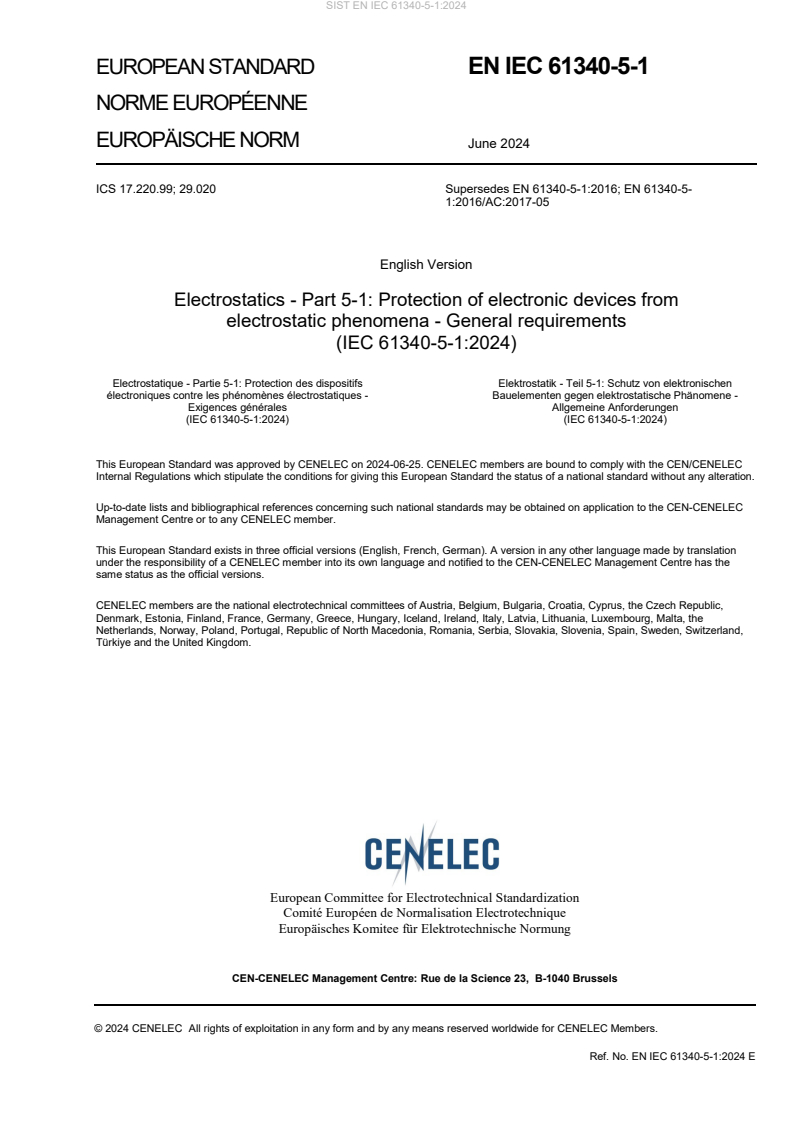
EUROPEAN STANDARD EN IEC 61340-5-1
NORME EUROPÉENNE
EUROPÄISCHE NORM June 2024
ICS 17.220.99; 29.020 Supersedes EN 61340-5-1:2016; EN 61340-5-
1:2016/AC:2017-05
English Version
Electrostatics - Part 5-1: Protection of electronic devices from
electrostatic phenomena - General requirements
(IEC 61340-5-1:2024)
Electrostatique - Partie 5-1: Protection des dispositifs Elektrostatik - Teil 5-1: Schutz von elektronischen
électroniques contre les phénomènes électrostatiques - Bauelementen gegen elektrostatische Phänomene -
Exigences générales Allgemeine Anforderungen
(IEC 61340-5-1:2024) (IEC 61340-5-1:2024)
This European Standard was approved by CENELEC on 2024-06-25. CENELEC members are bound to comply with the CEN/CENELEC
Internal Regulations which stipulate the conditions for giving this European Standard the status of a national standard without any alteration.
Up-to-date lists and bibliographical references concerning such national standards may be obtained on application to the CEN-CENELEC
Management Centre or to any CENELEC member.
This European Standard exists in three official versions (English, French, German). A version in any other language made by translation
under the responsibility of a CENELEC member into its own language and notified to the CEN-CENELEC Management Centre has the
same status as the official versions.
CENELEC members are the national electrotechnical committees of Austria, Belgium, Bulgaria, Croatia, Cyprus, the Czech Republic,
Denmark, Estonia, Finland, France, Germany, Greece, Hungary, Iceland, Ireland, Italy, Latvia, Lithuania, Luxembourg, Malta, the
Netherlands, Norway, Poland, Portugal, Republic of North Macedonia, Romania, Serbia, Slovakia, Slovenia, Spain, Sweden, Switzerland,
Türkiye and the United Kingdom.
European Committee for Electrotechnical Standardization
Comité Européen de Normalisation Electrotechnique
Europäisches Komitee für Elektrotechnische Normung
CEN-CENELEC Management Centre: Rue de la Science 23, B-1040 Brussels
© 2024 CENELEC All rights of exploitation in any form and by any means reserved worldwide for CENELEC Members.
Ref. No. EN IEC 61340-5-1:2024 E
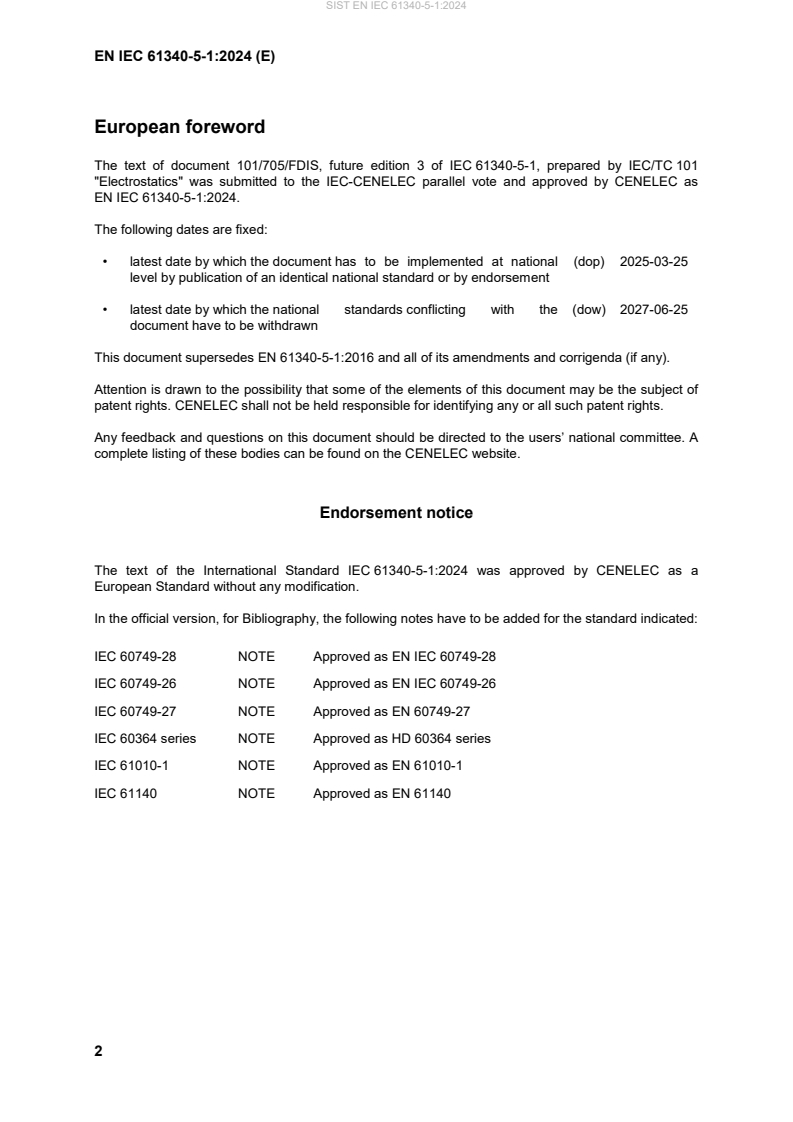
European foreword
The text of document 101/705/FDIS, future edition 3 of IEC 61340-5-1, prepared by IEC/TC 101
"Electrostatics" was submitted to the IEC-CENELEC parallel vote and approved by CENELEC as
The following dates are fixed:
• latest date by which the document has to be implemented at national (dop) 2025-03-25
level by publication of an identical national standard or by endorsement
• latest date by which the national standards conflicting with the (dow) 2027-06-25
document have to be withdrawn
This document supersedes EN 61340-5-1:2016 and all of its amendments and corrigenda (if any).
Attention is drawn to the possibility that some of the elements of this document may be the subject of
patent rights. CENELEC shall not be held responsible for identifying any or all such patent rights.
Any feedback and questions on this document should be directed to the users’ national committee. A
complete listing of these bodies can be found on the CENELEC website.
Endorsement notice
The text of the International Standard IEC 61340-5-1:2024 was approved by CENELEC as a
European Standard without any modification.
In the official version, for Bibliography, the following notes have to be added for the standard indicated:
IEC 60749-28 NOTE Approved as EN IEC 60749-28
IEC 60749-26 NOTE Approved as EN IEC 60749-26
IEC 60749-27 NOTE Approved as EN 60749-27
IEC 60364 series NOTE Approved as HD 60364 series
IEC 61010-1 NOTE Approved as EN 61010-1
IEC 61140 NOTE Approved as EN 61140
Annex ZA
(normative)
Normative references to international publications
with their corresponding European publications
The following documents are referred to in the text in such a way that some or all of their content
constitutes requirements of this document. For dated references, only the edition cited applies. For
undated references, the latest edition of the referenced document (including any amendments)
applies.
NOTE 1 Where an International Publication has been modified by common modifications, indicated by (mod),
the relevant EN/HD applies.
NOTE 2 Up-to-date information on the latest versions of the European Standards listed in this annex is available
here: www.cencenelec.eu.
Publication Year Title EN/HD Year
IEC 61340-2-3 - Electrostatics - Part 2-3: Methods of test EN 61340-2-3 -
for determining the resistance and
resistivity of solid materials used to avoid
electrostatic charge accumulation
IEC 61340-4-1 - Electrostatics - Part 4-1: Standard test EN 61340-4-1 -
methods for specific applications -
Electrical resistance of floor coverings and
installed floors
IEC 61340-4-3 - Electrostatics – Part 4-3: Standard test EN IEC 61340-4-3 -
methods for specific applications –
Footwear
IEC 61340-4-5 - Electrostatics – Part 4-5: Standard test EN IEC 61340-4-5 -
methods for specific applications –
Methods for characterizing the electrostatic
protection of footwear and flooring in
combination with a person
IEC 61340-4-6 - Electrostatics - Part 4-6: Standard test EN 61340-4-6 -
methods for specific applications - Wrist
straps
IEC 61340-4-7 - Electrostatics - Part 4-7: Standard test EN 61340-4-7 -
methods for specific applications -
Ionization
IEC 61340-4-8 - Electrostatics - Part 4-8: Standard test EN 61340-4-8 -
methods for specific applications -
Electrostatic discharge shielding - Bags
IEC 61340-4-9 - Electrostatics - Part 4-9: Standard test EN 61340-4-9 -
methods for specific applications -
Garments
IEC 61340-5-3 - Electrostatics - Part 5-3: Protection of EN IEC 61340-5-3 -
electronic devices from electrostatic
phenomena - Properties and requirements
classification for packaging intended for
electrostatic discharge sensitive devices
IEC/TS 61340-5-4 - Electrostatics - Part 5-4: Protection of - -
electronic devices from electrostatic
phenomena - Compliance verification
IEC 61340-5-1 ®
Edition 3.0 2024-05
INTERNATIONAL
STANDARD
NORME
INTERNATIONALE
Electrostatics –
Part 5-1: Protection of electronic devices from electrostatic phenomena –
General requirements
Électrostatique –
Partie 5-1: Protection des dispositifs électroniques contre les phénomènes
électrostatiques – Exigences générales
INTERNATIONAL
ELECTROTECHNICAL
COMMISSION
COMMISSION
ELECTROTECHNIQUE
INTERNATIONALE
ICS 17.220.99, 29.020 ISBN 978-2-8322-8889-4
– 2 – IEC 61340-5-1:2024 © IEC 2024
CONTENTS
FOREWORD . 3
INTRODUCTION . 5
1 Scope . 7
2 Normative references . 7
3 Terms, definitions and abbreviated terms . 8
3.1 Terms and definitions . 8
3.2 Abbreviated terms . 9
4 Personnel safety . 10
5 ESD control program . 10
5.1 General . 10
5.1.1 ESD control program requirements . 10
5.1.2 ESD control program manager or coordinator . 10
5.1.3 Tailoring . 10
5.2 ESD control program administrative requirements . 10
5.2.1 ESD control program plan . 10
5.2.2 Training plan . 11
5.2.3 Product qualification plan . 11
5.2.4 Compliance verification plan . 12
5.3 ESD control program plan technical requirements . 12
5.3.1 General . 12
5.3.2 Grounding/equipotential bonding systems . 12
5.3.3 Personnel grounding . 14
5.3.4 ESD protected areas (EPA) . 15
5.3.5 Packaging. 18
5.3.6 Marking . 18
Annex A (informative) Tailoring examples . 19
Bibliography . 21
Figure 1 – Schematic of an EPA with a ground reference . 13
Figure 2 – Schematic of an equipotential bonding system . 14
Table 1 – Grounding/bonding requirements . 14
Table 2 – Personnel grounding requirements . 15
Table 3 – EPA technical requirements . 17
Table 4 – Packaging requirements . 18
IEC 61340-5-1:2024 © IEC 2024 – 3 –
INTERNATIONAL ELECTROTECHNICAL COMMISSION
____________
ELECTROSTATICS –
Part 5-1: Protection of electronic devices from
electrostatic phenomena – General requirements
FOREWORD
1) The International Electrotechnical Commission (IEC) is a worldwide organization for standardization comprising
all national electrotechnical committees (IEC National Committees). The object of IEC is to promote international
co-operation on all questions concerning standardization in the electrical and electronic fields. To this end and
in addition to other activities, IEC publishes International Standards, Technical Specifications, Technical Reports,
Publicly Available Specifications (PAS) and Guides (hereafter referred to as “IEC Publication(s)”). Their
preparation is entrusted to technical committees; any IEC National Committee interested in the subject dealt with
may participate in this preparatory work. International, governmental and non-governmental organizations liaising
with the IEC also participate in this preparation. IEC collaborates closely with the International Organization for
Standardization (ISO) in accordance with conditions determined by agreement between the two organizations.
2) The formal decisions or agreements of IEC on technical matters express, as nearly as possible, an international
consensus of opinion on the relevant subjects since each technical committee has representation from all
interested IEC National Committees.
3) IEC Publications have the form of recommendations for international use and are accepted by IEC National
Committees in that sense. While all reasonable efforts are made to ensure that the technical content of IEC
Publications is accurate, IEC cannot be held responsible for the way in which they are used or for any
misinterpretation by any end user.
4) In order to promote international uniformity, IEC National Committees undertake to apply IEC Publications
transparently to the maximum extent possible in their national and regional publications. Any divergence between
any IEC Publication and the corresponding national or regional publication shall be clearly indicated in the latter.
5) IEC itself does not provide any attestation of conformity. Independent certification bodies provide conformity
assessment services and, in some areas, access to IEC marks of conformity. IEC is not responsible for any
services carried out by independent certification bodies.
6) All users should ensure that they have the latest edition of this publication.
7) No liability shall attach to IEC or its directors, employees, servants or agents including individual experts and
members of its technical committees and IEC National Committees for any personal injury, property damage or
other damage of any nature whatsoever, whether direct or indirect, or for costs (including legal fees) and
expenses arising out of the publication, use of, or reliance upon, this IEC Publication or any other IEC
Publications.
8) Attention is drawn to the Normative references cited in this publication. Use of the referenced publications is
indispensable for the correct application of this publication.
9) IEC draws attention to the possibility that the implementation of this document may involve the use of (a)
patent(s). IEC takes no position concerning the evidence, validity or applicability of any claimed patent rights in
respect thereof. As of the date of publication of this document, IEC had not received notice of (a) patent(s), which
may be required to implement this document. However, implementers are cautioned that this may not represent
the latest information, which may be obtained from the patent database available at https://patents.iec.ch. IEC
shall not be held responsible for identifying any or all such patent rights.
IEC 61340-5-1 has been prepared by IEC technical committee 101: Electrostatics. It is an
International Standard.
This third edition cancels and replaces the second edition published in 2016. This edition
constitutes a technical revision.
This edition includes the following significant technical changes with respect to the previous
edition:
a) definitions have been added to the document;
b) updates to product qualification requirements;
c) subclause 5.3.3 now includes a reference to groundable static control garment systems;
d) Table 2 was replaced;
– 4 – IEC 61340-5-1:2024 © IEC 2024
e) subclause 5.3.4.2 was updated to define what an insulator is;
f) subclause 5.3.4.3 was updated to include a definition for isolated conductor;
g) Table 3 was updated, technical items added, including a reference to IEC 61340-5-4 for
compliance verification testing;
h) Table 4 was added as a summary of the requirements in IEC 61340-5-3 and to include
requirements for compliance verification of packaging;
i) Annex A was replaced: the former Annex is no longer required. Annex A are examples of
tailoring.
The text of this International Standard is based on the following documents:
Draft Report on voting
101/705A/FDIS 101/710/RVD
Full information on the voting for its approval can be found in the report on voting indicated in
the above table.
The language used for the development of this International Standard is English.
This document was drafted in accordance with ISO/IEC Directives, Part 2, and developed in
accordance with ISO/IEC Directives, Part 1 and ISO/IEC Directives, IEC Supplement, available
at www.iec.ch/members_experts/refdocs. The main document types developed by IEC are
described in greater detail at www.iec.ch/publications.
A list of all parts in the IEC 61340 series, published under the general title Electrostatics, can
be found on the IEC website.
The committee has decided that the contents of this document will remain unchanged until the
stability date indicated on the IEC website under webstore.iec.ch in the data related to the
specific document. At this date, the document will be
• reconfirmed,
• withdrawn, or
• revised.
IEC 61340-5-1:2024 © IEC 2024 – 5 –
INTRODUCTION
This part of IEC 61340 covers the requirements necessary to design, establish, implement and
maintain an electrostatic discharge (ESD) control program for activities that: manufacture,
process, assemble, install, package, label, service, test, inspect, transport, or otherwise handle
electrical or electronic parts, assemblies, and equipment susceptible to damage by electrostatic
discharges greater than or equal to 100 V human body model (HBM), 200 V charged device
model (CDM), and 35 V on isolated conductors. The 35 V limit is related to the level achievable
using ionizers specified in this document.
Any contact and physical separation of materials or flow of solids, liquids, or particle-laden
gases can generate electrostatic charges. Common sources of ESD include charged:
personnel, conductors, common polymeric materials, and processing equipment. ESD damage
can occur when:
• a charged person or object comes into contact with an ESD sensitive device (ESDS);
• an ESDS comes into direct contact with a conductive surface while exposed to an
electrostatic field;
• a charged ESDS comes into contact with another conductive surface which is at a different
electrical potential. This surface can be grounded or ungrounded.
Examples of ESDS are microcircuits, discrete semiconductors, thick and thin film resistors,
hybrid devices, printed circuit boards and piezoelectric crystals. It is possible to determine
device and item susceptibility by exposing the device to simulated ESD events. The ESD
withstand voltage determined by sensitivity tests using simulated ESD events does not
necessarily represent the ability of the device to withstand ESD from real sources at that voltage
level. However, the levels of sensitivity are used to establish a baseline of susceptibility data
for comparison of devices with equivalent part numbers from different manufacturers. Three
different models have been used for qualification of electronic components – HBM, MM, and
CDM. In current practice devices are qualified only using HBM and CDM susceptibility tests.
This document covers the ESD control program requirements necessary for setting up a
program to handle ESDS, based on the historical experience of both military and commercial
organizations. The fundamental ESD control principles that form the basis of this document are
as follows.
• Avoid a discharge from any charged, conductive object (personnel and especially automated
handling equipment) into the ESDS. This can be accomplished by bonding or electrically
connecting all conductors in the environment, including personnel, to a known ground or
contrived ground (as on board ship or on aircraft). This attachment creates an equipotential
balance between all conducting objects and personnel. Electrostatic protection can be
maintained at a potential different from a “zero” voltage ground potential as long as all
conductive objects in the system are at the same potential.
• Avoid a discharge from any charged ESD sensitive device. Charging can result from direct
contact and separation or it can be induced by an electric field. Necessary insulators in the
environment cannot lose their electrostatic charge by attachment to ground. Ionization
systems provide neutralization of charges on these necessary insulators (circuit board
materials and some device packages are examples of necessary insulators). The ESD
hazard created by electrostatic charges on the necessary insulators in the workplace is
assessed to ensure that appropriate actions are implemented, according to the risk.
– 6 – IEC 61340-5-1:2024 © IEC 2024
• Once outside of an electrostatic discharge protected area (hereinafter referred to as an
EPA) it is generally not possible to control the above items; therefore, ESD protective
packaging can be required. ESD protection can be achieved by enclosing ESD sensitive
products in static protective materials, although the type of material depends on the situation
and destination. Inside an EPA, static dissipative materials can provide adequate protection.
Outside an EPA, static discharge shielding materials are recommended. Whilst all of these
materials are not discussed in this document, it is important to recognize the differences in
their application. For more information see IEC 61340-5-3 and IEC TR 61340-5-5 [1] .
Each organization has different processes, and so will require a different blend of ESD
prevention measures for an optimum ESD control program. Measures should be selected,
based on technical necessity, and carefully documented in an ESD control program plan, so
that all concerned can be sure of the program requirements.
Training is an essential part of an ESD control program in order to ensure that the personnel
involved understand the equipment and procedures they are to use in order to be in compliance
with the ESD control program plan. Training is also essential in raising awareness and
understanding of ESD issues. Without training, personnel are often a major source of ESD risk.
With training, they become an effective first line of defence against ESD damage. Product
qualification ensures that equipment sourced for use in the ESD control program meets the
technical requirements before it is placed in service.
A product qualification plan details the criteria to be used for selection of ESD control items.
Regular compliance verification checks and tests are essential to ensure that equipment
remains effective and that the ESD control program is correctly implemented in compliance with
the ESD control program plan.
_____________
Numbers in square brackets refer to the bibliography.
IEC 61340-5-1:2024 © IEC 2024 – 7 –
ELECTROSTATICS –
Part 5-1: Protection of electronic devices from
electrostatic phenomena – General requirements
1 Scope
This part of IEC 61340 applies to organizations that: manufacture, process, assemble, install,
package, label, service, test, inspect, transport, or otherwise handle electrical or electronic
parts, assemblies and equipment with withstand voltages greater than or equal to 100 V human
body model (HBM) and 200 V charge device model (CDM). Also, protection from isolated
conductors is addressed by limiting the voltage on isolated conductors to less than 35 V. ESDS
with lower withstand voltages can require additional control elements or adjusted limits.
Processes designed to handle items that have lower ESD withstand voltage(s) can still claim
compliance to this document.
This document provides the requirements for an ESD control program. IEC TR 61340-5-2 [2]
provides guidance on the implementation of this document.
This document does not apply to electrically initiated explosive devices, flammable liquids,
gases, and powders.
The purpose of this document is to provide the administrative and technical requirements for
establishing, implementing, and maintaining an ESD control program (hereinafter referred to as
the “program”).
2 Normative references
The following documents are referred to in the text in such a way that some or all of their content
constitutes requirements of this document. For dated references, only the edition cited applies.
For undated references, the latest edition of the referenced document (including any
amendments) applies.
IEC 61340-2-3, Electrostatics – Part 2-3: Methods of test for determining the resistance and
resistivity of solid materials used to avoid electrostatic charge accumulation
IEC 61340-4-1, Electrostatics – Part 4-1: Standard test methods for specific applications –
Electrical resistance of floor coverings and installed floors
IEC 61340-4-3, Electrostatics – Part 4-3: Standard test methods for specific applications –
Footwear
IEC 61340-4-5, Electrostatics – Part 4-5: Standard test methods for specific applications –
Methods for characterizing the electrostatic protection of footwear and flooring in combination
with a person
IEC 61340-4-6, Electrostatics – Part 4-6: Standard test methods for specific applications – Wrist
straps
IEC 61340-4-7, Electrostatics – Part 4-7: Standard test methods for specific applications –
Ionization
– 8 – IEC 61340-5-1:2024 © IEC 2024
IEC 61340-4-8, Electrostatics – Part 4-8: Standard test methods for specific applications –
Electrostatic discharge shielding – Bags
IEC 61340-4-9, Electrostatics – Part 4-9: Standard test methods for specific applications –
Garments
IEC 61340-5-3, Electrostatics – Part 5-3: Protection of electronic devices from electrostatic
phenomena – Properties and requirements classification for packaging intended for
electrostatic discharge sensitive devices
IEC TS 61340-5-4, Electrostatics – Part 5-4: Protection of electronic devices from electrostatic
phenomena – Compliance verification
3 Terms, definitions and abbreviated terms
3.1 Terms and definitions
For the purposes of this document, the following terms and definitions apply.
ISO and IEC maintain terminological databases for use in standardization at the following
addresses:
• IEC Electropedia: available at https://www.electropedia.org/
• ISO Online browsing platform: available at https://www.iso.org/obp
NOTE For the purposes of this document “earth” and “ground” have the same meaning.
3.1.1
charged device model
CDM
ESD stress model that approximates the discharge event that occurs when a charged
component is quickly discharged to another object at a different electrostatic potential
Note 1 to entry: Charged device model is described in IEC 60749-28 [3].
Note 2 to entry: This note only applies to the French language.
3.1.2
common ground point
grounded device or location where the conductors of two or more ESD control items are bonded
3.1.3
common connection point
device or location where the conductors of two or more ESD control items are connected in
order to bring the ESD control items to the same electrical potential through equipotential
bonding
3.1.4
equipotential bonding
electrical connection of items used to control ESD so that they are at substantially the same
voltage under normal and fault conditions
3.1.5
electrostatic discharge
ESD
rapid transfer of charge between bodies that are at different electrostatic potentials
IEC 61340-5-1:2024 © IEC 2024 – 9 –
3.1.6
ESD control items
materials or products designed to either prevent the generation of static charge or dissipate
static charges that have been generated, or both, so as to prevent damage to ESD sensitive
devices
3.1.7
ESD protected area
EPA
area in which an ESDS can be handled with accepted risk of damage as a result of electrostatic
discharge or fields
3.1.8
ESD sensitive device
ESDS
sensitive device, integrated circuit or assembly that can be damaged by electrostatic discharge
3.1.9
ESD withstand voltage
highest voltage level in an ESD stress model test that does not cause failure
Note 1 to entry: The device passes all tested lower voltages.
3.1.10
functional ground
terminal used to connect parts to ground for reasons other than safety
3.1.11
human body model
HBM
ESD stress model that approximates the discharge from the fingertip of a typical human being
onto a pin of a device with another pin grounded
Note 1 to entry: Human body model is described in IEC 60749-26 [4].
3.1.12
organization
company, group or body that handles ESDS
Note 1 to entry: For the purposes of this document an organization can be an individual person.
3.1.13
protective earth
terminal used to connect parts to earth for safety reasons
3.1.14
unprotected ESDS
ESDS without ESD protective packaging or coverings
3.1.15
worksurface
surface where any type of work or processing can be performed on an unprotected ESDS
3.2 Abbreviated terms
CDM charge device model
EPA electrostatic protected area
ESD electrostatic discharge
ESDS ESD sensitive devices
– 10 – IEC 61340-5-1:2024 © IEC 2024
HBM human body model
...