

SIST EN IEC 60810:2018
(Main)Lamps, light sources and led packages for road vehicles - Performance requirements (IEC 60810:2017)
General Information
- Abstract
NEW!IEC 60810:2017 is available as IEC 60810:2017 RLV which contains the International Standard and its Redline version, showing all changes of the technical content compared to the previous edition.
IEC 60810:2017 is applicable to filament lamps, discharge lamps, LED light sources and LED packages to be used in road vehicles, i.e. in headlamps, fog-lamps, signalling lamps and interior lighting. It is especially applicable to those lamps and light sources which are listed in IEC 60809.
This fifth edition cancels and replaces the fourth edition published in 2014 and Amendment 1:2017. This edition constitutes a technical revision. This edition includes the following significant technical changes with respect to the previous edition:
- update and clarification of the title and scope;
- introduction of new LED light sources;
- introduction of requirements for LED light sources;
- introduction of guidelines on LED package robustness validation for LED packages.
- Status
- Published
- Publication Date
- 28-Feb-2018
- Technical Committee
- IESV - Lamps and related equipment
- Current Stage
- 6060 - National Implementation/Publication (Adopted Project)
- Start Date
- 14-Feb-2018
- Due Date
- 21-Apr-2018
- Completion Date
- 01-Mar-2018


Overview
SIST EN IEC 60810:2018 (identical to IEC 60810:2017) defines performance requirements and test methods for lamps, light sources and LED packages intended for road-vehicle use - including headlamps, fog lamps, signalling lamps and interior lighting. This fifth edition cancels and replaces the 2014 edition and its 2017 amendment and constitutes a technical revision that explicitly introduces and clarifies requirements for LED light sources and LED package robustness validation. The IEC 60810:2017 Redline version (RLV) showing changes versus the previous edition is available from the IEC webstore.
Key topics and technical requirements
The standard covers a broad set of performance and reliability topics for different light-source technologies:
- Scope and interchangeability for filament lamps, discharge lamps, LED light sources and LED packages
- Life and luminous performance: characteristic life, luminous flux and colour maintenance, and life (B3) tests
- Mechanical and environmental durability: vibration, mechanical shock, glass-bulb strength, torsion and solderability
- Electrical robustness for LED light sources: overvoltage, reverse voltage, transient/load-dump, and electrostatic discharge (ESD) tests
- Thermal and operating-life tests: powered thermal cycling, pulsed operating-life (PLT), high-temperature operating life (HTOL), wet HTOL and temperature cycling
- LED package qualification and stress tests: lot and production sampling, pre/post electrical and photometric checks, DPA, wire-bond and die shear/pull, thermal resistance, moisture preconditioning and corrosion/flowing mixed gas tests
- Typical circuit considerations and maximum power consumption clauses for LED modules
- Normative references and harmonized test methods (IEC/ISO/JESD/CISPR/JESD51 families)
Practical applications - who uses this standard
SIST EN IEC 60810:2018 is primarily used by:
- Automotive lighting manufacturers and LED package suppliers for product design, qualification and production control
- Automotive OEMs and Tier‑1 suppliers to specify performance and approve lighting components
- Test laboratories and certification bodies performing reliability and electromagnetic compatibility testing
- Component and electronics engineers responsible for thermal, mechanical and electrical robustness of vehicle lighting
- Regulatory and homologation teams aligning products to vehicle approval requirements
Using IEC 60810 helps ensure safety, interchangeability and long-term reliability of road‑vehicle lighting systems.
Related standards
Key referenced standards include (non‑exhaustive): IEC 60809, IEC 60068 series (environmental tests), CISPR 25, ISO 7637-2, ISO 10605, JESD22/JESD51 series (LED thermal & reliability test methods), ANSI/IPC J-STD-002C and relevant UN vehicle regulations. These documents are commonly used alongside IEC 60810 for comprehensive testing and homologation.
Relations
- Effective Date
- 13-Feb-2018
- Effective Date
- 13-Feb-2018
- Effective Date
- 09-Feb-2026
- Effective Date
- 03-Feb-2026
- Effective Date
- 03-Feb-2026
- Effective Date
- 03-Feb-2026
- Effective Date
- 03-Feb-2026
- Effective Date
- 03-Feb-2026
- Effective Date
- 03-Feb-2026
- Effective Date
- 03-Feb-2026
- Effective Date
- 03-Feb-2026
- Effective Date
- 26-Jul-2021
- Effective Date
- 17-Apr-2018
- Effective Date
- 23-Aug-2016
- Effective Date
- 23-Aug-2016
Get Certified
Connect with accredited certification bodies for this standard

TÜV Rheinland
TÜV Rheinland is a leading international provider of technical services.

TÜV SÜD
TÜV SÜD is a trusted partner of choice for safety, security and sustainability solutions.

DEKRA Certification Inc.
DEKRA US certification services.
Sponsored listings
Frequently Asked Questions
SIST EN IEC 60810:2018 is a standard published by the Slovenian Institute for Standardization (SIST). Its full title is "Lamps, light sources and led packages for road vehicles - Performance requirements (IEC 60810:2017)". This standard covers: <span style="color:red">NEW!</span>IEC 60810:2017 is available as <a href="https://webstore.iec.ch/publication/61553">IEC 60810:2017 RLV</a> which contains the International Standard and its Redline version, showing all changes of the technical content compared to the previous edition.</br></br>IEC 60810:2017 is applicable to filament lamps, discharge lamps, LED light sources and LED packages to be used in road vehicles, i.e. in headlamps, fog-lamps, signalling lamps and interior lighting. It is especially applicable to those lamps and light sources which are listed in IEC 60809. This fifth edition cancels and replaces the fourth edition published in 2014 and Amendment 1:2017. This edition constitutes a technical revision. This edition includes the following significant technical changes with respect to the previous edition: - update and clarification of the title and scope; - introduction of new LED light sources; - introduction of requirements for LED light sources; - introduction of guidelines on LED package robustness validation for LED packages.
<span style="color:red">NEW!</span>IEC 60810:2017 is available as <a href="https://webstore.iec.ch/publication/61553">IEC 60810:2017 RLV</a> which contains the International Standard and its Redline version, showing all changes of the technical content compared to the previous edition.</br></br>IEC 60810:2017 is applicable to filament lamps, discharge lamps, LED light sources and LED packages to be used in road vehicles, i.e. in headlamps, fog-lamps, signalling lamps and interior lighting. It is especially applicable to those lamps and light sources which are listed in IEC 60809. This fifth edition cancels and replaces the fourth edition published in 2014 and Amendment 1:2017. This edition constitutes a technical revision. This edition includes the following significant technical changes with respect to the previous edition: - update and clarification of the title and scope; - introduction of new LED light sources; - introduction of requirements for LED light sources; - introduction of guidelines on LED package robustness validation for LED packages.
SIST EN IEC 60810:2018 is classified under the following ICS (International Classification for Standards) categories: 29.140.20 - Incandescent lamps; 43.040.20 - Lighting, signalling and warning devices. The ICS classification helps identify the subject area and facilitates finding related standards.
SIST EN IEC 60810:2018 has the following relationships with other standards: It is inter standard links to SIST EN 60810:2015/A1:2017, SIST EN 60810:2015, SIST EN ISO 10692-1:2002, SIST EN IEC 60068-2-14:2024, SIST EN 60068-2-60:2016, SIST EN 60061-1:1999, SIST EN 60068-2-58:2015, SIST EN 60068-2-43:2005, SIST EN IEC 55025:2022, SIST EN IEC 60809:2021, SIST EN IEC 60809:2021/A1:2024, SIST EN IEC 60810:2018/A2:2022, SIST EN IEC 60810:2018/A1:2019, SIST EN 60810:2015/A1:2017, SIST EN 60810:2015. Understanding these relationships helps ensure you are using the most current and applicable version of the standard.
SIST EN IEC 60810:2018 is available in PDF format for immediate download after purchase. The document can be added to your cart and obtained through the secure checkout process. Digital delivery ensures instant access to the complete standard document.
Standards Content (Sample)
2003-01.Slovenski inštitut za standardizacijo. Razmnoževanje celote ali delov tega standarda ni dovoljeno.Lamps, light sources and led packages for road vehicles - Performance requirements (IEC 60810:2017)43.040.20Naprave za osvetlitev, signalizacijo in opozarjanjeLighting, signalling and warning devices29.140.20Žarnice z žarilno nitkoIncandescent lampsICS:Ta slovenski standard je istoveten z:EN IEC 60810:2018SIST EN IEC 60810:2018en01-april-2018SIST EN IEC 60810:2018SLOVENSKI
STANDARDSIST EN 60810:2015/A1:2017SIST EN 60810:20151DGRPHãþD
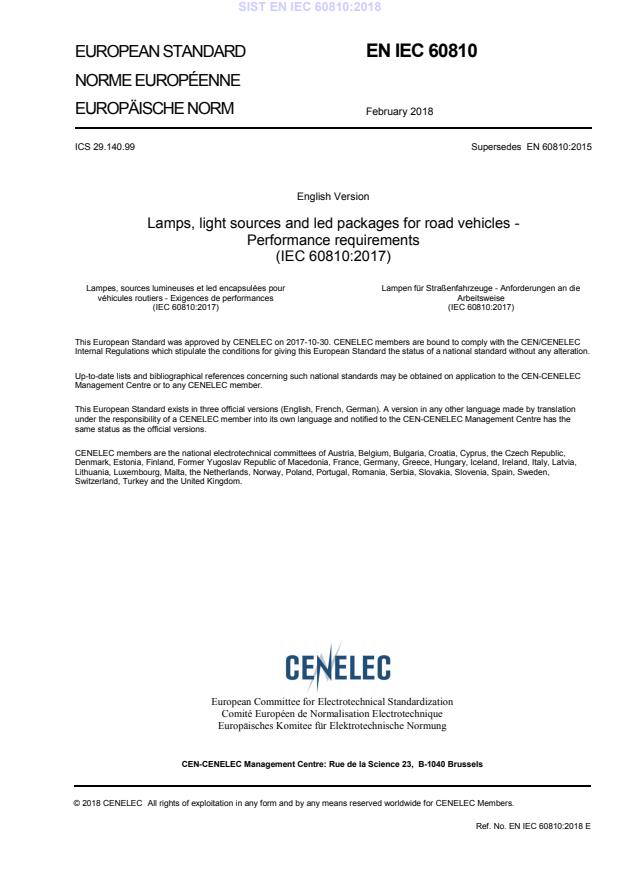
EUROPEAN STANDARD NORME EUROPÉENNE EUROPÄISCHE NORM
EN IEC 60810
February 2018 ICS 29.140.99
Supersedes
EN 60810:2015
English Version
Lamps, light sources and led packages for road vehicles - Performance requirements (IEC 60810:2017)
Lampes, sources lumineuses et led encapsulées pour véhicules routiers - Exigences de performances (IEC 60810:2017)
Lampen für Straßenfahrzeuge - Anforderungen an die Arbeitsweise (IEC 60810:2017) This European Standard was approved by CENELEC on 2017-10-30. CENELEC members are bound to comply with the CEN/CENELEC Internal Regulations which stipulate the conditions for giving this European Standard the status of a national standard without any alteration. Up-to-date lists and bibliographical references concerning such national standards may be obtained on application to the CEN-CENELEC Management Centre or to any CENELEC member.
This European Standard exists in three official versions (English, French, German). A version in any other language made by translation under the responsibility of a CENELEC member into its own language and notified to the CEN-CENELEC Management Centre has the same status as the official versions. CENELEC members are the national electrotechnical committees of Austria, Belgium, Bulgaria, Croatia, Cyprus, the Czech Republic, Denmark, Estonia, Finland, Former Yugoslav Republic of Macedonia, France, Germany, Greece, Hungary, Iceland, Ireland, Italy, Latvia, Lithuania, Luxembourg, Malta, the Netherlands, Norway, Poland, Portugal, Romania, Serbia, Slovakia, Slovenia, Spain, Sweden, Switzerland, Turkey and the United Kingdom. European Committee for Electrotechnical Standardization
Comité Européen de Normalisation Electrotechnique Europäisches Komitee für Elektrotechnische Normung CEN-CENELEC Management Centre: Rue de la Science 23,
B-1040 Brussels © 2018 CENELEC All rights of exploitation in any form and by any means reserved worldwide for CENELEC Members.
Ref. No. EN IEC 60810:2018 E SIST EN IEC 60810:2018
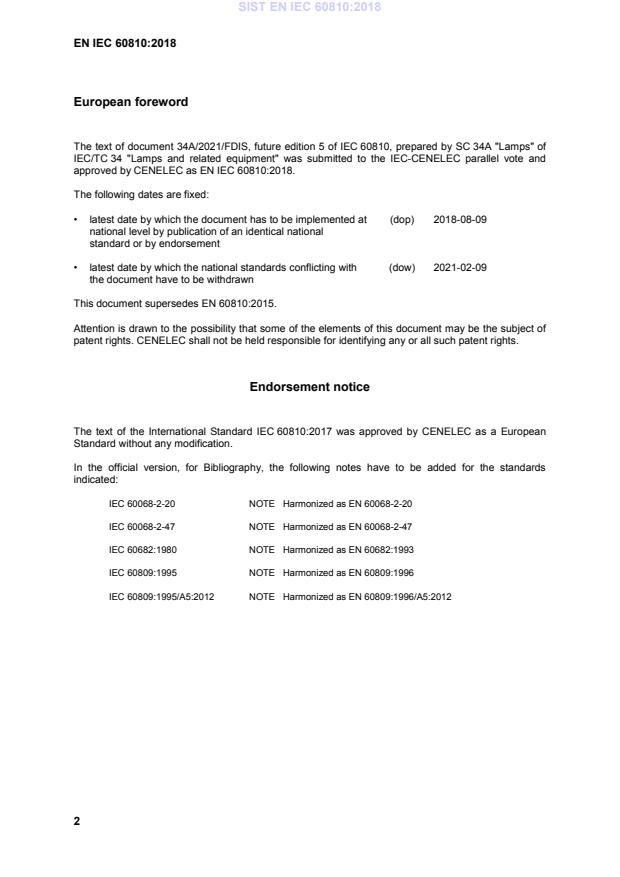
Harmonized as EN 60068-2-20 IEC 60068-2-47 NOTE
Harmonized as EN 60068-2-47 IEC 60682:1980 NOTE
Harmonized as EN 60682:1993 IEC 60809:1995 NOTE
Harmonized as EN 60809:1996 IEC 60809:1995/A5:2012 NOTE
Harmonized as EN 60809:1996/A5:2012
Normative references to international publications with their corresponding European publications The following documents are referred to in the text in such a way that some or all of their content constitutes requirements of this document. For dated references, only the edition cited applies. For undated references, the latest edition of the referenced document (including any amendments) applies. NOTE 1 When an International Publication has been modified by common modifications, indicated by (mod), the relevant EN/HD applies. NOTE 2 Up-to-date information on the latest versions of the European Standards listed in this annex is available here: www.cenelec.eu. Publication Year Title EN/HD Year IEC 60050-845 -
International Electrotechnical Vocabulary (IEV) -- Chapter 845: Lighting - -
IEC 60061-1 -
Lamp caps and holders together with gauges for the control of interchangeability and safety -- Part 1: Lamp caps EN 60061-1 -
IEC 60068-2-14 -
Environmental testing -- Part 2-14: Tests - Test N: Change of temperature EN 60068-2-14 -
IEC 60068-2-43 -
Environmental testing -- Part 2-43: Tests - Test Kd: Hydrogen sulphide test for contacts and connections EN 60068-2-43 -
IEC 60068-2-58 -
Environmental testing - Part 2-58: Tests - Test Td: Test methods for solderability, resistance to dissolution of metallization and to soldering heat of surface mounting devices (SMD) EN 60068-2-58 -
IEC 60068-2-60 -
Environmental testing -- Part 2-60: Tests - Test Ke: Flowing mixed gas corrosion test EN 60068-2-60 -
IEC 60809 2014 Lamps for road vehicles - Dimensional, electrical and luminous requirements EN 60809 2015
ISO 7637-2 2011
Road vehicles_- Electrical disturbances from conduction and coupling_- Part_2: Electrical transient conduction along supply lines only - -
ISO 10605 -
Road vehicles_- Test methods for electrical disturbances from electrostatic discharge - -
CISPR 25 -
Vehicles, boats and internal combustion engines - Radio disturbance characteristics - Limits and methods of measurement for the protection of on-board receivers EN 55025 -
United Nations Vehicle Regulations 1958 Agreement concerning the adoption of uniform technical prescriptions for wheeled vehicles, equipment and parts which can be fitted and/or be used on wheeled vehicles and the conditions for reciprocal recognition of approvals granted on the basis of these prescriptions
JESD22-A101C -
Steady-state temperature humidity bias life test - -
JESD22-A104E -
Temperature cycling - -
Power and temperature cycling - -
JESD22-A106B -
Thermal shock - -
JESD22-A108D -
Temperature, bias, and operating life - -
JESD22-A113F -
Preconditioning of plastic surface mount devices prior to reliability testing - -
JESD22-A115C -
Electrostatic discharge (ESD) sensitivity testing machine model (MM) - -
JESD22-B101B -
External visual - -
JESD22-B103B -
Vibration, variable frequency - -
JESD22-B106D -
Resistance to solder shock for through-hole mounted devices - -
JESD22-B110B -
Mechanical shock - Component and subassembly - -
JESD22-B116 1998 Wire Bond Shear Test Method - -
JESD51-50:2012-04 -
Overview of methodologies for the thermal measurement of single- and multi-chip, single- and multi-pn-junction light-emitting diodes (LEDs) - -
JESD51-51:2012-04 -
Implementation of the electrical test method for the measurement of real thermal resistance and impedance of light-emitting diodes with exposed cooling surface - -
JESD51-52:2012-04 -
Guidelines for combining CIE 127-2007 total flux measurements with thermal measurements of LEDs with exposed cooling surface - -
JESD51-53:2012-05 -
Terms, definitions and units glossary for LED thermal testing - -
ANSI/IPC/ECA J-STD-002C - Solderability tests for component leads, terminations, lugs, terminals and wires - - ANSI/ESDA/JEDEC JS-001 2012 Joint JEDEC/ESDA standard for electrostatic discharge sensitivity testing human body model (HBM) – component level - - MIL-STD-883E 2015 Visual Inspection Criteria - - ZVEI 2016 Guideline for Customer Notifications of Product and/or Process Changes (PCN) of Electronic Components specified for Automotive Applications - -
IEC 60810 Edition 5.0 2017-09 INTERNATIONAL STANDARD NORME INTERNATIONALE Lamps, light sources and led packages for road vehicles –
Performance requirements
Lampes, sources lumineuses et led encapsulées pour véhicules routiers – Exigences de performances INTERNATIONAL ELECTROTECHNICAL COMMISSION COMMISSION ELECTROTECHNIQUE INTERNATIONALE
ICS 29.140.99
ISBN 978-2-8322-4818-8
– 2 – IEC 60810:2017 © IEC 2017 CONTENTS FOREWORD . 8 1 Scope . 10 2 Normative references . 10 3 Terms and definitions . 12 4 Requirements and test conditions for filament lamps . 16 4.1 Basic function and interchangeability . 16 4.2 Torsion strength . 16 4.3 Characteristic life Tc . 16 4.4 Life B3 . 16 4.5 Luminous flux maintenance . 17 4.6 Resistance to vibration and shock . 17 4.7 Glass-bulb strength . 17 5 Filament lamp data . 17 6 Requirements and test conditions for discharge lamps . 22 6.1 Basic function and interchangeability . 22 6.2 Mechanical strength . 22 6.2.1 Bulb-to-cap connection . 22 6.2.2 Cable-to-cap connection (if any) . 22 6.3 Characteristic life Tc . 22 6.4 Life B3 . 22 6.5 Luminous flux maintenance . 22 6.6 Resistance to vibration and shock . 22 6.7 Discharge lamps with integrated starting device . 22 6.8 Discharge lamps with integrated starting device and integrated ballast . 23 7 Requirements and test conditions for LED light sources . 23 7.1 Basic function and interchangeability . 23 7.2 UV radiation . 24 7.3 Luminous flux and colour maintenance . 24 7.4 Resistance to vibration and shock . 26 7.5 Electromagnetic compatibility . 27 7.6 Powered thermal cycling test . 27 7.7 Mass . 28 7.8 Typical circuits for LED light sources . 28 7.8.1 General . 28 7.8.2 Typical circuits for LR3, LR5, LY3, LY5, LW3 and LW5 LED light sources. 28 7.8.3 Typical circuits for LR4 LED light sources . 29 7.9 Maximum power consumption . 30 7.10 Overvoltage test. 30 7.11 Reverse voltage test . 30 7.12 Transient voltage test (field decay) . 31 7.13 Transient voltage test (load dump) . 32 7.14 Electrostatic discharge test (ESD) . 33 7.15 Pulsed operating life (PLT) test . 33 8 Requirements and test conditions for LED packages . 33 8.1 LED package stress test qualification . 33 SIST EN IEC 60810:2018
IEC 60810:2017 © IEC 2017 – 3 –
8.2 Test samples . 34 8.2.1 Lot requirements. 34 8.2.2 Production requirements . 34 8.2.3 Pre- and post-stress test requirements . 34 8.2.4 Assembly of LED packages on test boards . 35 8.2.5 Moisture pre-conditioning (MP) . 35 8.2.6 Thermal resistance (TR) test . 35 8.3 Definition of failure criteria . 35 8.4 Choice between test conditions . 36 8.5 Criteria for passing qualification/requalification . 36 8.6 Qualification test . 36 8.6.1 Pre- and post- electrical and photometric test . 36 8.6.2 Pre- and post- external visual (EV) test . 36 8.6.3 High temperature operating life (HTOL) test . 36 8.6.4 Temperature cycling (TMCL) test . 37 8.6.5 Wet high temperature operating life (WHTOL) test . 37 8.6.6 Power temperature cycling (PTMCL) test . 37 8.6.7 Electrostatic discharge, human body model (ESD-HBM) test . 38 8.6.8 Electrostatic discharge, machine model (ESD-MM) test . 38 8.6.9 Destructive physical analysis (DPA) test . 38 8.6.10 Physical dimensions (PD) test . 38 8.6.11 Vibrations variable frequency (VVF) test . 38 8.6.12 Mechanical shock (MS) test . 38 8.6.13 Resistance to soldering heat (RSH-TTW) test . 38 8.6.14 Resistance to soldering heat (RSH-reflow) test . 39 8.6.15 Solderability (SO) test. 39 8.6.16 Thermal shock (TMSK) test . 39 8.6.17 Hydrogen sulphide (H2S) test . 39 8.6.18 Pulsed operating life (PLT) test . 39 8.6.19 Dew (DEW) test . 40 8.6.20 Flowing mixed gas corrosion (FMGC) test . 41 8.6.21 Wire bond pull test (WBP) . 41 8.6.22 Bond shear test (BS) . 42 8.6.23 Die shear test (DS) . 42 Annex A (normative)
Life test conditions for filament lamps . 43 A.1 Ageing . 43 A.2 Test voltage . 43 A.3 Operating position and operating conditions . 43 A.4 Switching cycle . 43 A.4.1 Single-filament lamps . 43 A.4.2 Dual-filament lamps for headlamps . 44 A.4.3 Dual-filament lamps for light signalling equipment . 44 A.5 Luminous flux and colour maintenance . 44 Annex B (normative)
Vibration tests . 45 B.1 General . 45 B.2 Test conditions . 46 B.2.1 General . 46 B.2.2 Mounting (see IEC 60068-2-47) . 46 B.2.3 Measuring points . 46 SIST EN IEC 60810:2018
– 4 – IEC 60810:2017 © IEC 2017 B.2.4 Control point . 46 B.2.5 Conditioning . 46 B.2.6 Axis of vibration . 46 B.2.7 WBR test – Basic motion . 47 B.3 Test conditions . 47 B.3.1 General . 47 B.3.2 Narrowband random vibration tests. 47 B.3.3 Wideband random vibration tests . 48 Annex C (normative)
Glass-bulb strength test . 50 C.1 General . 50 C.2 Test equipment and procedure . 50 C.2.1 Principle of the test equipment . 50 C.2.2 Test conditions . 50 C.2.3 Requirements for plates . 51 C.3 Requirements . 51 C.4 Evaluation . 52 C.4.1 General . 52 C.4.2 Assessment based on attributes . 52 C.4.3 Assessment based on variables . 52 Annex D (normative)
Life and luminous flux maintenance
test conditions for discharge lamps . 54 D.1 Ageing . 54 D.2 Test circuit and test voltage . 54 D.3 Burning position and operating conditions . 54 D.4 Switching cycle . 54 D.5 Luminous flux maintenance . 56 Annex E (normative)
Bulb deflection test. 57 E.1 General . 57 E.2 Test set-up and procedure . 57 E.3 Requirement . 57 Annex F (informative)
Guidance on equipment design . 58 F.1 Pinch temperature limit . 58 F.2 Solder temperature limit . 58 F.3 Maximum filament lamp outline . 58 F.4 Maximum surge voltage . 58 F.5 Recommended instructions for use and handling of halogen filament lamps . 58 F.6 Recommended instructions for use and handling of discharge lamps . 59 Annex G (informative)
Ballast design . 64 Annex H (informative)
Symbols . 65 H.1 General . 65 H.2 Symbol indicating that lamps operate at high temperatures . 66 H.3 Symbol indicating that care should be taken to avoid touching the bulb. 66 H.4 Symbol indicating that the use of protective gloves is advised . 66 H.5 Symbol indicating that lamps with scratched or otherwise
damaged bulbs should not be used. 66 H.6 Symbol indicating that before handling, the lamp shall be switched off . 66 H.7 Symbol indicating that the use of eye protection is advised . 66 H.8 Symbol indicating that during operation, the lamp emits UV-radiation . 67 SIST EN IEC 60810:2018
IEC 60810:2017 © IEC 2017 – 5 –
H.9 Symbol indicating that the lamp shall be operated only in a luminaire with a protective shield . 67 H.10 Symbol indicating dangerous voltage . 68 H.11 Pictogram for instruction "Non-ECE" . 68 H.12 Pictogram for instruction "Interior lighting only" . 69 Annex I (normative)
Luminous flux maintenance test conditions
for LED light sources . 70 I.1 Ageing . 70 I.2 Test voltage . 70 I.3 Operating conditions . 70 I.3.1 Test rack . 70 I.3.2 LED light sources with integrated thermal management . 70 I.3.3 LED light sources with external thermal management . 70 I.4 Switching cycle . 71 I.4.1 Single-function LED light sources . 71 I.4.2 Dual-function LED light sources for headlamps . 71 I.4.3 Multiple-function LED light sources for light signalling equipment . 71 I.5 Luminous flux maintenance measurements . 72 I.6 Colour measurement . 72 Annex J (normative)
Destructive physical analysis for LED packages . 73 J.1 Description . 73 J.2 Equipment . 73 J.3 Procedure . 73 J.4 Failure criteria . 73 Annex K (informative)
Communication sheet LED package testing . 74 Annex L (normative)
Re-testing matrix for LED packages testing . 77 Annex M (informative)
Guidelines for LED packages robustness validation . 78 M.1 General . 78 M.2 Test samples . 80 M.2.1 Lot requirements. 80 M.2.2 Production requirements . 81 M.2.3 Pre- and post-stress test requirements . 81 M.2.4 Assembly of LED packages on test boards . 81 M.3 Definition of end-of-test criteria . 81 M.4 Test sequence of over-stress testing . 81 M.5 Over-stress test definition . 82 M.5.1 Pre- and post-electrical and photometric test . 82 M.5.2 Pre- and post-external visual (EV) test . 82 M.5.3 High temperature operating life (HTOL) and low temperature operating life (LTOL) tests . 82 M.5.4 Temperature cycling (TMCL) test . 83 M.5.5 Wet high temperature operating life (WHTOL) test . 83 M.5.6 Power temperature cycling (PTMCL) test . 84 M.5.7 Thermal shock (TMSK) test . 84 M.6 Destructive physical analysis (DPA) test . 85 M.7 Projection models . 85 Bibliography . 89
Figure 1 – Examples of LED packages . 14 SIST EN IEC 60810:2018
– 6 – IEC 60810:2017 © IEC 2017 Figure 2 – Example of an LED module without integrated heatsink . 14 Figure 3 – Example of an LED module with integrated heatsink . 14 Figure 4 – Example of a replaceable LED light source . 15 Figure 5 – Example of a non-replaceable LED light source . 15 Figure 6 – Position of the centre of gravity (shaded areas). 23 Figure 7 – Extract from IEC 60068-2-14 Test Nb,
showing the temperature cycle profile . 27 Figure 8 – Typical electrical circuit for an LR3, LR5, LY3, LY5, LW3
and LW5 LED light source . 29 Figure 9 – Typical electrical circuit for an LR4 LED light source . 29 Figure 10 – Profile of pulse 1 from ISO 7637-2 . 31 Figure 11 – Profile of pulse 2a from ISO 7637-2 . 32 Figure 12 – Temperature–humidity characteristics for the DEW test . 41 Figure B.1 – Recommended equipment layout for vibration testing . 49 Figure C.1 – Diagrammatic sketch of the principle of the test equipment . 50 Figure D.1 – Superposition of on/off switching and power switching cycle . 55 Figure E.1 – Sketch of the test set-up . 57 Figure F.1 – Voltage surges for 12 V filament lamps – Maximum tolerable duration for a voltage surge as
a function of its height . 59 Figure F.2 – Maximum filament lamp outlines H1 . 60 Figure F.3 – Maximum filament lamp outlines H2 . 61 Figure F.4 – Maximum filament lamp outlines H3 . 62 Figure F.5 – Maximum filament lamp outlines P21W, PY21W, P21/4W and P21/5W . 63 Figure H.1 – Pictogram for instruction "Non-ECE" . 68 Figure H.2 – Pictogram for instruction "Interior lighting only" . 69 Figure M.1 – Concept of over-stress testing
for two stress parameters . 79 Figure M.2 – Flow diagram for the robustness validation process. 80
Table 1 – Conditions of compliance for life B3 . 17 Table 2 – Conditions of compliance for the vibration test . 17 Table 3 – Rated life values for continuous operation . 18 Table 4 – Rated luminous flux-maintenance values
for continuous operation . 21 Table 5 – Minimum L70B10 values for replaceable LED light sources . 25 Table 6 – Typical “on”-times for the different functions
per 100 000 km drive distance, based on an average
speed of 33,6 km/h a . 26 Table 7 – Example of product data . 26 Table 8 – Temperature classes for the powered
thermal cycling test . 27 Table 9 – Maximum mass for LED light sources . 28 Table 10 – Maximum power consumption . 30 Table 11 – Test parameters for pulse 1 from ISO 7637-2 . 31 Table 12 – Test parameters for pulse 2a from ISO 7637-2 . 32 Table B.1 – Vibration test on motor vehicle lamps – Test conditions . 47 Table B.2 – Vibration test on motor vehicle lamps − Standard test conditions (narrowband) . 47 Table B.3 – Vibration test on motor vehicle lamps −
Heavy-duty test conditions . 48 SIST EN IEC 60810:2018
IEC 60810:2017 © IEC 2017 – 7 –
Table B.4 – Vibration test on motor vehicle lamps –
Standard test conditions (wideband) . 48 Table C.1 – Compression strength . 51 Table C.2 – Inspection by attributes – Double sampling plan . 52 Table C.3 – Inspection by variables – "S" method of assessment . 53 Table D.1 – On/off switching cycle . 54 Table D.2 – Power switching cycle . 55 Table D.3 – Fast power switching cycle . 56 Table G.1 – Open circuit voltage . 64 Table I.1 – Examples of possible product data . 71 Table M.1 – Typical over-stress matrix for two stress parameters . 82 Table M.2 – Acceleration models . 86
– 8 – IEC 60810:2017 © IEC 2017 INTERNATIONAL ELECTROTECHNICAL COMMISSION ____________
LAMPS, LIGHT SOURCES AND LED PACKAGES FOR
ROAD VEHICLES – PERFORMANCE REQUIREMENTS
FOREWORD 1) The International Electrotechnical Commission (IEC) is a worldwide organization for standardization comprising all national electrotechnical committees (IEC National Committees). The object of IEC is to promote international co-operation on all questions concerning standardization in the electrical and electronic fields. To this end and in addition to other activities, IEC publishes International Standards, Technical Specifications, Technical Reports, Publicly Available Specifications (PAS) and Guides (hereafter referred to as “IEC Publication(s)”). Their preparation is entrusted to technical committees; any IEC National Committee interested in the subject dealt with may participate in this preparatory work. International, governmental and non-governmental organizations liaising with the IEC also participate in this preparation. IEC collaborates closely with the International Organization for Standardization (ISO) in accordance with conditions determined by agreement between the two organizations. 2) The formal decisions or agreements of IEC on technical matters express, as nearly as possible, an international consensus of opinion on the relevant subjects since each technical committee has representation from all interested IEC National Committees.
3) IEC Publications have the form of recommendations for international use and are accepted by IEC National Committees in that sense. While all reasonable efforts are made to ensure that the technical content of IEC Publications is accurate, IEC cannot be held responsible for the way in which they are used or for any misinterpretation by any end user. 4) In order to promote international uniformity, IEC National Committees undertake to apply IEC Publications transparently to the maximum extent possible in their national and regional publications. Any divergence between any IEC Publication and the corresponding national or regional publication shall be clearly indicated in the latter. 5) IEC itself does not provide any attestation of conformity. Independent certification bodies provide conformity assessment services and, in some areas, access to IEC marks of conformity. IEC is not responsible for any services carried out by independent certification bodies. 6) All users should ensure that they have the latest edition of this publication. 7) No liability shall attach to IEC or its directors, employees, servants or agents including individual experts and members of its technical committees and IEC National Committees for any personal injury, property damage or other damage of any nature whatsoever, whether direct or indirect, or for costs (including legal fees) and expenses arising out of the publication, use of, or reliance upon, this IEC Publication or any other IEC Publications.
8) Attention is drawn to the Normative references cited in this publication. Use of the referenced publications is indispensable for the correct application of this publication. 9) Attention is drawn to the possibility that some of the elements of this IEC Publication may be the subject of patent rights. IEC shall not be held responsible for identifying any or all such patent rights. International Standard IEC 60810 has been prepared by subcommittee 34A: Lamps, of IEC technical committee 34: Lamps and related equipment. This fifth edition cancels and replaces the fourth edition published in 2014 and Amendment 1:2017. This edition constitutes a technical revision. This edition includes the following significant technical changes with respect to the previous edition: a) update and clarification of the title and scope; b) introduction of new LED light sources; c) introduction of requirements for LED light sources; d) introduction of guidelines on LED package robustness validation for LED packages. SIST EN IEC 60810:2018
IEC 60810:2017 © IEC 2017 – 9 –
The text of this International Standard is based on the following documents: FDIS Report on voting 34A/2021/FDIS 34A/2033/RVD
Full information on the voting for the approval of this International Standard can be found in the report on voting indicated in the above table. This document has been drafted in accordance with the ISO/IEC Directives, Part 2. The committee has decided that the contents of this document will remain unchanged until the stability date indicated on the IEC website under "http://webstore.iec.ch" in the data related to the specific document. At this date, the document will be
• reconfirmed, • withdrawn, • replaced by a revised edition, or • amended.
IMPORTANT – The 'colour inside' logo on the cover page of this publication indicates that it contains colours which are considered to be useful for the correct understanding of its contents. Users should therefore print this document using a colour printer.
– 10 – IEC 60810:2017 © IEC 2017 LAMPS, LIGHT SOURCES AND LED PACKAGES FOR
ROAD VEHICLES – PERFORMANCE REQUIREMENTS
1 Scope This document is applicable to filament lamps, discharge lamps, LED light sources and LED packages to be used in road vehicles, i.e. in headlamps, fog-lamps, signalling lamps and interior lighting. It is especially applicable to those lamps and light sources which are listed in IEC 60809.
It specifies requirements and test methods for the measurement of performance charac-teristics such as lamp life, luminous flux maintenance, torsion strength, glass bulb strength and resistance to vibration and shock. Moreover, information on temperature limits, maximum lamp outlines and maximum tolerable voltage surges is given as guidance for lighting and electrical equipment design. For some of the requirements given in this document, reference is made to data given in tables. For lamps not listed in such tables, the relevant data are supplied by the lamp manufacturer or responsible vendor. The performance requirements are additional to the basic requirements specified in IEC 60809. They are, however, not intended to be used by authorities for legal type-approval purposes. NOTE 1 In the various vocabularies and standards, different terms are used for "incandescent lamp" (IEC 60050-845:1987, 845-07-04) and "discharge lamp" (IEC 60050-845:1987, 845-07-17). In this document, "filament lamp" and "discharge lamp" are used. However, where only “lamp” is written both types are meant, unless the context clearly shows that it applies to one type only. NOTE 2 This document does not apply to luminaires. NOTE 3 In this document, the term LED light source is used, in other standards the term LED lamps can be used to describe similar products. 2 Normative references The following documents are referred to in the text in such a way that some or all of their content constitutes requirements of this document. For dated references, only the edition cited applies. For undated references, the latest edition of the referenced document (including any amendments) applies. IEC 60050-845, International Electrotechnical Vocabulary – Part 845: Lighting (available at http://www.electropedia.org) IEC 60061-1, Lamp caps and holders together with gauges for the control of interchangeability and safety – Part 1: Lamp caps IEC 60068-2-14, Environmental testing – Part 2–14: Tests – Test N: Change of temperature IEC 60068-2-43, Environmental testing – Part 2-43: Tests – Test Kd: Hydrogen sulphide test for contacts and connections IEC 60068-2-58, Environmental testing – Part 2-58: Tests – Test Td: Test methods for solderability, resistance to dissolution of metallization and to soldering heat of surface mount
...