

SIST EN 16124:2012
(Main)Founding - Low alloyed ferritic spheroidal graphite cast iron for elevated temperature applications
General Information
- Abstract
This European Standard defines the grades and the corresponding requirements for low-alloyed ferritic spheroidal graphite cast irons for elevated temperature applications.
These requirements are specified in terms of
chemical composition: as given for each of the grades,
graphite form and metal structure: spheroidal graphite in a predominantly ferritic matrix,
mechanical properties measured on machined test pieces prepared from cast samples.
This European Standard does not cover technical delivery conditions for iron castings, see EN 1559 1 [1] and EN 1559 3 [2].
- Status
- Published
- Public Enquiry End Date
- 24-Sep-2010
- Publication Date
- 06-Dec-2011
- Technical Committee
- IFEK - Ferrous metals
- Current Stage
- 6060 - National Implementation/Publication (Adopted Project)
- Start Date
- 06-Dec-2011
- Due Date
- 10-Feb-2012
- Completion Date
- 07-Dec-2011

Overview
EN 16124:2011 (CEN) - "Founding - Low-alloyed ferritic spheroidal graphite cast irons for elevated temperature applications" - specifies grades and requirement criteria for low-alloyed ferritic spheroidal graphite cast irons (commonly referred to as SiMo cast irons) intended for high-temperature service. The standard defines composition ranges, required graphite and matrix structure, and mechanical property criteria measured on machined test pieces prepared from representative cast samples. EN 16124 does not replace delivery conditions for castings (see EN 1559-1 and EN 1559-3).
Key topics and technical requirements
- Material grades: Nine Si–Mo grades are specified by their silicon and molybdenum contents (designation examples: EN-GJS-SiMo40-6, EN-GJS-SiMo45-10, EN-GJS-SiMo50-6).
- Chemical composition: Each grade is defined by specific silicon (Si) and molybdenum (Mo) mass-fraction ranges. Other element limits are agreed between purchaser and manufacturer.
- Graphite form: Graphite must be spheroidal (nodular), predominantly form V and VI per EN ISO 945-1 (graphite classification).
- Matrix structure: Predominantly ferritic matrix (minimum 85% ferrite); remaining phases may include pearlite and small amounts of carbides (carbides ≤ 5% unless agreed otherwise).
- Mechanical properties: Tensile and proof strengths, elongation and Brinell hardness ranges are specified for grades and relevant wall thicknesses. For example, some grades list guidance values such as Rp0.2 ≈ 380–500 MPa, Rm ≈ 480–600 MPa and Brinell hardness ranges from ~190 to 260 HBW (values vary by grade).
- Sampling and testing: Defines acceptable cast sample types (separately cast, side-by-side, cast-on, or samples cut from a casting), sample sizing relative to wall thickness, and test methods (chemical analysis, metallography, tensile testing per EN ISO 6892-1, Brinell hardness per EN ISO 6506-1).
Applications and practical value
- Optimized for elevated temperature applications where oxidation resistance and dimensional stability are critical.
- Typical uses:
- Power generation: turbine housings, compressor parts
- Automotive: exhaust manifolds, turbocharger components
- Heavy-duty industrial castings exposed to heat and oxidation
- Practical benefits:
- Provides a harmonized specification for material selection, casting acceptance, and quality control
- Facilitates supplier–purchaser agreements on grade, sampling method and testing criteria
- Helps foundries and OEMs ensure predictability of high-temperature mechanical performance
Who should use this standard
- Foundry engineers and metallurgists
- Quality managers and inspection teams in casting supply chains
- Design and materials engineers in automotive and power industries
- Procurement specialists specifying cast iron components for elevated-temperature service
Related standards
- EN 1559-1 / EN 1559-3 - technical delivery conditions for iron castings
- EN ISO 945-1 - graphite classification
- EN ISO 6892-1 - tensile test method
- EN ISO 6506-1 - Brinell hardness test
- EN 10204 - inspection documentation
Keywords: EN 16124:2011, low-alloyed ferritic spheroidal graphite cast iron, SiMo cast iron, elevated temperature applications, spheroidal graphite, ferritic matrix, casting standards, foundry, high-temperature castings.
Relations
- Effective Date
- 28-Jan-2026
- Effective Date
- 28-Jan-2026
- Effective Date
- 28-Jan-2026
- Effective Date
- 28-Jan-2026
Get Certified
Connect with accredited certification bodies for this standard

Element Materials Technology
Materials testing and product certification.

Inštitut za kovinske materiale in tehnologije
Institute of Metals and Technology. Materials testing, metallurgical analysis, NDT.
Sponsored listings
Frequently Asked Questions
SIST EN 16124:2012 is a standard published by the Slovenian Institute for Standardization (SIST). Its full title is "Founding - Low alloyed ferritic spheroidal graphite cast iron for elevated temperature applications". This standard covers: This European Standard defines the grades and the corresponding requirements for low-alloyed ferritic spheroidal graphite cast irons for elevated temperature applications. These requirements are specified in terms of chemical composition: as given for each of the grades, graphite form and metal structure: spheroidal graphite in a predominantly ferritic matrix, mechanical properties measured on machined test pieces prepared from cast samples. This European Standard does not cover technical delivery conditions for iron castings, see EN 1559 1 [1] and EN 1559 3 [2].
This European Standard defines the grades and the corresponding requirements for low-alloyed ferritic spheroidal graphite cast irons for elevated temperature applications. These requirements are specified in terms of chemical composition: as given for each of the grades, graphite form and metal structure: spheroidal graphite in a predominantly ferritic matrix, mechanical properties measured on machined test pieces prepared from cast samples. This European Standard does not cover technical delivery conditions for iron castings, see EN 1559 1 [1] and EN 1559 3 [2].
SIST EN 16124:2012 is classified under the following ICS (International Classification for Standards) categories: 77.140.80 - Iron and steel castings. The ICS classification helps identify the subject area and facilitates finding related standards.
SIST EN 16124:2012 has the following relationships with other standards: It is inter standard links to SIST EN ISO 6892-1:2020, SIST EN ISO 6506-1:2014, SIST EN ISO 945-1:2009, SIST EN 10204:2004. Understanding these relationships helps ensure you are using the most current and applicable version of the standard.
SIST EN 16124:2012 is available in PDF format for immediate download after purchase. The document can be added to your cart and obtained through the secure checkout process. Digital delivery ensures instant access to the complete standard document.
Standards Content (Sample)
2003-01.Slovenski inštitut za standardizacijo. Razmnoževanje celote ali delov tega standarda ni dovoljeno.Livarstvo - Malolegirana nodularna litina za uporabo pri povišanih temperaturahGießereiwesen - Niedriglegiertes ferritisches Gusseisen mit Kugelgraphit für Anwendungen bei höheren TemperaturenFonderie - Fontes ferritiques à graphite sphéroïdal faiblement alliées pour applications à haute températureFounding - Low alloyed ferritic spheroidal graphite cast iron for elevated temperature applications77.140.80Železni in jekleni ulitkiIron and steel castingsICS:Ta slovenski standard je istoveten z:EN 16124:2011SIST EN 16124:2012en,fr,de01-februar-2012SIST EN 16124:2012SLOVENSKI
STANDARD
EUROPEAN STANDARD NORME EUROPÉENNE EUROPÄISCHE NORM
EN 16124
November 2011 ICS 77.080.10 English Version
Founding - Low-alloyed ferritic spheroidal graphite cast irons for elevated temperature applications
Fonderie - Fontes ferritiques à graphite sphéroïdal faiblement alliées pour applications à haute température
Gießereiwesen - Niedriglegiertes ferritisches Gusseisen mit Kugelgraphit für Anwendungen bei höheren TemperaturenThis European Standard was approved by CEN on 15 October 2011.
CEN members are bound to comply with the CEN/CENELEC Internal Regulations which stipulate the conditions for giving this European Standard the status of a national standard without any alteration. Up-to-date lists and bibliographical references concerning such national standards may be obtained on application to the CEN-CENELEC Management Centre or to any CEN member.
This European Standard exists in three official versions (English, French, German). A version in any other language made by translation under the responsibility of a CEN member into its own language and notified to the CEN-CENELEC Management Centre has the same status as the official versions.
CEN members are the national standards bodies of Austria, Belgium, Bulgaria, Croatia, Cyprus, Czech Republic, Denmark, Estonia, Finland, France, Germany, Greece, Hungary, Iceland, Ireland, Italy, Latvia, Lithuania, Luxembourg, Malta, Netherlands, Norway, Poland, Portugal, Romania, Slovakia, Slovenia, Spain, Sweden, Switzerland and United Kingdom.
EUROPEAN COMMITTEE FOR STANDARDIZATION
COMITÉ EUROPÉEN DE NORMALISATION EUROPÄISCHES KOMITEE FÜR NORMUNG
Management Centre:
Avenue Marnix 17,
B-1000 Brussels © 2011 CEN All rights of exploitation in any form and by any means reserved worldwide for CEN national Members. Ref. No. EN 16124:2011: ESIST EN 16124:2012
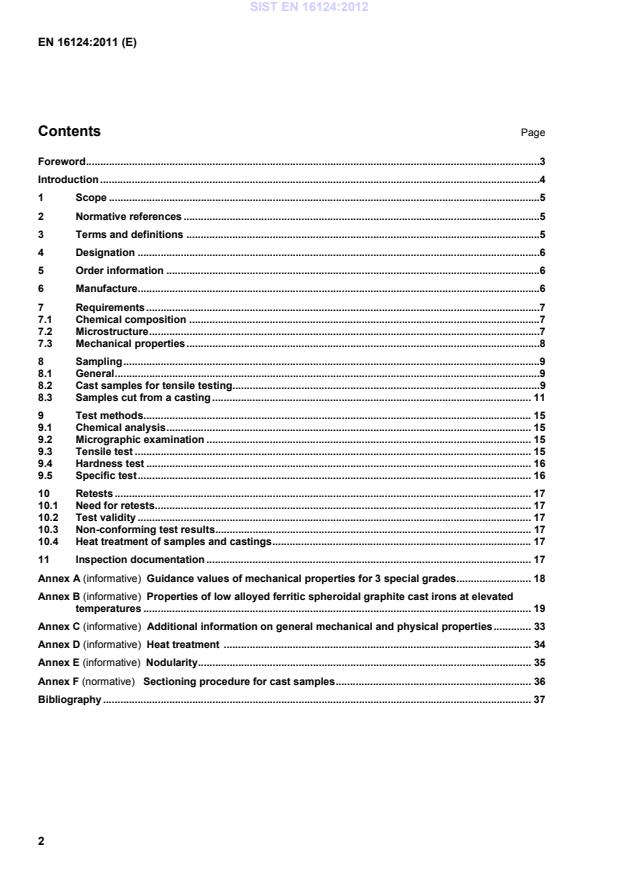
Guidance values of mechanical properties for 3 special grades . 18Annex B (informative)
Properties of low alloyed ferritic spheroidal graphite cast irons at elevated temperatures . 19Annex C (informative)
Additional information on general mechanical and physical properties . 33Annex D (informative)
Heat treatment
........................................................................................................... 34Annex E (informative)
Nodularity . 35Annex F (normative)
Sectioning procedure for cast samples . 36Bibliography . 37 SIST EN 16124:2012
operation that brings the liquid iron into contact with a substance to produce graphite in the predominantly spheroidal (nodular) form during solidification NOTE This operation is often followed by a second one called inoculation. 3.3 cast sample quantity of material cast to represent the cast material, including separately cast sample, side by side cast sample and cast-on sample 3.4 separately cast sample
sample cast in a separate sand mould under representative manufacturing conditions and material grade SIST EN 16124:2012
sample cast in the mould alongside the casting, with a joint running system 3.6 cast-on sample
sample attached directly to the casting
3.7 relevant wall thickness
wall thickness representative of the casting, defined for the determination of the size of the cast samples to which the mechanical properties apply 4 Designation The material shall be designated either by symbol or by number as given in Table 1. NOTE The designation system is in accordance with EN 1560 [3]. In the case of samples cut from the casting, the letter C is added at the end of the designation by symbol. 5 Order information The following information shall be supplied by the purchaser: a) the number of this European Standard; b) the designation of the material; c) the relevant wall thickness of the casting; d) any special requirements. All requirements shall be agreed between the manufacturer and the purchaser by the time of acceptance of the order, e.g. technical delivery conditions according to EN 1559-1 and EN 1559-3. 6 Manufacture Unless otherwise specified by the purchaser, the method of manufacture of low-alloyed ferritic spheroidal graphite cast irons and any heat treatment required to obtain the specified mechanical properties and microstructure shall be left to the discretion of the manufacturer. The manufacturer shall ensure that the requirements defined in this European Standard are met for the material grade specified in the order. All agreements between the manufacturer and the purchaser shall be made by the time of acceptance of the order. SIST EN 16124:2012
Unless otherwise agreed, the content of other elements shall be left to the discretion of the manufacturer. If the presence of any element specified in Table 1 is required to be outside the limits indicated, or if any other alloying elements are required, their contents shall be agreed between the manufacturer and the purchaser and specified in the order. Table 1 — Chemical composition Material designation Silicon % (mass fraction) Molybdenum % (mass fraction) Symbol Number EN-GJS-SiMo25-5 5.3111 2,3 to 2,7 0,4 to 0,6 EN-GJS-SiMo30-7 5.3112 2,8 to 3,2 0,6 to 0,8 EN-GJS-SiMo35-5 5.3113 3,3 to 3,7 0,4 to 0,6 EN-GJS-SiMo40-6 5.3114 3,8 to 4,2 0,5 to 0,7 EN-GJS-SiMo40-10 5.3115 0,8 to 1,1 EN-GJS-SiMo45-6 5.3116 4,3 to 4,7 0,5 to 0,7 EN-GJS-SiMo45-10 5.3117 0,8 to 1,1 EN-GJS-SiMo50-6 5.3118 4,8 to 5,2 0,5 to 0,7 EN-GJS-SiMo50-10 5.3119 0,8 to 1,1
7.2 Microstructure 7.2.1 Graphite structure The graphite structure shall be mainly of form V and Vl in accordance with EN ISO 945-1. A more precise definition may be agreed upon by the time of acceptance of the order. NOTE Annex E gives more information on nodularity. 7.2.2 Matrix structure The matrix structure shall consist of minimum 85 % ferrite, the balance consisting of pearlite and carbides.
Carbides can be present to a maximum of 5 %.
Other limits may be agreed upon by the time of acceptance of the order. SIST EN 16124:2012
Other requirements, such as the mechanical properties to be met on samples with a thickness > 30 mm or at specified locations on the castings, shall be agreed between the manufacturer and the purchaser and specified in the order. If applicable, the position of the cast-on sample or the specified location on the casting shall be agreed between the manufacturer and the purchaser and specified in the order. NOTE Tensile testing requires sound test pieces in order to guarantee pure uni-axial stress during the test. 7.3.2 Hardness Guidance values for the Brinell hardness range of the material grades are given in Table 2 and are applicable to the casting. Table 2 — Mechanical properties measured at ambient temperature on test pieces machined from cast samples of low-alloyed ferritic spheroidal graphite cast irons Material designation 0,2 % proof strength Tensile strength Elongation Brinell
hardness range a Rp0,2 Rm A Symbol Number MPa MPa % HBW min. min. min. EN-GJS-SiMo25-5 5.3111 Guidance values are given in Annex A EN-GJS-SiMo30-7 5.3112 EN-GJS-SiMo35-5 5.3113 EN-GJS-SiMo40-6 5.3114 380 480 8 190 to 240 EN-GJS-SiMo40-10 5.3115 400 510 6 190 to 240 EN-GJS-SiMo45-6 5.3116 420 520 7 200 to 250 EN-GJS-SiMo45-10 5.3117 460 550 5 200 to 250 EN-GJS-SiMo50-6 5.3118 480 580 4 210 to 260 EN-GJS-SiMo50-10 5.3119 500 600 3 210 to 260 a Values for information, measured on the casting.
8.2 Cast samples for tensile testing 8.2.1 Size of cast samples The size of the sample shall be in correspondence with the relevant wall thickness of the casting as shown in Table 3. If other sizes are used, this shall be agreed between the manufacturer and purchaser. Table 3 — Types and size of cast sample and size of tensile test pieces in relation to relevant wall thickness of the casting Relevant wall thickness
t mm Type of sample Preferred diameter of tensile test piece a d mm Option 1 U-shaped (see Figure 1) Option 2 Y-shaped (see Figure 2) Option 3 round bar (see Figure 3) Cast-on sample (see Figure 4) t ≤ 12,5 — I Types b, c A 7 (Option 3: 14 mm) 12,5 < t ≤ 30 — II Types a, b, c B 14 30 < t ≤ 60 b III — C 14 60 < t ≤ 200 — IV — D 14 a Other diameters, in accordance with Figure 5, may be agreed between the manufacturer and the purchaser. b The cooling rate of this cast sample corresponds to that of a 40 mm thick wall.
The location of the cast-on sample shall be agreed between the manufacturer and the purchaser by the time of acceptance of the order, taking into account the shape of the casting and the running system, in order to avoid any unfavourable effect on the properties of the adjacent material. 8.2.6 Test pieces machined from cast samples The tensile test piece shown in Figure 5 shall be machined from a sample shown in Figure 3 or from the hatched part of Figures 1, 2 or 4. The sectioning procedure for cast samples according to Figure 2 and 4 shall be in accordance with Annex F. Unless otherwise agreed, the preferred diameter for the test piece shall be used. SIST EN 16124:2012
NOTE 1 When the zone of last solidification in the casting is included in the test piece diameter, the minimum elongation value may not be obtained. NOTE 2 In the case of large individual castings trepanned samples may be taken at agreed positions in the casting which are to be stated.
Dimensions in millimetres
The thickness of the sand mould surrounding the samples shall be at least 40 mm. Key a For information only. b The length z shall be chosen to allow a test piece of dimensions shown in Figure 5 to be machined from the sample. Figure 1 — Separately cast or side-by-side cast sample — Option 1: U-shaped sample
Dimensions in millimetres Dimension Type I II III lV u 12,5 25 50 75 v 40 55 100 125 x 25 40 50 65 y a 135 140 150 175 z b A function of the test piece length a For information only. b The length z shall be chosen to allow a test piece of dimensions shown in Figure 5 to be machined from the sample. The thickness of the sand mould surrounding the samples shall be at least: 40 mm for types I and II; 80 mm for types III and IV. Figure 2 — Separately cast or side by side cast samples — Option 2: Y-shaped sample
Type a
Type b
Type c Dimensions in millimetres Type A B D H Hb Lf Ln Lt W a 4,5 5,5 25 50 — Lt + 20 Lt – 50 a 100 b 4,5 5,5 25 50 — Lt + 20 Lt – 50 50 c 4,0 5,0 25 35 15 Lt + 20 Lt – 50 50 a Lt
shall be chosen to allow a test piece of dimensions shown in Figure 5 to be machined from the sample. The thickness of the sand mould surrounding the samples shall be at least 40 mm. Figure 3 — Separately cast or side by side cast samples — Option 3: round bar-shaped sample
Dimensions in millimetres Type Relevant wall thickness of castings t a b c h Lt max min A t ≤ 12,5 15 11 7,5 20 to 30 a B 12,5 < t ≤ 30 25 19 12,5 30 to 40 C 30 < t ≤ 60 40 30 20 40 to 65 D 60 < t ≤ 100 70 52,5 35 65 to 105 a Lt shall be chosen to allow a test piece of a dimension shown in Figure 5 to be machined from the sample. Key 1 casting Th
...