

SIST EN 13231-1:2024
(Main)Railway applications - Track - Acceptance of works - Part 1: Works on ballasted track - Plain line, switches and crossings
General Information
- Abstract
This document specifies technical requirements and tolerances for the acceptance of works on ballasted track situated on:
- plain line;
- switches and crossings; and
- rail expansion devices as part of the track
for 1 435 mm and wider track gauge railways.
The works on ballasted track, hereafter referred to as track works, concern construction of new track, track renewal and track maintenance.
This document specifies the requirements for substructure works, track geometry, absolute track position, working parameters of on track machines, track components, ballast cross section, structure gauge, stressing works, specific measurements and quality checks for switches and crossings and rail expansion devices, and for the measuring systems used to perform measurements, verifications and checks for the scope of acceptance. Requirements for responsibilities and documentation necessary for the acceptance of track works are specified.
This document also requires compliance of all track materials with the customer’s relevant acceptance criteria and specifications provided by the supplier.
This document does not cover works related to reprofiling the railhead or the associated measurements, except for some measurements related to safety, as these works are covered by other parts of EN 13231 series.
Platform reconstruction works and level crossing works are not covered by this document.
This document does not apply to urban rail systems or ballastless track.
- Status
- Published
- Public Enquiry End Date
- 30-Nov-2022
- Publication Date
- 13-Dec-2023
- Technical Committee
- IŽNP - Reilway applications
- Current Stage
- 6060 - National Implementation/Publication (Adopted Project)
- Start Date
- 01-Dec-2023
- Due Date
- 05-Feb-2024
- Completion Date
- 14-Dec-2023


Overview
SIST EN 13231-1:2024 - Railway applications - Track - Acceptance of works - Part 1: Works on ballasted track - Plain line, switches and crossings - defines the technical requirements, tolerances and acceptance processes for construction, renewal and maintenance of ballasted track on 1 435 mm and wider gauges. The standard covers plain line, switches and crossings and rail expansion devices as part of the track and sets out requirements for substructure works, track geometry, absolute track position, on‑track machine (OTM) parameters, track components, ballast cross‑section, structure gauge, neutralization (stress‑free temperature) and quality checks. It also specifies measurement, verification methods and documentation needed for formal acceptance and assigns responsibilities for the acceptance process.
Key topics and technical requirements
- Scope and exclusions: Applies to new build, renewal and maintenance of ballasted track (plain line, switches & crossings, rail expansion devices). Does not apply to urban rail systems, ballastless track, platform reconstruction or level crossing works; railhead reprofiling is covered in other EN 13231 parts except for a few safety‑related checks.
- Acceptance process & responsibilities: Defines procedures, deadlines, roles and documentation required for the formal acceptance of track works and warranty handling.
- Track geometry & absolute position: Requirements for longitudinal and transverse geometry and geodetic positioning to confirm alignment and layout.
- On‑track machines (OTMs): Working parameters and quality control for tamping, ballast compaction/stabilization, ballast replacement and cleaning.
- Track components: Acceptance criteria for rails, welds, mechanical/insulated joints, fastenings, sleepers/bearers, anchors, under‑ballast mats and substructure materials.
- Switches and crossings: Specific measurements, functional and safety dimensions, gap verification and quality checks for movable parts and rail expansion devices.
- Neutralization works: Specification of stress‑free temperature and procedures for neutralizing rails.
- Measuring systems & documentation (Annex A): Normative requirements for measurement devices, geodetic network, data acquisition, measurement methods and traceable documentation.
- Material compliance: Requires all track materials to meet the customer’s acceptance criteria and supplier specifications.
Practical applications
- Use in project acceptance testing for new track construction and major renewals
- Defining contractual acceptance criteria and handover documentation between contractors and infrastructure managers
- Setting measurement and reporting protocols for quality assurance and commissioning
- Guiding on‑site inspection, surveying and validation activities for tamping, ballast works and switch/crossing installations
- Aligning supplier deliveries and component inspections with client acceptance requirements
Who should use this standard
- Railway infrastructure owners/operators and asset managers
- Track engineering and surveying teams
- Contractors undertaking construction, renewal or maintenance of ballasted track
- On‑track machine operators and maintenance planners
- Quality assurance, testing and inspection personnel
- Suppliers of rails, fastenings, sleepers and ballast materials
Related standards
- Other parts of the EN 13231 series (for topics such as railhead reprofiling and additional acceptance procedures)
- National adaptations and customer‑specific technical specifications referenced within project contracts
Keywords: SIST EN 13231-1:2024, railway track acceptance, ballasted track, switches and crossings, track geometry, on-track machines, rail expansion devices, track maintenance, infrastructure acceptance.
Relations
- Effective Date
- 01-Feb-2024
- Effective Date
- 05-Aug-2026
- Effective Date
- 15-Jul-2026
- Effective Date
- 28-Jan-2026
- Effective Date
- 28-Jan-2026
- Effective Date
- 28-Jan-2026
- Effective Date
- 28-Jan-2026
- Effective Date
- 28-Jan-2026
- Effective Date
- 28-Jan-2026
- Effective Date
- 28-Jan-2026
- Effective Date
- 28-Jan-2026
- Effective Date
- 28-Jan-2026
- Effective Date
- 28-Jan-2026
- Effective Date
- 28-Jan-2026
- Effective Date
- 28-Jan-2026
Get Certified
Connect with accredited certification bodies for this standard

IRIS Certification (UNIFE)
International Railway Industry Standard certification.

TÜV SÜD Rail GmbH
TÜV SÜD railway certification services.

Bureau Veritas Railway Certification
Railway and transportation certification.
Sponsored listings
Frequently Asked Questions
SIST EN 13231-1:2024 is a standard published by the Slovenian Institute for Standardization (SIST). Its full title is "Railway applications - Track - Acceptance of works - Part 1: Works on ballasted track - Plain line, switches and crossings". This standard covers: This document specifies technical requirements and tolerances for the acceptance of works on ballasted track situated on: - plain line; - switches and crossings; and - rail expansion devices as part of the track for 1 435 mm and wider track gauge railways. The works on ballasted track, hereafter referred to as track works, concern construction of new track, track renewal and track maintenance. This document specifies the requirements for substructure works, track geometry, absolute track position, working parameters of on track machines, track components, ballast cross section, structure gauge, stressing works, specific measurements and quality checks for switches and crossings and rail expansion devices, and for the measuring systems used to perform measurements, verifications and checks for the scope of acceptance. Requirements for responsibilities and documentation necessary for the acceptance of track works are specified. This document also requires compliance of all track materials with the customer’s relevant acceptance criteria and specifications provided by the supplier. This document does not cover works related to reprofiling the railhead or the associated measurements, except for some measurements related to safety, as these works are covered by other parts of EN 13231 series. Platform reconstruction works and level crossing works are not covered by this document. This document does not apply to urban rail systems or ballastless track.
This document specifies technical requirements and tolerances for the acceptance of works on ballasted track situated on: - plain line; - switches and crossings; and - rail expansion devices as part of the track for 1 435 mm and wider track gauge railways. The works on ballasted track, hereafter referred to as track works, concern construction of new track, track renewal and track maintenance. This document specifies the requirements for substructure works, track geometry, absolute track position, working parameters of on track machines, track components, ballast cross section, structure gauge, stressing works, specific measurements and quality checks for switches and crossings and rail expansion devices, and for the measuring systems used to perform measurements, verifications and checks for the scope of acceptance. Requirements for responsibilities and documentation necessary for the acceptance of track works are specified. This document also requires compliance of all track materials with the customer’s relevant acceptance criteria and specifications provided by the supplier. This document does not cover works related to reprofiling the railhead or the associated measurements, except for some measurements related to safety, as these works are covered by other parts of EN 13231 series. Platform reconstruction works and level crossing works are not covered by this document. This document does not apply to urban rail systems or ballastless track.
SIST EN 13231-1:2024 is classified under the following ICS (International Classification for Standards) categories: 45.080 - Rails and railway components; 93.100 - Construction of railways. The ICS classification helps identify the subject area and facilitates finding related standards.
SIST EN 13231-1:2024 has the following relationships with other standards: It is inter standard links to SIST EN 13231-1:2013, SIST EN 13848-6:2026, SIST EN 15273-4:2025, SIST EN 13481-7:2022, SIST EN 13803:2017, SIST EN 13848-2:2021, SIST EN 13232-8:2023, SIST EN 13230-3:2016, SIST EN 13481-4:2022, SIST EN 14033-2:2017, SIST EN 13848-5:2017, SIST EN 13230-2:2016, SIST EN 13230-4:2016+A1:2020, SIST EN 13232-2:2023, SIST EN 13232-1:2023. Understanding these relationships helps ensure you are using the most current and applicable version of the standard.
SIST EN 13231-1:2024 is associated with the following European legislation: EU Directives/Regulations: 2010-01-4867. When a standard is cited in the Official Journal of the European Union, products manufactured in conformity with it benefit from a presumption of conformity with the essential requirements of the corresponding EU directive or regulation.
SIST EN 13231-1:2024 is available in PDF format for immediate download after purchase. The document can be added to your cart and obtained through the secure checkout process. Digital delivery ensures instant access to the complete standard document.
Standards Content (Sample)
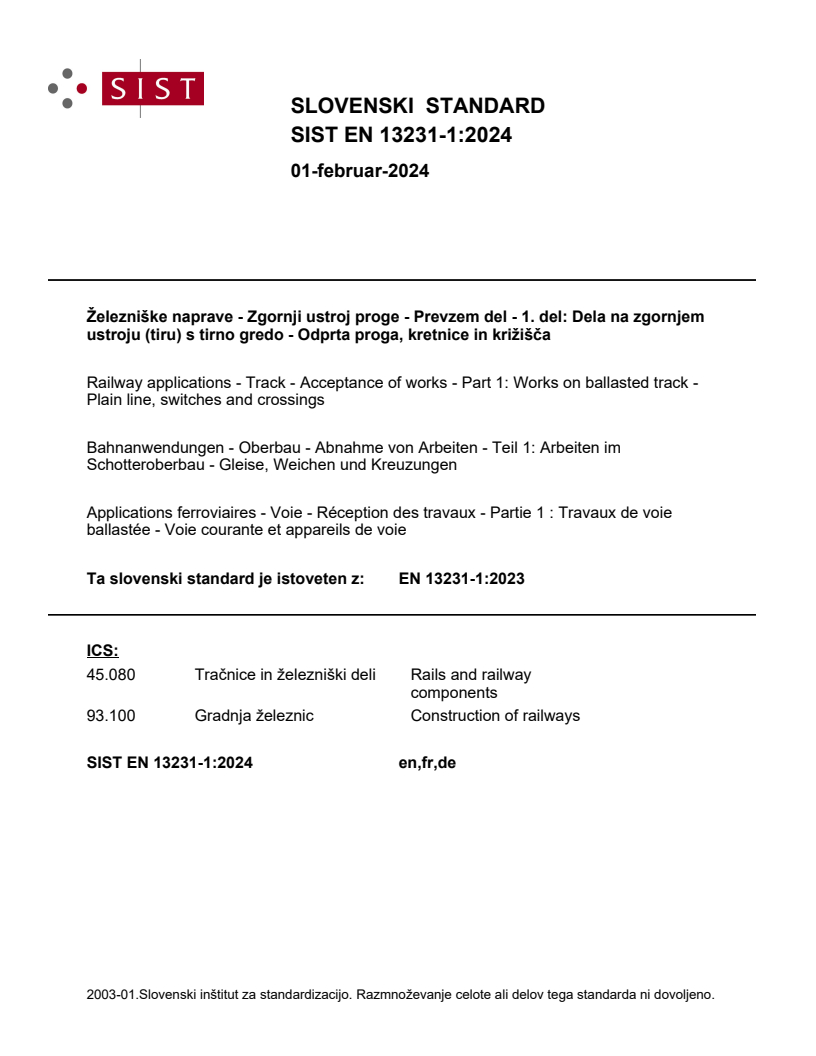
SLOVENSKI STANDARD
01-februar-2024
Železniške naprave - Zgornji ustroj proge - Prevzem del - 1. del: Dela na zgornjem
ustroju (tiru) s tirno gredo - Odprta proga, kretnice in križišča
Railway applications - Track - Acceptance of works - Part 1: Works on ballasted track -
Plain line, switches and crossings
Bahnanwendungen - Oberbau - Abnahme von Arbeiten - Teil 1: Arbeiten im
Schotteroberbau - Gleise, Weichen und Kreuzungen
Applications ferroviaires - Voie - Réception des travaux - Partie 1 : Travaux de voie
ballastée - Voie courante et appareils de voie
Ta slovenski standard je istoveten z: EN 13231-1:2023
ICS:
45.080 Tračnice in železniški deli Rails and railway
components
93.100 Gradnja železnic Construction of railways
2003-01.Slovenski inštitut za standardizacijo. Razmnoževanje celote ali delov tega standarda ni dovoljeno.
EN 13231-1
EUROPEAN STANDARD
NORME EUROPÉENNE
November 2023
EUROPÄISCHE NORM
ICS 93.100 Supersedes EN 13231-1:2013
English Version
Railway applications - Infrastructure - Acceptance of
works - Part 1: Works on ballasted track - Plain line,
switches and crossings
Applications ferroviaires - Voie - Réception des travaux Bahnanwendungen - Oberbau - Abnahme von Arbeiten
- Partie 1: Travaux de voie ballastée - Voie courante et - Teil 1: Arbeiten im Schotteroberbau - Gleise, Weichen
appareils de voie und Kreuzungen
This European Standard was approved by CEN on 8 October 2023.
CEN members are bound to comply with the CEN/CENELEC Internal Regulations which stipulate the conditions for giving this
European Standard the status of a national standard without any alteration. Up-to-date lists and bibliographical references
concerning such national standards may be obtained on application to the CEN-CENELEC Management Centre or to any CEN
member.
This European Standard exists in three official versions (English, French, German). A version in any other language made by
translation under the responsibility of a CEN member into its own language and notified to the CEN-CENELEC Management
Centre has the same status as the official versions.
CEN members are the national standards bodies of Austria, Belgium, Bulgaria, Croatia, Cyprus, Czech Republic, Denmark, Estonia,
Finland, France, Germany, Greece, Hungary, Iceland, Ireland, Italy, Latvia, Lithuania, Luxembourg, Malta, Netherlands, Norway,
Poland, Portugal, Republic of North Macedonia, Romania, Serbia, Slovakia, Slovenia, Spain, Sweden, Switzerland, Türkiye and
United Kingdom.
EUROPEAN COMMITTEE FOR STANDARDIZATION
COMITÉ EUROPÉEN DE NORMALISATION
EUROPÄISCHES KOMITEE FÜR NORMUNG
CEN-CENELEC Management Centre: Rue de la Science 23, B-1040 Brussels
© 2023 CEN All rights of exploitation in any form and by any means reserved Ref. No. EN 13231-1:2023 E
worldwide for CEN national Members.
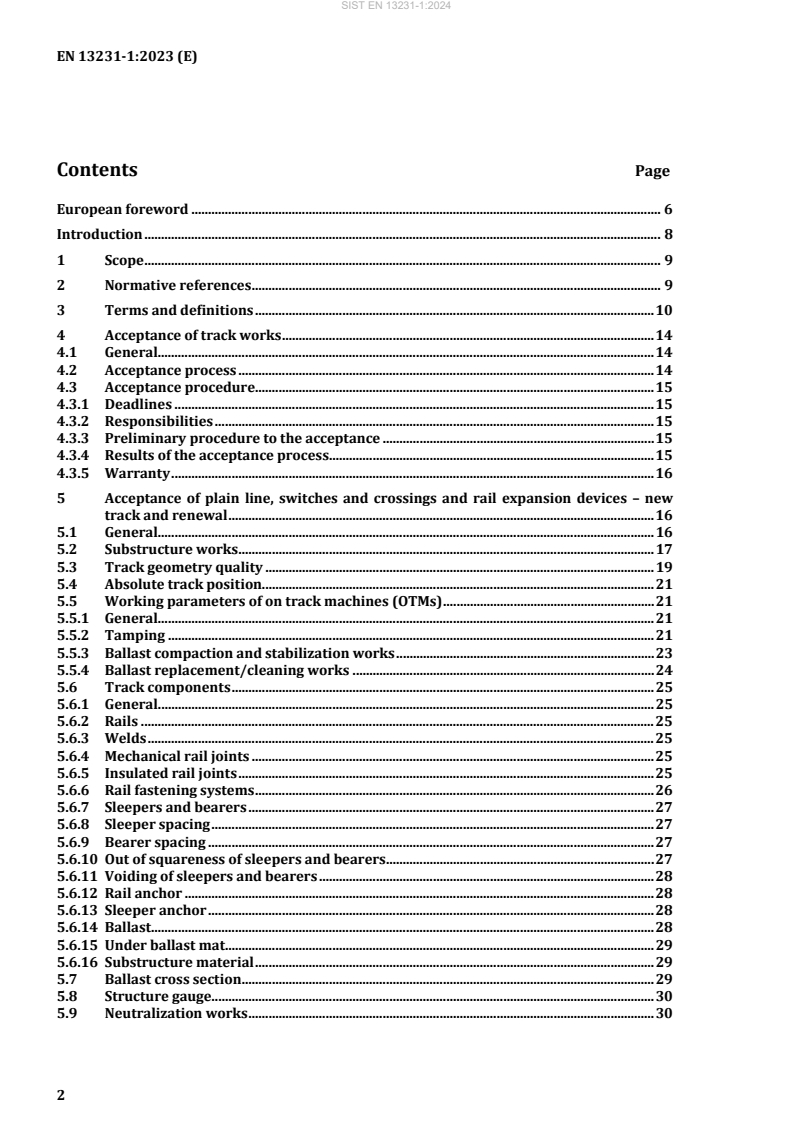
Contents Page
European foreword . 6
Introduction . 8
1 Scope . 9
2 Normative references . 9
3 Terms and definitions . 10
4 Acceptance of track works . 14
4.1 General. 14
4.2 Acceptance process . 14
4.3 Acceptance procedure . 15
4.3.1 Deadlines . 15
4.3.2 Responsibilities . 15
4.3.3 Preliminary procedure to the acceptance . 15
4.3.4 Results of the acceptance process. 15
4.3.5 Warranty . 16
5 Acceptance of plain line, switches and crossings and rail expansion devices – new
track and renewal . 16
5.1 General. 16
5.2 Substructure works . 17
5.3 Track geometry quality . 19
5.4 Absolute track position. 21
5.5 Working parameters of on track machines (OTMs) . 21
5.5.1 General. 21
5.5.2 Tamping . 21
5.5.3 Ballast compaction and stabilization works . 23
5.5.4 Ballast replacement/cleaning works . 24
5.6 Track components . 25
5.6.1 General. 25
5.6.2 Rails . 25
5.6.3 Welds . 25
5.6.4 Mechanical rail joints . 25
5.6.5 Insulated rail joints . 25
5.6.6 Rail fastening systems . 26
5.6.7 Sleepers and bearers . 27
5.6.8 Sleeper spacing . 27
5.6.9 Bearer spacing . 27
5.6.10 Out of squareness of sleepers and bearers . 27
5.6.11 Voiding of sleepers and bearers . 28
5.6.12 Rail anchor . 28
5.6.13 Sleeper anchor . 28
5.6.14 Ballast. 28
5.6.15 Under ballast mat. 29
5.6.16 Substructure material . 29
5.7 Ballast cross section . 29
5.8 Structure gauge. 30
5.9 Neutralization works . 30
5.9.1 General . 30
5.9.2 Specification of the stress-free temperature . 31
5.9.3 Neutralization of rails . 31
5.10 Measurements and quality checks for switches and crossings and rail expansion
devices . 31
5.10.1 General . 31
5.10.2 Verification of positioning of rail parts for switches and crossings and rail expansion
devices . 32
5.10.3 Verification of functional and safety dimensions for switches and crossings and rail
expansion devices . 38
5.10.4 Verification of gaps for switches and crossings and rail expansion devices . 49
5.10.5 Quality checks for switches and crossings and rail expansion devices . 52
5.10.6 Verification of safety and functionality of switches and crossings with moveable parts
................................................................................................................................................................... 52
6 Acceptance of plain line, switches and crossings and rail expansion devices –
Maintenance . 53
6.1 General . 53
6.2 Machine tamping – maintenance measure . 53
6.2.1 General . 53
6.2.2 Preliminary works . 53
6.2.3 Track geometry quality . 54
6.2.4 Absolute track position . 56
6.2.5 Working parameters of on track machines (OTM) . 56
6.2.6 Track components . 56
6.2.7 Ballast cross section . 56
6.2.8 Structure gauge . 56
6.2.9 Measurements and quality verifications for switches and crossings and rail expansion
devices . 56
6.3 Ballast cleaning – maintenance measure . 56
6.3.1 General . 56
6.3.2 Preliminary works . 56
6.3.3 Ballast replacement and cleaning works . 56
6.4 Hand tamping and manual geometry correction – maintenance measure . 57
6.5 Replacement of track components (fastener and sleeper) – maintenance measure. 57
6.6 (Local) Spot ballast replacement – maintenance measure. 57
6.7 Neutralization works – maintenance measure . 57
6.8 Works in switches and crossings and rail expansion devices – maintenance measure
................................................................................................................................................................... 57
6.8.1 General . 57
6.8.2 Verification of functional and safety dimensions for switches and crossings and rail
expansion devices . 57
6.8.3 Verification of gaps for switches and crossings and rail expansion devices . 59
6.8.4 Quality checks for switches and crossings and rail expansion devices . 62
Annex A (normative) Measuring systems – Requirements and documentation . 63
A.1 General . 63
A.2 Track geometry . 63
A.2.1 General . 63
A.2.2 Measurement devices . 63
A.2.3 Measurement methods . 63
A.3 Absolute track position. 64
A.3.1 General. 64
A.3.2 Network of survey points and reference systems . 64
A.3.3 Specifications for geodetic measurements . 65
A.3.4 Measuring systems . 66
A.4 Working parameters of on track machines . 66
A.4.1 General. 66
A.4.2 Quality control factors of tamping works . 66
A.4.3 Ballast compaction and stabilization – mechanical stabilization tools . 67
A.4.4 Ballast replacement/cleaning works . 68
A.5 Track components . 69
A.5.1 Welds . 69
A.5.2 Rail fastening system . 69
A.5.3 Sleeper spacing . 70
A.5.4 Bearer spacing . 70
A.5.5 Out of squareness of the sleepers . 70
A.5.6 Voiding of sleepers and bearers . 70
A.6 Ballast cross section . 70
A.7 Structure gauge check . 70
A.7.1 General. 70
A.7.2 Data acquisition . 70
A.7.3 Assessment . 71
A.7.4 Acceptance of the clearance of the structure gauge . 71
A.8 Neutralization works . 72
A.8.1 General. 72
A.8.2 Neutralization of rails . 72
Annex B (normative) Requirements for measuring systems for switches and crossings and
rail expansion devices . 74
B.1 General. 74
B.2 Special design . 74
B.3 Requirements and accuracy of the measurement equipment . 76
B.4 Specific measurements . 84
Annex C (informative) Relationship between D1 values and chord values for LL and AL (based
on statistical evaluation) . 85
C.1 General. 85
C.2 Comparison method . 85
C.3 Results . 87
C.4 Conclusions . 89
Bibliography . 90
European foreword
This document (EN 13231-1:2023) has been prepared by Technical Committee CEN/TC 256 “Railway
applications”, the secretariat of which is held by DIN.
This European Standard shall be given the status of a national standard, either by publication of an
identical text or by endorsement, at the latest by May 2024, and conflicting national standards shall be
withdrawn at the latest by May 2024.
Attention is drawn to the possibility that some of the elements of this document may be the subject of
patent rights. CEN shall not be held responsible for identifying any or all such patent rights.
This document supersedes EN 13231-1:2013.
The main changes compared to the previous edition EN 13231-1:2013 are listed below:
— Enlargement of the scope by inclusion of:
— requirements for substructure works as the quality of these works is substantial for the building
of new tracks or the renewal of existing tracks;
— conformity requirements of all track materials with the relevant acceptance criteria of the
customer and the specifications provided by the supplier.
— New structure of this document in order to offer higher processability/workability and clearer
responsibilities in the track works acceptance process as follows:
— separate clause for acceptance process including acceptance procedure, responsibilities and
warranty specifications;
— separation of requirements for new tracks and renewal works from those for maintenance
works; systematic treatment of requirements for working parameters and track components;
— separate consideration of requirements for corresponding measuring systems and specific
documentation of measurements in a normative Annex;
— structured presentation of the requirements for positioning, functionality, safety dimension and
quality checks for switches and crossings and rail expansion devices, and separate consideration
of corresponding measuring devices in a normative Annex.
— Implementation of new available measurement technologies on tamping and stabilizing machines.
— Comprehensive clarification on tamping, ballast stabilizing and ballast cleaning processes and
sustainable use of track ballast.
— Revision of the existing tolerances.
— Definition of new parameters and the respective tolerances.
— Improved coordination with EN 13848 series by systematic references.
This document is one of the EN 13231 series “Railway applications — Track — Acceptance of works” as
listed below:
— Part 1: Works on ballasted track — Plain line, switches and crossings (the present document)
— Part 2: Acceptance of reprofiling rails in plain line, switches, crossings and expansion devices
— Part 5: Procedures for rail reprofiling in plain line, switches, crossings and expansion devices
Any feedback and questions on this document should be directed to the users’ national standards body.
A complete listing of these bodies can be found on the CEN website.
According to the CEN-CENELEC Internal Regulations, the national standards organisations of the
following countries are bound to implement this European Standard: Austria, Belgium, Bulgaria, Croatia,
Cyprus, Czech Republic, Denmark, Estonia, Finland, France, Germany, Greece, Hungary, Iceland, Ireland,
Italy, Latvia, Lithuania, Luxembourg, Malta, Netherlands, Norway, Poland, Portugal, Republic of North
Macedonia, Romania, Serbia, Slovakia, Slovenia, Spain, Sweden, Switzerland, Türkiye and the United
Kingdom.
Introduction
The European rail network has a variety of different track construction types, track components,
construction materials, working equipment and methods. These have evolved historically and are also a
result from different geographical and climatic conditions.
Therefore, in some cases, this document provides only minimum requirements. Additionally, national
regulations may apply for particular parameters.
1 Scope
This document specifies technical requirements and tolerances for the acceptance of works on ballasted
track situated on:
— plain line;
— switches and crossings; and
— rail expansion devices as part of the track
for 1 435 mm and wider track gauge railways.
The works on ballasted track, hereafter referred to as track works, concern construction of new track,
track renewal and track maintenance.
This document specifies the requirements for substructure works, track geometry, absolute track
position, working parameters of on track machines, track components, ballast cross section, structure
gauge, stressing works, specific measurements and quality checks for switches and crossings and rail
expansion devices, and for the measuring systems used to perform measurements, verifications and
checks for the scope of acceptance. Requirements for responsibilities and documentation necessary for
the acceptance of track works are specified.
This document also requires compliance of all track materials with the customer’s relevant acceptance
criteria and specifications provided by the supplier.
This document does not cover works related to reprofiling the railhead or the associated measurements,
except for some measurements related to safety, as these works are covered by other parts of EN 13231
series.
Platform reconstruction works and level crossing works are not covered by this document.
This document does not apply to urban rail systems or ballastless track.
2 Normative references
The following documents are referred to in the text in such a way that some or all of their content
constitutes requirements of this document. For dated references, only the edition cited applies. For
undated references, the latest edition of the referenced document (including any amendments) applies.
EN 932-1, Tests for general properties of aggregates — Part 1: Methods for sampling
EN 13145, Railway applications — Track — Wood sleepers and bearers
EN 13230 (all parts), Railway applications — Track — Concrete sleepers and bearers
EN 13232 (all parts), Railway applications — Track — Switches and crossings
EN 13450, Aggregates for railway ballast
EN 13481 (all parts), Railway applications — Track — Performance requirements for fastening systems
EN 13803, Railway applications — Track — Track alignment design parameters — Track gauges 1 435
mm and wider
EN 13848 (all parts), Railway applications — Track — Track geometry quality
EN 14033-2:2017, Railway applications — Track — Railbound construction and maintenance machines —
Part 2: Technical requirements for travelling and working
EN 15273-1, Railway applications — Gauges — Part 1: General — Common rules for infrastructure and
rolling stock
EN 15273-3, Railway applications — Gauges — Part 3: Structure gauges
3 Terms and definitions
For the purposes of this document, the following terms and definitions apply.
ISO and IEC maintain terminology databases for use in standardization at the following addresses:
— IEC Electropedia: available at https://www.electropedia.org/
— ISO Online browsing platform: available at https://www.iso.org/obp
3.1
absolute track position
position of the track measured from surrounding geodetic reference points
3.2
acceptance
declaration of the customer to the contractor that the works have been achieved in accordance with the
contract
3.2.1
acceptance process
set of interrelated or interacting activities in order to deliver the acceptance
3.2.2
acceptance procedure
specific way to carry out the acceptance process
3.3
Actuation Locking Detection System
ALDS
system that ensures the correct movement and locking, and enables the verification of correct positioning
of the moveable parts of switches and crossings
3.4
anti-creep device
device to stop or limit relative longitudinal movement between switch and stock rails
3.5
ballast stabilization
dynamic conditioning of the ballast bed which provides compaction of the ballast bed and an increase of
the lateral track resistance
3.5.1
natural stabilization
achieved by train passing in service or machine passing during construction
3.5.2
artificial stabilization
applied by means of ballast compacting tools or dynamic stabilising equipment
3.6
bearer
sleeper for switches and crossings and rail expansion devices
3.7
design track gauge
design value of track gauge for a given track section, which might be different from the nominal track
gauge
[SOURCE: EN 13848-5:2017, 3.2]
3.8
design value
parameter adopted within the design phase/design process
3.9
design track position
position of the track, in a geodetic reference system, defined in the track design process
Note 1 to entry: The control of the design documents and layouts for new or upgraded tracks according to
EN 13803-1 and EN 13803-2 or other regulations is not part of this document.
3.10
deviation from design track position
vertical and lateral difference between absolute track position and design track position
3.11
fixed objects
permanent objects along the track as platform, bridge, level crossing, multiple switches, overhead wire
3.12
insulated rail joint
mechanical rail joint with the additional function to separate the rail ends electrically
[SOURCE: EN 16843:2023, 3.7].
3.13
maintenance
all other works than construction of new track and renewal
3.14
mechanical rail joint
mechanical assembly, for example with fishplates to join two rail ends
[SOURCE: EN 16843:2023, 3.3].
3.15
minor defect
defect which does not reduce the functionality and/or lifetime of the track component
3.16
neutral temperature
temperature value, set by the customer based on the mean value of the lowest and highest expected rail
temperature
Note 1 to entry: The customer may add an offset to the mean value in order to reduce the compressive forces in the
rail at high temperatures.
3.16.1
neutral temperature range
deviation from the neutral temperature
3.17
neutralization
stressing works of the rail involving release of the track to normal traffic at the nominal speed
3.18
new track
complete track construction on a new line where none existed before, applying new materials, including
ballast and substructure material
3.19
nominal track gauge
reference value for track gauge used by individual networks
[SOURCE: EN 13848-5:2017, 3.1]
3.20
OTM
on-track machine
machine specially designed for construction and maintenance of the track and infrastructure as a self-
propelling or as a hauled vehicle, when it is running on its own rail wheels
[SOURCE: EN 17343:2023, 3.1.7.8.1.1, modified (without Note 1 to entry and SOURCE)]
3.20.1
OTMM
track construction and maintenance machine
self-propelled or hauled machine/vehicle which is used in construction, maintenance and/or
improvement of the quality of the infrastructure and which is equipped with a track geometry measuring
system
Note 1 to entry: OTMMs are a subset of on-track machines (OTM).
3.21
plain line
any section of track excluding switches and crossings and rail expansion devices
3.22
pre-neutralization
stressing works of the rail involving release of the track to normal traffic at a speed limit
3.23
rail anchor
device clamped to the rail foot, fitted close to sleeper, to prevent longitudinal displacement of the rail
relative to the sleeper
3.24
renewal
replacement of track components, switches and crossings and rail expansion devices applying new
materials, including the ballast and possibly formation layer material, if necessary
Note 1 to entry: Renewal can be complete renewal or partial renewal.
Note 2 to entry: The customer specifies, depending on the amount of the partial renewal, whether the limits for
new tracks or maintenance shall be applied.
3.25
sleeper anchor
device placed in the middle or at the head of sleepers to increase lateral track resistance
3.26
stress-free temperature
rail temperature at which the rail is free of thermal stress
3.27
substantial defect
defect which reduces the functionality and/or lifetime of the track component
3.28
tamping
correction works of track geometry and absolute track position by machines or manually-operated
devices
3.29
tolerance
permissible deviation from reference or designed value
3.30
track components
rails, welds, rail fastenings, sleepers and bearers, mechanical rail joints, insulated rail joints, anti-creep
devices, sleeper anchors, ballast, under ballast mats
3.31
track geometry
geometric description of the track, characterized by the principal track geometric parameters: track
gauge, longitudinal level, cross level, alignment and twist as described in EN 13848-1
3.32
track geometry quality
assessment of excursions in the vertical and lateral planes from the mean or designed geometrical
characteristics of specified parameters which give rise to safety concerns or have a correlation with ride
quality
4 Acceptance of track works
4.1 General
Acceptance is the declaration of the customer to the contractor, that specified works have been executed
in accordance with the contract. Acceptance is achieved by following the acceptance process, in
accordance with the acceptance procedure.
Acceptance shall only take place when the works have been completed in accordance with the
requirements of the contract.
Works on ballasted track including plain line, switches and crossings and rail expansion devices cover:
— new track,
— renewal or partial renewal and maintenance of track components,
— removing and relaying existing track because of works on substructure (e.g. bridges, tunnels,
earthworks, etc.),
— ballast cleaning and compacting,
— works to correct track geometry,
— stressing works and
— welding.
4.2 Acceptance process
The acceptance process begins when the contractor informs the customer of the completion of their
works and requests the acceptance by means of a written notification.
Representatives of the customer and of the contractor take part in the acceptance process.
For the purpose of acceptance, each part of the track concerned shall be verified as follows:
— for the preliminary acceptance the customer shall carry out a series of checks and verifications in the
frameworks of a preliminary acceptance as listed in 4.3.3;
— for the acceptance of new tracks or renewal works, measurements and verifications shall be
performed according to the requirements specified in Clause 5;
— for the acceptance of maintenance works, measurements and verifications shall be performed
according to the requirements specified in Clause 6.
In case of substantial defects, acceptance should be postponed until their elimination or shall be the
subject of negotiation between both parties. Substantial defects shall be documented (e.g. in an
acceptance form, report, etc.).
In case of minor defects, acceptance should be granted either with reservations or with allowance and
should be documented (e.g. in an acceptance form, report, etc.) as well as, when required, the period
granted for their elimination.
The result of the acceptance shall be documented in written form, outlining the results achieved
according to 4.3.4.
4.3 Acceptance procedure
4.3.1 Deadlines
Acceptance procedure shall take place after the written notification from the contractor has been
registered. The time interval between notification and date of acceptance shall be specified by the
customer in the contract.
4.3.2 Responsibilities
After the completion of works, the contractor shall notify the customer in writing that the preliminary
procedure to the acceptance can be carried out.
The customer and contractor shall specify in the contract who will carry out the measurements,
verifications and checks and how they will be documented.
The customer shall carry out the preliminary procedure for the acceptance of the works.
The personnel and equipment necessary for carrying out the preliminary acceptance procedure shall be
provided by the contractor or by the customer in accordance with the contract.
4.3.3 Preliminary procedure to the acceptance
The preliminary procedure to the acceptance consists of the following operations:
— checking volume and extent of the works carried out;
— checking the records of the measurements and tests according to the contract;
— checking the documents according to the contract (e.g. drawings, notes of calculations, measuring
reports, certificates of used material and of measuring instruments, quality control, etc.);
— listing of works not executed in accordance with the contract;
— listing of non-conformities (missing documents, certificates of used material and of measuring
instruments, other evidence).
4.3.4 Results of the acceptance process
The consequences of the acceptance process shall be notified to the contractor as follows:
— acceptance is granted; or
— acceptance is granted with reservations; or
— acceptance is granted with allowance; or
— acceptance is not granted.
If the acceptance is granted with reservations, the contractor shall take the necessary actions to correct
the defects and/or supply the missing documents within the period of time as agreed in the contract.
After completion of corrective works, the preliminary acceptance procedure shall again be applied to the
corrected defects.
If the acceptance is granted with allowance, the customer decides, in accordance with the contract, which
defects, if any, shall not be corrected and shall be the subject of negotiation between both parties.
If the acceptance is not granted, the contractor shall take the necessary actions to fulfil the acceptance
requirements as specified in the contract. After completion of the acceptance requirements, the
acceptance procedure shall again be applied.
4.3.5 Warranty
The warranty is a contractual term and specifies the right of the customer to have defects corrected by
the contractor even after acceptance, if the customer can prove that the defect is a result of an incorrect
(faulty) production by the contractor. The warranty is limited by a warranty period which shall be
specified in the contract together with the warranty conditions and which starts after acceptance.
5 Acceptance of plain line, switches and crossings and rail expansion devices –
new track and renewal
5.1 General
Prior to acceptance and depending on the type of track works, measurements and checks shall be carried
out on new or renewed plain line and switches and crossings and rail expansion devices manually, or by
automatic means, and shall be documented.
The measurements and checks shall be carried out as follows:
— substructure works as specified in 5.2, see also Figure 1;
— track geometry of plain line, switches and crossings and rail expansion devices as specified in 5.3;
— absolute position of plain line, switches and crossings and rail expansion devices as specified in 5.4;
— working parameters of on track machines:
— tamping works as specified in 5.5.2;
— ballast compaction and stabilization works as specified in 5.5.3;
— ballast replacement/cleaning works as specified in 5.5.4;
— track components:
— rails as specified in 5.6.2;
— welds as specified in 5.6.3;
— mechanical rail joints as specified in 5.6.4;
— insulated rail joints as specified in 5.6.5;
— rail fastening systems as specified in 5.6.6;
— sleeper spacing, bearer spacing, out of squareness of sleepers and bearers and voiding of
sleepers and bearers as specified in 5.6.7, 5.6.8, 5.6.9 and 5.6.10;
— ballast as specified in 5.6.14;
— under ballast mat as specified in 5.6.15;
— substructure material as specified in 5.6.16, see also Figure 1;
— ballast cross section as specified in 5.7;
— structure gauge as specified in 5.8;
— neutralization works as specified in 5.9;
— specific measurements and quality checks for switches and crossings and rail expansion devices as
specified in 5.10;
— damage caused to rails, sleepers, bearers, fastenings, cables and other track equipment, as well as
displacements of the sleepers, bearers or rail pads which occurred during the works;
— compliance of all track materials with the customer’s relevant acceptance criteria or specifications,
in particular acceptance of associated works as well as approval and acceptance of the material
provided by the contractor.
Documentation shall consist of a report substantiated with figures and objective observations, justifying
how acceptance criteria has been met. It shall be signed and dated by the author.
The customer may request additional documented measurements or checks, if contractually agreed.
5.2 Substructure works
The substructure layers, see Figure 1, shall be produced according to the following requirements:
— the load-bearing and deformation behaviour is as homogeneous as possible;
— the load-bearing capacity and frost resistance are not impaired by impurities or fine grain
accumulations;
— no segregation of the grain mixture occurs;
— even compaction with an appropriate water content is undertaken;
— avoiding of grain fragmentation.
...