

SIST EN 16431:2026
(Main)Railway applications - Infrastructure - Hollow sleepers and bearers
- Abstract
This document defines technical criteria and control procedures which are satisfied by hollow sleepers and bearers used in ballasted track with Vignole rails. The hollow sleepers and bearers designed for ballasted track can also be used in ballastless track. In this case, the requirements are defined by the customer.
- Status
- Published
- Public Enquiry End Date
- 31-Jan-2025
- Publication Date
- 22-Jun-2026
- Technical Committee
- IŽNP - Reilway applications
- Current Stage
- 6060 - National Implementation/Publication (Adopted Project)
- Start Date
- 17-Jun-2026
- Due Date
- 22-Aug-2026
- Completion Date
- 23-Jun-2026

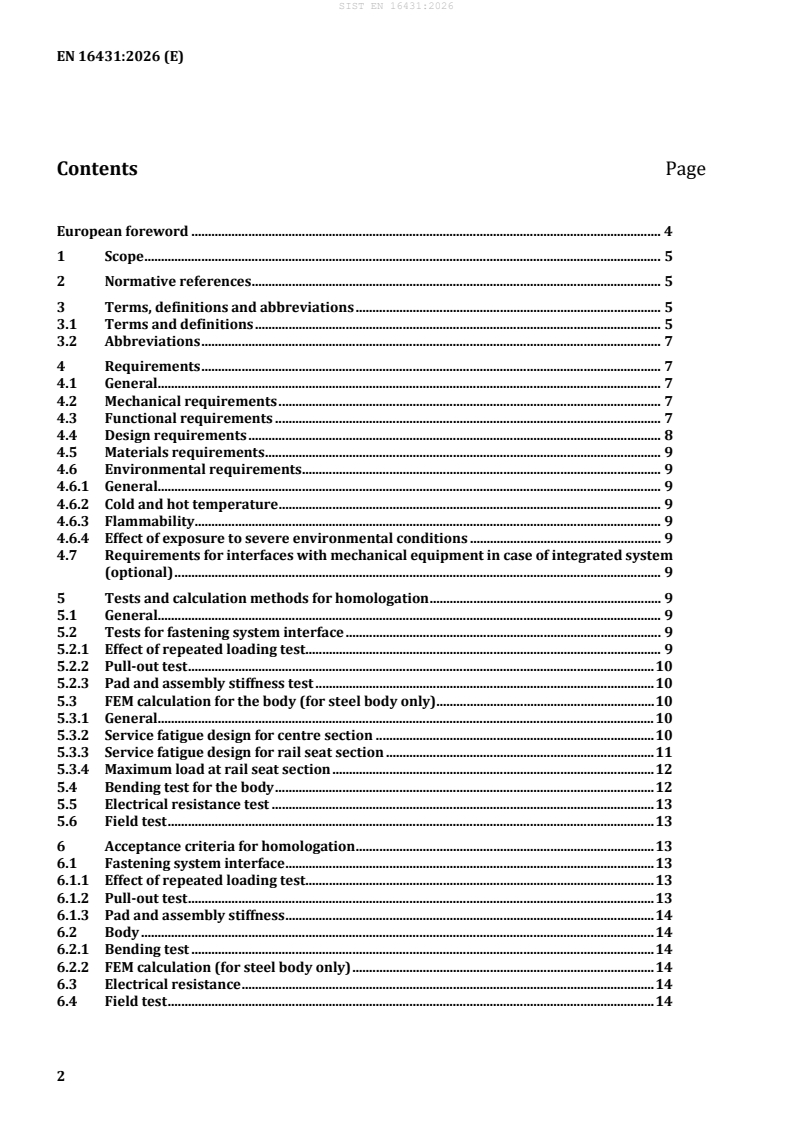
SIST EN 16431:2026 is the Slovenian adoption of EN 16431:2026 for railway infrastructure. It specifies technical criteria and control procedures for hollow sleepers and bearers used in ballasted track with Vignole rails, and it lets the customer define the requirements when these elements are used in ballastless track.
What does SIST EN 16431:2026 specify?
SIST EN 16431:2026 covers the design, testing, acceptance, quality control and traceability of hollow sleepers and bearers. The standard is organized into clauses for scope, normative references, terms and definitions, requirements, homologation tests, acceptance criteria, quality control, quality, and traceability, plus one normative annex for a bending test.
| Annex | What it covers |
|---|---|
| A | Normative bending test for the body only, including apparatus, specimens, procedure and test report |
Clauses 4 to 9 describe the main technical and quality provisions, while Annex A gives the detailed laboratory procedure for the body bending test. The document also includes a bibliography with related railway sleeper standards and quality and test-machine references.
What are the key requirements of SIST EN 16431:2026?
SIST EN 16431:2026 requires hollow sleepers and bearers to have a hollow structure of at least 50% of cross-sectional area so they can contain railway equipment such as S&C actuation, detection and locking devices, wheel detection, rods, bars, cables and pipes. In practice, this means the sleeper or bearer must be designed around the equipment it carries, not only around track support.
Design, geometry and materials
The body of the hollow sleeper or bearer shall withstand the bending moments created by traffic load, and the fastening system interface and body resistance are checked through the specified tests and calculations. Elastic fastening systems should be used, and their components shall come from homologated fastening systems according to EN 13481-7.
The document sets customer-defined values for height, tamping area and length, but it fixes other dimensions and mass-related limits. The mass per unit length, including rail fastening and cover plates, shall be at least 80 kg/m, the maximum bottom width shall be 350 mm with at least 70% flat bottom, hollow bearers shall not exceed 425 mm top width in the tamping area, and hollow sleepers in track shall not exceed 350 mm width. These limits matter because they control track geometry, tamping access and compatibility with surrounding track components.
The supplier shall specify the materials used for all components, including the body, together with the relevant standard or the mechanical and environmental characteristics where no standard exists. Cover plates shall prevent ballast penetration and withstand aerodynamic effects, drainage shall be provided, and if under sleeper pads (USP) are used they shall sit on the flat bottom area and their connection shall be verified by the pull-out principle used for EN 16730.
Environmental and integrated-system requirements
For environmental performance, hollow bearers used as an integrated system with actuating, locking and detection devices are tested according to EN 50125-3, with the customer selecting the relevant tests and criteria from this document. The operating temperature range is -25 °C to +40 °C, and within that range the track gauge change shall not exceed 2 mm.
Where practicable, equipment inside a hollow sleeper shall be made from non-combustible materials. If that is not possible, the supplier shall provide data on toxic gas and smoke emissions and the customer shall agree the materials. If requested, severe-environment testing includes a neutral salt spray test, after which the fastening assembly must still be dismantled and reassembled with manual tools.
Homologation tests, acceptance and quality control
The document uses homologation tests to check long-term performance. These include repeated loading of the fastening system interface, a pull-out test when requested, pad and assembly stiffness measurement when requested, FEM calculations for steel bodies, a body bending test, electrical resistance testing and a field test of at least one year with at least three pieces under customer monitoring.
The repeated loading test uses 3 million cycles, and the body bending test uses 2 million cycles. For steel bodies, FEM checks cover service fatigue at the centre section and rail seat section, plus maximum load at the rail seat section. In practice, this is how the standard verifies that the design can survive repeated train loading before it is accepted for use.
Acceptance criteria are set for damage, cracks, deflection and electrical resistance. Examples include no cracks in the fastening interface, limited permanent displacement after repeated loading, limited vertical deflection after the body bending test, and electrical resistance values that meet the wet and dry condition requirements in the relevant clauses.
Quality control covers dimensional tolerances, electrical resistance checks, supplier quality planning, routine tests and traceability. Each hollow sleeper shall carry permanent marking for the year of manufacture and the production plant identification mark.
What terms does SIST EN 16431:2026 define?
SIST EN 16431:2026 uses a defined set of technical terms so that designers, suppliers and testers work with the same meaning.
- Hollow sleepers - sleepers and bearers with a hollow structure for Vignole rails, including fastening systems and other components, with at least 50% of the cross-sectional area hollow throughout the length.
- Special hollow sleepers - hollow sleepers and bearers longer than 2.6 m with at least three fastening points at different positions, such as bearers used in moveable crossings.
- Body - the hollow structure that contacts the ballast or slab and supports the fastening system and other components.
- Interface - the device used to fix the fastening system to the top of the hollow sleeper body.
- Tamping area - the distance on each side of the rail centre where ballast must be tamped.
- Positive bending moment - a moment that produces tension at the bottom of the hollow sleeper.
- Negative bending moment - a moment that produces tension at the top of the hollow sleeper.
- FEM - Finite Element Method, used here for structural calculation of steel bodies.
Who uses SIST EN 16431:2026?
SIST EN 16431:2026 is used by railway infrastructure owners, track designers, sleeper and bearer manufacturers, fastening-system suppliers, test laboratories and quality managers. It is also relevant for buyers and project engineers who need to specify hollow sleepers or bearers for ballasted track, or for ballastless track when customer requirements are defined separately.
In practice, these users rely on the standard to design the body and interface, define customer requirements, run homologation tests, set acceptance criteria, organize routine quality control and record traceability information.
What changed in SIST EN 16431:2026 from the previous edition?
SIST EN 16431:2026 supersedes SIST EN 16431:2014. The foreword states three main technical changes: the clauses on the rail fastening system and references were updated to the new fastening-system standard series, the document was improved using recent experience from suppliers and customers in hollow sleeper design, and the acceptance procedures were improved, especially for testing the body and its fastening system interface.
Which standards are used with SIST EN 16431:2026?
SIST EN 16431:2026 names several standards that support its requirements and test methods.
- EN 13481-7:2022 - provides performance requirements for the fastening systems used with the document, and is also the basis for the electrical resistance minimum in clause 6.
- EN ISO 22074-3 - gives the proof load test method for pull-out resistance.
- EN ISO 22074-4 - gives the resistance to repeated loading test method.
- EN ISO 22074-5 - gives the electrical resistance test method.
- EN ISO 22074-6 - gives the test method for resistance to severe environmental conditions.
- EN ISO 22074-8 - gives the vertical stiffness test method used for pad and assembly stiffness.
- EN 50125-3 - is used for environmental testing of integrated systems and for vibration-related interface testing.
- EN 13230-2:2016 - is referenced for sleeper type dimensions used in FEM calculations.
- EN 17343 - provides general railway terms and definitions.
- EN 16730:2016 - provides the principle used for the USP pull-out verification.
What does the SIST EN 16431:2026 document contain?
SIST EN 16431:2026 contains the technical framework for hollow sleepers and bearers, but it does not just describe the product - it also defines how to prove that the product meets the requirements. It includes clauses for design limits, environmental behavior, homologation tests, acceptance criteria, quality control, quality documentation and traceability.
Annex A gives a detailed bending test procedure for the body only, with the test setup, load application devices, resilient pad, procedure and required test report items. The main text also includes tables for test loads, cycles, tolerances and reference dimensions, which are used for design verification, laboratory testing, homologation and routine quality control.
Relations
- Effective Date
- 01-Sep-2026
- Effective Date
- 24-Jun-2026
- Effective Date
- 24-Jun-2026
- Effective Date
- 24-Jun-2026
- Effective Date
- 24-Jun-2026
- Effective Date
- 24-Jun-2026
- Effective Date
- 24-Jun-2026
- Effective Date
- 24-Jun-2026
- Effective Date
- 24-Jun-2026
- Effective Date
- 24-Jun-2026
- Effective Date
- 24-Jun-2026
Get Certified
Connect with accredited certification bodies for this standard

IRIS Certification (UNIFE)
International Railway Industry Standard certification.

TÜV SÜD Rail GmbH
TÜV SÜD railway certification services.

Bureau Veritas Railway Certification
Railway and transportation certification.
Sponsored listings
Frequently Asked Questions
SIST EN 16431:2026 is a standard published by the Slovenian Institute for Standardization (SIST). Its full title is "Railway applications - Infrastructure - Hollow sleepers and bearers". This standard covers: This document defines technical criteria and control procedures which are satisfied by hollow sleepers and bearers used in ballasted track with Vignole rails. The hollow sleepers and bearers designed for ballasted track can also be used in ballastless track. In this case, the requirements are defined by the customer.
This document defines technical criteria and control procedures which are satisfied by hollow sleepers and bearers used in ballasted track with Vignole rails. The hollow sleepers and bearers designed for ballasted track can also be used in ballastless track. In this case, the requirements are defined by the customer.
SIST EN 16431:2026 is classified under the following ICS (International Classification for Standards) categories: 45.080 - Rails and railway components; 93.100 - Construction of railways. The ICS classification helps identify the subject area and facilitates finding related standards.
SIST EN 16431:2026 has the following relationships with other standards: It is inter standard links to SIST EN 16431:2014, SIST EN 50125-3:2003, SIST EN 13481-7:2022, SIST EN 13230-2:2016, SIST EN ISO 22074-4:2024, SIST EN ISO 22074-8:2024, SIST EN ISO 22074-3:2024, SIST EN 17343:2023, SIST EN ISO 22074-6:2024, SIST EN 16730:2016, SIST EN ISO 22074-5:2024. Understanding these relationships helps ensure you are using the most current and applicable version of the standard.
SIST EN 16431:2026 is associated with the following European legislation: EU Directives/Regulations: 2016/797/EU, 2016/797/EU, 2016/797/EU, 2016/797/EU, 2016/797/EU, 2016/797/EU, 2016/797/EU, 2016/797/EU, 2016/797/EU, 2016/797/EU, 2016/797/EU, 2016/797/EU, 2016/797/EU; Standardization Mandates: M/483. When a standard is cited in the Official Journal of the European Union, products manufactured in conformity with it benefit from a presumption of conformity with the essential requirements of the corresponding EU directive or regulation.
SIST EN 16431:2026 is available in PDF format for immediate download after purchase. The document can be added to your cart and obtained through the secure checkout process. Digital delivery ensures instant access to the complete standard document.
Standards Content (Sample)
SLOVENSKI STANDARD
01-september-2026
Nadomešča:
SIST EN 16431:2014
Železniške naprave - Infrastruktura - Votli pragovi in nosilci
Railway applications - Infrastructure - Hollow sleepers and bearers
Bahnanwendungen - Infrastruktur - Hohlschwellen für Gleise und Weichen
Applications ferroviaires - Voie - Traverses et supports creux
Ta slovenski standard je istoveten z: EN 16431:2026
ICS:
45.080 Tračnice in železniški deli Rails and railway
components
93.100 Gradnja železnic Construction of railways
2003-01.Slovenski inštitut za standardizacijo. Razmnoževanje celote ali delov tega standarda ni dovoljeno.
EN 16431
EUROPEAN STANDARD
NORME EUROPÉENNE
June 2026
EUROPÄISCHE NORM
ICS 93.100 Supersedes EN 16431:2014
English Version
Railway applications - Infrastructure - Hollow sleepers and
bearers
Applications ferroviaires - Infrastructure - Traverses et Bahnanwendungen - Infrastruktur - Hohlschwellen für
supports creux Gleise und Weichen
This European Standard was approved by CEN on 13 April 2026.
CEN members are bound to comply with the CEN/CENELEC Internal Regulations which stipulate the conditions for giving this
European Standard the status of a national standard without any alteration. Up-to-date lists and bibliographical references
concerning such national standards may be obtained on application to the CEN-CENELEC Management Centre or to any CEN
member.
This European Standard exists in three official versions (English, French, German). A version in any other language made by
translation under the responsibility of a CEN member into its own language and notified to the CEN-CENELEC Management
Centre has the same status as the official versions.
CEN members are the national standards bodies of Austria, Belgium, Bulgaria, Croatia, Cyprus, Czech Republic, Denmark, Estonia,
Finland, France, Germany, Greece, Hungary, Iceland, Ireland, Italy, Latvia, Lithuania, Luxembourg, Malta, Netherlands, Norway,
Poland, Portugal, Republic of North Macedonia, Romania, Serbia, Slovakia, Slovenia, Spain, Sweden, Switzerland, Türkiye and
United Kingdom.
EUROPEAN COMMITTEE FOR STANDARDIZATION
COMITÉ EUROPÉEN DE NORMALISATION
EUROPÄISCHES KOMITEE FÜR NORMUNG
CEN-CENELEC Management Centre: Rue de la Science 23, B-1040 Brussels
© 2026 CEN All rights of exploitation in any form and by any means reserved Ref. No. EN 16431:2026 E
worldwide for CEN national Members.
Contents Page
European foreword . 4
1 Scope . 5
2 Normative references . 5
3 Terms, definitions and abbreviations . 5
3.1 Terms and definitions . 5
3.2 Abbreviations . 7
4 Requirements . 7
4.1 General. 7
4.2 Mechanical requirements . 7
4.3 Functional requirements . 7
4.4 Design requirements . 8
4.5 Materials requirements . 9
4.6 Environmental requirements . 9
4.6.1 General. 9
4.6.2 Cold and hot temperature . 9
4.6.3 Flammability . 9
4.6.4 Effect of exposure to severe environmental conditions . 9
4.7 Requirements for interfaces with mechanical equipment in case of integrated system
(optional) . 9
5 Tests and calculation methods for homologation . 9
5.1 General. 9
5.2 Tests for fastening system interface . 9
5.2.1 Effect of repeated loading test . 9
5.2.2 Pull-out test . 10
5.2.3 Pad and assembly stiffness test . 10
5.3 FEM calculation for the body (for steel body only) . 10
5.3.1 General. 10
5.3.2 Service fatigue design for centre section . 10
5.3.3 Service fatigue design for rail seat section . 11
5.3.4 Maximum load at rail seat section . 12
5.4 Bending test for the body . 12
5.5 Electrical resistance test . 13
5.6 Field test . 13
6 Acceptance criteria for homologation . 13
6.1 Fastening system interface . 13
6.1.1 Effect of repeated loading test . 13
6.1.2 Pull-out test . 13
6.1.3 Pad and assembly stiffness . 14
6.2 Body . 14
6.2.1 Bending test . 14
6.2.2 FEM calculation (for steel body only) . 14
6.3 Electrical resistance . 14
6.4 Field test . 14
7 Tests and tolerances for quality control . 14
7.1 Dimensional tolerances . 14
7.2 Electrical resistance . 15
8 Quality . 15
8.1 General . 15
8.2 Quality control during homologation tests . 16
8.3 Quality control during manufacturing (routine tests) . 16
9 Traceability . 16
Annex A (normative) Bending test for body only . 17
A.1 Scope . 17
A.2 Apparatus - Load application devices . 17
A.3 Test specimens . 19
A.4 Procedure . 19
A.4.1 General . 19
A.4.2 Test arrangement . 19
A.4.3 Resilient pad . 20
A.4.4 Procedure . 21
A.5 Test report . 22
Bibliography . 23
European foreword
This document (EN 16431:2026) has been prepared by Technical Committee CEN/TC 256 “Railway
applications”, the secretariat of which is held by DIN.
This European Standard shall be given the status of a national standard, either by publication of an
identical text or by endorsement, at the latest by December 2026, and conflicting national standards shall
be withdrawn at the latest by December 2026.
Attention is drawn to the possibility that some of the elements of this document may be the subject of
patent rights. CEN shall not be held responsible for identifying any or all such patent rights.
This document supersedes EN 16431:2014.
This document has been prepared under a standardization request addressed to CEN by the European
Commission. The Standing Committee of the EFTA States subsequently approves these requests for its
Member States.
In comparison with EN 16431:2014, the following technical modifications have been made:
— update clauses concerning the rail fastening system and references to the new fastening system
standard series;
— improve the document with the latest experience acquired by suppliers and customers in the field of
design of hollow sleepers and bearers;
— include improvements about acceptance procedures, particularly with regard to the testing of hollow
sleeper body and its fastening system interface.
Any feedback and questions on this document should be directed to the users’ national standards body.
A complete listing of these bodies can be found on the CEN website.
According to the CEN-CENELEC Internal Regulations, the national standards organisations of the
following countries are bound to implement this European Standard: Austria, Belgium, Bulgaria, Croatia,
Cyprus, Czech Republic, Denmark, Estonia, Finland, France, Germany, Greece, Hungary, Iceland, Ireland,
Italy, Latvia, Lithuania, Luxembourg, Malta, Netherlands, Norway, Poland, Portugal, Republic of North
Macedonia, Romania, Serbia, Slovakia, Slovenia, Spain, Sweden, Switzerland, Türkiye and the United
Kingdom.
1 Scope
This document defines technical criteria and control procedures which are satisfied by hollow sleepers
and bearers used in ballasted track with Vignole rails. The hollow sleepers and bearers designed for
ballasted track can also be used in ballastless track. In this case, the requirements are defined by the
customer.
2 Normative references
The following documents are referred to in the text in such a way that some or all of their content
constitutes requirements of this document. For dated references, only the edition cited applies. For
undated references, the latest edition of the referenced document (including any amendments) applies.
EN 13481-7:2022, Railway applications - Track - Performance requirements for fastening systems - Part 7:
Fastening systems for switches and crossings, check rails, insulated rail joints and rail expansion devices
EN ISO 22074-3, Railway infrastructure — Rail fastening systems — Part 3: Proof load test method for pull-
out resistance (ISO 22074-3)
EN ISO 22074-4, Railway infrastructure — Rail fastening systems — Part 4: Test methods for resistance to
repeated loading (ISO 22074-4)
EN ISO 22074-5, Railway infrastructure — Rail fastening systems — Part 5: Test method for electrical
resistance (ISO 22074-5)
EN ISO 22074-6, Railway infrastructure — Rail fastening systems — Part 6: Test method for resistance to
severe environmental conditions (ISO 22074-6)
EN ISO 22074-8, Railway infrastructure — Rail fastening systems — Part 8: Test method for vertical
stiffness (ISO 22074-8)
EN 50125-3, Railway applications - Environmental conditions for equipment – Part 3: Equipment for
signalling and telecommunications
EN 13230-2:2016, Railway applications - Track - Concrete sleepers and bearers - Part 2: Prestressed
monoblock sleepers
EN 17343, Railway applications - General terms and definitions
EN 16730:2016, Railway applications - Track - Concrete sleepers and bearers with under sleeper pads
3 Terms, definitions and abbreviations
3.1 Terms and definitions
For the purposes of this document, the terms and definitions given in EN 17343 and the following apply.
ISO and IEC maintain terminology databases for use in standardization at the following addresses:
— ISO Online browsing platform: available at https://www.iso.org/obp
— IEC Electropedia: available at https://www.electropedia.org/
3.1.1
hollow sleepers
sleepers and bearers with hollow structure, with support for Vignole rails on ballasted or ballastless
track, including the fastenings systems and all components, with a minimum of 50 % of the cross
sectional-area hollow throughout its length
3.1.2
special hollow sleepers
sleepers and bearers with a length > 2,6 m and minimum of three fastening points at different positions
(for example bearers in moveable crossings, inside double slips…)
3.1.3
body
hollow structure which is in contact with the ballast/slab and supports the fastening system and other
components
3.1.4
other components of the hollow sleepers
parts inside or around the body of the hollow structure except fastening system components
3.1.5
interface
any device used to fix the fastening system to the top of hollow sleeper body
3.1.6
top width
maximum width of the hollow sleepers at the top (including the body and the fastening system)
3.1.7
bottom width
maximum width of the hollow sleepers at the bottom level of the body (in the tamping area)
3.1.8
tamping area
distance on each side to the rail centre where the ballast has to be tamped
3.1.9
bending moment
moment applied on the hollow sleeper which produces tension and compression in the element
3.1.10
positive bending moment
moment which produces tension at the bottom of the hollow sleeper
3.1.11
negative bending moment
moment which produces tension at the top of the hollow sleeper
3.2 Abbreviations
For the purposes of this document, the following abbreviations apply:
MGT Mega Gross Tons
USP Under Sleeper Pad
FEM Finite Element Method
S&C Switch and Crossing
4 Requirements
4.1 General
A hollow sleeper is different from a regular sleeper by the fact that at least 50 % of the cross-sectional
area is hollow to permit containment of devices and/or systems as:
— switch and crossing actuation, detection and locking (in the case of bearers);
— wheel detection;
— rods, bars, cables, pipes, etc.
A sufficient space for maintenance of these devices and/or systems shall be considered.
In this document electrical, mechanical, chemical and corrosion tests for approval are defined which
provide assurance of the capability of hollow sleepers and bearers to resist repeated loading and provide
sufficient durability.
Additional controls during the manufacturing process are not part of this document and shall follow the
corresponding material test standards.
4.2 Mechanical requirements
The body of the hollow sleepers and bearers shall be designed in order to withstand the bending
moments due to the traffic load.
The fastening system interface and the mechanical resistance of the body shall be checked according to
Clause 5 and 6 of this document.
Elastic fastening systems should be used.
Elastic fastening systems shall only use components from homologated fastening systems according to
EN 13481-7.
Specific design may require rigid fastening systems (e.g. bearers housing actuation, detection and locking
system for turnouts).
NOTE Test loads, given in Table 1 and Table 2, correspond to the category C of EN 13481-7:2022 and category
E limited to a maximum axle load of 300 kN.
4.3 Functional requirements
All types of hollow sleepers and bearers shall meet the following requirements:
— the height between the top of the rail and the bottom shall be defined by the customer. This height is
usually the same as the neighbouring sleepers;
— the tamping area shall be defined by the customer;
— the mass per unit of length (including rail fastening, cover plates) shall be ≥ 80 kg/m;
— the length shall be defined by the customer (regarding, transportation and installation limits or
regulations);
— the maximum bottom width shall be 350 mm, and flat part of the bottom shall represent minimum
70 % of the bottom width (see Figure 1);
— the electrical resistance shall be checked according to 5.5, 6.3 and 7.2 of this document.
Hollow bearers shall fulfil the following additional requirements:
— the maximum top width in the tam
...