

SIST ISO 5657:1999
(Main)Reaction to fire tests -- Ignitability of building products using a radiant heat source
General Information
- Abstract
- Status
- Published
- Publication Date
- 31-Aug-1999
- Technical Committee
- POZ - Požarna varnost
- Current Stage
- 6060 - National Implementation/Publication (Adopted Project)
- Start Date
- 01-Sep-1999
- Due Date
- 01-Sep-1999
- Completion Date
- 01-Sep-1999


Overview
ISO 5657:1997 - "Reaction to fire tests - Ignitability of building products using a radiant heat source" specifies a laboratory method to assess the ignitability of essentially flat building products, composites or assemblies when exposed horizontally to a controlled radiant heat flux. The test is intended for comparative evaluation and quality control of materials and does not by itself predict full-scale fire behaviour.
Key topics and technical requirements
- Test principle: specimens are irradiated on the exposed surface at constant irradiance (typical range 10–70 kW/m²) while a pilot flame is applied periodically above the centre to detect ignition.
- Specimens: five specimens tested per irradiance level; nominal specimen size 165 mm × 165 mm; full thickness up to about 70 mm (thicker products are reduced to the required thickness).
- Ignition definitions: distinguishes sustained surface ignition (flame still present after next pilot application, >4 s) and transitory ignition (<4 s), plus plume ignition.
- Preparation & conditioning: specimens and baseboards conditioned to constant mass at (23 ± 2) °C and (50 ± 5) % RH. Specimens are mounted on a non‑combustible insulation baseboard and wrapped in aluminium foil with a 140 mm diameter cut‑out over the exposed area.
- Baseboards & spacers: baseboards are non‑combustible insulation (nominal thickness ~6 mm, specified density). Air gaps can be simulated with spacers; total specimen-plus-spacer thickness is limited.
- Apparatus: uses a radiator cone and automated pilot-flame application mechanism positioned 10 mm above specimen centre; calibration and radiometer checks required.
- Special cases & limits: guidance for reflective metallic coatings (test both virgin and coated with matt black/carbon black at ~5 g/m²), and warning that the method may be unsuitable for dimensionally unstable or intumescent materials.
- Safety: toxic decomposition gases may be released - follow Annex A safety guidance.
Applications and users
ISO 5657 is used for:
- Product manufacturers for fire performance classification, R&D and formulation changes.
- Independent testing laboratories performing standardized ignitability tests.
- Fire safety engineers, specifiers, architects and building regulators assessing material suitability for interior use and compliance with reaction‑to‑fire requirements.
- Certification bodies and quality assurance programs comparing ignitability under controlled radiant exposure.
This standard is most valuable where a repeatable laboratory indication of ease of ignition is required (comparative ranking, product control), but not as a sole predictor of real fire scenarios.
Related standards
- ISO 291 (conditioning atmospheres)
- ISO/IEC Guide 52 (glossary, definitions for fire terms)
- ISO/TR 14697 (guidance on substrates for building products)
- Annexes A–E of ISO 5657 provide operator guidance, limitations, higher heat‑flux notes, interlaboratory variability and bibliography.
Keywords: ISO 5657, ignitability test, reaction to fire tests, radiant heat source, building products, fire testing, specimen preparation, pilot flame, irradiance.
Relations
- Referred By
SIST EN ISO 10093:2000 - Plastics - Fire tests - Standard ignition sources (ISO 10093:1998) - Effective Date
- 25-Aug-2026
- Effective Date
- 10-Feb-2026
- Referred By
SIST EN IEC 62688:2018 - Concentrator photovoltaic (CPV) module and assembly safety qualification - Effective Date
- 10-Feb-2026
- Effective Date
- 12-May-2008
Get Certified
Connect with accredited certification bodies for this standard

CIS Institut d.o.o.
Personal Protective Equipment (PPE) certification body. Notified Body NB-2890 for EU Regulation 2016/425 PPE.

Kiwa BDA Testing
Building and construction product certification.
Kmetijski inštitut Slovenije
Agricultural Institute of Slovenia. Soil testing, plant health, agricultural product analysis.
Sponsored listings
Frequently Asked Questions
SIST ISO 5657:1999 is a standard published by the Slovenian Institute for Standardization (SIST). Its full title is "Reaction to fire tests -- Ignitability of building products using a radiant heat source". This standard covers: Reaction to fire tests -- Ignitability of building products using a radiant heat source
Reaction to fire tests -- Ignitability of building products using a radiant heat source
SIST ISO 5657:1999 is classified under the following ICS (International Classification for Standards) categories: 13.220.50 - Fire-resistance of building materials and elements. The ICS classification helps identify the subject area and facilitates finding related standards.
SIST ISO 5657:1999 has the following relationships with other standards: It is inter standard links to SIST EN ISO 10093:2000, SIST EN 60695-1-20:2016, SIST EN IEC 62688:2018, ISO 5657:1986. Understanding these relationships helps ensure you are using the most current and applicable version of the standard.
SIST ISO 5657:1999 is available in PDF format for immediate download after purchase. The document can be added to your cart and obtained through the secure checkout process. Digital delivery ensures instant access to the complete standard document.
Standards Content (Sample)
SLOVENSKI STANDARD
01-september-1999
Preskusi odziva na ogenj – Sposobnost vžiga gradbenih proizvodov pri sevalnem
viru vžiga
Reaction to fire tests -- Ignitability of building products using a radiant heat source
Essais de réaction au feu -- Allumabilité des produits de bâtiment avec une source de
chaleur rayonnante
Ta slovenski standard je istoveten z: ISO 5657:1997
ICS:
13.220.50 Požarna odpornost Fire-resistance of building
gradbenih materialov in materials and elements
elementov
2003-01.Slovenski inštitut za standardizacijo. Razmnoževanje celote ali delov tega standarda ni dovoljeno.
INTERNATIONAL ISO
STANDARD 5657
Second edition
1997-12-15
Reaction to fire tests — Ignitability of
building products using a radiant heat
source
Essais de réaction au feu — Allumabilité des produits de bâtiment avec une
source de chaleur rayonnante
A
Reference number
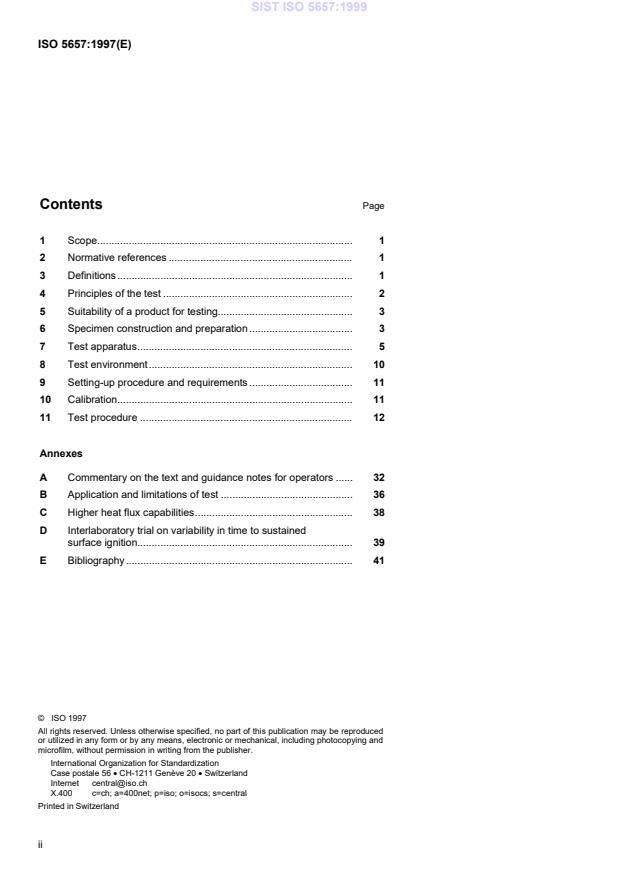
Contents Page
1 Scope. 1
2 Normative references . 1
3 Definitions. 1
4 Principles of the test . 2
Suitability of a product for testing.
5 3
6 Specimen construction and preparation . 3
7 Test apparatus. 5
8 Test environment. 10
9 Setting-up procedure and requirements . 11
10 Calibration. 11
11 Test procedure . 12
Annexes
A Commentary on the text and guidance notes for operators . 32
B Application and limitations of test . 36
C Higher heat flux capabilities. 38
D Interlaboratory trial on variability in time to sustained
surface ignition. 39
E Bibliography. 41
© ISO 1997
All rights reserved. Unless otherwise specified, no part of this publication may be reproduced
or utilized in any form or by any means, electronic or mechanical, including photocopying and
microfilm, without permission in writing from the publisher.
International Organization for Standardization
Case postale 56 • CH-1211 Genève 20 • Switzerland
Internet central@iso.ch
X.400 c=ch; a=400net; p=iso; o=isocs; s=central
Printed in Switzerland
ii
©
ISO ISO 5657:1997(E)
Foreword
ISO (the International Organization for Standardization) is a worldwide
federation of national standards bodies (ISO member bodies). The work of
preparing International Standards is normally carried out through ISO
technical committees. Each member body interested in a subject for which
a technical committee has been established has the right to be represented
on that committee. International organizations, governmental and non-
governmental, in liaison with ISO, also take part in the work. ISO
collaborates closely with the International Electrotechnical Commission
(IEC) on all matters of electrotechnical standardization.
Draft International Standards adopted by the technical committees are
circulated to the member bodies for voting. Publication as an International
Standard requires approval by at least 75 % of the member bodies casting
a vote.
International Standard ISO 5657 was prepared by Technical Committee
ISO/TC 92, Fire safety, Subcommitte SC 1, Reaction to fire.
This second edition cancels and replaces the first edition (ISO 5657:1986),
which has been technically revised.
Annexes A to E of this International Standard are for information only.
iii
©
Introduction
Fire is a complex phenomenon: its behaviour and its effects depend upon a
number of interrelated factors. The behaviour of materials and products
depends upon the characteristics of the fire, the method of use of the
materials and the environment in which they are exposed. The philosophy
of "reaction to fire" tests is explained in ISO/TR 3814.
A test such as is specified in this International Standard deals only with a
simple representation of a particular aspect of the potential fire situation
typified by a radiant heat source in the presence of a pilot flame; it cannot
alone provide any direct guidance on behaviour or safety in fire. A test of
this type may, however, be used for comparative purposes or to ensure the
existence of a certain quality of performance (in this case ignitability)
considered to have a bearing on fire performance generally. It would be
wrong to attach any other meaning to performance in this test.
The term "ignitability" is defined in ISO/IEC Guide 52 as the measure of the
ease with which a specimen can be ignited due to the influence of an
external heat source, under specific test conditions. It is one of the first fire
properties to be manifest and should almost always be taken into account
in any assessment of fire hazard. It may not, however, be the main
characteristic of the material which affects the subsequent development of
fire in a building.
This test does not rely upon the use of asbestos-based materials.
iv
©
INTERNATIONAL STANDARD ISO ISO 5657:1997(E)
Reaction to fire tests — Ignitability of building products
using a radiant heat source
SAFETY WARNING - So that suitable precautions may be taken to safeguard health, the attention of all
concerned in fire tests is drawn to the possibility that toxic or harmful gases may be evolved during
exposure of test specimens. The advice on safety given in annex A clause A.7 should also be noted.
1 Scope
This International Standard specifies a method for examining the ignition characteristics of the exposed
surfaces of specimens of essentially flat materials, composites or assemblies not exceeding 70mm in
thickness, when placed horizontally and subjected to specified levels of thermal irradiance.
Annex A gives a commentary on the text and guidance notes for operators. Advice on the limitations of
the test is given in annex B.
2 Normative references
The following standards contain provisions which, through reference in this text, constitute provisions of
this International Standard. At the time of publication, the editions indicated were valid. All standards are
subject to revision, and parties to agreements based on this International Standard are encouraged to
investigate the possibility of applying the most recent editions of the standards indicated below.
Members of IEC and ISO maintain registers of currently valid International Standards.
ISO 291:1997, Plastics — Standard atmospheres for conditioning and testing.
ISO/IEC Guide 52:1990, Glossary of fire terms and definitions.
ISO/TR 14697:1997,
Reaction to fire tests — Guidance on the choice of substrates for building
products.
3 Definitions
NOTE — See also A.1.
For the purposes of this International Standard, the definitions given in ISO/IEC Guide 52, together with
the following, apply.
©
ISO
3.1 assembly: Fabrication of materials and/or composites.
NOTE — This may include an air gap.
EXAMPLE — Sandwich panels.
3.2 composite: Combination of materials which are generally recognised in building construction as
discrete entities.
EXAMPLE — Coated or laminated materials.
3.3 essentially flat surface: Surface whose irregularity from a plane does not exceed ± 1mm.
: That surface of the product subjected to the heating conditions of the test.
3.4 exposed surface
3.5 irradiance (at a point of a surface): Quotient of the radiant flux incident on an infinitesimal
element of surface containing the point, by the area of that element.
3.6 material: Single substance or uniformly dispersed mixture.
EXAMPLES — Metal, stone, timber, concrete, mineral fibre, polymers.
3.7 plume ignition: Inception of any flame in the plume above the specimen, sustained or transitory.
3.8 product: Material, composite or assembly about which information is required.
: Representative piece of the product which is to be tested together with any substrate
3.9 specimen
or treatment.
NOTE — This may include an air gap.
3.10 sustained surface ignition: Inception of a flame on the surface of the specimen which is still
present at the next application of the pilot flame (greater than 4s duration).
3.11 transitory surface ignition: Inception of any flame on the surface of the specimen which is not
present at the next application of the pilot flame (less than 4s duration).
4 Principles of the test
NOTE — See also A.2.
Specimens of the product are mounted horizontally and exposed to thermal radiation on their upper
surface at selected levels of constant irradiance within the range 10 to 70kW/m².
A pilot flame is applied at regular intervals to a position 10mm above the centre of each specimen to
ignite any volatile gases given off. The time at which sustained surface ignition occurs is reported.
NOTE 1 Information is given on the use of the apparatus to determine the ignitability of materials under higher
irradiances in annex C.
NOTE 2 Other types of ignition which occur are reported in 11.5.
NOTE 3 Convection transfer may also make a very small contribution (not more than a few per cent) to the heating
at the centre of a specimen and to the reading of the radiometer during the calibration procedure. However, the term
irradiance is used throughout this International Standard as best indicating the essentially radiative mode of heat
transfer.
©
ISO
5 Suitability of a product for testing
NOTE — See also A.3.
5.1 Surface characteristics
5.1.1 A product having one of the following properties is suitable for testing:
a) an essentially flat exposed surface; or
b) a surface irregularity which is evenly distributed over the exposed surface provided that
— at least 50% of the surface of a representative 150mm diameter area lies within a depth of 10mm
from a plane taken across the highest points on the exposed surface, and/or
— for surfaces containing cracks, fissures or holes not exceeding 8mm in width nor 10mm in depth, the
total area of such cracks, fissures or holes at the surface does not exceed 30% of a representative
150mm diameter area of the exposed surface.
5.1.2 When an exposed surface does not meet the requirements of either 5.1.1a) or 5.1.1b), the
product shall, if practicable, be tested in a modified form complying as nearly as possible with the
requirements given in 5.1.1. The test report shall state that the product has been tested in a modified
form and clearly describe the modification (see clause 13).
5.2 Asymmetrical products
A product submitted for this test could have faces which differ or could contain laminations of different
materials arranged in a different order in relation to the two faces. If either of the faces can be exposed
in use, for example, within a room, cavity or void, then both faces shall be tested.
6 Specimen construction and preparation
NOTE — See also A.4.
6.1 Specimens
Five specimens shall be tested at each level of irradiance selected and for each different
6.1.1
exposed surface.
+0
6.1.2 The specimens shall be representative of the product, square, with sides measuring 165 mm.
-5
6.1.3 Materials and composites of thickness 70mm or less shall be tested using their full thickness.
6.1.4 For materials and composites of thickness greater than 70mm, the requisite specimens shall be
+0
obtained by cutting away the unexposed face to reduce the thickness to mm.
-3
6.1.5 When cutting specimens from products with irregular surfaces, the highest point on the surface
shall be arranged to occur at the centre of the specimen.
6.1.6 Assemblies shall be tested as specified in 6.1.3 or 6.1.4 as appropriate. However, where thin
materials or composites are used in the fabrication of an assembly, the presence of air or an air gap
and/or the nature of any underlying construction may significantly affect the ignition characteristics of the
©
ISO
exposed surface. The influence of the underlying layers should be understood and care taken to ensure
that the test result obtained on any assembly is relevant to its use in practice (see A.4.1).
When the product is a material or composite which would normally be attached to a well-defined
substrate, then it shall be tested in conjunction with that substrate using the recommended fixing
technique, e.g. bonded with the appropriate adhesive or mechanically fixed.
Alternatively, where the end-use substrate is non-combustible or of limited combustibility, then the
material or composite may be tested using a reference substrate of a density less than the end-use
substrate.
See ISO/TR14697 for advice on substrates.
6.2 Baseboards
6.2.1 One baseboard will be required for each test specimen. However, since it will sometimes be
possible to re-use the baseboard after test, the total number required will depend on the frequency of
testing and the type of product being tested.
+0
6.2.2 The baseboards shall be square with sides measuring 165 mm and shall be made of non-
-5
combustible insulation board of oven dry density (825 ± 125) kg/m³ and nominal thickness 6mm. The
4 2 4 2
thermal inertia of these boards shall be nominally 9,0 3 10 W s/m K .
6.3 Conditioning of specimens
NOTE — See also A.4.3.
)
Before test, the specimens and baseboards shall be conditioned to constant mass at a temperature of
(23 ± 2)°C and a relative humidity of (50 ± 5)% with free access of air to both sides.
6.4 Preparation
6.4.1 A conditioned specimen shall be placed on a baseboard treated according to 6.3 and the
combination shall be wrapped in one piece of aluminium foil of nominal thickness 0,02mm from which a
circle 140mm diameter has been previously cut (see figure 1). The circular cut-out zone shall be
centrally positioned over the upper surface of the specimen. After preparation, the specimen-baseboard
combination shall be returned to the conditioning atmosphere until required for test.
6.4.2 Where a product will normally be backed by air (see 6.1.6), then the specimen shall, where
practicable, be backed by an air gap in the test. The air gap shall be formed by including a spacer
between the specimen and the baseboard. The spacer shall consist of a piece of non-combustible
insulation board of the same size and density as the baseboard, from the centre of which a circular
+0
area mm in diameter has been removed. The thickness of the spacer shall correspond to the size
-
of the air gap, if this is known, except that the total thickness of the spacer plus specimen shall not
exceed 70mm. If the size of the air gap is not known or the total thickness of the air gap plus specimen
exceeds 70mm, then the specimen shall be tested with a spacer which will give a total thickness for the
+0
specimen and spacer of 70 mm.
-3
The spacer and baseboard shall be placed for at least 24h in an atmosphere at a temperature of (23 ±
2)°C and a relative humidity of (50 ± 5)%, with free access of air to both sides of each. The spacer shall
Constant mass is considered to be reached when two successive weighing operations, carried out at an interval
of 24h, do not differ by more than 0,1% of the mass of the test piece or 0,1g, whichever is the greater.
©
ISO
then be interposed between the baseboard and the specimen and the combination shall be wrapped in
aluminium foil as described in 6.4.1. A clean spacer shall be used for each specimen tested. After
preparation the combination shall be returned to the conditioning atmosphere until required for test.
6.4.3 Baseboards and/or spacers used to back the specimens may be re-used if they are not
contaminated. Immediately before re-use, however, they should have been in the conditioning
atmosphere specified in 6.3 and 6.4.2 for at least 24h. If there is any doubt about the condition of a
baseboard or spacer, it may be placed in a ventilated oven at a temperature of approximately 250°C for
a period of 2h in an attempt to remove any volatile residue. If there is still any doubt about the condition,
it shall be discarded.
6.5 Reflective coatings
In real fires, metallic coatings which tend to reflect heat may become coated with black soot or tarnish.
When assessing the ignitability of materials with a reflective metallic coatings, the product should be
assessed both in its virgin state and also with an applied thin coating of matt black water-based
emulsion. Apply a coating of carbon black dispersed in organic solvent to give a coverage rate of 5g/m²
of the carbon black. The coated specimen should then be prepared and tested according to the normal
testing procedures in 6.4 and clause 11 respectively.
6.6 Dimensionally unstable materials
This test method may prove unsuitable for materials that change their dimensions substantially when
exposed to radiant heat, for example, materials that intumesce or shrink away from the radiator. The
irradiance on the surface of such materials may differ significantly from the irradiance set by the
temperature controller, either greater or less depending upon the behaviour of the material, which could
lead to a worse precision in the repeatability and reproducibility of the method than that indicated in
annex D.
7 Test apparatus
All dimensions given in the following description of test apparatus are nominal unless tolerances are
specified.
The test apparatus shall consist essentially of a support framework which clamps the test specimen
horizontally between a pressing plate and a masking plate such that a defined area of the upper surface
of the specimen is exposed to radiation. This radiation shall be provided by a radiator cone positioned
above and supported from the specimen support framework. An automated pilot flame application
mechanism shall be used to bring a test flame through the radiator cone to a position above the centre
of the surface of the specimen. A specimen insertion and location tray shall be used to position the
specimen accurately on the pressing plate of the specimen support framework and a screening plate
shall be used to shield the surface of the specimen during its insertion into the apparatus.
A general arrangement of a suitable apparatus is shown in figure 2, with detailed drawings in figures 3
to 6.
7.1 Specimen support framework, masking plate and pressing plate
7.1.1 The specimen support framework and the other parts of the system to hold the specimen in
position shall be constructed from stainless steel. It shall consist of a rectangular base-frame made from
25mm x 25mm square tube of 1.5mm wall thickness and shall have overall dimensions of 275mm x
230mm. A horizontal masking plate, 220mm square and 4mm thick, shall be mounted centrally and
©
ISO
260mm above the top of the base-frame on four 16mm diameter legs positioned at the corners of the
masking plate. A 150mm diameter circular opening shall be cut centrally in the masking plate, the edges
of the hole being chamfered on the top surface of the plate at an angle of 45° and to a horizontal width
of 4mm.
7.1.2 Two vertical guide rods not less than 355mm long of 20mm diameter steel shall be mounted on
the base-frame, one at the mid-length of each of the short sides of the frame. A horizontal adjustable bar
25mm x 25mm which can slide on the rods and be locked in position by bolts capable of being tightened
by hand shall be mounted below the masking plate and between the vertical guide rods. A vertical
central hole and sleeve in the adjustable bar shall be used to located a sliding vertical rod of 12mm
diameter and 148mm long, surmounted by a 180mm square pressing plate 4mm thick. The pressing
plate shall be pushed against the underside of the masking plate by the counterweighted pivot arm
which shall be mounted below the adjustable horizontal bar and shall press against the bottom of the
sliding vertical rod. This can be achieved by an arm about 320mm long.
It shall contain at one end a roller which shall bear against a boss on the bottom of the sliding vertical
rod and at the other end an adjustable counterweight.
The counterweight shall be capable of compensating for different masses of specimens and of
maintaining a force of approximately 20 N between the upper surface of the specimen and the masking
plate. A counterweight of about 3kg has been found to be suitable. An adjustable stop shall be provided
to limit upward movement of the pressing plate, due to collapse, softening or melting of the specimen
during its exposure, to 5mm. Alternatively spacing blocks between the pressing plate and the masking
plate may be used.
7.1.3 Figure 3 shows details of the specimen support framework.
7.2 Radiator cone
7.2.1 The radiator cone shall consist of a heating element, of nominal rating 3kW, contained within a
stainless steel tube, approximately 3,500mm in length and 8,5mm in diameter, coiled into the shape of a
truncated cone and fitted into a shade. The shade shall have an overall height of (75 ± 1)mm, an internal
diameter of (66 ± 1)mm and an internal base diameter of (200 ± 3)mm. It shall consist of two layers of
1mm thick stainless steel with a 10mm thickness of ceramic fibre insulation of nominal density 100kg/m³
sandwiched between them. The heating element shall be fastened to the inside face of the shade by
steel pins. At least four clamps shall be used, positioned equidistantly around the perimeter of the shade
to prevent additional sagging of the lower coil below the base of the shade. (See figure 4b.)
The upper turn of the heating element shall not obstruct the area of the top aperture of the shade by
more than 10% when projected vertically.
7.2.2 The radiator cone shall be capable of providing irradiance in the range 10 to 70kW/m² at the
centre of the aperture in the masking plate and in a reference plane coinciding with the underside of the
masking plate, when measured as described in 10.2. The distribution of irradiance provided by the cone
at the reference plane shall be such that the variation of irradiance within a circle of 50mm diameter,
drawn from the centre of the masking plate aperture, shall be not more than ±3% of that at the centre;
the variation of irradiance within a circle of 100mm diameter shall be not more than ±5% of that at the
centre.
The distribution of irradiance shall be determined from readings at the centres of selected 10mm
squares forming the grids shown in figure 4d). The tolerances given shall apply to the readings within
the grid comprising all the squares shown in figure 4d).
©
ISO
For these measurements, the opening in the masking plate shall be completely filled; it is therefore
advisable to employ a number of calibration boards of special horizontal shapes and sizes.
7.2.3 The radiator cone shall be located and secured from the vertical guide rods of the specimen
support framework by clamps which position the lower rim of the radiator cone shade (22 ± 1)mm above
the upper surface of the masking plate.
7.2.4 Details of the radiator cone are shown in figure 4b).
The temperature of the radiator cone shall be controlled by reference to the reading of a
7.2.5
thermocouple (primary thermocouple) (7.6) in close and stable thermal contact with the heater element
tube. A second thermocouple (secondary thermocouple) shall be attached similarly, mounted in a
diametrically opposite position. The thermocouples shall have a speed of response not slower than that
of a thermocouple with insulated hot junction in a stainless steel sheath 1mm in diameter. Each
thermocouple shall be attached to a coil of the heater element tube which places them between one-
third and half way down from the top of the radiator cone. At least 8mm of the end of the thermocouple
shall lie in a region of approximately uniform temperature.
A description of methods of attaching thermocouples which have been found satisfactory in practice is
given in A.5.1.
7.3 Pilot flame application mechanism
NOTE — See also A.5.2.
7.3.1 The apparatus shall be provided with a mechanism which is capable of bringing a pilot flame
from a re-ignition position outside the radiator cone to the test position within the cone. The mechanism
shall be capable to taking the pilot flame through the radiator cone and through the aperture in the
masking plate to a maximum distance of 60mm below the underside of the masking plate.
7.3.2 The pilot flame shall issue from a nozzle made of stainless steel as specified in figure 5, attached
near the end of the pilot flame tube.
7.3.3 The normal position of the pilot flame shall be above the radiator cone and clear of the plume of
smoke or decomposition products which may rise through the top of the cone. When in this position the
)
having a heat output not greater
pilot flame nozzle shall be adjacent to a secondary ignition source
than 50W which shall be capable of re-igniting the pilot flame should it be extinguished.
7.3.4 The normal position of the pilot flame shall be such that the flame issues horizontally over the
centre point of the aperture in the masking plate and perpendicular to the plane of movement of the pilot
arm, with the centre of the orifice in the nozzle positioned (10 ± 1)mm above the underside of the
masking plate.
7.3.5 The application mechanism shall automatically bring the pilot flame to the "normal test position"
+0,4
once every 4 0 s. The pilot flame shall not take longer than 0,5s to travel from the opening at the top of
+0,1
the radiator shade to the test position where it shall remain for 1 0 s. The time taken for the pilot flame to
travel back over the same distance shall not exceed 0,5s.
The mechanism shall be provided with an adjustable stop which will restrict the lowest point of
7.3.6
travel of the pilot flame to any position within the range from 20mm above the test position to 60mm
below.
The secondary ignition source can be a gas flame, hot wire or spark ignited. A propane flame 15mm long, from a
nozzle with an internal diameter of 1mm to 2mm, has a heat output of approximately 50W.
©
ISO
7.3.7 A suitable pilot flame application mechanism is shown in figures 6a), 6b) and 6c).
NOTE — The pilot flame application mechanism should be constructed to a close tolerance since minor changes in
the dimensions can lead to changes to the timing as specified in 7.3.5. Small changes can, however, be
accommodated by slight changes in the diameter of the slave roller.
7.4 Specimen insertion and location tray
7.4.1 The specimen insertion and location tray shall be used to facilitate rapid insertion of the
specimen on to the pressing plate and to locate accurately the exposed area of the specimen in relation
to the aperture in the masking plate.
It shall consist essentially of a flat metal plate having lugs on its upper surface to position and
7.4.2
hold the specimen. Guides shall be fixed to the lower surface to locate the tray in the apparatus and a
stop shall also be provided to bear against the pressing plate, thus limiting the distance of insertion. The
tray should be provided with a handle to facilitate use.
7.4.3 A suitable device is shown in figure 7.
7.5 Specimen screening plate
7.5.1 The screening plate shall be designed to slide over the top of the masking plate during the period
of insertion of the specimen, thus shielding the specimen from radiation until commencement of the test.
The plate shall be made from 2mm-thick polished aluminium or stainless steel and shall have
7.5.2
overall dimension which allow it to cover the masking plate. It should be provided with a stop, to limit its
insertion against the masking plate, and a handle.
7.5.3 A suitable design is shown in figure 8.
7.6 Temperature controller
The temperature controller for the radiator cone shall be of the proportional integral and derivative type
("3-term" controller) with thyristor stack fast-cycle or phase angle (see A.5.3) control of not less than 15A
maximum rating. Capacity for adjustment of integral times between about 10s and 150s, and differential
times between about 2s and 30s, shall be provided to permit reasonable matching with the response
characteristics of the heater. The temperature at which the heater is to be controlled shall be set on a
scale capable of being read to ±2°C. An input range of temperature of about 0°C to 1000°C is suitable.
(An irradiance of 50kW/m² will be given by a heater temperature in the region of 800°C.) Automatic cold
junction compensation for the thermocouple shall be provided.
Desirable features are a meter to indicate the output to the heater and a control which, in the event of an
open circuit in the thermocouple line, will cause the temperature to fall to near the bottom of its range.
The monitor heater temperature, particularly to show the operator when the heater has attained
temperature equilibrium, heater temperature shall be indicated by a meter capable of being read to
±2°C. This may be incorporated in the controller or separate.
7.7 Radiometer (heat flux meter)
The radiometer shall be of the Schmidt Boelter or Gardon type with a range of 0 to 70kW/m². The target
receiving radiation, and possibly to a small extent convection, shall be flat, circular, not more than 10mm
in diameter and coated with a durable matt black finish. The target shall be contained within a water-
©
ISO
cooled body the front face of which shall be of highly polished metal, flat, coinciding with the plane of the
target and circular, with a diameter of about 25mm.
Radiation shall not pass through any window before reaching the target. The instrument shall be robust,
simple to set up and use, insensitive to draughts, and stable in calibration. The instrument shall have an
accuracy of within ±3% and a repeatability within 0,5%.
The calibration of the radiometer shall be checked whenever a recalibration of the apparatus is carried
out (see 10.2), by comparison with an instrument held as a reference standard and not used for any
other purpose. The reference standard instrument shall be fully calibrated at yearly intervals.
7.8 Millivolt measuring device
This shall be compatible with the output from the radiometer specified in 7.7. It shall have a full scale
deflection, sensitivity and accuracy which enables the irradiance measure by the radiometer to be
resolved to 0,5kW/m².
7.9 Secondary thermocouple monitoring device
To monitor the secondary thermocouple, an instrument is required with a resolution equivalent to ±2°C.
This may read directly in temperature or in millivolts. Allowance or automatic compensation for cold
junction temperature shall be made. If a separate device is used to monitor heater temperature, this
may, with a suitable switch connection, also be used to monitor the secondary thermocouple.
7.10 Timing device (timer)
This shall be capable of recording elapsed time to the nearest second and shall be accurate to within 1s
in 1h.
7.11 Air and propane supplies
Air and propane shall be fed to the pilot flame (see 7.3) via regulating valves, filters (if necessary), flow
meters, non-return valves, a suitable junction connection and a flame arrester as shown in figure 10.
7.11.1 Gas regulating valves
These shall be capable of adjusting the pressure and flow of propane and air to the pilot flame to the
levels required by 9.2.
7.11.2 Filters
Filters may need to be installed in the propane and/or air lines to avoid the readings of the flow-meters
being affected by impurities (for example oil droplets) carried in the flow.
7.11.3 Flow-meters
These shall be capable of measuring the flow-rates of propane and air to the pilot flame to an accuracy
of at least 5%.
7.11.4 Non-return valves
A suitable non-return valve shall be included in both air and propane lines, sited as close to the junction
point as possible.
©
ISO
7.11.5 Flame arrester
A flame arrester (see figure 6a) shall be mounted at the point of entry of the propane air mixture to the
pilot flame arm.
7.11.6 Connections
All connections with flexible tubing shall be firmly attached with suitable clips.
7.12 Calibration board
The board shall be made of ceramic fibre of density (200 ± 50)kg/m³, and shall be square, with sides
0 +5
measuring 165 mm and of thickness not less than 20 mm.
−5 0
A suitable hole or groove cut to fit closely around the radiometer shall be cut in the centre of the board.
The target of the radiometer shall be in the plane of the upper surface of the board. If additional support
for the radiometer is required, it shall be provided from below the calibration board.
7.13 Dummy specimen board
The dummy specimen board shall be constructed as specified in figure 11. The necessary total
thickness of ceramic fibre board may be built up from a number of thinner sheets attached to each other
by adhesive or long fine pins.
7.14 Extinguishing board
The extinguishing board shall be made of the same material as the baseboards (6.2) and shall have
nominal dimensions of 300mm x 185mm x 6mm.
7.15 Oven
If it is necessary to meet the recommendation given in 6.4.3, then a ventilated oven capable of
maintaining a temperature of approximately 250°C is required.
7.16 Specimen conditioning cabinet
The specimen conditioning cabinet shall be capable of maintaining a constant temperature of (23 ± 2)°C
and a relative humidity of (50 ± 5)%.
7.17 Balance
The balance shall have a nominal capacity of 5kg and shall be capable of being read to the nearest
0,1g.
8 Test environment
8.1 The test shall be carried out in an environment essentially free of air currents and protected,
where necessary, by a screen. The air velocity close to the test apparatus should be not more than
0,2m/s. The operator should be protected from any products of combustion generated by the specimen.
The effluent gases shall be extracted without causing forced ventilation over the apparatus.
©
ISO
8.2 A suitable design for screening the apparatus from draughts and exhausting the effluent gases is
shown in figure 9.
9 Setting-up procedure and requirements
9.1 Siting the apparatus
The apparatus shall be placed in an environment essentially free of air currents (see clause 8).
9.2 Pilot flame
NOTE — See also A.5.2.
The pilot flame nozzle (see 7.3) shall be fed with a mixture of propane and air which is achieved by
regulating the propane flow-rate to 19 to 20ml/min and the air flow-rate to 160 to 180ml/min. These flow-
rates shall be measured after the pressure and flow regulating valves and shall be fed directly to the
pilot flame from the flow meters so that the pressure is nominally atmospheric.
9.3 Electrical requirements
9.3.1 The heating element of the radiometer cone (7.2) shall be connected to the output from the
thyristor of the temperature controller as shown in figure 10. No element or wiring in this circuit shall be
changed between calibration and testing. The primary thermocouple shall be connected to the
temperature controller and its temperature-monitoring device. The secondary thermocouple shall be
connected to its monitoring device (7.9).
9.3.2 The framework of the apparatus shall be provided with a good electrical earth.
9.4 Precautions against electrical interference
The radiometer shall be connected to the millivolt measuring device (7.8) using leads which should be
screened to minimize any electrical interference to the signal. The radiometer shall be earthed back to
the millivolt measuring device and by no other route (i.e. not to the earthed frame of the apparatus). All
connections shall be thoroughly checked to ensure good electrical contact.
10 Calibration
10.1 Installation of radiometer
For calibration of the apparatus, the radiometer (7.7) shall be installed in the hole or groove of the
calibration board (7.12).
10.2 Calibration procedure
Calibration procedure shall be as follows.
a) Set up the apparatus as described in clause 9, except that the pilot flame mechanism shall be kept in
the re-ignition position with the gas supply turned off throughout the calibration procedure.
b) Place the calibration board (7.12) in the apparatus in the specimen position so that the target of the
radiometer (7.7) is located centrally within the circular opening of the masking plate, in the plane of the
bottom face of the masking plate.
©
ISO
c) Switch on the electricity supply and establish the temperature settings of the controller required to
produce irradiances at the centre of the circular opening in the masking plate of 10, 20, 30, 40, 50, 60
and 70kW/m². Adjustments near the final setting for the heater temperature should be followed by a 5-
min period without further adjustment to ensure that the remainder of the apparatus has attained
sufficient temperature equilibrium.
At each full equilibrium, read and record the secondary thermocouple monitor. These readings are to
enable a close and independent check to be made on the temperature of the heater during testing.
d) Carry out this procedure at least twice, the first time at setting of increasing temperature and the
second time at decreasing settings.
The values should be repeatable to within ±5°C. Repeatability values outside these limits indicate
possible defects in control of monitoring equipment, or significant changes in the test environment,
which shall be corrected before any further calibrations are carried out.
10.3 Calibration check
The irradiance produced by the temperature setting which the initial calibration has shown to correspond
to an irradiance of 30kW/m² shall be frequently checked (at least once every 50 operating hours) and
the apparatus shall be recalibrated if such a check reveals a deviation greater than 0,6kW/m².
11 Test procedure
11.1 Initial procedure
The initial procedure shall be as follows.
a) Set up the apparatus as described in clause 9.
b) Weigh a prepared specimen-baseboard combination (6.4.1) and return to the conditioning
atmosphere.
c) Adjust the counterweight mechanism to give a force of (20 ± 2)N between the upper surface of the
specimen and the underside of the masking plate (see 7.1.2, A.6.1 and A.6.2), when the specimen-
baseboard combination is positioned on the pressing plate in the insertion and location tray. This
adjustment may be made by methods indicated in A.6.1 but using a dummy of the same mass as the
specimen-baseboard combination instead of a prepared and conditioned specimen.
d) Insert the dummy specimen-board (7.13).
e) Adjust the temperature setting of the controller to the appropriate value established by the calibration
procedure to correspond to 50kW/m² (or other levels as required).
f) Allow the apparatus to heat up to equilibrium. When the heater has attained temperature equilibrium,
as shown by the indicating meter of the temperature controller, a further 5 min should be allowed to
elapse before commencing exposure of a specimen.
g) Check that the reading of the secondary thermocouple is within the equivalent of ±2°C of the value
established during the calibration procedure (10.2). A deviation outside this tolerance indicates the need
for a complete re-calibration.
©
ISO
h) Remove a prepared specimen from the conditioning cabinet (7.16) and place it on the insertion and
location tray (7.4).
i) Place the specimen screening plate on top of the masking plate.
j) Start the pilot flame application mechanism (7.3).
k) Use the adjustable stop on the pilot flame mechanism to ensure a distance of 10mm is maintained
between the surface of the dummy specimen board and the pilot flame.
l) Place the specimen screening plate on top of the masking plate
m) Lower the pressing plate, remove the dummy specimen board and replace it with the insertion and
location tray containing the specimen.
n) Release the pressing plate.
p) When the pilot flame is at the re-ignition position, simultaneously remove the specimen screening
plate and start the timer (7.10).
11.2 Time permitted for test initiation
All operations detailed in 11.1 i) to m) shall be completed within 15s.
11.3 Conduct and termination of test
11.3.1 If sustained surface ignition of the specimen occurs (see 3.9), the timer shall be stopped. Any
flames shall immediately be extinguished by placing the extinguishing board (7.14) on top of the
masking plate and the pilot flame application mechanism shall be stopped. The tray and remains of the
specimen shall then be quickly removed and replaced by the dummy specimen board. The extinguishing
board shall then be removed as quickly as possible (see A.6.3).
11.3.2 If no sustained surface ignition of the specimen occurs within 15min, the test shall be stopped by
placing the extinguishing board on top of the masking plate and the pilot flame application mechanism
shall be stopped. The specimen shall then be removed and replaced by the dummy specimen board.
The extinguishing board shall then be removed as quickly as possible.
11.3.3 Continue the test until termination even if transitory surface ignitions and/or plume ignitions occur
which should be noted (see 11.5.2).
11.4 Repeat tests
11.4.1 Operations 11.1 h) to p) and 11.3 shall be repeated with four more specimens at the same
irradiance after allowing sufficient time between applications to allow the apparatus to reach thermal
equilibrium (see A.6.3).
11.4.2 If sustained surface ignition occurs with any specimen in a set of five at a given irradiance, a
further set of five specimens shall be tested at the next lower level of irradiance (or at any other set
lower level).
11.4.3 Operation 11.4.2 shall be repeated as necessary until a set of five specimens has been tested at
each required irradiance.
©
ISO
11.4.4 If no sustained surface ignition occurs (see 11.3.2) with all specimens in a set of five at a given
irradiance, a further set of five specimens shall be tested at the next highest level of irradiance (or at any
other set higher level).
11.4.5 When adjusting the heater to the next level of irradiance, sufficient time shall be allowed for the
apparatus to reach thermal equilibrium following the change in temperature setting (see A.6.3).
At full equilibrium the reading of the secondary thermocouple should be within ±2°C of the value
established during the calibration procedure (10.2).
11.5 Observations during test
11.5.1 For each specimen tested, the time at which sustained surface ignition occurs shall be noted
(see 3.9).
11.5.2 Observations shall be made during each test of the general behaviour of the specimen and, in
particular, note should be made of the following:
a) the time, position and nature of other ignitions;
b) glowing decomposition of the specimen;
c) melting, foaming, spalling, cracking, expansion or shrinkage of the exposed surface of the
specimen.
11.6 Special procedures
11.6.1 Soft and softening products
11.6.1.1 For some soft products, especi
...
INTERNATIONAL ISO
STANDARD 5657
Second edition
1997-12-15
Reaction to fire tests — Ignitability of
building products using a radiant heat
source
Essais de réaction au feu — Allumabilité des produits de bâtiment avec une
source de chaleur rayonnante
A
Reference number
Contents Page
1 Scope. 1
2 Normative references . 1
3 Definitions. 1
4 Principles of the test . 2
Suitability of a product for testing.
5 3
6 Specimen construction and preparation . 3
7 Test apparatus. 5
8 Test environment. 10
9 Setting-up procedure and requirements . 11
10 Calibration. 11
11 Test procedure . 12
Annexes
A Commentary on the text and guidance notes for operators . 32
B Application and limitations of test . 36
C Higher heat flux capabilities. 38
D Interlaboratory trial on variability in time to sustained
surface ignition. 39
E Bibliography. 41
© ISO 1997
All rights reserved. Unless otherwise specified, no part of this publication may be reproduced
or utilized in any form or by any means, electronic or mechanical, including photocopying and
microfilm, without permission in writing from the publisher.
International Organization for Standardization
Case postale 56 • CH-1211 Genève 20 • Switzerland
Internet central@iso.ch
X.400 c=ch; a=400net; p=iso; o=isocs; s=central
Printed in Switzerland
ii
©
ISO ISO 5657:1997(E)
Foreword
ISO (the International Organization for Standardization) is a worldwide
federation of national standards bodies (ISO member bodies). The work of
preparing International Standards is normally carried out through ISO
technical committees. Each member body interested in a subject for which
a technical committee has been established has the right to be represented
on that committee. International organizations, governmental and non-
governmental, in liaison with ISO, also take part in the work. ISO
collaborates closely with the International Electrotechnical Commission
(IEC) on all matters of electrotechnical standardization.
Draft International Standards adopted by the technical committees are
circulated to the member bodies for voting. Publication as an International
Standard requires approval by at least 75 % of the member bodies casting
a vote.
International Standard ISO 5657 was prepared by Technical Committee
ISO/TC 92, Fire safety, Subcommitte SC 1, Reaction to fire.
This second edition cancels and replaces the first edition (ISO 5657:1986),
which has been technically revised.
Annexes A to E of this International Standard are for information only.
iii
©
Introduction
Fire is a complex phenomenon: its behaviour and its effects depend upon a
number of interrelated factors. The behaviour of materials and products
depends upon the characteristics of the fire, the method of use of the
materials and the environment in which they are exposed. The philosophy
of "reaction to fire" tests is explained in ISO/TR 3814.
A test such as is specified in this International Standard deals only with a
simple representation of a particular aspect of the potential fire situation
typified by a radiant heat source in the presence of a pilot flame; it cannot
alone provide any direct guidance on behaviour or safety in fire. A test of
this type may, however, be used for comparative purposes or to ensure the
existence of a certain quality of performance (in this case ignitability)
considered to have a bearing on fire performance generally. It would be
wrong to attach any other meaning to performance in this test.
The term "ignitability" is defined in ISO/IEC Guide 52 as the measure of the
ease with which a specimen can be ignited due to the influence of an
external heat source, under specific test conditions. It is one of the first fire
properties to be manifest and should almost always be taken into account
in any assessment of fire hazard. It may not, however, be the main
characteristic of the material which affects the subsequent development of
fire in a building.
This test does not rely upon the use of asbestos-based materials.
iv
©
INTERNATIONAL STANDARD ISO ISO 5657:1997(E)
Reaction to fire tests — Ignitability of building products
using a radiant heat source
SAFETY WARNING - So that suitable precautions may be taken to safeguard health, the attention of all
concerned in fire tests is drawn to the possibility that toxic or harmful gases may be evolved during
exposure of test specimens. The advice on safety given in annex A clause A.7 should also be noted.
1 Scope
This International Standard specifies a method for examining the ignition characteristics of the exposed
surfaces of specimens of essentially flat materials, composites or assemblies not exceeding 70mm in
thickness, when placed horizontally and subjected to specified levels of thermal irradiance.
Annex A gives a commentary on the text and guidance notes for operators. Advice on the limitations of
the test is given in annex B.
2 Normative references
The following standards contain provisions which, through reference in this text, constitute provisions of
this International Standard. At the time of publication, the editions indicated were valid. All standards are
subject to revision, and parties to agreements based on this International Standard are encouraged to
investigate the possibility of applying the most recent editions of the standards indicated below.
Members of IEC and ISO maintain registers of currently valid International Standards.
ISO 291:1997, Plastics — Standard atmospheres for conditioning and testing.
ISO/IEC Guide 52:1990, Glossary of fire terms and definitions.
ISO/TR 14697:1997,
Reaction to fire tests — Guidance on the choice of substrates for building
products.
3 Definitions
NOTE — See also A.1.
For the purposes of this International Standard, the definitions given in ISO/IEC Guide 52, together with
the following, apply.
©
ISO
3.1 assembly: Fabrication of materials and/or composites.
NOTE — This may include an air gap.
EXAMPLE — Sandwich panels.
3.2 composite: Combination of materials which are generally recognised in building construction as
discrete entities.
EXAMPLE — Coated or laminated materials.
3.3 essentially flat surface: Surface whose irregularity from a plane does not exceed ± 1mm.
: That surface of the product subjected to the heating conditions of the test.
3.4 exposed surface
3.5 irradiance (at a point of a surface): Quotient of the radiant flux incident on an infinitesimal
element of surface containing the point, by the area of that element.
3.6 material: Single substance or uniformly dispersed mixture.
EXAMPLES — Metal, stone, timber, concrete, mineral fibre, polymers.
3.7 plume ignition: Inception of any flame in the plume above the specimen, sustained or transitory.
3.8 product: Material, composite or assembly about which information is required.
: Representative piece of the product which is to be tested together with any substrate
3.9 specimen
or treatment.
NOTE — This may include an air gap.
3.10 sustained surface ignition: Inception of a flame on the surface of the specimen which is still
present at the next application of the pilot flame (greater than 4s duration).
3.11 transitory surface ignition: Inception of any flame on the surface of the specimen which is not
present at the next application of the pilot flame (less than 4s duration).
4 Principles of the test
NOTE — See also A.2.
Specimens of the product are mounted horizontally and exposed to thermal radiation on their upper
surface at selected levels of constant irradiance within the range 10 to 70kW/m².
A pilot flame is applied at regular intervals to a position 10mm above the centre of each specimen to
ignite any volatile gases given off. The time at which sustained surface ignition occurs is reported.
NOTE 1 Information is given on the use of the apparatus to determine the ignitability of materials under higher
irradiances in annex C.
NOTE 2 Other types of ignition which occur are reported in 11.5.
NOTE 3 Convection transfer may also make a very small contribution (not more than a few per cent) to the heating
at the centre of a specimen and to the reading of the radiometer during the calibration procedure. However, the term
irradiance is used throughout this International Standard as best indicating the essentially radiative mode of heat
transfer.
©
ISO
5 Suitability of a product for testing
NOTE — See also A.3.
5.1 Surface characteristics
5.1.1 A product having one of the following properties is suitable for testing:
a) an essentially flat exposed surface; or
b) a surface irregularity which is evenly distributed over the exposed surface provided that
— at least 50% of the surface of a representative 150mm diameter area lies within a depth of 10mm
from a plane taken across the highest points on the exposed surface, and/or
— for surfaces containing cracks, fissures or holes not exceeding 8mm in width nor 10mm in depth, the
total area of such cracks, fissures or holes at the surface does not exceed 30% of a representative
150mm diameter area of the exposed surface.
5.1.2 When an exposed surface does not meet the requirements of either 5.1.1a) or 5.1.1b), the
product shall, if practicable, be tested in a modified form complying as nearly as possible with the
requirements given in 5.1.1. The test report shall state that the product has been tested in a modified
form and clearly describe the modification (see clause 13).
5.2 Asymmetrical products
A product submitted for this test could have faces which differ or could contain laminations of different
materials arranged in a different order in relation to the two faces. If either of the faces can be exposed
in use, for example, within a room, cavity or void, then both faces shall be tested.
6 Specimen construction and preparation
NOTE — See also A.4.
6.1 Specimens
Five specimens shall be tested at each level of irradiance selected and for each different
6.1.1
exposed surface.
+0
6.1.2 The specimens shall be representative of the product, square, with sides measuring 165 mm.
-5
6.1.3 Materials and composites of thickness 70mm or less shall be tested using their full thickness.
6.1.4 For materials and composites of thickness greater than 70mm, the requisite specimens shall be
+0
obtained by cutting away the unexposed face to reduce the thickness to mm.
-3
6.1.5 When cutting specimens from products with irregular surfaces, the highest point on the surface
shall be arranged to occur at the centre of the specimen.
6.1.6 Assemblies shall be tested as specified in 6.1.3 or 6.1.4 as appropriate. However, where thin
materials or composites are used in the fabrication of an assembly, the presence of air or an air gap
and/or the nature of any underlying construction may significantly affect the ignition characteristics of the
©
ISO
exposed surface. The influence of the underlying layers should be understood and care taken to ensure
that the test result obtained on any assembly is relevant to its use in practice (see A.4.1).
When the product is a material or composite which would normally be attached to a well-defined
substrate, then it shall be tested in conjunction with that substrate using the recommended fixing
technique, e.g. bonded with the appropriate adhesive or mechanically fixed.
Alternatively, where the end-use substrate is non-combustible or of limited combustibility, then the
material or composite may be tested using a reference substrate of a density less than the end-use
substrate.
See ISO/TR14697 for advice on substrates.
6.2 Baseboards
6.2.1 One baseboard will be required for each test specimen. However, since it will sometimes be
possible to re-use the baseboard after test, the total number required will depend on the frequency of
testing and the type of product being tested.
+0
6.2.2 The baseboards shall be square with sides measuring 165 mm and shall be made of non-
-5
combustible insulation board of oven dry density (825 ± 125) kg/m³ and nominal thickness 6mm. The
4 2 4 2
thermal inertia of these boards shall be nominally 9,0 3 10 W s/m K .
6.3 Conditioning of specimens
NOTE — See also A.4.3.
)
Before test, the specimens and baseboards shall be conditioned to constant mass at a temperature of
(23 ± 2)°C and a relative humidity of (50 ± 5)% with free access of air to both sides.
6.4 Preparation
6.4.1 A conditioned specimen shall be placed on a baseboard treated according to 6.3 and the
combination shall be wrapped in one piece of aluminium foil of nominal thickness 0,02mm from which a
circle 140mm diameter has been previously cut (see figure 1). The circular cut-out zone shall be
centrally positioned over the upper surface of the specimen. After preparation, the specimen-baseboard
combination shall be returned to the conditioning atmosphere until required for test.
6.4.2 Where a product will normally be backed by air (see 6.1.6), then the specimen shall, where
practicable, be backed by an air gap in the test. The air gap shall be formed by including a spacer
between the specimen and the baseboard. The spacer shall consist of a piece of non-combustible
insulation board of the same size and density as the baseboard, from the centre of which a circular
+0
area mm in diameter has been removed. The thickness of the spacer shall correspond to the size
-
of the air gap, if this is known, except that the total thickness of the spacer plus specimen shall not
exceed 70mm. If the size of the air gap is not known or the total thickness of the air gap plus specimen
exceeds 70mm, then the specimen shall be tested with a spacer which will give a total thickness for the
+0
specimen and spacer of 70 mm.
-3
The spacer and baseboard shall be placed for at least 24h in an atmosphere at a temperature of (23 ±
2)°C and a relative humidity of (50 ± 5)%, with free access of air to both sides of each. The spacer shall
Constant mass is considered to be reached when two successive weighing operations, carried out at an interval
of 24h, do not differ by more than 0,1% of the mass of the test piece or 0,1g, whichever is the greater.
©
ISO
then be interposed between the baseboard and the specimen and the combination shall be wrapped in
aluminium foil as described in 6.4.1. A clean spacer shall be used for each specimen tested. After
preparation the combination shall be returned to the conditioning atmosphere until required for test.
6.4.3 Baseboards and/or spacers used to back the specimens may be re-used if they are not
contaminated. Immediately before re-use, however, they should have been in the conditioning
atmosphere specified in 6.3 and 6.4.2 for at least 24h. If there is any doubt about the condition of a
baseboard or spacer, it may be placed in a ventilated oven at a temperature of approximately 250°C for
a period of 2h in an attempt to remove any volatile residue. If there is still any doubt about the condition,
it shall be discarded.
6.5 Reflective coatings
In real fires, metallic coatings which tend to reflect heat may become coated with black soot or tarnish.
When assessing the ignitability of materials with a reflective metallic coatings, the product should be
assessed both in its virgin state and also with an applied thin coating of matt black water-based
emulsion. Apply a coating of carbon black dispersed in organic solvent to give a coverage rate of 5g/m²
of the carbon black. The coated specimen should then be prepared and tested according to the normal
testing procedures in 6.4 and clause 11 respectively.
6.6 Dimensionally unstable materials
This test method may prove unsuitable for materials that change their dimensions substantially when
exposed to radiant heat, for example, materials that intumesce or shrink away from the radiator. The
irradiance on the surface of such materials may differ significantly from the irradiance set by the
temperature controller, either greater or less depending upon the behaviour of the material, which could
lead to a worse precision in the repeatability and reproducibility of the method than that indicated in
annex D.
7 Test apparatus
All dimensions given in the following description of test apparatus are nominal unless tolerances are
specified.
The test apparatus shall consist essentially of a support framework which clamps the test specimen
horizontally between a pressing plate and a masking plate such that a defined area of the upper surface
of the specimen is exposed to radiation. This radiation shall be provided by a radiator cone positioned
above and supported from the specimen support framework. An automated pilot flame application
mechanism shall be used to bring a test flame through the radiator cone to a position above the centre
of the surface of the specimen. A specimen insertion and location tray shall be used to position the
specimen accurately on the pressing plate of the specimen support framework and a screening plate
shall be used to shield the surface of the specimen during its insertion into the apparatus.
A general arrangement of a suitable apparatus is shown in figure 2, with detailed drawings in figures 3
to 6.
7.1 Specimen support framework, masking plate and pressing plate
7.1.1 The specimen support framework and the other parts of the system to hold the specimen in
position shall be constructed from stainless steel. It shall consist of a rectangular base-frame made from
25mm x 25mm square tube of 1.5mm wall thickness and shall have overall dimensions of 275mm x
230mm. A horizontal masking plate, 220mm square and 4mm thick, shall be mounted centrally and
©
ISO
260mm above the top of the base-frame on four 16mm diameter legs positioned at the corners of the
masking plate. A 150mm diameter circular opening shall be cut centrally in the masking plate, the edges
of the hole being chamfered on the top surface of the plate at an angle of 45° and to a horizontal width
of 4mm.
7.1.2 Two vertical guide rods not less than 355mm long of 20mm diameter steel shall be mounted on
the base-frame, one at the mid-length of each of the short sides of the frame. A horizontal adjustable bar
25mm x 25mm which can slide on the rods and be locked in position by bolts capable of being tightened
by hand shall be mounted below the masking plate and between the vertical guide rods. A vertical
central hole and sleeve in the adjustable bar shall be used to located a sliding vertical rod of 12mm
diameter and 148mm long, surmounted by a 180mm square pressing plate 4mm thick. The pressing
plate shall be pushed against the underside of the masking plate by the counterweighted pivot arm
which shall be mounted below the adjustable horizontal bar and shall press against the bottom of the
sliding vertical rod. This can be achieved by an arm about 320mm long.
It shall contain at one end a roller which shall bear against a boss on the bottom of the sliding vertical
rod and at the other end an adjustable counterweight.
The counterweight shall be capable of compensating for different masses of specimens and of
maintaining a force of approximately 20 N between the upper surface of the specimen and the masking
plate. A counterweight of about 3kg has been found to be suitable. An adjustable stop shall be provided
to limit upward movement of the pressing plate, due to collapse, softening or melting of the specimen
during its exposure, to 5mm. Alternatively spacing blocks between the pressing plate and the masking
plate may be used.
7.1.3 Figure 3 shows details of the specimen support framework.
7.2 Radiator cone
7.2.1 The radiator cone shall consist of a heating element, of nominal rating 3kW, contained within a
stainless steel tube, approximately 3,500mm in length and 8,5mm in diameter, coiled into the shape of a
truncated cone and fitted into a shade. The shade shall have an overall height of (75 ± 1)mm, an internal
diameter of (66 ± 1)mm and an internal base diameter of (200 ± 3)mm. It shall consist of two layers of
1mm thick stainless steel with a 10mm thickness of ceramic fibre insulation of nominal density 100kg/m³
sandwiched between them. The heating element shall be fastened to the inside face of the shade by
steel pins. At least four clamps shall be used, positioned equidistantly around the perimeter of the shade
to prevent additional sagging of the lower coil below the base of the shade. (See figure 4b.)
The upper turn of the heating element shall not obstruct the area of the top aperture of the shade by
more than 10% when projected vertically.
7.2.2 The radiator cone shall be capable of providing irradiance in the range 10 to 70kW/m² at the
centre of the aperture in the masking plate and in a reference plane coinciding with the underside of the
masking plate, when measured as described in 10.2. The distribution of irradiance provided by the cone
at the reference plane shall be such that the variation of irradiance within a circle of 50mm diameter,
drawn from the centre of the masking plate aperture, shall be not more than ±3% of that at the centre;
the variation of irradiance within a circle of 100mm diameter shall be not more than ±5% of that at the
centre.
The distribution of irradiance shall be determined from readings at the centres of selected 10mm
squares forming the grids shown in figure 4d). The tolerances given shall apply to the readings within
the grid comprising all the squares shown in figure 4d).
©
ISO
For these measurements, the opening in the masking plate shall be completely filled; it is therefore
advisable to employ a number of calibration boards of special horizontal shapes and sizes.
7.2.3 The radiator cone shall be located and secured from the vertical guide rods of the specimen
support framework by clamps which position the lower rim of the radiator cone shade (22 ± 1)mm above
the upper surface of the masking plate.
7.2.4 Details of the radiator cone are shown in figure 4b).
The temperature of the radiator cone shall be controlled by reference to the reading of a
7.2.5
thermocouple (primary thermocouple) (7.6) in close and stable thermal contact with the heater element
tube. A second thermocouple (secondary thermocouple) shall be attached similarly, mounted in a
diametrically opposite position. The thermocouples shall have a speed of response not slower than that
of a thermocouple with insulated hot junction in a stainless steel sheath 1mm in diameter. Each
thermocouple shall be attached to a coil of the heater element tube which places them between one-
third and half way down from the top of the radiator cone. At least 8mm of the end of the thermocouple
shall lie in a region of approximately uniform temperature.
A description of methods of attaching thermocouples which have been found satisfactory in practice is
given in A.5.1.
7.3 Pilot flame application mechanism
NOTE — See also A.5.2.
7.3.1 The apparatus shall be provided with a mechanism which is capable of bringing a pilot flame
from a re-ignition position outside the radiator cone to the test position within the cone. The mechanism
shall be capable to taking the pilot flame through the radiator cone and through the aperture in the
masking plate to a maximum distance of 60mm below the underside of the masking plate.
7.3.2 The pilot flame shall issue from a nozzle made of stainless steel as specified in figure 5, attached
near the end of the pilot flame tube.
7.3.3 The normal position of the pilot flame shall be above the radiator cone and clear of the plume of
smoke or decomposition products which may rise through the top of the cone. When in this position the
)
having a heat output not greater
pilot flame nozzle shall be adjacent to a secondary ignition source
than 50W which shall be capable of re-igniting the pilot flame should it be extinguished.
7.3.4 The normal position of the pilot flame shall be such that the flame issues horizontally over the
centre point of the aperture in the masking plate and perpendicular to the plane of movement of the pilot
arm, with the centre of the orifice in the nozzle positioned (10 ± 1)mm above the underside of the
masking plate.
7.3.5 The application mechanism shall automatically bring the pilot flame to the "normal test position"
+0,4
once every 4 0 s. The pilot flame shall not take longer than 0,5s to travel from the opening at the top of
+0,1
the radiator shade to the test position where it shall remain for 1 0 s. The time taken for the pilot flame to
travel back over the same distance shall not exceed 0,5s.
The mechanism shall be provided with an adjustable stop which will restrict the lowest point of
7.3.6
travel of the pilot flame to any position within the range from 20mm above the test position to 60mm
below.
The secondary ignition source can be a gas flame, hot wire or spark ignited. A propane flame 15mm long, from a
nozzle with an internal diameter of 1mm to 2mm, has a heat output of approximately 50W.
©
ISO
7.3.7 A suitable pilot flame application mechanism is shown in figures 6a), 6b) and 6c).
NOTE — The pilot flame application mechanism should be constructed to a close tolerance since minor changes in
the dimensions can lead to changes to the timing as specified in 7.3.5. Small changes can, however, be
accommodated by slight changes in the diameter of the slave roller.
7.4 Specimen insertion and location tray
7.4.1 The specimen insertion and location tray shall be used to facilitate rapid insertion of the
specimen on to the pressing plate and to locate accurately the exposed area of the specimen in relation
to the aperture in the masking plate.
It shall consist essentially of a flat metal plate having lugs on its upper surface to position and
7.4.2
hold the specimen. Guides shall be fixed to the lower surface to locate the tray in the apparatus and a
stop shall also be provided to bear against the pressing plate, thus limiting the distance of insertion. The
tray should be provided with a handle to facilitate use.
7.4.3 A suitable device is shown in figure 7.
7.5 Specimen screening plate
7.5.1 The screening plate shall be designed to slide over the top of the masking plate during the period
of insertion of the specimen, thus shielding the specimen from radiation until commencement of the test.
The plate shall be made from 2mm-thick polished aluminium or stainless steel and shall have
7.5.2
overall dimension which allow it to cover the masking plate. It should be provided with a stop, to limit its
insertion against the masking plate, and a handle.
7.5.3 A suitable design is shown in figure 8.
7.6 Temperature controller
The temperature controller for the radiator cone shall be of the proportional integral and derivative type
("3-term" controller) with thyristor stack fast-cycle or phase angle (see A.5.3) control of not less than 15A
maximum rating. Capacity for adjustment of integral times between about 10s and 150s, and differential
times between about 2s and 30s, shall be provided to permit reasonable matching with the response
characteristics of the heater. The temperature at which the heater is to be controlled shall be set on a
scale capable of being read to ±2°C. An input range of temperature of about 0°C to 1000°C is suitable.
(An irradiance of 50kW/m² will be given by a heater temperature in the region of 800°C.) Automatic cold
junction compensation for the thermocouple shall be provided.
Desirable features are a meter to indicate the output to the heater and a control which, in the event of an
open circuit in the thermocouple line, will cause the temperature to fall to near the bottom of its range.
The monitor heater temperature, particularly to show the operator when the heater has attained
temperature equilibrium, heater temperature shall be indicated by a meter capable of being read to
±2°C. This may be incorporated in the controller or separate.
7.7 Radiometer (heat flux meter)
The radiometer shall be of the Schmidt Boelter or Gardon type with a range of 0 to 70kW/m². The target
receiving radiation, and possibly to a small extent convection, shall be flat, circular, not more than 10mm
in diameter and coated with a durable matt black finish. The target shall be contained within a water-
©
ISO
cooled body the front face of which shall be of highly polished metal, flat, coinciding with the plane of the
target and circular, with a diameter of about 25mm.
Radiation shall not pass through any window before reaching the target. The instrument shall be robust,
simple to set up and use, insensitive to draughts, and stable in calibration. The instrument shall have an
accuracy of within ±3% and a repeatability within 0,5%.
The calibration of the radiometer shall be checked whenever a recalibration of the apparatus is carried
out (see 10.2), by comparison with an instrument held as a reference standard and not used for any
other purpose. The reference standard instrument shall be fully calibrated at yearly intervals.
7.8 Millivolt measuring device
This shall be compatible with the output from the radiometer specified in 7.7. It shall have a full scale
deflection, sensitivity and accuracy which enables the irradiance measure by the radiometer to be
resolved to 0,5kW/m².
7.9 Secondary thermocouple monitoring device
To monitor the secondary thermocouple, an instrument is required with a resolution equivalent to ±2°C.
This may read directly in temperature or in millivolts. Allowance or automatic compensation for cold
junction temperature shall be made. If a separate device is used to monitor heater temperature, this
may, with a suitable switch connection, also be used to monitor the secondary thermocouple.
7.10 Timing device (timer)
This shall be capable of recording elapsed time to the nearest second and shall be accurate to within 1s
in 1h.
7.11 Air and propane supplies
Air and propane shall be fed to the pilot flame (see 7.3) via regulating valves, filters (if necessary), flow
meters, non-return valves, a suitable junction connection and a flame arrester as shown in figure 10.
7.11.1 Gas regulating valves
These shall be capable of adjusting the pressure and flow of propane and air to the pilot flame to the
levels required by 9.2.
7.11.2 Filters
Filters may need to be installed in the propane and/or air lines to avoid the readings of the flow-meters
being affected by impurities (for example oil droplets) carried in the flow.
7.11.3 Flow-meters
These shall be capable of measuring the flow-rates of propane and air to the pilot flame to an accuracy
of at least 5%.
7.11.4 Non-return valves
A suitable non-return valve shall be included in both air and propane lines, sited as close to the junction
point as possible.
©
ISO
7.11.5 Flame arrester
A flame arrester (see figure 6a) shall be mounted at the point of entry of the propane air mixture to the
pilot flame arm.
7.11.6 Connections
All connections with flexible tubing shall be firmly attached with suitable clips.
7.12 Calibration board
The board shall be made of ceramic fibre of density (200 ± 50)kg/m³, and shall be square, with sides
0 +5
measuring 165 mm and of thickness not less than 20 mm.
−5 0
A suitable hole or groove cut to fit closely around the radiometer shall be cut in the centre of the board.
The target of the radiometer shall be in the plane of the upper surface of the board. If additional support
for the radiometer is required, it shall be provided from below the calibration board.
7.13 Dummy specimen board
The dummy specimen board shall be constructed as specified in figure 11. The necessary total
thickness of ceramic fibre board may be built up from a number of thinner sheets attached to each other
by adhesive or long fine pins.
7.14 Extinguishing board
The extinguishing board shall be made of the same material as the baseboards (6.2) and shall have
nominal dimensions of 300mm x 185mm x 6mm.
7.15 Oven
If it is necessary to meet the recommendation given in 6.4.3, then a ventilated oven capable of
maintaining a temperature of approximately 250°C is required.
7.16 Specimen conditioning cabinet
The specimen conditioning cabinet shall be capable of maintaining a constant temperature of (23 ± 2)°C
and a relative humidity of (50 ± 5)%.
7.17 Balance
The balance shall have a nominal capacity of 5kg and shall be capable of being read to the nearest
0,1g.
8 Test environment
8.1 The test shall be carried out in an environment essentially free of air currents and protected,
where necessary, by a screen. The air velocity close to the test apparatus should be not more than
0,2m/s. The operator should be protected from any products of combustion generated by the specimen.
The effluent gases shall be extracted without causing forced ventilation over the apparatus.
©
ISO
8.2 A suitable design for screening the apparatus from draughts and exhausting the effluent gases is
shown in figure 9.
9 Setting-up procedure and requirements
9.1 Siting the apparatus
The apparatus shall be placed in an environment essentially free of air currents (see clause 8).
9.2 Pilot flame
NOTE — See also A.5.2.
The pilot flame nozzle (see 7.3) shall be fed with a mixture of propane and air which is achieved by
regulating the propane flow-rate to 19 to 20ml/min and the air flow-rate to 160 to 180ml/min. These flow-
rates shall be measured after the pressure and flow regulating valves and shall be fed directly to the
pilot flame from the flow meters so that the pressure is nominally atmospheric.
9.3 Electrical requirements
9.3.1 The heating element of the radiometer cone (7.2) shall be connected to the output from the
thyristor of the temperature controller as shown in figure 10. No element or wiring in this circuit shall be
changed between calibration and testing. The primary thermocouple shall be connected to the
temperature controller and its temperature-monitoring device. The secondary thermocouple shall be
connected to its monitoring device (7.9).
9.3.2 The framework of the apparatus shall be provided with a good electrical earth.
9.4 Precautions against electrical interference
The radiometer shall be connected to the millivolt measuring device (7.8) using leads which should be
screened to minimize any electrical interference to the signal. The radiometer shall be earthed back to
the millivolt measuring device and by no other route (i.e. not to the earthed frame of the apparatus). All
connections shall be thoroughly checked to ensure good electrical contact.
10 Calibration
10.1 Installation of radiometer
For calibration of the apparatus, the radiometer (7.7) shall be installed in the hole or groove of the
calibration board (7.12).
10.2 Calibration procedure
Calibration procedure shall be as follows.
a) Set up the apparatus as described in clause 9, except that the pilot flame mechanism shall be kept in
the re-ignition position with the gas supply turned off throughout the calibration procedure.
b) Place the calibration board (7.12) in the apparatus in the specimen position so that the target of the
radiometer (7.7) is located centrally within the circular opening of the masking plate, in the plane of the
bottom face of the masking plate.
©
ISO
c) Switch on the electricity supply and establish the temperature settings of the controller required to
produce irradiances at the centre of the circular opening in the masking plate of 10, 20, 30, 40, 50, 60
and 70kW/m². Adjustments near the final setting for the heater temperature should be followed by a 5-
min period without further adjustment to ensure that the remainder of the apparatus has attained
sufficient temperature equilibrium.
At each full equilibrium, read and record the secondary thermocouple monitor. These readings are to
enable a close and independent check to be made on the temperature of the heater during testing.
d) Carry out this procedure at least twice, the first time at setting of increasing temperature and the
second time at decreasing settings.
The values should be repeatable to within ±5°C. Repeatability values outside these limits indicate
possible defects in control of monitoring equipment, or significant changes in the test environment,
which shall be corrected before any further calibrations are carried out.
10.3 Calibration check
The irradiance produced by the temperature setting which the initial calibration has shown to correspond
to an irradiance of 30kW/m² shall be frequently checked (at least once every 50 operating hours) and
the apparatus shall be recalibrated if such a check reveals a deviation greater than 0,6kW/m².
11 Test procedure
11.1 Initial procedure
The initial procedure shall be as follows.
a) Set up the apparatus as described in clause 9.
b) Weigh a prepared specimen-baseboard combination (6.4.1) and return to the conditioning
atmosphere.
c) Adjust the counterweight mechanism to give a force of (20 ± 2)N between the upper surface of the
specimen and the underside of the masking plate (see 7.1.2, A.6.1 and A.6.2), when the specimen-
baseboard combination is positioned on the pressing plate in the insertion and location tray. This
adjustment may be made by methods indicated in A.6.1 but using a dummy of the same mass as the
specimen-baseboard combination instead of a prepared and conditioned specimen.
d) Insert the dummy specimen-board (7.13).
e) Adjust the temperature setting of the controller to the appropriate value established by the calibration
procedure to correspond to 50kW/m² (or other levels as required).
f) Allow the apparatus to heat up to equilibrium. When the heater has attained temperature equilibrium,
as shown by the indicating meter of the temperature controller, a further 5 min should be allowed to
elapse before commencing exposure of a specimen.
g) Check that the reading of the secondary thermocouple is within the equivalent of ±2°C of the value
established during the calibration procedure (10.2). A deviation outside this tolerance indicates the need
for a complete re-calibration.
©
ISO
h) Remove a prepared specimen from the conditioning cabinet (7.16) and place it on the insertion and
location tray (7.4).
i) Place the specimen screening plate on top of the masking plate.
j) Start the pilot flame application mechanism (7.3).
k) Use the adjustable stop on the pilot flame mechanism to ensure a distance of 10mm is maintained
between the surface of the dummy specimen board and the pilot flame.
l) Place the specimen screening plate on top of the masking plate
m) Lower the pressing plate, remove the dummy specimen board and replace it with the insertion and
location tray containing the specimen.
n) Release the pressing plate.
p) When the pilot flame is at the re-ignition position, simultaneously remove the specimen screening
plate and start the timer (7.10).
11.2 Time permitted for test initiation
All operations detailed in 11.1 i) to m) shall be completed within 15s.
11.3 Conduct and termination of test
11.3.1 If sustained surface ignition of the specimen occurs (see 3.9), the timer shall be stopped. Any
flames shall immediately be extinguished by placing the extinguishing board (7.14) on top of the
masking plate and the pilot flame application mechanism shall be stopped. The tray and remains of the
specimen shall then be quickly removed and replaced by the dummy specimen board. The extinguishing
board shall then be removed as quickly as possible (see A.6.3).
11.3.2 If no sustained surface ignition of the specimen occurs within 15min, the test shall be stopped by
placing the extinguishing board on top of the masking plate and the pilot flame application mechanism
shall be stopped. The specimen shall then be removed and replaced by the dummy specimen board.
The extinguishing board shall then be removed as quickly as possible.
11.3.3 Continue the test until termination even if transitory surface ignitions and/or plume ignitions occur
which should be noted (see 11.5.2).
11.4 Repeat tests
11.4.1 Operations 11.1 h) to p) and 11.3 shall be repeated with four more specimens at the same
irradiance after allowing sufficient time between applications to allow the apparatus to reach thermal
equilibrium (see A.6.3).
11.4.2 If sustained surface ignition occurs with any specimen in a set of five at a given irradiance, a
further set of five specimens shall be tested at the next lower level of irradiance (or at any other set
lower level).
11.4.3 Operation 11.4.2 shall be repeated as necessary until a set of five specimens has been tested at
each required irradiance.
©
ISO
11.4.4 If no sustained surface ignition occurs (see 11.3.2) with all specimens in a set of five at a given
irradiance, a further set of five specimens shall be tested at the next highest level of irradiance (or at any
other set higher level).
11.4.5 When adjusting the heater to the next level of irradiance, sufficient time shall be allowed for the
apparatus to reach thermal equilibrium following the change in temperature setting (see A.6.3).
At full equilibrium the reading of the secondary thermocouple should be within ±2°C of the value
established during the calibration procedure (10.2).
11.5 Observations during test
11.5.1 For each specimen tested, the time at which sustained surface ignition occurs shall be noted
(see 3.9).
11.5.2 Observations shall be made during each test of the general behaviour of the specimen and, in
particular, note should be made of the following:
a) the time, position and nature of other ignitions;
b) glowing decomposition of the specimen;
c) melting, foaming, spalling, cracking, expansion or shrinkage of the exposed surface of the
specimen.
11.6 Special procedures
11.6.1 Soft and softening products
11.6.1.1 For some soft products, especially low-density products such as glass- or mineral-fibre
products with or without coatings, the pressure of the pressing plate may cause some compression of
the edges of the specimen so that the exposed face of the specimen is not flat but convex upwards. This
can occur even without heating from the radiator cone.
In order that the specimen should not be subjected to an irradiance higher than that for a flat, stable
specimen, an adjustable stop should be installed and operated on the pressing plate mechanism to
avoid the crushing of the aluminium foil wrapping, to maintain the surface of the specimen flat and to
preserve the nominal thickness of the product. Alternatively, spacing blocks between the pressing plate
and the masking plate may be used.
11.6.1.2 For specimens which are likely to contract, soften or melt away when heated it is necessary to
prevent the pressing plate (7.1.2) from unduly crushing the aluminium foil wrapping on the edge of the
specimen. This can be accomplished by an adjustable stop on the pressing plate mechanism or spacing
blocks between the pressing plate and the masking plate.
11.6.1.3 With certain products t
...