

SIST EN 1366-3:2022+A1:2025
(Main + Amendment)Fire resistance tests for service installations - Part 3: Penetration seals
General Information
- Abstract
This part of the EN 1366 series specifies a method of test and criteria for the evaluation (including field of direct application rules) of the ability of a penetration seal to maintain the fire resistance of a separating element at the position at which it has been penetrated by a service or services. Penetration seals used to seal gaps around chimneys, air ventilation systems, fire rated ventilation ducts, fire rated service ducts, shafts and smoke extraction ducts as well as combined penetration seals are excluded from this part of the EN 1366 series.
NOTE EN 15882-5 [6] deals with penetration seals including ducts and dampers.
Supporting constructions are used in this part of the EN 1366 series to represent separating elements such as walls or floors. These simulate the interaction between the test specimen and the separating element into which the sealing system is to be installed in practice.
This part of the EN 1366 series is intended to be used in conjunction with EN 1363 1.
The purpose of a test described in this part of the EN 1366 series is to assess the integrity and insulation performance of the penetration seal, of the penetrating service or services and of the separating element in the surrounding area of the penetration seal.
No information can be implied by the test concerning the influence of the inclusion of such penetrations and penetration seals on the loadbearing capacity of the separating element.
It is assumed that in each case the lintel above a penetration seal in the wall is designed in hot and cold state in a way that it does not apply any additional vertical load on the penetration seal.
It is not the intention of this test to provide quantitative information on the rate of leakage of smoke and/or hot gases or on the transmission or generation of fumes. Such phenomena are only noted in the test report in describing the general behaviour of test specimens during the test.
Tests in accordance with this part of the EN 1366 series are not intended to supply any information on the ability of the penetration seal to withstand stress caused by movements or displacements of the penetrating services.
The risk of spread of fire downwards caused by burning material, which drips e.g. through a pipe downwards to floors below, is at present excluded from this document.
Tests in accordance with this part of the EN 1366 series do not address any risks associated with leakage of dangerous liquids or gases caused by failure of pipes in case of fire.
Tests in accordance with this part of the EN 1366 series of pipe penetration seals for pipes of pneumatic dispatch systems, pressurized air systems, etc. simulate a situation where the systems are shut off in case of fire.
Explanatory notes to this test method are given in Annex H.
All values given without tolerances in this document are nominal ones unless otherwise specified.
All pipe diameters are outside diameters unless otherwise specified.
- Status
- Published
- Publication Date
- 08-Dec-2024
- Technical Committee
- POZ - Požarna varnost
- Current Stage
- 6060 - National Implementation/Publication (Adopted Project)
- Start Date
- 05-Dec-2024
- Due Date
- 09-Feb-2025
- Completion Date
- 09-Dec-2024

Overview
SIST EN 1366-3:2022+A1:2025 (aligned with EN 1366-3:2021+A1:2024) specifies a standardized method to test and evaluate the fire resistance performance of penetration seals used where building services pass through separating elements (walls, floors). The standard defines test procedures, performance criteria and the field of direct application rules to judge whether a penetration seal maintains the integrity and insulation of the separating element under fire exposure. It is intended to be used together with EN 1363‑1 (general fire resistance test conditions) and includes normative annexes for different service types.
Key technical topics and requirements
- Scope and exclusions: Applies to penetration seals around services (cables, pipes, trunking, busbars) but excludes seals for chimneys, ventilation systems, fire-rated ducts/shafts and smoke extraction ducts (see EN 15882‑5 for ducts/dampers).
- Test method and criteria: Defines how to assess integrity and insulation performance of the penetration seal, the penetrating services and adjacent separating element area; does not assess loadbearing capacity, smoke leakage rates quantitatively, or resistance to service movements.
- Supporting constructions: Uses representative supporting constructions (walls/floors) to simulate installation interaction; includes field of direct application rules for different wall/floor types.
- Test specimen design & installation: Guidance on specimen size, number, construction, service support and seal installation.
- Test conditions and instrumentation: Heating, pressure conditions, thermocouple placement, roving thermocouples and other measurement techniques are specified.
- Performance criteria & reporting: Integrity and insulation failure criteria, additional observations, and required content of the test report.
- Annexes: Several normative annexes (A–G) cover configurations and field of direct application for cables, conduits, pipes, mixed seals, bus bars and special systems; Annex H provides explanatory notes.
Practical applications
- Provides the basis for third‑party fire testing and certification of penetration seal products.
- Used to validate fire‑stopping solutions for installations in commercial, residential and industrial buildings.
- Supports product manufacturers, test laboratories, fire engineers and specifiers in demonstrating compliance with fire-resistance requirements.
- Helps building control bodies, certifiers and installers assess suitability of penetration seal systems for specific separating elements.
Who should use this standard
- Fire test laboratories and product certification bodies
- Manufacturers of fire‑stop materials and penetration seal systems
- Fire safety engineers and consultants
- Architects, specifiers and building inspectors
- Installers and contractors responsible for fire‑stopping building services
Keywords: EN 1366‑3, penetration seals, fire resistance tests, fire‑stopping, integrity and insulation, field of direct application, EN 1363‑1, penetration seal testing.
Relations
- Merged From
SIST EN 1366-3:2022 - Fire resistance tests for service installations - Part 3: Penetration seals - Effective Date
- 01-Jan-2025
- Effective Date
- 01-Jan-2025
- Effective Date
- 27-May-2026
- Effective Date
- 13-May-2026
- Effective Date
- 09-Feb-2026
- Effective Date
- 09-Feb-2026
- Effective Date
- 09-Feb-2026
- Effective Date
- 09-Feb-2026
- Effective Date
- 28-Jan-2026
- Effective Date
- 28-Jan-2026
- Effective Date
- 28-Jan-2026
- Effective Date
- 28-Jan-2026
- Effective Date
- 28-Jan-2026
- Effective Date
- 28-Jan-2026
- Effective Date
- 28-Jan-2026
Get Certified
Connect with accredited certification bodies for this standard

CIS Institut d.o.o.
Personal Protective Equipment (PPE) certification body. Notified Body NB-2890 for EU Regulation 2016/425 PPE.

Kiwa BDA Testing
Building and construction product certification.
Kmetijski inštitut Slovenije
Agricultural Institute of Slovenia. Soil testing, plant health, agricultural product analysis.
Sponsored listings
Frequently Asked Questions
SIST EN 1366-3:2022+A1:2025 is a standard published by the Slovenian Institute for Standardization (SIST). Its full title is "Fire resistance tests for service installations - Part 3: Penetration seals". This standard covers: This part of the EN 1366 series specifies a method of test and criteria for the evaluation (including field of direct application rules) of the ability of a penetration seal to maintain the fire resistance of a separating element at the position at which it has been penetrated by a service or services. Penetration seals used to seal gaps around chimneys, air ventilation systems, fire rated ventilation ducts, fire rated service ducts, shafts and smoke extraction ducts as well as combined penetration seals are excluded from this part of the EN 1366 series. NOTE EN 15882-5 [6] deals with penetration seals including ducts and dampers. Supporting constructions are used in this part of the EN 1366 series to represent separating elements such as walls or floors. These simulate the interaction between the test specimen and the separating element into which the sealing system is to be installed in practice. This part of the EN 1366 series is intended to be used in conjunction with EN 1363 1. The purpose of a test described in this part of the EN 1366 series is to assess the integrity and insulation performance of the penetration seal, of the penetrating service or services and of the separating element in the surrounding area of the penetration seal. No information can be implied by the test concerning the influence of the inclusion of such penetrations and penetration seals on the loadbearing capacity of the separating element. It is assumed that in each case the lintel above a penetration seal in the wall is designed in hot and cold state in a way that it does not apply any additional vertical load on the penetration seal. It is not the intention of this test to provide quantitative information on the rate of leakage of smoke and/or hot gases or on the transmission or generation of fumes. Such phenomena are only noted in the test report in describing the general behaviour of test specimens during the test. Tests in accordance with this part of the EN 1366 series are not intended to supply any information on the ability of the penetration seal to withstand stress caused by movements or displacements of the penetrating services. The risk of spread of fire downwards caused by burning material, which drips e.g. through a pipe downwards to floors below, is at present excluded from this document. Tests in accordance with this part of the EN 1366 series do not address any risks associated with leakage of dangerous liquids or gases caused by failure of pipes in case of fire. Tests in accordance with this part of the EN 1366 series of pipe penetration seals for pipes of pneumatic dispatch systems, pressurized air systems, etc. simulate a situation where the systems are shut off in case of fire. Explanatory notes to this test method are given in Annex H. All values given without tolerances in this document are nominal ones unless otherwise specified. All pipe diameters are outside diameters unless otherwise specified.
This part of the EN 1366 series specifies a method of test and criteria for the evaluation (including field of direct application rules) of the ability of a penetration seal to maintain the fire resistance of a separating element at the position at which it has been penetrated by a service or services. Penetration seals used to seal gaps around chimneys, air ventilation systems, fire rated ventilation ducts, fire rated service ducts, shafts and smoke extraction ducts as well as combined penetration seals are excluded from this part of the EN 1366 series. NOTE EN 15882-5 [6] deals with penetration seals including ducts and dampers. Supporting constructions are used in this part of the EN 1366 series to represent separating elements such as walls or floors. These simulate the interaction between the test specimen and the separating element into which the sealing system is to be installed in practice. This part of the EN 1366 series is intended to be used in conjunction with EN 1363 1. The purpose of a test described in this part of the EN 1366 series is to assess the integrity and insulation performance of the penetration seal, of the penetrating service or services and of the separating element in the surrounding area of the penetration seal. No information can be implied by the test concerning the influence of the inclusion of such penetrations and penetration seals on the loadbearing capacity of the separating element. It is assumed that in each case the lintel above a penetration seal in the wall is designed in hot and cold state in a way that it does not apply any additional vertical load on the penetration seal. It is not the intention of this test to provide quantitative information on the rate of leakage of smoke and/or hot gases or on the transmission or generation of fumes. Such phenomena are only noted in the test report in describing the general behaviour of test specimens during the test. Tests in accordance with this part of the EN 1366 series are not intended to supply any information on the ability of the penetration seal to withstand stress caused by movements or displacements of the penetrating services. The risk of spread of fire downwards caused by burning material, which drips e.g. through a pipe downwards to floors below, is at present excluded from this document. Tests in accordance with this part of the EN 1366 series do not address any risks associated with leakage of dangerous liquids or gases caused by failure of pipes in case of fire. Tests in accordance with this part of the EN 1366 series of pipe penetration seals for pipes of pneumatic dispatch systems, pressurized air systems, etc. simulate a situation where the systems are shut off in case of fire. Explanatory notes to this test method are given in Annex H. All values given without tolerances in this document are nominal ones unless otherwise specified. All pipe diameters are outside diameters unless otherwise specified.
SIST EN 1366-3:2022+A1:2025 is classified under the following ICS (International Classification for Standards) categories: 13.220.50 - Fire-resistance of building materials and elements. The ICS classification helps identify the subject area and facilitates finding related standards.
SIST EN 1366-3:2022+A1:2025 has the following relationships with other standards: It is inter standard links to SIST EN 1366-3:2022, SIST EN 1366-3:2022/kFprA1:2024, SIST EN 12666-1:2026, SIST EN 1329-1:2026, SIST EN IEC 61386-21:2021, SIST HD 603 S1:1998, SIST EN 50525-2-31:2011, SIST HD 604 S1:1998, SIST EN 1519-1:2019, SIST EN 12201-1:2024, SIST EN 1451-1:2018, SIST EN 13600:2021, SIST EN 12449:2023, SIST EN 12666-1:2006+A1:2011, SIST EN 10305-6:2016. Understanding these relationships helps ensure you are using the most current and applicable version of the standard.
SIST EN 1366-3:2022+A1:2025 is associated with the following European legislation: EU Directives/Regulations: 305/2011; Standardization Mandates: M/117. When a standard is cited in the Official Journal of the European Union, products manufactured in conformity with it benefit from a presumption of conformity with the essential requirements of the corresponding EU directive or regulation.
SIST EN 1366-3:2022+A1:2025 is available in PDF format for immediate download after purchase. The document can be added to your cart and obtained through the secure checkout process. Digital delivery ensures instant access to the complete standard document.
Standards Content (Sample)
SLOVENSKI STANDARD
01-januar-2025
Preskusi požarne odpornosti servisnih inštalacij - 3. del: Tesnitve prebojev
(vključno z dopolnilom A1)
Fire resistance tests for service installations - Part 3: Penetration seals
Feuerwiderstandsprüfungen für Installationen - Teil 3: Abschottungen
Essais de résistance au feu des installations techniques - Partie 3: Calfeutrement des
trémies
Ta slovenski standard je istoveten z: EN 1366-3:2021+A1:2024
ICS:
13.220.50 Požarna odpornost Fire-resistance of building
gradbenih materialov in materials and elements
elementov
2003-01.Slovenski inštitut za standardizacijo. Razmnoževanje celote ali delov tega standarda ni dovoljeno.
EN 1366-3:2021+A1
EUROPEAN STANDARD
NORME EUROPÉENNE
November 2024
EUROPÄISCHE NORM
ICS 13.220.50 Supersedes EN 1366-3:2021
English Version
Fire resistance tests for service installations - Part 3:
Penetration seals
Essais de résistance au feu des installations techniques Feuerwiderstandsprüfungen für Installationen - Teil 3:
- Partie 3: Calfeutrement des trémies Abschottungen
This European Standard was approved by CEN on 20 September 2021 and includes Amendment 1 approved by CEN on 27
October 2024.
CEN members are bound to comply with the CEN/CENELEC Internal Regulations which stipulate the conditions for giving this
European Standard the status of a national standard without any alteration. Up-to-date lists and bibliographical references
concerning such national standards may be obtained on application to the CEN-CENELEC Management Centre or to any CEN
member.
This European Standard exists in three official versions (English, French, German). A version in any other language made by
translation under the responsibility of a CEN member into its own language and notified to the CEN-CENELEC Management
Centre has the same status as the official versions.
CEN members are the national standards bodies of Austria, Belgium, Bulgaria, Croatia, Cyprus, Czech Republic, Denmark, Estonia,
Finland, France, Germany, Greece, Hungary, Iceland, Ireland, Italy, Latvia, Lithuania, Luxembourg, Malta, Netherlands, Norway,
Poland, Portugal, Republic of North Macedonia, Romania, Serbia, Slovakia, Slovenia, Spain, Sweden, Switzerland, Türkiye and
United Kingdom.
EUROPEAN COMMITTEE FOR STANDARDIZATION
COMITÉ EUROPÉEN DE NORMALISATION
EUROPÄISCHES KOMITEE FÜR NORMUNG
CEN-CENELEC Management Centre: Rue de la Science 23, B-1040 Brussels
© 2024 CEN All rights of exploitation in any form and by any means reserved Ref. No. EN 1366-3:2021+A1:2024 E
worldwide for CEN national Members.
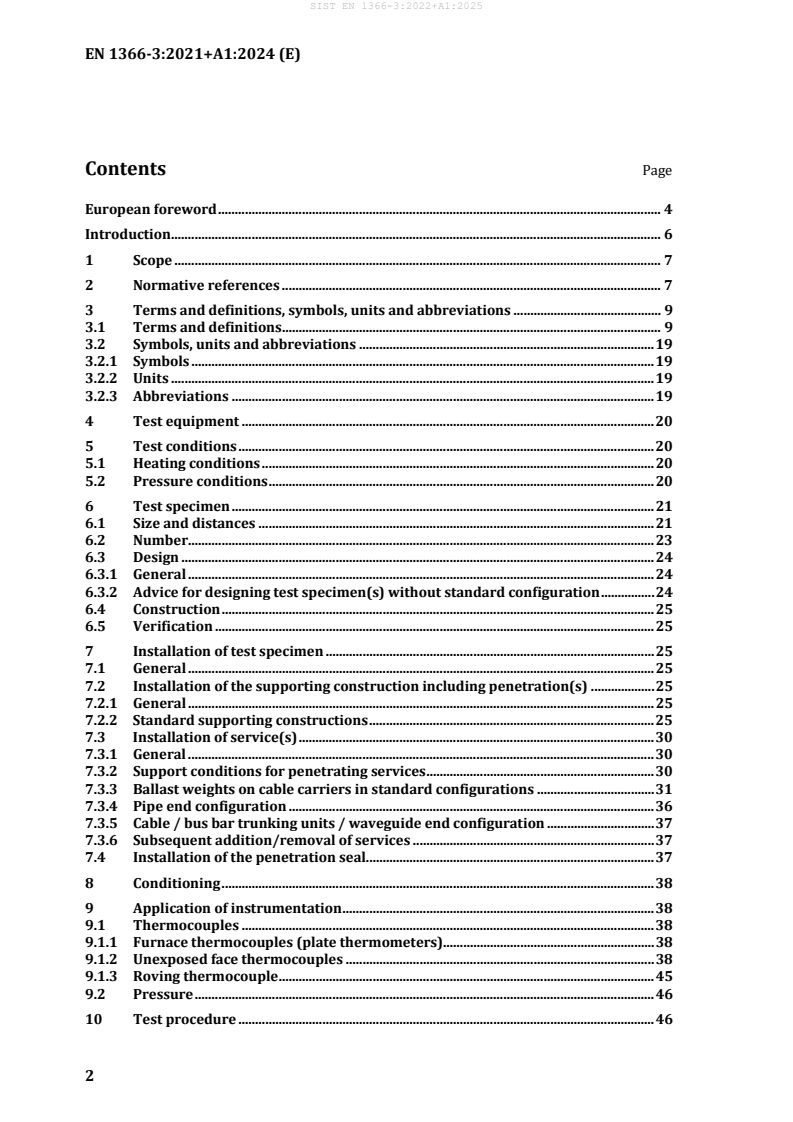
Contents Page
European foreword . 4
Introduction . 6
1 Scope . 7
2 Normative references . 7
3 Terms and definitions, symbols, units and abbreviations . 9
3.1 Terms and definitions . 9
3.2 Symbols, units and abbreviations . 19
3.2.1 Symbols . 19
3.2.2 Units . 19
3.2.3 Abbreviations . 19
4 Test equipment . 20
5 Test conditions . 20
5.1 Heating conditions . 20
5.2 Pressure conditions . 20
6 Test specimen . 21
6.1 Size and distances . 21
6.2 Number. 23
6.3 Design . 24
6.3.1 General . 24
6.3.2 Advice for designing test specimen(s) without standard configuration . 24
6.4 Construction . 25
6.5 Verification . 25
7 Installation of test specimen . 25
7.1 General . 25
7.2 Installation of the supporting construction including penetration(s) . 25
7.2.1 General . 25
7.2.2 Standard supporting constructions . 25
7.3 Installation of service(s) . 30
7.3.1 General . 30
7.3.2 Support conditions for penetrating services . 30
7.3.3 Ballast weights on cable carriers in standard configurations . 31
7.3.4 Pipe end configuration . 36
7.3.5 Cable / bus bar trunking units / waveguide end configuration . 37
7.3.6 Subsequent addition/removal of services . 37
7.4 Installation of the penetration seal. 37
8 Conditioning . 38
9 Application of instrumentation . 38
9.1 Thermocouples . 38
9.1.1 Furnace thermocouples (plate thermometers). 38
9.1.2 Unexposed face thermocouples . 38
9.1.3 Roving thermocouple . 45
9.2 Pressure . 46
10 Test procedure . 46
10.1 General . 46
10.2 Integrity . 46
10.3 Other observations . 46
11 Performance criteria . 46
11.1 Integrity . 46
11.2 Insulation . 46
11.3 Multiple service penetration seals and mixed penetration seals . 47
11.4 Several penetrations in a test construction . 47
12 Test report . 47
13 Field of direct application of test results . 48
13.1 General . 48
13.2 Orientation . 48
13.3 Supporting construction . 48
13.3.1 Rigid floor and wall constructions . 48
13.3.2 Double-sided flexible wall constructions . 48
13.3.3 One-sided flexible wall constructions . 52
13.3.4 Cross laminated timber walls . 53
13.3.5 Cross-laminated timber floors . 53
13.4 Services . 54
13.5 Service support construction . 54
13.6 Penetration seal size . 54
13.7 Distances . 55
Annex A (normative) Configuration and field of direct application for cable penetration
seals . 57
Annex B (normative) Special penetration seal systems . 75
Annex C (normative) Test configuration and field of direct application for conduits and
trunkings for cables . 85
Annex D (normative) Test specimen design and field of direct application for bus bars /
bus bar trunking units . 99
Annex E (normative) Test specimen design, test procedure and field of direct
application for pipe penetration seals . 103
Annex F (normative) Test specimen design, test procedure and field of direct
application for mixed penetration seals . 143
Annex G (normative) Critical service approach . 152
Annex H (informative) Explanatory notes . 157
Bibliography . 194
European foreword
This document (EN 1366-3:2021+A1:2024) has been prepared by Technical Committee CEN/TC 127
“Fire Safety in Buildings”, the secretariat of which is held by BSI.
This European Standard shall be given the status of a national standard, either by publication of an
identical text or by endorsement, at the latest by May 2025, and conflicting national standards shall
be withdrawn at the latest by May 2025.
Attention is drawn to the possibility that some of the elements of this document may be the subject
of patent rights. CEN shall not be held responsible for identifying any or all such patent rights.
This document includes Amendment 1 approved by CEN on 27 October 2024.
This document supersedes !EN 1366-3:2021".
The start and finish of text introduced or altered by amendment is indicated in the text by tags
!".
This document has been prepared under a mandate given to CEN by the European Commission and
the European Free Trade Association.
Annexes A to G are normative. Annex H is informative.
EN 1366 ‘Fire resistance tests for service installations’ consists of the following:
— Part 1: Ventilation ducts
— Part 2: Fire dampers
— Part 3: Penetration seals
— Part 4: Linear joint seals
— Part 5: Service ducts and shafts
— Part 6: Raised access floors and hollow core floors
— Part 7: Closures for conveyors and track bound transportation systems
— Part 8: Smoke extraction ducts
— Part 9: Single compartment smoke extraction ducts
— Part 10: Smoke control dampers
— Part 11: Fire protective systems for cable systems and associated components
— Part 12: Non-mechanical fire barrier for ventilation ductwork
— Part 13: Chimneys
— Part 14: Kitchen extraction ducts
Any feedback and questions on this document should be directed to the users’ national standards
body. A complete listing of these bodies can be found on the CEN website.
According to the CEN-CENELEC Internal Regulations, the national standards organisations of the
following countries are bound to implement this European Standard: Austria, Belgium, Bulgaria,
Croatia, Cyprus, Czech Republic, Denmark, Estonia, Finland, France, Germany, Greece, Hungary,
Iceland, Ireland, Italy, Latvia, Lithuania, Luxembourg, Malta, Netherlands, Norway, Poland, Portugal,
Republic of North Macedonia, Romania, Serbia, Slovakia, Slovenia, Spain, Sweden, Switzerland,
Türkiye and the United Kingdom.
Introduction
This part of the EN 1366 series has been prepared to provide a method of test for assessing the
contribution of a penetration seal to the fire resistance of separating elements when they have been
penetrated by a service or services.
Caution
The attention of all persons concerned with managing and carrying out fire resistance testing is
drawn to the fact that fire testing can be hazardous and that there is a possibility that toxic and/or
harmful smoke and gases will be emitted during the test. Mechanical and operational hazards might
also arise during the construction of the test elements or structures, their testing and disposal of test
residues.
An assessment of all potential hazards and risks to health needs to be made and safety precautions
need to be identified and provided. Written safety instructions will be given to relevant personnel.
Appropriate training should be given to relevant personnel. Laboratory personnel will ensure that
they follow written safety instructions at all times.
1 Scope
This part of the EN 1366 series specifies a method of test and criteria for the evaluation (including
field of direct application rules) of the ability of a penetration seal to maintain the fire resistance of
a separating element at the position at which it has been penetrated by a service or services.
Penetration seals used to seal gaps around chimneys, air ventilation systems, fire rated ventilation
ducts, fire rated service ducts, shafts and smoke extraction ducts as well as combined penetration
seals are excluded from this part of the EN 1366 series.
NOTE EN 15882-5 [6] deals with penetration seals including ducts and dampers.
Supporting constructions are used in this part of the EN 1366 series to represent separating
elements such as walls or floors. These simulate the interaction between the test specimen and the
separating element into which the sealing system is to be installed in practice.
This part of the EN 1366 series is intended to be used in conjunction with EN 1363-1.
The purpose of a test described in this part of the EN 1366 series is to assess the integrity and
insulation performance of the penetration seal, of the penetrating service or services and of the
separating element in the surrounding area of the penetration seal.
No information can be implied by the test concerning the influence of the inclusion of such
penetrations and penetration seals on the loadbearing capacity of the separating element.
It is assumed that in each case the lintel above a penetration seal in the wall is designed in hot and
cold state in a way that it does not apply any additional vertical load on the penetration seal.
It is not the intention of this test to provide quantitative information on the rate of leakage of smoke
and/or hot gases or on the transmission or generation of fumes. Such phenomena are only noted in
the test report in describing the general behaviour of test specimens during the test.
Tests in accordance with this part of the EN 1366 series are not intended to supply any information
on the ability of the penetration seal to withstand stress caused by movements or displacements of
the penetrating services.
The risk of spread of fire downwards caused by burning material, which drips e.g. through a pipe
downwards to floors below, is at present excluded from this document.
Tests in accordance with this part of the EN 1366 series do not address any risks associated with
leakage of dangerous liquids or gases caused by failure of pipes in case of fire.
Tests in accordance with this part of the EN 1366 series of pipe penetration seals for pipes of
pneumatic dispatch systems, pressurized air systems, etc. simulate a situation where the systems are
shut off in case of fire.
Explanatory notes to this test method are given in Annex H.
All values given without tolerances in this document are nominal ones unless otherwise specified.
All pipe diameters are outside diameters unless otherwise specified.
2 Normative references
The following documents are referred to in the text in such a way that some or all of their content
constitutes requirements of this document. For dated references, only the edition cited applies. For
undated references, the latest edition of the referenced document (including any amendments)
applies.
EN 338, Structural timber – Strength classes
EN 520, Gypsum plasterboards – Definitions, requirements and test methods
EN 1329-1, Plastics piping systems for soil and waste discharge (low and high temperature) within the
building structure – Unplasticized poly(vinyl chloride) (PVC-U) – Part 1: Specifications for pipes, fittings
and the system
EN 1363-1, Fire resistance tests – Part 1: General Requirements
EN 1363-2, Fire resistance tests – Part 2: Alternative and additional procedures
EN 1451-1, Plastics piping systems for soil and waste discharge (low and high temperature) within the
building structure – Polypropylene (PP) – Part 1: Specifications for pipes, fittings and the system
EN 1453-1, Plastics piping systems with structured-wall pipes for soil and waste discharge (low and
high temperature) inside buildings – Unplasticized poly(vinyl chloride) (PVC-U) – Part 1: Specifications
for pipes and the system
EN 1455-1, Plastics piping systems for soil and waste discharge (low and high temperature) within the
building structure – Acrylonitrile-butadiene-styrene (ABS) – Part 1: Requirements for pipes, fittings and
the system
EN 1519-1, Plastics piping systems for soil and waste discharge (low and high temperature) within the
building structure – Polyethylene (PE) – Part 1: Requirements for pipes, fittings and the system
EN 1566-1, Plastics piping systems for soil and waste discharge (low and high temperature) within the
building structure – Chlorinated poly(vinyl chloride) (PVC-C) – Part 1: Specifications for pipes, fittings
and the system
EN 1995-1-2, Eurocode 5: Design of timber structures – Part 1-2: General – Structural fire design
EN 10305-4, Steel tubes for precision applications – Technical delivery conditions – Part 4: Seamless
cold drawn tubes for hydraulic and pneumatic power systems
EN 10305-6, Steel tubes for precision applications – Technical delivery conditions – Part 6: Welded cold
drawn tubes for hydraulic and pneumatic power systems
EN 12201-1; Plastics piping systems for water supply, and for drainage and sewerage under pressure –
Polyethylene (PE) – Part 1: General
EN 12201-2, Plastics piping systems for water supply, and for drainage and sewerage under pressure –
Polyethylene (PE) – Part 2: Pipes
EN 12449, Copper and copper alloys – Seamless, round tubes for general purposes
EN 12666-1, Plastics piping systems for non-pressure underground drainage and sewerage –
Polyethylene (PE) – Part 1: Specifications for pipes, fittings and the system
EN 13381-3, Test methods for determining the contribution to the fire resistance of structural members
– Part 3: Applied protection to concrete members
EN 13501-1, Fire classification of construction products and building elements – Part 1: Classification
using test data from reaction to fire tests
EN 13501-2, Fire classification of construction products and building elements – Part 2: Classification
using data from fire resistance tests, excluding ventilation services
EN 13600, Copper and copper alloys – Seamless copper tubes for electrical purposes
EN 14195, Metal framing components for gypsum board systems – Definitions, requirements and test
methods
EN 50525-2-31, Electric cables – Low voltage energy cables of rated voltages up to and including
450/750 V (Uo/U) – Part 2-31: Cables for general applications – Single core non-sheathed cables with
thermoplastic PVC insulation
EN 61386-21, Conduit systems for cable management – Part 21: Particular requirements – Rigid
conduit systems (IEC 61386-21)
EN ISO 1452-2, Plastics piping systems for water supply and for buried and above-ground drainage and
sewerage under pressure – Unplasticized poly(vinyl chloride) (PVC-U) – Part 2: Pipes (ISO 1452-2)
EN ISO 13943, Fire safety – Vocabulary (ISO 13943)
EN ISO 15493, Plastics piping systems for industrial applications – Acrylonitrile-butadiene-styrene
(ABS), unplasticized poly(vinyl chloride) (PVC-U) and chlorinated poly(vinyl chloride) (PVC-C) –
Specifications for components and the system – Metric series (ISO 15493)
EN ISO 15494, Plastics piping systems for industrial applications – Polybutene (PB), polyethylene (PE),
polyethylene of raised temperature resistance (PE-RT), crosslinked polyethylene (PE-X),
polypropylene (PP) – Metric series for specifications for components and the system (ISO 15494)
EN ISO 15875-2, Plastics piping systems for hot and cold water installations – Crosslinked polyethylene
(PE-X)
EN ISO 15877-2, Plastics piping systems for hot and cold water installations – Chlorinated poly(vinyl
chloride) (PVC-C)
HD 603 S1, Distribution cables of rated voltage 0,6/1 kV
HD 604 S1, 0,6/1 kV and 1,9/3,3 kV power cables with special fire performance for use in power stations
ISO 19220, Plastics piping systems for soil and waste discharge (low and high temperature) inside
buildings – Styrene copolymer blends (SAN + PVC)
3 Terms and definitions, symbols, units and abbreviations
3.1 Terms and definitions
For the purposes of this document, the terms and definitions given in EN 1363-1 and EN ISO 13943
and the following apply.
ISO and IEC maintain terminological databases for use in standardization at the following addresses:
• IEC Electropedia: available at https://www.electropedia.org/
• ISO Online browsing platform: available at https://www.iso.org/obp
3.1.1
penetration
aperture in a separating element with one or more services passing through
3.1.2
penetration seal
system used to maintain the fire resistance of a separating element at the position where one or more
services pass through or where there is provision for services to pass through a separating element
Note 1 to entry: For the latter see blank penetration seal.
3.1.3
blank penetration seal
aperture in the separating element without services passing through which is sealed or closed by the
specified seal
3.1.4
single service penetration seal
penetration seal intended for penetrations with only one service passing through
3.1.5
multiple service penetration seal
penetration seal intended for penetrations where more than one service of the same type (e.g.
cables) or pipe material group pass through
3.1.6
mixed penetration seal
penetration seal intended for penetrations where more than one type of services (e.g. cables and
pipes or pipes of different pipe material groups) pass through
3.1.7
combined penetration seal
mixed penetration seal with fire ducts or fire dampers passing through in addition to other services
3.1.8
aperture part of the penetration seal
part of the penetration seal used to fill the penetration
Note 1 to entry: See Figure 1.
Note 2 to entry: A beading, a pattress and parts of the penetration seal filling the space created by a beading
or extending over the penetration on the separating element (e.g. a coating of a slab) are also taken as part of
the aperture part of the penetration seal.
3.1.9
service part of the penetration seal
part of the penetration seal that is related to a service
EXAMPLE Insulation material on pipes, intumescent coatings on cables and/or pipe closure devices on
plastic pipes; see Figure 1.
Key
1 aperture part of the penetration seal (e.g. mortar, foam)
2 service part(s) of the penetration seal (as an example pipe collars are shown)
3 beading
4 pattress
Figure 1 — Aperture part and service part of the penetration seal
3.1.10
modular system
pre-sized frame into which are installed elastomeric insert blocks, compressed around the service
3.1.11
single opening frame
rectangular or circular frame of a modular system, with predefined dimensions in different sizes and
variations
Note 1 to entry: See Annex B, Figure B.1.
3.1.12
combination frame
rectangular frame of a modular system incorporating two or several single openings
Note 1 to entry: See Annex B, Figure B.1.
3.1.13
single opening
area of the modular system within a single opening frame or one division of a combination frame
which is available for the modules
Note 1 to entry: See Annex B, Figure B.1.
3.1.14
module
block, available in different sizes, to be used inside a single opening of a modular system, to seal
around penetrating services in different sizes and shapes or as blanks or filler blocks
Note 1 to entry: See Annex B, Figure B.1.
3.1.15
single module
module to seal around a single service
3.1.16
multi-service module
module allowing sealing around several services in one module
Note 1 to entry: See Figure 2 for an example.
Figure 2 — Example of an undividable multi-cable module for more than one cable
3.1.17
annular space
width of the gap between a centred positioned circular single service and the aperture edge in a
circular penetration
3.1.18
cable box
housing with intumescent inlays that forms a channel
3.1.19
pipe closure device
reactive device to seal penetrations for insulated or non-insulated pipes
3.1.20
service
part of a line to convey electrical power, waves, liquids or gases such as cables, conduits, pipes (with
or without insulation) or trunkings
3.1.21
single arrangement
arrangement of penetration seals or services with a distance of ≥ 100 mm between all penetration
seals / services
Note 1 to entry: See Figure 3.
a, b, c, d ≥ 100 mm a, b, c ≥ 100 mm
NOTE The orientation of the triangle configuration shown is an example only.
Figure 3 — Single arrangement of penetration seals / services
3.1.22
linear arrangement
arrangement of minimum two penetration seals or minimum two services in a line with a distance
of less than 100 mm between the penetration seals or services and where the distance to other
penetration seals/services not in this line is ≥ 100 mm
Note 1 to entry: See Figure 4.
a, b, c < 100 mm
a, b < 100 mm
d, e, f, g ≥ 100 mm
A – Linear arrangement B – Two parallel linear arrangements
Figure 4 — Linear arrangement of penetration seals / services
3.1.23
cluster arrangement
arrangement of minimum three penetration seals or minimum three services with a distance of less
than 100 mm between all of the penetration seals or services
Note 1 to entry: See Figure 5 A and B.
a, b, c < 100 mm a, b, c, d < 100 mm
A – Triangular arrangement B – Rectangular arrangement
NOTE The orientation of the triangle configuration shown is an example only.
Figure 5 — Cluster arrangement of penetration seals / services
3.1.24
bus bar
strip or bar of copper, brass, aluminium or a combination that conducts electricity, either as a single
element or within a bus bar trunking unit
3.1.25
bus bar trunking unit
unit of bus bar trunking system complete with bus bars, their supports and insulation, external
enclosure and any fixing and connection means to other units, with or without tap-off facilities
[SOURCE: EN 60439-2:2000, 2.3.5]
3.1.26
non-sheathed cable
wire
cable with only one layer of covering
Note 1 to entry: Non-sheathed cables are normally single core cables.
Note 2 to entry: For an illustration, see H.4.1.2.
3.1.27
sheathed cable
single or multi-core cable with individual covering of the cores and an additional protective covering
of the assembly
Note 1 to entry: For an illustration, see H.4.1.2.
3.1.28
coaxial cable
cable of which the transmission line is in the form of two coaxial conductors
Note 1 to entry: For examples, see H.4.1.5.
3.1.29
tied cable bundle
bundle consisting of a number of parallel cables tightly packed and firmly tied together
Note1 to entry: See Figure 6.
Note 2 to entry: When a penetration containing a tied cable bundle is sealed off, no seal material can be
installed between the cables of the tied bundle - different to the cable bunches of A- and C-cables of the
standard configuration in accordance with Annex A.
Figure 6 — Tied cable bundle
3.1.30
cable carrier
component of a cable installation system for the continuous support of cables
EXAMPLES Ladders, trays, baskets, that penetrate the penetration seal, excluding the local support/fixing
construction.
3.1.31
conduit
metal or plastic casing designed to accommodate cables. Normally a conduit is circular in section
Note 1 to entry: See also trunking.
3.1.32
continued conduit
conduit which in practice passes through the compartments adjacent to the separating element
without any interruption and opening
Note 1 to entry: See Figure H.5.
3.1.33
flush conduit
conduit which is positioned within the building element ending flush with the wall/floor surface and
includes a seal inside the conduit
Note 1 to entry: See Figure C.2.
3.1.34
projecting conduit
conduit which in practice projects on both sides of the building element for a particular length and
includes a seal inside the conduit at both ends of the conduit
Note 1 to entry: See Figure C.2.
3.1.35
conduit bundle
bundle consisting of a number of parallel conduits
3.1.36
metal conduit (hmp)
conduit of class A1 in accordance with EN 13501-1 with a melting or decomposition point higher
than the nominal furnace temperature at the intended classification time in accordance with
Table H.1 in Annex H, including the above conduits with a coating provided the overall classification
is minimum A2 in accordance with EN 13501-1
EXAMPLES Conduits made of galvanised steel, stove enamel coated steel, stainless steel.
3.1.37
metal conduit (lmp)
conduit of class A1 in accordance with EN 13501-1 with a melting or decomposition point equal to
or less than the nominal furnace temperature at the intended classification time in accordance with
Table H.1 in Annex H, including the above conduits with a coating provided the overall classification
is minimum A2 in accordance with EN 13501-1
EXAMPLE Conduits made of aluminium.
3.1.38
plastic conduit
conduit not classified to A1 or A2 in accordance with EN 13501-1, made of thermoplastic or
thermosetting material
3.1.39
wave height
distance between the outer and the inner surface of the wall of a flexible or pliable conduit, including
inner or outer layers
Note 1 to entry: See Figure C.1.
3.1.40
metal pipe (hmp)
pipe of class A1 in accordance with EN 13501-1 with a melting or decomposition point higher
than the nominal furnace temperature at the intended classification time in accordance with
Table H.1 in Annex H
EXAMPLES Pipes made of steel, cast iron, copper and some copper alloys, nickel alloys.
3.1.41
metal pipe (lmp)
pipe of class A1 in accordance with EN 13501-1 with a melting or decomposition point equal to or
less than the nominal furnace temperature at the intended classification time in accordance with
Table H.1 in Annex H
EXAMPLES Pipes made of lead, brass, aluminium and aluminium alloys.
3.1.42
coated metal pipe (hmp)
pipe of class A1 in accordance with EN 13501-1 with a melting or decomposition point higher
than the nominal furnace temperature at the intended classification time in accordance with
Table H.1 in Annex H with a coating of a type or thickness resulting in an overall classification
minimum A2 in accordance with EN 13501-1
3.1.43
coated metal pipe (lmp)
pipe of class A1 in accordance with EN 13501-1 with a melting or decomposition point equal to or
less than the nominal furnace temperature at the intended classification time in accordance with
Table H.1 in Annex H with a coating of a type or thickness resulting in an overall classification less
than A2 in accordance with EN 13501-1
3.1.44
single layer plastic pipe
pipe not classified to A1 or A2 in accordance with EN 13501-1, made of a single layer of thermoplastic
or thermosetting material
3.1.45
multilayer plastic pipe
pipe not classified to A1 or A2 in accordance with EN 13501-1, made of thermoplastic or
thermosetting material consisting of 2 or more layers
3.1.46
composite pipe
pipe not classified to A1 or A2 in accordance with EN 13501-1, made basically of thermoplastic or
thermosetting material but including other materials except metal layers
EXAMPLES Glass fibre reinforced plastic pipes.
3.1.47
MLC pipe
multi-layered pipe not classified to A1 or A2 in accordance with EN 13501-1, made basically of
thermoplastic or thermosetting material including one or more metal layers
Note 1 to entry: The material of the metal layer(s) in most cases is aluminium.
3.1.48
pipes with the risk of fracture
pipes of class A1 in accordance with EN 13501-1 with the risk of fracture, either insulated or non-
insulated
EXAMPLES Pipes made of glass, pipes made of fibre cement.
3.1.49
pipe insulation
Table 1 shows the terms used throughout the document for the various purposes of pipe insulation
Table 1 — Definition of pipe insulation (3.1.49)
Sustained Interrupted
Continued
Case CS Case CI
Local
Case LS Case LI
NOTE The insulation may act as penetration seal / may be part of the penetration seal or may be part of
the service(s). For further explanation, see H.4.1.8.2.
Key
Building element
Pipe
Insulation
3.1.50
small tube
tube up to a diameter of 16 mm used for pressurized systems
EXAMPLES Pneumatic or hydraulic systems.
3.1.51
trunking
metal or plastic casing including a lid designed to accommodate cables
Note 1 to entry: Normally trunking is square or rectangular in section. Sometimes also “lidded cable tray” is
used synonymously.
Note 2 to entry: See also conduit.
3.1.52
metal trunking (hmp)
trunking of class A1 in accordance with EN 13501-1 with a melting or decomposition point higher
than the nominal furnace temperature at the intended classification time in accordance with
Table H.1 in Annex H, including the above trunkings with a coating provided the overall classification
is minimum A2 in accordance with EN 13501-1
EXAMPLES Trunking made of steel, galvanised steel.
3.1.53
metal trunking (lmp)
trunking of class A1 in accordance with EN 13501-1 with a melting or decomposition point equal to
or less than the nominal furnace temperature at the intended classification time in accordance with
Table H.1 in Annex H, including the above trunkings with a coating provided the overall classification
is minimum A2 in accordance with EN 13501-1
EXAMPLES Trunking made of aluminium and aluminium alloys.
3.1.54
plastic trunking
trunking not classified to A1 or A2 in accordance with EN 13501-1, made of thermoplastic or
thermosetting material
3.1.55
waveguide
circular, elliptical or rectangular metal tube or pipe through which electromagnetic waves are
propagated in microwave and radio wave frequency communications
Note 1 to entry: For examples, see H.4.1.3.
3.1.56
service support construction
local mechanical support provided in the form of clips, ties, hangers, or any device designed to carry
the load of the penetrating services
Note 1 to entry: The service support construction does not include cable carriers.
3.1.57
supporting construction
wall or floor construction used to support the penetration seal being evaluated
3.1.58
flexible supporting construction
horizontal or vertical supporting construction consisting of studs or joists, including linings and
optional insulation
3.1.59
double-sided flexible wall
vertical flexible supporting construction consisting of studs/channels and a lining on both sides of
the studs
3.1.60
one-sided flexible wall
vertical flexible supporting construction consisting of studs/channels and a lining only on one side
Note 1 to entry: For this type of wall also the term “shaft wall” is used.
3.1.61
test specimen
assembly for the fire test consisting of the penetrating service or services (including cable carriers,
if any) and the penetration seal materials or penetration seal devices, together with any service
support construction, framing or beading
3.1.62
beading
frame fixed to the surface of the supporting construction / fire separating element allowing a
thickness of the penetration seal higher than the thickness of the supporting construction / fire
separating element
3.2 Symbols, units and abbreviations
For the purposes of this document, the following symbols, units and abbreviations apply.
3.2.1 Symbols
x y x covers y Test situation; fire (exposed) side
x y x covers y and vice versa Practical application; as in practice
x y x does not cover y Ø Diameter
x y x covers y but not vice versa
x y x does not cover y, y does not cover x
x y Range between x and y covered
3.2.2 Units
°C degree Celsius mm millimetre
g Gram square metre
m
K Kelvin cubic metre
m
kg Kilogram Pa Pascal
m Metre W Watt
3.2.3 Abbreviations
ABS is acrylonitrile-butadiene-styrene
Al is Aluminium
EVAC is ethylene-(vinyl acetate)
hmp is high melting point
lmp is low melting point
PC+ABS is polycarbonate + acrylonitrile-butadiene-styrene
PE is polyethylene
PE-X is cross-linked polyethylene
PP is polypropylene
PP-C is polypropylene block copolymer
PP-CO is polypropylene copolymer
PP-MV is mineral-filled polypropylene
PP-TV is talcum-filled polypropylene
PVC is poly(vinyl chloride)
PVC-C is chlorinated poly(vinyl chloride)
PVC-U is unplasticized poly(vinyl chloride)
SAN is styrene-arcylonitrile
SAN+PVC is styrene copolymer blends
4 Test equipment
See EN 1363-1, and if applicable EN 1363-2.
5 Test conditions
5.1 Heating conditions
The heating conditions and the furnace atmosphere shall conform to those given in EN 1363-1 or, if
applicable, EN 1363-2.
5.2 Pressure conditions
5.2.1 Pressure conditions including tolerances shall be as given in EN 1363-1 subject to the
following:
5.2.2 A minimum pressure of 20 Pa shall be maintained at the top of the uppermost penetration
seal in a vertical supporting construction. Services shall only be included in the zone where the
positive pressure exceeds 10 Pa (a minimum pressure of 10 Pa shall be maintained at the lowest
point of the lowest service, see Figure 7).
NOTE A pressure of 10 Pa is expected to be maintained ca. 1 200 mm below the plane where a pressure
of 20 Pa is maintained in accordance with the pressure gradient given in EN 1363-1.
5.2.3 In case of a blank penetration seal in a vertical supporting construction a minimum pressure
of 20 Pa shall be maintained at the top of the penetration seal.
5.2.4 For horizonta
...