

SIST EN 13501-3:2025
(Main)Fire classification of construction products and building elements - Part 3: Classification using data from fire resistance tests on products and elements used in building service installations: fire resisting ventilation ducts and fire dampers and/or power, control and communication cables
General Information
- Abstract
This document specifies the procedure for classification of the resistance to fire performance of construction products and building elements used as components of building service installations, using data from fire resistance tests which are within the direct field of application of the relevant test method. Classification on the basis of extended application of test results is also included in the scope of this document.
Construction products or building elements for use in ventilation systems include (excluding smoke control system):
— fire resisting ventilation ducts;
— fire dampers.
Construction products or building elements for use in or as cables systems:
— unprotected electric cables with intrinsic fire resistance;
— fire protective systems for cable systems and associated components.
Relevant test methods which have been prepared for these construction products/building elements are listed in Clause 2.
NOTE Cables associated with fire dampers are not generally covered by this document unless there is a local regulation that requires it.
- Status
- Published
- Public Enquiry End Date
- 20-Dec-2023
- Publication Date
- 01-Sep-2025
- Technical Committee
- POZ - Požarna varnost
- Current Stage
- 6060 - National Implementation/Publication (Adopted Project)
- Start Date
- 01-Sep-2025
- Due Date
- 06-Nov-2025
- Completion Date
- 02-Sep-2025

Overview
EN 13501-3:2025 is the CEN European standard for the fire classification of construction products and building elements used in building service installations. It defines a harmonized procedure to derive fire resistance classification (formerly “performance”) from fire resistance test data for components such as fire‑resisting ventilation ducts, fire dampers, unprotected electric cables with intrinsic fire resistance, and fire protective systems for cable systems. The standard covers direct and extended fields of application of test results and supports regulatory requirements for fire safety in buildings.
Key topics and requirements
- Scope: Classification procedure for service installation components (ventilation ducts, dampers, cables, cable protection systems). Excludes smoke control systems; cables for dampers only where locally required.
- Fire scenarios: Uses standard temperature/time curves (post‑flashover) and specified exposure regimes referenced in relevant test methods.
- Performance characteristics: Classification letters and characteristics include:
- E - Integrity
- I - Insulation
- S - Smoke leakage
- P / Pca / PHca - Continuity of power and/or signal supply (newly clarified in the 2025 edition)
- Classification procedure: Rules for deriving classification from fire resistance tests, including requirements for the number of tests, field of application and extended application (EXAP) according to EN 15725.
- Declaration and presentation: How to declare classes in product specifications; combinations of classes and specific presentation rules for ducts, dampers and cable systems.
- Notable 2025 updates: Added paragraphs on cable-related classifications (P, Pca, PHca), clarifying terminology from “performance” to classification, and inclusion of a normative Annex B on additional fire damper classifications.
Practical applications and users
- Who uses EN 13501-3:2025:
- Manufacturers of ducts, dampers, cables and cable protection systems - to classify and market products.
- Test laboratories - to report fire resistance test data and support extended application reports.
- Fire safety engineers and consultants - to specify compliant components in building designs.
- Regulators and certification bodies - to assess conformity with construction product regulations (e.g., CPR) and national rules.
- Installers and system designers - to select appropriate fire‑resisting components for HVAC and service installations.
- Practical benefits: enables consistent, comparable classifications across Europe, supports product selection for fire compartmentation and circuit integrity, and provides a legal and technical basis for compliance documentation.
Related standards
- EN 1366‑1 (ventilation ducts), EN 1366‑2 (fire dampers), EN 1366‑11 (cable protective systems)
- EN 50577, EN 50200, EN 50289‑4‑16, EN 50582 (cable circuit integrity)
- EN 15725 (extended application / EXAP)
Keywords: EN 13501-3:2025, fire classification, fire resistance, ventilation ducts, fire dampers, fire protective systems, power cables, control cables, communication cables, EN 1366.
Relations
- Effective Date
- 01-Oct-2025
- Effective Date
- 09-Feb-2026
- Effective Date
- 09-Feb-2026
- Effective Date
- 09-Feb-2026
- Effective Date
- 09-Feb-2026
- Effective Date
- 28-Jan-2026
- Effective Date
- 28-Jan-2026
- Effective Date
- 28-Jan-2026
- Effective Date
- 28-Jan-2026
- Effective Date
- 28-Jan-2026
- Effective Date
- 09-Feb-2026
- Effective Date
- 28-Jan-2026
- Effective Date
- 28-Jan-2026
- Effective Date
- 28-Jan-2026
- Effective Date
- 28-Jan-2026
Get Certified
Connect with accredited certification bodies for this standard

DIBt (Deutsches Institut für Bautechnik)
German Institute for Building Technology.
DIN CERTCO
DIN Group product certification.

Kiwa BDA Testing
Building and construction product certification.
Sponsored listings
Frequently Asked Questions
SIST EN 13501-3:2025 is a standard published by the Slovenian Institute for Standardization (SIST). Its full title is "Fire classification of construction products and building elements - Part 3: Classification using data from fire resistance tests on products and elements used in building service installations: fire resisting ventilation ducts and fire dampers and/or power, control and communication cables". This standard covers: This document specifies the procedure for classification of the resistance to fire performance of construction products and building elements used as components of building service installations, using data from fire resistance tests which are within the direct field of application of the relevant test method. Classification on the basis of extended application of test results is also included in the scope of this document. Construction products or building elements for use in ventilation systems include (excluding smoke control system): — fire resisting ventilation ducts; — fire dampers. Construction products or building elements for use in or as cables systems: — unprotected electric cables with intrinsic fire resistance; — fire protective systems for cable systems and associated components. Relevant test methods which have been prepared for these construction products/building elements are listed in Clause 2. NOTE Cables associated with fire dampers are not generally covered by this document unless there is a local regulation that requires it.
This document specifies the procedure for classification of the resistance to fire performance of construction products and building elements used as components of building service installations, using data from fire resistance tests which are within the direct field of application of the relevant test method. Classification on the basis of extended application of test results is also included in the scope of this document. Construction products or building elements for use in ventilation systems include (excluding smoke control system): — fire resisting ventilation ducts; — fire dampers. Construction products or building elements for use in or as cables systems: — unprotected electric cables with intrinsic fire resistance; — fire protective systems for cable systems and associated components. Relevant test methods which have been prepared for these construction products/building elements are listed in Clause 2. NOTE Cables associated with fire dampers are not generally covered by this document unless there is a local regulation that requires it.
SIST EN 13501-3:2025 is classified under the following ICS (International Classification for Standards) categories: 13.220.50 - Fire-resistance of building materials and elements; 91.060.40 - Chimneys, shafts, ducts. The ICS classification helps identify the subject area and facilitates finding related standards.
SIST EN 13501-3:2025 has the following relationships with other standards: It is inter standard links to SIST EN 13501-3:2006+A1:2009, SIST EN 50582:2016, SIST EN 50200:2016, SIST EN 50577:2016, SIST EN 50289-4-16:2016, SIST EN 1366-11:2018+A1:2022, SIST EN 1366-1:2014+A1:2020, SIST EN 15725:2023, SIST EN 15650:2010, SIST EN 1366-2:2015, SIST EN 50290-4-1:2015, SIST EN 1366-11:2018, SIST EN 12101-6:2005, SIST EN 15882-2:2022, SIST-TP CEN/TR 12101-4:2009. Understanding these relationships helps ensure you are using the most current and applicable version of the standard.
SIST EN 13501-3:2025 is associated with the following European legislation: EU Directives/Regulations: 305/2011; Standardization Mandates: M/117. When a standard is cited in the Official Journal of the European Union, products manufactured in conformity with it benefit from a presumption of conformity with the essential requirements of the corresponding EU directive or regulation.
SIST EN 13501-3:2025 is available in PDF format for immediate download after purchase. The document can be added to your cart and obtained through the secure checkout process. Digital delivery ensures instant access to the complete standard document.
Standards Content (Sample)
SLOVENSKI STANDARD
01-oktober-2025
Nadomešča:
SIST EN 13501-3:2006+A1:2009
Požarna klasifikacija gradbenih proizvodov in elementov stavb - 3. del:
Klasifikacija na podlagi podatkov iz preskusov požarne odpornosti proizvodov in
elementov servisnih inštalacij v stavbah: požarno odporni ventilacijski kanali in
požarne lopute in/ali električni, krmilni in komunikacijski kabli
Fire classification of construction products and building elements - Part 3: Classification
using data from fire resistance tests on products and elements used in building service
installations: fire resisting ventilation ducts and fire dampers and/or power, control and
communication cables
Klassifizierung von Bauprodukten und Bauteilen zu ihrem Brandverhalten - Teil 3:
Klassifizierung mit den Ergebnissen aus den Feuerwiderstandsprüfungen an
Bauprodukten und Bauteilen von gebäudetechnischen Anlagen: feuerwiderstandsfähige
Lüftungsleitungen und Brandschutzklappen und/oder Stromkabel und -leitungen, Steuer-
und Kommunikationskabel
Classement au feu des produits et éléments de construction - Partie 3 : Classement
utilisant des données d’essais de résistance au feu de produits et éléments utilisés dans
des installations de service : conduits de ventilation et clapets résistants au feu, et/ou
câbles de puissance, de commande et de communication
Ta slovenski standard je istoveten z: EN 13501-3:2025
ICS:
13.220.50 Požarna odpornost Fire-resistance of building
gradbenih materialov in materials and elements
elementov
91.060.40 Dimniki, jaški, kanali Chimneys, shafts, ducts
2003-01.Slovenski inštitut za standardizacijo. Razmnoževanje celote ali delov tega standarda ni dovoljeno.
EN 13501-3
EUROPEAN STANDARD
NORME EUROPÉENNE
August 2025
EUROPÄISCHE NORM
ICS 13.220.50 Supersedes EN 13501-3:2005+A1:2009
English Version
Fire classification of construction products and building
elements - Part 3: Classification using data from fire
resistance tests on products and elements used in building
service installations: fire resisting ventilation ducts and
fire dampers and/or power, control and communication
cables
Classement au feu des produits et éléments de Klassifizierung von Bauprodukten und Bauarten zu
construction - Partie 3 : Classement utilisant des ihrem Brandverhalten - Teil 3: Klassifizierung mit den
données d'essais de résistance au feu de produits et Ergebnissen aus den Feuerwiderstandsprüfungen an
éléments utilisés dans des installations de service : Bauteilen von haustechnischen Anlagen:
conduits de ventilation et clapets résistants au feu, Feuerwiderstandsfähige Leitungen,
et/ou câbles de puissance, de commande et de Brandschutzklappen und/oder Strom-, Steuer- und
communication Kommunikationskabel
This European Standard was approved by CEN on 18 May 2025.
CEN members are bound to comply with the CEN/CENELEC Internal Regulations which stipulate the conditions for giving this
European Standard the status of a national standard without any alteration. Up-to-date lists and bibliographical references
concerning such national standards may be obtained on application to the CEN-CENELEC Management Centre or to any CEN
member.
This European Standard exists in three official versions (English, French, German). A version in any other language made by
translation under the responsibility of a CEN member into its own language and notified to the CEN-CENELEC Management
Centre has the same status as the official versions.
CEN members are the national standards bodies of Austria, Belgium, Bulgaria, Croatia, Cyprus, Czech Republic, Denmark, Estonia,
Finland, France, Germany, Greece, Hungary, Iceland, Ireland, Italy, Latvia, Lithuania, Luxembourg, Malta, Netherlands, Norway,
Poland, Portugal, Republic of North Macedonia, Romania, Serbia, Slovakia, Slovenia, Spain, Sweden, Switzerland, Türkiye and
United Kingdom.
EUROPEAN COMMITTEE FOR STANDARDIZATION
COMITÉ EUROPÉEN DE NORMALISATION
EUROPÄISCHES KOMITEE FÜR NORMUNG
CEN-CENELEC Management Centre: Rue de la Science 23, B-1040 Brussels
© 2025 CEN All rights of exploitation in any form and by any means reserved Ref. No. EN 13501-3:2025 E
worldwide for CEN national Members.
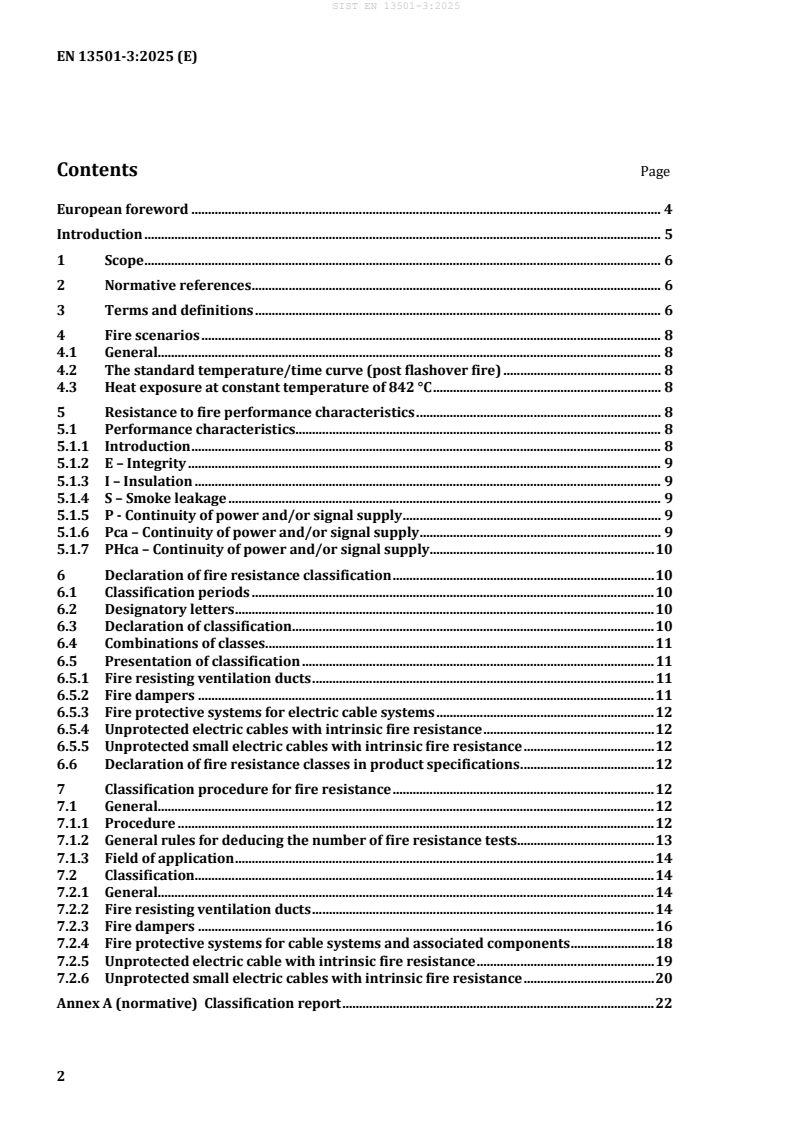
Contents Page
European foreword . 4
Introduction . 5
1 Scope . 6
2 Normative references . 6
3 Terms and definitions . 6
4 Fire scenarios . 8
4.1 General. 8
4.2 The standard temperature/time curve (post flashover fire) . 8
4.3 Heat exposure at constant temperature of 842 °C . 8
5 Resistance to fire performance characteristics . 8
5.1 Performance characteristics. 8
5.1.1 Introduction . 8
5.1.2 E – Integrity . 9
5.1.3 I – Insulation . 9
5.1.4 S – Smoke leakage . 9
5.1.5 P - Continuity of power and/or signal supply . 9
5.1.6 Pca – Continuity of power and/or signal supply . 9
5.1.7 PHca – Continuity of power and/or signal supply . 10
6 Declaration of fire resistance classification . 10
6.1 Classification periods . 10
6.2 Designatory letters . 10
6.3 Declaration of classification . 10
6.4 Combinations of classes . 11
6.5 Presentation of classification . 11
6.5.1 Fire resisting ventilation ducts . 11
6.5.2 Fire dampers . 11
6.5.3 Fire protective systems for electric cable systems . 12
6.5.4 Unprotected electric cables with intrinsic fire resistance . 12
6.5.5 Unprotected small electric cables with intrinsic fire resistance . 12
6.6 Declaration of fire resistance classes in product specifications . 12
7 Classification procedure for fire resistance . 12
7.1 General. 12
7.1.1 Procedure . 12
7.1.2 General rules for deducing the number of fire resistance tests. 13
7.1.3 Field of application . 14
7.2 Classification. 14
7.2.1 General. 14
7.2.2 Fire resisting ventilation ducts . 14
7.2.3 Fire dampers . 16
7.2.4 Fire protective systems for cable systems and associated components . 18
7.2.5 Unprotected electric cable with intrinsic fire resistance . 19
7.2.6 Unprotected small electric cables with intrinsic fire resistance . 20
Annex A (normative) Classification report . 22
Annex B (normative) Additional fire damper classifications if declared . 28
Bibliography . 29
European foreword
This document (EN 13501-3:2025) has been prepared by Technical Committee CEN/TC 127 “Fire safety
in buildings”, the secretariat of which is held by BSI.
This European Standard shall be given the status of a national standard, either by publication of an
identical text or by endorsement, at the latest by February 2026, and conflicting national standards shall
be withdrawn at the latest by February 2026.
Attention is drawn to the possibility that some of the elements of this document may be the subject of
patent rights. CEN shall not be held responsible for identifying any or all such patent rights.
This document will supersede EN 13501-3:2005+A1:2009.
3:2005+A1:2009:
— paragraphs related to fire protective systems for electric cable systems; unprotected electric cables
with intrinsic fire resistance; unprotected small electric cables with intrinsic fire resistance the
added paragraphs are: 5.1.5; 5.1.6; 5.1.7; 6.5.3; 6.5.4; 6.5.5; 7.2.4; 7.2.5; 7.2.6. Improving the text by
replacing Declaration of fire resistance performance by Declaration of fire resistance classification
o
avoiding the misinterpretation in relation with the text in regulation n 305/2011/EC;
— adding an Annex B (normative) on Additional fire damper classifications if declared.
This document has been prepared under a mandate given to CEN by the European Commission and the
European Free Trade Association.
EN 13501 consists of the following parts:
— Part 1: Classification using data from reaction to fire tests;
— Part 2: Classification using data from fire resistance tests, excluding ventilation services;
— Part 3: Classification using data from fire resistance tests on products and elements used in building
service installations: fire resistant ventilation ducts and fire dampers and/or power, control and
communication cables;
— Part 4: Classification using data from fire resistance tests on components of smoke control systems;
— Part 5: Classification using data from external fire exposure to roofs tests;
— Part 6: Classification using data from, reaction to fire tests on power, control and communication cables.
Any feedback and questions on this document should be directed to the users’ national standards body.
A complete listing of these bodies can be found on the CEN website.
According to the CEN-CENELEC Internal Regulations, the national standards organisations of the
following countries are bound to implement this European Standard: Austria, Belgium, Bulgaria, Croatia,
Cyprus, Czech Republic, Denmark, Estonia, Finland, France, Germany, Greece, Hungary, Iceland, Ireland,
Italy, Latvia, Lithuania, Luxembourg, Malta, Netherlands, Norway, Poland, Portugal, Republic of North
Macedonia, Romania, Serbia, Slovakia, Slovenia, Spain, Sweden, Switzerland, Türkiye and the United
Kingdom.
Introduction
The aim of this document is to define a harmonized procedure for the classification for resistance to fire
of construction products and building elements. This classification is based on the test procedures listed
in Clause 2 and the relevant field of application procedures.
This document is prepared in support of the second essential requirement in the EC Construction
Products Regulation (305/2011), which is detailed in the Interpretative Document number 2
(ID2): Safety in case of fire (OJ C62 Vol 37). It reflects the Commission Decision (EU) 2000/367/EC
of 03/05/2000 amended by 2003/629/EC of 27/08/2003 and 2011/232/EC of 11/04/2011 as regards
the classification of the resistance to fire performance of construction products, construction works and
parts thereof.
Commission delegated regulation (EU) 2024/1681 of 6 March 2024 specifies performance and classes
regarding fire resistance. These classes are identified by designation letters, each of which refers to an
important characteristic of fire resistance behaviour.
This document provides for a common understanding for these requirements. It interprets the functional
requirements for the different groups of construction products and building elements and explains the
method for deriving their classification on the basis of test results and/or extended application results
for individual construction products or building elements.
NOTE Test reports constitute the basis for extended application reports as explained in EN 15725.
CEN, CENELEC and EOTA committees preparing technical specifications which contain performance
requirements against fire resistance tests should make reference to the fire resistance classification given
in this document and not refer directly to any specific fire test method.
1 Scope
This document specifies the procedure for classification of the resistance to fire performance of
construction products and building elements used as components of building service installations, using
data from fire resistance tests which are within the direct field of application of the relevant test method.
Classification on the basis of extended application of test results is also included in the scope of this
document.
Construction products or building elements for use in ventilation systems include (excluding smoke
control system):
— fire resisting ventilation ducts;
— fire dampers.
Construction products or building elements for use in or as cables systems:
— unprotected electric cables with intrinsic fire resistance;
— fire protective systems for cable systems and associated components.
Relevant test methods which have been prepared for these construction products/building elements are
listed in Clause 2.
NOTE Cables associated with fire dampers are not generally covered by this document unless there is a local
regulation that requires it.
2 Normative references
The following documents are referred to in the text in such a way that some or all of their content
constitutes requirements of this document. For dated references, only the edition cited applies. For
undated references, the latest edition of the referenced document (including any amendments) applies.
EN 1366-1, Fire resistance tests for service installations — Part 1: Ventilation ducts
EN 1366-2, Fire resistance tests for service installations — Part 2: Fire dampers
EN 1366-11, Fire resistance tests for service installations — Part 11: Fire protective systems for cable
systems and associated components
EN 15650, Ventilation for buildings — Fire dampers
EN 15725, Extended application on the fire performance of construction products and building elements:
Principle of EXAP standards and EXAP reports
EN 50200, Method of test for resistance to fire of unprotected small cables for use in emergency circuits
EN 50289-4-16, Communication cables — Specifications for test methods — Part 4-16: Environmental test
methods — Circuit integrity under fire conditions
EN 50577, Electric cables — Fire resistance test for unprotected electric cables (P classification)
EN 50582, Procedure to assess the circuit integrity of optical fibres in a cable under resistance to fire testing
3 Terms and definitions
For the purposes of this document, the following terms and definitions apply.
ISO and IEC maintain terminology databases for use in standardization at the following addresses:
— IEC Electropedia: available at https://www.electropedia.org/
— ISO Online browsing platform: available at https://www.iso.org/obp
3.1
direct field of application
outcome of a process (involving the application of defined rules) whereby a test result is deemed to be
equally valid for variations in one or more of the product properties and/or intended end use applications
3.2
extended field of application
outcome of a process (involving the application of defined rules that may incorporate calculation
procedures) that predicts, for a variation of a product property and/or its intended end use
application(s), a test result on the basis of one or more test results to the same test standard
3.3
test specimen
element (or part) of building construction provided for the purpose of determining either its fire
resistance or its contribution to the fire resistance of another building element
Note 1 to entry: For the purposes of this document, this definition refers to a specific component of a service
installation.
3.4
fire resisting ventilation duct
duct used for the distribution or extraction of air and designed to provide a degree of fire resistance
Note 1 to entry: Fire resisting ventilation ducts can be subject to an additional classification S: smoke leakage.
3.5
fire damper
device for use in heating ventilation and air-conditioning (HVAC) system at fire boundaries to maintain
compartmentation and protect means of escape in case of fire
3.6
extended application result
predicted result for performance parameter obtained following the process of extended field of
application
3.7
extended application report
document reporting extended application results, including all details of the process leading to those
results
Note 1 to entry: Extended application reports are prepared in accordance with EN 15725.
3.8
fire protective system for cables/cable systems and associated components
construction to allow cables and components of their installation (connectors, glands, junctions,
mountings, etc.) to maintain during a defined time a reliable function whilst exposed to fire
Note 1 to entry: The protective system can be ducts, shafts, conducts, trunkings, jacket enclosures or similar
systems.
3.9
electric cables
power, control and communication cables, including optical fibre cables and hybrid cables which are a
combination of two or more of these cable types
3.10
small electric cables
power, control and communication cables, including optical fibre cables and hybrid cables with an overall
diameter not exceeding 20 mm and with conductor size up to and including 2,5 mm
Note 1 to entry: For optical fibre cables only the 20 mm diameter limit applies.
4 Fire scenarios
4.1 General
Fire resistance shall be assessed using the thermal attack given in 4.2 or 4.3 as appropriate. The levels of
thermal action given in 4.2 and 4.3 reflect different fire scenarios and the standards which prescribe their
translation into practical tests give tolerances for their application.
4.2 The standard temperature/time curve (post flashover fire)
When applied as a basis for testing, the standard temperature/time relationship shall be applied for the
full duration of the test. The relationship, which is a model of a fully developed fire in a compartment, is
given by the following relationship:
T 345 log 8t+ 1 + 20 (1)
( )
where
t is the time from the start of the test in minutes;
T is the mean furnace temperature in °C.
Further details relating to the practical application of this curve, and other test parameters, e.g.
tolerances, are given in EN 1363-1.
4.3 Heat exposure at constant temperature of 842 °C
The evaluation of unprotected small electric cables with intrinsic fire resistance using a constant
temperature attack is carried out by means of flame single burner attack instead of furnace testing.
Further details relating to the practical application of this curve, and other test parameters, e.g.
tolerances, are given in EN 50200.
5 Resistance to fire performance characteristics
5.1 Performance characteristics
5.1.1 Introduction
5.1.2 to 5.1.7 describe which performance characteristics apply to which construction products/building
elements.
=
5.1.2 E – Integrity
Integrity E is the ability of a component of a service installation to prevent the transmission of fire as a
result of the passage of significant quantities of flames or hot gases from the fire to the unexposed side,
thereby causing ignition either of the non-fire exposed surface or of any material adjacent to that surface.
The assessment of integrity is made on the basis of one or more of the following aspects simultaneously:
— cracks or openings in excess of given dimensions;
— ignition of a cotton pad;
— sustained flaming on the unexposed side;
— leakage in excess of given values.
The integrity shall be determined by all methods during the test. The cotton pad procedure shall be
applied until the pad ignites and, once it has ignited, it shall be withdrawn and the test continued until all
aspects have been exceeded (the sponsor has the option, however, of stopping the test once the desired
level has been reached). The times of each mode of integrity failure shall be recorded.
Classification of integrity is according to whether or not the component is also classified for insulation.
Where a component is classified both for integrity E and insulation I, the integrity value shall be that
determined by whichever of the four criteria fails first. Where a component is classified E but without
an I classification, failure of the cotton pad shall not be taken into account.
For fire dampers, cracks or openings, ignition of cotton pad and sustained flaming on the unexposed side
shall be taken into account only for the area around the ventilation duct and wall or floor junction. The
criterion inside the duct containing the damper shall be the limitation of the leakage rate
3 2
to 360 m /(m⋅h) after the first five minutes of exposure to the standard temperature/time curve.
5.1.3 I – Insulation
Insulation I is the ability of a component of a service installation to withstand fire exposure without the
transmission of fire as a result of significant transfer of heat. Transmission shall be limited so that
unexposed surfaces or any material in close proximity to those surfaces are not ignited. The component
shall also provide a barrier to heat, sufficient to protect people near to it.
5.1.4 S – Smoke leakage
Smoke leakage S is the ability of the component to resist the passage of gases or smoke at ambient
temperature and during exposure to the standard temperature/time test.
NOTE The leakage rate is normalized to the conditions at to 20°C.
5.1.5 P - Continuity of power and/or signal supply
P applies to Fire protective systems for cable systems and associated components and is the ability, when
exposed to the conditions of the standard temperature / time curve (see 4.2), to ensure that the protected
cable maintain a reliable power or signal supply
5.1.6 Pca – Continuity of power and/or signal supply
Pca is the ability of unprotected electric cables with intrinsic fire resistance to maintain a reliable power
or signal supply when exposed to the conditions of the standard temperature / time curve (see 4.2) and
the installation and electrical conditions used for the test (see EN 50577)
5.1.7 PHca – Continuity of power and/or signal supply
PHca is the ability of power, control and communication cables, including optical fibre cables and hybrid
cables with an overall diameter not exceeding 20 mm and with conductor size less or equal to 2,5 mm
to maintain a reliable power or signal supply from the source to the safety installation(s) when exposed
to a constant flame temperature attack of 842 °C (see 4.3) in accordance with the test standard. For
optical fibre cables only the 20 mm diameter limit applies.
6 Declaration of fire resistance classification
6.1 Classification periods
All classification periods against any of the characteristics shall be declared in minutes using one of the
periods 15, 20, 30, 45, 60, 90, 120, 180 or 240.
Not all periods apply to all components, and further subclauses show which classification periods apply
to which products.
6.2 Designatory letters
For the classification of components of service installations, use shall be made of the designatory letters
explained in 5.1.
6.3 Declaration of classification
Combinations of these designatory letters, as appropriate, shall be used as part of the classification of
performance. They shall be supplemented by the time, in elapsed completed minutes of the nearest lower
class, during which the functional requirements are satisfied.
The classes for fire dampers and fire resisting ventilation ducts shall be expressed as follows:
EI ttt (…) ttt being the classification period during which the criteria integrity and insulation
are satisfied;
E ttt (…) ttt being the classification period during which the criterion integrity is satisfied;
EI ttt (…) S ttt being the classification period during which the criteria integrity, insulation and
smoke leakage are satisfied;
E ttt (…) S ttt being the classification period during which the criteria integrity and smoke
leakage are satisfied.
Designatory letters within brackets shall include all information on the direction of exposure of the
specimen, as specified in 7.2.2.4 and 7.2.3.4.
Thus, the following classes may be defined:
— EI 15 (…) S, E 30 (…) S, E 60 (…)
Test results and extended application results shall always be rounded down to the nearest lower class.
When characteristics are combined, the time declared is that for the characteristic having the shortest
time.
The classes for ‘Fire protective systems for cable systems and associated components’ shall be expressed
as follows:
P ttt ttt being the classification period during which the criterion continuity of power
and/or signal supply is satisfied according to EN 1366-11.
The classes for unprotected electric cables with intrinsic fire resistance shall be expressed as follows:
Pca ttt ttt being the classification period during which the criterion continuity of power
and/or signal supply is satisfied as defined either in EN 50577, EN 50582 or
EN 50289-4–16;
And/or
PHca ttt ttt being the classification period during which the criteria continuity of power
and/or signal supply is satisfied as defined in EN 50200 or EN 50582 or
EN 50289-4-16.
Thus, the following classes may be defined:
— P 30 (…), Pca 60 (…), PHca 90 (…), PHca 120 (…)
6.4 Combinations of classes
Only those combinations of designatory letters and performance times explained in Clause 7 shall be used
for the relevant construction products/building elements.
6.5 Presentation of classification
6.5.1 Fire resisting ventilation ducts
The classification for fire resisting ventilation ducts shall be presented according to the following
template:
E I t t t ve ho ( i ↔ o ) S
The combination of classes and times for E, I and S shall be deduced from test results and/or extended
application results. Only those combinations of classes and times as defined in the following clauses of
this document shall be used for the relevant elements. Combined classifications shall be declared in order
of decreasing number of performance criteria and increasing time. The designatory letters for the
expansion of performance parameters shall be added as far as relevant and as far as the conditions are
satisfied. The classification(s) shall be awarded after verification that specific additional requirements
for certain construction products/building elements are satisfied.
6.5.2 Fire dampers
The classification for fire dampers shall be presented according to the following template:
E I t t t ve ho S
The combination of classes and times for E, I and S shall be deduced from test results and/or extended
application results. Only those combinations of classes and times as defined in the following clauses of
this document shall be used for the relevant elements. Combined classifications shall be declared in order
of decreasing number of performance criteria and increasing time. The designatory letters for the
expansion of performance parameters shall be added as far as relevant and as far as the conditions are
satisfied. The classification(s) shall be awarded after verification that specific additional requirements
for certain construction products/building elements are satisfied, according to Annex B.
6.5.3 Fire protective systems for electric cable systems
The P classification for fire protective systems for cable systems shall be as follows:
P t t t Rated VOLTAGE (only for power
and control cable)
6.5.4 Unprotected electric cables with intrinsic fire resistance
The Pca classification for unprotected cables with intrinsic fire resistance
Pca t t t Rated VOLTAGE (only for power
and control cable)
6.5.5 Unprotected small electric cables with intrinsic fire resistance
The PHca classification for unprotected small electric cables with intrinsic fire resistance
PHca t t t Rated VOLTAGE (only for power
and control cable)
6.6 Declaration of fire resistance classes in product specifications
Product specifications including descriptive product requirements and claiming a given fire resistance
classification in accordance
...