

SIST EN 15224:2017
(Main)Health care services - Quality management systems - Requirements based on EN ISO 9001:2015
General Information
- Abstract
This European Standard specifies requirements for a quality management system when a healthcare organization:
a) needs to demonstrate its ability to consistently provide healthcare product or service that meets customer and applicable statutory and regulatory requirements, and
b) aims to enhance customer satisfaction through the effective application of the system, including processes for improvement of the system and the assurance of conformity to customer requirements, applicable statutory and regulatory requirements and requirements related to the quality characteristics; appropriate, correct care; availability; continuity of care; effectiveness; efficiency; equity; evidence/knowledge based care; patient centred care including physical, psychological and social integrity; patient involvement; patient safety and timelines/accessibility.
NOTE 1 Statutory and regulatory requirements can be expressed as legal requirements.
Requirements related to material outputs such as tissue, blood products, pharmaceuticals, cell culture products and medical devices have not been focused in the scope of this standard as they are regulated elsewhere.
This standard is focused on requirements for clinical processes. Organizations that also include research or education processes, or both in their quality management system could use the requirements in this standard where applicable.
This standard aims to adjust and specify the requirements, as well as the “product and service” concept and customer perspectives in EN ISO 9001:2015 to the specific conditions for healthcare providing mainly services and where customers are mainly patients.
- Status
- Published
- Public Enquiry End Date
- 05-Apr-2016
- Publication Date
- 12-Jan-2017
- Technical Committee
- VZK - Quality management and quality assurance
- Current Stage
- 6100 - Translation of adopted SIST standards (Adopted Project)
- Start Date
- 13-Jan-2022
- Due Date
- 12-Jan-2023
- Completion Date
- 25-Oct-2022
Buy Documents




Overview
EN 15224:2016 - “Quality management systems – EN ISO 9001:2015 for healthcare” (CEN) adapts ISO 9001:2015 specifically for healthcare providers. It specifies requirements for a quality management system (QMS) when an organization needs to demonstrate consistent delivery of healthcare products or services that meet customer, statutory and regulatory requirements, and when it aims to enhance patient satisfaction. The standard focuses on clinical processes, patient-centred care, patient safety and clinical risk management, while acknowledging that material outputs (e.g., blood products, medical devices) are regulated elsewhere.
Key Topics
- Alignment with EN ISO 9001:2015: Incorporates ISO 9001 structure and principles (process approach, PDCA, risk‑based thinking) with healthcare-specific interpretations.
- Context and interested parties (Clauses 4.1–4.3): Understanding organizational context and stakeholder needs (patients, regulators, payers).
- Leadership and policy (Clause 5): Management commitment, quality policy and defined roles/responsibilities.
- Planning and risk-based thinking (Clause 6): Clinical risk management integrated into QMS planning and objectives.
- Support and competence (Clause 7): Resource management, competence, awareness, communication and documented information.
- Operation and clinical processes (Clause 8): Operational control, requirements for services, design/development, control of externally provided care, release and management of nonconforming outputs.
- Performance evaluation and improvement (Clauses 9–10): Monitoring, internal audit, management review, corrective action and continual improvement.
- Healthcare quality characteristics: Emphasis on availability, continuity, effectiveness, efficiency, equity, evidence‑based care, physical/psychological/social integrity, patient involvement and accessibility.
Applications
- Implementing or upgrading a healthcare QMS to meet European expectations and support certification.
- Structuring clinical process management, performance measurement and continuous improvement programs.
- Demonstrating conformity to regulatory and contractual requirements and improving patient satisfaction.
- Supporting internal/external audits, management reviews and risk management integrated into everyday clinical workflows.
Who uses this standard
- Healthcare organizations: hospitals, primary care, clinics, nursing homes, hospices, mental health services, rehabilitation, dental and occupational health services.
- Quality managers, clinical leads, compliance officers, auditors, certification bodies and healthcare consultants.
Related Standards
- EN ISO 9001:2015 - foundational quality management system requirements.
- ISO 9000:2015 - quality management terminology and fundamentals.
- Documents developed by ISO/TC 176 and related guidance referenced in EN 15224 annexes.
EN 15224:2016 is a practical, sector‑specific QMS standard that helps healthcare providers deliver safer, more effective and patient‑centred services while meeting statutory, regulatory and customer expectations.
Relations
- Effective Date
- 01-Feb-2017
- Refers
SIST EN ISO 9000:2015 - Quality management systems - Fundamentals and vocabulary (ISO 9000:2015) - Effective Date
- 28-Jan-2026
Buy Documents
Get Certified
Connect with accredited certification bodies for this standard

BSI Group
BSI (British Standards Institution) is the business standards company that helps organizations make excellence a habit.

TÜV SÜD
TÜV SÜD is a trusted partner of choice for safety, security and sustainability solutions.

Bureau Veritas
Bureau Veritas is a world leader in laboratory testing, inspection and certification services.
Sponsored listings
Frequently Asked Questions
SIST EN 15224:2017 is a standard published by the Slovenian Institute for Standardization (SIST). Its full title is "Health care services - Quality management systems - Requirements based on EN ISO 9001:2015". This standard covers: This European Standard specifies requirements for a quality management system when a healthcare organization: a) needs to demonstrate its ability to consistently provide healthcare product or service that meets customer and applicable statutory and regulatory requirements, and b) aims to enhance customer satisfaction through the effective application of the system, including processes for improvement of the system and the assurance of conformity to customer requirements, applicable statutory and regulatory requirements and requirements related to the quality characteristics; appropriate, correct care; availability; continuity of care; effectiveness; efficiency; equity; evidence/knowledge based care; patient centred care including physical, psychological and social integrity; patient involvement; patient safety and timelines/accessibility. NOTE 1 Statutory and regulatory requirements can be expressed as legal requirements. Requirements related to material outputs such as tissue, blood products, pharmaceuticals, cell culture products and medical devices have not been focused in the scope of this standard as they are regulated elsewhere. This standard is focused on requirements for clinical processes. Organizations that also include research or education processes, or both in their quality management system could use the requirements in this standard where applicable. This standard aims to adjust and specify the requirements, as well as the “product and service” concept and customer perspectives in EN ISO 9001:2015 to the specific conditions for healthcare providing mainly services and where customers are mainly patients.
This European Standard specifies requirements for a quality management system when a healthcare organization: a) needs to demonstrate its ability to consistently provide healthcare product or service that meets customer and applicable statutory and regulatory requirements, and b) aims to enhance customer satisfaction through the effective application of the system, including processes for improvement of the system and the assurance of conformity to customer requirements, applicable statutory and regulatory requirements and requirements related to the quality characteristics; appropriate, correct care; availability; continuity of care; effectiveness; efficiency; equity; evidence/knowledge based care; patient centred care including physical, psychological and social integrity; patient involvement; patient safety and timelines/accessibility. NOTE 1 Statutory and regulatory requirements can be expressed as legal requirements. Requirements related to material outputs such as tissue, blood products, pharmaceuticals, cell culture products and medical devices have not been focused in the scope of this standard as they are regulated elsewhere. This standard is focused on requirements for clinical processes. Organizations that also include research or education processes, or both in their quality management system could use the requirements in this standard where applicable. This standard aims to adjust and specify the requirements, as well as the “product and service” concept and customer perspectives in EN ISO 9001:2015 to the specific conditions for healthcare providing mainly services and where customers are mainly patients.
SIST EN 15224:2017 is classified under the following ICS (International Classification for Standards) categories: 03.100.70 - Management systems; 11.020.01 - Quality and environmental management in health care. The ICS classification helps identify the subject area and facilitates finding related standards.
SIST EN 15224:2017 has the following relationships with other standards: It is inter standard links to SIST EN 15224:2012, SIST EN ISO 9000:2015. Understanding these relationships helps ensure you are using the most current and applicable version of the standard.
SIST EN 15224:2017 is available in PDF format for immediate download after purchase. The document can be added to your cart and obtained through the secure checkout process. Digital delivery ensures instant access to the complete standard document.
Standards Content (Sample)
2003-01.Slovenski inštitut za standardizacijo. Razmnoževanje celote ali delov tega standarda ni dovoljeno.Zdravstvene storitve - Sistemi vodenja kakovosti - Zahteve na osnovi EN ISO 9001:2015Dienstleistungen in der Gesundheitsversorgung - Qualitätsmanagementsysteme - Anforderungen nach EN ISO 9001:2015Services de santé - Systèmes de management de la qualité - Application de l'EN ISO 9001:2015 aux soins de santéHealth care services - Quality management systems - Requirements based on EN ISO 9001:201511.020.01Vodenje kakovosti in ravnanje z okoljem v zdravstvuQuality and environmental management in health care03.100.70Sistemi vodenjaManagement systemsICS:Ta slovenski standard je istoveten z:EN 15224:2016SIST EN 15224:2017en,fr,de01-februar-2017SIST EN 15224:2017SLOVENSKI
STANDARDSIST EN 15224:20121DGRPHãþD
EUROPEAN STANDARD NORME EUROPÉENNE EUROPÄISCHE NORM
EN 15224
December
t r s x ICS
r uä s r rä y râ
r uä s t rä s râ
s sä r t rä r s Supersedes EN
s w t t vã t r s tEnglish Version
Quality management systems æ EN ISO
{ r r sã t r s w for healthcare Services de santé æ Systèmes de management de la qualité æ Application de l 5EN ISO
{ r r sã t r s w aux soins de santé
Qualitätsmanagementsysteme æ EN ISO
{ r r sã t r s w für die Gesundheitsversorgung This European Standard was approved by CEN on
t r December
t r s xä
egulations which stipulate the conditions for giving this European Standard the status of a national standard without any alterationä Upætoædate lists and bibliographical references concerning such national standards may be obtained on application to the CENæCENELEC Management Centre or to any CEN memberä
translation under the responsibility of a CEN member into its own language and notified to the CENæCENELEC Management Centre has the same status as the official versionsä
CEN members are the national standards bodies of Austriaá Belgiumá Bulgariaá Croatiaá Cyprusá Czech Republicá Denmarká Estoniaá Finlandá Former Yugoslav Republic of Macedoniaá Franceá Germanyá Greeceá Hungaryá Icelandá Irelandá Italyá Latviaá Lithuaniaá Luxembourgá Maltaá Netherlandsá Norwayá Polandá Portugalá Romaniaá Slovakiaá Sloveniaá Spainá Swedená Switzerlandá Turkey andUnited Kingdomä
EUROPEAN COMMITTEE FOR STANDARDIZATION COMITÉ EUROPÉEN DE NORMALISATION EUROPÄISCHES KOMITEE FÜR NORMUNG
CEN-CENELEC Management Centre:
Avenue Marnix 17,
B-1000 Brussels
t r s x CEN All rights of exploitation in any form and by any means reserved worldwide for CEN national Membersä Refä Noä EN
s w t t vã t r s x ESIST EN 15224:2017
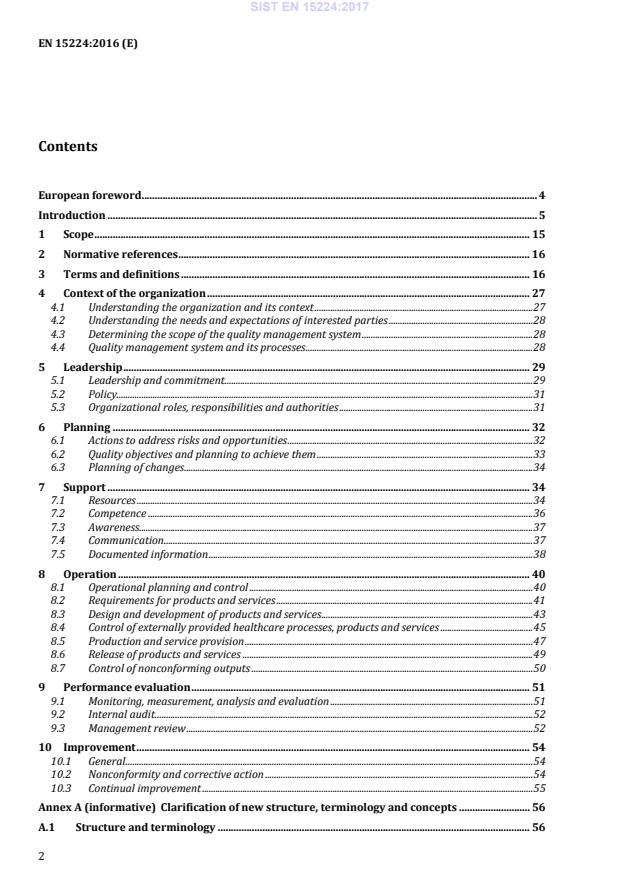
European foreword . 4 Introduction . 5 1 Scope . 15 2 Normative references . 16 3 Terms and definitions . 16 4 Context of the organization . 27 4.1 Understanding the organization and its context . 27 4.2 Understanding the needs and expectations of interested parties . 28 4.3 Determining the scope of the quality management system . 28 4.4 Quality management system and its processes . 28 5 Leadership . 29 5.1 Leadership and commitment. 29 5.2 Policy. 31 5.3 Organizational roles, responsibilities and authorities . 31 6 Planning . 32 6.1 Actions to address risks and opportunities . 32 6.2 Quality objectives and planning to achieve them . 33 6.3 Planning of changes . 34 7 Support . 34 7.1 Resources . 34 7.2 Competence . 36 7.3 Awareness. 37 7.4 Communication . 37 7.5 Documented information . 38 8 Operation . 40 8.1 Operational planning and control . 40 8.2 Requirements for products and services . 41 8.3 Design and development of products and services . 43 8.4 Control of externally provided healthcare processes, products and services . 45 8.5 Production and service provision . 47 8.6 Release of products and services . 49 8.7 Control of nonconforming outputs . 50 9 Performance evaluation . 51 9.1 Monitoring, measurement, analysis and evaluation . 51 9.2 Internal audit . 52 9.3 Management review . 52 10 Improvement . 54 10.1 General . 54 10.2 Nonconformity and corrective action . 54 10.3 Continual improvement . 55 Annex A (informative)
Clarification of new structure, terminology and concepts . 56 A.1 Structure and terminology . 56 SIST EN 15224:2017
Other International Standards on quality management and quality management systems developed by ISO/TC 176 . 61 Annex C (informative)
Correlation matrix EN 15224:2012 to EN ISO 9001:2015 to EN 15224:2016 . 65 Annex D (informative)
Quality requirements and quality characteristics in healthcare . 71 Annex E (informative)
Guidance for process approach in healthcare . 74 E.1 Background . 74 E.2 Processes and workflow in general . 74 E.3 Clinical Processes . 75 E.4 Analysis and management of clinical processes . 79 Bibliography . 82
0.1.7 Healthcare specific preconditions Healthcare is characterized by numerous interactions between patients, healthcare personnel, external providers, insurers, industry and governmental bodies who shall be identified and taken into consideration. Examples of specific preconditions in healthcare are: a) Healthcare is delivered through clinical processes that are dependent on the effect/results of a number of management and supporting activities/processes. A clinical process is a continuum of care from the patient's perspective. Depending on the scope of the organization the clinical processes consist of the whole or part of the continuum of care. The results of provided processes in healthcare are mainly services where patients have interacted with healthcare personnel. b) Patient satisfaction based on needs and expectations is an overall objective in healthcare. The patient cannot always evaluate all aspects of the results of the processes in healthcare. Some aspects of the services have to be evaluated by healthcare professionals. c) It is the responsibility of the organization to support and balance between the patient's expectations and the professionally assessed needs for care. There may be differences between the expectations expressed by the patient and the patient’s needs as judged by the professionals, which has to be considered. SIST EN 15224:2017
Figure 1 — Schematic representation of the elements of a single process 0.3.1.1 Processes in the provision of healthcare There are three types of directly customer-oriented processes in healthcare organizations: — clinical processes, — research processes and — educational processes The main activities in healthcare organizations are related to the interaction between patients and healthcare personnel/professionals. These activities are performed in a wide variety of processes, called clinical processes, which encompasses all healthcare activities related to one or more health issues. Clinical processes, as processes in general, are influenced by leadership and management activities as well as by resource management (support) activities. Depending on the scope of the organization, the healthcare services provided can encompass comprehensive clinical processes or parts of it. Depending of the scope of the organization it can deal with any combination of the types and parts of processes mentioned here. SIST EN 15224:2017
Figure 2 — Representation of the structure of this standard in the PDCA cycle The PDCA cycle can be briefly described as follows: — Plan: establish the objectives of the system and its processes, and the resources needed to deliver results in accordance with customers' requirements and the organization's policies; and identify and address risks and opportunities; — Do: implement what was planned; — Check: monitor and (where applicable) measure processes and the resulting products and services against policies, objectives and requirements and planned activities, and report the results; — Act: take actions to improve performance, as necessary. 0.3.3 Risk-based thinking Risk-based thinking (see Clause A.4) is essential for achieving an effective quality management system. The concept of risk-based thinking has been implicit in previous editions of this standard (referring to EN ISO 9001:2008) including, for example, carrying out preventive action to eliminate potential nonconformities, analysing any nonconformities that do occur, and taking action to prevent recurrence that is appropriate for the effects of the nonconformity. To conform to the requirements of this standard, an organization needs to plan and implement actions to address risks and opportunities. In healthcare approaches for clinical risk management in planning and performing clinical processes is the essential aspect of risk-based thinking. Addressing both risks and opportunities establishes a basis for increasing the effectiveness of the quality management system, achieving improved results and preventing negative effects. Opportunities can arise as a result of a situation favourable to achieving an intended result, for example, a set of circumstances that allow the organization to attract customers, develop new products and SIST EN 15224:2017
EN ISO 14001, Environmental management systems — Requirements with guidance for use;
EN ISO 13940:2016. Health informatics - System of concepts to support continuity of care
EN ISO 27002 Information technology – Security
ISO 31000, Risk Management — Principles and guidelines
EN 80001-1 Application of risk management for IT-networks incorporating medical devices - Part 1: Roles, responsibilities and activities
EN ISO 13485 Medical devices – Quality management systems – Requirements for regulatory purposes This standard enables an organization to align or integrate its own quality management system with related management system requirements. This standard also enables a healthcare organization to be conformant to the generic system of concepts and clinical process model in EN ISO 13940:2016. It is possible to adapt the organization’s existing management system(s) in order to comply with the requirements of this standard. Annex C provides a cross-reference table with details on the congruence and difference between this standard, EN ISO 9001:2015 and EN 15224:2012. Sector-specific quality management system standards based on the requirements of this International Standard have been developed for a number of sectors. Some of these standards specify additional quality management system requirements, while others are limited to providing guidance to the application of this International Standard within the particular sector. SIST EN 15224:2017
Certain definitions from ISO 31000:2009 and ISO Guide 73 (written in black) also apply. Additional terms and definitions specific for healthcare apply and are written in blue italics. NOTE Definitions from EN ISO 9000 (only notes considered relevant for healthcare included) are repeated in this standard if specializations of the definitions and/or comments for healthcare are added in Notes. Such specializations and notes are written in blue italics. Most additional terms and definitions for healthcare refer to EN ISO 13940:2016 which is a healthcare specific system of concepts. 3.1 health state physical and mental functions, body structure, personal factors, activity, participation and environmental aspects as the composite health of a subject of care Note 1 to entry: An observation of a health state is a health condition. A health state may possibly give way to more than one observation, resulting in more than one health condition. The underlying health state is nevertheless present even if not perceived by an observer, for example, the subject of care having a cancer before it gives symptoms. Note 2 to entry: In ICF (the International Classification of Functioning, Disability and Health) of the WHO, the concept of health is described. ICF identifies five health components; body function, body structure, activity, participation and environmental factors. [SOURCE: EN ISO 13940:2016] 3.1.1 health issue representation of an issue related to the health of a subject of care as identified by one or more healthcare actors Note 1 to entry: According to this definition, a health issue can correspond to a health problem, a disease, an illness or another kind of health condition. EXAMPLES A loss of weight, a heart attack, a drug addiction, an injury, dermatitis. [SOURCE: EN ISO 13940:2016] SIST EN 15224:2017
A health need is the deficit in a subject of care’s health state. Note 2 to entry:
The current health state is observed as observed conditions. Note 3 to entry:
The desired future health state can be a health objective expressed as target conditions. Note 4 to entry:
The health ne
...
S L O V E N S K I SIST EN 15224
S T A N D A R D februar 2017
Zdravstvene storitve – Sistemi vodenja kakovosti – Zahteve na osnovi
EN ISO 9001:2015
Healthcare services – Quality management systems – Requirements based on
EN ISO 9001:2015
Dienstleistungen in der Gesundheitsversorgung – Qualitätsmanagementsysteme
– Anforderungen nach EN ISO 9001:2015
Services de santé – Systèmes de management de la qualité – Application de
l'EN ISO 9001:2015 aux soins de santé
Referenčna oznaka
ICS 03.100.70; 11.020.01 SIST EN 15224:2017 (sl, en)
Nadaljevanje na straneh I in od 1 do 126
2022-11. Slovenski inštitut za standardizacijo. Razmnoževanje ali kopiranje celote ali delov tega dokumenta ni dovoljeno.
SIST EN 15224 : 2017
NACIONALNI UVOD
Standard SIST EN 15224 (sl, en), Zdravstvene storitve – Sistemi vodenja kakovosti – Zahteve na osnovi
EN ISO 9001:2015, 2017, ima status slovenskega standarda in je istoveten evropskemu standardu EN
15224 (en), Healthcare services – Quality management systems – Requirements based on EN ISO
9001:2015, 2016.
Ta standard nadomešča SIST EN 15224:2012.
NACIONALNI PREDGOVOR
Besedilo standarda EN 15224:2016 je pripravil tehnični odbor CEN/TC 362 Zdravstvene storitve –
Sistemi vodenja kakovosti, katerega sekretariat vodi SIS. Slovenski standard SIST EN 15224:2017 je
prevod angleškega besedila evropskega standarda EN 15224:2016. V primeru spora glede besedila
slovenskega prevoda v tem standardu je odločilen izvirni evropski standard v angleškem jeziku.
Slovensko-angleško izdajo standarda je pripravil SIST/TC VZK Vodenje in zagotavljanje kakovosti.
Odločitev za privzem tega standarda je 4. januarja 2017 sprejel tehnični odbor SIST/TC VZK Vodenje
in zagotavljanje kakovosti.
ZVEZA S STANDARDI
S privzemom tega evropskega standarda veljajo za omejeni namen referenčnih standardov vsi
standardi, navedeni v izvirniku, razen standarda, ki je že sprejet v nacionalno standardizacijo:
SIST EN ISO 9000:2015 (sl, en) Sistemi vodenja kakovosti – Osnove in slovar (ISO 9000:2015)
OSNOVA ZA IZDAJO STANDARDA
– privzem standarda EN 15224:2016
PREDHODNA IZDAJA
– SIST EN 15224:2012, Zdravstvene storitve – Sistemi vodenja kakovosti – Zahteve na osnovi
EN ISO 9001:2008
OPOMBE
– Povsod, kjer se v besedilu standarda uporablja izraz "evropski standard", v SIST EN 15224:2017
to pomeni "slovenski standard".
– Nacionalni uvod in nacionalni predgovor nista sestavni del standarda.
– Ta nacionalni dokument je istoveten EN 15224:2016 in je objavljen z dovoljenjem
CEN-CENELEC
Upravni center
Avenue Marnix 17
1050 Bruselj
Belgija
This national document is identical with EN 15224:2016 and is published with the permission of
CEN-CENELEC
Management Centre
Avenue Marnix 17
1050 Bruxelles
Belgium
II
EVROPSKI STANDARD EN 15224
EUROPEAN STANDARD
NORME EUROPÉENNE
december 2016
EUROPÄISCHE NORM
ICS 03.100.70; 03.120.10; 11.020.01 Nadomešča EN 15224:2012
Slovenska izdaja
Zdravstvene storitve – Sistemi vodenja kakovosti – Zahteve na osnovi
EN ISO 9001:2015
Healthcare services – Quality Services de santé – Systèmes Dienstleistungen in der
management systems – de management de la qualité – Gesundheitsversorgung –
Requirements based on Application de l'EN ISO Qualitätsmanagementsysteme –
EN ISO 9001:2015 9001:2015 aux soins de santé Anforderungen nach EN ISO
9001:2015
Ta evropski standard je CEN sprejel 20. decembra 2016.
Člani CEN morajo izpolnjevati določila notranjih predpisov CEN/CENELEC, s katerimi je predpisano, da
mora biti ta standard brez kakršnihkoli sprememb sprejet kot nacionalni standard. Seznami najnovejših
izdaj teh nacionalnih standardov in njihovi bibliografski podatki so na zahtevo na voljo pri Upravnem
centru CEN-CENELEC ali članih CEN.
Ta evropski standard obstaja v treh uradnih izdajah (angleški, francoski in nemški). Izdaje v drugih
jezikih, ki jih člani CEN na lastno odgovornost prevedejo in izdajo ter prijavijo pri Upravnem centru CEN-
CENELEC, veljajo kot uradne izdaje.
Člani CEN so nacionalni organi za standarde Avstrije, Belgije, Bolgarije, Cipra, Češke republike,
Danske, Estonije, Finske, Francije, Grčije, Hrvaške, Irske, Islandije, Italije, Latvije, Litve, Luksemburga,
Madžarske, Malte, Nekdanje jugoslovanske republike Makedonije, Nemčije, Nizozemske, Norveške,
Poljske, Portugalske, Romunije, Slovaške, Slovenije, Španije, Švedske, Švice, Turčije in Združenega
kraljestva.
CEN
Evropski komite za standardizacijo
European committee for standardization
Comité européen de normalisation
Europäisches komitee für normung
Upravni center CEN-CENELEC: Avenue Marnix 17, B-1040 Bruselj
© 2016 CEN Vse pravice do izkoriščanja v kakršnikoli obliki in na kakršenkoli Ref. oznaka EN 15224:2016 E
način imajo nacionalni člani CEN.
SIST EN 15224 : 2017
VSEBINA Stran CONTENTS Page
Evropski predgovor . 4 European foreword . 4
Uvod . 5 Introduction . 5
1 Področje uporabe . 23 1 Scope .23
2 Zveze s standardi . 23 2 Normative references .23
3 Izrazi in definicije . 23 3 Terms and definitions .23
4 Kontekst organizacije . 38 4 Context of the organization .38
4.1 Razumevanje organizacije in 4.1 Understanding the organization and its
njenega konteksta . 38 context .38
4.2 Razumevanje potreb in pričakovanj 4.2 Understanding the needs and
zainteresiranih strani . 39 expectations of interested parties .39
4.3 Opredeljevanje področja uporabe 4.3 Determining the scope of the quality
sistema vodenja kakovosti . 39 management system .39
4.4 Sistem vodenja kakovosti in njegovi 4.4 Quality management system and its
procesi . 40 processes .40
5 Voditeljstvo . 42 5 Leadership .42
5.1 Voditeljstvo in zavezanost . 42 5.1 Leadership and commitment .42
5.2 Politika . 43 5.2 Policy .43
5.3 Vloge, odgovornosti in pooblastila 5.3 Organizational roles, responsibilities and
organizacije . 44 authorities .44
6 Planiranje . 45 6 Planning .45
6.1 Ukrepi za obravnavanje tveganj in 6.1 Actions to address risks and
priložnosti . 45 opportunities .45
6.2 Cilji kakovosti in planiranje za 6.2 Quality objectives and planning to achieve
njihovo doseganje . 46 them .46
6.3 Planiranje sprememb . 47 6.3 Planning of changes .47
7 Podpora . 47 7 Support .47
7.1 Viri . 47 7.1 Resources .47
7.2 Kompetentnost . 51 7.2 Competence .51
7.3 Ozaveščenost . 52 7.3 Awareness .52
7.4 Komuniciranje . 52 7.4 Communication .52
7.5 Dokumentirane informacije . 53 7.5 Documented information .53
8 Delovanje . 56 8 Operation .56
8.1 Planiranje in obvladovanje delovanja . 56 8.1 Operational planning and control .56
8.2 Zahteve za izdelke in storitve . 57 8.2 Requirements for products and services .57
8.3 Snovanje in razvoj izdelkov in 8.3 Design and development of products and
storitev . 59 services .59
8.4 Obvladovanje procesov, izdelkov in 8.4 Control of externally provided
storitev zunanjih ponudnikov v healthcare processes, products and
zdravstvenem varstvu . 64 services .64
8.5 Proizvodnja in izvedba storitev . 66 8.5 Production and service provision .66
8.6 Sprostitev izdelkov in storitev . 70 8.6 Release of products and services .70
8.7 Obvladovanje neskladnih izhodov . 71 8.7 Control of nonconforming outputs .71
9 Vrednotenje izvedbe . 72 9 Performance evaluation .72
9.1 Nadzorovanje, merjenje, analiziranje 9.1 Monitoring, measurement, analysis and
in vrednotenje . 72 evaluation .72
9.2 Notranja presoja . 74 9.2 Internal audit .74
9.3 Vodstveni pregled . 74 9.3 Management review .74
SIST EN 15224 : 2017
10 Izboljševanje . 76 10 Improvement .76
10.1 Splošno . 76 10.1 General .76
10.2 Neskladnost in korektivni ukrepi . 76 10.2 Nonconformity and corrective action .76
10.3 Nenehno izboljševanje . 77 10.3 Continual improvement .77
Dodatek A (informativni): Pojasnilo o Annex A (informative) Clarification of new
novi strukturi, terminologiji in pojmih . 78 structure, terminology and concepts .78
A.1 Struktura in terminologija . 78 A.1 Structure and terminology .78
A.2 Izdelki in storitve . 80 A.2 Products and services .90
A.3 Razumevanje potreb in pričakovanj A.3 Understanding the needs and
zainteresiranih strani . 80 expectations of interested parties .80
A.4 Razmišljanje na podlagi tveganja in A.4 Risk-based thinking and systematic
sistematično obvladovanje kliničnega clinical risk management .81
tvveganja . 81
A.5 Primernost . 82 A.5 Applicability .82
A.6 Dokumentirane informacije . 83 A.6 Documented information .83
A.7 Znanje organizacije . 84 A.7 Organizational knowledge .84
A.8 Obvladovanje zdravstvenih storitev A.8 Control of externally provided healthcare
in izdelkov zunanjih ponudnikov . 85 products and services .85
Dodatek B (informativni): Drugi Annex B (informative) Other International
mednarodni standardi o vodenju Standards on quality management and
kakovosti in sistemih vodenja quality management systems developed
kakovosti, ki jih je razvil ISO/TC 176 . 86 by ISO/TC 176 .86
Dodatek C (informativni): Korelacijska Annex C (informative) Correlation matrix EN
matrika EN 15224:2012 proti EN ISO 15224:2012 to EN ISO 9001:2015 to EN
9001:2015 in proti EN 15224:2016 . 93 15224:2016 .93
Dodatek D (informativni): Zahteve in Annex D (informative) Quality requirements
karakteristike kakovosti v and quality characteristics
zdravstvenem varstvu . 105 in healthcare .105
Dodatek E (informativni): Smernice za Annex E (informative) Guidance for
procesni pristop v zdravstvenem process approach in healthcare .109
varstvu . 109
E.1 Ozadje . 109 E.1 Background .109
E.2 Procesi in potek dela na splošno . 109 E.2 Processes and workflow in general .109
E.3 Klinični procesi . 112 E.3 Clinical Processes .112
E.4 Analiziranje in u kliničnih procesov . 121 E.4 Analysis and management of clinical
processes .121
Literatura . 124 Bibliography .124
SIST EN 15224 : 2017
Evropski predgovor European foreword
Ta dokument (EN 15224:2016) je pripravil This document (EN 15224:2016) has been
tehnični odbor CEN/TC 362 Zdravstvene storitve prepared by Technical Committee CEN/TC 362,
– Sistemi vodenja kakovosti, katerega Healthcare services – Quality management
sekretariat vodi SIS. systems, the secretariat of which is held by SIS.
Ta dokument nadomešča EN 15224:2012. This document supersedes EN 15224:2012.
Ta evropski standard mora dobiti status This European Standard shall be given the status
nacionalnega standarda bodisi z objavo of a national standard, either by publication of an
istovetnega besedila ali z razglasitvijo identical text or by endorsement, at the latest by
najpozneje do junija 2017, nacionalne June 2017, and conflicting national standards
standarde, ki so v nasprotju s tem standardom, shall be withdrawn at the latest by June 2017.
pa je treba razveljaviti najpozneje do junija 2017.
Opozoriti je treba na možnost, da je lahko nekaj Attention is drawn to the possibility that some of
elementov tega dokumenta predmet patentnih the elements of this document may be the subject
pravic. CEN [in/ali CENELEC] ne prevzema of patent rights. CEN [and/or CENELEC] shall not
odgovornosti za identifikacijo katerihkoli ali vseh be held responsible for identifying any or all such
takih patentnih pravic. patent rights.
V skladu z notranjimi pravili CEN/CENELEC According to the CEN/CENELEC Internal
morajo ta evropski standard prevzeti nacionalne Regulations, the national standards organizations
organizacije za standarde naslednjih držav: of the following countries are bound to implement
Avstrije, Belgije, Bolgarije, Cipra, Češke this European Standard: Austria, Belgium,
republike, Danske, Estonije, Finske, Francije, Bulgaria, Croatia, Cyprus, Czech Republic,
Grčije, Hrvaške, Irske, Islandije, Italije, Latvije, Denmark, Estonia, Finland, Former Yugoslav
Litve, Luksemburga, Madžarske, Malte, Republic of Macedonia, France, Germany,
Nekdanje jugoslovanske republike Makedonije, Greece, Hungary, Iceland, Ireland, Italy, Latvia,
Nemčije, Nizozemske, Norveške, Poljske, Lithuania, Luxembourg, Malta, Netherlands,
Portugalske, Romunije, Slovaške, Slovenije, Norway, Poland, Portugal, Romania, Slovakia,
Španije, Švedske, Švice, Turčije in Združenega Slovenia, Spain, Sweden, Switzerland, Turkey
kraljestva. and the United Kingdom.
SIST EN 15224 : 2017
Uvod Introduction
0.1 Splošno 0.1 General
Privzem sistema vodenja kakovosti je strateška The adoption of a quality management system is
odločitev zdravstvene organizacije, ki ji lahko a strategic decision for a healthcare organization
pomaga izboljšati celotno izvajanje in daje trdno that can help to improve its overall performance
and provide a sound basis for sustainable
podlago pobudam za trajnostni razvoj.
development initiatives.
Koristi, ki jih ima lahko zdravstvena organizacija The potential benefits to a healthcare
od izvajanja sistema vodenja kakovosti na organization of implementing a quality
podlagi tega mednarodnega standarda, so: management system based on this standard are:
a) zmožnost, da dosledno zagotavlja a) the ability to consistently provide healthcare
zdravstvene izdelke in storitve, ki products and services that meet customer
izpolnjujejo zahteve odjemalcev ter and applicable statutory and regulatory
veljavne zahteve zakonodaje in regulative, requirements;
b) dajanje priložnosti za povečanje b) facilitating opportunities to enhance
zadovoljstva odjemalcev, customer satisfaction;
c) obravnavanje tveganj in priložnosti, c) addressing risks and opportunities
povezanih z njenim kontekstom in cilji, associated with its context and objectives;
d) zmožnost, da dokaže izpolnjevanje d) the ability to demonstrate conformity to
skladnosti s specificiranimi zahtevami specified quality management system
sistema vodenja kakovosti. requirements.
Ta standard lahko uporabljajo strani v This standard can be used by internal and
organizaciji in zunaj nje. external parties.
Ta standard nima namena nakazovati potrebe It is not the intent of this standard to imply the
po: need for:
enotni zgradbi različnih sistemov vodenja uniformity in the structure of different quality
kakovosti, management systems;
uskladitvi dokumentacije s strukturo točk alignment of documentation to the clause
tega standarda, structure of this standard;
uporabi specifične terminologije tega the use of the specific terminology of this
standarda v organizaciji. standard within the organization.
Ta standard vključuje zahteve za vodenje This standard includes requirements for quality
kakovosti, ne določa pa zahtev za specifične management but does not specify requirements
zdravstvene storitve. Zahteve sistema vodenja for specific healthcare services. The quality
kakovosti, določene v tem standardu, naj bi management system requirements specified in
dopolnjevale zahteve za ravni zdravstvenih this standard are supposed to be complemented
storitev. by requirements for levels of healthcare services
.
Ta standard uporablja procesni pristop, ki This standard employs the process approach,
vključuje cikel "planiraj-izvedi-preveri-ukrepaj" which incorporates the Plan-Do-Check-Act
(PDCA) in razmišljanje na podlagi tveganja. (PDCA) cycle and risk-based thinking.
Procesni pristop pomaga organizaciji planirati The process approach enables an organization
njene klinične in druge procese ter njihovo to plan its clinical and other processes and their
interakcijo. interactions.
SIST EN 15224 : 2017
Cikel PDCA pomaga organizaciji zagotavljati, da The PDCA cycle enables an organization to
so njeni procesi ustrezno podprti in vodeni ter da ensure that its processes are adequately
so priložnosti za izboljšanje prepoznane in resourced and managed and opportunities for
izvedene. improvement are identified and acted on.
Razmišljanje na podlagi tveganja pomaga Risk-based thinking enables a healthcare
zdravstveni organizaciji opredeliti dejavnike, ki bi organization to determine the factors that could
lahko povzročili odstopanje njenih kliničnih in cause its clinical and other processes and its
drugih procesov ter njenega sistema vodenja quality management system to deviate from the
kakovosti od planiranih rezultatov, sprejeti planned results, to put in place preventive
preventivne ukrepe za zmanjšanje negativnih controls to minimize negative effects and to
vplivov in kar najbolje izkoristiti priložnosti, ko se make maximum use of opportunities as they
ponudijo (glej točko A.4). arise (see A.4).
Dosledno izpolnjevanje zahtev ter obravnavanje Consistently meeting requirements and
prihodnjih potreb in pričakovanj v vse bolj addressing future needs and expectations poses
dinamičnem in kompleksnem okolju a challenge for healthcare organizations in an
predstavljata za zdravstvene organizacije velik increasingly dynamic and complex environment.
izziv. Da bi organizacija dosegla ta cilj, se ji lahko To achieve this objective, the organization might
zdi potrebno, da poleg korekcij in nenehnega find it necessary to adopt various forms of
izboljševanja sprejme različne oblike izboljšav, improvement in addition to correction and
kot so na primer prebojne spremembe, inovacije continual improvement, such as breakthrough
in reorganizacija. change, innovation and re-organization.
V tem standardu so uporabljene naslednje In this standard, the following verbal forms are
glagolske oblike: used:
"treba je" ali "mora" označuje zahtevo; “shall” indicates a requirement;
"naj" označuje priporočilo; “should” indicates a recommendation;
"sme" označuje dovoljenje; “may” indicates a permission;
"lahko" označuje možnost ali sposobnost. “can” indicates a possibility or a capability.
Informacije, označene kot "OPOMBA", so Information marked as “NOTE” is for guidance in
namenjene usmerjanju pri razumevanju ali understanding or clarifying the associated
pojasnjevanju pripadajoče zahteve. requirement.
0.1.1 Vodenje kakovosti v zdravstvenem 0.1.1 Quality management in healthcare
varstvu
To je področno specifičen standard sistema This is a sector specific quality management
vodenja kakovosti za zdravstveno varstvo. system standard for healthcare. This standard
Standard vključuje standard EN ISO 9001:2015 incorporates EN ISO 9001:2015 and adds
in dodaja interpretacije, razlage, primere in interpretations, explanations, examples and
dodatne zahteve. Ta standard nadomešča additional requirements. This standard replaces
standard EN 15224:2012. Dodatno besedilo, EN 15224:2012. Additional text specific to
posebej namenjeno zdravstvenemu varstvu, je v healthcare is shown in blue italics in Clause 0 to
točkah od 0 do 10 ter v dodatkih A in B prikazano 10 and in Annex A and B. Information marked as
v modrem poševnem tisku. Informacije, ki so v “NOTE” in Clause 4 to 10 is for guidance on
točkah od 4 do 10 označene kot "OPOMBA", so understanding or clarifying the associated
namenjene usmerjanju pri razumevanju ali requirement. In Clause 3 such additional
pojasnjevanju ustrezne zahteve. V točki 3 so information is written “note to entry” according to
take dodatne informacije v skladu s pravili CEN CEN rules. However, if the aspect refers to a
zapisane kot "opomba k vnosu". Če pa se neki special cited external document the format
vidik nanaša na posebej navedeni zunanji follows from that document (e.g. as NOTE from
dokument, oblika izhaja iz tega dokumenta (npr. ISO 13940).
kot OPOMBA iz ISO 13940).
SIST EN 15224 : 2017
To je samostojen standard in se lahko uporablja This is a standalone standard and can be used
za ugotavljanje skladnosti za namene for conformity assessment for certification
certificiranja v zdravstvenih organizacijah. purposes of healthcare organizations.
Zahteve v tem standardu celovito vključujejo The requirements in this standard
zahteve iz standarda EN ISO 9001:2015 z comprehensively incorporate those from EN ISO
dodatnimi zahtevami, specifikacijami in 9001:2015 with additional requirements,
razlagami za zdravstveno varstvo. Po potrebi so specifications and interpretations for healthcare.
dodane nove zahteve, obstoječe zahteve pa so Requirements have been added when
razjasnjene v skladu s posebnostmi v considered relevant and existing requirements
zdravstvenem varstvu. Ta standard vključuje are clarified according to the specific healthcare
tudi vidike, povezane z obvladovanjem context. This standard also includes aspects
kliničnega tveganja med planiranjem, related to clinical risk management throughout
delovanjem in obvladovanjem procesov. the planning, operation and control of processes.
ISO 9001:2008 je bil revidiran in v EN ISO ISO 9001:2008 has been reviewed and
9001:2015 so bile vključene pomembne important changes were included in EN ISO
spremembe. 9001:2015.
Nekateri primeri večjih sprememb so: Some examples of major changes are:
"razmišljanje na podlagi tveganja" je “Risk-based thinking” is an approach that
pristop, ki poteka skozi novi standard v flows through the new standard in Clauses
točkah 4, 5, 6, 8, 9 in 10, 4, 5, 6 8, 9 and 10
vključeni sta dve novi točki (4.1, 4.2), Two new clauses (4.1, 4.2) relating to the
povezani s kontekstom organizacije. context of the organization are included.
Zahtevata, da organizacija opredeli These require that the organization
vprašanja in zahteve, ki lahko vplivajo na determines the issues and requirements
planiranje sistema vodenja kakovosti. that can have impact on the planning of the
quality management system
Teh sprememb se je pomembno zavedati, ko se These changes are important to be aware of
uporablja revidirani standard. when the reviewed standard is applied.
V tej reviziji standarda EN 15224 so upoštevane All changes have been considered in this review
vse spremembe. of EN 15224.
0.1.2 Pojem zdravja 0.1.2 The concept of health
Deklaracija Svetovne zdravstvene organizacije The World Health Organization (WHO)
(WHO) definira zdravje kot "stanje popolne declaration of health is “a state of complete
telesne, duševne in socialne blaginje, in ne le kot physical, mental and social well-being and not
odsotnost bolezni ali invalidnosti". V Mednarodni merely the absence of disease or infirmity.” The
klasifikaciji funkcioniranja, zmanjšane zmožnosti International Classification of Functioning,
in zdravja (MKF), ki jo je izdelala WHO, je Disability and Health (ICF), by WHO, identifies
identificiranih pet sestavin zdravja: telesna five health components; body function, body
funkcija, telesna zgradba, aktivnost, sodelovanje structure, activity, participation and
in okoljski dejavniki. Ti opisi WHO so v tem environmental factors. These descriptions from
standardu uporabljeni kot osnova in ozadje WHO are used as the basis and background for
pojma "zdravje". the concept of “health” in this standard.
0.1.3 Zdravstveno varstvo v povezavi s 0.1.3 Healthcare in relation to social care
socialnim varstvom
Zdravstveno varstvo je v tem standardu Healthcare is in this standard defined as “care
definirano kot "aktivnosti oskrbe, upravljanje activities, services management or supplies
storitev ali dobave v zvezi z zdravjem related to the health of an individual”. The
posameznika". Pojem zdravja je povezan tako z concept of health relates to both healthcare and
zdravstvenim varstvom kot s socialnim. Ta
SIST EN 15224 : 2017
standard je osredotočen na zahteve za social care. This standard is focused on
zdravstveno varstvo. requirements for healthcare.
V različnih državah lahko zdravstveno varstvo What is included in healthcare can differ from
vključuje različne stvari in to je pri nacionalni rabi country to country and this has to be considered
treba upoštevati. V tem standardu zdravstveno in national applications. In this standard
varstvo vključuje npr. primarno zdravstveno healthcare includes e.g. primary healthcare, pre-
varstvo, predbolnišnično in bolnišnično oskrbo, hospital and hospital care, tertiary care, nursing
terciarno oskrbo, negovalne domove, hospice, homes, hospices, preventive healthcare, mental
preventivno zdravstveno varstvo, psihiatrične health services, dental services, physiotherapy,
zdravstvene storitve, zobozdravstvene storitve, occupational health services, rehabilitation and
fizioterapijo, storitve zdravja pri delu, pharmacies.
rehabilitacijo in lekarne.
0.1.4 Kakovost, zahteve kakovosti in 0.1.4 Quality, quality requirements and
karakteristike kakovosti v zdravstvenem quality characteristics in healthcare
varstvu
V standardu EN ISO 9000:2015 je kakovost na Quality in general is defined in EN ISO
splošno definirana kot "stopnja, na kateri skupek 9000:2015 as “degree to which a set of inherent
svojstvenih karakteristik predmeta izpolnjuje characteristics of an object fulfils requirements”.
zahteve".
Zahteva je v EN ISO 9000:2015 definirana kot Requirement is defined in EN ISO 9000:2015 as:
"potrebe ali pričakovanja, ki so izraženi, na “needs or expectations that are stated, generally
splošno samoumevni ali obvezni". implied or obligatory”.
Za sistem vodenja kakovosti zdravstvene Quality requirements concerning healthcare
organizacije so zahteve kakovosti za products and services shall be determined for
zdravstvene izdelke in storitve opredeljene v the quality management system of a healthcare
skladu s točko 8.2.2 in vključujejo: organization according to 8.2.2 and include:
1) vse ustrezne zahteve zakonodaje in 1) any applicable statutory and regulatory
regulative. Zahteve kakovosti se lahko requirements. According to national
razlikujejo glede na nacionalno zakonodajo, legislation quality requirements may differ;
2) tiste zahteve, ki jih organizacija šteje za 2) those considered necessary by the
potrebne in lahko vključujejo zahteve: organization which may include
requirements
a) ki jih pacient ne navaja, a so povezane a) not stated by the patient but related to
z ravnjo kakovosti storitev, ki jih nudi the quality level of services offered by
organizacija, the organization;
b) temelječe na znanstvenih dokazih in b) based on scientific evidence and clinical
kliničnem znanju, knowledge;
c) drugih zainteresiranih strani, npr. c) from other interested parties, e.g.
kupcev storitev, zavarovalnic in purchasers of services, insurance
organizacij za financiranje. companies and funding organizations.
To pomeni, da mora zdravstvena organizacija pri This means that the healthcare organization has
opredeljevanju zahtev kakovosti, ki jih bo to consider a broad variety of quality aspects
vključila v svoj sistem vodenja kakovosti, from several perspectives when determining the
upoštevati raznolike vidike kakovosti, gledano z quality requirements included in their quality
več zornih kotov. Kontekst organizacije, opisan management system. The context of the
v točki 4.1, bo določal tudi obseg zahtev organization described in 4.1 will set the scope
kakovosti. also for the quality requirements.
Glavni cilj vsake zdravstvene organizacije je The main aim for any healthcare organization is
prispevati k zdravstvenemu stanju potencialnih to contribute to the health state of the persons
SIST EN 15224 : 2017
ali trenutnih pacientov z različnimi zdravstvenimi that are potential or current patients with different
potrebami glede na zdravstveno kondicijo. kinds of health needs based on health
Zahteve kakovosti naj odražajo te zdravstvene conditions. Quality requirements should reflect
potrebe, ugotovljene pri populaciji pacientov. Pri these health needs identified in the patient
določanju zdravstvenih potreb naj se za population. When defining health needs the
kategorizacijo in specifikacijo zahtev kakovosti components of health from the International
uporabijo sestavine zdravja iz Mednarodne Classification for Functioning, Disability and
klasifikacije funkcioniranja, zmanjšane Health (ICF) from WHO should be used for
zmožnosti in zdravja (MKF) organizacije WHO. categorization and specification of quality
Zdravstvene potrebe lahko na podlagi MKF requirements. Health needs based on ICF can
specificirajo pacient in/ali strokovni akterji, ki be specified by the patient and/or by the
interaktivno delujejo s pacienti v kliničnih professional actors interacting with the patients
procesih. in clinical processes.
Znanstveni dokazi in klinično znanje so drugi Scientific evidence and/or clinical knowledge is
vidiki, ki jih je treba upoštevati pri opredeljevanju another perspective to be considered when
zahtev kakovosti. determining quality requirements.
V tem standardu je identificiranih enajst This standard identifies eleven basic quality
osnovnih vidikov kakovosti, ki so po kliničnih aspects that by clinical experience are known to
izkušnjah relevantni v zdravstvenih be relevant in healthcare organizations. To
organizacijah. Da bi organizacija ocenila assess fulfilment of quality requirements the
izpolnjevanje zahtev kakovosti, mora določiti organization need to specify quality
karakteristike kakovosti, povezane s temi characteristics related to these requirements.
zahtevami. Te karakteristike so vključene tudi v These are also included in the list of complex
seznam kompleksnih vidikov, ki jih mora aspects that shall be considered (assessed if
zdravstvena organizacija upoštevati (če je relevant) when a healthcare organization
relevantno, oceniti), kadar opredeljuje zahteve determines the quality requirements for
kakovosti za zdravstvene storitve kot rezultate healthcare services as outcomes of clinical
kliničnih procesov. processes.
Enajst identificiranih osnovnih vidikov kakovosti The identified eleven basic quality aspects from
iz te perspektive je: this perspective are:
ustrezna, korektna oskrba, appropriate, correct care;
razpoložljivost, availability;
neprekinjenost oskrbe, continuity of care;
uspešnost, effectiveness;
učinkovitost, efficiency;
enakost, equity;
na dokazih/znanju temelječa oskrba, evidence/knowledge based care;
na pacienta osredotočena oskrba, vključno patient centred care including physical,
s telesno, psihološko in socialno integriteto psychological and social integrity (ICF);
(MKF),
vključenost pacientov, patient involvement;
varnost pacientov, patient safety;
pravočasnost/dostopnost. timeliness/accessibility;
Ti osnovni vidiki niso vedno celoviti ali v celoti These basic aspects are not always
uporabni. Pri opredelitvi vseh zahtev kakovosti, comprehensive or applicable in total. Other
ki jih zdravstvena organizacija šteje za aspects often need to be considered for
relevantne, je pogosto treba upoštevati tudi determining all quality requirements considered
druge vidike. relevant by the healthcare organization.
SIST EN 15224 : 2017
Vendar pa teh enajst vidikov zagotavlja, da bo However, these eleven aspects are ensuring that
upoštevana večina vidikov, ki so na splošno most aspects that are commonly known as
znani kot relevantni. relevant will be considered.
Če zdravstvena organizacija meni, da kateri od If the healthcare organization considers any of
enajstih vidikov ni relevanten ali uporaben, lahko the eleven basic aspects not to be relevant or
ta vidik izključi. V skladu s točko 8.2.2 je treba applicable it can exclude that aspect. Reasons
razloge za izključitev hraniti kot dokumentirane for exclusion shall, according to 8.2.2 be retained
informacije. as documented information.
Druge zahteve kakovosti lahko temeljijo na Other quality requirements can be based on the
vidikih drugih zainteresiranih strani. Tak primer perspectives from other interested parties. An
so zavarovalnice, ki navajajo določene ravni example of such is insurance companies stating
dostopnosti za osebe s posebnimi zdravstvenimi certain levels of accessibility for persons with
težavami. specific health problems.
Karakteristika kakovosti je v standardu ISO Quality characteristic is defined in ISO
9000:2015 definirana kot "svojstvena 9000:2015 as: “inherent characteristic of an
karakteristika predmeta, ki se nanaša na object related to a requirement”. This means that
zahtevo". To pomeni, da se bo vsaka zahteva any quality requirement determined by the
kakovosti, ki jo organizacija opredeli, nanašala organization will also relate to one or more
tudi na eno ali več karakteristik kakovosti quality characteristics of the processes, services
procesov, storitev in/ali zdravstvenega sistema and/or the healthcare system as such.
kot takega.
V točki 9.1 je navedeno: "Organizacija mora In 9.1 is stated that: “The organization shall
nadzorovati in meriti rezultate kliničnih procesov, monitor and measure the outcomes of the
da preveri, ali so izpolnjene zahteve glede clinical processes to verify that requirements
vidikov kakovosti." related to quality aspects have been met.”
Skratka, identificirani vidiki kakovosti In summary, identified quality aspects of
zdravstvenih storitev, procesov in sistemov so healthcare services, processes and systems are
potrebni za določitev in opredelitev karakteristik needed to specify and determine quality
kakovosti, ki jih je mogoče validirati. V characteristics possible to validate. In healthcare
zdravstvenem varstvu, osredotočenem na with focus on the clinical aspects and the clinical
klinične vidike in klinične procese, so posebej processes, the quality characteristics related to
pomembne karakteristike kakovosti, povezane z the health needs of patients and the eleven basic
zdravstvenimi potrebami pacientov in enajstimi quality aspects identified in this standard are of
osnovnimi vidiki kakovosti, identificiranimi v tem special importance. With a process approach
standardu. S procesnim pristopom, ki ga recommended in EN ISO 9001:2015 this can be
priporoča standard EN ISO 9001:2015, je to achieved by systematic clinical process
mogoče doseči s sistematičnim upravljanjem management. Further guidance for such a
kliničnih procesov. Nadaljnji napotki za tak clinical process approach is given in Annex E.
pristop vodenja kliničnih procesov so podani v
dodatku E.
0.1.5 Pojem "kliničen" 0.1.5 The concept of “clinical”
Izraz "kliničen" ima lahko v različnih državah The term “clinical” can have different meanings
različen pomen. V tem standardu se "kliničen" in different countries. In this standard “clinical”
nanaša na vse vrste interaktivnosti med pacienti refers to all types of interactions between
in zdravstvenim osebjem. "Kliničen" vedno patients and healthcare personnel. “Clinical”
vključuje pacientov pogled in interakcijo z vsemi always include the patient perspective and the
vrstami zdravstvenega osebja ne glede na interaction with all types of healthcare personnel,
strokovni naziv (npr. doktor, medicinska sestra, regardless professional entitlement (like doctor,
fizioterapevt itd.). nurse, physiotherapist etc.).
SIST EN 15224 : 2017
0.1.6 Klinično tveganje 0.1.6 Clinical risk
V standardu EN ISO 9000:2015 je tveganje In EN ISO 9000:2015 risk is defined as ”effect of
definirano kot "učinek negotovosti". EN uncertainty”. EN 15224:2016 applies the
15224:2016 uporablja definicijo iz standarda ISO definition from ISO 31000:2009 where risk is
31000:2009, kjer je tveganje definirano kot defined as ”effect of uncertainty on objectives”.
"učinek neskladnosti na cilje". Definicija iz ISO The definition from ISO 31000:2009 is preferred
31000:2009 je ustreznejša, saj EN 15224 since EN 15224 explicitly requires clinical risk
izrecno zahteva obvladovanje kliničnega management.
tveganja.
Klinično tveganje označuje vsako tveganje, ki bi Clinical risk denotes any risk that could have
lahko negativno vplivalo na rezultate za katerikoli negative effects on the outcomes for any of the
vidik kakovosti v zdravstvenem varstvu, tudi če quality aspects in healthcare, even if the risk
so dejavniki tveganja in sami dogodki factors and events itself is categorized to be non-
kategorizirani kot neklinični. V ta standard so clinical. Aspects of clinical risk management in
vključeni vidiki obvladovanja kliničnega tveganja planning, control and performance of clinical
pri planiranju, obvladovanju in izvajanju kliničnih processes are integrated in this standard.
procesov.
0.1.7 Predpogoji, specifični za zdravstveno 0.1.7 Healthcare specific preconditions
varstvo
Za zdravstveno varstvo so značilne številne Healthcare is characterized by numerous
interaktivnosti med pacienti, zdravstvenim interactions between patients, healthcare
osebjem, zunanjimi ponudniki, zavarovalnicami, personnel, external providers, insurers, industry
industrijo in državnimi organi, ki jih je treba and governmental bodies who shall be identified
identificirati in upoštevati. and taken into consideration.
Primeri specifičnih predpogojev v zdravstvenem Examples of specific preconditions in healthcare
varstvu so: are:
a) Zdravstveno varstvo se izvaja s kliničnimi a) Healthcare is delivered through clinical
procesi, ki so odvisni od učinka oziroma processes that are dependent on the
rezultatov številnih vodstvenih in podpornih effect/results of a number of management
aktivnosti oziroma procesov. S and supporting activities/processes. A
pacientovega zornega kota pomeni klinični clinical process is a continuum of care from
proces celoten potek oskrbe. Odvisno od the patient's perspective. Depending on the
obsega organizacije je klinični proces scope of the organization the clinical
sestavljen iz celotnega ali delnega poteka processes consist of the whole or part of the
oskrbe. Rezultati izvajanih procesov v continuum of care. The results of provided
zdravstvenem varstvu so v glavnem processes in healthcare are mainly services
storitve, kjer so pacienti v interakciji z where patients have interacted with
zdravstvenim osebjem. healthcare personnel.
b) Splošni cilj zdravstvenega varstva je b) Patient satisfaction based on needs and
zadovoljstvo pacientov, ki temelji na expectations is an overall objective in
njihovih potrebah in pričakovanjih. Pacient healthcare. The patient cannot always
ne more vedno ovrednotiti vseh vidikov evaluate all aspects of the results of the
rezultatov procesov v zdravstvenem processes in healthcare. Some aspects of
varstvu. Nekatere vidike storitev morajo the services have to be evaluated by
ovrednotiti strokovnjaki. healthcare professionals.
c) Organizacija je tista, ki je odgovorna za c) It is the responsibility of the organization to
podporo in uravnoteženost med support and balance between the patient's
pacientovimi pričakovanji in strokovno expectations and the professionally
ocenjenimi potrebami oskrbe. Med assessed needs for care. There may be
pričakovanji, ki jih izrazi pacient, in differences between the expectations
pacientovimi potrebami, kot jih presodijo expressed by the patient and the patient’s
strokovnjaki, so lahko razlike, ki jih je treba
SIST EN 15224 : 2017
upoštevati. needs as judged by the professionals,
which has to be considered.
d) V zdravstvenem varstvu obstajajo tako d) In healthcare there are both individual
zapisi o posameznih pacientih, ki vsebujejo patient records, which contain confidential
zaupne podatke o posameznem pacientu, information about a single patient, and
kakor tudi zbrani zapisi, kjer se zbirajo collated records where accumulated
nakopičeni podatki o pacientih. Zaščita in information on patients is collected. The
zasebnost vseh takih informacij in protection and privacy of all such
dokumentacije sta predmet nacionalnih information and documentation is subject to
predpisov. national regulation.
e) Obvladovanje kliničnega tveganja je ključni e) Clinical risk management is a key
sestavni del sistema vodenja kakovosti. component in the quality management
system.
f) Kakovost in
...