

SIST EN 17735:2023
(Main)Commercial dishwashing machines - Hygiene requirements and testing
General Information
- Abstract
This document specifies hygiene requirements for the operation of commercial dishwashing machines (hereinafter referred to as dishwashing machines) and the tests to be performed on these machines. It specifies requirements for reaching an appropriate hygienic status of articles treated in the dishwashing machines. This document also includes guidelines for the hygienic and proper operation, care and maintenance of dishwashing machines. Furthermore, methods for testing hygienic operation are defined.
This document applies to dishwashing machines used in a professional environment for cleaning wash ware that is used in contact with food, such as plates, crockery, glassware, cutlery, reusable boxes and similar articles.
Dishwashing machines are used in professional kitchens, e.g. in restaurants, canteens and hospitals and in businesses such as bakeries, butcher's shops, etc.
This document does not apply to domestic dishwashing machines, washer disinfectors for the treatment of medical devices and machines for industrial use.
- Status
- Published
- Public Enquiry End Date
- 30-Nov-2021
- Publication Date
- 22-Jan-2023
- Technical Committee
- I13 - Imaginarni 13
- Current Stage
- 6060 - National Implementation/Publication (Adopted Project)
- Start Date
- 04-Jan-2023
- Due Date
- 11-Mar-2023
- Completion Date
- 23-Jan-2023

Overview
SIST EN 17735:2023 is a European Standard published by CEN, titled "Commercial dishwashing machines - Hygiene requirements and testing." This standard establishes comprehensive hygiene requirements and testing methods for commercial dishwashing machines used in professional environments, such as restaurants, canteens, hospitals, bakeries, and butcher's shops. Its primary focus is to ensure that dishwashing equipment consistently achieves a hygienic status for wash ware - including plates, cutlery, crockery, glassware, reusable boxes, and similar articles that come into direct contact with food.
This document covers hygiene requirements, proper operating procedures, care and maintenance, and defines specific test methods for verifying hygienic performance. SIST EN 17735:2023 is not applicable to domestic dishwashers, machines for medical devices, or industrial-use washers.
Key Topics
- Hygiene Requirements: The standard specifies strict criteria for the cleanliness and safety of items treated in commercial dishwashing machines, with a focus on minimizing microbiological contamination.
- Testing Methods: Detailed procedures for both type and post-installation tests are included, covering practical and laboratory methods for ensuring hygienic outcomes.
- Operational Guidelines: SIST EN 17735:2023 offers recommendations for the hygienic installation, operation, and maintenance of dishwashing machines.
- Technical Requirements: Outlines requirements for construction materials, functional features, temperature control, dosing, and ease of cleaning components within the machines.
- Process Factors: Addresses variables such as temperature, contact time, treating agents (detergents, rinse aids), machine mechanics, and drying processes to achieve optimal hygienic standards.
Applications
Organizations utilizing commercial dishwashing machines in foodservice and catering industries benefit from the implementation of SIST EN 17735:2023 by:
- Ensuring Food Safety: Protecting consumers and end users from potential health hazards by emphasizing consistent and validated cleaning results.
- Streamlining Compliance: Providing a clear and harmonized set of requirements that align with European food hygiene regulations and reduce compliance ambiguity.
- Optimizing Operations: Assisting facilities in planning, organizing, and monitoring dishwashing processes, including personnel training and maintenance scheduling.
- Supporting Verification: Enabling operators and manufacturers to verify performance through standardized microbiological and visual cleanliness tests.
Common professional environments applying this standard include:
- Restaurants and catering kitchens
- Hospitals and care facilities
- Institutional canteens and cafeterias
- Bakeries, butcher's shops, and food processing establishments
Adhering to SIST EN 17735:2023 helps organizations achieve higher standards of hygiene, enhances public confidence, and minimizes the risk of foodborne illnesses - critical components of modern food safety management systems.
Related Standards
For comprehensive hygiene management, SIST EN 17735:2023 should be considered alongside these related standards:
- EN IEC 63136: Electric dishwashers for commercial use - Test methods for measuring performance
- EN 10088-3: Stainless steels - Technical delivery conditions for corrosion-resisting steels
- EN ISO 18593: Microbiology of the food chain - Horizontal methods for surface sampling
These standards complement SIST EN 17735:2023 by addressing professional dishwasher performance, material robustness, and microbiological assessment techniques essential for validating hygiene in food-contact environments.
By following SIST EN 17735:2023, organizations can ensure that their commercial dishwashing systems are hygienically effective, meet regulatory expectations, and safeguard consumers through robust, consistent practices tailored for the food industry.
Relations
- Effective Date
- 09-Feb-2026
- Effective Date
- 28-Jan-2026
- Effective Date
- 28-Jan-2026
Frequently Asked Questions
SIST EN 17735:2023 is a standard published by the Slovenian Institute for Standardization (SIST). Its full title is "Commercial dishwashing machines - Hygiene requirements and testing". This standard covers: This document specifies hygiene requirements for the operation of commercial dishwashing machines (hereinafter referred to as dishwashing machines) and the tests to be performed on these machines. It specifies requirements for reaching an appropriate hygienic status of articles treated in the dishwashing machines. This document also includes guidelines for the hygienic and proper operation, care and maintenance of dishwashing machines. Furthermore, methods for testing hygienic operation are defined. This document applies to dishwashing machines used in a professional environment for cleaning wash ware that is used in contact with food, such as plates, crockery, glassware, cutlery, reusable boxes and similar articles. Dishwashing machines are used in professional kitchens, e.g. in restaurants, canteens and hospitals and in businesses such as bakeries, butcher's shops, etc. This document does not apply to domestic dishwashing machines, washer disinfectors for the treatment of medical devices and machines for industrial use.
This document specifies hygiene requirements for the operation of commercial dishwashing machines (hereinafter referred to as dishwashing machines) and the tests to be performed on these machines. It specifies requirements for reaching an appropriate hygienic status of articles treated in the dishwashing machines. This document also includes guidelines for the hygienic and proper operation, care and maintenance of dishwashing machines. Furthermore, methods for testing hygienic operation are defined. This document applies to dishwashing machines used in a professional environment for cleaning wash ware that is used in contact with food, such as plates, crockery, glassware, cutlery, reusable boxes and similar articles. Dishwashing machines are used in professional kitchens, e.g. in restaurants, canteens and hospitals and in businesses such as bakeries, butcher's shops, etc. This document does not apply to domestic dishwashing machines, washer disinfectors for the treatment of medical devices and machines for industrial use.
SIST EN 17735:2023 is classified under the following ICS (International Classification for Standards) categories: 97.040.40 - Dishwashers. The ICS classification helps identify the subject area and facilitates finding related standards.
SIST EN 17735:2023 has the following relationships with other standards: It is inter standard links to SIST EN IEC 63136:2020, SIST EN 10088-3:2024, SIST EN ISO 18593:2018. Understanding these relationships helps ensure you are using the most current and applicable version of the standard.
SIST EN 17735:2023 is available in PDF format for immediate download after purchase. The document can be added to your cart and obtained through the secure checkout process. Digital delivery ensures instant access to the complete standard document.
Standards Content (Sample)
SLOVENSKI STANDARD
01-marec-2023
Komercialni pomivalni stroji - Higienske zahteve in preskušanje
Commercial dishwashing machines - Hygiene requirements and testing
Gewerbliche Spülmaschinen - Hygieneanforderungen und Prüfung
Machines à laver la vaisselle commerciales - Exigences liées à l'hygiène et essais
Ta slovenski standard je istoveten z: EN 17735:2022
ICS:
97.040.40 Pomivalni stroji Dishwashers
2003-01.Slovenski inštitut za standardizacijo. Razmnoževanje celote ali delov tega standarda ni dovoljeno.
EN 17735
EUROPEAN STANDARD
NORME EUROPÉENNE
December 2022
EUROPÄISCHE NORM
ICS 97.040.40
English Version
Commercial dishwashing machines - Hygiene
requirements and testing
Machines à laver la vaisselle commerciales - Exigences Gewerbliche Spülmaschinen - Hygieneanforderungen
liées à l'hygiène et essais und Prüfung
This European Standard was approved by CEN on 14 November 2022.
CEN members are bound to comply with the CEN/CENELEC Internal Regulations which stipulate the conditions for giving this
European Standard the status of a national standard without any alteration. Up-to-date lists and bibliographical references
concerning such national standards may be obtained on application to the CEN-CENELEC Management Centre or to any CEN
member.
This European Standard exists in three official versions (English, French, German). A version in any other language made by
translation under the responsibility of a CEN member into its own language and notified to the CEN-CENELEC Management
Centre has the same status as the official versions.
CEN members are the national standards bodies of Austria, Belgium, Bulgaria, Croatia, Cyprus, Czech Republic, Denmark, Estonia,
Finland, France, Germany, Greece, Hungary, Iceland, Ireland, Italy, Latvia, Lithuania, Luxembourg, Malta, Netherlands, Norway,
Poland, Portugal, Republic of North Macedonia, Romania, Serbia, Slovakia, Slovenia, Spain, Sweden, Switzerland, Türkiye and
United Kingdom.
EUROPEAN COMMITTEE FOR STANDARDIZATION
COMITÉ EUROPÉEN DE NORMALISATION
EUROPÄISCHES KOMITEE FÜR NORMUNG
CEN-CENELEC Management Centre: Rue de la Science 23, B-1040 Brussels
© 2022 CEN All rights of exploitation in any form and by any means reserved Ref. No. EN 17735:2022 E
worldwide for CEN national Members.
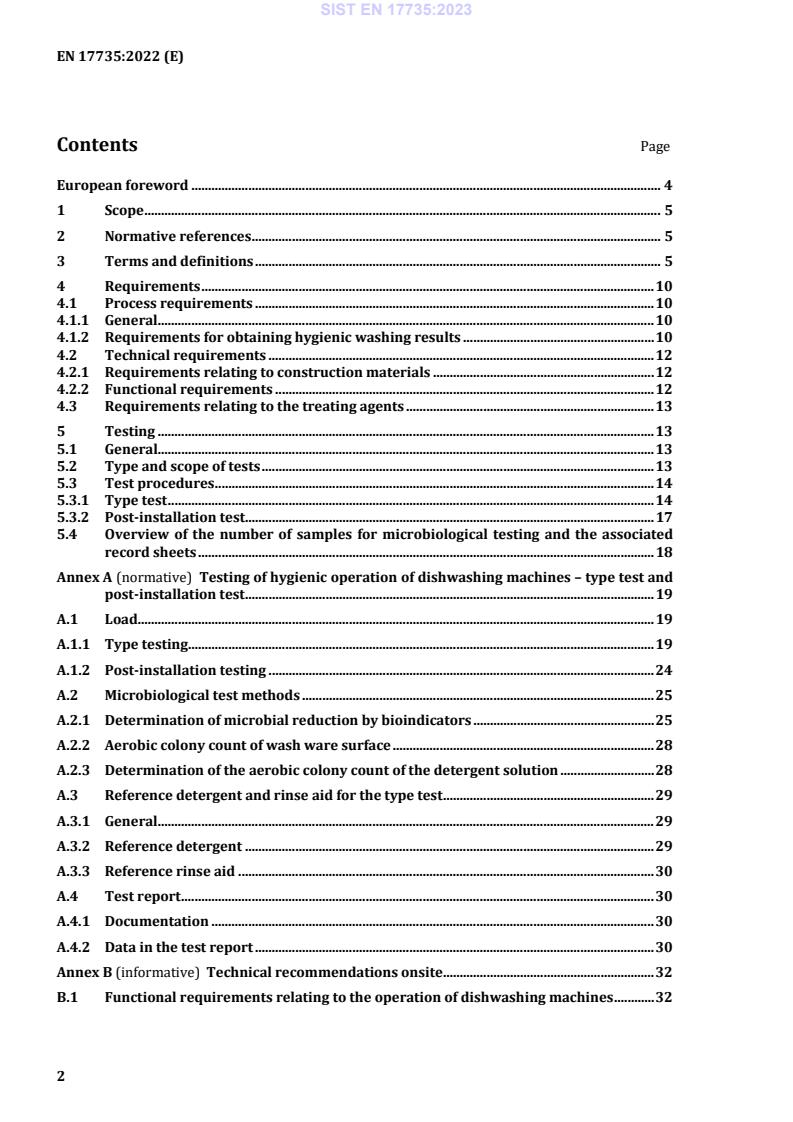
Contents Page
European foreword . 4
1 Scope . 5
2 Normative references . 5
3 Terms and definitions . 5
4 Requirements . 10
4.1 Process requirements . 10
4.1.1 General. 10
4.1.2 Requirements for obtaining hygienic washing results . 10
4.2 Technical requirements . 12
4.2.1 Requirements relating to construction materials . 12
4.2.2 Functional requirements . 12
4.3 Requirements relating to the treating agents . 13
5 Testing . 13
5.1 General. 13
5.2 Type and scope of tests . 13
5.3 Test procedures . 14
5.3.1 Type test . 14
5.3.2 Post-installation test . 17
5.4 Overview of the number of samples for microbiological testing and the associated
record sheets . 18
Annex A (normative) Testing of hygienic operation of dishwashing machines – type test and
post-installation test . 19
A.1 Load. 19
A.1.1 Type testing . 19
A.1.2 Post-installation testing . 24
A.2 Microbiological test methods . 25
A.2.1 Determination of microbial reduction by bioindicators . 25
A.2.2 Aerobic colony count of wash ware surface . 28
A.2.3 Determination of the aerobic colony count of the detergent solution . 28
A.3 Reference detergent and rinse aid for the type test . 29
A.3.1 General. 29
A.3.2 Reference detergent . 29
A.3.3 Reference rinse aid . 30
A.4 Test report . 30
A.4.1 Documentation . 30
A.4.2 Data in the test report . 30
Annex B (informative) Technical recommendations onsite . 32
B.1 Functional requirements relating to the operation of dishwashing machines . 32
B.1.1 General . 32
B.1.2 Water quality. 32
B.1.3 Temperature . 33
B.1.4 Contact time . 33
B.1.5 Requirements relating to the treating agents . 34
B.2 Testing . 35
B.2.1 General . 35
B.2.2 Type of tests and scope of testing onsite . 35
B.2.3 Daily inspection . 36
B.2.4 Periodic inspection . 36
B.2.5 Overview of the number of samples for microbiological testing and the associated
record sheets . 36
Annex C (informative) Guideline for planning, organization of the dishwashing process,
maintenance and servicing of dishwashing machines and also relating to wash ware
................................................................................................................................................................... 37
C.1 Planning of dishwashing machine facilities . 37
C.2 Organization of the dishwashing process . 38
C.2.1 Operating personnel . 38
C.2.2 Receiving of used wash ware . 38
C.2.3 Pre-cleaning and loading of dishwashing machines . 38
C.2.4 Dishwashing machine programme cycle . 38
C.2.5 Drying and preparation and storage of the wash ware for further use . 39
C.3 Maintenance and servicing . 39
C.3.1 Operational and functional safety . 39
C.3.2 Operation logbook. 39
C.3.3 Cleaning of dishwashing machine . 39
C.4 Wash ware . 40
C.4.1 General . 40
C.4.2 Shape . 40
C.4.3 Surface characteristics . 40
C.4.4 Shape and surface of drinking glasses . 40
Annex D (informative) Examples record sheets . 41
D.1 Evaluation of the determination of the surface aerobic colony count . 41
D.2 Checking the aerobic microorganism count of the detergent solution . 41
D.3 Results of inspection with bioindicators . 42
Annex E (informative) Alternative Test Method . 45
Bibliography . 46
European foreword
This document (EN 17735:2022) has been prepared by Technical Committee CEN/TC 429 “Food hygiene
- Commercial warewashing machines - Hygiene requirements and testing”, the secretariat of which is
held by DIN.
This European Standard shall be given the status of a national standard, either by publication of an
identical text or by endorsement, at the latest by June 2023, and conflicting national standards shall be
withdrawn at the latest by June 2023.
Attention is drawn to the possibility that some of the elements of this document may be the subject of
patent rights. CEN shall not be held responsible for identifying any or all such patent rights.
Any feedback and questions on this document should be directed to the users’ national standards body.
A complete listing of these bodies can be found on the CEN website.
According to the CEN-CENELEC Internal Regulations, the national standards organisations of the
following countries are bound to implement this European Standard: Austria, Belgium, Bulgaria, Croatia,
Cyprus, Czech Republic, Denmark, Estonia, Finland, France, Germany, Greece, Hungary, Iceland, Ireland,
Italy, Latvia, Lithuania, Luxembourg, Malta, Netherlands, Norway, Poland, Portugal, Republic of North
Macedonia, Romania, Serbia, Slovakia, Slovenia, Spain, Sweden, Switzerland, Türkiye and the United
Kingdom.
1 Scope
This document specifies hygiene requirements for the operation of commercial dishwashing machines
(hereinafter referred to as dishwashing machines) and the tests to be performed on these machines. It
specifies requirements for reaching an appropriate hygienic status of articles treated in the dishwashing
machines. This document also includes guidelines for the hygienic and proper operation, care and
maintenance of dishwashing machines. Furthermore, methods for testing hygienic operation are defined.
This document applies to dishwashing machines used in a professional environment for cleaning wash
ware that is used in contact with food, such as plates, crockery, glassware, cutlery, reusable boxes and
similar articles.
Dishwashing machines are used in professional kitchens, e.g. in restaurants, canteens and hospitals and
in businesses such as bakeries, butcher's shops, etc.
This document does not apply to domestic dishwashing machines, washer disinfectors for the treatment
of medical devices and machines for industrial use.
2 Normative references
The following documents are referred to in the text in such a way that some or all of their content
constitutes requirements of this document. For dated references, only the edition cited applies. For
undated references, the latest edition of the referenced document (including any amendments) applies.
EN 10088-3, Stainless steels — Part 3: Technical delivery conditions for semi-finished products, bars, rods,
wire, sections and bright products of corrosion resisting steels for general purposes
EN IEC 63136, Electric dishwashers for commercial use — Test methods for measuring the performance
(IEC 63136)
EN ISO 18593, Microbiology of the food chain — Horizontal methods for surface sampling (ISO 18593)
3 Terms and definitions
For the purposes of this document, the following terms and definitions apply.
ISO and IEC maintain terminology databases for use in standardization at the following addresses:
• ISO Online browsing platform: available at https://www.iso.org/obp
• IEC Electropedia: available at https://www.electropedia.org/
3.1
wash ware
articles and utensils that come into contact with foodstuffs and re-usable crates/containers that are
cleaned in a dishwashing machine
Note 1 to entry: Examples of wash ware are plates, crockery, cutlery, glasses, kitchen utensils, pots, containers,
crates and trays made of materials such as porcelain, plastic, glass, stainless steel and silver as well as coated
materials.
3.2
re-usable container
wash ware that is used to store and transport unpacked easily perishable foods used in a professional
environment
Note 1 to entry: The container can be a crate.
3.3
wash ware carrier
device for holding and/or supporting wash ware in the optimum orientation for cleaning
Note 1 to entry: The wash ware carrier can be e.g. racks, conveyor belts, cutlery trays.
3.4
dishwashing machine
appliance that is specially designed for use in professional environments and that cleans and rinses
plates, glasses, cutlery, and, in some cases, cooking utensils by chemical, mechanical and thermal means
3.4.1
batch dishwashing machine
dishwashing machine, in which the wash ware carrier loaded with wash ware stays in the same treatment
zone during the cleaning process
Note 1 to entry: A distinction is made between the following machine designs:
— dishwashing machine in which recirculated detergent solution is used for the detergent circulation process
and fresh water is used for the fresh water rinsing; the fresh water rinsing circuit is separate from the detergent
circulation circuit;
— dishwashing machine in which fresh water is used in each detergent circulation or rinsing process; the rinsing
circuit is not necessarily separate from the detergent circulation circuit.
Note 2 to entry: Batch-type dishwashing machines can be loaded with one or more racks at the same time.
3.4.2
conveyor dishwashing machine
dishwashing machine in which the wash ware carriers loaded with wash ware are automatically
conveyed through the machine during the cleaning process
Note 1 to entry: A distinction is made between the following machine designs:
— rack conveyor dishwashing machine; dishwashing machine in which racks loaded with wash ware are
conveyed through the machine automatically by a rack transporting system;
— flight conveyor dishwashing machine; dishwashing machine in which the wash ware is conveyed through the
machine automatically on an endless conveyor.
Note 2 to entry: Conveyor type dishwashing machines can include different treatment zones. Zones are for
example prewash zone, detergent circulation zone and fresh water rinsing zone.
3.5
treating agent
product used to clean and/or sanitize and/or rinse and/or descale wash ware in dishwashing machines
Note 1 to entry: Examples of treating agents are: detergent, rinse aid and granules.
3.5.1
detergent
chemical product used to remove soil from wash ware and which prevents re-contamination of the wash
ware by soil in the detergent solution
Note 1 to entry: A detergent can also improve the sanitisation process.
3.5.2
detergent solution
water mixed with detergent used for the detergent circulation process
3.5.3
rinse aid
chemical product added to the water in the final rinsing operation which decreases the surface tension
of the rinse aid solution
Note 1 to entry: Rinse aid can also improve drying and reduce water spots on wash ware.
3.5.4
rinse aid solution
fresh water mixed with rinse aid used for fresh water rinsing
3.5.5
soaking agent
special detergent used in pre-soaking tanks outside the dishwashing machine to remove e.g. stubborn
soil from wash ware
3.5.6
descaling agent
chemical product used to remove lime-scale, mixed lime, calcium or magnesium phosphate deposits in
the dishwashing machine and on the wash ware
3.5.7
granules
particles, e.g. of plastic, which are added to the detergent solution to assist the mechanical cleaning effect
3.6
fresh water
untreated or treated water which, from the microbiological point of view, is of drinking water quality,
contains no substances that are harmful to health, and is used to supply the dishwashing machine
3.7
treated water
water which has been subjected to a treatment process to modify its ingredients
Note 1 to entry: A distinction is made between processes for softening the water and processes for reducing the
overall salt content
3.7.1
softened water
water from which the hardness ions or minerals have been removed in a water softener by cation
exchange processes without any reduction in the overall salt content
Note 1 to entry: The precipitation of water-insoluble salts is prevented.
3.7.2
demineralized water
water from which the salt content has been removed
Note 1 to entry: For example, by ion exchange or reverse osmosis processes.
3.8
pre-cleaning
removing loose scraps and food residues from the wash ware and emptying hollow vessels
Note 1 to entry: Pre-cleaning is normally carried out by wiping off the residues into waste containers and - if
possible - by rinsing the wash ware with warm water (max. 35 °C). Pre-cleaning reduces the amount of soiling
entering the dishwashing machine.
3.9
detergent circulation
process during which the detergent solution, which is kept heated to the nominal temperature, is
circulated and sprayed onto the surface of the wash ware to remove the soil
3.10
auxiliary rinsing
circulation rinsing upstream to fresh water rinsing, in which no detergent is dosed
3.11
fresh water rinsing
process after detergent circulation, during which the wash ware is sprayed with rinse aid solution in
order to remove residues of detergent solution, dissolved and undissolved soil particles
3.12
drying
process during which the moisture drips or evaporates from the surface of the wash ware
3.13
cleaning process
process including at least one detergent circulation process and one fresh-water rinsing process
3.14
sanitisation
chemical and/or physical process that reduces microorganisms to a level which is neither harmful to
health nor impairs the quality of foodstuffs
3.15
re-contamination
soiling of the wash ware between the end of the cleaning process and the preparation for further use
which causes deterioration of the cleaning result
3.16
contact time
time during which the detergent solution impacts the wash ware
Note 1 to entry: For conveyor-type machines the contact time commences from the centre of first prewash nozzle
and extends until the centre of the first fresh water rinse nozzle. For batch type dishwashing machines, the contact
time commences upon start of the detergent circulation and lasts until the start of the fresh water rinsing.
3.17
operating time
period during which the dishwashing machine is operational
3.18
spray system
sum of all pipelines, jets and spray pipes required to circulate and spray detergent and rinse aid solutions
3.19
interior
all parts of the dishwashing machine which come into contact with detergent solution, rinse aid solution
or the wash ware during the cleaning process as intended
3.20
exterior
all parts of the dishwashing machine which do not come into contact during the cleaning process with
detergent solution and rinse aid solution (e.g. pedestals, adjustable feet, handles, casing) but which are
accessible from outside
3.21
bioindicator
standardised test object meant to be contaminated with a test soiling media and a test microorganism
and is used to check the sanitisation performance of dishwashing machines
Note 1 to entry: Examples are stainless steel bioindicators.
3.22
operating company
company who actually uses the appliance to clean wash ware within its own activity
Note 1 to entry: Examples are the operators of restaurants or canteens.
3.23
hygiene requirement
condition of the wash ware which is neither harmful to health nor impairs the quality of foodstuffs
3.24
programme
series of operations that are pre-defined within the dishwashing machine and that are declared by the
manufacturer as suitable for cleaning certain wash ware
Note 1 to entry: Programme time, conveyer speed and temperatures are examples of main parameters which
define a programme.
Note 2 to entry: If there is no end of programme indicator, the programme time is equal to the cycle time.
3.25
cycle
complete cleaning process, as defined by the programme selected, consisting of a series of operations
(detergent circulation, fresh water rinsing, drying, etc.) and including any operations that occur after the
completion of the programme
Note 1 to entry: Examples of operations that can occur after the completion of the programme are refilling of the
boiler, heating, operation of pumps and fans.
4 Requirements
4.1 Process requirements
4.1.1 General
Each cleaning process as well as the resultant cleanliness and the hygienic condition of the wash ware
are determined by the interaction of several main factors:
— temperature of all process steps;
— contact time;
— treating agents;
— mechanics;
— design and interior shape of the wash ware;
— rinsing;
— drying.
4.1.2 Requirements for obtaining hygienic washing results
General requirements are:
a) The wash ware shall be visually clean under practical conditions at the customers' side.
b) The wash ware shall be dry upon removal from the wash ware carriers, with remaining droplets on
the supporting points and residual moisture in the interior of hollow articles being tolerated.
c) The machine shall lead, under test conditions (see 5.3.1.2), to a level of hygienic performance in
accordance with the requirements as specified in Table 1.
d) Treating agents used in the cleaning process shall be removed from the wash ware to a level that is
not harmful to health.
NOTE For further information see Annex B and Annex C.
Table 1 — Hygienic Performance
Microbiological requirements
Type of test Test object Criteria Requirement Test method
Bioindicators in the Bacterial In the cutlery tray: according to
cutlery tray, on test reduction A.2.1
Minimum 7 out of
plates
8 bioindicators shall
show a minimum
reduction of 5-log
a
levels ;
None of the
bioindicators shall
show a reduction
a
below 4-log levels .
On test plates:
Minimum 90 % of
the
Type test
bioindicators shall
show a minimum
reduction of 5-log
a
levels ;
None of the
bioindicators shall
show a reduction
a
below 4-log levels .
Bioindicators in the Bacterial All 10 bioindicators according to
test rack reduction shall show a A.2.1
minimum reduction
a
of 5-log levels .
b 2
Wash ware except Aerobic colony Contact plate
≤5 cfu per 10 cm
of re-usable count method
Post-
crates/containers according to
installation
made of plastic A.2.2
test
b
Detergent solution Aerobic colony according to
<500 cfu /ml
count A.2.3
a
Log levels are expressed as logarithms (base 10).
b
cfu: colony forming units.
4.2 Technical requirements
4.2.1 Requirements relating to construction materials
In terms of hygiene, the materials used shall be serviceable, scratch-proof, ageing-resistant and
corrosion-resistant under normal conditions of use. These conditions are:
— in the interior: contact with food remnants, detergents, disinfectants and rinse aids, descaling agent
solutions and hot air;
— on the exterior: contact with water, cleaning agents, disinfectants and care products.
4.2.2 Functional requirements
4.2.2.1 General
It shall be possible to place the wash ware easily into the wash ware carriers and the wash ware carriers
in the intended optimum position.
4.2.2.2 Temperature control
To ensure that the nominal temperature range has been reached, an indication (e.g. lamp, display
information) is required. Alternatively, the machine controls shall be designed so that the machine can
start operating only when the nominal temperature range is reached. In the intended range of
temperatures, the measurement instruments shall have an uncertainty of measurements of ± 3 K. This
can be temperature in tanks, zones, boilers.
The operation of a dishwashing machine requires a constant supply of energy. It is principally not
permissible to switch off heating elements temporarily to avoid electrical peak loads (operation at partial
load) as this would involve a reduction of the temperature.
Additional recommendations are given in Annex B.
4.2.2.3 Programme
Dishwashing machines usually have several programmes with different contact times.
At least one programme shall ensure that the requirements specified in 4.1.2 are fulfilled and it shall be
in accordance to 5.3.1.2.2.
4.2.2.4 Dosing
Correct dosing of the detergent and rinse aid into the detergent and rinse aid solutions shall be ensured
at any time.
NOTE Automatic dosing equipment is a good possibility for providing a correct dosing.
4.2.2.5 Design
Effective distribution of detergent solution and rinse aid solution to the wash ware shall be ensured.
All parts which have to be removed for cleaning (e.g. strainers and parts of the spray system) shall be
removable without use of tools and easily accessible. The removal and the reposition of the parts shall be
done according to the manufacturer’s instruction.
NOTE Additional information is given in Annex C.
4.3 Requirements relating to the treating agents
If treating agents are used they shall be used according to the manufacturers' instructions.
NOTE Additional information is given in the Annex B.
5 Testing
5.1 General
The dishwashing machine manufacturer’s instructions regarding installation and use of the dishwashing
machines shall be followed, except if they stand in conflict to this document. In this case, this document
shall prevail.
The dishwashing machine shall be checked to ensure that it is operating correctly before measurements
are made. All tests shall be started with the appliance at the conditions in accordance with 5.3.1.2.
The test materials specified in A.1 shall be used.
The following tests, which differ in scope, shall be carried out to check the hygienic results of the articles
treated in the dishwashing machine:
Types of test:
— type test;
— post-installation test.
Additional test method is under consideration (see Annex E).
5.2 Type and scope of tests
The individual types of test and the scope of testing can be found in Table 2.
Table 2 — Types of test and scope of testing
Type of test Area of application Test Methods/checks
a
Type test (arranged by Machines in series production
— Temperature check
manufacturer)
— Check of dosing/concentration of
a
treating agents
— Tests with bioindicators
— Visual inspection of cleanliness and
dryness of the wash ware
a
Post-installation test Customised machines after
— Temperature check
(arranged by the installation under practical
— Check of dosing/concentration of
operating company) conditions
a
treating agents
— Incoming fresh water quality check
— Determination of the aerobic colony
count of the wash ware surface
— Microbiological testing of the
detergent solution
— Visual inspection of cleanliness and
dryness of the wash ware
a
According to information/specification given by the manufacturer of the machine and/or the treating
agents.
5.3 Test procedures
5.3.1 Type test
5.3.1.1 General
The purpose of the type test is to verify the hygienic results of the articles treated depending on the main
use of the dishwashing machine .
5.3.1.2 General conditions for measurements
5.3.1.2.1 Electricity supply
The dishwashing machine shall be supplied at the rated voltage ±2 % and this shall be maintained at the
appliance's terminal throughout the test.
The supply frequency shall be at the rated frequency ±1 %.
If the appliance has a rated voltage range and/or a frequency range, then the test voltage and/or
frequency shall be the nominal voltage and/or frequency of the country in which the dishwashing
machine is intended to be used.
5.3.1.2.2 Test programme
The programme to be tested shall be the one that cleans normally soiled wash ware (standard cleaning
programme).
The manufacturer shall declare the programme to be used for testing.
For dishwashing machines in the scope of EN IEC 63136, the programme for the test shall be the one used
for the EN IEC 63136 performance test.
5.3.1.2.3 Ambient conditions
The following ambient conditions shall be maintained throughout the measurements:
— ambient temperature of the room: (23 ± 2) °C;
— relative humidity: (55 ± 5) % RH.
5.3.1.2.4 Water supply
a) Water supply – Hardness
If the dishwashing machine is fitted with an integrated water softening unit, it shall be deactivated (set
to soft water supply). During testing, soft water shall have a total hardness of
(Ca2+ + Mg2+) < 0,54 mmol/l.
b) Water supply – Pressure
The flow pressure of the water supply shall be set to 240 kPa and shall be maintained within the range
±20 kPa. If it is not possible to maintain the pressure within this range, a flow rate of (15 ± 2) l/min shall
be maintained.
The method described below deals with a test method for commercial dishwashing machines used primarily
for washing plates and cutlery. As future projects it is planned to develop test methods for commercial
dishwashing machines used primarily for washing glasses or re-usable crates and containers.
5.3.1.2.5 Detergent
The reference detergent described in A.3 shall be used for the tests.
The concentration shall be (3 ± 0,3) g/l for the tests.
The amount of detergent shall be calculated by the given concentration and the measured water
consumption of the previous operation.
The detergent shall be added by hand directly into the wash chamber except for conveyor machines.
The detergent used during the tests shall all be from the same batch. The detergent shall be stored and
handled in accordance with the detergent manufacturer's specifications.
5.3.1.2.6 Rinse aid
The reference rinse aid described in A.3 shall be used for the tests.
The dosing of the rinse aid shall be done in accordance with the rinse aid manufacturer’s instructions.
The concentration of the rinse aid shall be set in accordance with the rinse aid manufacturer’s
instructions.
The rinse aid used during the tests shall all be from the same batch. The rinse aid shall be stored and
handled in accordance with the rinse aid manufacturer's specifications.
5.3.1.2.7 Load
The load is the relevant wash ware carrier, with the appropriate wash ware items (see A.1.1). The wash
ware carrier shall be filled in accordance with the manufacturer’s instructions.
5.3.1.3 Procedure for batch-type dishwashing machines
5.3.1.3.1 Conditioning of the machine
For the conditioning of the machine the load is the relevant load according to A.1.1.2 but without
bioindicators.
Switch on the dishwasher and wait until it has reached the ready-to-use mode and all energy-consuming
elements are inactive.
Load the machine, close the door/hood and start the first programme cycle.
After the machine is indicating the end of the programme, wait until all energy-consuming elements are
inactive.
Open door/hood and keep it open for 30 s to unload and load and add detergent.
Close door/hood and start the next conditioning cycle immediately.
After the 3rd conditioning cycle, unload the machine and close the door/hood.
Wait until the dishwasher is in the ready-to-use mode and all energy-consuming elements are inactive.
The test shall now be started within 5 min.
5.3.1.3.2 Test with the bioindicators
For the test the load is the relevant load according to A.1.1.2.
Open door/hood and keep it open for 30 s to load the machine.
Load the machine, close the door/hood and start the first programme cycle.
After the machine is indicating the end of the programme, open door/hood and keep it open for 30 s to
unload the machine.
Unload the machine. Close the door/hood and wait until all energy-consuming elements are inactive.
Open door/hood and keep it open for 30 s to add detergent and load the next rack previously prepared
for the second cycle.
Close door/hood and start the programme cycle immediately.
Open door/hood and unload the machine.
After each of the two cycles process the bioindicator as detailed in procedure A.2.1.4.
After the completion of the test, follow procedure 5.3.1.6 to decontaminate the machine.
5.3.1.4 Procedure for conveyor-type dishwashing machines
5.3.1.4.1 Conditioning of the machine
Switch on the dishwasher and wait until it has reached the ready-to-use mode and all energy-consuming
elements are inactive.
The dosing of chemical treating agents shall be carried out using a suitable dosing device according to
manufacturer’s instructions.
Start the dishwashing machine and run it for a time of 5 min.
During this time all pumps and all other equipment relevant for the cleaning process shall be activated
by continuously running empty racks or similar suitable means.
The test shall now be started within 5 min.
5.3.1.4.2 Test with the bioindicators
For the test the load is the relevant load according to A.1.1.2.
Load the machine and start the first cycle.
After the first load has left the machine start the second cycle.
Unload the machine.
After each of the two cycles process the bioindicator as detailed in procedure A.2.1.4.
After the completion of the test, follow procedure 5.3.1.6 to decontaminate the machine.
5.3.1.5 Test results
The results of the type test shall be presented in a test report complying with A.4 (see Annex D for record
sheets examples); for evaluation criteria see Table 1
5.3.1.6 Dishwashing machine decontamination procedure
Add an active chlorine-based chemical to the detergent solution, to achieve a concentration of at least
10 mg/l of active chlorine. Then decontaminate the machine by running it for a complete cycle. Then
drain off the detergent solution and refill the machine with water. When the set temperature has been
achieved, run for another full cycle and empty the tank.
5.3.2 Post-installation test
5.3.2.1 General
The purpose of the post-installation test, arranged by the operating company, is to verify that the hygienic
results of the articles treated in the dishwashing machines, if operated in accordance with the
manufacturer’s instructions.
The post-installation test consists of:
— the aerobic colony count of the wash ware surface;
— the aerobic colony count of the detergent solution.
All the wash ware tested shall be given a visual inspection for cleanliness and dryness. The wash ware
shall be externally dry when removed from the wash ware carriers, water droplets on the supporting
points and residual moisture in the interior of hollow articles are acceptable
NOTE For further information see Annex B and Annex C.
5.3.2.2 General conditions for measurements
5.3.2.2.1 Test programme
The standard cleaning programme, suitable for normally soiled wash ware, shall be used for the test.
The manufacturer shall declare the programme to be used for testing.
For dishwashing machines included in the scope of EN IEC 63136, the programme to be tested shall be
the one that is used in performance test according to EN IEC 63136.
5.3.2.2.2 Water supply
Fresh water supplying the machine should fulfil the manufacturer’s instructions.
Water hardness can cause deposits in the machine and on the wash ware. To avoid these deposits the
incoming water shall be suitably treated (e.g. softened or fully demineralized).
5.3.2.2.3 Chemical treating agents
The chemical treating agents shall be chosen taking into account the fresh water quality.
Chemical treating agents shall be used according to the treating agents’ manufacturers’ instruction.
5.3.2.2.4 Load
The load is the relevant wash ware carrier, with the appropriate wash ware items (see A.1.2).
The wash ware carrier shall be filled in accordance with the manufacturer’s instructions.
5.3.2.3 Procedure
5.3.2.3.1 Conditioning of the machine
The test shall be carried out during the main operating period, at the earliest after the dishwashing
machine has been operating fully loaded for at least 0,5 h or after at least three wash cycles.
5.3.2.3.2 Aerobic colony count of the surface of the wash ware (see A.2.2)
The aerobic colony count shall be determined using the contact plate method as specified in
EN ISO 18593. At least ten wash ware items according to A.1.2 shall be used for this purpose.
5.3.2.3.3 Determination of the aerobic microorganism count of the detergent solution
The aerobic colony count of the detergent solution shall be determined according to A.2.3.
5.3.2.4 Test results
The results of the post-installation test shall be evaluated in a test report according to A.4 (see Annex D
for record sheets examples); evaluation criteria are listed in Table 1.
5.4 Overview of the number of samples for microbiological testing and the associated
record sheets
Table 3 gives an overview of the number of microbiological test samples (bioindicators), depending on
the test object with details of the requirements, methods and record sheets.
Table 3 — Number of microbiological test samples/bioindicators
Test object Test with Number of samples Requirements, methods
bioindicators Type test and record sheet
Batch-type Bioindicator in the 2 x 8 Table 1
cutlery tray
and rack conveyor 5.3.1
dish-washing A.1.1
machine D.3.1
Bioindicator on test 1 x number of plates Table 1
plates depending on loading
5.3.1
A.1.1
D.3.2
Flight conveyor dish- Bioindicator in the 2 x 8 Table 1
washing machine cutlery tray
5.3.1
A.1.1
D.3.1
Bioindicator in the 1 x 10 Table 1
test rack
5.3.1
A.1.1
D.3.3
Table 4 gives an overview of the number of microbiological test samples/surface aerobic colony count
samples, depending on the test object for the post-installation test with details of the requirements,
methods and record sheets.
Table 4 — Number of samples for microbiological tests/surface aerobic colony count
Test object Surface aerobic colony Number of samples Requirements,
count test Post-installation test methods and
record sheets
Wash ware (except Aerobic colony count 10 A.2.2
re-usable D.1
crates/container
Table 1
made of plastic)
Annex A
(normative)
Testing of hygienic operation of dishwashing machines – type test and post-
installation test
A.1 Load
A.1.1 Type testing
A.1.1.1 General
The load is the appr
...