

oSIST prEN 1127-1:2025
(Main)Explosive atmospheres - Explosion prevention and protection - Part 1: Basic concepts, methodology and design
- Abstract
This document specifies methods for the identification and assessment of hazardous situations leading to explosion and the design and construction measures appropriate for the required safety. This is achieved by:
— risk assessment;
— risk reduction.
The safety of equipment, protective systems and components can be achieved by eliminating hazards and/or limiting the risk, i.e. by steps (figure below from ISO EN 12100):
a) appropriate design (without using safeguarding) – Step 1;
b) safeguarding – Step 2;
c) information for use – Step 3;
d) any other preventive measures.
In this standard the measures in accordance with
a) (prevention) and
b) (protection) against explosions are dealt with in Clause 6.
The measures according to
c) against explosions are dealt with in Clause 7.
Measures in accordance with d) are not specified in this standard.
Refer to EN ISO 12100:2010 for complementary preventive and protective measures
Inherently safe design measures are the first and most important step in the risk reduction process. This is because protective measures inherent to the characteristics of the product or system are likely to remain effective, whereas experience has shown that even well-designed guards and protective devices can fail or be violated, and information for use might not be followed.
Guards and protective devices shall be used whenever an inherently safe design measure does not reasonably make it possible either to remove hazards or to sufficiently reduce risks. Complementary protective measures involving additional equipment (e.g. emergency stop equipment) might have to be implemented.
The end user has a role to play in the risk reduction procedure by complying with the information provided by the designer/supplier. However, information for use shall not be a substitute for the correct application of inherently safe design measures, guards or complementary protective measures.
The preventive and protective measures described in this document will not provide the required level of safety unless the equipment, protective systems and components are operated within their intended use and are installed and maintained according to the relevant codes of practice or requirements.
This document specifies general design and construction methods to help designers and manufacturers in achieving explosion safety in the design of equipment, protective systems and components.
This document is applicable to any equipment, protective systems and components intended to be used in potentially explosive atmospheres, under atmospheric conditions. These atmospheres can arise from flammable/combustible substances processed, used or released by the equipment, protective systems and components or from materials in the vicinity of the equipment, protective systems and components and/or from the materials of construction of the equipment, protective systems and components.
This document is applicable to equipment, protective systems and components at all stages of its use.
This document is only applicable to equipment group II which is intended for use in other places than underground parts of mines and those parts of surface installations of such mines endangered by firedamp and/or combustible dust.
- Status
- Not Published
- Public Enquiry End Date
- 29-Sep-2025
- Technical Committee
- EXP - Product for explosive atmospheres
- Current Stage
- 4020 - Public enquire (PE) (Adopted Project)
- Start Date
- 16-Jul-2025
- Due Date
- 03-Dec-2025
- Completion Date
- 09-Oct-2025

oSIST prEN 1127-1:2025 is the Slovenian standard identical to the CEN draft European Standard prEN 1127-1:2025, published by SIST. It gives basic concepts, methodology, and design guidance for explosion prevention and protection in potentially explosive atmospheres, for designers, manufacturers, users, and maintenance staff.
The document tells you how to identify explosion hazards, assess the risk, and choose design, construction, and use measures for equipment, protective systems, and components. It is written for equipment in group II, used under atmospheric conditions outside underground mines.
What does oSIST prEN 1127-1:2025 specify?
oSIST prEN 1127-1:2025 specifies methods for identifying and assessing hazardous situations that can lead to explosion, and for selecting design and construction measures to achieve the required safety. It covers risk assessment, risk reduction, and information for use.
The standard applies to equipment, protective systems, and components at all stages of use when they are intended for potentially explosive atmospheres. It is also limited to equipment group II, which means it is for locations other than underground parts of mines and the endangered surface parts of such mines.
The document is organized into seven clauses plus annexes.
| Annex | What it covers |
|---|---|
| Annex A | Information for the use of tools in potentially explosive atmospheres |
| Annex B | Tightness of equipment, including normal tightness and enhanced tightness |
| Annex C | Normative verification procedure for the threshold limit of ultrasound in liquids |
| Annex D | Significant technical changes compared with EN 1127-1:2019 |
| Annex ZA | Relationship with Directive 2014/34/EU |
| Annex ZB | Relationship with Regulation 2023/1230 |
What are the key requirements of oSIST prEN 1127-1:2025?
The core message of oSIST prEN 1127-1:2025 is that explosion safety starts with risk assessment and then moves through risk reduction in a defined order. In practice, the designer must first try to avoid a hazardous explosive atmosphere, then avoid effective ignition sources, and only then limit explosion effects if the first two steps are not enough.
Risk assessment has to be documented
Clause 4 requires a documented risk assessment, using EN ISO 12100:2010 and, for non-electrical equipment, EN 15198:2007 where appropriate. For products with their own potential ignition sources intended for explosive atmospheres, ignition hazard assessment is carried out according to EN ISO 80079-36:2016.
This matters because the standard does not treat explosion safety as a single test or label. It requires the user to look at the whole hazard chain: where the explosive atmosphere can come from, what can ignite it, and what the consequences would be.
The assessment must cover hazards, ignition, effects, and misuse
Clause 4 requires the assessment of explosion hazards, ignition hazards, the possible effects of an explosion, and whether the intended level of protection has been achieved. It also requires consideration of intended use, reasonably foreseeable misuse, severity of harm, number of exposed persons, duration of exposure, and the feasibility of avoiding harm.
In practice, this means the engineer cannot stop at normal operation. Start-up, shut-down, malfunction, and predictable misuse have to be considered when deciding whether the design is safe enough.
Hazardous atmosphere avoidance comes before protection measures
Clause 6 sets the prevention sequence. The first choice is to reduce or avoid the hazardous explosive atmosphere, for example by limiting flammable substance concentration, reducing oxygen, inerting, or limiting releases. The next step is to avoid effective ignition sources, and only after that to reduce explosion effects.
This order matters because inherent safety is more reliable than add-on protection. The standard explicitly points out that information for use cannot replace good design, guards, or other protective measures.
Clause 6 links design measures to specific hazard types
Clause 6 and Clause 5 cover the main ignition sources and corresponding design measures: hot surfaces, flames and hot gases, mechanical impact and friction, electrical equipment, stray currents, static electricity, lightning, radio frequency (RF) electromagnetic waves, electromagnetic waves, ionizing radiation, ultrasonic waves, adiabatic compression and shock waves, and exothermic reactions.
For a buyer or designer, this means the document is not generic advice. It points you to the hazard family that matches your equipment and asks you to control that specific ignition route by design, construction, monitoring, or operating limits.
Hazardous area classification and tightness are part of the decision
Clause 6.3 ties the extent of ignition-source protection to the frequency and duration of a hazardous explosive atmosphere. It points to EN IEC 60079-10-1 and EN IEC 60079-10-2 for hazardous area classification, and Annex B explains how equipment tightness affects release and area formation.
That matters in practice because the same machine can need different protection depending on whether it is a source of release itself, how often leakage can occur, and whether the atmosphere is gas, vapor, mist, or dust.
Explosion effects, emergency measures, and monitoring are covered
Clause 6.5 allows explosion-resistant design, venting, suppression, isolation, flame arresters, flameless venting, diverters, and isolation flap valves when avoidance is not enough. Clause 6.6 adds emergency shutdown, emptying, flow isolation, and flooding as possible emergency measures. Clause 6.7 connects these measures to measuring and control systems, including gas detection.
In practice, this is the part used when the designer must show how an explosion will be limited or how the plant will move to a safe state.
Information for use is part of the safety system
Clause 7 requires instructions for intended use, limits, commissioning, maintenance, repair, cleaning, fault handling, testing, and training. It also expects the instructions to state the equipment group and category, and to identify any explosion-protection parameters or supporting systems.
This is important because the standard treats safe operation and maintenance as part of explosion safety, not as an afterthought.
What terms does oSIST prEN 1127-1:2025 define?
- Explosive atmosphere - A mixture with air, under atmospheric conditions, of flammable substances in which ignition can spread through the whole unburned mixture.
- Equipment - Machines, apparatus, devices, control components, instrumentation, and detection or prevention systems that can cause an explosion through their own ignition sources.
- Risk assessment - The overall process of risk analysis and risk evaluation.
- Residual risk - The risk that remains after protective measures have been implemented.
- Normal tightness - A condition where testing or monitoring does not reveal hazardous leakage during normal operation.
- Enhanced tightness - A tighter condition where design and maintenance keep hazardous leakage from being expected in normal operation and expected malfunctions.
- Inherently safe design measure - A protective measure that removes a hazard or reduces risk by changing the design or operating characteristics.
- Reasonably foreseeable misuse - Use that was not intended by the designer but can be expected from predictable human behavior.
Who uses oSIST prEN 1127-1:2025?
oSIST prEN 1127-1:2025 is used by designers, manufacturers, integrators, safety engineers, quality managers, buyers, and maintenance teams who work with equipment in explosive atmospheres. It is also useful to users who have to choose suitable equipment and operating rules for a workplace.
The introduction names typical sectors and sites where it is used, including fuel stations, oil refineries, chemical and pharmaceutical plants, hydrogen, ammonia, and methanol applications, painting and surface coating, gas infrastructure, HVAC with flammable refrigerants, grain handling, woodworking, sugar refining, food industries, and metal grinding with combustible dusts.
What changed in oSIST prEN 1127-1:2025 from the previous edition?
oSIST prEN 1127-1:2025 will supersede EN 1127-1:2019. Annex D identifies the main technical changes, including:
- the title now includes design, to reflect construction measures as well as basic concepts
- the foreword updates the EN and IEC references
- the scope wording is clarified for consistency with a type B standard
- the introduction adds clearer application examples across industry sectors
- the risk-assessment wording and flowcharts are updated to align with ISO/IEC Guide 51 and EN ISO 12100
- the terminology section is expanded and aligned with directive and standards vocabulary
- Clause 5.13.2 adds thermal runaway of cells and battery (Lithium)
- Clause 6.1 is reorganized for clearer presentation of the prevention and protection sequence
Which standards are used with oSIST prEN 1127-1:2025?
| Standard | What it contributes |
|---|---|
| EN 13237:2024 | Core terms and definitions for potentially explosive atmospheres |
| EN 15198:2007 | Risk assessment method for non-electrical equipment |
| EN IEC 60079-0:2018 | General requirements for electrical equipment in explosive atmospheres |
| EN IEC 60079-14:2024 | Electrical installation design, selection, installation, and initial inspection |
| EN IEC 60079-17:2024 | Electrical inspection and maintenance |
| EN 60079-29 series | Flammable gas detection performance, selection, use, and functional safety |
| EN ISO 12100:2010 | General risk assessment and risk reduction principles |
| EN ISO 80079-36:2016 | Basic method and requirements for non-electrical equipment |
| ISO Guide 51:2014 | Safety principles used in standard writing |
| ISO 26142:2010 | Stationary hydrogen detection apparatus |
The text also points to EN IEC 60079-10-1 and EN IEC 60079-10-2 for hazardous area classification, and to EN ISO 80079-37, EN 14460, EN 14797, EN 14373, EN 15089, EN ISO 16852, EN 14491, EN 14994, EN 16009, EN 16020, EN 16447, and EN IEC 62127-1 for specific protection and verification methods.
What does the oSIST prEN 1127-1:2025 document contain?
The document contains clauses that walk through the whole explosion-safety process, from identifying hazards to selecting prevention and protection measures. It also contains figures for the iterative risk-assessment process, examples of explosion behavior, and examples of equipment/category marking.
Annex A gives practical guidance for tool use in hazardous areas, Annex B explains tightness classes and leakage behavior, and Annex C gives a normative ultrasound verification procedure with calculation and measurement routes. Annex D summarizes the changes from EN 1127-1:2019, while Annex ZA and Annex ZB connect the standard to EU legislation.
Relations
- Effective Date
- 09-Aug-2023
Get Certified
Connect with accredited certification bodies for this standard

CIS Institut d.o.o.
Personal Protective Equipment (PPE) certification body. Notified Body NB-2890 for EU Regulation 2016/425 PPE.

Kiwa BDA Testing
Building and construction product certification.
Kmetijski inštitut Slovenije
Agricultural Institute of Slovenia. Soil testing, plant health, agricultural product analysis.
Sponsored listings
Frequently Asked Questions
oSIST prEN 1127-1:2025 is a draft published by the Slovenian Institute for Standardization (SIST). Its full title is "Explosive atmospheres - Explosion prevention and protection - Part 1: Basic concepts, methodology and design". This standard covers: This document specifies methods for the identification and assessment of hazardous situations leading to explosion and the design and construction measures appropriate for the required safety. This is achieved by: — risk assessment; — risk reduction. The safety of equipment, protective systems and components can be achieved by eliminating hazards and/or limiting the risk, i.e. by steps (figure below from ISO EN 12100): a) appropriate design (without using safeguarding) – Step 1; b) safeguarding – Step 2; c) information for use – Step 3; d) any other preventive measures. In this standard the measures in accordance with a) (prevention) and b) (protection) against explosions are dealt with in Clause 6. The measures according to c) against explosions are dealt with in Clause 7. Measures in accordance with d) are not specified in this standard. Refer to EN ISO 12100:2010 for complementary preventive and protective measures Inherently safe design measures are the first and most important step in the risk reduction process. This is because protective measures inherent to the characteristics of the product or system are likely to remain effective, whereas experience has shown that even well-designed guards and protective devices can fail or be violated, and information for use might not be followed. Guards and protective devices shall be used whenever an inherently safe design measure does not reasonably make it possible either to remove hazards or to sufficiently reduce risks. Complementary protective measures involving additional equipment (e.g. emergency stop equipment) might have to be implemented. The end user has a role to play in the risk reduction procedure by complying with the information provided by the designer/supplier. However, information for use shall not be a substitute for the correct application of inherently safe design measures, guards or complementary protective measures. The preventive and protective measures described in this document will not provide the required level of safety unless the equipment, protective systems and components are operated within their intended use and are installed and maintained according to the relevant codes of practice or requirements. This document specifies general design and construction methods to help designers and manufacturers in achieving explosion safety in the design of equipment, protective systems and components. This document is applicable to any equipment, protective systems and components intended to be used in potentially explosive atmospheres, under atmospheric conditions. These atmospheres can arise from flammable/combustible substances processed, used or released by the equipment, protective systems and components or from materials in the vicinity of the equipment, protective systems and components and/or from the materials of construction of the equipment, protective systems and components. This document is applicable to equipment, protective systems and components at all stages of its use. This document is only applicable to equipment group II which is intended for use in other places than underground parts of mines and those parts of surface installations of such mines endangered by firedamp and/or combustible dust.
This document specifies methods for the identification and assessment of hazardous situations leading to explosion and the design and construction measures appropriate for the required safety. This is achieved by: — risk assessment; — risk reduction. The safety of equipment, protective systems and components can be achieved by eliminating hazards and/or limiting the risk, i.e. by steps (figure below from ISO EN 12100): a) appropriate design (without using safeguarding) – Step 1; b) safeguarding – Step 2; c) information for use – Step 3; d) any other preventive measures. In this standard the measures in accordance with a) (prevention) and b) (protection) against explosions are dealt with in Clause 6. The measures according to c) against explosions are dealt with in Clause 7. Measures in accordance with d) are not specified in this standard. Refer to EN ISO 12100:2010 for complementary preventive and protective measures Inherently safe design measures are the first and most important step in the risk reduction process. This is because protective measures inherent to the characteristics of the product or system are likely to remain effective, whereas experience has shown that even well-designed guards and protective devices can fail or be violated, and information for use might not be followed. Guards and protective devices shall be used whenever an inherently safe design measure does not reasonably make it possible either to remove hazards or to sufficiently reduce risks. Complementary protective measures involving additional equipment (e.g. emergency stop equipment) might have to be implemented. The end user has a role to play in the risk reduction procedure by complying with the information provided by the designer/supplier. However, information for use shall not be a substitute for the correct application of inherently safe design measures, guards or complementary protective measures. The preventive and protective measures described in this document will not provide the required level of safety unless the equipment, protective systems and components are operated within their intended use and are installed and maintained according to the relevant codes of practice or requirements. This document specifies general design and construction methods to help designers and manufacturers in achieving explosion safety in the design of equipment, protective systems and components. This document is applicable to any equipment, protective systems and components intended to be used in potentially explosive atmospheres, under atmospheric conditions. These atmospheres can arise from flammable/combustible substances processed, used or released by the equipment, protective systems and components or from materials in the vicinity of the equipment, protective systems and components and/or from the materials of construction of the equipment, protective systems and components. This document is applicable to equipment, protective systems and components at all stages of its use. This document is only applicable to equipment group II which is intended for use in other places than underground parts of mines and those parts of surface installations of such mines endangered by firedamp and/or combustible dust.
oSIST prEN 1127-1:2025 is classified under the following ICS (International Classification for Standards) categories: 13.230 - Explosion protection. The ICS classification helps identify the subject area and facilitates finding related standards.
oSIST prEN 1127-1:2025 has the following relationships with other standards: It is inter standard links to SIST EN 1127-1:2019. Understanding these relationships helps ensure you are using the most current and applicable version of the standard.
oSIST prEN 1127-1:2025 is associated with the following European legislation: EU Directives/Regulations: 2006/42/EC, 2014/34/EU, 2023/1230; Standardization Mandates: M/396, M/596, M/605, M/BC/CEN/92/46. When a standard is cited in the Official Journal of the European Union, products manufactured in conformity with it benefit from a presumption of conformity with the essential requirements of the corresponding EU directive or regulation.
oSIST prEN 1127-1:2025 is available in PDF format for immediate download after purchase. The document can be added to your cart and obtained through the secure checkout process. Digital delivery ensures instant access to the complete standard document.
Standards Content (Sample)
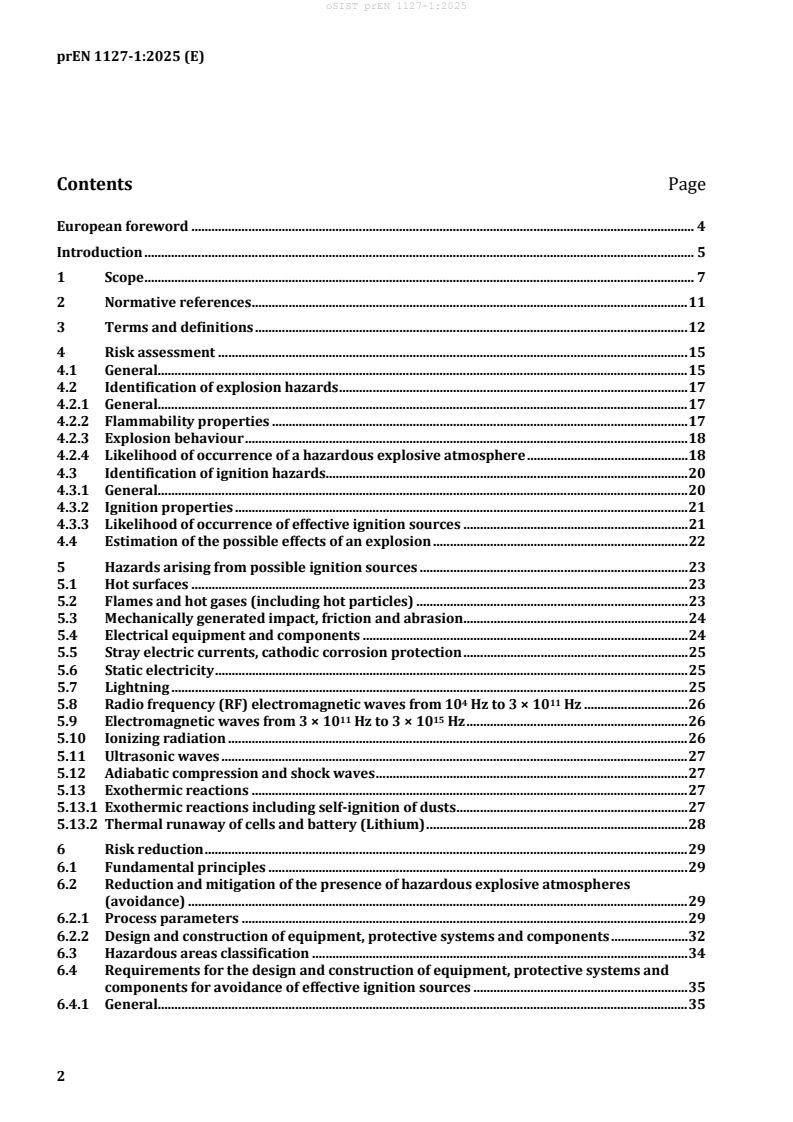
Contents
- Introduction
- 1 Scope
- 2 Normative references
- 3 Terms and definitions
- 3.1 normal tightness
- 3.2 enhanced tightness
- 3.3 non-electrical equipment
- 3.4 equipment
- 3.5 harm
- 3.6 hazard
- 3.7 ignition hazard
- 3.8 hazardous event
- 3.9 hazardous situation
- 3.10 explosive atmosphere
- 3.11 risk
- 3.12 residual risk
- 3.13 risk estimation
- 3.14 risk analysis
- 3.15 risk evaluation
- 3.16 risk assessment
- 3.17 adequate risk reduction
- 3.18 protective measure
- 3.19 inherently safe design measure
- 3.20 intended use
- 3.21 reasonably foreseeable misuse
- 4 Risk assessment
- 4.1 General
- 4.2 Identification of explosion hazards
- 4.3 Identification of ignition hazards
- 4.4 Estimation of the possible effects of an explosion
- 5 Hazards arising from possible ignition sources
- 5.1 Hot surfaces
- 5.2 Flames and hot gases (including hot particles)
- 5.3 Mechanically generated impact, friction and abrasion
- 5.4 Electrical equipment and components
- 5.5 Stray electric currents, cathodic corrosion protection
- 5.6 Static electricity
- 5.7 Lightning
- 5.8 Radio frequency (RF) electromagnetic waves from 10 Hz to 3 × 10 Hz
- 5.9 Electromagnetic waves from 3 × 10 Hz to 3 × 10 Hz
- 5.10 Ionizing radiation
- 5.11 Ultrasonic waves
- 5.12 Adiabatic compression and shock waves
- 5.13 Exothermic reactions
- 6 Risk reduction
- 6.1 Fundamental principles
- 6.2 Reduction and mitigation of the presence of hazardous explosive atmospheres
- 6.3 Hazardous areas classification
- 6.4 Requirements for the design and construction of equipment, protective systems and
- 6.5 Requirements for the design and construction of equipment, protective systems and
- 6.6 Provisions for emergency measures
- 6.7 Principles of measuring and control systems for explosion prevention and
- 7 Information for use
- 7.1 General
- 7.2 Information for commissioning, maintenance and repair to prevent explosion
- 7.3 Qualifications and training
- Annex A
- Annex B
- Annex C
- Annex D
- 6.4.5.1 Introduction of EN IEC 60079-14); splitted
- 6.4.5.2 the item of Electrical equipment, to
- Annex ZA
- Annex ZB
- Bibliography
Introduction
CEN and CENELEC are producing a set of standards to assist designers, manufacturers and other interested bodies to interpret the essential safety requirements in order to achieve conformity with European Legislation. Within this series of standards CEN has undertaken to draw up a standard to give guidance in the field of explosion prevention and protection, as hazards from explosions are intended to be considered in accordance with EN ISO 12100:2010.
In accordance with EN ISO 12100:2010, it is a type B standard dealing with the particular safety aspects of the explosion hazards (due explosive atmosphere) of equipment and protective system, as for the ISO Guide 78:2012, Safety of machinery — Rules for drafting and presentation of safety standards. This document describes the basic concepts and methodology of explosion prevention and protection. CEN/TC 305 has a mandate in this area to produce B-type, and C-type standards, which will allow verification of conformity with the essential safety requirements. Explosions can occur from:
a) materials processed or used by the equipment, protective systems and components; b) materials released by the equipment, protective systems and components; c) materials in the vicinity of the equipment, protective systems and components; d) materials of construction of the equipment, protective systems and components. Since safety depends not only on equipment, protective systems and components but also on the material being handled and its use, this document includes aspects related to the intended use and foreseeable misuse, i.e. the manufacturer should consider in which way and for which purpose the equipment, protective systems and components will be used and take this into account during its design and construction. This is the only way hazards inherent in equipment, protective systems and components can be reduced.
NOTE This standard can also serve as a guide for users of equipment, protective systems and components when assessing the risk of explosion in the workplace (Directive 1999/92/EC) and selecting the appropriate equipment, protective systems and components.
Such workplace and areas or processes can include (but are not limited to) - filling stations or petrol stations, dispensers (gasoline, diesel, CNG, LPG, Hydrogen and the like) - oil refineries and processing plants - chemical and pharmaceutical processing plants - renewable energy sources with low carbon fuels industries such those using as hydrogen, ammonia (NH ) or methanol (CH OH), 3 3 - painting industries, paper and textiles, surface coating industries - medical device using ethers, - gas pipelines and distribution grid, gas infrastructure, gas metering, gas blending - heat exchanger and flammable refrigerants, mechanical refrigerating systems used for cooling and heating (as HVAC)
oSIST prEN 1127-1:2025 prEN 1127-1:2025 (E) - grain handling and storage - woodworking areas - sugar refineries and food industries - metal surface grinding, especially aluminium dusts and particles
oSIST prEN 1127-1:2025 prEN 1127-1:2025 (E)
1 Scope
This document specifies methods for the identification and assessment of hazardous situations leading to explosion and the design and construction measures appropriate for the required safety. This is achieved by:
- risk assessment;
- risk reduction.
The iterative process of risk assessment and risk reduction is described in Figure 1.
oSIST prEN 1127-1:2025 prEN 1127-1:2025 (E)
Figure 1 — Iterative process of risk assessment and risk reduction
oSIST prEN 1127-1:2025 prEN 1127-1:2025 (E) The safety of equipment, protective systems and components can be achieved by eliminating hazards and/or limiting the risk, i.e. by steps (Figure 2 below derived from EN ISO 12100 describes the process of Risk Assessment Process and risk reduction to describe the combination of efforts at design and use phase):
a) appropriate design (without using safeguarding or protective device) — Step 1; b) safeguarding or protections — Step 2; c) information for use — Step 3; d) any other preventive measures.
In this document the measures in accordance with 1) (prevention) and 2) (protection) against explosions are dealt with in Clause 6. 3) The measures according to c) against explosions are dealt with in Clause 7. 4) Measures in accordance with d) are not specified in this document. Refer to EN ISO 12100:2010 for complementary preventive and protective measures.
oSIST prEN 1127-1:2025 prEN 1127-1:2025 (E)
Figure 2 — Risk reduction: combination of efforts at design and use (workplace) The preventive and protective measures described in this document will not provide the required level of safety unless the equipment, protective systems and components are operated within their intended use and are installed and maintained according to the relevant codes of practice or requirements. This document specifies general design and construction methods to help designers and manufacturers in achieving explosion safety in the design of equipment, protective systems and components. This document is applicable to any equipment, protective systems and components intended to be used in potentially explosive atmospheres, under atmospheric conditions. These atmospheres can arise from flammable/combustible substances processed, used or released by the equipment, protective systems and components or from materials in the vicinity of the equipment, protective systems and components and/or from the materials of construction of the equipment, protective systems and components.
oSIST prEN 1127-1:2025 prEN 1127-1:2025 (E) This document is applicable to equipment, protective systems and components at all stages of its use. This document is only applicable to equipment group II which is intended for use in other places than underground parts of mines and those parts of surface installations of such mines endangered by firedamp and/or combustible dust.
This document is not applicable to the design and construction of systems containing desired, controlled combustion processes, unless they can act as ignition sources in potentially explosive atmospheres.
2 Normative references
The following documents are referred to in the text in such a way that some or all of their content constitutes requirements of this document. For dated references, only the edition cited applies. For undated references, the latest edition of the referenced document (including any amendments) applies. EN 13237:2024, Potentially explosive atmospheres - Terms and definitions for equipment and protective systems intended for use in potentially explosive atmospheres EN 15198:2007, Methodology for the risk assessment of non-electrical equipment and components for intended use in potentially explosive atmospheres EN IEC 60079-0:2018, Explosive atmospheres - Part 0: Equipment - General requirements EN IEC 60079-14:2024, Explosive atmospheres - Part 14: Electrical installation design, selection and installation of equipment, including initial inspection EN IEC 60079-17:2024, Explosive atmospheres - Part 17: Electrical installations inspection and maintenance EN 60079-29-1:2016, Explosive atmospheres - Part 29-1: Gas detectors - Performance requirements of detectors for flammable gases EN 60079-29-2:2015, Explosive atmospheres - Part 29-2: Gas detectors - Selection, installation, use and maintenance of detectors for flammable gases and oxygen EN 60079-29-3:2014, Explosive atmospheres - Part 29-3: Gas detectors - Guidance on functional safety of fixed gas detection systems EN 60079-29-4:2010, Explosive atmospheres - Part 29-4: Gas detectors - Performance requirements of open path detectors for flammable gases EN ISO 12100:2010, Safety of machinery - General principles for design - Risk assessment and risk reduction (ISO 12100:2010) EN ISO 80079-36:2016, Explosive atmospheres - Part 36: Non-electrical equipment for explosive atmospheres - Basic method and requirements (ISO 80079-36:2016) ISO Guide 51:2014, Safety aspects — Guidelines for their inclusion in standards (supersede the CEN/CLC Guide 9) ISO 26142:2010, Hydrogen detection apparatus — Stationary applications
oSIST prEN 1127-1:2025 prEN 1127-1:2025 (E)
3 Terms and definitions
For the purposes of this document, the terms and definitions given in EN 13237:2024 and the following apply.
ISO and IEC maintain terminology databases for use in standardization at the following addresses:
- ISO Online browsing platform: available at https://www.iso.org/obp/
- IEC Electropedia: available at https://www.electropedia.org/
3.1 normal tightness
absence of leakage when any of the tightness tests or tightness monitoring appropriate for the application does not reveal any hazardous leaks during normal operation
3.2 enhanced tightness
absence of leakage when due to the design and measures of maintenance any of the tightness tests or tightness monitoring appropriate for the application does not reveal any hazardous leaks during normal operations and expected malfunctions
3.3 non-electrical equipment
equipment that can achieve its intended function mechanically Note 1 to entry: The prime mover for this equipment can be powered by any kind of energy, including electrical (for example a complete package of Compressor including electrical motors, hydrokinetic and pneumatic power, sensors, transmitter, mechanical gears and basement or container). [SOURCE: ATEX 2014/34/EU Directive art. 13 1.(b) (ii) so called “other equipment”]
3.4 equipment
machines, equipment, apparatus, fixed or mobile devices, control components and instrumentation thereof and detection or prevention systems which, separately or jointly in assembly, are intended for the generation, transfer, storage, measurement, control and conversion of energy and/or the processing of material and which are capable of causing an explosion through their own potential sources of ignition [SOURCE: ATEX 2014/34/EU Directive art. 2(1)]
3.5 harm
physical injury or damage to health [SOURCE: ISO Guide 51, EN ISO 12100]
oSIST prEN 1127-1:2025 prEN 1127-1:2025 (E)
3.6 hazard
potential source of harm Note 1 to entry: The term “hazard” can be qualified in order to define its origin or the nature of the potential harm; ignition hazard or source of ignition hazards due to the nature of the potential harm (explosion). Note 2 to entry: The hazard envisaged by this definition depends on the frequency and duration of occurrence of a hazardous explosive atmosphere during the intended use of the equipment. [SOURCE: ISO Guide 51]
3.7 ignition hazard
occurrence of a potential ignition source that is capable of igniting an explosive atmosphere [SOURCE: EN 15198:2007, 3.1]
3.8 hazardous event
event that can cause harm (the ignition of explosive atmosphere) [SOURCE: ISO/IEC Guide 51]
3.9 hazardous situation
circumstance in which a person is exposed to at least one hazard Note 1 to entry: The exposure can result in harm immediately or over a period of time. [SOURCE: ISO/IEC Guide 51]
3.10 explosive atmosphere
mixture with air, under atmospheric conditions, of flammable substances in the form of gases, vapours, mists or dusts in which, after ignition has occurred, combustion spreads to the entire unburned mixture [SOURCE: EN 13237:2024, A.1]
3.11 risk
combination of the probability of occurrence of harm and the severity of that harm [SOURCE: ISO/IEC Guide 51]
3.12 residual risk
risk remaining after protective measures have been implemented Note 1 to entry: This document distinguishes the residual risk after protective measures have been implemented by the designer, so called inherently safe design measures; the residual risk remaining after all protective measures have been implemented by the user.
[SOURCE: ISO/IEC Guide 51]
oSIST prEN 1127-1:2025 prEN 1127-1:2025 (E)
3.13 risk estimation
defining likely severity of harm and probability of its occurrence [SOURCE: ISO/IEC Guide 51]
3.14 risk analysis
combination of the specification of the limits of the Equipment, hazard identification and risk estimation [SOURCE: ISO/IEC Guide 51]
3.15 risk evaluation
judgment, on the basis of risk analysis, of whether the risk reduction objectives have been achieved [SOURCE: ISO/IEC Guide 51]
3.16 risk assessment
overall process comprising a risk analysis and a risk evaluation [SOURCE: ISO/IEC Guide 51]
3.17 adequate risk reduction
risk reduction that is at least in accordance with legal requirements, taking into consideration the current state of the art [SOURCE: ISO/IEC Guide 51]
3.18 protective measure
measure intended to achieve risk reduction, implemented - by the designer (inherently safe design, protective system, safeguarding and complementary protective measures, information for use) and/or - by the user (organization: safe working procedures, supervision, permit-to-work systems; provision and use of additional safeguards; use of personal protective equipment; training) [SOURCE: ISO/IEC Guide 51]
3.19 inherently safe design measure
protective measure which either eliminates hazards or reduces the risks associated with hazards by changing the design or operating characteristics of the Equipment without the use protection system [SOURCE: ISO/IEC Guide 51]
oSIST prEN 1127-1:2025 prEN 1127-1:2025 (E)
3.20 intended use
use of equipment, protective systems, and devices in accordance with the equipment group and category as specified in Directive 2014/34EU, Annex I Art. 2 (9), and taking into account all the information supplied by the manufacturer which is required for the safe functioning of equipment, protective systems, and devices Note 1 to entry: The above mentioned devices are safety devices, controlling and regulating ones intended for use outside potentially explosive atmospheres but required for or contributing to the safe functioning of equipment and protective systems with respect to the risks of explosion. [SOURCE: EN 13237:2024, A.3]
3.21 reasonably foreseeable misuse
use of an Equipment in a way not intended by the designer, but which can result from readily predictable human behaviour [SOURCE: ISO/IEC Guide 51]
4 Risk assessment
4.1 General
Risk assessment shall be carried out and documented for Equipment (as defined in 3.4) in accordance with EN ISO 12100:2010 and/or methodology in EN 15198:2007 regarding non-electrical equipment, unless other standards can be identified as being more appropriate. This document addresses the significant ignition hazard in line to the principle of the EN ISO 12100:2010. The ignition hazard assessment, for the identification of ignition hazard and determination of the likelihood of occurrence of ignition sources shall be carried out and documented according to EN ISO 80079-36:2016 for products, which have their own potential ignition sources and are intended for use in explosive atmospheres. Electrical items (equipment and component) have to be complying to the protection methods in EN IEC 60079-0:2018 series regardless, including the electrical design, installation and selection according to EN IEC 60079-14:2024.
Risk assessment shall also include the possibility of an explosion inside the equipment and/or the components which can rise to harm outside, in a way to mitigate risk of explosion posed by the equipment or components that produce/have themselves gases, liquids, dust, vapours or other substances produced or used by.
NOTE 1 The risk assessment can be carried out as imposed by law, following Legislation and local Code requirements like, 1999/92/EC for European Union, or demanded by the local legislation or LJA (Local Jurisdiction Authority) either for the plant or for the manufacturer of Equipment. Other standards can be identified as being appropriate in the risk assessment EN IEC 31010:2019, NFPA 69 and equivalent, provided adequate risk reduction or acceptable level of safety can be achieved. Risk assessment shall be carried out considering the following:
a) identification of explosion hazards and determination of the likelihood of occurrence of a hazardous explosive atmosphere (see 4.2); b) identification of ignition hazards and determination of the likelihood of occurrence of potential ignition sources (see 4.3);
oSIST prEN 1127-1:2025 prEN 1127-1:2025 (E) c) estimation of the possible effects of an explosion in case of ignition (see 4.4); d) evaluation of the risk and whether the intended level of protection has been achieved; NOTE 2 The intended level of protection is defined by at least legal requirements and, if necessary, additional requirements specified by the user.
e) consideration of measures to reduce the risk (see Clause 6). Comprehensive approach shall be taken, especially for complex equipment such as assemblies, protective systems and components, plants comprising individual units and, above all, for extended plants. This risk assessment shall take into account the ignition and explosion hazard from:
1) the equipment, protective systems and components themselves; 2) the interaction between the equipment, protective systems and components and the substances being handled; 3) the particular process performed in the equipment, protective systems and components; 4) the surroundings of the equipment, protective systems and components and possible interaction with neighbouring processes.
Risk is indeed a combination of the probability of occurrence of harm and the severity of that harm. The risk reduction could be achieved by applying only one of the above prevention or protection principles, in other terms the likehood of exposure to hazards, occurrence of hazardous event and mitigation or avoidance to limit the harm.
A combination of these principles can also be applied.
The risk assessment shall be established based on the combination of the probability of occurrence of harm due to the explosion, and severity of that harm (see Figure 3). In determining the probability and severity of harm caused by explosion, the following criteria shall be taken into account, where relevant:
5) hazards taking into account the intended use and reasonably foreseeable misuse; 6) the severity of harm, which can result from the considered hazard; 7) the number of persons potentially affected by the harm; 8) the frequency and the duration of the exposure to the hazards; 9) the feasibility of avoiding or limiting the occurrence of that harm.
oSIST prEN 1127-1:2025 prEN 1127-1:2025 (E)
Figure 3 — Element of risk (from ISO/IEC Guide 51 — EN ISO 12100) for the Risk Analysis
4.2 Identification of explosion hazards
4.2.1 General
The explosion hazard is generally related to the materials and substances processed, used or released by equipment, protective systems and components and materials used to construct equipment, protective systems and components.
Some of these released substances can undergo combustion processes in air. These processes are often accompanied by the release of considerable amounts of heat and can be associated with a pressure build-up and the release of hazardous materials. In contrast to burning in a fire, an explosion is essentially a self-sustained propagation of the reaction zone (flame) through the hazardous explosive atmosphere. This potential hazard associated with the hazardous explosive atmosphere is released when ignited by an effective ignition source.
The safety characteristics listed in 4.2.2 and 4.2.3 describe safety relevant properties of flammable/combustible substances. The material properties and the safety characteristics are used for the identification of the explosion hazard.
It is necessary to bear in mind that such safety characteristics are not constants but depend for instance on the techniques used for their measurement.
...