

SIST EN 13146-1:2012/FprA1:2014
(Amendment)Railway applications - Track - Test methods for fastening systems - Part 1: Determination of longitudinal rail restraint
General Information
- Abstract
The same as for EN 13146-1:2012.
- Status
- Not Published
- Public Enquiry End Date
- 10-Aug-2014
- Technical Committee
- IŽNP - Reilway applications
- Current Stage
- 98 - Abandoned project (Adopted Project)
- Start Date
- 14-Oct-2019
- Due Date
- 19-Oct-2019
- Completion Date
- 14-Oct-2019


Overview
SIST EN 13146-1:2012/FprA1:2014 is a European standard developed by CEN Technical Committee 256, focused on railway applications and track systems. Specifically, it defines standardized test methods for railway fastening systems, with Part 1 addressing the determination of longitudinal rail restraint. This amendment to the 2012 version refines the testing procedures and specifications related to the rail and rail support used during testing.
This standard ensures consistent evaluation of fastening systems that secure rails to sleepers or track structures-an essential aspect affecting rail stability, safety, and longevity. It applies to various types of fastening systems, including mechanically and adhesively fastened embedded rails and surface-mounted rails.
Key Topics
Longitudinal Rail Restraint Testing: The standard specifies methods to measure the resistance of fastening systems to longitudinal movement of rails under applied forces, crucial for maintaining track geometry and preventing rail displacement.
Rail Sample Requirements: Detailed requirements for the test rail sample include:
- Use of a short length of rail corresponding to the fastening system design.
- Surface conditions stipulating no laminated layers, loose rust, or polished surfaces.
- Length specifications:
- Approximately 0.5 meters for surface-mounted rails.
- For embedded rails, length depends on fastening type-typically the spacing between mechanical fastenings or 0.5 to 0.85 meters for adhesive fastenings.
Rail Support Specifications: Adjustments in the standard clarify rail support conditions during testing, essential to simulate real operational environments accurately.
Amendment Details: This document introduces minor textual modifications enhancing clarity in sections 5.1 (Rail) and 6.1 (Rail support).
Applications
SIST EN 13146-1:2012/FprA1:2014 serves as a vital reference for:
Railway Manufacturers and Suppliers: Ensuring fastening systems meet minimum performance requirements related to longitudinal restraint.
Track Engineers and Maintenance Teams: Assessing and selecting appropriate fastening systems to mitigate rail movement, reduce maintenance costs, and enhance track safety.
Testing Laboratories: Standardizing test procedures for rail fastening components, facilitating reliable product certification and compliance with European regulations.
Rail Infrastructure Projects: Incorporating standardized fastening system evaluation during design and validation phases to optimize track performance under dynamic loads.
Related Standards
To complement SIST EN 13146-1:2012/FprA1:2014, the following standards can be referenced for comprehensive railway track system assessment:
- EN 13146-2: Test methods for fastening systems - part 2, addressing vertical holding force measurement.
- EN 13481: Performance requirements for track components including fastenings.
- EN 13232: Rail fastening systems product standards covering performance and design.
- National standards aligned with CEN standards for regional railway infrastructure compatibility.
By ensuring accurate determination of longitudinal rail restraint, SIST EN 13146-1:2012/FprA1:2014 supports safer and more durable railway track systems. It is an indispensable tool in the ongoing enhancement of railway track fastening technology, contributing to optimal rail stability and operational reliability.
Relations
- Effective Date
- 01-Jan-2015
- Effective Date
- 01-Jul-2014
Get Certified
Connect with accredited certification bodies for this standard

Zavod za gradbeništvo Slovenije (ZAG) - Inšpekcija
ZAG inspection body for construction products, structures, and materials.
Sponsored listings
Frequently Asked Questions
SIST EN 13146-1:2012/FprA1:2014 is a draft published by the Slovenian Institute for Standardization (SIST). Its full title is "Railway applications - Track - Test methods for fastening systems - Part 1: Determination of longitudinal rail restraint". This standard covers: The same as for EN 13146-1:2012.
The same as for EN 13146-1:2012.
SIST EN 13146-1:2012/FprA1:2014 is classified under the following ICS (International Classification for Standards) categories: 93.100 - Construction of railways. The ICS classification helps identify the subject area and facilitates finding related standards.
SIST EN 13146-1:2012/FprA1:2014 has the following relationships with other standards: It is inter standard links to SIST EN 13146-1:2012+A1:2015, SIST EN 13146-1:2012. Understanding these relationships helps ensure you are using the most current and applicable version of the standard.
SIST EN 13146-1:2012/FprA1:2014 is associated with the following European legislation: EU Directives/Regulations: 2008/57/EC; Standardization Mandates: M/483. When a standard is cited in the Official Journal of the European Union, products manufactured in conformity with it benefit from a presumption of conformity with the essential requirements of the corresponding EU directive or regulation.
SIST EN 13146-1:2012/FprA1:2014 is available in PDF format for immediate download after purchase. The document can be added to your cart and obtained through the secure checkout process. Digital delivery ensures instant access to the complete standard document.
Standards Content (Sample)
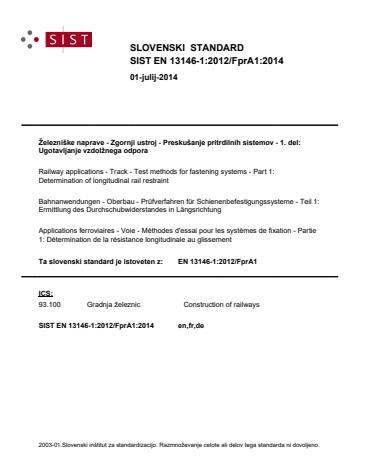
SLOVENSKI STANDARD
01-julij-2014
Železniške naprave - Zgornji ustroj - Preskušanje pritrdilnih sistemov - 1. del:
Ugotavljanje vzdolžnega odpora
Railway applications - Track - Test methods for fastening systems - Part 1:
Determination of longitudinal rail restraint
Bahnanwendungen - Oberbau - Prüfverfahren für Schienenbefestigungssysteme - Teil 1:
Ermittlung des Durchschubwiderstandes in Längsrichtung
Applications ferroviaires - Voie - Méthodes d'essai pour les systèmes de fixation - Partie
1: Détermination de la résistance longitudinale au glissement
Ta slovenski standard je istoveten z: EN 13146-1:2012/FprA1
ICS:
93.100 Gradnja železnic Construction of railways
2003-01.Slovenski inštitut za standardizacijo. Razmnoževanje celote ali delov tega standarda ni dovoljeno.
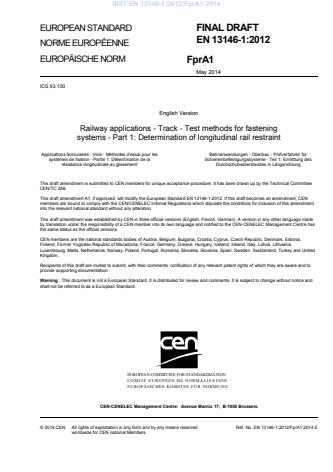
EUROPEAN STANDARD
FINAL DRAFT
EN 13146-1:2012
NORME EUROPÉENNE
EUROPÄISCHE NORM
FprA1
May 2014
ICS 93.100
English Version
Railway applications - Track - Test methods for fastening
systems - Part 1: Determination of longitudinal rail restraint
Applications ferroviaires - Voie - Méthodes d'essai pour les Bahnanwendungen - Oberbau - Prüfverfahren für
systèmes de fixation - Partie 1: Détermination de la Schienenbefestigungssysteme - Teil 1: Ermittlung des
résistance longitudinale au glissement Durchschubwiderstandes in Längsrichtung
This draft amendment is submitted to CEN members for unique acceptance procedure. It has been drawn up by the Technical Committee
CEN/TC 256.
This draft amendment A1, if approved, will modify the European Standard EN 13146-1:2012. If this draft becomes an amendment, CEN
members are bound to comply with the CEN/CENELEC Internal Regulations which stipulate the conditions for inclusion of this amendment
into the relevant national standard without any alteration.
This draft amendment was established by CEN in three official versions (English, French, German). A version in any other language made
by translation under the responsibility of a CEN member into its own language and notified to the CEN-CENELEC Management Centre has
the same status as the official versions.
CEN members are the national standards bodies of Austria, Belgium, Bulgaria, Croatia, Cyprus, Czech Republic, Denmark, Estonia,
Finland, Former Yugoslav Republic of Macedonia, France, Germany, Greece, Hungary, Iceland, Ireland, Italy, Latvia, Lithuania,
Luxembourg, Malta, Netherlands, Norway, Poland, Portugal, Romania, Slovakia,
...