

SIST EN 1992-3:2006
(Main)Eurocode 2 - Design of concrete structures - Part 3: Liquid retaining and containment structures
- Abstract
1.1.2 Scope of Part 3 of Eurocode 2
(101)P Part 3 of EN 1992 covers additional rules to those in Part 1 for the design of structures constructed from plain or lightly reinforced concrete, reinforced concrete or prestressed concrete for the containment of liquids or granular solids.
(102)P Principles and Application Rules are given in this Part for the design of those elements of structure which directly support the stored liquids or materials (i.e. the directly loaded walls of tanks, reservoirs or silos). Other elements which support these primary elements (for example, the tower structure which supports the tank in a water tower) should be designed according to the provisions of Part 1-1.
(103)P This part does not cover:
- Structures for the storage of materials at very low or very high temperatures
- Structures for the storage of hazardous materials the leakage of which could constitute a major health or safety risk.
- The selection and design of liners or coatings and the consequences of the choice of these on the design of the structure.
- Pressurised vessels.
- Floating structures
- Gas tightness
(104) This code is valid for stored materials which are permanently at a temperature between -40 °C and +200 °C.
(105) For the selection and design of liners or coatings, reference should be made to appropriate documents.
(106) It is recognised that, while this code is specifically concerned with structures for the containment of liquids and granular materials, the clauses covering design for liquid tightness may also be relevant to other types of structure where liquid tightness is required.
(107) In clauses relating to leakage and durability, this code mainly covers aqueous liquids. Where other liquids are stored in direct contact with structural concrete, reference should be made to specialist literature.
- Status
- Published
- Publication Date
- 31-Oct-2006
- Withdrawal Date
- 17-Apr-2007
- Technical Committee
- KON - Structures
- Current Stage
- 6060 - National Implementation/Publication (Adopted Project)
- Start Date
- 01-Nov-2006
- Due Date
- 01-Nov-2006
- Completion Date
- 01-Nov-2006


SIST EN 1992-3:2006 is the Slovenian adoption of EN 1992-3, Eurocode 2, Part 3. It gives additional design rules for concrete structures that retain liquids or contain granular solids, especially tanks, reservoirs and silos. The document focuses on liquid tightness, cracking, durability, temperature effects and detailing for plain, reinforced and prestressed concrete.
What does SIST EN 1992-3:2006 specify?
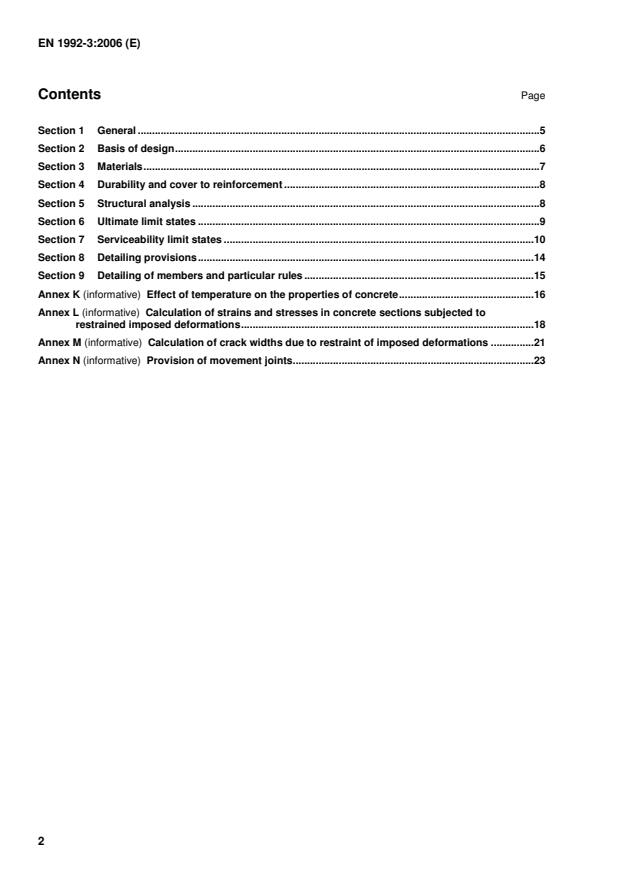
SIST EN 1992-3:2006 covers the extra rules needed on top of EN 1992-1-1 for containment structures. It is organised into Sections 1 to 9 and four informative annexes.
| Annex | What it covers |
|---|---|
| K | Effect of temperature on the properties of concrete |
| L | Strains and stresses in concrete sections subjected to restrained imposed deformations |
| M | Crack widths due to restraint of imposed deformations |
| N | Provision of movement joints |
The scope is limited to structures in plain or lightly reinforced concrete, reinforced concrete and prestressed concrete that directly support stored liquids or materials. Supporting parts such as a tower for a water tank are designed to Part 1-1.
What are the key requirements of SIST EN 1992-3:2006?
Loads, temperature and analysis
- Clause 2.1.1 links design situations to EN 1990, EN 1991-4 and EN 1991-1-5, and adds cases such as filling and discharge patterns, dust explosions, thermal effects and watertightness testing. In practice, the designer must check operating and accidental conditions, not only normal structural loading.
- Clause 2.3.1.1 takes action factors for these structures from EN 1991-4, and ground-related actions from EN 1997. This matters when tank walls or silos interact with soil or stored material pressures.
- Clause 3 requires temperature effects on concrete to be considered, with Annex K providing guidance. If thermal exposure is important, the designer needs to account for changing strength, stiffness, creep and strain.
- Clause 5.13 distinguishes liquid pressure and solid pressure. Without a more rigorous analysis, liquid pressure may be taken at the centre of the retaining members, while solid material pressure acts on the inner surface.
Crack control and tightness
- Clause 7.3.1 introduces Tightness Class 0 to 3. Class 0 allows some leakage, Class 1 limits leakage, Class 2 seeks minimal leakage, and Class 3 requires no leakage. This classification drives crack limits and whether special measures are needed.
- Clause 7.3.1 also links crack control to compression-zone depth and, for classes 2 and 3, often to liners or prestress. In practice, this means the section must be detailed so cracks do not pass through the full thickness.
- Clause 7.3.5 gives ways to reduce cracking from restraint and shrinkage, including limiting hydration temperature rise, reducing restraints, lowering shrinkage and using prestressing. Annex L and Annex M support the calculation of restrained deformations and crack widths.
- Clause 9.6.6 states that movement joints should be used if cracking cannot otherwise be controlled. Joints must be inspectable and repairable or renewable, because sealants may not last as long as the structure.
Detailing and special cases
- Clause 8.10.1.3 sets rules for post-tension ducts in circular tanks, including duct placement and uniform prestressing. This reduces local failure risk and uneven force effects.
- Clause 9.11.1 gives minimum wall thickness guidance for reservoir and tank walls and requires passive reinforcement where there is no vertical prestressing. This affects buildability and the practical watertightness of the wall.
- Clause 6.9 requires silo structures exposed to dust explosion risk to resist the expected pressure or be vented safely. Actions from dust explosions are treated as accidental actions, so this becomes a separate safety check.
What terms does SIST EN 1992-3:2006 define?
- Tightness Class - The leakage classification for containment structures, ranging from Class 0 with some leakage acceptable to Class 3 with no leakage permitted.
- Rax - A factor that describes the degree of external axial restraint provided by attached elements.
- Rm - A factor that describes the degree of moment restraint provided by attached elements.
- fckT - The characteristic compressive strength of concrete modified to take account of temperature.
- eTr - Transitional thermal strain, the irrecoverable strain that can occur when concrete is heated while stressed.
- wk1 - The crack-width limit used for Tightness Class 1, with the value taken from the National Annex.
- xmin - The minimum compression-zone depth used to show that cracks do not pass through the full thickness in tighter classes.
Who uses SIST EN 1992-3:2006?
Structural engineers use SIST EN 1992-3:2006 to design tanks, reservoirs, silos and similar containment structures. Prestressed concrete designers use it for tendon layout, anchorage details and crack control.
Quality managers and buyers use it when specifying watertightness, durability and acceptance criteria for liquid-retaining concrete works. Geotechnical engineers use it where ground water or soil actions affect the structure.
Inspectors and testing teams use it for reservoir watertightness checks and for judging whether cracking, leakage or joints meet the intended tightness class.
What changed in SIST EN 1992-3:2006 from the previous edition?
SIST EN 1992-3:2006 supersedes ENV 1992-4:1998.
Which standards are used with SIST EN 1992-3:2006?
- EN 1990 - basis of structural design, used for the general design framework.
- EN 1991-1-5 - thermal actions on structures.
- EN 1991-4 - actions on silos and tanks, including partial safety factors for these structures.
- EN 1992-1-1 - the general concrete design rules that this part complements and in some places modifies.
- EN 1992-1-2 - structural fire design and elevated-temperature material data.
- EN 1997 - geotechnical design, used for soil and groundwater actions.
- EN 1991-1-7 - explosion-related considerations, referred to for dust explosion design context.
- EN 1992-2 - referenced for strut-and-tie design and for some crack-control procedures.
What does the SIST EN 1992-3:2006 document contain?
The document contains the Eurocode clause structure for containment design, plus tables, figures and annex methods for crack control, restraint and joint design. Clause 7 includes a tightness classification table and crack-width control figures for reinforcement sizing. Annex K gives temperature-related material behaviour, Annex L gives restraint factors and stress/strain expressions, Annex M gives crack-width expressions for restrained deformations, and Annex N compares full-restraint and movement-joint strategies. These parts are used for design checks, detailing, serviceability assessment and, where needed, testing and inspection planning.
Relations
- Effective Date
- 01-Nov-2006
- Effective Date
- 30-Mar-2028
- Effective Date
- 25-Mar-2026
- Effective Date
- 25-Mar-2026
- Effective Date
- 28-Jan-2026
- Effective Date
- 28-Jan-2026
- Effective Date
- 28-Jan-2026
- Effective Date
- 28-Jan-2026
- Effective Date
- 28-Jan-2026
Get Certified
Connect with accredited certification bodies for this standard

DIBt (Deutsches Institut für Bautechnik)
German Institute for Building Technology.
DIN CERTCO
DIN Group product certification.

Aboma Certification B.V.
Specialized in construction, metal, and transport sectors.
Sponsored listings
Frequently Asked Questions
SIST EN 1992-3:2006 is a standard published by the Slovenian Institute for Standardization (SIST). Its full title is "Eurocode 2 - Design of concrete structures - Part 3: Liquid retaining and containment structures". This standard covers: 1.1.2 Scope of Part 3 of Eurocode 2 (101)P Part 3 of EN 1992 covers additional rules to those in Part 1 for the design of structures constructed from plain or lightly reinforced concrete, reinforced concrete or prestressed concrete for the containment of liquids or granular solids. (102)P Principles and Application Rules are given in this Part for the design of those elements of structure which directly support the stored liquids or materials (i.e. the directly loaded walls of tanks, reservoirs or silos). Other elements which support these primary elements (for example, the tower structure which supports the tank in a water tower) should be designed according to the provisions of Part 1-1. (103)P This part does not cover: - Structures for the storage of materials at very low or very high temperatures - Structures for the storage of hazardous materials the leakage of which could constitute a major health or safety risk. - The selection and design of liners or coatings and the consequences of the choice of these on the design of the structure. - Pressurised vessels. - Floating structures - Gas tightness (104) This code is valid for stored materials which are permanently at a temperature between -40 °C and +200 °C. (105) For the selection and design of liners or coatings, reference should be made to appropriate documents. (106) It is recognised that, while this code is specifically concerned with structures for the containment of liquids and granular materials, the clauses covering design for liquid tightness may also be relevant to other types of structure where liquid tightness is required. (107) In clauses relating to leakage and durability, this code mainly covers aqueous liquids. Where other liquids are stored in direct contact with structural concrete, reference should be made to specialist literature.
1.1.2 Scope of Part 3 of Eurocode 2 (101)P Part 3 of EN 1992 covers additional rules to those in Part 1 for the design of structures constructed from plain or lightly reinforced concrete, reinforced concrete or prestressed concrete for the containment of liquids or granular solids. (102)P Principles and Application Rules are given in this Part for the design of those elements of structure which directly support the stored liquids or materials (i.e. the directly loaded walls of tanks, reservoirs or silos). Other elements which support these primary elements (for example, the tower structure which supports the tank in a water tower) should be designed according to the provisions of Part 1-1. (103)P This part does not cover: - Structures for the storage of materials at very low or very high temperatures - Structures for the storage of hazardous materials the leakage of which could constitute a major health or safety risk. - The selection and design of liners or coatings and the consequences of the choice of these on the design of the structure. - Pressurised vessels. - Floating structures - Gas tightness (104) This code is valid for stored materials which are permanently at a temperature between -40 °C and +200 °C. (105) For the selection and design of liners or coatings, reference should be made to appropriate documents. (106) It is recognised that, while this code is specifically concerned with structures for the containment of liquids and granular materials, the clauses covering design for liquid tightness may also be relevant to other types of structure where liquid tightness is required. (107) In clauses relating to leakage and durability, this code mainly covers aqueous liquids. Where other liquids are stored in direct contact with structural concrete, reference should be made to specialist literature.
SIST EN 1992-3:2006 is classified under the following ICS (International Classification for Standards) categories: 91.010.30 - Technical aspects; 91.080.40 - Concrete structures. The ICS classification helps identify the subject area and facilitates finding related standards.
SIST EN 1992-3:2006 has the following relationships with other standards: It is inter standard links to SIST ENV 1992-4:2004, kSIST FprEN 1992-1-1:2023, kSIST FprEN 1990-2:2025, kSIST FprEN 1991-4:2025, kSIST FprEN 1997-1:2024, SIST EN 1991-4:2006, kSIST FprEN 1991-1-5:2024, kSIST FprEN 1992-1-2:2023, SIST EN 1998-4:2006. Understanding these relationships helps ensure you are using the most current and applicable version of the standard.
SIST EN 1992-3:2006 is associated with the following European legislation: EU Directives/Regulations: 2005-01-4408, 305/2011, 89/106/EEC; Standardization Mandates: M/265, M/BC/CEN/89/11. When a standard is cited in the Official Journal of the European Union, products manufactured in conformity with it benefit from a presumption of conformity with the essential requirements of the corresponding EU directive or regulation.
SIST EN 1992-3:2006 is available in PDF format for immediate download after purchase. The document can be added to your cart and obtained through the secure checkout process. Digital delivery ensures instant access to the complete standard document.
Standards Content (Sample)
2003-01.Slovenski inštitut za standardizacijo. Razmnoževanje celote ali delov tega standarda ni dovoljeno.Eurocode 2 - Design of concrete structures - Part 3: Liquid retaining and containment structuresEurocode 2 - Calcul des structures en béton - Partie 3: Silos et réservoirsEurocode 2 - Bemessung und Konstruktion von Stahlbeton- und Spannbetontragwerken - Teil 3: Silos und Behälterbauwerke aus BetonTa slovenski standard je istoveten z:EN 1992-3:2006SIST EN 1992-3:2006en91.080.40Betonske konstrukcijeConcrete structures91.010.30Technical aspectsICS:SIST ENV 1992-4:20041DGRPHãþDSLOVENSKI
STANDARDSIST EN 1992-3:200601-november-2006
EUROPEAN STANDARDNORME EUROPÉENNEEUROPÄISCHE NORMEN 1992-3June 2006ICS 91.010.30; 91.080.40Supersedes ENV 1992-4:1998
English VersionEurocode 2 - Design of concrete structures - Part 3: Liquidretaining and containment structuresEurocode 2 - Calcul des structures en béton - Partie 3:Silos et réservoirsEurocode 2 - Bemessung und Konstruktion von Stahlbeton-und Spannbetontragwerken - Teil 3: Stütz- undBehälterbauwerke aus BetonThis European Standard was approved by CEN on 24 November 2005.CEN members are bound to comply with the CEN/CENELEC Internal Regulations which stipulate the conditions for giving this EuropeanStandard the status of a national standard without any alteration. Up-to-date lists and bibliographical references concerning such nationalstandards may be obtained on application to the Central Secretariat or to any CEN member.This European Standard exists in three official versions (English, French, German). A version in any other language made by translationunder the responsibility of a CEN member into its own language and notified to the Central Secretariat has the same status as the officialversions.CEN members are the national standards bodies of Austria, Belgium, Cyprus, Czech Republic, Denmark, Estonia, Finland, France,Germany, Greece, Hungary, Iceland, Ireland, Italy, Latvia, Lithuania, Luxembourg, Malta, Netherlands, Norway, Poland, Portugal, Romania,Slovakia, Slovenia, Spain, Sweden, Switzerland and United Kingdom.EUROPEAN COMMITTEE FOR STANDARDIZATIONCOMITÉ EUROPÉEN DE NORMALISATIONEUROPÄISCHES KOMITEE FÜR NORMUNGManagement Centre: rue de Stassart, 36
B-1050 Brussels© 2006 CENAll rights of exploitation in any form and by any means reservedworldwide for CEN national Members.Ref. No. EN 1992-3:2006: E
Effect of temperature on the properties of concrete.16 Annex L (informative)
Calculation of strains and stresses in concrete sections subjected to restrained imposed deformations.18 Annex M (informative)
Calculation of crack widths due to restraint of imposed deformations.21 Annex N (informative)
Provision of movement joints.23
See EN 1992-1-1. National Standards implementing Eurcodes See EN 1992-1-1. Links between Eurocodes and harmonized technical specifications (ENs and ETAs) for products See EN 1992-1-1. Additional information specific to EN 1992-3 and link to EN 1992-1-1 The scope of Eurocode 2 is defined in 1.1.1 of EN 1992-1-1 and the scope of this Part of Eurocode 2 is defined in 1.1.2. Other Additional Parts of Eurocode 2 which are planned are indicated in 1.1.3 of EN 1992-1-1; these will cover additional technologies or applications, and will complement and supplement this Part. It has been necessary to introduce into EN 1992-3 a few clauses which are not specific to liquid retaining or containment structures and which strictly belong to Part 1-1. These are deemed valid interpretations of Part 1-1 and design complying with the requirements of EN 1992-3 are deemed to comply with the principles of EN 1992-1-1.
Structures for the storage of materials at very low or very high temperatures ¾ Structures for the storage of hazardous materials the leakage of which could constitute a major health or safety risk. ¾ The selection and design of liners or coatings and the consequences of the choice of these on the design of the structure. ¾ Pressurised vessels. ¾ Floating structures ¾ Large dams ¾ Gas tightness (104) This code is valid for stored materials which are permanently at a temperature between –40 °C and +200 °C. (105) For the selection and design of liners or coatings, reference should be made to appropriate documents. (106) It is recognised that, while this code is specifically concerned with structures for the containment of liquids and granular materials, the clauses covering design for liquid tightness may also be relevant to other types of structure where liquid tightness is required. (107) In clauses relating to leakage and durability, this code mainly covers aqueous liquids.
Where other liquids are stored in direct contact with structural concrete, reference should be made to specialist literature. 1.2 Normative references The following normative documents contain provisions that, though referenced in this text, constitute provisions of this European Standard.
For dated references, subsequent amendments to, or revisions of, any of these publications do not apply.
However, parties to agreements based on this European Standard are encouraged to investigate the possibility of applying the most recent editions of the normative documents indicated below.
For undated references, the latest edition of the normative document referred to applies. EN 1990, Eurocode, Basis of structural design
NOTE Guidance is given in Informative Annex K on the estimation of creep effects at elevated temperatures. 3.1.11 Heat evolution and temperature development due to hydration (101) Where conditions during the construction phase are considered to be significant, the heat evolution characteristics for a particular cement should generally be obtained from tests. The actual heat evolution
...