

SIST EN 50156-1:2025
(Main)Electrical equipment for furnaces and ancillary equipment - Part 1: Requirements for application design and installation
General Information
- Abstract
This document applies to the application design and installation of electrical equipment, control circuits and safety-related systems for furnaces which are operated with solid, liquid or gaseous fuels and their ancillary equipment. It specifies requirements to meet the operating conditions of furnaces, to reduce the hazards of combustion and to protect the heated systems from damage e.g. by overheating.
Such furnaces and the electrical equipment can be part by way of example of the following plant:
a) water heating systems;
b) steam boiler installations (steam and hot-water boilers) and heat recovery steam boilers;
NOTE 1 The requirements of this document apply according to the electrical equipment of electrically heated steam boilers.
NOTE 2 Seagoing vessels and offshore facilities are governed by International Maritime Law and as such are not within the scope of this document. These requirements can be used for such facilities.
c) warm air heaters;
d) hot-gas heaters;
e) heat exchanger systems;
f) combustion chambers of stationary turbines;
g) as long as no other standard is applicable for combined heat and power stations, we recommend the use of the requirements of this document;
This document can also be used as reference for electrical equipment requirements for thermo-processing equipment.
The requirements in this document are not applicable to electrical equipment for:
1) non-electrically heated appliances and burner control systems for household and similar purposes;
2) furnaces using technologies for the direct conversion of heat into electrical energy;
3) combustion chambers of non-stationary prime movers and turbines;
4) central oil supply systems for individual heating appliances;
5) furnaces using solid fuels for heating purposes for household use with a nominal thermal output up to 1 MW;
6) furnaces which are used to heat process fluids and gasses in chemical plant.
This document can be used as a basis for the requirements placed on electrical equipment for furnaces, which are excluded from its field of application.
This document specifies special requirements for the management of functional safety.
- Status
- Published
- Public Enquiry End Date
- 31-Dec-2022
- Publication Date
- 17-Nov-2024
- Technical Committee
- I09 - Imaginarni 09
- Current Stage
- 6060 - National Implementation/Publication (Adopted Project)
- Start Date
- 13-Nov-2024
- Due Date
- 18-Jan-2025
- Completion Date
- 18-Nov-2024

Overview
SIST EN 50156-1:2025 - Electrical equipment for furnaces and ancillary equipment, Part 1 - sets requirements for the application design and installation of electrical equipment, control circuits and safety‑related systems for furnaces fired by solid, liquid or gaseous fuels. It is a CENELEC European standard (EN 50156‑1 approved 2024) adopted as the Slovenian standard in 2025.
The standard aims to ensure safe operation of furnaces and to protect heated systems from hazards such as combustion risks and overheating. It applies to a wide range of plant examples (steam and hot‑water boilers, warm air and hot‑gas heaters, heat exchangers, combustion chambers of stationary turbines, and certain CHP and thermo‑processing equipment) while explicitly excluding several household and specialised applications listed in the scope.
Key topics and requirements
SIST EN 50156‑1:2025 covers practical technical areas essential for reliable, safe furnace installations:
- General and environmental requirements - operating conditions, EMC, ambient temperature, humidity, contamination, vibration, flammable atmospheres.
- Power supply and incoming connections - types of connection, terminations, isolation and emergency stop devices.
- Protection measures - safeguards against electric shock, ingress (IP), overcurrent, and short‑circuit risks.
- Equipotential bonding and grounding - protective and functional bonding (including lightning considerations).
- Auxiliary circuits - supply methods, preferred voltages, overcurrent protection and connection to protective conductors.
- Safety‑related systems and functional safety management - hazard and risk analysis, safety lifecycle, safety requirements allocation, design, verification, validation, commissioning, operation, maintenance, modification and decommissioning.
- Documentation and verification - design records, periodic testing, and validation activities to demonstrate compliance.
Note: the document specifies special requirements for the management of functional safety throughout the lifecycle.
Practical applications and who uses it
This standard is essential for professionals involved in furnace systems and industrial heating plant:
- Electrical and control systems designers specifying equipment and wiring for boilers, heaters and heat‑recovery systems.
- Installation contractors and commissioning engineers responsible for safe installation and startup.
- Plant operators and maintenance teams implementing periodic testing, validation and modifications.
- Safety managers, risk assessors and certification bodies assessing compliance and functional safety.
- OEMs and system integrators developing control and safety systems for furnace applications.
Using SIST EN 50156‑1 helps reduce combustion hazards, prevent overheating damage, and align installations with recognised European best practice for electrical and safety‑related systems.
Related standards
- EN 50156‑1 is Part 1 of the EN 50156 series (application design and installation). It should be used alongside applicable national electrical installation rules and other industry standards addressing specific equipment or functional safety management.
Relations
- Effective Date
- 01-Jan-2025
- Effective Date
- 09-Feb-2026
- Effective Date
- 09-Feb-2026
- Effective Date
- 09-Feb-2026
- Effective Date
- 09-Feb-2026
- Effective Date
- 09-Feb-2026
- Referred By
SIST EN 764-7:2002 - Pressure equipment - Part 7: Safety systems for unfired pressure equipment - Effective Date
- 09-Feb-2026
- Effective Date
- 09-Feb-2026
Get Certified
Connect with accredited certification bodies for this standard

DNV
DNV is an independent assurance and risk management provider.

Lloyd's Register
Lloyd's Register is a global professional services organisation specialising in engineering and technology.
DNV Energy Systems
Energy and renewable energy certification.
Sponsored listings
Frequently Asked Questions
SIST EN 50156-1:2025 is a standard published by the Slovenian Institute for Standardization (SIST). Its full title is "Electrical equipment for furnaces and ancillary equipment - Part 1: Requirements for application design and installation". This standard covers: This document applies to the application design and installation of electrical equipment, control circuits and safety-related systems for furnaces which are operated with solid, liquid or gaseous fuels and their ancillary equipment. It specifies requirements to meet the operating conditions of furnaces, to reduce the hazards of combustion and to protect the heated systems from damage e.g. by overheating. Such furnaces and the electrical equipment can be part by way of example of the following plant: a) water heating systems; b) steam boiler installations (steam and hot-water boilers) and heat recovery steam boilers; NOTE 1 The requirements of this document apply according to the electrical equipment of electrically heated steam boilers. NOTE 2 Seagoing vessels and offshore facilities are governed by International Maritime Law and as such are not within the scope of this document. These requirements can be used for such facilities. c) warm air heaters; d) hot-gas heaters; e) heat exchanger systems; f) combustion chambers of stationary turbines; g) as long as no other standard is applicable for combined heat and power stations, we recommend the use of the requirements of this document; This document can also be used as reference for electrical equipment requirements for thermo-processing equipment. The requirements in this document are not applicable to electrical equipment for: 1) non-electrically heated appliances and burner control systems for household and similar purposes; 2) furnaces using technologies for the direct conversion of heat into electrical energy; 3) combustion chambers of non-stationary prime movers and turbines; 4) central oil supply systems for individual heating appliances; 5) furnaces using solid fuels for heating purposes for household use with a nominal thermal output up to 1 MW; 6) furnaces which are used to heat process fluids and gasses in chemical plant. This document can be used as a basis for the requirements placed on electrical equipment for furnaces, which are excluded from its field of application. This document specifies special requirements for the management of functional safety.
This document applies to the application design and installation of electrical equipment, control circuits and safety-related systems for furnaces which are operated with solid, liquid or gaseous fuels and their ancillary equipment. It specifies requirements to meet the operating conditions of furnaces, to reduce the hazards of combustion and to protect the heated systems from damage e.g. by overheating. Such furnaces and the electrical equipment can be part by way of example of the following plant: a) water heating systems; b) steam boiler installations (steam and hot-water boilers) and heat recovery steam boilers; NOTE 1 The requirements of this document apply according to the electrical equipment of electrically heated steam boilers. NOTE 2 Seagoing vessels and offshore facilities are governed by International Maritime Law and as such are not within the scope of this document. These requirements can be used for such facilities. c) warm air heaters; d) hot-gas heaters; e) heat exchanger systems; f) combustion chambers of stationary turbines; g) as long as no other standard is applicable for combined heat and power stations, we recommend the use of the requirements of this document; This document can also be used as reference for electrical equipment requirements for thermo-processing equipment. The requirements in this document are not applicable to electrical equipment for: 1) non-electrically heated appliances and burner control systems for household and similar purposes; 2) furnaces using technologies for the direct conversion of heat into electrical energy; 3) combustion chambers of non-stationary prime movers and turbines; 4) central oil supply systems for individual heating appliances; 5) furnaces using solid fuels for heating purposes for household use with a nominal thermal output up to 1 MW; 6) furnaces which are used to heat process fluids and gasses in chemical plant. This document can be used as a basis for the requirements placed on electrical equipment for furnaces, which are excluded from its field of application. This document specifies special requirements for the management of functional safety.
SIST EN 50156-1:2025 is classified under the following ICS (International Classification for Standards) categories: 27.060.01 - Burners and boilers in general. The ICS classification helps identify the subject area and facilitates finding related standards.
SIST EN 50156-1:2025 has the following relationships with other standards: It is inter standard links to SIST EN 50156-1:2015, SIST EN 12952-9:2003, SIST EN 12952-16:2003, SIST EN 12953-12:2004, SIST EN 12952-14:2004, SIST EN 12952-8:2002, SIST EN 764-7:2002, SIST EN 13842:2005. Understanding these relationships helps ensure you are using the most current and applicable version of the standard.
SIST EN 50156-1:2025 is associated with the following European legislation: EU Directives/Regulations: 2014/35/EU; Standardization Mandates: M/511. When a standard is cited in the Official Journal of the European Union, products manufactured in conformity with it benefit from a presumption of conformity with the essential requirements of the corresponding EU directive or regulation.
SIST EN 50156-1:2025 is available in PDF format for immediate download after purchase. The document can be added to your cart and obtained through the secure checkout process. Digital delivery ensures instant access to the complete standard document.
Standards Content (Sample)
SLOVENSKI STANDARD
01-januar-2025
Električna oprema za peči in pomožno opremo - 1. del: Zahteve za zasnovo in
vgradnjo
Electrical equipment for furnaces and ancillary equipment - Part 1: Requirements for
application design and installation
Elektrische Ausrüstung von Feuerungsanlagen und zugehörige Einrichtungen - Teil 1:
Bestimmungen für die Anwendungsplanung und Errichtung
Equipements électriques d'installation de chaudière - Partie 1: Exigences pour la
conception, pour l'application et l'installation
Ta slovenski standard je istoveten z: EN 50156-1:2024
ICS:
27.060.01 Gorilniki in grelniki vode na Burners and boilers in
splošno general
2003-01.Slovenski inštitut za standardizacijo. Razmnoževanje celote ali delov tega standarda ni dovoljeno.
EUROPEAN STANDARD EN 50156-1
NORME EUROPÉENNE
EUROPÄISCHE NORM November 2024
ICS 27.060.01 Supersedes EN 50156-1:2015
English Version
Electrical equipment for furnaces and ancillary equipment –
Part 1: Requirements for application design and installation
Equipements électriques d'installation de chaudière - Partie Elektrische Ausrüstung von Feuerungsanlagen und
1: Règles pour la conception, pour l'application et zugehörige Einrichtungen - Teil 1: Bestimmungen für die
l'installation Anwendungsplanung und Errichtung
This European Standard was approved by CENELEC on 2024-10-07. CENELEC members are bound to comply with the CEN/CENELEC
Internal Regulations which stipulate the conditions for giving this European Standard the status of a national standard without any alteration.
Up-to-date lists and bibliographical references concerning such national standards may be obtained on application to the CEN-CENELEC
Management Centre or to any CENELEC member.
This European Standard exists in three official versions (English, French, German). A version in any other language made by translation
under the responsibility of a CENELEC member into its own language and notified to the CEN-CENELEC Management Centre has the
same status as the official versions.
CENELEC members are the national electrotechnical committees of Austria, Belgium, Bulgaria, Croatia, Cyprus, the Czech Republic,
Denmark, Estonia, Finland, France, Germany, Greece, Hungary, Iceland, Ireland, Italy, Latvia, Lithuania, Luxembourg, Malta, the
Netherlands, Norway, Poland, Portugal, Republic of North Macedonia, Romania, Serbia, Slovakia, Slovenia, Spain, Sweden, Switzerland,
Türkiye and the United Kingdom.
European Committee for Electrotechnical Standardization
Comité Européen de Normalisation Electrotechnique
Europäisches Komitee für Elektrotechnische Normung
CEN-CENELEC Management Centre: Rue de la Science 23, B-1040 Brussels
© 2024 CENELEC All rights of exploitation in any form and by any means reserved worldwide for CENELEC Members.
Ref. No. EN 50156-1:2024 E
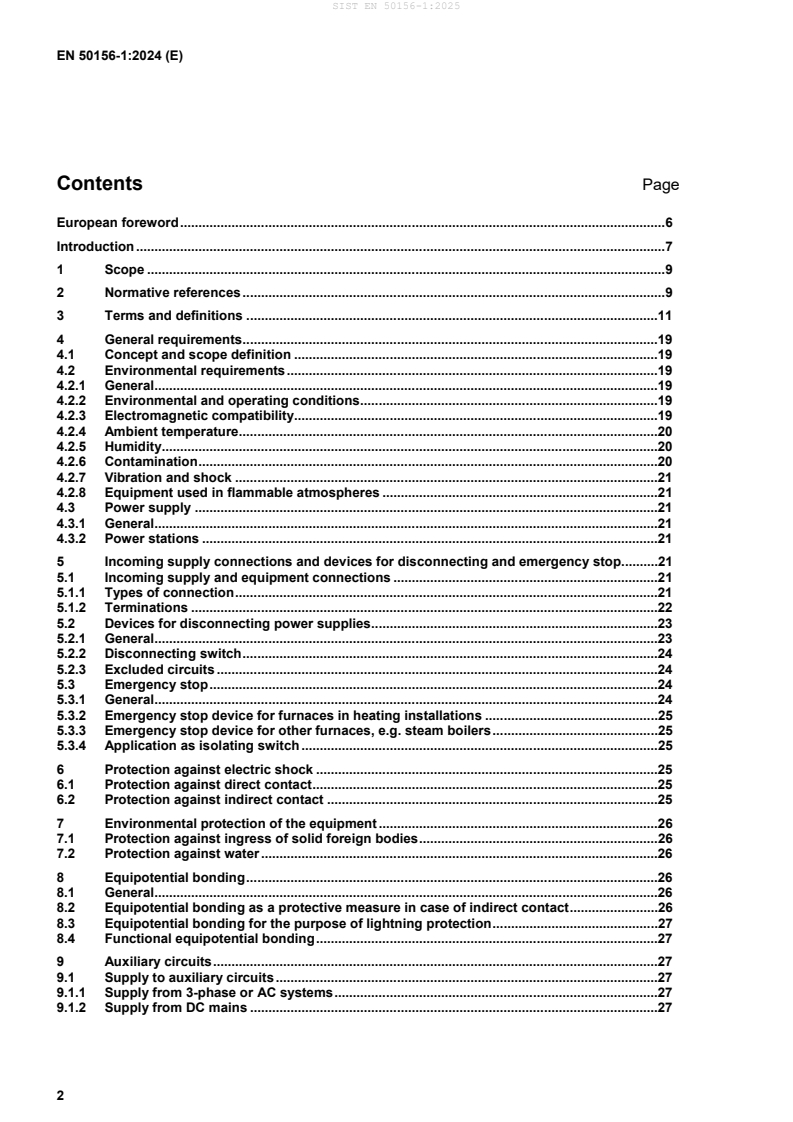
Contents Page
European foreword . 6
Introduction . 7
1 Scope . 9
2 Normative references . 9
3 Terms and definitions .11
4 General requirements .19
4.1 Concept and scope definition .19
4.2 Environmental requirements .19
4.2.1 General .19
4.2.2 Environmental and operating conditions .19
4.2.3 Electromagnetic compatibility.19
4.2.4 Ambient temperature .20
4.2.5 Humidity.20
4.2.6 Contamination .20
4.2.7 Vibration and shock .21
4.2.8 Equipment used in flammable atmospheres .21
4.3 Power supply .21
4.3.1 General .21
4.3.2 Power stations .21
5 Incoming supply connections and devices for disconnecting and emergency stop.21
5.1 Incoming supply and equipment connections .21
5.1.1 Types of connection .21
5.1.2 Terminations .22
5.2 Devices for disconnecting power supplies .23
5.2.1 General .23
5.2.2 Disconnecting switch .24
5.2.3 Excluded circuits .24
5.3 Emergency stop .24
5.3.1 General .24
5.3.2 Emergency stop device for furnaces in heating installations .25
5.3.3 Emergency stop device for other furnaces, e.g. steam boilers .25
5.3.4 Application as isolating switch .25
6 Protection against electric shock .25
6.1 Protection against direct contact .25
6.2 Protection against indirect contact .25
7 Environmental protection of the equipment .26
7.1 Protection against ingress of solid foreign bodies .26
7.2 Protection against water .26
8 Equipotential bonding .26
8.1 General .26
8.2 Equipotential bonding as a protective measure in case of indirect contact .26
8.3 Equipotential bonding for the purpose of lightning protection .27
8.4 Functional equipotential bonding .27
9 Auxiliary circuits .27
9.1 Supply to auxiliary circuits .27
9.1.1 Supply from 3-phase or AC systems .27
9.1.2 Supply from DC mains .27
9.1.3 Auxiliary circuits connected between the line conductors. 28
9.2 Voltage for auxiliary circuits . 28
9.2.1 Operating voltage of auxiliary circuits . 28
9.2.2 Preferred nominal voltages . 28
9.3 Connection to the protective conductor . 29
9.4 Overcurrent protection of auxiliary circuits . 29
9.4.1 Rating of overcurrent protective devices . 29
9.4.2 Overcurrent protection of auxiliary circuits connected to the protective conductor . 29
9.4.3 Overcurrent protection of auxiliary circuit with the middle conductor connected to the
protective conductor . 29
9.4.4 Overcurrent protection of auxiliary circuits with no electrical connection to the protective
conductor . 29
9.4.5 Overcurrent protection of control system supply transformers . 29
9.4.6 Rating and setting of overcurrent protection . 29
9.5 Measures to prevent danger from short circuits to exposed conductive parts or earth . 30
9.6 Influence of capacitance and leakage resistance . 30
10 Additional requirements for the application of a safety-related system . 30
10.1 General safety requirements . 30
10.1.1 General principles of the safety life cycle. 30
10.1.2 Objective . 32
10.1.3 Requirements . 33
10.1.4 Planning . 39
10.2 Concept and scope definition . 44
10.2.1 Objective . 44
10.2.2 Requirements . 44
10.2.3 Verification . 45
10.3 Hazard and risk analysis . 45
10.3.1 Objective . 45
10.3.2 Requirements . 46
10.3.3 Verification . 46
10.4 Safety requirements allocation . 48
10.4.1 Objective . 48
10.4.2 Requirements . 48
10.4.3 Measures for fault avoidance . 50
10.4.4 Verification . 50
10.5 Design . 50
10.5.1 Objective . 50
10.5.2 Requirements . 51
10.5.3 Measures for fault avoidance . 57
10.5.4 Consideration of times. 57
10.5.5 Hardware design . 58
10.5.6 Plant specific application software . 62
10.5.7 Periodical test . 65
10.5.8 Documentation . 65
10.5.9 Verification . 65
10.6 Installation and commissioning . 65
10.6.1 Objective . 65
10.6.2 Requirements . 65
10.6.3 Measures for fault avoidance . 66
10.6.4 Verification . 67
10.7 Safety validation . 68
10.7.1 Objective . 68
10.7.2 Requirements . 68
10.7.3 Measures for fault avoidance . 71
10.8 Operation and maintenance . 72
10.8.1 Objective . 72
10.8.2 Requirements . 72
10.9 Modification and retrofit . 76
10.9.1 Causes for modification and/or retrofit . 76
10.9.2 Objectives .76
10.9.3 Requirements .76
10.9.4 Measures against unauthorised changes or overriding .77
10.9.5 Verification .77
10.10 Decommissioning .77
10.10.1 Objectives .77
10.10.2 Requirements .77
10.10.3 Verification .78
10.11 Assessment .78
10.11.1 Objectives .78
10.11.2 Verification .78
11 Electrical equipment .78
11.1 General requirements .78
11.2 Creepage distances and clearances .78
11.3 Motors .79
11.4 Transformers .79
11.5 Switching devices .79
11.6 Operator control devices .79
11.7 Immersion electrodes .79
11.8 Trace heating systems .80
12 Cables and cords .80
12.1 General requirements .80
12.2 Insulation .80
12.3 Current-carrying capacity .80
12.4 Conductors of separate circuits .81
13 Warning signs and item designation .81
13.1 Warning signs .81
13.2 Functional identification .81
13.3 Item designations .81
14 Technical documentation .82
14.1 General .82
14.2 Documentation describing functions and connections .82
14.2.1 General .82
14.2.2 Documentation describing functions .82
14.2.3 Requirements for periodical tests .82
14.2.4 Documentation describing connections .82
14.2.5 Documentation describing the process .83
14.2.6 Documentation of the risk assessment .83
14.3 Documents for type approved components .83
14.4 Documentation of the application software .83
Annex A (informative) Configurations of programmable safety devices (PSD) with reference to
EN 61508 .85
A.1 General .85
A.2 Configuration 1oo2 .86
A.3 Configuration 1oo2D .87
A.4 Configuration 2oo3 .88
A.5 Configuration 2oo3D .89
Annex B (informative) Lifecycle of programmable safety device.91
Annex C (informative) Management of functional safety .92
Annex D (informative) Examples of determining the safety integrity level SIL using the risk graph
method .93
D.1 General .93
D.2 Risk parameter C (Consequences of the hazardous event) . 93
D.3 Risk parameter F (Frequency and duration of the time spent in the hazard area) . 93
D.4 Risk parameter P (Possibility of preventing the hazardous event) . 93
D.5 Risk parameter W (Likelihood of occurrence of the hazardous event) . 93
Bibliography . 95
European foreword
This document (EN 50156-1:2024) has been prepared by CLC/BTTF 132-2 “Revision of EN 50156 ‘Electrical
equipment for furnaces and ancillary equipment’”.
The following dates are fixed:
• latest date by which this document has (dop) 2025-10-07
to be implemented at national level by
publication of an identical national
standard or by endorsement
• latest date by which the national (dow) 2027-10-07
standards conflicting with this document
have to be withdrawn
This document supersedes EN 50156-1:2015 and all of its amendments and corrigenda (if any).
— harmonization of the definitions to the new version of EN 61508:2010;
— check and updating of the normative references;
— significant changes in subclause 4.1 and Clause 10;
— EN 50156-3 will not be created.
Attention is drawn to the possibility that some of the elements of this document may be the subject of patent
rights. CENELEC shall not be held responsible for identifying any or all such patent rights.
This document has been prepared under a standardization request addressed to CENELEC by the European
Commission.
This document covers the Principle Elements of the Safety Objectives for Electrical Equipment Designed for
Use within Certain Voltage Limits 2014/35/EU [2014 OJ L96].
This document is the first part of a series of European Standards which specify the requirements for equipment
of safety functions for furnaces, especially safety-related system to protect personnel, the furnace with its
ancillary equipment against hazards related to heat generation, the heated system and to operate reliably during
normal conditions, and abnormal conditions which can be foreseen.
This document has been prepared by the German National Committee with the participation of experts of other
National Committees. It is currently divided into 2 parts under the generic title “Electrical equipment for furnaces
and ancillary equipment”:
— Part 1: Requirements for application design and installation;
— Part 2: Requirements for design, development and type approval of safety devices and subsystems.
Any feedback and questions on this document should be directed to the users’ national committee. A
complete listing of these bodies can be found on the CENELEC website.
Introduction
This Part of EN 50156 specifies the requirements and recommendations for the application design and
installation of electrical and control equipment for furnaces and ancillary equipment and for the systems heated
by the thermal energy released in the furnace to ensure:
— safety of personnel, property and the environment;
— consistency of proper function.
The operating conditions of the furnace, the hazards of combustion and the safety of heated systems are
considered.
A safety-related system consisting of safety devices for
— monitoring of flames and other safety conditions of the firing,
— interrupting the flow of fuel to the furnace,
— ventilating the body of the furnace and the flue gas ducts,
— monitoring of the safety condition of the heated systems (e.g. water level limiter in steam boilers),
may be necessary to ensure proper ignition and combustion of fuel and to avoid the development, existence
and/or ignition of an explosive mixture of fuel and air, and also to avoid damage to the heated systems (see
3.22).
The rating of necessary safety integrity levels is based on EN 61508-1:2010.
Figure 1 is provided as an aid to understanding the relationship between the various elements of furnaces and
their ancillary equipment, the heated systems, the control system and the safety-related systems.
Key
fuel control signal
combustion air safety-related signal
flue gas system interconnection
Figure 1 — Example of the functionality of a furnace with its ancillary equipment, heated systems and
relationship to control system and safety-related system
1 Scope
This document applies to the application design and installation of electrical equipment, control circuits and
safety-related systems for furnaces which are operated with solid, liquid or gaseous fuels and their ancillary
equipment. It specifies requirements to meet the operating conditions of furnaces, to reduce the hazards of
combustion and to protect the heated systems from damage e.g. by overheating.
Such furnaces and the electrical equipment can be part by way of example of the following plant:
a) water heating systems;
b) steam boiler installations (steam and hot-water boilers) and heat recovery steam boilers;
NOTE 1 The requirements of this document apply according to the electrical equipment of electrically heated steam
boilers.
NOTE 2 Seagoing vessels and offshore facilities are governed by International Maritime Law and as such are not within
the scope of this document. These requirements can be used for such facilities.
c) warm air heaters;
d) hot-gas heaters;
e) heat exchanger systems;
f) combustion chambers of stationary turbines;
g) as long as no other standard is applicable for combined heat and power stations, we recommend the use
of the requirements of this document;
This document can also be used as reference for electrical equipment requirements for thermo-processing
equipment.
The requirements in this document are not applicable to electrical equipment for:
1) non-electrically heated appliances and burner control systems for household and similar purposes;
2) furnaces using technologies for the direct conversion of heat into electrical energy;
3) combustion chambers of non-stationary prime movers and turbines;
4) central oil supply systems for individual heating appliances;
5) furnaces using solid fuels for heating purposes for household use with a nominal thermal output up to
1 MW;
6) furnaces which are used to heat process fluids and gasses in chemical plant.
This document can be used as a basis for the requirements placed on electrical equipment for furnaces, which
are excluded from its field of application.
This document specifies special requirements for the management of functional safety.
2 Normative references
The following documents are referred to in the text in such a way that some or all of their content constitutes
requirements of this document. For dated references, only the edition cited applies. For undated references, the
latest edition of the referenced document (including any amendments) applies.
EN 1854:2022+A1:2023, Safety and control devices for burners and appliances burning gaseous and/or liquid
fuels — Pressure sensing devices for gas burners and gas burning appliances
EN 14597:2012, Temperature control devices and temperature limiters for heat generating systems
EN 50156-2, Electrical equipment for furnaces and ancillary equipment — Part 2: Requirements for design,
development and type approval of safety devices and subsystems
EN 55011:2016, Industrial, scientific and medical equipment — Radio-frequency disturbance characteristics
— Limits and methods of measurement (CISPR 11:2015)
EN 60034-1:2010, Rotating electrical machines — Part 1: Rating and performance (IEC 60034-1:2010)
EN 60034 (series), Rotating electrical machines (IEC 60034)
EN IEC 60309-1:2022, Plugs, fixed or portable socket-outlets and appliance inlets for industrial purposes —
Part 1: General requirements (IEC 60309-1:2021)
EN 60332-1-1:2004, Tests on electric and optical fibre cables under fire conditions — Part 1-1: Test for vertical
flame propagation for a single insulated wire or cable — Apparatus (IEC 60332-1-1:2004)
EN 60332-2-1:2004, Tests on electric and optical fibre cables under fire conditions — Part 2-1: Test for vertical
flame propagation for a single small insulated wire or cable — Apparatus (IEC 60332-2-1:2004)
EN 60519 (series), Safety in electroheating installations
EN 60529:1991, Degrees of protection provided by enclosures (IP Code) (IEC 60529:1989)
EN 60654-3:1997, Operating conditions for industrial-process measurement and control equipment — Part 3:
Mechanical influences (IEC 60654-3:1983)
EN 60947-2:2017, Low-voltage switchgear and controlgear — Part 2: Circuit-breakers (IEC 60947-2:2016)
EN 60947-5-1:2017, Low-voltage switchgear and controlgear — Part 5-1: Control circuit devices and switching
elements — Electromechanical control circuit devices (IEC 60947-5-1:2016)
EN 61000-4 (series), Electromagnetic compatibility (EMC) (IEC 61000-4)
EN 61000-6-7:2015, Electromagnetic compatibility (EMC) — Part 6-7: Generic standards — Immunity
requirements for equipment intended to perform functions in a safety-related system (functional safety) in
industrial locations (IEC 61000-6-7:2014)
EN 61082-1:2015, Preparation of documents used in electrotechnology — Part 1: Rules (IEC 61082-1:2014)
EN 61508-1:2010, Functional safety of electrical/electronic/programmable electronic safety-related systems —
Part 1: General requirements (IEC 61508-1:2010)
EN 61508-2:2010, Functional safety of electrical/electronic/programmable electronic safety-related systems —
Part 2: Requirements for electrical/electronic/programmable electronic safety-related systems
(IEC 61508-2:2010)
EN 61508-3:2010, Functional safety of electrical/electronic/programmable electronic safety-related systems —
Part 3: Software requirements (IEC 61508-3:2010)
As amended by EN 55011:2016/A1:2017, EN 55011:2016/A11:2020 and EN 55011:2016/A2:2021.
As amended by EN 60529:1991/A1:2000, EN 60529:1991/corrigendum May 1993, EN 60529:1991/A2:2013,
EN 60529:1991/A2:2013/AC:2016-12, EN 60529:1991/A2:2013/AC:2019-02.
As impacted by EN 60947-2:2017/A1:2020.
EN 61508-6:2010, Functional safety of electrical/electronic/programmable electronic safety-related systems —
Part 6: Guidelines on the application of IEC 61508-2 and IEC 61508-3 (IEC 61508-6:2010)
EN 61810-1:2015, Electromechanical elementary relays — Part 1: General and safety requirements
(IEC 61810-1:2015)
EN IEC 81346-1:2022, Industrial systems, installations and equipment and industrial products — Structuring
principles and reference designations — Part 1: Basic rules (IEC 81346-1:2022)
EN IEC 60445:2021, Basic and safety principles for man-machine interface, marking and identification —
Identification of equipment terminals, conductor terminations and conductors (IEC 60445:2021)
EN IEC 60664-1:2020, Insulation coordination for equipment within low-voltage systems — Part 1: Principles,
requirements and tests (IEC 60664-1:2020)
EN IEC 60947-3:2021, Low-voltage switchgear and controlgear — Part 3: Switches, disconnectors, switch-
disconnectors and fuse-combination units (IEC 60947-3:2020)
EN IEC 60947-4-1:2019, Low-voltage switchgear and controlgear — Part 4-1: Contactors and motor-starters —
Electromechanical contactors and motor-starters (IEC 60947-4-1:2018)
EN IEC 61000-6-4:2019, Electromagnetic compatibility (EMC) — Part 6-4: Generic standards — Emission
standard for industrial environments (IEC 61000-6-4:2018)
EN IEC 61558-1:2019, Safety of transformers, reactors, power supply units and combinations thereof — Part
1: General requirements and tests (IEC 61558-1:2017)
IEC 60364-4 (series), Low-voltage electrical installations — Part 4: Protection for safety
HD 60364-4-41:2017, Low-voltage electrical installations — Part 4-41: Protection for safety — Protection
against electric shock (IEC 60364-4-41:2005)
IEC 60417 DB, Graphical symbols for use on equipment
IEC 60617 DB:2024, Graphical symbols for diagrams
ISO 3864 (series), Graphical symbols — Safety colours and safety signs
3 Terms and definitions
For the purposes of this document, the following terms and definitions apply.
ISO and IEC maintain terminological databases for use in standardization at the following addresses:
— ISO Online browsing platform: available at https://www.iso.org/obp
— IEC Electropedia: available at https://www.electropedia.org/
3.1
actuating element
component which produces changes in other electrical circuits or volume flows (e.g. fuel, air) as a result of the
effect of changes in signal
Note 1 to entry: Examples are valves, switches and motors including their common auxiliaries, also for example solenoid
valve with magnetic actuation and final control element for direct process control.
As amended by HD 60364-4-41:2017/A11:2017 and HD 60364-4-41:2017/A12:2019.
3.2
assessment
investigation to judge if the functional safety of the EUC is achieved by the realized safety-related system
3.3
audit
systematic and independent examination on the basis of evidence if defined specifications for the management
of functional safety are met for every life cycle phase
3.4
auxiliary circuit
electrical circuit for ancillary functions, e.g. control circuits (command initiation, interlocking operation), signalling
and measuring circuits
3.5
control circuit
electrical circuit used for the operational control and the protection of the furnace and of the power circuits
3.6
control device
device connected into the control circuit and used for controlling the operation of the furnace
EXAMPLES A manually operated switch, a limit transducer, or a valve
3.7
current limiting
limiting of electric current to a predetermined maximum value for the defined operation by means of a suitable
arrangement of components in the circuit
3.8
diagnostic coverage
proportion of all hardware faults which are detected by the online diagnostics embedded in the safety-related
system
Note 1 to entry: To determine the diagnostic coverage a fault model should be used which is sufficient for the concerned
technology.
3.9
electrical equipment
equipment for furnaces including all electrical equipment for the fields of application mentioned in Clause 1
3.10
emergency stop device
manually operated switch which can be used to shut down the furnace and its associated equipment in the
event of danger
Note 1 to entry: The emergency stop device shall prevent fuel flow and electrical preheating.
Note 2 to entry: In EN 12952-8:2022 and EN 12952-9:2022 the emergency stop is defined as master fuel trip (MFT).
3.11
equipment under control
EUC
equipment, machinery, apparatus or plant used for manufacturing, process, transportation, medical or other
activities
Note 1 to entry: The EUC control system is separate and distinct from the EUC.
[SOURCE: IEC 61508-4:2010, 3.2.1]
3.12
external influences
influences from the environment which could bring about a failure or malfunction of the function
Note 1 to entry: The following are examples of external influences on electrical systems:
a) Power failure and return of power, over-voltage and under-voltage, short-power interruptions (< 0,5 s);
b) Electromagnetic and electrical disturbances, such as inductive or capacitive interference or leakage currents
through resistive connections;
c) For microelectronic components, ionising radiation.
3.13
factory acceptance test
FAT
test performed in the factory of the manufacturer which proves the correct functions of a logic subsystem
3.14
failure
F
termination of the ability of an item to perform required function
Note 1 to entry: After failure, the item is in fault condition.
Note 2 to entry: A failure is an event, as distinguished from a fault, which is a state.
Note 3 to entry: This concept as defined does not apply to items consisting of software only.
[SOURCE: IEC 60050-845:1990, definition 845-27-105]
3.15
failure mechanism
physical or chemical process which causes an assembly to fail
Note 1 to entry: It may also define how the assembly fails, e.g. fail to safety. In doing so it may be possible to detect a
failure tendency direction.
3.16
fault
state of an item characterised by the inability to perform a required function, excluding the inability during
preventative maintenance or other planned actions, or due to lack of external resources e.g. loss of power
supplied
Note 1 to entry: See Figure 2 and Figure 3.
Note 2 to entry: A fault is often the result of a failure of the item itself, but can exist without prior failure (192–04–01 of
IEC 60050-192:2015).
Figure 2 — Types of faults to be considered
Figure 3 — Causes of faults to be considered
3.17
fault exclusion
exclusion of a theoretically possible fault whose occurrence, in the light of practical experience, or under the
given physical conditions is so unlikely that it needs not to be taken into account
3.18
fault tolerance time
time between the occurrence of an unsafe condition (caused by the process itself or due to equipment failure)
and the point when the process changes into critical operation, which would result in a hazardous event in the
absence of any safety-related systems
3.19
flame monitoring device
flame monitoring unit
safety device which is triggered by the presence or absence of flame and gives an appropriate signal to the
protective equipment
3.20
function test
complete test of an individual safety-related function
Note 1 to entry: This includes testing as to whether the safety-related system (sensors, protective equipment and actuating
elements) is acting correctly when a process parameter is changed to ensure correct operation of the safety-related function.
Note 2 to entry: Function tests of the complete safety-related functions may be carried out by overlapping partial tests.
3.21
furnace
structure within which heat is generated to a controlled temperature by combustion of fuel
Note 1 to entry: The English term “furnace” includes struct
...