

SIST-TP CEN/TR 17924:2025
(Main)Safety and control devices for burners and appliances burning gaseous and/or liquid fuels - Guidance on hydrogen specific aspects
General Information
- Abstract
This document gives guidance on hydrogen specific safety, design, construction, and performance requirements and testing of safety, control or regulating devices (hereafter referred to as controls) for burners and appliances burning gases with hydrogen content.
The following hydrogen concentrations are covered in this document:
- H2NG (hydrogen in natural gas) blends of 20 % hydrogen; or
- 100 % hydrogen; or
- varying blends / admixtures to natural gas.
Furthermore, it identifies the expected revision needs of the existing CEN/TC 58 standards as well as the need of potential further new standardization deliverables.
- Status
- Published
- Public Enquiry End Date
- 01-Dec-2024
- Publication Date
- 12-Feb-2025
- Technical Committee
- PLN - Gas appliances for domestic use
- Current Stage
- 6060 - National Implementation/Publication (Adopted Project)
- Start Date
- 07-Feb-2025
- Due Date
- 14-Apr-2025
- Completion Date
- 13-Feb-2025

Overview
SIST-TP CEN/TR 17924:2025 - Safety and control devices for burners and appliances burning gaseous and/or liquid fuels - Guidance on hydrogen specific aspects - is a CEN Technical Report prepared by CEN/TC 58. It provides guidance for adapting safety, design, construction and performance requirements and tests of safety and control devices (controls) used with fuels containing hydrogen. The document covers hydrogen concentrations including H2NG blends (~20 % H2), 100 % hydrogen, and varying hydrogen admixtures to natural gas, and addresses controls with declared inlet pressures up to 500 kPa and nominal sizes up to DN 250.
Key technical topics and requirements
This guidance highlights hydrogen-specific considerations that may require future revisions of CEN/TC 58 standards. Key topics include:
- Classification and terminology for hydrogen and hydrogen admixtures, referencing ISO 14687 purity concepts and H2NG scenarios.
- Design and construction impacts on mechanical components (holes, breathers, diaphragms), materials (metals, zinc alloys, elastomers, springs), and electrical parts.
- Performance requirements such as leak-tightness, leakage-rate measurement methods, laminar flow modelling, and durability under hydrogen exposure.
- Risk assessment for explosion limits (LEL), carbon monoxide formation and thermal effects when using hydrogen or hydrogen-rich gases.
- Marking and instructions for safe installation, operation and maintenance.
- Mitigation measures for diaphragm fracture or non-metallic part failure and strategies to maintain concentrations below 25 % LEL (Annexes H and I).
- Proposals for leakage rate testing and room-size impact for installations (Annex G).
- Identification of standardization gaps and recommended future research and new deliverables (Annexes A–F).
Practical applications and who uses this standard
This Technical Report is practical for:
- Manufacturers of pressure regulators, automatic shut-off valves, flame supervision devices, gas/air ratio controls, multifunctional controls and valve proving systems.
- Product designers and R&D teams assessing material compatibility, leak paths and durability with hydrogen-containing fuels.
- Test labs and certification bodies developing or updating test methods for hydrogen service.
- Installers, integrators and safety engineers planning appliance installations, room ventilation and mitigation measures to stay below LEL thresholds.
- Standards committees and regulators preparing revisions to CEN/TC 58 standards and coordinating across CEN/TCs (e.g., gas infrastructure, boilers, burners, industrial thermoprocessing).
Related standards (select)
- EN 13611:2019 (general requirements for safety & control devices)
- EN 16726:2015+A1:2018 (gas quality)
- ISO 14687:2019 (hydrogen purity)
- PAS 4444:2020 (hydrogen properties reference)
For implementation or certification questions, consult your national standards body or the full CEN/TR 17924:2025 text for detailed annexes and measurement guidance.
Relations
- Effective Date
- 01-Mar-2025
- Effective Date
- 28-Jan-2026
Get Certified
Connect with accredited certification bodies for this standard

DNV
DNV is an independent assurance and risk management provider.

Lloyd's Register
Lloyd's Register is a global professional services organisation specialising in engineering and technology.
DNV Energy Systems
Energy and renewable energy certification.
Sponsored listings
Frequently Asked Questions
SIST-TP CEN/TR 17924:2025 is a technical report published by the Slovenian Institute for Standardization (SIST). Its full title is "Safety and control devices for burners and appliances burning gaseous and/or liquid fuels - Guidance on hydrogen specific aspects". This standard covers: This document gives guidance on hydrogen specific safety, design, construction, and performance requirements and testing of safety, control or regulating devices (hereafter referred to as controls) for burners and appliances burning gases with hydrogen content. The following hydrogen concentrations are covered in this document: - H2NG (hydrogen in natural gas) blends of 20 % hydrogen; or - 100 % hydrogen; or - varying blends / admixtures to natural gas. Furthermore, it identifies the expected revision needs of the existing CEN/TC 58 standards as well as the need of potential further new standardization deliverables.
This document gives guidance on hydrogen specific safety, design, construction, and performance requirements and testing of safety, control or regulating devices (hereafter referred to as controls) for burners and appliances burning gases with hydrogen content. The following hydrogen concentrations are covered in this document: - H2NG (hydrogen in natural gas) blends of 20 % hydrogen; or - 100 % hydrogen; or - varying blends / admixtures to natural gas. Furthermore, it identifies the expected revision needs of the existing CEN/TC 58 standards as well as the need of potential further new standardization deliverables.
SIST-TP CEN/TR 17924:2025 is classified under the following ICS (International Classification for Standards) categories: 23.060.40 - Pressure regulators; 27.060.01 - Burners and boilers in general. The ICS classification helps identify the subject area and facilitates finding related standards.
SIST-TP CEN/TR 17924:2025 has the following relationships with other standards: It is inter standard links to SIST-TP CEN/TR 17924:2023, SIST EN 13611:2019. Understanding these relationships helps ensure you are using the most current and applicable version of the standard.
SIST-TP CEN/TR 17924:2025 is available in PDF format for immediate download after purchase. The document can be added to your cart and obtained through the secure checkout process. Digital delivery ensures instant access to the complete standard document.
Standards Content (Sample)
SLOVENSKI STANDARD
01-marec-2025
Nadomešča:
SIST-TP CEN/TR 17924:2023
Varnostne in nadzorne naprave za gorilnike in aparate na plin in/ali tekoča goriva -
Navodilo o posebnih vidikih, značilnih za vodik
Safety and control devices for burners and appliances burning gaseous and/or liquid
fuels - Guidance on hydrogen specific aspects
Sicherheits- und Regeleinrichtungen für Brenner und Brennstoffgeräte für gasförmige
und/oder flüssige Brennstoffe - Leitfaden zu wasserstoffspezifischen Aspekten
Dispositifs de sécurité et de contrôle des brûleurs et des appareils brûlant des
combustibles gazeux et/ou liquides - Orientations concernant les aspects spécifiques à
l'hydrogène
Ta slovenski standard je istoveten z: CEN/TR 17924:2025
ICS:
23.060.40 Tlačni regulatorji Pressure regulators
27.060.01 Gorilniki in grelniki vode na Burners and boilers in
splošno general
2003-01.Slovenski inštitut za standardizacijo. Razmnoževanje celote ali delov tega standarda ni dovoljeno.
CEN/TR 17924
TECHNICAL REPORT
RAPPORT TECHNIQUE
February 2025
TECHNISCHER REPORT
ICS 23.060.40 Supersedes CEN/TR 17924:2023
English Version
Safety and control devices for burners and appliances
burning gaseous and/or liquid fuels - Guidance on
hydrogen specific aspects
Dispositifs de sécurité et de contrôle des brûleurs et Sicherheits- und Regeleinrichtungen für Brenner und
des appareils brûlant des combustibles gazeux et/ou Brennstoffgeräte für gasförmige und/oder flüssige
liquides - Orientations concernant les aspects Brennstoffe - Leitfaden zu wasserstoffspezifischen
spécifiques à l'hydrogène Aspekten
This Technical Report was approved by CEN on 6 January 2025. It has been drawn up by the Technical Committee CEN/TC 58.
CEN members are the national standards bodies of Austria, Belgium, Bulgaria, Croatia, Cyprus, Czech Republic, Denmark, Estonia,
Finland, France, Germany, Greece, Hungary, Iceland, Ireland, Italy, Latvia, Lithuania, Luxembourg, Malta, Netherlands, Norway,
Poland, Portugal, Republic of North Macedonia, Romania, Serbia, Slovakia, Slovenia, Spain, Sweden, Switzerland, Türkiye and
United Kingdom.
EUROPEAN COMMITTEE FOR STANDARDIZATION
COMITÉ EUROPÉEN DE NORMALISATION
EUROPÄISCHES KOMITEE FÜR NORMUNG
CEN-CENELEC Management Centre: Rue de la Science 23, B-1040 Brussels
© 2025 CEN All rights of exploitation in any form and by any means reserved Ref. No. CEN/TR 17924:2025 E
worldwide for CEN national Members.
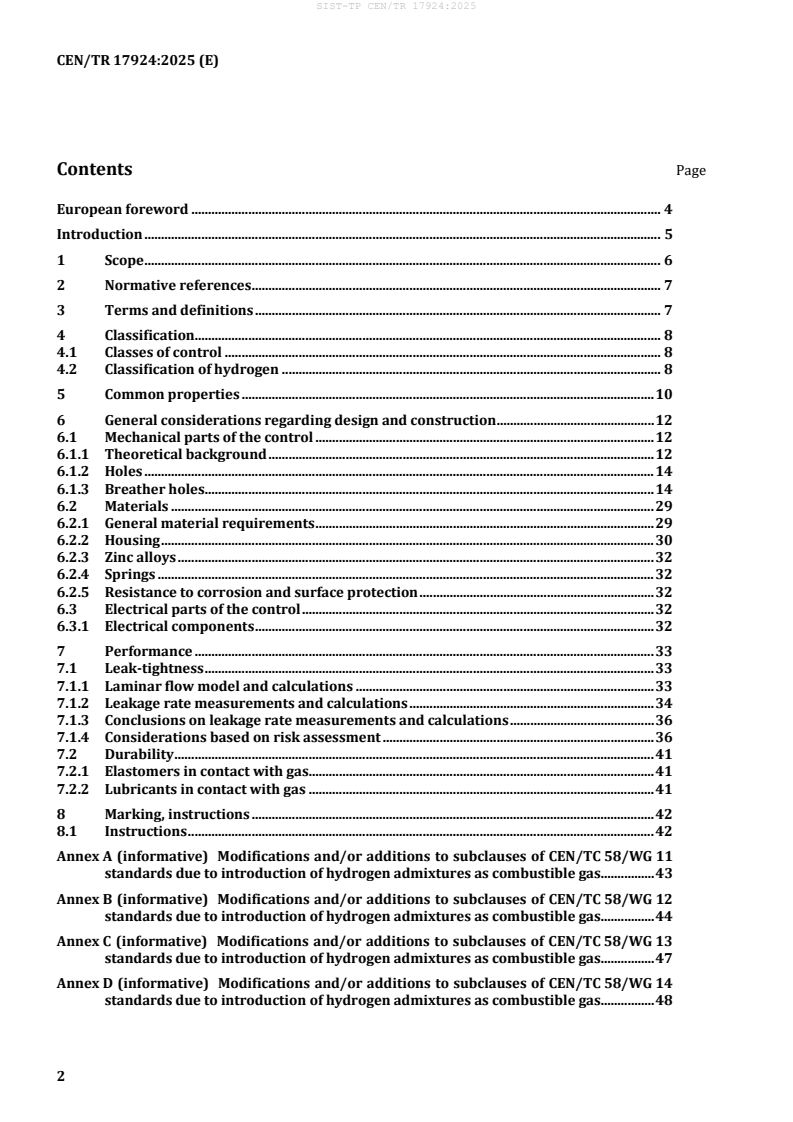
Contents Page
European foreword . 4
Introduction . 5
1 Scope . 6
2 Normative references . 7
3 Terms and definitions . 7
4 Classification. 8
4.1 Classes of control . 8
4.2 Classification of hydrogen . 8
5 Common properties . 10
6 General considerations regarding design and construction . 12
6.1 Mechanical parts of the control . 12
6.1.1 Theoretical background . 12
6.1.2 Holes . 14
6.1.3 Breather holes . 14
6.2 Materials . 29
6.2.1 General material requirements . 29
6.2.2 Housing . 30
6.2.3 Zinc alloys . 32
6.2.4 Springs . 32
6.2.5 Resistance to corrosion and surface protection . 32
6.3 Electrical parts of the control . 32
6.3.1 Electrical components . 32
7 Performance . 33
7.1 Leak-tightness . 33
7.1.1 Laminar flow model and calculations . 33
7.1.2 Leakage rate measurements and calculations . 34
7.1.3 Conclusions on leakage rate measurements and calculations . 36
7.1.4 Considerations based on risk assessment . 36
7.2 Durability . 41
7.2.1 Elastomers in contact with gas . 41
7.2.2 Lubricants in contact with gas . 41
8 Marking, instructions . 42
8.1 Instructions . 42
Annex A (informative) Modifications and/or additions to subclauses of CEN/TC 58/WG 11
standards due to introduction of hydrogen admixtures as combustible gas. 43
Annex B (informative) Modifications and/or additions to subclauses of CEN/TC 58/WG 12
standards due to introduction of hydrogen admixtures as combustible gas. 44
Annex C (informative) Modifications and/or additions to subclauses of CEN/TC 58/WG 13
standards due to introduction of hydrogen admixtures as combustible gas. 47
Annex D (informative) Modifications and/or additions to subclauses of CEN/TC 58/WG 14
standards due to introduction of hydrogen admixtures as combustible gas. 48
Annex E (informative) Risk assessment, standardization, certification, and operation of gas
appliances with admixtures fluctuating up to 20 vol.-% hydrogen to natural gas . 49
Annex F (informative) Risk assessment, standardization, certification, and operation of gas
appliances using hydrogen referring to ISO 14687:2019, Type I, Grade A . 54
F.1 General . 54
F.2 Hydrogen Grade A and impurities: Risk analysis concerning CO thermal overload . 60
F.3 Reaction equations which explain carbon monoxide formation . 61
F.3.1 Hydrogen . 61
F.3.2 Methane, ethane, and propane . 61
F.4 Conclusions for carbon monoxide and thermal loads . 62
Annex G (informative) Proposal for leakage rate requirements and tests for gas pipe work
including controls (e. g., valves, regulators, pressure switches) used in gas appliances
(e. g., forced draught gas-burners or industrial thermo-processing equipment) and
the impact on the installation room size . 63
Annex H (informative) Diaphragm fracture or fracture of non-metallic parts leakage rate
mitigation measures . 75
Annex I (informative) Leakage rate mitigation measures . 82
Bibliography . 86
European foreword
This document (CEN/TR 17924:2025) has been prepared by Technical Committee CEN/TC 58 “Safety
and control devices for burners and appliances burning gaseous or liquid fuels”, the secretariat of which
is held by BSI.
Attention is drawn to the possibility that some of the elements of this document may be the subject of
patent rights. CEN shall not be held responsible for identifying any or all such patent rights.
Any feedback and questions on this document should be directed to the users’ national standards body.
A complete listing of these bodies can be found on the CEN website.
Introduction
The use of hydrogen as a renewable fuel next to biomethane is seen as a promising alternative to natural
gas soon. As soon as the according regulations and standards are in force, the use of hydrogen can be
expected on a more regular basis.
For this reason, the heating and combustion business have to provide suitable solutions based on
standardized safety, construction, and performance requirements.
This document provides a summary of considerations regarding safety and performance aspects for
safety and control devices which will in some cases require further research.
There are research projects on the use of hydrogen admixture with natural gas in various percentages or
as hydrogen like the European THyGA project (up to 60 vol.-% hydrogen fluctuating admixtures to
natural gas).
Therefore, this document is written in preparation of future revisions of CEN/TC 58 documents and will
describe findings pointing at potential changes, give the according research backgrounds and provide
literature sources.
This document includes evaluations regarding different gases, comparing their distinctive
characteristics, properties, and their impact on the risk assessment for gas appliances. Theoretical
evaluations are complemented by laboratory measurements.
For the future implementation of hydrogen in the whole value chain co-operation with other CEN/TCs is
necessary like e. g., CEN/TC 234 “Gas infrastructure”, CEN/TC 109 “Central heating boilers using gaseous
fuels”, CEN/TC 131 “Gas burners using fans”, and CEN/TC 186 “Industrial thermoprocessing — Safety”.
This document up to Annex A is based on the structure of EN 13611:2019.
In this document only those clauses of EN 13611:2019 are referred to, which can be affected by using
hydrogen or hydrogen admixtures as gaseous fuels. All other clauses, which can be not affected, are not
listed in this document.
For the calculations and measurements in this document the specific admixture of 20 vol.-% hydrogen
and 80 vol.-% methane is used. This admixture is already used as a typical reference in other standards.
1 Scope
This document is written in preparation of future revision of standards dealing with the general safety,
design, construction, and performance requirements and testing of safety, control or regulating devices
(hereafter referred to as controls) for burners and appliances burning hydrogen (see 3.2) or hydrogen
admixtures (see 3.3).
This document refers to controls with declared maximum inlet pressure up to and including 500 kPa and
of nominal connection sizes up to and including DN 250.
The purpose of this document is to provide guidance on hydrogen specific topics, which need to be
considered in the future standardization of controls covered by CEN/TC 58 documents including:
— automatic shut-off valves;
— automatic burner control systems;
— flame supervision devices;
— gas/air ratio controls;
— pressure regulators;
— manual taps;
— mechanical thermostats;
— multifunctional controls;
— pressure sensing devices;
— valve proving systems;
— automatic vent valves.
Hydrogen will play a significant role in the future in several energy segments and requirements and test
methods need to be verified and adapted, if necessary.
The main target of this document is to lay the ground for defining requirements and tests for controls
used for safety related functions (e. g., safety valves, automatic burner control systems, gas/air ratio
controls) or regulating devices.
Summaries of subclauses to be addressed in the respective standards of each CEN/TC 58 WG are given in
— Annex A: Specific considerations to CEN/TC 58/WG 11 standards,
— Annex B: Specific considerations to CEN/TC 58/WG 12 standards,
— Annex C: Specific considerations to CEN/TC 58/WG 13 standards, and
— Annex D: Specific considerations to CEN/TC 58/WG 14 standards.
Aspects to be included for gas appliances (e. g., boilers, forced draught gas-burners, or industrial
thermoprocessing equipment) covering e. g., risk assessment, standardization, certification, and
operation are listed in
— Annex E: Risk assessment, standardization, certification, and operation of gas appliances with
admixtures fluctuating up to 20 vol.-% hydrogen to natural gas, and
— Annex F: Risk assessment, standardization, certification, and operation of gas appliances using
hydrogen referring to ISO 14687:2019, Type I, Grade A.
Proposals for leakage rate requirements and tests for gas pipework including controls (e. g., valves,
regulators, pressure switches) used in gas appliances (e. g., forced draught gas-burners or industrial
thermoprocessing equipment) and the impact on the installation room size are shown in Annex G.
Considerations to be taken to stay below possible lower explosion limits in gas appliances (e. g., boilers,
forced draught gas-burners, or industrial thermoprocessing equipment) and its installation rooms are
shown in
— Annex H: Examples of mitigation measures in case of diaphragm fracture or fracture of non-metallic
parts for different combustible gases to stay below 25 % of their LEL, based on measurements and
calculations, and
— Annex I: Examples of mitigation measures in case of leakages for different combustible gases to stay
below 25 % of their LEL, based on measurements and calculations.
2 Normative references
The following documents are referred to in the text in such a way that some or all of their content
constitutes requirements of this document. For dated references, only the edition cited applies. For
undated references, the latest edition of the referenced document (including any amendments) applies.
EN 13611:2019 , Safety and control devices for burners and appliances burning gaseous and/or liquid
fuels — General requirements
3 Terms and definitions
For the purposes of this document, the terms and definitions given in EN 13611:2019, and the following
apply.
ISO and IEC maintain terminology databases for use in standardization at the following addresses:
— ISO Online browsing platform: available at https://www.iso.org/obp/
— IEC Electropedia: available at https://www.electropedia.org/
3.1
lower explosion limit
LEL
lowest concentration of the explosion range at which an explosion can occur
[SOURCE: EN 13237:2012, 3.19.1]
3.2
hydrogen
gaseous hydrogen with a purity of at least Type I, Grade A
Note 1 to entry: Purity limits are given in ISO 14687:2019.
Note 2 to entry: For calculations in this document hydrogen is considered as 100 % H2.
1 2
Impacted by EN 13611:2019/AC:2021 Assumption for calculations for DN > 100
3.3
hydrogen admixture
hydrogen in natural gas fluctuating admixture with an overall hydrogen content from 0 to 100 vol.-%
4 Classification
4.1 Classes of control
In some standards the use of hydrogen can require a categorization based on the used concentration.
There will be fluctuations and variation in concentration which will be limited and will be described in
future revisions of EN 16726:2015+A1:2018.
There are research and considerations on the use of hydrogen as an admixture with natural gas in various
percentages or as hydrogen.
Referring to the scope there is no further need in this document to classify controls with respect to using
hydrogen admixtures or hydrogen.
4.2 Classification of hydrogen
Based on literature hydrogen gas properties and purity are:
Table 1 is an extract of PAS 4444:2020 + A1:2021, Table 1:
Table 1 — Hydrogen test gas characteristics — gas dry at 15 °C and 1 013,25 mbar
Gas family Test gases Designation Composition Wl Hl Ws Hs d
by volume
3 3 3 3
MJ/m MJ/m MJ/m MJ/m
Gases of the fourth family
Group Y Reference gas G40 H2 = 99,9 38,67 10,2 45,88 12,1 0,0696
Limit gases To be defined
Purity report from Hy4Heat:
https://static1.squarespace.com/static/5b8eae345cfd799896a803f4/t/5e58ebfc9df53f4eb31f7cf8/15
82885917781/WP2+Report+final.pdf
Table 2 is an extract of ISO 14687:2019, Table 1.
Table 3 is an extract of ISO 14687:2019, Table 4.
Table 2 — Hydrogen and hydrogen-based fuel classification by application
Type Grade Category Applications Clause
A — Gaseous hydrogen; internal combustion engines for 7
transportation; residential/commercial combustion
appliances (e. g., boilers, cookers, and similar
applications)
B — Gaseous hydrogen; industrial fuel for power generation 7
I
and heat generation except PEM fuel cell applications
Gas
C — Gaseous hydrogen; aircraft and space-vehicle ground 7
support systems except PEM fuel cell applications
a,b
D — Gaseous hydrogen; PEM fuel cells for road vehicles 5
E PEM fuel cells for stationary appliances 6
1 Hydrogen-based fuel; high efficiency/low power
applications
2 Hydrogen-based fuel; high power applications
3 Gaseous hydrogen; high power/high efficiency
applications
a
Grade D may be used for other fuel cell applications for transportation including forklifts and other industrial
trucks if agreed upon between supplier and customer.
b
Grade D may be used for PEM fuel cell stationary appliances alternative to grade E category 3.
Table 3 — Fuel quality specification for applications other than PEM fuel cell road vehicle and
stationary applications
Constituents Type I Type II Type III
Grade A Grade B Grade C Grade C
a
Hydrogen fuel index 98,0 % 99,90 % 99,995 % 99,995 % 99,995 %
(minimum mole
fraction, %)
Para-hydrogen NS NS NS 95,0 % 95,0 %
(minimum mole
fraction, %)
Impurities
(maximum content)
Total gases 20 000 µmol/mol 1 000 µmol/mol 50 µmol/mol 50 µmol/mol
c c
Water (H20) Non-condensing Non-condensing
at all ambient at all ambient
(mole fraction, %)
b
conditions conditions
c c
Total hydrocarbon 100 µmol/mol Non-condensing
at all ambient
conditions
b d d
Oxygen (O ) 100 µmol/mol
b d d
Argon (Ar)
b c c
Nitrogen (N2) 400 µmol/mol
Constituents Type I Type II Type III
Grade A Grade B Grade C Grade C
Helium (He) 39 µmol/mol 39 µmol/mol
e e
Carbon dioxide (CO )
e e
Carbon monoxide 1 µmol/mol
(CO)
Mercury (Hg) 0,004 µmol/mol
Sulfur (S) 2,0 µmol/mol 10 µmol/mol
g f f f
Permanent
particulates
f
Density
NOTE NS: Not specified.
a
The hydrogen fuel index is determined by subtracting the “total non-hydrogen gases” expressed in mole
percent, from 100 mol percent.
b
Combined water, oxygen, nitrogen, and argon: maximum mole fraction of 1,9 %.
c
Combined nitrogen, water, and hydrocarbon: max. 9 μmol/mol.
d
Combined oxygen and argon: max. 1 μmol/mol.
e
Total CO and CO: max. 1 μmol/mol.
f
To be agreed between supplier and customer.
g
The hydrogen cannot contain dust, sand, dirt, gums, oils, or other substances in an amount sufficient to
damage the fuelling station equipment or the vehicle (engine) being fuelled.
EASEE-Gas also published a common business practice about the hydrogen quality specification for
dedicated hydrogen pipelines. Link: https://easee-gas.eu/latest-cbps
Furthermore, a CEN/TS 17977 for the quality of hydrogen used in converted/rededicated gas systems is
available, which is proposing a minimum hydrogen concentration of 98 mol-% within certain maximum
impurity concentrations.
5 Common properties
The intention of this document is to enable the use of the controls with hydrogen and hydrogen
admixtures. Controls are already used with several fuels like biomethane or natural gas. Therefore, it is
reasonable to summarize the properties of different common fuels like methane (natural gas), propane,
and butane in comparison to a specific hydrogen admixture and hydrogen. Based on similarities and
differences further conclusions, consequences, risk assessments, and impacts on materials are derived in
this document.
Table 4 summarizes the properties of air (as common reference), methane (natural gas), propane, butane,
hydrogen, and 20 vol.-% hydrogen/80 vol.-% methane admixtures.
Table 4 — Gas properties
properties unit air methane propane butane hydro- 20 vol.-%
(CH4) (C3H8) (isobu- gen (H2) H2/80 vol.-%
tane) CH
(C H ) admixture
4 10
a a a a b
lower explosion limit [%] — 4,4 1,7 1,3 4,0 4,2
LEL (20 °C)
a a a a c
flammability [°C] — 595 445 460 560 588
temperature (air)
3 d d d d d d
density ρ (at 15 °C) [kg/m ] 1,220 0,680 1,893 2,527 0,084 0,560
gas
e e e d d
relative density d — 1 0,555 1,550 2,075 0,069 0,457
V
related to air
d d d f
dynamic viscosity η [Pa⋅s] 17,97 E- 10,87 E- 7,95 E-6 7,32 E-6 8,65 E-6 10,98 E-6
d d
(at 15 °C) 6 6
3 3 g g g g c
minimum air supply [m air]/[m — 9,52 23,80 30,94 2,38 8,12
AS gas]
3 e e e g c
calorific value H [MJ/m ] — 34,02 88.00 116,09 10,22 29,27
i
(inferior) (at 15 °C;
101,3 kPa)
3 e e e d d
calorific value H [MJ/m ] — 37,78 95,65 125,81 11,97 32,56
s
(superior) (at 15 °C;
101,3 kPa)
3 e e e d d
Wobbe Index W [MJ/m ] — 45,67 70,69 80,58 38,62 43,24
i
(inferior)
3 e e e d d
Wobbe Index W [MJ/m ] — 50,72 76,84 87,33 45,65 48,20
s
(superior)
Source:
a
IEC 80079-20-1:2017 “Explosive atmospheres — Part 20-1: Material characteristics for gas and vapour
classification — Test methods and data”
b
Scholten Dörr Wersky “Mögliche Beeinflussung von Bauteilen der Gasinstallation bei Wasserstoffan-
wendungen”
c
Calculation by CEN/TC 58 WG 15/PG 1, 2022–02
d th
VDI-Wärmeatlas: 2013. 11 edition
e
EN 437:2021
f
Mason, E.A., and S. C. Saxena: The Physics of Fluids, Volume 1, Number 5 (1958), pp. 361; and C. R. Wilke: The
Journal of Chemical Fluids, Volume 18, Number 4 (1950), pp. 517
g
Günter Cerbe: “Grundlagen der Gastechnik — Gasbeschaffung — Gasverteilung — Gasverwendung”
Based on the common properties and measurements the following aspects demand further
considerations with respect to subclauses of EN 13611:2019:
a) leak-tightness — see 7.1
b) breather holes and housings — see 6.1.3 and 6.2.2
c) materials — see 6.2
d) safety aspects (risk assessment — see Annexes E and F)
6 General considerations regarding design and construction
6.1 Mechanical parts of the control
NOTE 6.1 refers to EN 13611:2019, 6.2.
6.1.1 Theoretical background
To avoid too much damping on the regulator, breather holes need to have a certain minimum size. That
is, the flow can turn from laminar to turbulent, because breather hole sizes are bigger than
internal/external leakage hole sizes.
Figure 1 — Leakage models by theory
Figure 1 summarizes the flow characteristics which need to be taken into consideration if leakage of
gaseous fuel is to be expected.
Depending on the design and the leakage rate a molecular, laminar, or turbulent flow of the gaseous fuel
is differentiated.
Based on the common configuration of a control a molecular flow can be excluded.
Calculations in the area between a molecular and laminar flow showed that the “Knudsen flow” is not
relevant (see also Figure 2).
NOTE Information regarding the modified Knudsen equation for transitional flow (between molecular and
laminar) can be found in EN ISO 12807:2021, Annex B. Practical maximum leakage rates for molecular flow and
minimum leakage rates for viscous laminar flow can be found in EN 1779:1999+A1:2004, 7.3.
Key
X pinhole diameter (mm)
Y air flow rate (cm /h)
Figure 2 — Pinhole calculations derived from leakage rate measurements at Δp = 15 kPa
Justification that Knudsen flow is not applicable is supported by calculation results.
Very small pinholes are needed for EN 13611:2019 and EN 15502-1:2021 limits:
— ~ 35 μm for 40 cm /h at Δp = 15 kPa air;
— ~ 50 μm for 140 cm /h at Δp = 15 kPa air.
Calculation with Knudsen number:
The diameter of a pinhole leakage rate needs to be:
— < 230 nm for pure molecular flow type;
— > 11,5 μm for pure laminar flow type.
Conclusion: 35 μm > 11,5 μm, therefore, molecular flow and Knudsen flow is not relevant.
The internal and external leakage rates are limited by the CEN/TC 58 and CEN/TC 109 standards. A
summary of these values is given in Table 5. Based on the design of the control (the leakage path is
assumed to have a greater length than cross-section) a laminar flow was confirmed by measurements.
For breather holes, where the leakage rate limit value in case of fracture of a diaphragm is 70 dm /h of
air, and for housings, where the leakage rate limit value in case of fracture of non-metallic parts is
30 dm /h of air, referring to the model given in 6.1.3.2 turbulent flow was confirmed.
Table 5 — Summary of internal and external leakage rate requirements in current standard
editions
Parameter Nominal inlet size Internal leakage rate at External leakage rate at
⋅ p /minimum ⋅ p /minimum
1,5 max 1,5 max
Test criteria
15 kPa 15 kPa
Unit
3 3
[cm /h] [cm /h]
EN 13611:2019, Safety DN < 10 ≤ 20 ≤ 20
and control devices for
10 ≤ DN ≤ 25 ≤ 40 ≤ 40
burners and appliances
burning gaseous and/or
25 < DN ≤ 80 ≤ 60 ≤ 60
liquid fuels — General
80 < DN ≤ 150 ≤ 100
requirements
150 < DN ≤ 250 ≤ 150
EN 126:2012, DN < 10 EN 13611:2019 ≤ 60
Multifunctional controls
10 ≤ DN EN 13611:2019 ≤ 120
for gas burning appliances
EN 161:2022, EN 88-1:2022, EN 88-2:2022, EN 88-3:2022, and EN 1854:2022 refer to the requirements and
tests of EN 13611:2019.
EN 15502-1:2021, Gas- — — ≤ 140 (at 5 kPa or 15 kPa
fired heating boilers — only)
Part 1: General
requirements and tests
6.1.2 Holes
NOTE 6.1.2 refers to EN 13611:2019, 6.2.2.
There are no specific considerations to holes.
6.1.3 Breather holes
NOTE 6.1.3 refers to EN 13611:2019, 6.2.3.
6.1.3.1 Alternative requirements for breather holes
For breather holes the leakage rate limit values in case of diaphragm fracture is 70 dm /h of air, and
turbulent flow was confirmed by measurements.
In case of transition flow, where the flow rates are between the values of
— laminar flow referring to the flow model in 7.1.1, and
— turbulent flow referring to the flow model in 6.1.3.2,
the leakage rate limit values are to be calculated referring to the turbulent flow model as given in 6.1.3.2.
This covers the higher leakage rate values to stay on the safe side.
Table 6 shows the breather hole and housing leakage rate limits (referring to air as test gas), which are
only to be considered if a diaphragm fracture or fracture of non-metallic parts is assumed as failure, and
the possibility to use an alternative requirement and test.
Table 6 — Breather hole and housings leakage rates referring to air as test gas
Parameter Scope limit of Housing at Breather hole at
standards
Test criteria pmax pmax pmax
3 3
Unit [kPa] [dm /h] [dm /h]
EN 13611:2019: General up to and including 500 30 70
EN 126:2012: up to and including 50 — —
Multifunctional controls
EN 161:2022: Automatic up to and including 500 EN 13611:2019 —
shut-off valves
EN 88-1:2022: Pressure up to and including 50 EN 13611:2019 EN 13611:2019 or
regulators, pneumatic type alternative requirement
and test
EN 88-2:2022: Pressure above 50 up to and EN 13611:2019 EN 13611:2019
regulators, pneumatic type including 500
EN 88-3:2022: Pressure EN 13611:2019 or
up to and including 500 EN 13611:2019
regulators, electronic type alternative requirement
and test
EN 1854:2022: Pressure up to and including 500 EN 13611:2019 or EN 13611:2019 or
sensing devices alternative requirement alternative requirement
and test and test
If all controls used in applications fulfil the modifications and additions described in
— EN 88-1:2022, 6.2.3, or
— EN 88-3:2022, 6.2.3, or
— EN 1854:2022, 6.2.3 and 6.3.2,
the leakage rate limits and tests are the same as given in Table 5.
Modifications and additions for leakage rates are described in EN 88-1:2022, 6.2.3, EN 88-3:2022, 6.2.3
or EN 1854:2022, 6.2.3 and 6.3.2. In instances where all controls used in applications fulfil these
modifications and additions in any of these documents, see Table 5.
In this case there is no need to apply the considerations given in 6.1.3.2 to 6.1.3.5 concerning breather
holes.
6.1.3.2 Turbulent flow model and calculations
For a turbulent flow characteristic, the Bernoulli equation is applicable:
𝜌𝜌 𝑉𝑉̇
𝑖𝑖 leak, 𝑖𝑖
𝛥𝛥𝛥𝛥 =𝜉𝜉 × � �
2 𝐴𝐴
leak
where
𝛥𝛥𝛥𝛥 is the pressure difference between two pressure zones;
𝜉𝜉 is the pressure drop coefficient;
𝜌𝜌 is the density of the gas;
𝑖𝑖 is the type of gas;
is the volume flow rate of the leak;
𝑉𝑉̇
leak
𝐴𝐴 is the dimension of the leak.
leak
This leads to:
𝑉𝑉̇
air,leak
𝑉𝑉̇=
gas,leak, 𝑖𝑖
𝑑𝑑
�
𝑉𝑉,gas,𝑖𝑖
where
𝑑𝑑 is the relative density (see Table 4).
𝑉𝑉
Table 7 shows the calculation of leakage rates referring to the turbulent flow model.
Table 7 — Calculation of leakage rates and their relation to different combustible gases in case
of diaphragm fracture or fracture of non-metallic housing parts (turbulent flow)
air me- pro- butane hy- 20 vol.-%
thane pane (C H ) dro- H /80 vol.-
4 10 2
(CH4) (C3H8) gen % CH4
(H2) admixture
density ρgas at 15 °C [kg/m ] 1,220 0,680 1,893 2,527 0,084 0,560
volume flow rate 1,0 1,34 0,80 0,69 3,81 1,48
𝜌𝜌
air
factor related to air =
�
𝜌𝜌
gas
volume flow rate — 1,0 0,60 0,52 2,85 1,10
𝜌𝜌
methane
=
factor related to
�
𝜌𝜌
gas
methane
lower explosion limit (LEL) [%] — 4,4 1,7 1,3 4,0 4,2
LEL
LEL factor considered methane — 1,0 2,59 3,38 1,10 1,05
=
as an additional factor
LEL
gas
gas leakage rate — 1,0 0,64 0,57 0,32 0,87
𝜌𝜌 LEL
methane methane
factor related to
= 1/� ⋅ �
�
𝜌𝜌 LEL
gas gas
methane for different
gases to stay below
their LEL
related to methane, the limit values for leakage rates — — 36 % 43 % 68 % 13 %
measured with air for different gases to stay below
their LEL is reduced by (see Table 6):
NOTE The values do not consider the result of application risk assessments, which can lead to lower leakage
rates.
The gas density ρ and its LEL determine the risk level under turbulent flow conditions (e. g. for hydrogen
the leakage rate is reduced by 68 % to achieve the same risk level as for methane).
6.1.3.3 Leakage rate measurements and calculations
Leakage rates of different test leaks, sized for 1 dm³/h, 30 dm³/h, and 70 dm³/h air leakage rate at design
pressures of each Δp of 6 kPa, 15 kPa, 50 kPa, 100 kPa, and 500 kPa, were measured from 6 kPa up to
500 kPa with air, methane, hydrogen, and 20 vol.-% hydrogen/80 vol.-% methane admixture (see
Table 8). The test leak design pressures are chosen referring to typical used pressure limits in
applications and EN 13611:2019, EN 88-1:2022, EN 88-2:2022, EN 88-3:2022, and EN 1854:2022.
Table 8 — Test leaks and their design pressures
test leak designation air design pressures test media
leakage
rate
[dm³/h] [kPa]
A.3.1, A.3.2, A.3.3, A.3.4, A.3.5 1 6, 15, 50, 100, 500 air, hydrogen, methane, 20 vol.-%
hydrogen/80 vol.-% methane admixture
A.4.1, A.4.2, A.4.3, A.4.4, A.4.5 30 6, 15, 50, 100, 500 air, hydrogen, methane, 20 vol.-%
hydrogen/80 vol.-% methane admixture
A.5.1, A.5.2, A.5.3, A.5.4, A.5.5 70 6, 15, 50, 100, 500 air, hydrogen, methane, 20 vol.-%
hydrogen/80 vol.-% methane admixture
Measurement results are dependent on the size of the test leak: test leaks of the same leakage rate
designed at a Δp of e. g. 6 kPa and 500 kPa have different leakage rate ratios with respect to air and
methane. Therefore, each maximum measurement and worst-case ratio values are listed in Table 9 to
Table 12, columns measurement.
In case of test leak size 1 dm³/h the Reynold’s numbers calculated from measurements are much lower
than 2.300 indicating laminar flow referring to the Hagen-Poiseuille equation. In all other cases the
Reynold’s numbers calculated from measurements are much higher than 2.300 indicating turbulent flow
referring to the Bernoulli equation.
Table 9 — Measurements and calculations of leakage rate ratios for different combustible gases,
related to methane, in case of diaphragm fracture (70 dm³/h air leakage rate)
combustible gas column M1: column M3: column M5: column M7:
breather hole gas time to reach 1 m time to reach 25 % of minimum required
leakage rate BGL to methane emitted the LEL of methane air exchange flow
be considered based based on maximum emitted in a volume rate BACmin for
on maximum measured values of 1 m based on methane emitted to
measured values maximum measured stay below 25 % of its
|
values LEL in a volume of
|
column C3:
1 m based on
|
column C1:
calculations rounded
maximum measured
column C5:
calculations rounded to the worst case
values
to the worst case calculations rounded
|
to the worst case
column C7:
calculations rounded
to the worst case
3 3
[dm /h] [h] [h] [m /h]
3 3 3 3
at 70 dm /h air at 70 dm /h air at 70 dm /h air at 70 dm /h air
M1 C1 M3 C3 M5 C5 M7 C7
methane (CH ) 108,3 94 9,2 10,6 0,10 0,11 9,85 8,55
combustible gas column M2: column M4: column M6: column M8:
ratios compared
ratio calculations ratio calculations ratio calculations ratio calculations
to values of
rounded to the worst rounded to the worst rounded to the worst rounded to the worst
methane above
case of case of case of case of
breather hole gas time ratios to be time ratios to be minimum required
leakage rate ratios to considered to reach considered to reach air exchange rate
be considered based 1 m emitted gas 25 % of the LEL of the ratios to be
on maximum based on maximum emitted gas in a considered to stay
measured values measured values volume of 1 m based below 25 % of the LEL
on maximum of the emitted gas in a
| |
measured values volume of 1 m based
column C2: column C4:
on maximum
|
calculations rounded calculations rounded
measured values
column C6:
to the worst case to the worst case
|
calculations rounded
column C8:
to the worst case
calculations rounded
to the worst case
[–] [–] [–] [–]
M2 C2 M4 C4 M6 C6 M8 C8
propane (C H )/ no data 0,60 no data 1,67 no data 0,645 no data 1,55
3 8
methane available available available available
butane (C4H10)/ no data 0,52 no data 1,93 no data 0,570 no data 1,76
methane available available available available
hydrogen (H2)/ 2,74 2,93 0,36 0,34 0,32 0,30 3,05 3,23
methane
20 vol.-% 1,11 1,10 0,90 0,91 0,85 0,86 1,16 1,15
hydrogen/
80 vol.-%
methane
admixture
6.1.3.4 Conclusions on leakage rate measurements and calculations in case of diaphragm
fracture
The conclusions based on the flow rate calculations and laboratory measurements are:
— measurements confirmed a turbulent flow referring to the Bernoulli equation;
— the measured and calculated values for hydrogen are about 3 times higher than the limit values for
methane;
— for 20 vol.-% hydrogen/80 vol.-% methane admixtures the values are about 10 % higher.
The requirement stays at 70 dm /h, and a risk assessment for the application in the real foreseeable use
is conducted. Examples are given in 6.1.3.5.
The higher leakage rate values for propane and butane need to be considered (see Table 7) in the risk
assessment of appliances.
6.1.3.5 Considerations based on a risk assessment
6.1.3.5.1 Design – failure mode conditions
The existing design configurations have been reviewed under failure mode conditions as shown in
Figure 3. Under these configurations a leakage to the environment would be possible and would lead to
the following consequences.
a) Gas circuit pressurized during operation b) Gas circuit pressurized permanently
only (configuration A) (configuration B)
Under a failure two different leakage scenarios Under a failure two different leakage scenarios
occur: occur:
A.1 Damage of a diaphragm with one closed B.1 Damage of a diaphragm → leakage to environ-
upstream gas safety shut-off valve → no leakage ment
A.2 Damage of a diaphragm with open upstream B.2 Damage of a diaphragm with open downstream
gas safety shut-off valve→ leakage to environment gas safety shut-off valve → leakage to environment
and flow to combustion chamber and flow to combustion chamber
Key
V automatic shut-off valve (EN 161:2022)
M non-metallic housing part (EN 13611:2019)
R regulator, where a diaphragm rupture leads to external or internal leakage
(EN 88-1:2022, EN 88-2:2022, EN 88-3:2022)
S pressure sensing device (EN 1854:2022)
Figure 3 — Example of risk scenarios in case of diaphragm fracture
Since in case of diaphragm fracture or fracture of non-metallic parts a certain amount of gas can leak to
the environment (see Table 8 and Table 15), it is important to consider the accumulated gas within a
defined room volume and time. Therefore, the LEL values of each combustible gas are considered.
Two scenarios for different combustible gases are considered:
— calculation of minimum required air exchange rate BAC in case of diaphragm fracture or fracture
min
of non-metallic parts for different combustible gases to stay below 25 % of their LEL at certain
leakage rate limits (see Table 10);
— calculation of minimum required room volume BV in case of diaphragm fracture or fracture of non-
min
metallic parts at a typical air exchange rate of 0,3 1/h for different combustible gases to stay below
25 % of their LEL at certain leakage rate limits (see Table 11).
Table 10 — Worst-case calculations of minimum required breather hole air exchange flow rates
BACmin for different combustible gases to stay below 25 % of their LEL at certain leakage rate
limits
leakage combustible column M1: column M2: column M3: column M4:
rate gas
breather hole gas time to time to reach minimum required air
with
leakage rate BGL to be reach 1 m 25 % of the LEL exchange flow rate BAC
min
air
considered based on of the gas of the emitted for the emitted gas to stay
maximum measured emitted gas in a volume below 25 % of its LEL in a
3 3
values based on of 1 m based on volume of 1 m based on
maximum maximum maximum measured
|
measured measured values
column C1:
values values
|
calculations rounded to
| |
column C4:
the worst case with
column C2: column C3:
Hagen-Poiseuille calculations rounded to
calculations calculations the worst case
(laminar flow
rounded to rounded to the
@ 1 dm³/h) and
the worst worst case
Bernoulli (turbulent
case
flow)
3 3 3
[dm /h] [dm /h] [h] [h] [m /h]
M1 C1 M2 C2 M3 C3 M4 C4
1 methane (CH4) 1,65 1,65 606 606 6,6 6,6 0,15 0,15
propane — 2,26 — 442 — 1,8 — 0,53
(C H )
3 8
butane (C H ) — 2,45 — 408 — 1,3 — 0,75
4 10
hydrogen (H ) 3,59 2,08 278 480 2,7 4,8 0,36 0,2
20 vol.-% H /
2 1,71 1,64 584 609 6,1 6,4 0,16 0,15
80 vol.-% CH
admixture
30 methane (CH4) 40,3 40 24,8 25 0,27 0,27 3,67 3,63
propane — 24 — 42 — 0,17 — 5,67
(C H )
3 8
butane (C H ) — 21 — 48 — 0,15 — 6,41
4 10
hydrogen (H ) 102,3 114 9,7 8,7 0,09 0,08 10,31 11,49
20 vol.-% H /
2 41,6 44 24 22,7 0,25 0,23 3,96 4,20
80 vol.-% CH
admixture
70 methane (CH4) 108,3 94 9,2 10,6 0,10 0,11 9,9 8,6
propane — 56 — 18 — 0,07 — 13,2
(C H )
3 8
butane (C H ) — 49 — 21 — 0,06 — 15
4 10
hydrogen (H ) 238 267 4,2 3,7 0,04 0,03 23,8 27
20 vol.-% H /
2 110,6 103 9 9,7 0,09 0,1 10,6 9,8
80 vol.-% CH
admixture
For Table 10 the worst-case approach consists of:
— no air exchange;
— appliance is in stand-by → only external leakage rate is considered for a gas circuit under permanent
pressure;
— internal leakage rate is not connected to the room and therefore of no concern.
For each combustible gas, the time to reach 25 % of its LEL in a certain room volume can be
...