

SIST EN 12201-1:2024
(Main)Plastics piping systems for water supply, and for drains and sewers under pressure - Polyethylene (PE) - Part 1: General
General Information
- Abstract
This document specifies materials and the general aspects of polyethylene (PE) pressure piping systems (mains and service pipes) for buried or above ground applications, intended for the conveyance of water for human consumption, raw water prior to treatment, drains and sewers under pressure, vacuum sewer systems, and water for other purposes, with the exception of industrial application.
NOTE 1 For PE components intended for the conveyance of water intended for human consumption and raw water prior to treatment attention is drawn to Clause 6 of this document. Components manufactured for water for other purposes, drains and sewers, and vacuum systems are possibly not suitable for water supply for human consumption.
NOTE 2 Industrial application is covered by EN ISO 15494 [6].
The intended use includes sea outfalls, laid in water and pipes suspended below bridges.
It also specifies the test parameters for the test methods referred to in this document.
In conjunction with EN 12201-2, EN 12201 3, EN 12201 4 and EN 12201 5, this document is applicable to PE pipes, fittings and valves, their joints and joints with components of PE and other materials intended to be used under the following conditions:
a) allowable operating pressure, PFA, up to 25 bar ;
b) an operating temperature of 20 °C as a reference temperature.
NOTE 3 For applications operating at constant temperatures greater than 20 °C and up to and including 50 °C, see Annex A.
The EN 12201 series covers a range of allowable operating pressures and gives requirements concerning colours.
NOTE 4 It is the responsibility of the purchaser or specifier to make the appropriate selections from these aspects, taking into account their particular requirements and any relevant national guidance or regulations and installation practices or codes.
- Status
- Published
- Public Enquiry End Date
- 06-Nov-2023
- Publication Date
- 07-Mar-2024
- Technical Committee
- PCV - Plastic pipes, fittings and valves
- Current Stage
- 6060 - National Implementation/Publication (Adopted Project)
- Start Date
- 06-Mar-2024
- Due Date
- 11-May-2024
- Completion Date
- 08-Mar-2024

Overview
EN 12201-1:2024 - Plastics piping systems for water supply, and for drains and sewers under pressure - Polyethylene (PE) - Part 1: General, is the CEN system standard defining the materials and general requirements for PE pressure piping systems. It covers mains and service pipes for buried or above-ground use conveying drinking water, raw water prior to treatment, drains and sewers under pressure, vacuum sewer systems and other non-industrial water uses. The revision adds PE 100-RC materials (enhanced slow‑crack resistance), extends the size range up to 3 000 mm diameter, and updates test methods.
Key topics and requirements
- Scope and intended use: Includes sea outfalls, pipes laid in water and pipes suspended below bridges; excludes industrial applications (covered by EN ISO 15494).
- Materials & classification: Requirements for PE materials (PE 80, PE 100, PE 100‑RC), compounds, additives, pigments and colour requirements.
- Operating conditions: Applicable for allowable operating pressures (PFA) up to 25 bar and using 20 °C as the reference temperature; guidance for higher constant temperatures (up to 50 °C) is in Annex A.
- Joints and components: General aspects for pipes, fittings, valves and joints between PE and other materials; joint test methods referenced.
- Water quality: Clause 6 highlights considerations for components intended for drinking water - national regulations and testing arrangements may apply.
- Test parameters and methods: Specifies test parameters used across EN 12201 series and references to ISO/EN test standards (e.g., long‑term hydrostatic strength, RCP, FNCT).
- System performance: Fitness-for-purpose and conformity guidance addressed in companion parts (EN 12201-2 to EN 12201-5 and CEN/TS 12201-7).
Applications
EN 12201-1:2024 is used where reliable PE pressure piping is required:
- Drinking water distribution and service connections (subject to national drinking‑water approvals)
- Raw water conveyance, treatment plant intakes
- Pressurised sewer and vacuum sewer systems
- Coastal and marine outfalls, submerged runs and bridge‑suspended pipelines
- Municipal utilities, infrastructure contractors and designers select components compliant with this standard to ensure material performance, pressure rating and joint integrity.
Who should use this standard
- Pipe, fitting and valve manufacturers (product design and testing)
- Water utilities and specifiers (product selection and procurement)
- Design and civil engineers / consultants (system design and installation)
- Test laboratories and conformity assessment bodies
- Installers and contractors applying recognised materials and jointing methods
Related standards
- EN 12201-2 (Pipes), EN 12201-3 (Fittings), EN 12201-4 (Valves), EN 12201-5 (Fitness for purpose)
- CEN/TS 12201-7 (Guidance for assessment of conformity)
- Relevant ISO/EN test standards referenced within EN 12201-1 for RCP, long‑term hydrostatic strength, OIT, FNCT, etc.
Keywords: EN 12201-1:2024, polyethylene (PE) piping systems, PE100-RC, water supply standards, drains and sewers under pressure, PE pipes and fittings, pressure piping up to 25 bar.
Relations
- Effective Date
- 01-Apr-2024
- Effective Date
- 08-Apr-2026
- Effective Date
- 08-Apr-2026
- Effective Date
- 28-Jan-2026
- Effective Date
- 28-Jan-2026
- Effective Date
- 28-Jan-2026
- Effective Date
- 28-Jan-2026
- Effective Date
- 28-Jan-2026
- Effective Date
- 28-Jan-2026
- Refers
SIST EN 13059:2003+A1:2008 - Safety of industrial trucks - Test methods for measuring vibration - Effective Date
- 28-Jan-2026
- Effective Date
- 28-Jan-2026
- Effective Date
- 28-Jan-2026
- Effective Date
- 28-Jan-2026
- Effective Date
- 28-Jan-2026
- Effective Date
- 28-Jan-2026
Get Certified
Connect with accredited certification bodies for this standard

DIBt (Deutsches Institut für Bautechnik)
German Institute for Building Technology.
DIN CERTCO
DIN Group product certification.
Zavod za gradbeništvo Slovenije (ZAG) - Inšpekcija
ZAG inspection body for construction products, structures, and materials.
Sponsored listings
Frequently Asked Questions
SIST EN 12201-1:2024 is a standard published by the Slovenian Institute for Standardization (SIST). Its full title is "Plastics piping systems for water supply, and for drains and sewers under pressure - Polyethylene (PE) - Part 1: General". This standard covers: This document specifies materials and the general aspects of polyethylene (PE) pressure piping systems (mains and service pipes) for buried or above ground applications, intended for the conveyance of water for human consumption, raw water prior to treatment, drains and sewers under pressure, vacuum sewer systems, and water for other purposes, with the exception of industrial application. NOTE 1 For PE components intended for the conveyance of water intended for human consumption and raw water prior to treatment attention is drawn to Clause 6 of this document. Components manufactured for water for other purposes, drains and sewers, and vacuum systems are possibly not suitable for water supply for human consumption. NOTE 2 Industrial application is covered by EN ISO 15494 [6]. The intended use includes sea outfalls, laid in water and pipes suspended below bridges. It also specifies the test parameters for the test methods referred to in this document. In conjunction with EN 12201-2, EN 12201 3, EN 12201 4 and EN 12201 5, this document is applicable to PE pipes, fittings and valves, their joints and joints with components of PE and other materials intended to be used under the following conditions: a) allowable operating pressure, PFA, up to 25 bar ; b) an operating temperature of 20 °C as a reference temperature. NOTE 3 For applications operating at constant temperatures greater than 20 °C and up to and including 50 °C, see Annex A. The EN 12201 series covers a range of allowable operating pressures and gives requirements concerning colours. NOTE 4 It is the responsibility of the purchaser or specifier to make the appropriate selections from these aspects, taking into account their particular requirements and any relevant national guidance or regulations and installation practices or codes.
This document specifies materials and the general aspects of polyethylene (PE) pressure piping systems (mains and service pipes) for buried or above ground applications, intended for the conveyance of water for human consumption, raw water prior to treatment, drains and sewers under pressure, vacuum sewer systems, and water for other purposes, with the exception of industrial application. NOTE 1 For PE components intended for the conveyance of water intended for human consumption and raw water prior to treatment attention is drawn to Clause 6 of this document. Components manufactured for water for other purposes, drains and sewers, and vacuum systems are possibly not suitable for water supply for human consumption. NOTE 2 Industrial application is covered by EN ISO 15494 [6]. The intended use includes sea outfalls, laid in water and pipes suspended below bridges. It also specifies the test parameters for the test methods referred to in this document. In conjunction with EN 12201-2, EN 12201 3, EN 12201 4 and EN 12201 5, this document is applicable to PE pipes, fittings and valves, their joints and joints with components of PE and other materials intended to be used under the following conditions: a) allowable operating pressure, PFA, up to 25 bar ; b) an operating temperature of 20 °C as a reference temperature. NOTE 3 For applications operating at constant temperatures greater than 20 °C and up to and including 50 °C, see Annex A. The EN 12201 series covers a range of allowable operating pressures and gives requirements concerning colours. NOTE 4 It is the responsibility of the purchaser or specifier to make the appropriate selections from these aspects, taking into account their particular requirements and any relevant national guidance or regulations and installation practices or codes.
SIST EN 12201-1:2024 is classified under the following ICS (International Classification for Standards) categories: 23.040.05 - Pipeline and its parts for external sewage systems; 23.040.20 - Plastics pipes; 91.140.60 - Water supply systems; 93.030 - External sewage systems. The ICS classification helps identify the subject area and facilitates finding related standards.
SIST EN 12201-1:2024 has the following relationships with other standards: It is inter standard links to SIST EN 12201-1:2011, SIST EN ISO 1183-2:2026, SIST ISO 6964:2021, SIST EN ISO 1183-1:2025, SIST EN 12099:1999, SIST EN ISO 1183-2:2019, SIST EN ISO 1167-1:2006, SIST EN ISO 9080:2012, SIST EN 17722:2025, SIST EN 13059:2003+A1:2008, SIST EN ISO 16871:2003, SIST EN ISO 13477:2008, SIST EN ISO 6259-1:2015, SIST EN ISO 15512:2019, SIST EN ISO 11357-6:2025. Understanding these relationships helps ensure you are using the most current and applicable version of the standard.
SIST EN 12201-1:2024 is available in PDF format for immediate download after purchase. The document can be added to your cart and obtained through the secure checkout process. Digital delivery ensures instant access to the complete standard document.
Standards Content (Sample)
SLOVENSKI STANDARD
01-april-2024
Nadomešča:
SIST EN 12201-1:2011
Cevni sistemi iz polimernih materialov za oskrbo z vodo in za odvodnjavanje in
kanalizacijo pod tlakom - Polietilen (PE) - 1. del: Splošno
Plastics piping systems for water supply, and for drains and sewers under pressure -
Polyethylene (PE) - Part 1: General
Kunststoff-Rohrleitungssysteme für die Wasserversorgung und für Entwässerungs- und
Abwasserdruckleitungen - Polyethylen (PE) - Teil 1: Allgemeines
Systèmes de canalisations en plastique pour l'alimentation en eau et pour les
branchements et les collecteurs d'assainissement avec pression - Polyéthylène (PE) -
Partie 1: Généralités
Ta slovenski standard je istoveten z: EN 12201-1:2024
ICS:
23.040.05 Cevovodi za zunanje Pipeline and its parts for
sisteme za odpadno vodo in external sewage systems
njihovi deli
91.140.60 Sistemi za oskrbo z vodo Water supply systems
93.030 Zunanji sistemi za odpadno External sewage systems
vodo
2003-01.Slovenski inštitut za standardizacijo. Razmnoževanje celote ali delov tega standarda ni dovoljeno.
EN 12201-1
EUROPEAN STANDARD
NORME EUROPÉENNE
January 2024
EUROPÄISCHE NORM
ICS 23.040.20 Supersedes EN 12201-1:2011
English Version
Plastics piping systems for water supply, and for drains
and sewers under pressure - Polyethylene (PE) - Part 1:
General
Systèmes de canalisations en plastique pour Kunststoff-Rohrleitungssysteme für die
l'alimentation en eau et pour les branchements et les Wasserversorgung und für Entwässerungs- und
collecteurs d'assainissement avec pression - Abwasserdruckleitungen - Polyethylen (PE) - Teil 1:
Polyéthylène (PE) - Partie 1: Généralités Allgemeines
This European Standard was approved by CEN on 10 December 2023.
CEN members are bound to comply with the CEN/CENELEC Internal Regulations which stipulate the conditions for giving this
European Standard the status of a national standard without any alteration. Up-to-date lists and bibliographical references
concerning such national standards may be obtained on application to the CEN-CENELEC Management Centre or to any CEN
member.
This European Standard exists in three official versions (English, French, German). A version in any other language made by
translation under the responsibility of a CEN member into its own language and notified to the CEN-CENELEC Management
Centre has the same status as the official versions.
CEN members are the national standards bodies of Austria, Belgium, Bulgaria, Croatia, Cyprus, Czech Republic, Denmark, Estonia,
Finland, France, Germany, Greece, Hungary, Iceland, Ireland, Italy, Latvia, Lithuania, Luxembourg, Malta, Netherlands, Norway,
Poland, Portugal, Republic of North Macedonia, Romania, Serbia, Slovakia, Slovenia, Spain, Sweden, Switzerland, Türkiye and
United Kingdom.
EUROPEAN COMMITTEE FOR STANDARDIZATION
COMITÉ EUROPÉEN DE NORMALISATION
EUROPÄISCHES KOMITEE FÜR NORMUNG
CEN-CENELEC Management Centre: Rue de la Science 23, B-1040 Brussels
© 2024 CEN All rights of exploitation in any form and by any means reserved Ref. No. EN 12201-1:2024 E
worldwide for CEN national Members.
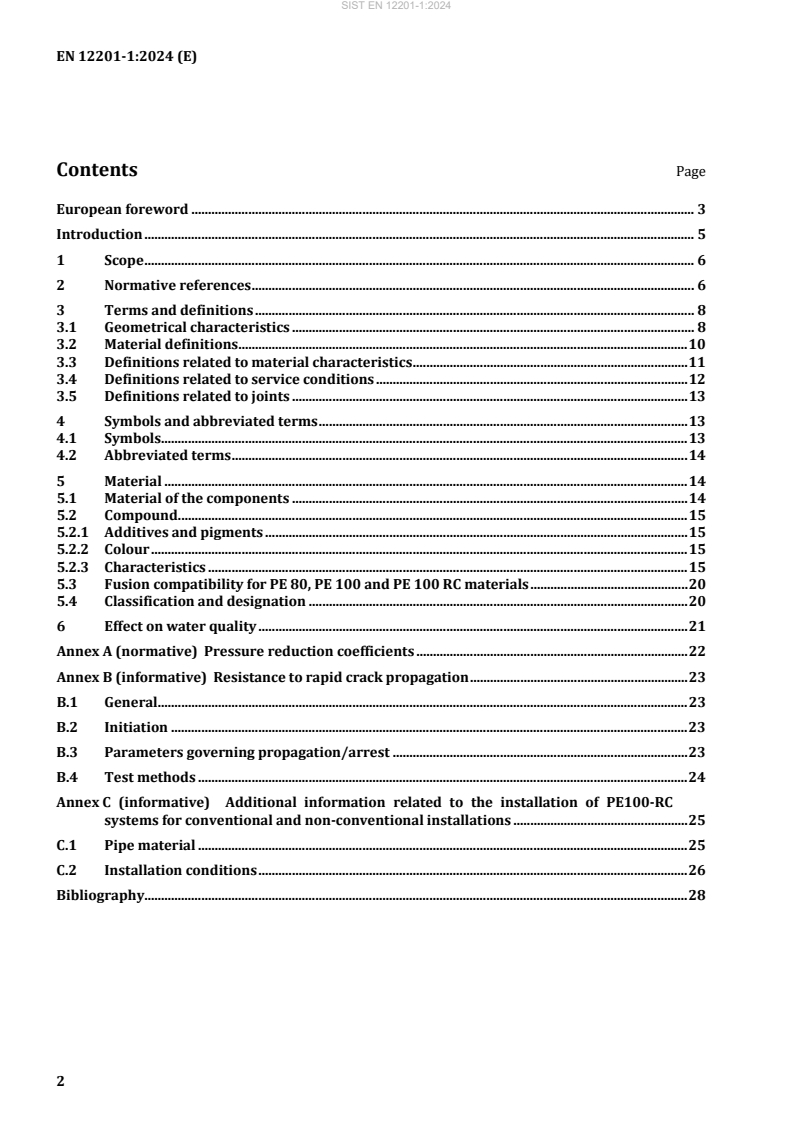
Contents Page
European foreword . 3
Introduction . 5
1 Scope . 6
2 Normative references . 6
3 Terms and definitions . 8
3.1 Geometrical characteristics . 8
3.2 Material definitions . 10
3.3 Definitions related to material characteristics . 11
3.4 Definitions related to service conditions . 12
3.5 Definitions related to joints . 13
4 Symbols and abbreviated terms . 13
4.1 Symbols. 13
4.2 Abbreviated terms . 14
5 Material . 14
5.1 Material of the components . 14
5.2 Compound . 15
5.2.1 Additives and pigments . 15
5.2.2 Colour . 15
5.2.3 Characteristics . 15
5.3 Fusion compatibility for PE 80, PE 100 and PE 100 RC materials . 20
5.4 Classification and designation . 20
6 Effect on water quality . 21
Annex A (normative) Pressure reduction coefficients . 22
Annex B (informative) Resistance to rapid crack propagation . 23
B.1 General . 23
B.2 Initiation . 23
B.3 Parameters governing propagation/arrest . 23
B.4 Test methods . 24
Annex C (informative) Additional information related to the installation of PE100-RC
systems for conventional and non-conventional installations . 25
C.1 Pipe material . 25
C.2 Installation conditions . 26
Bibliography. 28
European foreword
This document (EN 12201-1:2024) has been prepared by Technical Committee CEN/TC 155 “Plastics
piping systems and ducting systems”, the secretariat of which is held by NEN.
This European Standard shall be given the status of a national standard, either by publication of an
identical text or by endorsement, at the latest by July 2024, and conflicting national standards shall be
withdrawn at the latest by July 2024.
Attention is drawn to the possibility that some of the elements of this document may be the subject of
patent rights. CEN shall not be held responsible for identifying any or all such patent rights.
This document supersedes EN 12201-1:2011.
System Standards are based on the results of the work being undertaken in ISO/TC 138 “Plastics pipes,
fittings and valves for the transport of fluids”, which is a Technical Committee of the International
Organization for Standardization (ISO).
They are supported by separate standards on test methods to which references are made throughout the
System Standard.
The System Standards are consistent with general standards on functional requirements and on
recommended practice for installation.
EN 12201 consists of the following parts:
— EN 12201-1, Plastics piping systems for water supply, and for drains and sewers under pressure —
Polyethylene (PE) — Part 1: General (this document);
— EN 12201-2, Plastics piping systems for water supply, and for drains and sewers under pressure —
Polyethylene (PE) — Part 2: Pipes;
— EN 12201-3, Plastics piping systems for water supply, and for drains and sewers under pressure —
Polyethylene (PE) — Part 3: Fittings;
— EN 12201-4, Plastics piping systems for water supply, and for drains and sewers under pressure —
Polyethylene (PE) — Part 4: Valves for water supply systems;
— EN 12201-5, Plastics piping systems for water supply, and for drains and sewers under pressure —
Polyethylene (PE) — Part 5: Fitness for purpose of the system.
In addition, the following document provides guidance on the assessment of conformity:
— CEN/TS 12201-7, Plastics piping systems for water supply, and for drainage and sewerage under
pressure — Polyethylene (PE) — Part 7: Guidance for the assessment of conformity.
The revision of this System Standard has been carried out to add the PE 100-RC type materials with
enhanced resistance to slow crack growth. Annex C discusses the performance of this type of material
and gives additional information for non-conventional installation techniques. The size range has been
increased to 3 000 mm diameter, test methods have been updated, and new test methods have been
added for PE 100-RC materials.
Any feedback and questions on this document should be directed to the users’ national standards body.
A complete listing of these bodies can be found on the CEN website.
According to the CEN-CENELEC Internal Regulations, the national standards organisations of the
following countries are bound to implement this European Standard: Austria, Belgium, Bulgaria, Croatia,
Cyprus, Czech Republic, Denmark, Estonia, Finland, France, Germany, Greece, Hungary, Iceland, Ireland,
Italy, Latvia, Lithuania, Luxembourg, Malta, Netherlands, Norway, Poland, Portugal, Republic of North
Macedonia, Romania, Serbia, Slovakia, Slovenia, Spain, Sweden, Switzerland, Türkiye and the United
Kingdom.
Introduction
This document specifies the requirements for a piping system and its components made from
polyethylene (PE). The piping system is intended to be used for water supply intended for human
consumption, including the conveyance of raw water prior to treatment, drains and sewers under
pressure, vacuum sewer systems, and water for other purposes.
In respect of potential adverse effects on the quality of water intended for human consumption, caused
by the products covered by the EN 12201 series:
— this document provides no information as to whether the products may be used without restriction
in any of the Member States of the EU or EFTA;
NOTE Attention is drawn to the presence of national regulations and testing arrangements in relation to
products intended for use in water supply to ensure fitness for contact with drinking water.
Requirements and test methods for components of the piping system are specified in EN 12201-2,
EN 12201-3 and EN 12201-4.
Characteristics for fitness for purpose of the system are covered in EN 12201-5 [1]. CEN/TS 12201-7 [2]
gives guidance for assessment of conformity.
This part of EN 12201 covers the general aspects of the plastics piping system.
1 Scope
This document specifies materials and the general aspects of polyethylene (PE) pressure piping systems
(mains and service pipes) for buried or above ground applications, intended for the conveyance of water
for human consumption, raw water prior to treatment, drains and sewers under pressure, vacuum sewer
systems, and water for other purposes, with the exception of industrial application.
NOTE 1 For PE components intended for the conveyance of water intended for human consumption and raw
water prior to treatment attention is drawn to Clause 6 of this document. Components manufactured for water for
other purposes, drains and sewers, and vacuum systems are possibly not suitable for water supply for human
consumption.
NOTE 2 Industrial application is covered by EN ISO 15494 [6].
The intended use includes sea outfalls, laid in water and pipes suspended below bridges.
It also specifies the test parameters for the test methods referred to in this document.
In conjunction with EN 12201-2, EN 12201-3, EN 12201-4 and EN 12201-5, this document is applicable
to PE pipes, fittings and valves, their joints and joints with components of PE and other materials intended
to be used under the following conditions:
a) allowable operating pressure, PFA, up to 25 bar ;
b) an operating temperature of 20 °C as a reference temperature.
NOTE 3 For applications operating at constant temperatures greater than 20 °C and up to and including 50 °C,
see Annex A.
The EN 12201 series covers a range of allowable operating pressures and gives requirements concerning
colours.
NOTE 4 It is the responsibility of the purchaser or specifier to make the appropriate selections from these
aspects, taking into account their particular requirements and any relevant national guidance or regulations and
installation practices or codes.
2 Normative references
The following documents are referred to in the text in such a way that some or all of their content
constitutes requirements of this document. For dated references, only the edition cited applies. For
undated references, the latest edition of the referenced document (including any amendments) applies.
EN 12201-2:2024, Plastics piping systems for water supply, and for drains and sewers under pressure —
Polyethylene (PE) — Part 2: Pipes
EN 12201-3, Plastics piping systems for water supply, and for drains and sewers under pressure —
Polyethylene (PE) — Part 3: Fittings
EN 12201-4, Plastics piping systems for water supply, and for drains and sewers under pressure —
Polyethylene (PE) — Part 4: Valves for water supply systems
EN 12099, Plastics piping systems — Polyethylene piping materials and components — Determination of
volatile content
EN ISO 472, Plastics — Vocabulary (ISO 472)
1 5 2
1 bar = 0,1 MPa = 10 Pa; 1 MPa = 1 N/mm .
EN ISO 1043-1, Plastics — Symbols and abbreviated terms — Part 1: Basic polymers and their special
characteristics (ISO 1043-1)
EN ISO 1133-1, Plastics — Determination of the melt mass-flow rate (MFR) and melt volume-flow rate
(MVR) of thermoplastics — Part 1: Standard method (ISO 1133-1)
EN ISO 1167-1, Thermoplastics pipes, fittings and assemblies for the conveyance of fluids — Determination
of the resistance to internal pressure — Part 1: General method (ISO 1167-1)
EN ISO 1167-2, Thermoplastics pipes, fittings and assemblies for the conveyance of fluids — Determination
of the resistance to internal pressure — Part 2: Preparation of pipe test pieces (ISO 1167-2)
EN ISO 1183-1, Plastics — Methods for determining the density of non-cellular plastics — Part 1: Immersion
method, liquid pycnometer method and titration method (ISO 1183-1)
EN ISO 1183-2, Plastics — Methods for determining the density of non-cellular plastics — Part 2: Density
gradient column method (ISO 1183-2)
EN ISO 6259-1, Thermoplastics pipes — Determination of tensile properties — Part 1: General test method
(ISO 6259-1)
EN ISO 6259-3, Thermoplastics pipes — Determination of tensile properties — Part 3: Polyolefin pipes (ISO
6259-3)
EN ISO 9080, Plastics piping and ducting systems — Determination of the long-term hydrostatic strength of
thermoplastics materials in pipe form by extrapolation (ISO 9080)
EN ISO 11357-6, Plastics — Differential scanning calorimetry (DSC) — Part 6: Determination of oxidation
induction time (isothermal OIT) and oxidation induction temperature (dynamic OIT) (ISO 11357-6)
EN ISO 12162, Thermoplastics materials for pipes and fittings for pressure applications — Classification,
designation and design coefficient (ISO 12162)
EN ISO 13477, Thermoplastics pipes for the conveyance of fluids — Determination of resistance to rapid
crack propagation (RCP) — Small-scale steady-state test (S4 test) (ISO 13477)
EN ISO 15512, Plastics — Determination of water content (ISO 15512)
EN ISO 16871, Plastics piping and ducting systems — Plastics pipes and fittings — Method for exposure to
direct (natural) weathering (ISO 16871)
ISO 6964, Polyolefin pipes and fittings — Determination of carbon black content by calcination and
pyrolysis — Test method
ISO 11413:2019, Plastics pipes and fittings — Preparation of test piece assemblies between a polyethylene
(PE) pipe and an electrofusion fitting
ISO 11414:2009, Plastics pipes and fittings — Preparation of polyethylene (PE) pipe/pipe or pipe/fitting
test piece assemblies by butt fusion
ISO 13479:2022, Polyolefin pipes for the conveyance of fluids — Determination of resistance to crack
propagation — Test method for slow crack growth on notched pipes
ISO 13953, Polyethylene (PE) pipes and fittings — Determination of the tensile strength and failure mode
of test pieces from a butt-fused joint
ISO 13954, Plastics pipes and fittings — Peel decohesion test for polyethylene (PE) electrofusion assemblies
of nominal outside diameter greater than or equal to 90 mm
ISO 16770, Plastics — Determination of environmental stress cracking (ESC) of polyethylene — Full-notch
creep test (FNCT)
ISO 18488, Polyethylene (PE) materials for piping systems — Determination of Strain Hardening Modulus
in relation to slow crack growth — Test method
ISO 18489:2015, Polyethylene (PE) materials for piping systems — Determination of resistance to slow
crack growth under cyclic loading — Cracked Round Bar test method
ISO 18553, Method for the assessment of the degree of pigment or carbon black dispersion in polyolefin
pipes, fittings and compounds
3 Terms and definitions
For the purposes of this document, the terms and definitions given in EN ISO 472 and EN ISO 1043-1 and
the following apply.
ISO and IEC maintain terminology databases for use in standardization at the following addresses:
— ISO Online browsing platform: available at https://www.iso.org/obp
— IEC Electropedia: available at https://www.electropedia.org/
3.1 Geometrical characteristics
3.1.1
nominal size
DN/OD
numerical designation of the size of a component related to the outside diameter
Note 1 to entry: It is a convenient round number approximately equal to the manufacturing dimension in
millimetres (mm). It is not applicable to components designated by thread size.
3.1.2
nominal outside diameter
d
n
specified outside diameter assigned to a nominal size (3.1.1)
Note 1 to entry: Nominal outside diameter is expressed in millimetres.
3.1.3
outside diameter at any point
d
e
value of the measurement of the outside diameter through its cross-section at any point of the pipe or
spigot end, rounded to the next greater 0,1 mm
3.1.4
mean outside diameter
d
em
value of the measurement of the outer circumference of the pipe or spigot end of a fitting in any cross
section divided by π (= 3,142), rounded to the next greater 0,1 mm
3.1.5
minimum mean outside diameter
d
em,min
minimum value for the mean outside diameter as specified for a given nominal size
3.1.6
maximum mean outside diameter
d
em,max
maximum value for the mean outside diameter as specified for a given nominal size
3.1.7
out-of-roundness
ovality
difference between the maximum and the minimum outside diameter in the same cross-section of a pipe
or spigot
3.1.8
nominal wall thickness
e
n
numerical designation of the wall thickness of a component, which is a convenient round number,
approximately equal to the manufacturing dimension in millimetres (mm)
Note 1 to entry: For thermoplastics components conforming to the EN 12201 series, the value of the nominal wall
thickness, en, is identical to the specified minimum wall thickness at any point, emin.
3.1.9
wall thickness at any point
e
wall thickness at any point around the circumference of a component rounded to the next greater 0,1 mm
Note 1 to entry: The symbol for the wall thickness of a fitting and valve body at any point is E.
3.1.10
minimum wall thickness at any point
emin
minimum value for the wall thickness at any point (3.1.9) around the circumference of a component as
specified
3.1.11
maximum wall thickness at any point
e
max
maximum value for the wall thickness at any point (3.1.9) around the circumference of a component as
specified
3.1.12
mean wall thickness
e
m
arithmetical mean of a number of measurements of the wall thickness, regularly spaced around the
circumference and in the same cross-section of a component, including the measured minimum and the
measured maximum values of the wall thickness in that cross-section
3.1.13
tolerance
permitted variation of the specified value of a quantity expressed as the difference between the permitted
maximum and the permitted minimum values
3.1.14
wall thickness tolerance
t
y
permitted difference between the wall thickness at any point, e, (3.1.9) and the nominal wall thickness, e
n
(3.1.8)
Note 1 to entry: en ≤ e ≤ en + ty
3.1.15
pipe series
S
dimensionless number for pipe designation
Note 1 to entry: The relationship between the pipe series, S, and the standard dimension ratio, SDR, (3.1.16) is given
by the following equation as specified in ISO 4065:2018 [9].
SDR− 1
S=
3.1.16
standard dimension ratio
SDR
numerical designation of a pipe series (3.1.15), which is a convenient round number, approximately equal
to the dimension ratio of the nominal outside diameter, d , (3.1.2) and the nominal wall thickness, e (3.1.8)
n n
3.2 Material definitions
3.2.1
compound
clearly defined homogenous extruded mixture of base polymer (3.2.5) (polyethylene) and additives (i.e.
anti-oxidants, pigments, carbon black, UV-stabilizers and others) at a dosage level necessary for the
processing and use of components
3.2.2
virgin material
plastics material in the form of pellets or granules that has not been subjected to use or processing other
than that required for its initial manufacture
Note 1 to entry: Does not contain any reworked plastics material and/or plastics recyclate.
[SOURCE: EN 14541-1:2022, 3.1, modified – powder, floc, etc. removed, Note 2 to entry removed and
Note 3 to entry removed]
3.2.3
reworked material
plastics material from rejected unused products or trimmings capable of being reclaimed within the same
process that generated it
Note 1 to entry: Restrictions for use of reworked material for pipes are specified in EN 12201-2, fittings in
EN 12201-3 and for valves in EN 12201-4.
Note 2 to entry: Previously referred to as “own reprocessed material”.
[SOURCE: EN 14541-1:2022, 3.2 –Note 1 to entry removed, Note 2 to entry changed]
3.2.4
recyclate
plastics material resulting from the recycling of pre-consumer and post-consumer plastics products
Note 1 to entry: Also referred to as “secondary raw material” or “recycled plastics” or “regenerate”.
Note 2 to entry: Recycling can be chemical, physical or mechanical
[SOURCE: EN 14541-1:2022, 3.5]
3.2.5
base polymer
polymer produced by the material supplier for the manufacture of the compound (3.2.1)
3.3 Definitions related to material characteristics
3.3.1
lower confidence limit of the predicted hydrostatic strength
σ
LPL
quantity that represents the 97,5 % lower confidence limit of the predicted hydrostatic strength at a
temperature θ and time t
Note 1 to entry: It is expressed in megapascals (MPa).
3.3.2
minimum required strength
MRS
value of the lower confidence limit of the predicted hydrostatic strength, σ , (3.3.1) at 20 °C and 50 years,
LPL
rounded down to the next lower value of the R10 series or R20 series
Note 1 to entry: Only compounds with an MRS of 4 MPa, 8 MPa or 10 MPa are specified in this document.
Note 2 to entry: The R10 series and the R20 series conform to ISO 3 [7].
Note 3 to entry: It is expressed in megapascals (MPa).
[SOURCE: ISO 12162:2009, 3.3]
3.3.3
design coefficient
C
coefficient with a value greater than 1, which takes into consideration service conditions as well as
properties of the components of a piping system other than those represented in the lower confidence
limit of the predicted hydrostatic strength, σ , (3.3.1)
LPL
3.3.4
design stress
σ
s
allowable stress for a given application at 20 °C, that is derived from the minimum required strength, MRS,
(3.3.2) by dividing it by the design coefficient, C, (3.3.3) i.e.:
MRS
σ =
S
C
Note 1 to entry: It is expressed in megapascals (MPa).
3.3.5
melt mass-flow rate
MFR
value relating to the viscosity of the molten material at a specified temperature and load
Note 1 to entry: It is expressed in grams per 10 minutes (g/10 min).
3.4 Definitions related to service conditions
3.4.1
nominal pressure
PN
numerical designation used for reference purposes related to the mechanical characteristics of the
component of a piping system
Note 1 to entry: For plastic piping systems conveying water, it corresponds to the allowable operating pressure,
PFA, (3.4.2) in bar, which can be sustained with water at 20 °C with a design basis of 50 years, and based on the
minimum design coefficient, C, (3.3.3):
20× MRS
PN=
C×−()SDR 1
Note 2 to entry: Research on long term performance prediction of PE water distribution systems shows a possible
service life of at least 100 years, see Bibliography [13], [14] and [15].
3.4.2
allowable operating pressure
PFA
maximum hydrostatic pressure that a component is capable of withstanding continuously in service
Note 1 to entry: See Annex A.
3.4.3
reference temperature
temperature for which the piping system is designed
Note 1 to entry: It is used as the base for further calculation when designing a piping system or parts of a piping
system for operating temperatures different from the reference temperature.
3.5 Definitions related to joints
3.5.1
butt fusion joint using heated tool
joint made by heating the planed ends of pipes or spigot end fittings, the surfaces of which match by
holding them against a flat heating plate until the PE material reaches fusion temperature, removing the
heating plate quickly and pushing the two softened ends against one another
3.5.2
electrofusion joint
joint between a PE socket or saddle electrofusion fitting and pipe or fitting with spigot ends, made by
heating the electrofusion fittings by the Joule effect of the heating element incorporated at their jointing
surfaces, causing the material adjacent to them to melt and the pipe and fitting surfaces to fuse
3.5.3
mechanical joint
joint made by assembling a PE pipe to another PE pipe or any other element using a fitting that generally
includes a compression part to provide for pressure integrity, leaktightness and resistance to end loads
3.5.4
fusion compatibility
ability of two similar or dissimilar polyethylene materials to be fused together to form a joint which
conforms to the performance requirements of this document
4 Symbols and abbreviated terms
4.1 Symbols
For the purposes of this document, the following symbols apply.
C design coefficient
d outside diameter (at any point)
e
d mean outside diameter
em
d maximum mean outside diameter
em,max
d minimum mean outside diameter
em,min
d nominal outside diameter
n
E wall thickness (at any point) of a fitting or valve body
e wall thickness (at any point) of a pipe
e mean wall thickness
m
emax maximum wall thickness (at any point)
e minimum wall thickness (at any point)
min
e nominal wall thickness
n
σ lower confidence limit of the predicted hydrostatic strength
LPL
σ design stress
s
strain hardening modulus
p
t wall thickness tolerance
y
4.2 Abbreviated terms
For the purposes of this document, the following abbreviations apply.
AFNCT accelerated full notched creep test
ANPT accelerated notched pipe test
CRB cracked round bar
DN/OD nominal size
FNCT full notch creep test
LPL lower predicted limit
MFR melt mass-flow rate
MRS minimum required strength
NPT notched pipe test
OIT oxidation induction time
PE polyethylene
PFA allowable operating pressure
PLT point load test
PN nominal pressure
R Renard series of preferred numbers
RC raised crack resistance
RCP rapid crack propagation
S number for pipe designation
SCG slow crack growth
SDR standard dimension ratio
SHT strain hardening test
5 Material
5.1 Material of the components
The pipes, fittings and valves shall be made of a PE compound conforming to this document.
This document includes materials classified PE 40, PE 80 and PE 100.
In addition, another type of PE 100 designated PE 100-RC with enhanced resistance to SCG is inc
...