

SIST EN 13146-2:2012
(Main)Railway applications - Track - Test methods for fastening systems - Part 2: Determination of torsional resistance
- Abstract
This European Standard specifies a laboratory test procedure to determine the moment necessary to rotate a rail, secured to a sleeper by a rail fastening assembly, through 1° in a plane parallel to the base of the rail. The value obtained can be used in track stability calculations.
The test is not applicable to embedded rails.
This test procedure applies to a complete fastening assembly.
- Status
- Published
- Public Enquiry End Date
- 24-Mar-2010
- Publication Date
- 14-May-2012
- Technical Committee
- IŽNP - Reilway applications
- Current Stage
- 6060 - National Implementation/Publication (Adopted Project)
- Start Date
- 07-May-2012
- Due Date
- 12-Jul-2012
- Completion Date
- 15-May-2012

SIST EN 13146-2:2012 is the SIST publication of EN 13146-2:2012, a CEN European Standard for railway applications. It specifies a laboratory test method for determining the torsional resistance of a complete rail fastening assembly by measuring the moment needed to rotate a rail through 1°, and the result is used in track stability calculations.
What does SIST EN 13146-2:2012 specify?
SIST EN 13146-2:2012 specifies how to test a rail fastening assembly in the laboratory to obtain a torsional resistance value. The test applies to a complete fastening assembly on a sleeper or half sleeper, and it is not applicable to embedded rails.
The document is organized into these main clauses:
- Scope
- Normative references
- Terms and definitions
- Principle
- Apparatus
- Test specimens
- Procedure
- Test report
| Annex | What it covers |
|---|---|
| Annex A, informative | Typical moment of load-displacement graph |
This structure matters in practice because it tells a test laboratory what specimen to mount, what equipment to use, how to run the loading sequence, and what to report.
What are the key requirements of SIST EN 13146-2:2012?
Loading principle and result
Clause 4 states that a transverse load is applied to the foot of a rail fixed to one rail seat while the sleeper is restrained. The rail movement is recorded until the rail has rotated through at least 1.5°, and the moment needed to produce 1° of displacement is then read from the load-displacement graph. In practice, this gives a value that engineers can use in track stability calculations.
Rail, actuator and measuring equipment
Clause 5.1 requires a short length of the rail section for which the fastening assembly is designed, with the rail clean enough for repeatable contact. Clause 5.2 requires an actuator that can apply at least 25 kN at a controlled rate of (2 ± 1) kN/min, normal to the rail and parallel to the rail foot plane. This matters because the test depends on applying the load in a controlled and repeatable way.
Clause 5.3 requires displacement measurement to ± 0.1°; if linear measurement is used, the contact instruments must conform to EN ISO 9513:2002, Table 2, Class 2 and measure to ± 0.01 mm. Clause 5.4 requires force instruments conforming to EN ISO 7500-1:2004, class 1. Clause 5.5 requires periodic verification of calibration with traceable equipment using SI units.
Test specimens
Clause 6.1 requires the rail support to be a sleeper or half sleeper with cast-in fastening components or holes and rail seats, made as produced and without modification for the test. Clause 6.2 requires the fastening specimen to be the complete fastening assembly, including all components and the baseplate where relevant. In practice, the test is meant to reflect the fastening as it will be used, not a modified laboratory version.
Procedure and test arrangements
Clause 7.2 gives the loading sequence for fastenings in line, including loading from one side, then repeating from the opposite side after a minimum 3 min interval. Clause 7.3 says that if the fastenings are offset from the centre line, two tests are performed using the arrangements shown in Figure 2. The test also calls for continuous recording of moment and angular displacement, with the note that loading should stop as soon as contact is made that could damage the assembly.
Clause 7.4 points to Annex A for the graph used to extract the track-stability data. Clause 8 requires the report to identify the standard used, the laboratory, the test date, the fastening assembly and its components, the specimen origin, the rail section, the arrangement used, and the moment-versus-angle graphs for each loading direction.
What terms does SIST EN 13146-2:2012 define?
Clause 3 uses the terms and definitions from EN 13481-1:2012. Key terms in this document include:
- Fastening assembly - the complete set of components that secures the rail to the sleeper during the test.
- Sleeper - the rail support used with the fastening assembly in the test specimen.
- Rail seat - the support location on the sleeper where the rail is fixed.
- Rail support - a sleeper or half sleeper with rail seats and fastening provisions, used as the test base.
- Embedded rails - rails in an arrangement excluded from this test method.
- Track stability calculations - the downstream use of the torsional resistance value obtained from the test.
Who uses SIST EN 13146-2:2012?
SIST EN 13146-2:2012 is used by laboratories that test railway fastening systems, manufacturers of rail fastening components, and railway infrastructure organizations that need comparable data for design or assessment. It is also relevant to quality teams and buyers who need to verify that a complete fastening assembly has been tested by a defined method.
What changed in SIST EN 13146-2:2012 from the previous edition?
SIST EN 13146-2:2012 supersedes EN 13146-2:2002. The foreword states that detailed changes were made in this revision.
Which standards are used with SIST EN 13146-2:2012?
- EN 13481-1:2012 - provides the terms and definitions used in Clause 3.
- EN ISO 7500-1:2004 - sets the calibration and class requirements for the force-measuring system.
- EN ISO 9513:2002 - sets the calibration requirements for extensometers used when displacement is measured linearly.
- EN 13146 series - this part sits with the other fastening-system test methods, including longitudinal rail restraint, impact load attenuation, repeated loading, electrical resistance, severe environmental conditions, clamping force, in-service testing, and stiffness.
- EN 13481 series - these test methods support the performance requirements for fastening systems.
What does the SIST EN 13146-2:2012 document contain?
The document contains a defined laboratory method, equipment requirements, specimen requirements, a step-by-step procedure, and a reporting checklist. It also includes Figure 1 for the in-line test arrangement, Figure 2 for the offset fastening arrangement, and Annex A with a typical moment-of-load-displacement graph.
For testing, the important output is the graph of moment against rail angle, because that is where the 1° torsional resistance value is taken from. For engineering and product assessment, the report items and the controlled loading conditions make the results easier to compare across laboratories.
Relations
- Effective Date
- 01-Jul-2012
- Effective Date
- 28-Jan-2026
- Effective Date
- 28-Jan-2026
- Effective Date
- 28-Jan-2026
- Effective Date
- 28-Jan-2026
- Effective Date
- 28-Jan-2026
- Effective Date
- 28-Jan-2026
- Effective Date
- 28-Jan-2026
- Effective Date
- 28-Jan-2026
- Effective Date
- 28-Jan-2026
- Effective Date
- 28-Jan-2026
- Effective Date
- 28-Jan-2026
- Effective Date
- 28-Jan-2026
- Effective Date
- 28-Jan-2026
- Effective Date
- 28-Jan-2026
Get Certified
Connect with accredited certification bodies for this standard

Zavod za gradbeništvo Slovenije (ZAG) - Inšpekcija
ZAG inspection body for construction products, structures, and materials.
Sponsored listings
Frequently Asked Questions
SIST EN 13146-2:2012 is a standard published by the Slovenian Institute for Standardization (SIST). Its full title is "Railway applications - Track - Test methods for fastening systems - Part 2: Determination of torsional resistance". This standard covers: This European Standard specifies a laboratory test procedure to determine the moment necessary to rotate a rail, secured to a sleeper by a rail fastening assembly, through 1° in a plane parallel to the base of the rail. The value obtained can be used in track stability calculations. The test is not applicable to embedded rails. This test procedure applies to a complete fastening assembly.
This European Standard specifies a laboratory test procedure to determine the moment necessary to rotate a rail, secured to a sleeper by a rail fastening assembly, through 1° in a plane parallel to the base of the rail. The value obtained can be used in track stability calculations. The test is not applicable to embedded rails. This test procedure applies to a complete fastening assembly.
SIST EN 13146-2:2012 is classified under the following ICS (International Classification for Standards) categories: 93.100 - Construction of railways. The ICS classification helps identify the subject area and facilitates finding related standards.
SIST EN 13146-2:2012 has the following relationships with other standards: It is inter standard links to SIST EN 13146-2:2004, SIST EN ISO 9513:2004, SIST EN ISO 7500-1:2004, SIST EN 13481-3:2022, SIST EN 13481-1:2012, SIST EN 13481-4:2012, SIST EN 13481-2:2022, SIST EN 13481-8:2006, SIST EN 13232-7:2006+A1:2012, SIST EN 13481-4:2022, SIST EN 13232-6:2005+A1:2012, SIST EN 13232-5:2005+A1:2012, SIST EN 13481-3:2012, SIST EN 13481-2:2012, SIST EN 13481-2:2012+A1:2017. Understanding these relationships helps ensure you are using the most current and applicable version of the standard.
SIST EN 13146-2:2012 is associated with the following European legislation: EU Directives/Regulations: 2008/57/EC; Standardization Mandates: M/275, M/334, M/483. When a standard is cited in the Official Journal of the European Union, products manufactured in conformity with it benefit from a presumption of conformity with the essential requirements of the corresponding EU directive or regulation.
SIST EN 13146-2:2012 is available in PDF format for immediate download after purchase. The document can be added to your cart and obtained through the secure checkout process. Digital delivery ensures instant access to the complete standard document.
Standards Content (Sample)
2003-01.Slovenski inštitut za standardizacijo. Razmnoževanje celote ali delov tega standarda ni dovoljeno.Železniške naprave - Zgornji ustroj - Preskušanje pritrdilnih sistemov - 2. del: Ugotavljanje torzijskega odporaBahnanwendungen - Oberbau - Prüfverfahren für Schienenbefestigungssysteme - Teil 2: Ermittlung des VerdrehwiderstandesApplications ferroviaires - Voie - Méthodes d'essai pour les systèmes de fixation - Partie 2: Détermination du couple d'encastrementRailway applications - Track - Test methods for fastening systems - Part 2: Determination of torsional resistance93.100Gradnja železnicConstruction of railwaysICS:Ta slovenski standard je istoveten z:EN 13146-2:2012SIST EN 13146-2:2012en,de01-julij-2012SIST EN 13146-2:2012SLOVENSKI
STANDARDSIST EN 13146-2:20041DGRPHãþD
EUROPEAN STANDARD NORME EUROPÉENNE EUROPÄISCHE NORM
EN 13146-2
April 2012 ICS 93.100 Supersedes EN 13146-2:2002English Version
Railway applications - Track - Test methods for fastening systems - Part 2: Determination of torsional resistance
Applications ferroviaires - Voie - Méthodes d'essai pour les systèmes de fixation - Partie 2: Détermination du couple d'encastrement
Bahnanwendungen - Oberbau - Prüfverfahren für Schienenbefestigungssysteme - Teil 2: Ermittlung des Verdrehwiderstandes This European Standard was approved by CEN on 26 November 2011.
CEN members are bound to comply with the CEN/CENELEC Internal Regulations which stipulate the conditions for giving this European Standard the status of a national standard without any alteration. Up-to-date lists and bibliographical references concerning such national standards may be obtained on application to the CEN-CENELEC Management Centre or to any CEN member.
This European Standard exists in three official versions (English, French, German). A version in any other language made by translation under the responsibility of a CEN member into its own language and notified to the CEN-CENELEC Management Centre has the same status as the official versions.
CEN members are the national standards bodies of Austria, Belgium, Bulgaria, Croatia, Cyprus, Czech Republic, Denmark, Estonia, Finland, France, Germany, Greece, Hungary, Iceland, Ireland, Italy, Latvia, Lithuania, Luxembourg, Malta, Netherlands, Norway, Poland, Portugal, Romania, Slovakia, Slovenia, Spain, Sweden, Switzerland, Turkey and United Kingdom.
EUROPEAN COMMITTEE FOR STANDARDIZATION
COMITÉ EUROPÉEN DE NORMALISATION EUROPÄISCHES KOMITEE FÜR NORMUNG
Management Centre:
Avenue Marnix 17,
B-1000 Brussels © 2012 CEN All rights of exploitation in any form and by any means reserved worldwide for CEN national Members. Ref. No. EN 13146-2:2012: ESIST EN 13146-2:2012
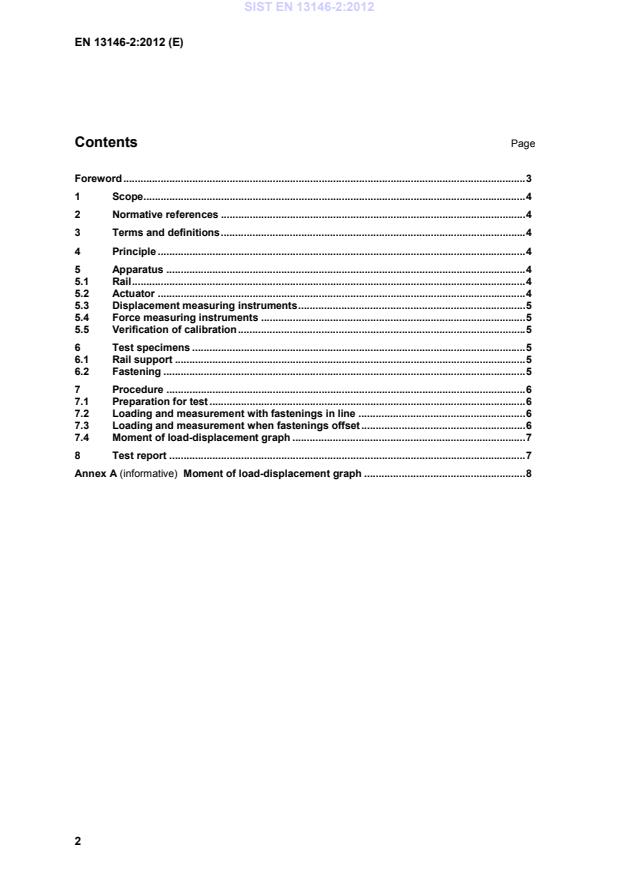
Moment of load-displacement graph . 8 SIST EN 13146-2:2012
...