

SIST EN 14519:2026
(Main)Solid softwood panelling and cladding - Machined profiles with tongue and groove
- Abstract
This document specifies characteristics of solid wood panelling and cladding with tongue and groove machined from softwoods (wood of trees of the botanical group gymnosperms).
Products are intended for interior or exterior use.
This document covers treated, untreated and surface treated products, including those made of thermally and chemically modified wood, as well as finger jointed products.
This document does not cover processes for treatment, surface coating or modification.
NOTE Where further regulatory provisions (e.g. durability, reaction to fire, dangerous substances and generally CE-marking according to CPR) are required, harmonized EN 14915 applies.
- Status
- Published
- Public Enquiry End Date
- 16-Jul-2025
- Publication Date
- 17-Aug-2026
- Technical Committee
- LLZ - Les, lesni izdelki in zaščita lesa
- Current Stage
- 6060 - National Implementation/Publication (Adopted Project)
- Start Date
- 30-Jul-2026
- Due Date
- 04-Oct-2026
- Completion Date
- 18-Aug-2026

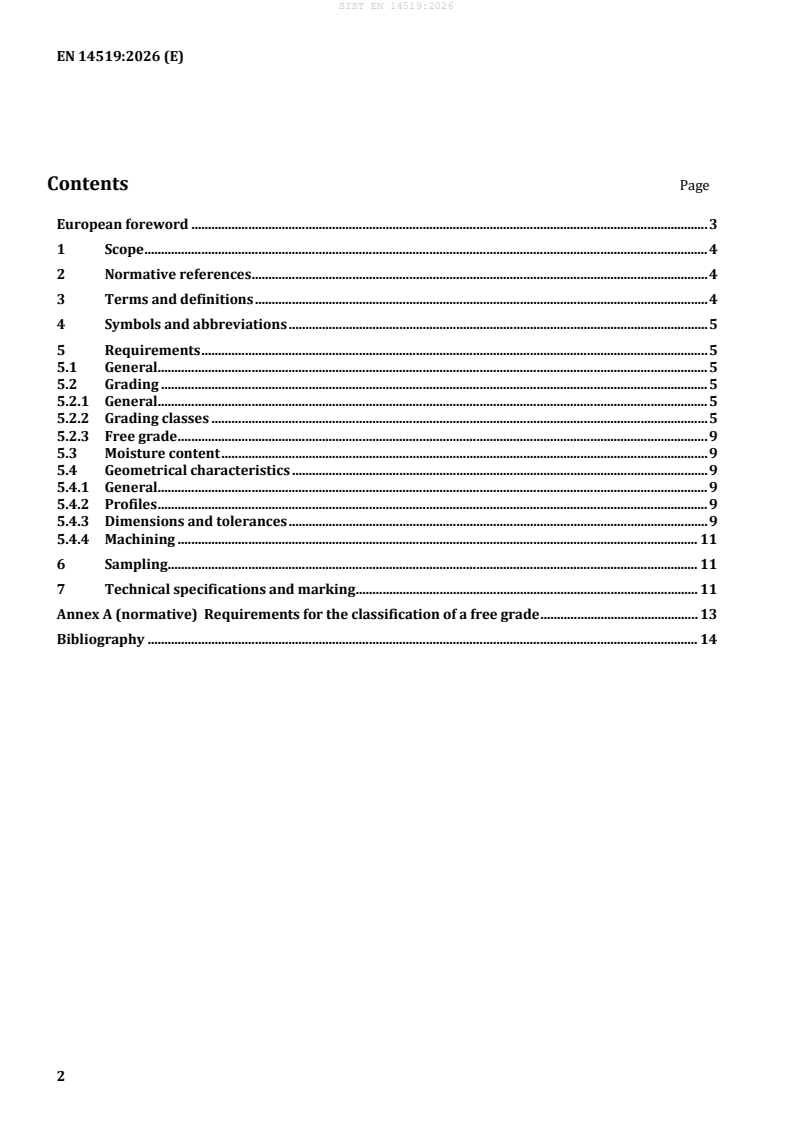
SIST EN 14519:2026 is the Slovenian adoption of EN 14519:2026, a CEN European Standard for solid softwood panelling and cladding with machined tongue-and-groove profiles. It specifies product characteristics, grading, moisture content, geometry, machining and marking for elements intended for interior or exterior use, so manufacturers, buyers and inspectors can describe and check the product in the same way.
What does SIST EN 14519:2026 specify?
SIST EN 14519:2026 specifies solid wood panelling and cladding machined from softwoods, meaning wood from trees in the botanical group gymnosperms. It covers treated, untreated and surface treated products, including thermally and chemically modified wood and finger jointed products.
The document does not cover the treatment, coating or modification processes themselves. Where additional regulatory requirements are needed, such as durability, reaction to fire, dangerous substances or CE-marking under CPR, EN 14915 is the related standard to use.
The document is organized into:
- Clause 1 - Scope
- Clause 2 - Normative references
- Clause 3 - Terms and definitions
- Clause 4 - Symbols and abbreviations
- Clause 5 - Requirements
- Clause 6 - Sampling
- Clause 7 - Technical specifications and marking
- Annex A - Normative requirements for classification of a free grade
| Annex | What it covers |
|---|---|
| Annex A | Requirements for classifying a free grade |
What are the key requirements of SIST EN 14519:2026?
Grading and product description
- Clause 5.1 ties the softwood species to the expected appearance and intended use, and it allows finger jointing when it is specified and agreed. In practice, the producer and buyer need to agree on species, use and any finger-jointed construction before supply.
- Clause 5.2 says grading applies to the face only unless otherwise specified, and the feature measurements follow EN 1309-3. This matters because the visible face is the main quality surface for installed panelling and cladding.
- Clause 5.2.2 separates grading into two systems: grades A and B for softwoods except maritime pine, and grades 0 (SN), A (PN) and B (NO) for maritime pine. The tables control knots, chipped grain, fissures, pith, colour, fungal attack, insect damage, wane and other features.
- Clause 5.2.3 allows a free grade when the standard grades are not suitable. In that case, the declared features must be agreed by the parties and Annex A gives the minimum feature list to state.
Moisture and geometry
- Clause 5.3 sets the moisture content at production for interior use, exterior use and maritime pine, and limits the share of elements outside the specified range. This helps control movement, fit and later distortion.
- Clause 5.4.1 and 5.4.3 require dimensional measurement according to EN 13647 at the reference moisture content. The practical effect is that width and thickness are assessed at a defined condition, not at any random site moisture.
- Figure 1 and Tables 3 and 4 define the tongue-and-groove profile concept and the permitted thickness and width ranges. Clause 5.4.3.5 also gives length tolerances, with different limits for rough lengths and for target-size or end-matched elements.
- Clause 5.4.3.6 addresses deformation such as bow, cup, spring and twist, and it sets a specific tolerance for cup. This is important because flatness affects installation and appearance.
Machining, sampling and marking
- Clause 5.4.4 requires planed faces unless otherwise specified, limits visible cutter marks, and says the elements shall fit together easily at production. For tongue-and-groove products, the joint must provide a proper connection along the full length.
- Clause 6 recommends CEN/TS 12169 for sampling in case of dispute. That gives a common basis when a lot must be checked independently.
- Clause 7 requires technical specifications and marking to identify the product, profile type, standard number, wood species, grade or free grade, use, dimensions, end matching or finger jointing, moisture content and treatment type before grading. This is the information needed for ordering, receiving and traceability.
What terms does SIST EN 14519:2026 define?
- Panelling - solid wood elements mainly for interior use that are machined on the face and regularised on the back.
- Cladding - solid wood elements mainly for exterior use that are machined on the face and regularised on the back.
- Face - the visible surfaces of an element after installation, including edges and chamfers.
- Regularised - a surface condition where some areas of a face remain untouched during machining.
- Tongue and groove - a matching edge profile with a groove on one side and a tongue on the opposite side, or a similar interlocking profile.
- End matching - an end profile that includes tongue and/or groove at the end of the element.
- Free grade - a declared grading approach outside the standard grading classes, with the feature set agreed between the parties and classified using Annex A.
Who uses SIST EN 14519:2026?
SIST EN 14519:2026 is used by manufacturers of solid softwood panelling and cladding, timber processors, graders, quality control staff, buyers, specifiers and inspectors. It is also relevant to laboratories and sampling personnel when product lots must be checked for moisture, dimensions, surface condition or grading features.
In practice, these users rely on the standard to specify the wood species, decide the grade, set moisture targets, verify tongue-and-groove fit, prepare marking and compare supplied material with ordered characteristics.
What changed in SIST EN 14519:2026 from the previous edition?
SIST EN 14519:2026 supersedes EN 14519:2005. The stated technical changes are:
- alignment of the product standards series EN 14519, EN 15146 and EN 14951
- updated scope, normative references and terms and definitions
- scope opened to all softwood species
- more precise moisture content ranges for panelling and cladding
- CEN/TS 12169 used for sampling instead of Annex C
- merging and alignment of the Technical specifications and Marking clauses
- deletion of Annex B and Annex C
Which standards are used with SIST EN 14519:2026?
- EN 844 - provides timber terminology.
- EN 1309-3 - gives the method for measuring features and biological degradations.
- EN 13183-1, EN 13183-2, EN 13183-3 - give three methods for determining or estimating moisture content.
- EN 13307-1 - sets requirements for timber blanks and semi-finished profiles for non-structural uses and is used for permitted finger jointing.
- EN 13647 - provides the method for measuring geometrical characteristics.
- EN 13756 - provides terminology used in the document.
- EN 13556 - supports botanical naming and abbreviations for wood species in marking.
- CEN/TS 12169 - supports sampling when a lot is disputed.
- EN 14915 - is the related standard for durability, reaction to fire, dangerous substances and CE-marking under CPR.
What does the SIST EN 14519:2026 document contain?
The document contains a figure showing the common tongue-and-groove cross section and the key profile dimensions. It contains grading tables for softwoods except maritime pine and for maritime pine, plus a table for free-grade classification in Annex A.
It also contains moisture content requirements, dimensional tolerances for thickness, width and length, and guidance on deformation and machining. Clause 7 gathers the marking items needed for product identification and traceability in supply, receiving and inspection.
Relations
- Effective Date
- 12-Aug-2026
- Effective Date
- 12-Aug-2026
- Effective Date
- 12-Aug-2026
- Effective Date
- 12-Aug-2026
- Effective Date
- 12-Aug-2026
- Effective Date
- 12-Aug-2026
- Effective Date
- 12-Aug-2026
- Effective Date
- 12-Aug-2026
- Effective Date
- 19-Jan-2023
Get Certified
Connect with accredited certification bodies for this standard

Gozdarski inštitut Slovenije
Slovenian Forestry Institute. Forest management certification support, timber testing.
Sponsored listings
Frequently Asked Questions
SIST EN 14519:2026 is a standard published by the Slovenian Institute for Standardization (SIST). Its full title is "Solid softwood panelling and cladding - Machined profiles with tongue and groove". This standard covers: This document specifies characteristics of solid wood panelling and cladding with tongue and groove machined from softwoods (wood of trees of the botanical group gymnosperms). Products are intended for interior or exterior use. This document covers treated, untreated and surface treated products, including those made of thermally and chemically modified wood, as well as finger jointed products. This document does not cover processes for treatment, surface coating or modification. NOTE Where further regulatory provisions (e.g. durability, reaction to fire, dangerous substances and generally CE-marking according to CPR) are required, harmonized EN 14915 applies.
This document specifies characteristics of solid wood panelling and cladding with tongue and groove machined from softwoods (wood of trees of the botanical group gymnosperms). Products are intended for interior or exterior use. This document covers treated, untreated and surface treated products, including those made of thermally and chemically modified wood, as well as finger jointed products. This document does not cover processes for treatment, surface coating or modification. NOTE Where further regulatory provisions (e.g. durability, reaction to fire, dangerous substances and generally CE-marking according to CPR) are required, harmonized EN 14915 applies.
SIST EN 14519:2026 is classified under the following ICS (International Classification for Standards) categories: 79.080 - Semi-manufactures of timber. The ICS classification helps identify the subject area and facilitates finding related standards.
SIST EN 14519:2026 has the following relationships with other standards: It is inter standard links to SIST EN 13307-1:2007, SIST EN 1309-3:2018, SIST EN 13647:2021, SIST EN 844:2019, SIST EN 13183-3:2005, SIST EN 13183-1:2003, SIST EN 13756:2018, SIST EN 13183-2:2003, SIST EN 14519:2006. Understanding these relationships helps ensure you are using the most current and applicable version of the standard.
SIST EN 14519:2026 is available in PDF format for immediate download after purchase. The document can be added to your cart and obtained through the secure checkout process. Digital delivery ensures instant access to the complete standard document.
Standards Content (Sample)
Contents
- 1 Scope
- 2 Normative references
- 3 Terms and definitions
- 3.1 panelling
- 3.2 cladding
- 3.3 face
- 3.4 regularised
- 3.5 tongue and groove
- 3.6 end matching
- 4 Symbols and abbreviations
- 5 Requirements
- 5.1 General
- 5.2 Grading
- 5.3 Moisture content
- 5.4 Geometrical characteristics
- 6 Sampling
- 7 Technical specifications and marking
- Annex A
- Bibliography
1 Scope
This document specifies characteristics of solid wood panelling and cladding with tongue and groove machined from softwoods (wood of trees of the botanical group gymnosperms). Products are intended for interior or exterior use.
This document covers treated, untreated and surface treated products, including those made of thermally and chemically modified wood, as well as finger jointed products. This document does not cover processes for treatment, surface coating or modification. NOTE Where further regulatory provisions (e.g. durability, reaction to fire, dangerous substances and generally CE-marking according to CPR) are required, harmonized EN 14915 applies.
2 Normative references
The following documents are referred to in the text in such a way that some or all of their content constitutes requirements of this document. For dated references, only the edition cited applies. For undated references, the latest edition of the referenced document (including any amendments) applies. EN 844, Round and sawn timber — Terminology EN 1309-3, Round and sawn timber — Methods of measurements — Part 3: Features and biological degradations EN 13183-1, Moisture content of a piece of sawn timber — Part 1: Determination by oven dry method EN 13183-2, Moisture content of a piece of sawn timber — Part 2: Estimation by electrical resistance method EN 13183-3, Moisture content of a piece of sawn timber — Part 3: Estimation by capacitance method EN 13307-1, Timber blanks and semi-finished profiles for non-structural uses — Part 1: Requirements EN 13647, Wood flooring and wood panelling and cladding — Determination of geometrical characteristics EN 13756, Wood flooring and parquet — Terminology
3 Terms and definitions
For the purposes of this document, the terms and definitions given in EN 13756, EN 844 and the following apply.
ISO and IEC maintain terminology databases for use in standardization at the following addresses:
- ISO Online browsing platform: available at https://www.iso.org/obp/
- IEC Electropedia: available at https://www.electropedia.org/
3.1 panelling
elements of solid wood mainly for interior use which have been machined on the face and have been regularised on the back
3.2 cladding
elements of solid wood mainly for exterior use which have been machined on the face and have been regularised on the back
SIST EN 14519:2026 EN 14519:2026 (E)
3.3 face
visible surfaces of an element when installed Note 1 to entry: This includes edges and chamfers.
3.4 regularised
<hit or missed> feature of the surface of an element where some areas of a face remain untouched during the machining process
3.5 tongue and groove
elements with groove on one edge and a corresponding tongue on the opposite edge (or similar interlocking profiles)
3.6 end matching
profile at the end of the panelling or cladding including tongue and/or groove
4 Symbols and abbreviations
Symbols and abbreviations used in this document are given in Figure 1, in Table 3 and Table 4.
5 Requirements
5.1 General
The softwood species shall be selected with regard to the appearance expected, the suitability for the intended purpose and the general characteristics of the species itself. All requirements apply at the time of production, unless otherwise specified.
Finger jointing according to EN 13307-1 is permitted if specified e.g. by the manufacturer and agreed upon by the parties.
NOTE Regarding the bonding and glue type other standards and regulations can apply.
5.2 Grading
5.2.1 General
Grading applies to the face only, unless otherwise specified. Machining requirements are covered in 5.4.4 and apply to all grades of all species.
The measurement of features shall be in accordance with EN 1309-3. The elements may be finished with surface coating. The grading shall be done before coating. Additionally, to the grading classes given in 5.2.2 different grading classes and quality criteria for panelling and cladding exist on national and company levels in Europe. Hence, free grades according to 5.2.3 may also be used.
5.2.2 Grading classes
Grading classes and the features for softwoods (except maritime pine) are given in Table 1. Grading and the features for maritime pine (Pinus pinaster) are given in Table 2. A combined grading class, e.g. A/B, is permitted if agreed upon and specified e.g. by the manufacturer.
SIST EN 14519:2026 EN 14519:2026 (E) Table Error! Unknown op code for conditional.1 — Grading classes of softwoods (except maritime pine) a b Features Grade A Grade B Permitted:
- black pin knots up to 5 mm if not in clusters;
- sound intergrown knots up to 10 % of width of the board + 30 mm;
- partially intergrown knots, Permitted:
barkringed knots, splay knots and dead knots (not loose); - black pin knots up to 5 mm; Spruce/fir and larch: up to 10 % of - sound intergrown knots, partially width of the board + 15 mm intergrown knots, barkringed knots, Knots splay knots, and dead knots up to Scots pine and Douglas Fir: up to 10 % 10 % of width of the board + 50 mm; of width of the board + 30 mm; - occasional loose knots, knot-holes - occasional small missing and and unsound knots up to 15 mm; damaged arris knots up to 20 % of the largest acceptable knot size - knot plugs of the same wood species.
provided coverage is not affected; - knot-plugs of the same wood species, up to the largest allowed knot size.
Not permitted:
- loose knots, knot-holes and unsound knots; Permitted Permitted Chipped Grain with knots: up to 20 % of knot area; with knots: up to 40 % of knot area; (machined with other spots up to 20 % of the with other spots up to 40 % of the damaged spots) maximum knot size (one per m). maximum knot size.
Compression Permitted wood Permitted:
Deformation subject to the tongue and groove providing a well-matched joint for the full length Stick marks Not permitted Permitted
...