

SIST EN 14354:2026
(Main)Wood-based panels - Wood veneer floor coverings
General Information
- Abstract
This document defines terms and specifies requirements and test methods for wood veneer floor coverings for internal use.
This document is not applicable to multilayer parquets according to EN 13489 with a top layer thickness 2,5 mm and to modular mechanical locked floor covering (MMF) panels with wear resistant top layer according EN 16511.
- Status
- Published
- Public Enquiry End Date
- 24-Dec-2024
- Publication Date
- 15-Jun-2026
- Technical Committee
- LLZ - Les, lesni izdelki in zaščita lesa
- Current Stage
- 6060 - National Implementation/Publication (Adopted Project)
- Start Date
- 10-Jun-2026
- Due Date
- 15-Aug-2026
- Completion Date
- 16-Jun-2026

Overview
SIST EN 14354:2026 - Wood-based panels - Wood veneer floor coverings is an upcoming European Standard developed by the Slovenian Institute for Standardization (SIST) and CEN/TC 112. This standard specifies the terminology, requirements, and testing methods for wood veneer floor coverings designed for internal use. The document ensures product consistency, performance, and safety for both manufacturers and end users. It supersedes EN 14354:2017, including updates that reflect advancements in materials, coating technologies, and requirements for environmental durability.
Notably, this standard does not apply to multilayer parquet floorings with a top layer ≥ 2.5 mm as defined in EN 13489, nor to modular mechanical locked floor covering (MMF) panels with wear-resistant layers covered in EN 16511.
Key Topics
The main aspects covered by SIST EN 14354:2026 include:
- Definitions: Precise terminology for wood veneer floor coverings, substrates, surface finishes, and maintenance concepts.
- Material Requirements: Wood species, substrate composition, thickness tolerances, moisture content, and finishing options.
- Dimensional Tolerances: Specifications for thickness, width, length, squareness, edge straightness, cup, and lipping to ensure quality and compatibility during installation.
- Performance Criteria:
- Indentation resistance
- Thickness swelling limits
- Surface and lacquer adhesion
- Resistance to chemical agents
- Micro-scratch, abrasion, and impact resistance (for film-forming finishes)
- Castor chair resistance for commercial applications
- Locking strength for mechanical assembly systems
- Top layer bonding and soundness
- Testing Methods: Referenced methods to evaluate properties such as indentation (EN 1534), abrasion (sand or sandpaper method), chemical resistance (EN 13442), and moisture resistance (ISO 4760).
- Classification for Use: Floor coverings are classified by performance level, referenced to EN ISO 10874, ranging from domestic to heavy commercial use.
Applications
SIST EN 14354:2026 serves as a comprehensive guideline for:
- Manufacturers: Ensures product consistency, compliance, and market access by adhering to uniform requirements for wood veneer flooring.
- Architects and Specifiers: Facilitates selection of appropriate wood veneer floor coverings that meet project-specific needs, including durability, appearance, and maintenance.
- Installers: Aids in identifying compliant products that fit dimensional and mechanical requirements, ensuring simpler and error-free installation.
- Quality Control Laboratories: Provides authoritative testing protocols for verifying that products meet required standards.
- Retailers and End Users: Assurance of the performance, safety, and longevity of wood veneer floorings for residential, commercial, or institutional environments.
Related Standards
This standard is closely linked to several other key documents in floor covering and wood-based panel construction, including:
- EN 13489: Multilayer parquet flooring with thick top layers.
- EN 16511: Modular mechanical locked floor coverings with wear-resistant layers.
- EN ISO 10874: Classification of floor coverings by use.
- EN 1534: Resistance to indentation method.
- EN 13329: Laminate floor coverings - specifications & test methods.
- EN 13442: Chemical resistance tests for wood flooring.
- EN 16354: Underlays for laminate floor coverings.
- EN 17456: Top layer delamination test method.
SIST EN 14354:2026 is vital for anyone involved in the production, specification, and installation of wood veneer floor coverings. Its adoption helps ensure high quality, safety, and customer satisfaction while supporting harmonization within the European flooring sector. For the full list of references and in-depth technical requirements, consult the standard directly.
Relations
- Effective Date
- 19-Aug-2026
- Effective Date
- 22-Jul-2026
- Effective Date
- 22-Jul-2026
- Effective Date
- 17-Jun-2026
- Referred By
SIST EN 14342:2013 - Wood flooring - Characteristics, evaluation of conformity and marking - Effective Date
- 03-Jun-2026
- Effective Date
- 28-Feb-2023
Get Certified
Connect with accredited certification bodies for this standard

Gozdarski inštitut Slovenije
Slovenian Forestry Institute. Forest management certification support, timber testing.
Sponsored listings
Frequently Asked Questions
SIST EN 14354:2026 is a standard published by the Slovenian Institute for Standardization (SIST). Its full title is "Wood-based panels - Wood veneer floor coverings". This standard covers: This document defines terms and specifies requirements and test methods for wood veneer floor coverings for internal use. This document is not applicable to multilayer parquets according to EN 13489 with a top layer thickness 2,5 mm and to modular mechanical locked floor covering (MMF) panels with wear resistant top layer according EN 16511.
This document defines terms and specifies requirements and test methods for wood veneer floor coverings for internal use. This document is not applicable to multilayer parquets according to EN 13489 with a top layer thickness 2,5 mm and to modular mechanical locked floor covering (MMF) panels with wear resistant top layer according EN 16511.
SIST EN 14354:2026 is classified under the following ICS (International Classification for Standards) categories: 79.080 - Semi-manufactures of timber; 97.150 - Floor coverings. The ICS classification helps identify the subject area and facilitates finding related standards.
SIST EN 14354:2026 has the following relationships with other standards: It is inter standard links to SIST EN ISO 6506-1:2014, SIST EN 17456:2021, SIST EN 16094:2021, SIST EN 1534:2020, SIST EN 14342:2013, SIST EN 14354:2017. Understanding these relationships helps ensure you are using the most current and applicable version of the standard.
SIST EN 14354:2026 is associated with the following European legislation: EU Directives/Regulations: 305/2011; Standardization Mandates: M/119 rev1. When a standard is cited in the Official Journal of the European Union, products manufactured in conformity with it benefit from a presumption of conformity with the essential requirements of the corresponding EU directive or regulation.
SIST EN 14354:2026 is available in PDF format for immediate download after purchase. The document can be added to your cart and obtained through the secure checkout process. Digital delivery ensures instant access to the complete standard document.
Standards Content (Sample)
SLOVENSKI STANDARD
01-julij-2026
Lesne plošče - Furnirane talne obloge
Wood-based panels - Wood veneer floor coverings
Holzwerkstoffe - Furnierte Fußbodenbeläge
Panneaux à base de bois - Revêtements de sol à placage bois
Ta slovenski standard je istoveten z: EN 14354:2026
ICS:
79.080 Polizdelki iz lesa Semi-manufactures of timber
97.150 Talne obloge Floor coverings
2003-01.Slovenski inštitut za standardizacijo. Razmnoževanje celote ali delov tega standarda ni dovoljeno.
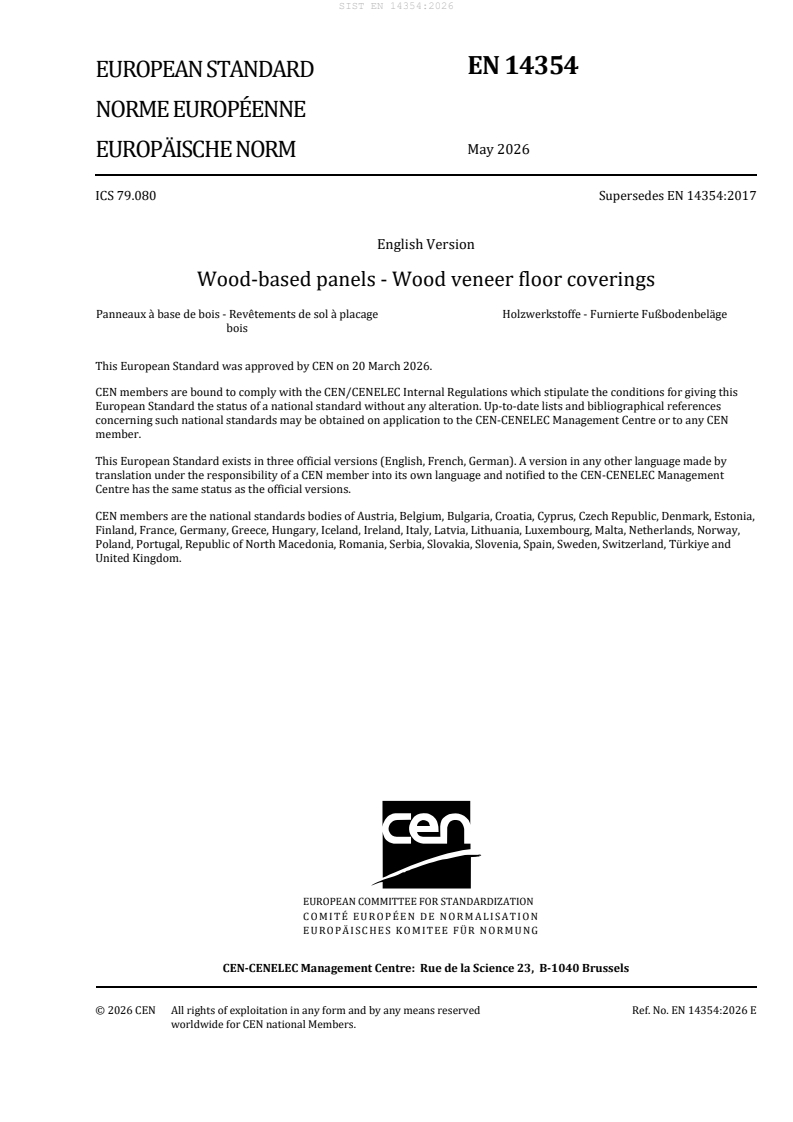
EN 14354
EUROPEAN STANDARD
NORME EUROPÉENNE
May 2026
EUROPÄISCHE NORM
ICS 79.080 Supersedes EN 14354:2017
English Version
Wood-based panels - Wood veneer floor coverings
Panneaux à base de bois - Revêtements de sol à placage Holzwerkstoffe - Furnierte Fußbodenbeläge
bois
This European Standard was approved by CEN on 20 March 2026.
CEN members are bound to comply with the CEN/CENELEC Internal Regulations which stipulate the conditions for giving this
European Standard the status of a national standard without any alteration. Up-to-date lists and bibliographical references
concerning such national standards may be obtained on application to the CEN-CENELEC Management Centre or to any CEN
member.
This European Standard exists in three official versions (English, French, German). A version in any other language made by
translation under the responsibility of a CEN member into its own language and notified to the CEN-CENELEC Management
Centre has the same status as the official versions.
CEN members are the national standards bodies of Austria, Belgium, Bulgaria, Croatia, Cyprus, Czech Republic, Denmark, Estonia,
Finland, France, Germany, Greece, Hungary, Iceland, Ireland, Italy, Latvia, Lithuania, Luxembourg, Malta, Netherlands, Norway,
Poland, Portugal, Republic of North Macedonia, Romania, Serbia, Slovakia, Slovenia, Spain, Sweden, Switzerland, Türkiye and
United Kingdom.
EUROPEAN COMMITTEE FOR STANDARDIZATION
COMITÉ EUROPÉEN DE NORMALISATION
EUROPÄISCHES KOMITEE FÜR NORMUNG
CEN-CENELEC Management Centre: Rue de la Science 23, B-1040 Brussels
© 2026 CEN All rights of exploitation in any form and by any means reserved Ref. No. EN 14354:2026 E
worldwide for CEN national Members.
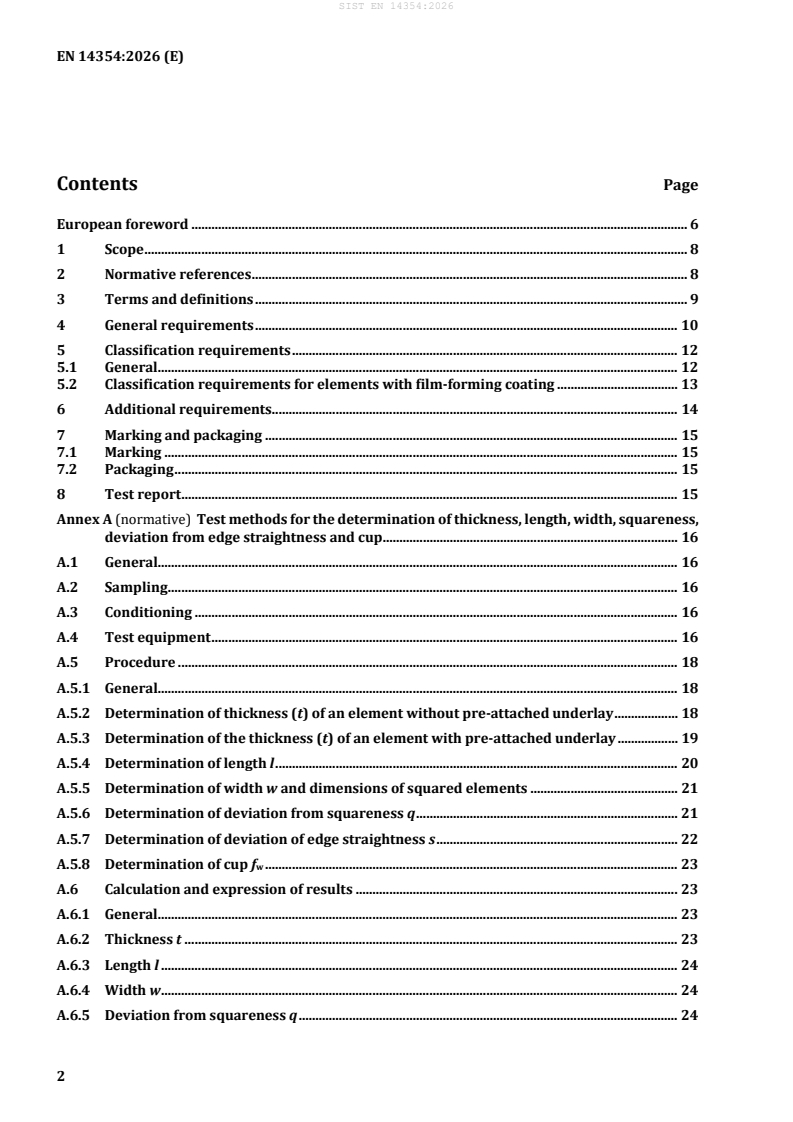
Contents Page
European foreword . 6
1 Scope . 8
2 Normative references . 8
3 Terms and definitions . 9
4 General requirements . 10
5 Classification requirements . 12
5.1 General. 12
5.2 Classification requirements for elements with film-forming coating . 13
6 Additional requirements. 14
7 Marking and packaging . 15
7.1 Marking . 15
7.2 Packaging . 15
8 Test report . 15
Annex A (normative) Test methods for the determination of thickness, length, width, squareness,
deviation from edge straightness and cup . 16
A.1 General. 16
A.2 Sampling . 16
A.3 Conditioning . 16
A.4 Test equipment . 16
A.5 Procedure . 18
A.5.1 General. 18
A.5.2 Determination of thickness (t) of an element without pre-attached underlay . 18
A.5.3 Determination of the thickness (t) of an element with pre-attached underlay . 19
A.5.4 Determination of length l . 20
A.5.5 Determination of width w and dimensions of squared elements . 21
A.5.6 Determination of deviation from squareness q . 21
A.5.7 Determination of deviation of edge straightness s . 22
A.5.8 Determination of cup fw . 23
A.6 Calculation and expression of results . 23
A.6.1 General. 23
A.6.2 Thickness t . 23
A.6.3 Length l . 24
A.6.4 Width w . 24
A.6.5 Deviation from squareness q . 24
A.6.6 Deviation from edge straightness s . 24
A.6.7 Cup f . 24
w
A.7 Test report . 24
Annex B (normative) Test method to determine the opening and lipping between elements . 25
B.1 General . 25
B.2 Sampling . 25
B.3 Conditioning . 25
B.4 Test equipment. 25
B.5 Procedure . 25
B.5.1 Assembling . 25
B.5.2 Measuring of lipping . 26
B.5.3 Measuring of openings . 26
B.6 Calculation and expression of results . 26
B.7 Test report . 26
Annex C (normative) Test method to determine the elasticity of lacquer . 28
C.1 General . 28
C.2 Sampling . 28
C.3 Apparatus . 28
C.4 Procedure . 28
C.5 Calculation and expression of results . 28
C.6 Evaluation of results, elasticity classification . 28
Annex D (normative) Determination of the wear resistance using the falling sand method . 29
D.1 General . 29
D.2 Sampling . 29
D.3 Conditioning . 29
D.4 Apparatus . 30
D.4.1 Testing machine . 30
D.4.2 Grit feeder and accessories . 30
D.4.3 Additional material or equipment . 35
D.5 Procedure . 35
D.5.1 General . 35
D.5.2 Maintenance of the abrading wheels . 35
D.5.3 Operation of the abrader . 35
D.5.4 Calibration. 36
D.5.5 Abrasion of test specimen . 37
D.6 Expression of results . 38
D.7 Test report . 38
Annex E (normative) Determination of abrasion resistance using the sand paper method . 39
E.1 General. 39
E.2 Sampling . 39
E.3 Conditioning . 39
E.4 Apparatus . 40
E.4.1 Testing machine . 40
E.4.2 Additional material or equipment . 43
E.5 Procedure . 43
E.5.1 General. 43
E.5.2 Preparation of test specimens and abrasive papers . 44
E.5.3 Preparation of abrasive wheels . 44
E.5.4 Determination of the abrasion rate of abrasive paper . 44
E.5.5 Abrasion of test specimen . 44
E.5.6 Expression of results . 46
E.5.7 Test report . 46
Annex F (normative) Test method to determine the adhesion of the lacquer — Cross cut test . 48
F.1 General. 48
F.2 Test equipment . 48
F.2.1 Cutting tool . 48
F.2.2 Spacing guide . 51
F.2.3 Soft brush . 51
F.2.4 Transparent pressure-sensitive adhesive tape . 51
F.3 Sampling . 51
F.4 Test procedure . 51
F.4.1 General. 51
F.4.2 Cutting and removing the lacquer . 51
F.5 Expression of the results . 53
F.6 Test report . 54
Annex G (normative) Topical moisture resistance – Assembled joint . 56
G.1 General. 56
G.2 Rating . 56
G.2.1 Qualitative rating . 56
G.2.2 Quantitative wet swell . 58
G.2.3 Qualitative rating and quantitative recovery swell. 58
G.3 Calculations . 58
G.3.1 Surface swell calculation . 58
G.3.2 Recovery swell measurement surface swell calculation . 59
G.4 Water tightness of the joints . 60
G.5 Report . 60
G.6 Example of photos to match with subjective ratings (informative) . 61
G.6.1 Grade 1 - No change . 61
G.6.2 Grade 2 - Slight swelling . 62
G.6.3 Grade 3 - Significate swelling . 62
G.6.4 Grade 4 - Objectionable (severe) swelling . 62
G.6.5 Grade 5 - Failed test . 63
Bibliography . 65
European foreword
This document (EN 14354:2026) has been prepared by Technical Committee CEN/TC 112 “Wood-based
panels”, the secretariat of which is held by DIN.
This European Standard shall be given the status of a national standard, either by publication of an
identical text or by endorsement, at the latest by November 2026, and conflicting national standards shall
be withdrawn at the latest by November 2026.
Attention is drawn to the possibility that some of the elements of this document may be the subject of
patent rights. CEN shall not be held responsible for identifying any or all such patent rights.
This document supersedes EN 14354:2017.
Compared to EN 14354:2017 the following modifications have been made:
a) reference to EN 16511 for modular mechanical locked floor coverings (MMF) added in the scope;
b) in 3.2 definition of top layer thickness added;
c) in 3.3 new definition of the substrate including minimum wood content of the substrate;
d) new definitions of surface finishes in 3.10 to 3.13 introduced;
e) in 3.14 new definition of underlay added;
f) in 4. explanation regarding creaking added;
g) in Table 1 thickness tolerance for elements with pre-attached underlays added and test method
added as 4.6 and 5.2;
h) in Table 1 requirements for internal bond deleted;
i) in Table 1 delamination test of top layer with requirements included;
j) distinction between general classification requirements in Table 2 and classification requirements
for coated and printed surfaces in Table 3 introduced;
k) requirements on resistance to indentation in Table 2 modified;
l) in Table 2 requirements for thickness swelling modified;
m) resistance to chemical agents introduced as general classification requirement in Table 2 for non-film
forming coatings and classification requirement in Table 3 for film-forming coatings added;
n) castor chair resistance in Table 2 added;
o) abrasion resistance in Table 3 modified;
p) in Table 3 micro scratch resistance introduced as classification requirement for coated and printed
surfaces;
q) additional requirements as new Table 4 added;
r) Clause 8 test report modified;
s) Annex A integration of measurement of thickness with pre-attached underlay;
t) normative references in Annex C modified;
u) former Annex G “Complementary properties” moved to Table 4 and former Annex H “Guide for
evaluation of conformity of product quality” deleted;
v) new Annex G “Topical moisture resistance – Assembled joint” added.
Any feedback and questions on this document should be directed to the users’ national standards body.
A complete listing of these bodies can be found on the CEN website.
According to the CEN-CENELEC Internal Regulations, the national standards organisations of the
following countries are bound to implement this European Standard: Austria, Belgium, Bulgaria, Croatia,
Cyprus, Czech Republic, Denmark, Estonia, Finland, France, Germany, Greece, Hungary, Iceland, Ireland,
Italy, Latvia, Lithuania, Luxembourg, Malta, Netherlands, Norway, Poland, Portugal, Republic of North
Macedonia, Romania, Serbia, Slovakia, Slovenia, Spain, Sweden, Switzerland, Türkiye and the United
Kingdom.
1 Scope
This document defines terms and specifies requirements and test methods for wood veneer floor
coverings for internal use.
This document is not applicable to multilayer parquets according to EN 13489 with a top layer
thickness ≥ 2,5 mm and to modular mechanical locked floor covering (MMF) panels with wear resistant
top layer according EN 16511.
2 Normative references
The following documents are referred to in the text in such a way that some or all of their content
constitutes requirements of this document. For dated references, only the edition cited applies. For
undated references, the latest edition of the referenced document (including any amendments) applies.
EN 438-2:2016+A1:2018, High-pressure decorative laminates (HPL) — Sheets based on thermosetting
resins (usually called laminates) — Part 2: Determination of properties
EN 1534, Wood flooring and parquet — Determination of resistance to indentation — Test method
EN 13329:2023, Laminate floor coverings — Specifications, requirements and test methods
EN 13442:2023, Wood and parquet flooring and wood panelling and cladding — Determination of the
resistance to chemical agents
EN 16094:2021, Laminate floor coverings — Test method for the determination of micro-scratch resistance
EN 17456:2021, Wood flooring and parquet — Determination of top layer delamination of multilayer
elements — Test method
EN 60454-2, Specification for pressure-sensitive adhesive tapes for electrical purposes — Part 2: Methods
of test (IEC 60454-2)
EN ISO 868:2003, Plastics and ebonite — Determination of indentation hardness by means of a durometer
(Shore hardness) (ISO 868:2003)
EN ISO 6506-1, Metallic materials — Brinell hardness test — Part 1: Test method (ISO 6506-1)
EN ISO 10874, Resilient, textile and laminate floor coverings — Classification (ISO 10874)
ISO 24334, Laminate floor coverings — Determination of locking strength for mechanically assembled
panels
ISO 24336, Laminate floor coverings — Determination of thickness swelling after partial immersion in
water
ISO 24339, Laminate and textile floor coverings — Determination of dimensional variations after exposure
to humid and dry climate conditions
ISO 48-2, Rubber, vulcanized or thermoplastic — Determination of hardness — Part 2: Hardness between
10 IRHD and 100 IRHD
ISO 48-7, Rubber, vulcanized or thermoplastic — Determination of hardness — Part 7: Apparent hardness
of rubber-covered rollers by Shore-type durometer method
ASTM D 785, Standard test method for Rockwell hardness of plastics and electrical insulating materials
3 Terms and definitions
For the purposes of this document, the following terms and definitions apply.
ISO and IEC maintain terminology databases for use in standardization at the following addresses:
— ISO Online browsing platform: available at https://www.iso.org/obp/
— IEC Electropedia: available at https://www.electropedia.org/
3.1
wood veneer floor covering
floor covering consisting of a substrate, with a top layer and possibly a backing
3.2
top layer
upper wood layer(s) with a thickness < 2,5 mm measured according to EN 13647, intended to be the
visible side when the floor is installed which can be uncovered or covered with surface treatments
Note 1 to entry: Surface treatments are defined in 3.10 to 3.13.
3.3
substrate
core material of the wood veneer floor covering, consisting of wood-based panel or wood-based product,
made of wood or wooden components for at least 75 % in mass
EXAMPLE High density fibreboard (HDF).
3.4
backing
layer opposite to the top layer
3.5
wood veneer floor covering element
smallest single item identified as the complete product, shaped and machined on its sides to the
appropriate dimensions
Note 1 to entry: The element is provided with a suitable system allowing the elements to be assembled together
at installation.
3.6
cup
curvature, concave or convex, of the element across the width of the face
3.7
lipping
difference in height, at the edge, between the upper faces of two adjacent and assembled elements when
laid on a flat surface
3.8
deviation from straight edge straightness
lengthwise curvature of an element perpendicular to the edge
Note 1 to entry: This characteristic is referred to as “spring” in EN 13756:2018.
3.9
wear layer
layer on which wearing occur
3.10
film-forming coating
coating that form a continuous, perceivable and measurable film with a thickness ≥ 20 µm
EXAMPLE Lacquers.
3.11
non film forming coating
coating with a thickness < 20 µm
Note 1 to entry: These are products containing oil, wax, oil-wax combination or soap as defined in EN 13756.
3.12
partly coloured surface
surface of the wood that is partly changed by technical surface treatment processes, whereby the natural
wood grain remains visible
Note 1 to entry: Partly colouring, staining and reactive staining are examples for technical surface treatments.
3.13
printed surface
surface with a décor that is printed and protected by film forming coating
3.14
underlay
resilient layer between the substrate and floor covering added to obtain specific properties
Note 1 to entry: It is also possible to have combinations of underlays and underlay materials as underlays, as well
as combinations of underlays with films or coatings (e.g. vapour barriers).
Note 2 to entry: The underlay can be profiled or textured.
[SOURCE: EN 16354:2018, definition 3.2]
4 General requirements
All wood veneer floor coverings shall comply with the general requirements given in Table 1 and Table 2.
Wood veneer floor coverings with film-forming coating and printed surfaces shall additionally comply
with the classification requirements given in Table 3.
The nominal dimensions shall be declared by the manufacturer at a given humidity.
The wood used for the top layer are hardwood or softwood species and shall be free from decay and
insect attack. Variations of colour can occur under the influence of light.
Uncovered surfaces will change their natural appearance depending on the level of use. A surface
treatment is necessary to protect the veneer surface after installation.
Climate changes and/or low use frequency can lead to slight creaking effects on floated installed wood
veneer floor covering.
Table 1 — General requirements
Characteristics Requirements Test methods
Moisture content H 4 % ≤ H ≤ 10 % and
average
EN 322
(dispatch from manufacturer) H – H ≤ 3 %
max min
t – t ≤ 0,50 mm
Thickness t of an element max min
without pre-attached underlay
| t – t | ≤ 0,50 mm
average nominal
t – t ≤ 0,80 mm
Thickness t of an element with max min
pre-attached underlay
| t – t | ≤ 0,50 mm
average nominal
l ≤ 1 500 mm: l – l ≤ 0,50 mm
max min
Length l of the top layer in the
l > 1 500 mm: l – l ≤ 0,30 mm/m
max min
same package
| l – l | ≤ 1 mm
mean nominal
w – w ≤ 0,20 mm
Width w of the top layer in the max min
same package
| w – w | ≤ 0,1mm
average nominal
Annex A
| l – l | ≤ 0,10 mm
average nominal
Length l and width w of squared
| w – w | ≤ 0,10 mm
average nominal
elements
l – l ≤ 0,20 mm
max min
l = w
w – w ≤ 0,20 mm
max min
Deviation of squareness q ≤ 0,20 mm
max
Deviation from edge straightness
s ≤ 0,30 mm/m
max
of the top layer s
| f | ≤ 0,20 %
w max
Cup f in width direction
w
| f | ≤ 0,15 %
w average
Lipping p p ≤ 0,15 mm
max
Annex B
Opening between elements ≤ 0,20 mm
a
Adhesion of the lacquer ≤ class 2 Annex F
b 2
EN 13329:2023, Annex B
Surface soundness ≥ 1,00 N/mm
D ≤ 1 %
t average EN 17456:2021,
Top layer bonding
Procedure AT1
D ≤ 5 %
t max
a
Not applicable for non-film forming coatings or unsealed surfaces.
b
For products with HDF-substrate.
5 Classification requirements
5.1 General
Wood veneer floor coverings shall be classified as suitable for different levels of use, according to the
performance requirements specified in Table 2, when tested with the methods given therein.
Classification shall conform to the scheme specified in EN ISO 10874 (classes 21, 22, 23, 31, 32, 33). The
use classification defined in the Table 2 had been fixed on the basis of the material and the linked test
methods.
Table 2 — General classification requirements
Class 21 22 23 31 32 33 Test
method
Symbol
Domestic Commercial
Level of
use
Moderate General Heavy Moderate General Heavy
Resistance
2 2 2 2 2
to ≥ 10 N/mm ≥ 20 N/mm ≥ 25 N/mm ≥ 30 N/mm ≥ 35 N/mm EN 1534
indentation
Thickness
≤ 20 % ≤ 18 % ≤ 15 % ISO 24336
swelling
Locking
Length ≥ 1,0 KN/m
No requirement ISO 24334
strength
Short side ≥ 2,0 KN/m
a
“f0,2”
≥ 10 000 ≥ 15 000 ≥ 25 000
“Castor
cycles cycles cycles
Chair” No EN ISO 4918
No requirement
No damage No damage No damage
a d
resistance requirement
with type W with type W with type W
c
wheels wheels wheels
Class 21
to 31 tested
according
to EN 13442
Resistance
procedure D
to chemical For each chemical agent rating code ≥ 4
Class 32
b
agents
to 33 tested
according
to EN 13442
procedure C
NOTE To remain in the declared used classes the necessary and appropriate periodic maintenance is needed.
a
For mechanical assembly systems only (assembly systems without glue).
b
Valid for non film forming coatings (only oiled, waxed or oiled/waxed surfaces).
c
No visible damage on the surface of the assembled test area caused by detachment of layers, opening of joints, or
crazing. Ignore any flattening or change in appearance, e.g. change in gloss.
d
Using soft castor wheels W PU (90 ± 5) Shore A. If no underlay is pre-attached or specified, a standard EPS foam of
(1,6 ± 0,2) mm thickness, with a CS value (compressive strength) of at least 60 kPa and with PC-value (punctual
conformability) of (0,9 ± 0,1) mm shall be used. The three parameters of the foam shall be determined according to
EN 16354.
5.2 Classification requirements for elements with film-forming coating
The additional classification requirements for elements with film-forming coating and printed surfaces
are given in Table 3. For the use of this table the producer shall declare which abrasion resistance test
method is to be used (Annex D or E).
Table 3 — Classification requirements for elements with film-forming coating and printed
surfaces
Class 21 22 23 31 32 33 Test method
Symbol
Domestic Commercial
Level of use
Moderate General Heavy Moderate General Heavy
Impact
resistance EC0 EC1 EC2 EC3 Annex C
(Elasticity)
≥ 500 ≥ 1 000 ≥ 1 500 ≥ 3 000
Wear
Annex D or E
a
resistance
revolutions revolutions revolutions revolutions
≥ 900 ≥ 1 500 ≥ 2 000 ≥ 4 000
Wear
Annex D or E
b
resistance
revolutions revolutions revolutions revolutions
For each
Resistance to
For each chemical agent chemical EN 13442:2023,
chemical For each chemical agent rating code ≥ 4
rating code ≥ 3 agent rating Procedure B
agents
code ≥ 5
Gloss level ≥ 7: ≤ MSR-
Micro scratch
A3
EN 16094:2021,
resistance
No requirement
Gloss level < 7 at 60°: Procedure A
[class]
I ≤ 1,5 unit change I
a
Film-forming coating except decor printed surfaces.
b
Printed surfaces.
6 Additional requirements
For additional requirements see Table 4. When any of the characteristics given in Table 4 are requested
for specific applications, the floor coverings shall be tested by the methods given therein. The properties
stated in Table 4 are considered important for some specific products or applications.
Table 4 — Additional requirements
Property Requirements Test method
Water resistance Qualitative and quantitative ratings
to be defined between customer Annex G
a
and supplier
Resistance of mechanical joints to No water leaks through the joints
Annex G
water leakage after 24 h of water exposure
Dimensional variations after exposure To be defined between costumer
ISO 24339
to humid and dry climate conditions and suppler
a
Specific maintenance after installation (e.g.: oil, wax) can increase the results (to be defined between
customer and supplier).
7 Marking and packaging
7.1 Marking
Wood veneer floor coverings which comply with the requirements of this standard shall have the
following information marked by the manufacturer, either on their packaging, or on a label or information
sheet included in the packaging.
a) product name, number and year of publication of this document, i.e. EN 14354:2026;
b) surface treatment (covered or uncovered), and film forming or none film forming;
c) level of use and used abrasion test method (Annex D or E);
d) wood species of the top layer;
e) nominal dimensions of one element: thickness × width × length in millimetres;
f) the number of elements contained in a package;
g) the area in square meters contained in a package;
h) manufacturer’s or supplier’s identification.
7.2 Packaging
The product shall be delivered in packages designed to protect the corners, edges and surfaces of the
product, under normal conditions of transport and handling. Installation, cleaning, maintenance
instructions and possibilities for refurbishment shall be delivered together with the product.
8 Test report
If a test report is requested, it shall contain at least the following information:
a) the name and address of the test laboratory;
b) date of the test;
c) a reference to this document;
d) the product tested;
e) sampling information, including the description of the underlay used for the test;
f) test result;
g) all deviations from the procedures;
h) any unusual features observed.
Annex A
(normative)
Test methods for the determination of thickness, length, width, squareness,
deviation from edge straightness and cup
A.1 General
This annex specifies methods for measuring the thickness, length, width, squareness, deviation from edge
straightness and cup of Wood veneer floor covering elements.
A.2 Sampling
Take 5 elements at random.
A.3 Conditioning
Elements are measured without conditioning. If requested, the test pieces shall be stabilized to a constant
mass in an atmosphere of (23 ± 2) °C and (50 ± 5) % relative humidity. Constant mass is considered to be
reached when the results of two successive weighing operations, carried out at an interval of 24 h, do not
differ by more than 0,1 % of the mass of the test pieces.
A.4 Test equipment
A.4.1 Micrometer, sliding caliper or any other equivalent tool giving an accuracy of 0,05 mm.
A.4.2 Sliding caliper or any other equivalent tool giving an accuracy of 0,01 mm.
A.4.3 Square arms with lengths of 300 mm and having a maximum angular distortion of 0,02 mm
at 300 mm.
A.4.4 Steel ruler of length at least equal to the length of test specimen and having a maximum
straightness deviation of 0,05 mm over 1 000 mm.
A.4.5 Apparatus (T–assembly) for measuring width flatness consisting of a dial gauge accurate
to ± 0,01 mm with a rounded tip with a radius of ≤ 5,5 mm, installed centrally in relation to three rounded
supports with a radius of ≥ 5 mm. The supports shall be adjustable along a T-shaped assembly of bars to
provide the required gauge length. The measurement d shall not be less than the width w of the test
specimen minus 10 mm. The tip of the gauge in contact with the face of the test specimen shall apply a
force of (1,0 ± 0,5) N. The mass of the apparatus shall not affect the flatness of the test specimen beyond
the limit of the accuracy of the gauge. See Figure A.1 for illustration. The instrument shall be set to zero
against a suitable reference plate.
Key
a
view A enlarged
1 dial gauge
2 T-groove
3 adjustable pin
4 adjustable bridge
Figure A.1 — Instrument for measuring the width flatness (Principle)
A.4.6 Device for measuring the thickness of an element with pre-attached underlay, as shown
in Figure A.2. The plunger must have a circular, flat foot parallel to the base plate with a diameter
of 10 mm and exert a force between 0,5 N and 2 N.
Key
1 rigid frame
2 dial gauge
3 circular pressure foot
4 floor covering element with pre-attached underlay (downward)
5 flat rigid baseplate
Figure A.2 — Device for measuring the thickness of an element with pre-attached underlay
A.4.7 Steel tape or ruler with an accuracy of ± 0,1 mm up to a length of 1,50 m, and ± 0,5 mm for longer
lengths.
A.4.8 Thickness gauges ranging from 0,05 mm to 0,10 mm in steps of 0,01 mm, and from 0,10 mm
to 0,50 mm in steps of 0,05 mm.
A.5 Procedure
A.5.1 General
On all 5 elements the following parameters shall be determined.
A.5.2 Determination of thickness (t) of an element without pre-attached underlay
Measure the thickness t with a micrometer, or any other device of the equipment described in A.4.1, at a
distance of 20 mm from the edges of the top layer, at points located in each corner and in the middle of
each long side (only four corner points if the length is ≤ 600 mm), see Figure A.3.
Dimensions in millimetres
Key
l length
Figure A.3 — Measuring points for determination of thickness (t) of an element without pre-
attached underlay
A.5.3 Determination of the thickness (t) of an element with pre-attached underlay
The determination is made on a laminate floor element. Three test specimens measuring approximately
100 mm × 100 mm can be taken from this element; two test pieces at a distance of 10 mm from the middle
of the narrow sides and one test piece exactly in the middle of the element (see Figure A.4).
If the elements are smaller than 100 mm, a square sample is to be cut in the actual element width. The
measurement is carried out in the middle of the samples with a device according to A.4.6 (see Figure A.2).
Calculate the average value of the three samples.
Dimensions in millimetres
Key
l length
w width
Figure A.4 — Measuring points for determination of thickness (t) of an element with pre-
attached underlay
A.5.4 Determination of length l
For decorative pattern effects, measure the length of the elements with the test equipment described in
A.4.2.
For non decorative pattern effects, measure the length of the elements when shorter than 500 mm with
the test equipment described in A.4.2 and for lengths equal to or longer than 500 mm, with the test
equipment described in A.4.7.
Measure the length l of the top layer along two lines parallel to the axis of the element and at a distance
of 20 mm from the edges (see Figure A.5).
Dimensions in millimetres
Key
l length
Figure A.5 — Measuring for determination of length l
A.5.5 Determination of width w and dimensions of squared elements
Measure the width w with a micrometer, or any of the other device in A.4.1 along two lines parallel to the
sides or edges of the top layer, at a distance of 20 mm from the edges or sides and in the middle for
elements with a length of > 600 mm (see Figure A.6).
Dimensions in millimetres
Key
l length
Figure A.6 — Measuring points for determination of width w
A.5.6 Determination of deviation from squareness q
Place one arm of the square (A.4.3) against one long side of the top layer of the element, and determine
the maximum deviation to square at
...