

SIST EN 14915:2013+A2:2020
(Main)Solid wood panelling and cladding - Characteristics, requirements and marking
General Information
- Abstract
This European Standard defines and specifies the relevant characteristics and the appropriate test methods to determine these characteristics for solid wood products to be used as panelling and cladding (including siding) for:
- wall and ceiling panelling for internal use,
- wall and ceiling cladding for external uses.
It provides for the assessment and verification of constancy of performance and the requirements for marking these products.
This European Standard does not cover panels intended for use as stiffening elements.
This European Standard does not cover suspended ceiling in wood panelling and cladding.
This European Standard does not cover the processes for treatment, surface coating or modification.
This European standard does not cover products which are produced from laminated layer section.
This European Standard covers treated, untreated and surface coated products, including those made of thermally or chemically modified wood, as well as finger jointed and edge glued products.
NOTE Prescriptions for surface coating and treatment can be found in documents valid in the place of use.
This European Standard covers products in compliance with EN 14519, EN 15146 and EN 14951, and other solid timber products manufactured for use as panelling and cladding.
- Status
- Published
- Publication Date
- 13-Feb-2020
- Technical Committee
- LLZ - Les, lesni izdelki in zaščita lesa
- Current Stage
- 6060 - National Implementation/Publication (Adopted Project)
- Start Date
- 22-Jan-2020
- Due Date
- 28-Mar-2020
- Completion Date
- 14-Feb-2020

Overview
EN 14915:2013+A2:2020 (CEN) is the European standard that defines the characteristics, test methods, performance requirements and marking for solid wood panelling and cladding (including siding). It covers internal wall and ceiling panelling and external wall and ceiling cladding, and sets out how to assess and declare product performance. The standard applies to treated, untreated and surface‑coated solid wood products - including thermally or chemically modified wood, finger‑jointed and edge‑glued items - but excludes laminated layer products, suspended ceilings and processes for surface treatment or coating.
Key Topics and Requirements
- Scope and definitions: Terms for panelling, cladding and assembled products; scope limits (no stiffening panels, no laminated layered sections).
- Durability against biological attack: Requirements tied to species durability or EN 350 assessment; provisions for preservative‑treated wood (use class per EN 335, penetration & retention per EN 351‑1 and performance per EN 599‑2).
- Reaction to fire: Classification in accordance with EN 13501‑1 after specified testing and mounting/conditioning rules; declared reaction-to-fire class required.
- Dangerous substances: Formaldehyde release classification (Annex C) and PCP content considerations; laboratory test methods referenced.
- Physical performance tests: Methods for water vapour permeability (EN ISO 12572), sound absorption (EN ISO 354 / EN ISO 11654), thermal conductivity (EN 12664) and resistance to fixing.
- Assessment & conformity: Procedures for Assessment and Verification of Constancy of Performance (AVCP), required type testing and Factory Production Control (FPC) requirements for manufacturers.
- Marking and labelling: Required product information, declared performance values and packaging/label requirements; Annex ZA links the standard to EU Construction Products Regulation (CPR).
Applications and Who Uses It
EN 14915 is essential for anyone specifying, manufacturing, testing or inspecting solid wood panelling and cladding:
- Manufacturers - product design, FPC and CE marking compliance
- Architects & specifiers - selecting materials meeting fire, durability and hygrothermal requirements
- Test laboratories & certification bodies - type testing, formaldehyde and reaction‑to‑fire classification
- Installers & contractors - understanding declared performance and correct mounting conditions
- Regulators & product compliance teams - linking to CPR and national requirements
Practical uses include internal wall/ceiling panelling, external timber cladding/siding, and product datasheets where declared thermal, acoustic, durability and fire properties are required.
Related Standards
EN 14915 references and integrates with other standards commonly used for timber products, including:
- EN 335 (use classes / durability)
- EN 351‑1, EN 599‑2 (preservatives, penetration/retention)
- EN 13501‑1 (reaction to fire)
- EN ISO 12572, EN ISO 354/11654 (hygrothermal & acoustic tests)
- EN 13986 (wood‑based panels) and EN 13556 (timber nomenclature)
Keywords: EN 14915:2013+A2:2020, solid wood panelling, cladding, characteristics, requirements, marking, reaction to fire, formaldehyde, durability, AVCP, FPC.
Relations
- Effective Date
- 01-Mar-2020
- Effective Date
- 28-Jan-2026
- Effective Date
- 28-Jan-2026
- Effective Date
- 28-Jan-2026
- Effective Date
- 28-Jan-2026
- Effective Date
- 28-Jan-2026
- Effective Date
- 28-Jan-2026
- Effective Date
- 28-Jan-2026
- Effective Date
- 28-Jan-2026
- Effective Date
- 28-Jan-2026
- Effective Date
- 28-Jan-2026
- Effective Date
- 28-Jan-2026
- Effective Date
- 28-Jan-2026
- Effective Date
- 28-Jan-2026
- Effective Date
- 28-Jan-2026
Get Certified
Connect with accredited certification bodies for this standard

Gozdarski inštitut Slovenije
Slovenian Forestry Institute. Forest management certification support, timber testing.
Sponsored listings
Frequently Asked Questions
SIST EN 14915:2013+A2:2020 is a standard published by the Slovenian Institute for Standardization (SIST). Its full title is "Solid wood panelling and cladding - Characteristics, requirements and marking". This standard covers: This European Standard defines and specifies the relevant characteristics and the appropriate test methods to determine these characteristics for solid wood products to be used as panelling and cladding (including siding) for: - wall and ceiling panelling for internal use, - wall and ceiling cladding for external uses. It provides for the assessment and verification of constancy of performance and the requirements for marking these products. This European Standard does not cover panels intended for use as stiffening elements. This European Standard does not cover suspended ceiling in wood panelling and cladding. This European Standard does not cover the processes for treatment, surface coating or modification. This European standard does not cover products which are produced from laminated layer section. This European Standard covers treated, untreated and surface coated products, including those made of thermally or chemically modified wood, as well as finger jointed and edge glued products. NOTE Prescriptions for surface coating and treatment can be found in documents valid in the place of use. This European Standard covers products in compliance with EN 14519, EN 15146 and EN 14951, and other solid timber products manufactured for use as panelling and cladding.
This European Standard defines and specifies the relevant characteristics and the appropriate test methods to determine these characteristics for solid wood products to be used as panelling and cladding (including siding) for: - wall and ceiling panelling for internal use, - wall and ceiling cladding for external uses. It provides for the assessment and verification of constancy of performance and the requirements for marking these products. This European Standard does not cover panels intended for use as stiffening elements. This European Standard does not cover suspended ceiling in wood panelling and cladding. This European Standard does not cover the processes for treatment, surface coating or modification. This European standard does not cover products which are produced from laminated layer section. This European Standard covers treated, untreated and surface coated products, including those made of thermally or chemically modified wood, as well as finger jointed and edge glued products. NOTE Prescriptions for surface coating and treatment can be found in documents valid in the place of use. This European Standard covers products in compliance with EN 14519, EN 15146 and EN 14951, and other solid timber products manufactured for use as panelling and cladding.
SIST EN 14915:2013+A2:2020 is classified under the following ICS (International Classification for Standards) categories: 79.080 - Semi-manufactures of timber. The ICS classification helps identify the subject area and facilitates finding related standards.
SIST EN 14915:2013+A2:2020 has the following relationships with other standards: It is inter standard links to SIST EN 14915:2013+A1:2017, SIST EN 13756:2003, SIST EN 844-9:2003, SIST EN 599-2:2017, SIST EN 351-1:2023, SIST EN 350:2017, SIST EN 12664:2002, SIST EN 335:2013, SIST EN ISO 354:2004, SIST EN 13986:2005+A1:2015, SIST EN ISO 10456:2008, SIST EN 13501-1:2019, SIST EN ISO 11654:1999, SIST EN 717-1:2005, SIST EN 13556:2004. Understanding these relationships helps ensure you are using the most current and applicable version of the standard.
SIST EN 14915:2013+A2:2020 is available in PDF format for immediate download after purchase. The document can be added to your cart and obtained through the secure checkout process. Digital delivery ensures instant access to the complete standard document.
Standards Content (Sample)
SLOVENSKI STANDARD
01-marec-2020
Nadomešča:
SIST EN 14915:2013+A1:2017
Stenske in stropne obloge iz masivnega lesa - Lastnosti, zahteve in označevanje
Solid wood panelling and cladding - Characteristics, requirements and marking
Wand- und Deckenbekleidungen aus Massivholz - Eigenschaften, Anforderungen und
Kennzeichnung
Lambris et bardages en bois - Caractéristiques, exigences et marquage
Ta slovenski standard je istoveten z: EN 14915:2013+A2:2020
ICS:
79.080 Polizdelki iz lesa Semi-manufactures of timber
2003-01.Slovenski inštitut za standardizacijo. Razmnoževanje celote ali delov tega standarda ni dovoljeno.
EN 14915:2013+A2
EUROPEAN STANDARD
NORME EUROPÉENNE
January 2020
EUROPÄISCHE NORM
ICS 79.080 Supersedes EN 14915:2013+A1:2017
English Version
Solid wood panelling and cladding - Characteristics,
requirements and marking
Lambris et bardages en bois - Caractéristiques, Wand- und Deckenbekleidungen aus Massivholz -
exigences et marquage Eigenschaften, Anforderungen und Kennzeichnung
This European Standard was approved by CEN on 10 April 2017 and includes Amendment 2 approved by CEN on 17 July 2019.
CEN members are bound to comply with the CEN/CENELEC Internal Regulations which stipulate the conditions for giving this
European Standard the status of a national standard without any alteration. Up-to-date lists and bibliographical references
concerning such national standards may be obtained on application to the CEN-CENELEC Management Centre or to any CEN
member.
This European Standard exists in three official versions (English, French, German). A version in any other language made by
translation under the responsibility of a CEN member into its own language and notified to the CEN-CENELEC Management
Centre has the same status as the official versions.
CEN members are the national standards bodies of Austria, Belgium, Bulgaria, Croatia, Cyprus, Czech Republic, Denmark, Estonia,
Finland, France, Germany, Greece, Hungary, Iceland, Ireland, Italy, Latvia, Lithuania, Luxembourg, Malta, Netherlands, Norway,
Poland, Portugal, Republic of North Macedonia, Romania, Serbia, Slovakia, Slovenia, Spain, Sweden, Switzerland, Turkey and
United Kingdom.
EUROPEAN COMMITTEE FOR STANDARDIZATION
COMITÉ EUROPÉEN DE NORMALISATION
EUROPÄISCHES KOMITEE FÜR NORMUNG
CEN-CENELEC Management Centre: Rue de la Science 23, B-1040 Brussels
© 2020 CEN All rights of exploitation in any form and by any means reserved Ref. No. EN 14915:2013+A2:2020 E
worldwide for CEN national Members.
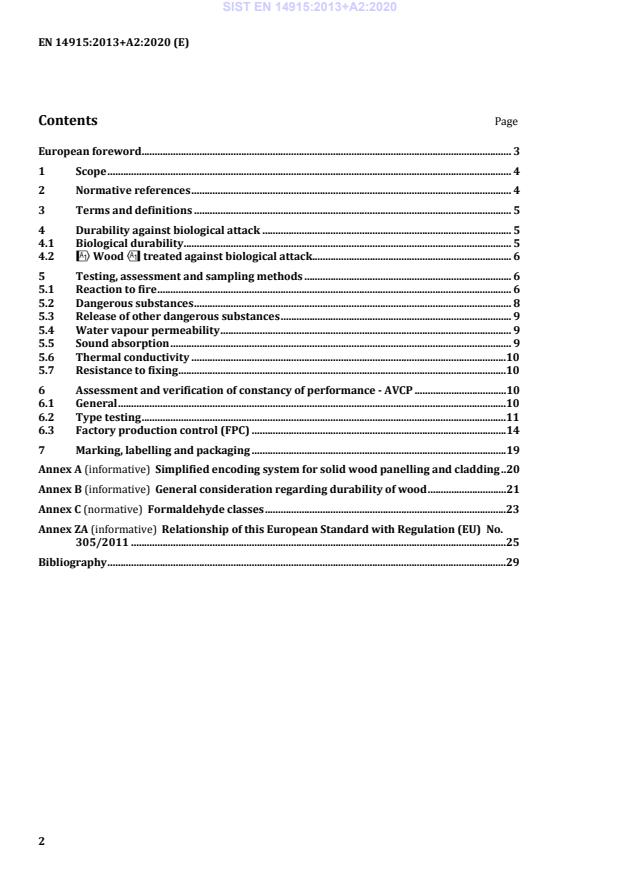
Contents Page
European foreword . 3
1 Scope . 4
2 Normative references . 4
3 Terms and definitions . 5
4 Durability against biological attack . 5
4.1 Biological durability . 5
4.2 !Wood" treated against biological attack. 6
5 Testing, assessment and sampling methods . 6
5.1 Reaction to fire . 6
5.2 Dangerous substances . 8
5.3 Release of other dangerous substances . 9
5.4 Water vapour permeability . 9
5.5 Sound absorption . 9
5.6 Thermal conductivity .10
5.7 Resistance to fixing .10
6 Assessment and verification of constancy of performance - AVCP .10
6.1 General .10
6.2 Type testing .11
6.3 Factory production control (FPC) .14
7 Marking, labelling and packaging .19
Annex A (informative) Simplified encoding system for solid wood panelling and cladding .20
Annex B (informative) General consideration regarding durability of wood .21
Annex C (normative) Formaldehyde classes .23
Annex ZA (informative) Relationship of this European Standard with Regulation (EU) No.
305/2011 .25
Bibliography .29
European foreword
This document (EN 14915:2013+A2:2020) has been prepared by Technical Committee CEN/TC 175
“Round and sawn timber”, the secretariat of which is held by AFNOR.
This European Standard shall be given the status of a national standard, either by publication of an
identical text or by endorsement, at the latest by July 2020, and conflicting national standards shall be
withdrawn at the latest by October 2021.
Attention is drawn to the possibility that some of the elements of this document may be the subject of
patent rights. CEN shall not be held responsible for identifying any or all such patent rights.
This document includes Amendment 1 approved by CEN on 10 April 2017 and Amendment 2 approved
by CEN on 17 July 2019.
This document supersedes #EN 14915:2013+A1:2017$.
The start and finish of text introduced or altered by amendment is indicated in the text by tags !"
and #$.
This document has been prepared under a mandate given to CEN by the European Commission and the
European Free Trade Association, and supports essential requirements of EU Directive(s).
!For relationship with EU Construction Products Regulation (CPR), see informative Annex ZA, which
is an integral part of this standard."
According to the CEN-CENELEC Internal Regulations, the national standards organisations of the
following countries are bound to implement this European Standard: Austria, Belgium, Bulgaria,
Croatia, Cyprus, Czech Republic, Denmark, Estonia, Finland, France, Germany, Greece, Hungary, Iceland,
Ireland, Italy, Latvia, Lithuania, Luxembourg, Malta, Netherlands, Norway, Poland, Portugal, Republic of
North Macedonia, Romania, Serbia, Slovakia, Slovenia, Spain, Sweden, Switzerland, Turkey and the
United Kingdom.
1 Scope
This European Standard defines and specifies the relevant characteristics and the appropriate test
methods to determine these characteristics for solid wood products to be used as panelling and
cladding (including siding) for:
— wall and ceiling panelling for internal use,
— wall and ceiling cladding for external uses.
!It provides for the assessment and verification of constancy of performance and the requirements
for marking these products."
This European Standard does not cover panels intended for use as stiffening elements.
This European Standard does not cover suspended ceiling in wood panelling and cladding.
This European Standard does not cover the processes for treatment, surface coating or modification.
This European standard does not cover products which are produced from laminated layer section.
This European Standard covers treated, untreated and surface coated products, including those made of
thermally or chemically modified wood, as well as finger jointed and edge glued products.
NOTE Prescriptions for surface coating and treatment can be found in documents valid in the place of use.
This European Standard covers products in compliance with EN 14519, EN 15146 and EN 14951, and
other solid timber products manufactured for use as panelling and cladding.
2 Normative references
The following documents, in whole or in part, are normatively referenced in this document and are
indispensable for its application. For dated references, only the edition cited applies. For undated
references, the latest edition of the referenced document (including any amendments) applies.
EN 335:2013, Durability of wood and wood-based products - Use classes: definitions, application to solid
wood and wood-based products
!EN 350, Durability of wood and wood-based products - Testing and classification of the durability to
biological agents of wood and wood-based materials"
EN 351-1, Durability of wood and wood-based products - Preservative-treated solid wood - Part 1:
Classification of preservative penetration and retention
EN 599-2, Durability of wood and wood-based products - Performance of preventive wood preservatives as
determined by biological tests - Part 2: Classification and labelling
EN 717-1, Wood-based panels - Determination of formaldehyde release - Part 1: Formaldehyde emission
by the chamber method
EN 717-2, Wood based panels - Determination of formaldehyde release - Part 2: Formaldehyde release by
the gas analysis method
EN 844-9:1997, Round and sawn timber - Terminology - Part 9: Terms relating to features of sawn timber
EN 1309-1:1997, Round and sawn timber - Method of measurement of dimensions - Part 1: Sawn timber
EN 12664, Thermal performance of building materials and products - Determination of thermal resistance
by means of guarded hot plate and heat flow meter methods - Dry and moist products of medium and low
thermal resistance
EN 13501-1, Fire classification of construction products and building elements - Part 1: Classification
using data from reaction to fire tests
EN 13556, Round and sawn timber - Nomenclature of timbers used in Europe
EN 13756:2002, Wood flooring - Terminology
EN 13986, Wood-based panels for use in construction - Characteristics, evaluation of conformity and
marking
EN ISO 354, Acoustics - Measurement of sound absorption in a reverberation room (ISO 354)
EN ISO 10456:2007, Building materials and products - Hygrothermal properties -Tabulated design values
and procedures for determining declared and design thermal values (ISO 10456:2007)
EN ISO 11654, Acoustics - Sound absorbers for use in buildings - Rating of sound absorption (ISO 11654)
EN ISO 12572, Hygrothermal performance of building materials and products - Determination of water
vapour transmission properties (ISO 12572)
3 Terms and definitions
For the purposes of this document, the terms and definitions given in EN 13756:2002, EN 844-9:1997
and EN 1309-1:1997 and the following apply.
3.1
siding
North American term, synonymous with exterior cladding; material attached to exterior of the building
wall where length predominates over the other two dimensions, having reduced thickness
3.2
assembled panelling/cladding
products put together, according to their method of assembly as given by the manufacturer (e.g. joined
tongue to groove), to form a panelling or cladding assembly
!Note 1 to entry: For the purpose of this document panelling relates to interior applications; cladding to
exterior applications"
!
4 Durability against biological attack
4.1 Biological durability
!If sapwood is not specifically excluded this shall be identified."
If the species is listed in !EN 350", the biological durability shall be as given therein; otherwise it
shall be assessed in accordance with !EN 350".
4.2 !Wood" treated against biological attack
4.2.1 General
!Wood" treated against biological attack shall meet regulatory requirements valid in the place of
use of the products.
Preservative treated products shall be defined by:
— use class in accordance with EN 335,
— wood preservative in accordance with EN 599-2,
— penetration class in accordance with EN 351-1,
— retention of preservative in accordance with EN 351-1.
4.2.2 !Wood"
Any machining, boring, planing, etc. shall be completed before preservative treatment. In case of wane,
the bark shall be removed.
4.2.3 Preservatives
Wood preservatives used shall conform to the performance requirements given in EN 599-2
appropriate for the use class.
4.2.4 Penetration
The minimum penetration shall be declared in terms of penetration classes listed in EN 351-1.
4.2.5 Retention
The mean retention in the analytical zone (see EN 351-1) shall be equal to or greater than the retention
requirement for the preservative used in the declared use class.
"
5 Testing, assessment and sampling methods
5.1 Reaction to fire
The reaction to fire performance of a solid wood panelling and cladding product, whether treated or
not, shall be classified in accordance with EN 13501-1, after being tested in accordance with the test
standards given therein and the relevant reaction to fire class declared.
When tested, the product shall be mounted and fixed in accordance with the same mounting and fixing
conditions used for obtaining the classification of products without the need of testing (i.e. those in
relevant footnotes a to j of Table 1). !Given that climatic conditions provided for testing in EN 13501-
1 represent average interior climatic conditions, as an alternative for exterior use to represent average
exterior conditions, the test specimen may be conditioned at 20 °C and 65 % relative humidity."
1)
In case the product meets the requirements given in Table 1 it may be classified without the need for
further testing (CWFT) in one of the appropriate classes shown therein. In this case, the relevant
reaction to fire class shall be declared (together with the corresponding mean density of the product,
the overall thickness of the product as well as the end-use conditions).
Table 1 — Classes of reaction to fire performance
Minimum
thickness
Minimum
e total/ d c
Material f
Product detail End-use condition Class
mean density
g
(kg/m )
minimum
(mm)
Panelling and Wood pieces with or Without air gap or with
9/6 D - s2,d 2
a without tongue and closed air gap behind
cladding
groove and with or 390
without profiled
12/8 D - s2,d 0
surface
Panelling and Wood pieces with or With open air gap ≤ 20
9/6
b without tongue and mm behind
cladding
groove and with or
390 D - s2,d 0
without profiled
Without air gap or with
18/12
surface
open air gap behind
Wood ribbon Wood pieces Surrounded by open air
h mounted on a j
390 18 D - s2,d 0
elements on all sides
i
support frame
a
Mounted mechanically on a wood batten support frame, with the gap closed or filled with a substrate of at least class A2 - s1,
d0 with minimum density of 10 kg/m or filled with a substrate of cellulose insulation material of at least class E and with or
without a vapour barrier behind. The wood product shall be designed to be mounted without open joints.
b
Mounted mechanically on a wood batten support frame, with or without an open air gap behind. The wood product shall be
designed to be mounted without open joints.
c
Class as provided for in Table 1 of the annex to Commission Decision 2000/147/EC.
d
An open air gap may include possibility for ventilation behind the product, while a closed air gap will exclude such ventilation.
The substrate behind the air gap shall be of at least class A2 - s1, d0 with a minimum density of 10 kg/m . Behind a closed air gap of
maximum 20 mm and with vertical wood pieces, the substrate may be of at least class D - s2, d0.
e
Joints include all types of joints, e.g. butt joints and tongue and groove joints.
f
Conditioned according to EN 13238.
g
As illustrated in Figure 1 below. Profiled area of the exposed side of the panel not more than 20 % of the plane area, or 25 % if
measured at both exposed and unexposed side of the panel. For butt joints, the larger thickness applies at the joint interface.
h
Rectangular wood pieces, with or without rounded corners, mounted horizontally or vertically on a support frame and
surrounded by air on all sides, mainly used close to other building elements, both in interior and exterior applications.
i
Maximum exposed area (all sides of rectangular wood pieces and wood support frame) not more than 110 % of the total plane
area, see Figure 2.
j
Other building elements closer than 100 mm from the wood ribbon element (excluding its support frame) shall be of at least
class A2 - s1, d0, at distances 100 mm - 300 mm of at least class B - s1, d0 and at distances more than 300 mm of at least class D - s2,
d0.
1)
This table and Figures 1 and 2 correspond to Table 2 and Figures a and b respectively of the Commission Decision
2006/213/EC (OJEU L79/27 of 16.3.2006).
Table 1 (continued)
Figure 1 — Profiles for solid wood panelling and cladding
Maximum exposed area of wood ribbon element:
2n (t+w) + a ≤ 1,10
where
n is number of wood pieces per metre
t is thickness of each wood piece, in metre
w is width of each wood piece, in metre
2 2
a is exposed area of wood support frame (if any), in m , per m of wood ribbon
element
Figure 2 — Maximum exposed area
5.2 Dangerous substances
2)
5.2.1 Formaldehyde release
The formaldehyde release of solid wood panelling and cladding products shall be determined according
to Annex C. The declared values !shall be" expressed in term of classes.
5.2.2 Content of pentachlorophenol
Solid wood panelling and cladding as such, without chemical treatment, without adhesive, without
coating or finishing, does not contain PCP. If the product contains raw materials that include PCP (may
concern only soft wood treated against blue stain), then the product shall be tested in accordance with
-6n -6n
is exceeded, the indication “PCP > 5 × 10 shall be added
CEN/TR 14823. In case the value of 5 × 10
-6n -6n
to the marking. In case the value is less than 5 × 10 , the indication PCP ≤ 5 × 10 shall be added to the
marking.
2)
Products CE marked according to this European Standard emitting formaldehyde above class E1 might be prohibited in
some Member States.
5.3 Release of other dangerous substances
National regulations on dangerous substances may require, verification and declaration on release, and
sometimes content, of other dangerous substances, in addition to those dealt with in other clauses,
when construction products covered by this standard are placed on those markets.
In the absence of European harmonised test methods, verification and declaration on release/content
should be done taking into account national provisions in the place of use.
NOTE An informative database covering European and national provisions on dangerous substances is
available at the Construction web site on EUROPA accessed through:
http://ec.europa.eu/enterprise/construction/cpd-ds/.
5.4 Water vapour permeability
If water vapour permeability is required, either the water vapour resistance factor of the product tested
as assembled panelling shall either be taken from Table 2 or, if the manufacturer wishes to declare a
better value, obtained by testing the product as assembled panelling according to EN ISO 12572.
Table 2 — Characteristic values of water vapour permeability of wood as given in EN
ISO 10456:2007 , Table 3
a
Wood type Density Water vapour resistance factor µ
kg/m
wet dry
timber 450 20 50
500 20 50
700 50 200
a
For other densities, interpolation is possible.
5.5 Sound absorption
If the sound absorption coefficient of a product is required, it shall either be taken from Table 3 or, if the
manufacturer wishes to declare a better value, obtained by testing the product as assembled panelling
to EN ISO 354 and the result expressed according to EN ISO 11654.
NOTE The sound absorption depends on finishing, geometrical characteristics, etc.
Table 3 — Sound absorption coefficient
Wood type Sound absorption coefficient
Frequency range Frequency range
250 Hz to 500 Hz 1 000 Hz to 2 000 Hz
Solid wood panelling and cladding 0,10 0,30
) EN ISO 10456 is currently impacted by EN ISO 10456:2007/AC:2009.
5.6 Thermal conductivity
The thermal conductivity shall be determined only for uses subject to thermal insulation requirements
for solid wood panelling !deleted text" for use on internal walls and ceilings. It shall either be
determined according to EN 12664 or given by using tabulated values related to density as shown in
Table 4, taken from EN ISO 10456.
The thermal resistance R (m K/W) of solid wood panelling and cladding of uniform thickness is given
by the formula:
t
R =
λ
where
t is the uniform minimum thickness of the wood panelling and cladding, in metres;
λ .
is the thermal conductivity, in W/m K.
Table 4 — Design thermal conductivity values (λ) (in conformity with EN ISO 10456)
a
Wood type Mean density ρ Thermal conductivity λ
at a moisture content of .
in W/(m K) (design value)
12 % in kg/m
Solid wood 300 0,09
400 0,11
500 0,13
600 0,15
700 0,18
1 000 0,24
a
For densities not given in this table, λ may be found by interpolation.
5.7 Resistance to fixing
Resistance to fixing of solid wood is dependent on species and with higher density hardwoods may
necessitate pre-drilling, especially if the wood has been dried. For wood species with an average density
(at 20 % moisture content) the manufacturer shall indicate whether pre-
greater than 600 kg/m
drilling is either advisable or necessary.
When mechanically fixed (by means of nails, anchors, etc.) to walls/ceiling, the panelling/cladding shall
be designed to take into account its own weight and other possible loads acting on it, e.g. wind load.
!
6 Assessment and verification of constancy of performance - AVCP
6.1 General
The compliance of solid wood panelling product and cladding product with the requirements of this
standard and with the performance declared by the manufacturer in the DoP shall be demonstrated by:
— determination of the product-type on the basis of type testing;
— factory production control by the manufacturer, including product assessment.
6.2 Type testing
6.2.1 General
Performance related to characteristics included in this standard shall be determined when the
manufacturer intends to declare the respective performance unless the standard gives provisions for
declaring them without performing tests. (e.g. use of previously existing data, CWFT and conventionally
accepted performance).
Assessment previously performed in accordance with the provisions of this standard, may be taken into
account provided that they were made to the same or a more rigorous test method, under the same
AVCP system on the same product-type, such that the results are applicable to the product in question.
NOTE 1 Same AVCP system means testing by an independent third party laboratory where relevant, under the
responsibility of a notified product certification body where relevant.
For the purposes of assessment, the manufacturer's products may be grouped into families, where it is
considered that the results for one or more characteristics from any one product within the family are
representative for that same characteristics for all products within that same family.
NOTE 2 Products may be grouped in different families for different characteristics.
Reference to the assessment method standards should be made to allow the selection of a suitable
representative sample.
In addition, the determination of the product-type shall be performed for all essential characteristics
included in the standard for which the manufacturer declares the performance:
— at the beginning of the production of a new or modified solid wood panelling product and cladding
product (unless it is a member of a same product range), or
— at the beginning of a new or modified method of production (where this may affect the stated
properties); or
— they shall be repeated for the appropriate essential characteristic(s), whenever a change occurs in
the solid wood panelling product and cladding product design, in the raw material or in the
supplier of the components, or in the method of production (subject to the definition of a family),
which would affect significantly one or more of the performance.
Where components are used whose performance have already been determined, by the component
manufacturer, on the basis of assessment methods of other product standards, these performance need
not be re-assessed. The specifications of these components shall be documented.
Products bearing regulatory marking in accordance with appropriate harmonized European
specifications may be presumed to have the performance declared in the DoP, although this does not
replace the responsibility on solid wood panelling product and cladding product manufacturer to
ensure that the solid wood panelling product and cladding product as a whole is correctly
manufactured and its component products have the declared performance values.
6.2.2 Test samples, testing and compliance criteria
The number of samples of solid wood panelling product and cladding product to be tested/assessed
shall be in accordance with Table 5.
Table 5 — Number of samples to be tested and compliance criteria
No. of
samples Compliance criteria
Assessment
Characteristic Requirement
method
[to be
assessed]
Reaction to fire 5.1 Table 1 or CWFT, Table 1
EN 13501-1 see Table 1
Classes according to
EN 13501-1 EN 13501-1
Release of dangerous substances
Release of 5.2.1 Annex C see Annex C Only for internal use
formaldehyde According to Annex C
E1 or E2
Content of 5.2.2 CEN/TR 14823 See Only for internal use
CEN/TR 14823
pentachlorophenol according to
CEN/TR 14823
-6n
> 5 × 10 or
-6n
≤ 5 × 10
Release of other 5.3 - As relevant Only for internal use
according to
dangerous As relevant acc. to 5.3
5.3
substances
Water vapour 5.4 Table 2 or - Not when there is an
EN ISO 12572 air gap between
permeability
cladding/panelling
and wall.
Tested in accordance
with 5.4 and value
not under declared
value.
Sound absorption 5.5 Table 3 or - Only for internal use
EN ISO 354
Value not under
declared value
Thermal resistance 5.6 5.6 - Only for internal use
expressed as See 5.6
thermal Value not under
declared value
conductivity
Resistance to 5.7 5.7 - See 5.7
fixings
No. of
samples Compliance criteria
Assessment
Characteristic Requirement
method
[to be
assessed]
Durability
Biological 4.1 For species listed - Natural durability in
in EN 350 accordance with
durability
EN 350
For species and
origins not listed Value same as the
in EN 350, declared value
assessed
according to
EN 350
Wood treated 4.2 See 4.2.1 - See 4.2.1
against biological
attack
6.2.3 Test reports
The results of the determination of the product type shall be documented in test reports. All test reports
shall be retained by the manufacturer for at least 10 years after the last date of production of the solid
wood panelling product and cladding product to which they relate.
6.2.4 Shared other party results
A manufacturer may use the results of the product type determination obtained by someone else (e.g.
by another manufacturer, as a common service to manufacturers, or by a product developer), to justify
his own declaration of performance regarding a product that is manufactured according to the same
design and with raw materials, constituents and manufacturing methods of the same kind, provided
that:
— the results are known to be valid for products with the same essential characteristics relevant for
the product performance;
— in addition to any information essential for confirming that the product has such same
performances related to specific essential characteristics, the other party who has carried out the
4)
determination of the product type concerned or has had it carried out, has expressly accepted to
transmit to the manufacturer the results and the test report to be used for the latter’s product type
determination, as well as information regarding production facilities and the production control
process that can be taken into account for FPC;
— the manufacturer using other party results accepts to remain responsible for the product having
the declared performances and he also:
— ensures that the product has the same characteristics relevant for performance asthe one that
has been subjected to the determination of the product type, and that there are no significant
4)
The formulation of such an agreement can be done by licence, contract, or any other type of written consent.
.
differences with regard to production facilities and the production control process compared
to that used for the product that was subjected to the determination of the product type;
— keeps available a copy of the determination of the product type report that also contains the
information needed for verifying that the product is manufactured according to the same
design and with raw materials, constituents and manufacturing methods of the same kind.
6.3 Factory production control (FPC)
6.3.1 General
The manufacturer shall establish, document and maintain an FPC system to ensure that the products
placed on the market comply with the declared performance of the essential characteristics.
The FPC system shall consist of procedures, regular inspections and tests and/or assessments and the
use of the results to control raw and other incoming materials or components, equipment, the
production process and the product.
All the elements, requirements and provisions adopted by the manufacturer shall be documented.
In case the manufacturer has used shared or cascading product type results, the FPC shall also include
the appropriate documentation as foreseen in 6.2.4.
6.3.2 Requirements
6.3.2.1 General
The effective implementation of the FPC system shall be organised in line with the content of this
product standard. Tasks and responsibilities in the production control organization shall be
documented and this documentation shall be kept up-to-date.
The responsibility, authority and the relationship between personnel that manages, performs or verifies
work affecting constancy of performance of the product, shall be defined. This applies in particular to
personnel that need to initiate actions preventing product non-constancies of performance of the
product from occurring, actions in case of non-constancies of performance of the product and to
identify and register product constancy of performance of the product problems.
The competence (e.g. on the basis of education, training, skills, or experience) of personnel performing
work affecting the constancy of performance of the product shall be recorded.
In each factory the manufacturer may delegate the action to a person having the necessary authority to:
— identify procedures to demonstrate constancy of performance of the product at appropriate stages;
— identify and record any instance of non-constancy of performance;
— identify procedures to correct instances of non-constancy of performance.
The manufacturer shall draw up and keep up-to-date documents defining the factory production
control. The manufacturer's documentation and procedures should be appropriate to the product and
manufacturing process. The FPC system should achieve an appropriate level of confidence in the
constancy of performance of the product. This involves:
a) the preparation of documented procedures and instructions relating to factory production control
operations, in accordance with the requirements of the technical specification to which reference is
made;
b) the effective implementation of these procedures and instructions;
c) the recording of these operations and their results;
d) the use of these results to correct any deviations, repair the effects of such deviations, treat any
resulting instances of non-conformity and, if necessary, revise the FPC to rectify the cause of non-
constancy of performance.
Where subcontracting takes place, the manufacturer shall retain the overall control of the product and
ensure that he receives all the information that is necessary.
If the manufacturer has part of the product designed, manufactured, assembled, packed, processed
and/or labelled by subcontracting, the FPC of the subcontractor may be taken into account, where
appropriate for the product in question.
The manufacturer who subcontracts all of his activities may in no circumstances pass the above
responsibilities on to a subcontractor.
NOTE Manufacturers having an FPC system, which complies with EN ISO 9001 standard and which addresses
the provisions of the present European standard are considered as satisfying the FPC requirements of the
Regulation (EU) No 305/2011.
6.3.2.2 Equipment
6.3.2.2.1 Testing
All weighing, measuring and testing equipment shall be checked and regularly inspected according to
documented procedures, frequencies and criteria.
6.3.2.2.2 Manufacturing
All equipment used in the manufacturing process shall be regularly inspected and maintained to ensure
use, wear or failure does not cause inconsistency in the manufacturing process. Inspections and
maintenance shall be carried out and recorded in accordance with the manufacturer’s written
procedures and the records retained for the period defined in the manufacturer's FPC procedures.
6.3.2.3 Raw materials and components
The specifications of all incoming raw materials and components shall be documented, as shall the
inspection scheme for ensuring their compliance.
6.3.2.4 Controls during manufacturing process
The manufacturer shall plan and carry out production under controlled conditions.
6.3.2.5 Product testing and evaluation
The manufacturer shall establish procedures to ensure that the stated values of the characteristics he
declares are maintained. The characteristics, and the means of control, are:
— Reaction to fire shall be subject to the tests indicated in 5.1;
The composition of the product shall be regularly controlled at a frequency to ensure that, for the
CWFT product, the requirements of Table 1 are satisfied and, for the tested product, to ensure that
the product remains in the same class as that obtained in the type testing. If a fire retardant treated
product (e.g. some surface coated products) is used, the indications given by the manufacturer to
maintain the characteristics shall be observed.
— Formaldehyde content shall be subject to the tests indicated in 5.2.1;
Where the manufacturer uses no formaldehyde containing materials, he shall continue to check,
with a frequency defined in his FPC manual, that no such material is used. For formaldehyde
containing materials, the manufacturer shall use the provisions of Table C.1 or Table C.2 with a
frequency to ensure that the class is obtained. A manufacturer declaring Class E2 need perform no
FPC testing, unless he wishes to change this declaration.
— Where Pentachlorophenol content shall be subject to the tests indicated in 5.2.2;
Where the manufacturer uses no pentachlorophenol containing materials, he shall continue to
check, with a frequency defined in his FPC manual, that no such material is used. For
pentachlorophenol containing materials, the manufacturer shall use the provisions of 5.2.2 with a
-6n
frequency to ensure that the class is obtained. A manufacturer declaring "PCP > 5 × 10 " need
perform no FPC testing, unless he wishes to change this declaration.
— Release of other dangerous substances shall be subject to the tests indicated in 5.3; Where no other
dangerous substances containing materials are used for the products, this shall be regularly
checked with a frequency defined in the FPC manual.
— Water vapour permeability shall be subject to the tests indicated in 5.4;
Where the manufacturer wishes to provide values for water vapour permeability, sound absorption
or thermal conductivity, the requirements in Clause 5 shall be followed. The values in Table 2, Table
3 and Table 4 refer to wood in the natural state and after thermal or chemical modification or
treatment but without surface coating. Otherwise, the manufacturer shall declare NPD.
— Sound absorption shall be subject to the tests indicated in 5.5; If a change in the product is made
(change of dimensions), such that it would significantly affect the sound absorption performance of
the product, the type testing shall be repeated
— Thermal resistance expressed as thermal conductivity: shall be subject to the tests indicated 5.6;
Where a thermal conductivity value is declared, it shall be ensured that the continuous mean
density of the material used for the product does not change by more than ±10 % from that of the
product used in the type testing (whether tested or using reference data).
— Resistance to fixings shall be subject to considerations indicated in 5.7; Where a resistance to fixing
is declared, it shall be ensured that the continuous mean density of the material used for the
product does not change by more than ±10 % from that of the product used in the type testing
(whether tested or using reference data).
— Biological durability: shall be subject to the tests indicated in Clause 4;
For biological durability, the manufacturer shall ensure that the timber species used in the finished
panelling and cladding product remain the same or do not change to an extent that would change
the declared durability class. For conferred durability classes, the producer shall apply the principle
defined in 4.2.1 and 4.2.2, knowing that less durable species will provide only limited service life in
fully exposed exterior situations unless appropriate preservative treatment or design are
employed. No FPC testing is necessary as long as the wood used does not change and the
preservative characteristics and the application method are maintained. For preservative use, the
panelling and cladding manufacturer shall follow indications of internal control expressed by the
preservative manufacturer. If the product, the characteristics of the product or the method of
application of the preservative change, the manufacturer shall repeat the type test using three
samples
6.3.2.6 Non-complying products
The manufacturer shall have written procedures which specify how non-complying products shall be
dealt with. Any such events shall be recorded as they occur and these records shall be kept for the
period defined in the manufacturer’s written procedures.
Where the product fails to satisfy the acceptance criteria, the provisions for non-complying products
shall apply, the necessary corrective action(s) shall immediately be taken and the products or batches
not complying shall be isolated and properly identified.
Once the fault has been corrected, the test where relevant or verification in question shall be repeated.
The results of controls and tests where relevant shall be properly recorded. The product description,
date of manufacture, test method adopted, test results and acceptance criteria shall be entered in the
records under the signature of the person responsible for the control/test.
With regard to any control result not meeting the requirements of this European standard, the
corrective measures taken to rectify the situation (e.g. a further test carried out, modification of
manufacturing process, throwing away or putting right of product) shall be indicated in the records.
6.3.2.7 Corrective action
The manufacturer shall have documented procedures that instigate action to eliminate the cause of
non-conformities in order to prevent recurrence.
6.3.2.8 Handling, storage and packaging
The manufacturer shall have procedures providing methods of product handling and shall provide
suitable storage areas preventing damage or deterioration.
6.3.3 Product specific requirements
The FPC system shall include a product specific FPC, which identifies procedures to demonstrate
compliance of the product at appropriate stages, i.e.:
a) the controls and tests to be carried out prior to and/or during manufacture according to a
frequency laid down in the FPC test plan;
and/or
b) the verifications and tests to be carried out on finished products according to a frequency laid down
in the FPC test plan.
If the manufacturer uses only finished products, the operations under b) shall lead to an equivalent
level of compliance of the product as if FPC had been carried out during the production.
If the manufacturer carries out parts of the production himself, the operations under b) may be reduced
and partly replaced by operations under a). Generally, the more parts of the production that are carried
out by the manufacturer, the more operations under b) may be replaced by operations under a).
In any case the operation shall lead to an equivalent level of compliance of the product as if FPC had
been carried out during the production.
The operations under a) refer to the intermediate states of the product as on manufacturing machines
and their adjustment, and measuring equipment etc. These controls and tests and their frequency shall
be chosen based on product type and composition, the manufacturing process and its complexity, the
sensitivity of pro
...