

SIST EN 13842:2005
(Main)Oil fired forced convection air heaters - Stationary and transportable for space heating
General Information
- Abstract
This European Standard specifies the requirements and test methods for the safety and efficiency of oil-fired air heaters using only forced draught oil burners, hereafter referred to as "appliances".
This European Standard applies to stationary and portable appliances. It also applies to appliances intended for outdoor installation. Provision of the heated air may be by means of ducting or may be directly into the heated space.
For the purpose of this standard the heat generation is by the combustion of liquid fuel oils as defined in EN 267 (gas oil with a viscosity at the burner inlet of 1,6 mm²/s (cSt) up to 6 mm²/s (cSt) at 20 °C). Alternatively, if the manufacturer requests, the fuel of kerosene may be used as defined in EN 304:1992. Kerosene with a viscosity at the burner of 1,3 mm2/s (cSt) to 2,9 mm2/s (cSt) at 20 °C) or other suitable liquid fuel oils may also be used.
This standard does not apply to:
- appliances intended for use in a single unit residential dwelling;
- appliances of the condensing type;
- appliances with atmospheric burners without a fan to assist the transportation of combustion air;
- dual purpose air conditioning appliances (heating and cooling);
- appliances where the air is heated by an intermediate fluid;
- appliances fitted with manual or automatic flue dampers;
- appliances having multiple heating units with a single flue;
- appliances fitted with more than one flue outlet.
This European Standard is applicable to appliances which are intended to be type tested.
NOTE Requirements for appliances which are not type tested would need to be subject to further consideration.
- Status
- Published
- Publication Date
- 31-Dec-2004
- Technical Committee
- PLN - Gas appliances for domestic use
- Current Stage
- 6060 - National Implementation/Publication (Adopted Project)
- Start Date
- 01-Jan-2005
- Due Date
- 01-Jan-2005
- Completion Date
- 01-Jan-2005


Overview
EN 13842:2004 is a CEN (European) standard that specifies safety and efficiency requirements and test methods for oil‑fired forced convection air heaters that use forced‑draught oil burners. It covers both stationary and transportable (portable) appliances intended for space heating, including units installed outdoors and units that deliver heated air directly or via ducting. Fuels are primarily liquid fuel oils defined in EN 267 (gas oil) with optional use of kerosene per EN 304 when requested by the manufacturer. EN 13842 is intended primarily for appliances that are type tested.
Key topics and requirements
- Scope and exclusions: Applies to forced‑draught oil burner heaters but excludes single‑unit residential heaters, condensing units, atmospheric burners without a fan, dual heating/cooling units, appliances heated by an intermediate fluid, units with manual/automatic flue dampers, multi‑unit single‑flue systems, and appliances with more than one flue outlet.
- Construction requirements: Mechanical, chemical and thermal robustness of components (heat exchanger, combustion chamber, casing), non‑use of asbestos or cadmium‑bearing solder, and non‑combustible materials where required.
- Combustion air and flue connections: Adequate combustion air supply across operating range; fixed combustion product outlet geometry and rules for flue connection depth and diameter to ensure safe evacuation of combustion products.
- Controls and safety devices: Requirements for automatic burner control systems, automatic shut‑off valves, overheat cut‑offs (manual reset), fan delay controls, thermostats, and lock‑out behavior after faults or power interruption.
- Electrical and EMC requirements: Compliance with prEN 50156‑1, EN 60335‑1, EN 60730 series, EN 60529 for IP ratings, and provisions for leakage current, wiring diagrams and protection.
- Accessibility & maintenance: Removable parts must be accessible and designed to avoid hazardous incorrect reassembly; user access panels must not allow combustion products into air distribution.
- Test methods, marking and instructions: Standard includes prescribed tests, measurements and mandatory documentation for safe commissioning and type testing.
Applications and users
Who uses EN 13842:
- Manufacturers and product designers of oil‑fired forced convection air heaters for ensuring compliance and preparing type tests.
- Test laboratories and certification bodies conducting safety and performance tests.
- Regulatory and compliance managers in HVAC, industrial heating and mobile/temporary heating sectors.
- Installers and system integrators who need to understand connection, flue and installation constraints.
- Procurement and safety engineers specifying equipment for warehouses, workshops, outdoor temporary sites and large non‑residential spaces.
Related standards
Relevant referenced documents include: EN 267, EN 304, EN 230, prEN 50156‑1, EN 60335‑1, EN 60529, EN 60730 series and EN ISO 1182 (non‑combustibility). These provide burner definitions, fuel specifications, electrical and safety requirements that complement EN 13842.
EN 13842 is the go‑to standard for certifying and safely deploying oil‑fired forced convection heaters in non‑residential and portable heating applications across Europe.
Relations
- Effective Date
- 07-Jul-2026
- Effective Date
- 09-Feb-2026
- Effective Date
- 09-Feb-2026
- Effective Date
- 09-Feb-2026
- Effective Date
- 09-Feb-2026
- Effective Date
- 09-Feb-2026
- Effective Date
- 28-Jan-2026
- Effective Date
- 28-Jan-2026
- Effective Date
- 28-Jan-2026
- Effective Date
- 28-Jan-2026
- Effective Date
- 09-Feb-2026
- Effective Date
- 09-Feb-2026
- Effective Date
- 09-Feb-2026
- Effective Date
- 09-Feb-2026
Frequently Asked Questions
SIST EN 13842:2005 is a standard published by the Slovenian Institute for Standardization (SIST). Its full title is "Oil fired forced convection air heaters - Stationary and transportable for space heating". This standard covers: This European Standard specifies the requirements and test methods for the safety and efficiency of oil-fired air heaters using only forced draught oil burners, hereafter referred to as "appliances". This European Standard applies to stationary and portable appliances. It also applies to appliances intended for outdoor installation. Provision of the heated air may be by means of ducting or may be directly into the heated space. For the purpose of this standard the heat generation is by the combustion of liquid fuel oils as defined in EN 267 (gas oil with a viscosity at the burner inlet of 1,6 mm²/s (cSt) up to 6 mm²/s (cSt) at 20 °C). Alternatively, if the manufacturer requests, the fuel of kerosene may be used as defined in EN 304:1992. Kerosene with a viscosity at the burner of 1,3 mm2/s (cSt) to 2,9 mm2/s (cSt) at 20 °C) or other suitable liquid fuel oils may also be used. This standard does not apply to: - appliances intended for use in a single unit residential dwelling; - appliances of the condensing type; - appliances with atmospheric burners without a fan to assist the transportation of combustion air; - dual purpose air conditioning appliances (heating and cooling); - appliances where the air is heated by an intermediate fluid; - appliances fitted with manual or automatic flue dampers; - appliances having multiple heating units with a single flue; - appliances fitted with more than one flue outlet. This European Standard is applicable to appliances which are intended to be type tested. NOTE Requirements for appliances which are not type tested would need to be subject to further consideration.
This European Standard specifies the requirements and test methods for the safety and efficiency of oil-fired air heaters using only forced draught oil burners, hereafter referred to as "appliances". This European Standard applies to stationary and portable appliances. It also applies to appliances intended for outdoor installation. Provision of the heated air may be by means of ducting or may be directly into the heated space. For the purpose of this standard the heat generation is by the combustion of liquid fuel oils as defined in EN 267 (gas oil with a viscosity at the burner inlet of 1,6 mm²/s (cSt) up to 6 mm²/s (cSt) at 20 °C). Alternatively, if the manufacturer requests, the fuel of kerosene may be used as defined in EN 304:1992. Kerosene with a viscosity at the burner of 1,3 mm2/s (cSt) to 2,9 mm2/s (cSt) at 20 °C) or other suitable liquid fuel oils may also be used. This standard does not apply to: - appliances intended for use in a single unit residential dwelling; - appliances of the condensing type; - appliances with atmospheric burners without a fan to assist the transportation of combustion air; - dual purpose air conditioning appliances (heating and cooling); - appliances where the air is heated by an intermediate fluid; - appliances fitted with manual or automatic flue dampers; - appliances having multiple heating units with a single flue; - appliances fitted with more than one flue outlet. This European Standard is applicable to appliances which are intended to be type tested. NOTE Requirements for appliances which are not type tested would need to be subject to further consideration.
SIST EN 13842:2005 is classified under the following ICS (International Classification for Standards) categories: 97.100.40 - Liquid fuel heaters. The ICS classification helps identify the subject area and facilitates finding related standards.
SIST EN 13842:2005 has the following relationships with other standards: It is inter standard links to SIST EN IEC 60730-2-9:2026, SIST EN 60335-1:2003, SIST EN 50156-1:2025, SIST EN 60529:1997, SIST EN 60730-2-1:1997, SIST EN IEC 60730-2-9:2019, SIST EN ISO 1182:2002, SIST EN 267:2020, SIST EN 304:1997, SIST EN 298:2023, SIST EN 61158-2:2008, SIST EN 61158-2:2015, SIST EN IEC 61158-2:2024, SIST EN 61158-2:2010. Understanding these relationships helps ensure you are using the most current and applicable version of the standard.
SIST EN 13842:2005 is associated with the following European legislation: EU Directives/Regulations: 2015/1185, 2015/1186, 2015/1188. When a standard is cited in the Official Journal of the European Union, products manufactured in conformity with it benefit from a presumption of conformity with the essential requirements of the corresponding EU directive or regulation.
SIST EN 13842:2005 is available in PDF format for immediate download after purchase. The document can be added to your cart and obtained through the secure checkout process. Digital delivery ensures instant access to the complete standard document.
Standards Content (Sample)
2003-01.Slovenski inštitut za standardizacijo. Razmnoževanje celote ali delov tega standarda ni dovoljeno.SURVWRURYÖlbefeuerte Warmlufterzeuger - Ortsfest und ortsbeweglich für die RaumheizungGénérateurs d'air chaud a convection forcée fonctionnant au fioul domestique - Fixes et transportables pour le chauffage des locauxOil fired forced convection air heaters - Stationary and transportable for space heating97.100.40Liquid fuel heatersICS:Ta slovenski standard je istoveten z:EN 13842:2004SIST EN 13842:2005en,fr,de01-januar-2005SIST EN 13842:2005SLOVENSKI
STANDARD
EUROPEAN STANDARDNORME EUROPÉENNEEUROPÄISCHE NORMEN 13842July 2004ICS 97.100.40English versionOil fired forced convection air heaters - Stationary andtransportable for space heatingGénérateurs d'air chaud à convection forcée fonctionnantau fioul domestique - Fixes et transportables pour lechauffage des locauxÖlbefeuerte Warmlufterzeuger - Ortsfest und ortsbeweglichfür die RaumheizungThis European Standard was approved by CEN on 13 May 2004.CEN members are bound to comply with the CEN/CENELEC Internal Regulations which stipulate the conditions for giving this EuropeanStandard the status of a national standard without any alteration. Up-to-date lists and bibliographical references concerning such nationalstandards may be obtained on application to the Central Secretariat or to any CEN member.This European Standard exists in three official versions (English, French, German). A version in any other language made by translationunder the responsibility of a CEN member into its own language and notified to the Central Secretariat has the same status as the officialversions.CEN members are the national standards bodies of Austria, Belgium, Cyprus, Czech Republic, Denmark, Estonia, Finland, France,Germany, Greece, Hungary, Iceland, Ireland, Italy, Latvia, Lithuania, Luxembourg, Malta, Netherlands, Norway, Poland, Portugal, Slovakia,Slovenia, Spain, Sweden, Switzerland and United Kingdom.EUROPEAN COMMITTEE FOR STANDARDIZATIONCOMITÉ EUROPÉEN DE NORMALISATIONEUROPÄISCHES KOMITEE FÜR NORMUNGManagement Centre: rue de Stassart, 36
B-1050 Brussels© 2004 CENAll rights of exploitation in any form and by any means reservedworldwide for CEN national Members.Ref. No. EN 13842:2004: ESIST EN 13842:2005
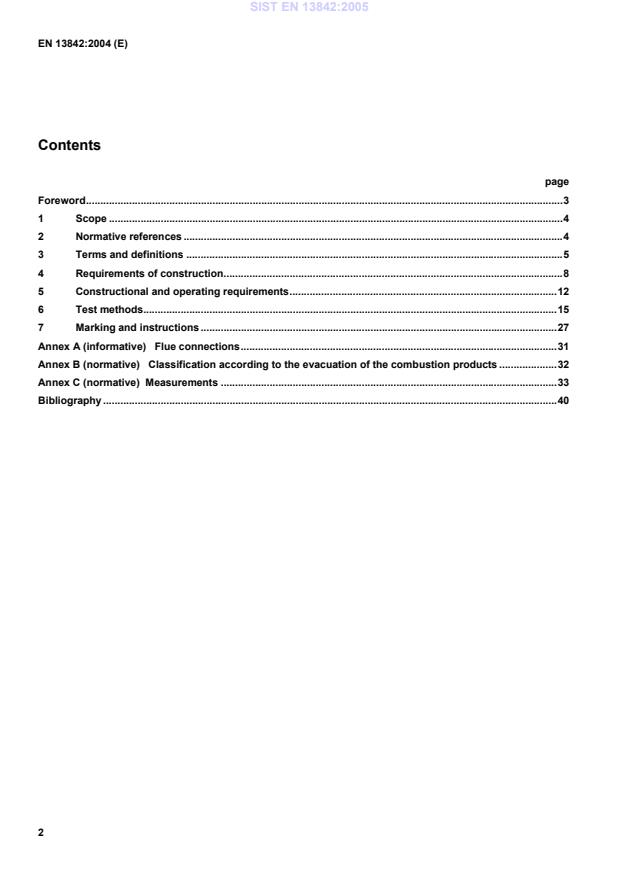
Flue connections.31 Annex B (normative)
Classification according to the evacuation of the combustion products.32 Annex C (normative)
Measurements.33 Bibliography.40 SIST EN 13842:2005
EN 230, Monobloc oil burners — Safety, control and regulation devices and safety times. EN 267, Forced draught oil burners — Definitions, requirements, testing, marking. EN 304:1992, Heating boilers — Test code for heating boilers for atomizing oil burners. prEN 50156-1, Electrical equipment for furnaces and ancillary equipment — Part 1: Requirements for application design and installation. EN 60335-1:2002, Household and similar electrical appliances — Safety — Part 1: General requirements (IEC 60335-1:2001, modified). EN 60529, Degrees of protection provided by enclosures (IP code) (IEC 60529:1989). SIST EN 13842:2005
1 013,25 mbar and temperature of 15 °C NOTE Cubic metres per second (m3/s) or cubic metres per hour (m3/h). 3.3.7 delivered air pressure static pressure available within the duct system provided by the appliance fan related to the delivered air volume NOTE Pascal's (Pa) or millibar (mbar); 1 Pa = 1 N/m2; 1 mbar = 100 N/m2. 3.3.8 controlled shut-down process where the power to the fuel shut off valves and/or the burner motor is removed immediately, e.g. as a result of the action of a controlling function 3.3.9 safety shut-down process which is effected immediately following the response of a safety limiter or sensor or detection of a fault in the burner control system and which puts the burner out of operation by immediately removing the power to the fuel shut-off valves, the ignition device and/or the burner motor SIST EN 13842:2005
mg/kWh mg/kWh 1 250 110 2 185 110 3 120 60 5.8 Combustion under normal fluctuation of auxiliary energy The CO-concentration in the dry air-free combustion products shall not exceed 0,2 % when the appliance is supplied with reference fuel under the conditions defined in 6.8; in addition, the appliance shall ignite and continue to operate safely. SIST EN 13842:2005
0,85 kg/dm3. If the density and sulphur content is known (e.g. by analysis) the calorific value can be calculated as follows: ()()sHi×−×−=3,093,1192,5215ρ in MJ/kg (6) where ρ15 = density of the fuel at 15 °C in kg/dm3; s = Sulphur content in kg/kg. 6.3.2.4 Calorific value of kerosene fuel oil If the calorific value is not determined calorimetrically and in the absence of a complete analysis, the value for kerosene can with sufficient accuracy be assumed as follows: Hi = 43,300 MJ/kg SIST EN 13842:2005
= 0,141 kg/kg; Sulphur content s = 0,004 kg/kg; density at 15 °C:
0,79 kg/dm3. If the density and sulphur content is known the calorific value can be calculated as in the formula in 6.3.2.3. 6.4 Temperature of parts of the appliance which have to be touched during normal use 6.4.1 General The temperatures of the parts specified in 5.2 shall be measured at thermal equilibrium using an instrument with an accuracy of ±2 K, for example using contact thermocouples, and compliance with the requirements of 5.2 is verified. 6.4.2 Temperatures of the side walls, front and top of the appliance The test is carried out when the appliance has reached thermal equilibrium. The temperatures of the hottest parts of the side walls, front and top of the appliance are measured by a suitable means having an accuracy of ±2 K, for example using contact thermocouples, and compliance with the requirements of 5.2.1.2 is verified. 6.4.3 Component temperatures Component temperatures are measured when thermal equilibrium has been reached and after the appliance has been turned off at the end of the test, and compliance with the requirements of 5.2.1.3 is verified. The component temperatures are measured by means of attached thermocouples having thermoelectric junctions with an accuracy of ±2 K. Alternative devices of equivalent accuracy may by used. However, if an electrical component is itself likely to cause a rise in temperature (e.g. automatic shut-off valves) the temperature of the component is not measured. In this case, thermocouples or alternative devices, are placed so as to measure the air temperature around the device. The temperature measurements of the components are deemed to be satisfactory if: ()Ctttasm025−+≤ (7) where tm is the maximum temperature measured in the test in degrees Celsius (°C); ts is the maximum temperature specified by the component manufacturer in degrees Celsius (°C); ta is the ambient room temperature in degrees Celsius (°C). NOTE If the maximum temperature of the component was specified for an ambient temperature other than 25 °C, this should be used. SIST EN 13842:2005
is the temperature rise in Kelvin (K); R1
is the resistance at the beginning of the test in ohms (Ω);
R2
is the maximum resistance at the end of the test in ohms (Ω);
t1
is the room temperature at the beginning of the test in °C; t2
is the room temperature at the end of the test in °C; C
is a constant equal to 234,5 °C for copper. 6.5 Efficiency 6.5.1 Principle of method The thermal efficiency is determined by the flue loss method from measurements of CO2 or O2 concentration and the temperature of the products of combustion. Where the appliance is intended for use within the heating space then the surface loss of the case may be ignored. 6.5.2 Preparation of appliance The appliance is installed in accordance with 6.2 and operated, in accordance with the manufacturer’s instructions, with the appropriate fuel oil. 6.5.3 Test conditions The appliance is supplied with the reference fuel and operated within ±2,5 % of the specified heat input(s) using the minimum delivered air flow declared by the manufacturer. The CO2 or O2 concentration and the temperature of the combustion products are measured by means of a suitable probe, incorporating a temperature-measuring device, located in the flue system. The sampling rate of combustion products for the measurement of temperature is approximately 100 l/h. SIST EN 13842:2005
in m3/kg (11) 2min Atr,AtrO76,4100100VV×−×= (12) where VCO2
is the volume of carbon dioxide CO2 in m3/kg; VSO2
is the volume of sulphur dioxide SO2 in m3/kg; VN2
is the volume of nitrogen N2 in m3/kg; (CO2 + SO2)measured
is the measured proportion of (CO2 + SO2) in the flue gases in m3/kg; O2
is the measured proportion of O2 in the flue gases in m3/kg; VAtr, min
is determined from equation (A.3), see EN 304:1992, Annex A. b) the volume of water vapour VW resulting from water content and the combustion of the water forming components of the fuel in m3/kg or m3/m3 (the water content of the combustion air may be ignored). When the volume of water vapour is separated from the volume of dry products of combustion, the equation becomes: iLAOH pm,WAtr pm,AtrAH1)tt()CVCV(q2×−××+×= (13) where Cpm, Atr is the mean specific heat of the dry flue gas in the temperature range tL to tA, in J/(m3 · K); Cpm, H2O is the mean
...