

SIST EN 1-1:2025
(Main)Residential liquid fuel burning appliances - Part 1: General requirements and test methods
General Information
- Abstract
This document is applicable to residential liquid fuel burning appliances intended for space heating.
This document specifies requirements relating to the design, manufacture, construction, safety and performance (efficiency and emission) of appliances fired by liquid fuel (hereafter referred to as “appliance(s)”) and provides instructions for them. Furthermore, it also gives provisions for the evaluation of conformity, i.e. initial type testing (ITT) and factory production control (FPC) and marking of these appliances.
This document specifies the test methods for the determination of the smoke number, and CO, NOx, and OGC emission test methods.
This document does not apply to:
- built-in appliances;
- appliances equipped with an atomizing burner;
- appliances incorporating a boiler or connected to a water system.
- Status
- Published
- Public Enquiry End Date
- 29-Sep-2023
- Publication Date
- 09-Jun-2025
- Technical Committee
- OGS - Heating for buildings
- Current Stage
- 6060 - National Implementation/Publication (Adopted Project)
- Start Date
- 04-Jun-2025
- Due Date
- 09-Aug-2025
- Completion Date
- 10-Jun-2025

Overview
SIST EN 1-1:2025 - Residential liquid fuel burning appliances - Part 1: General requirements and test methods - is the updated European standard for residential liquid fuel burning appliances intended for space heating. Published by CEN and adopted by SIST, this standard sets requirements for design, manufacture, construction, safety, performance (efficiency and emissions), instructions, conformity assessment (initial type testing - ITT - and factory production control - FPC) and marking. It also specifies standardized test methods for determining the smoke number and emissions of CO, NOx and organic gaseous carbon (OGC).
Note: the standard does not apply to built-in appliances, appliances with atomizing burners, or appliances that incorporate a boiler or are connected to a water system.
Key topics and technical requirements
- Scope & applicability: Residential liquid fuel heaters for space heating; exclusions clearly defined.
- Design & construction: Requirements for combustion chamber, fuel system, filters, fans, safety devices, flue-gas outlets, and protective clearances.
- Performance and operating requirements:
- Maximum/minimum fuel flow, ignition, flue gas temperature, space heat output.
- Efficiency: Seasonal space heating efficiency, Energy Efficiency Index (EEI) and energy efficiency classes.
- Emissions: Limits and test protocols for smoke number, CO, NOx, and OGC.
- Electrical safety and auxiliary electrical energy consumption.
- Testing & measurement: Normative annexes detail test apparatus and procedures (Annex A), smoke number measurement (Annex B), oil derivative detection (Annex C), NOx (Annex D), OGC (Annex E) and an energy label procedure (Annex F).
- Conformity & marking: Provisions for initial type testing (ITT), factory production control (FPC), product marking, installation and user instructions, and production documentation.
- Environmental sustainability: New requirements and calculation rules for product-stage, use-stage and end-of-life reporting and declared environmental information.
Practical applications - who uses this standard
- Manufacturers of residential liquid fuel burning appliances - to design compliant, marketable products and prepare technical documentation.
- Test laboratories - to apply standardized test methods (smoke number, CO, NOx, OGC) and produce accepted ITT reports.
- Certification bodies & regulators - to assess conformity, approve energy labeling and ensure safety and emissions compliance.
- Installers and system designers - to follow marking, installation and clearance requirements for safe deployment.
- Product compliance and sustainability teams - to calculate EEI, energy class, and environmental sustainability data.
Related standards and background
- Part of the EN 1 series maintained by CEN/TC 46 (secretariat: DIN).
- Supersedes EN 1:1998 and EN 1:1998/A1:2007; revised to include energy labelling and environmental sustainability.
- Published in English/French/German and to be adopted as national standards across CEN member bodies.
Keywords: residential liquid fuel burning appliances, liquid fuel heaters, emissions testing, smoke number, CO, NOx, OGC, energy efficiency, EEI, conformity assessment, ITT, FPC, energy label, environmental sustainability.
Relations
- Effective Date
- 01-Jul-2025
- Effective Date
- 01-Jul-2025
- Effective Date
- 09-Feb-2026
- Effective Date
- 28-Jan-2026
- Effective Date
- 28-Jan-2026
- Effective Date
- 28-Jan-2026
- Effective Date
- 28-Jan-2026
Frequently Asked Questions
SIST EN 1-1:2025 is a standard published by the Slovenian Institute for Standardization (SIST). Its full title is "Residential liquid fuel burning appliances - Part 1: General requirements and test methods". This standard covers: This document is applicable to residential liquid fuel burning appliances intended for space heating. This document specifies requirements relating to the design, manufacture, construction, safety and performance (efficiency and emission) of appliances fired by liquid fuel (hereafter referred to as “appliance(s)”) and provides instructions for them. Furthermore, it also gives provisions for the evaluation of conformity, i.e. initial type testing (ITT) and factory production control (FPC) and marking of these appliances. This document specifies the test methods for the determination of the smoke number, and CO, NOx, and OGC emission test methods. This document does not apply to: - built-in appliances; - appliances equipped with an atomizing burner; - appliances incorporating a boiler or connected to a water system.
This document is applicable to residential liquid fuel burning appliances intended for space heating. This document specifies requirements relating to the design, manufacture, construction, safety and performance (efficiency and emission) of appliances fired by liquid fuel (hereafter referred to as “appliance(s)”) and provides instructions for them. Furthermore, it also gives provisions for the evaluation of conformity, i.e. initial type testing (ITT) and factory production control (FPC) and marking of these appliances. This document specifies the test methods for the determination of the smoke number, and CO, NOx, and OGC emission test methods. This document does not apply to: - built-in appliances; - appliances equipped with an atomizing burner; - appliances incorporating a boiler or connected to a water system.
SIST EN 1-1:2025 is classified under the following ICS (International Classification for Standards) categories: 97.100.40 - Liquid fuel heaters. The ICS classification helps identify the subject area and facilitates finding related standards.
SIST EN 1-1:2025 has the following relationships with other standards: It is inter standard links to SIST EN 1:2000/A1:2007, SIST EN 1:2000, SIST EN 60335-2-102:2016, SIST EN 15804:2012+A2:2019, SIST EN 15456:2008, SIST EN 1-2:2025, SIST EN 12514-1:2003. Understanding these relationships helps ensure you are using the most current and applicable version of the standard.
SIST EN 1-1:2025 is associated with the following European legislation: EU Directives/Regulations: 305/2011; Standardization Mandates: M/577. When a standard is cited in the Official Journal of the European Union, products manufactured in conformity with it benefit from a presumption of conformity with the essential requirements of the corresponding EU directive or regulation.
SIST EN 1-1:2025 is available in PDF format for immediate download after purchase. The document can be added to your cart and obtained through the secure checkout process. Digital delivery ensures instant access to the complete standard document.
Standards Content (Sample)
SLOVENSKI STANDARD
01-julij-2025
Nadomešča:
SIST EN 1:2000
SIST EN 1:2000/A1:2007
Grelne naprave na tekoča goriva za stanovanjske stavbe - 1. del: Splošne zahteve
in preskusne metode
Residential liquid fuel burning appliances - Part 1: General requirements and test
methods
Häusliche Feuerstätten für flüssige Brennstoffe - Teil 1: Allgemeine Anforderungen und
Prüfverfahren
Équipement de chauffage domestique à combustible liquide - Partie 1 : Exigences et
méthodes d'essai générales
Ta slovenski standard je istoveten z: EN 1-1:2025
ICS:
97.100.40 Grelniki na tekoče gorivo Liquid fuel heaters
2003-01.Slovenski inštitut za standardizacijo. Razmnoževanje celote ali delov tega standarda ni dovoljeno.
EN 1-1
EUROPEAN STANDARD
NORME EUROPÉENNE
May 2025
EUROPÄISCHE NORM
ICS 97.100.40 Supersedes EN 1:1998
English Version
Residential liquid fuel burning appliances - Part 1: General
requirements and test methods
Appareils de chauffage domestiques à combustible Häusliche Feuerstätten für flüssige Brennstoffe - Teil 1:
liquide - Partie 1 : Exigences générales et méthodes Allgemeine Anforderungen und Prüfverfahren
d'essai
This European Standard was approved by CEN on 18 May 2025.
CEN members are bound to comply with the CEN/CENELEC Internal Regulations which stipulate the conditions for giving this
European Standard the status of a national standard without any alteration. Up-to-date lists and bibliographical references
concerning such national standards may be obtained on application to the CEN-CENELEC Management Centre or to any CEN
member.
This European Standard exists in three official versions (English, French, German). A version in any other language made by
translation under the responsibility of a CEN member into its own language and notified to the CEN-CENELEC Management
Centre has the same status as the official versions.
CEN members are the national standards bodies of Austria, Belgium, Bulgaria, Croatia, Cyprus, Czech Republic, Denmark, Estonia,
Finland, France, Germany, Greece, Hungary, Iceland, Ireland, Italy, Latvia, Lithuania, Luxembourg, Malta, Netherlands, Norway,
Poland, Portugal, Republic of North Macedonia, Romania, Serbia, Slovakia, Slovenia, Spain, Sweden, Switzerland, Türkiye and
United Kingdom.
EUROPEAN COMMITTEE FOR STANDARDIZATION
COMITÉ EUROPÉEN DE NORMALISATION
EUROPÄISCHES KOMITEE FÜR NORMUNG
CEN-CENELEC Management Centre: Rue de la Science 23, B-1040 Brussels
© 2025 CEN All rights of exploitation in any form and by any means reserved Ref. No. EN 1-1:2025 E
worldwide for CEN national Members.
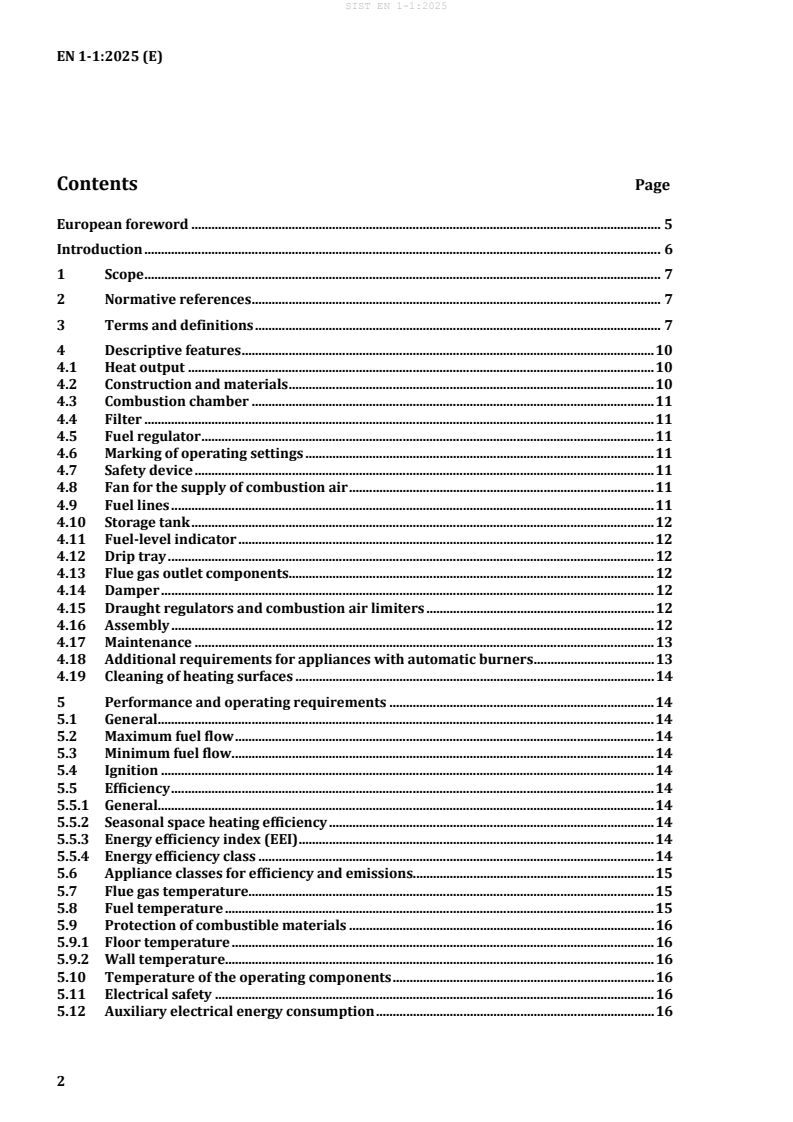
Contents Page
European foreword . 5
Introduction . 6
1 Scope . 7
2 Normative references . 7
3 Terms and definitions . 7
4 Descriptive features . 10
4.1 Heat output . 10
4.2 Construction and materials . 10
4.3 Combustion chamber . 11
4.4 Filter . 11
4.5 Fuel regulator . 11
4.6 Marking of operating settings . 11
4.7 Safety device . 11
4.8 Fan for the supply of combustion air . 11
4.9 Fuel lines . 11
4.10 Storage tank . 12
4.11 Fuel-level indicator . 12
4.12 Drip tray . 12
4.13 Flue gas outlet components. 12
4.14 Damper . 12
4.15 Draught regulators and combustion air limiters . 12
4.16 Assembly . 12
4.17 Maintenance . 13
4.18 Additional requirements for appliances with automatic burners . 13
4.19 Cleaning of heating surfaces . 14
5 Performance and operating requirements . 14
5.1 General. 14
5.2 Maximum fuel flow . 14
5.3 Minimum fuel flow. 14
5.4 Ignition . 14
5.5 Efficiency . 14
5.5.1 General. 14
5.5.2 Seasonal space heating efficiency . 14
5.5.3 Energy efficiency index (EEI) . 14
5.5.4 Energy efficiency class . 14
5.6 Appliance classes for efficiency and emissions. 15
5.7 Flue gas temperature. 15
5.8 Fuel temperature . 15
5.9 Protection of combustible materials . 16
5.9.1 Floor temperature . 16
5.9.2 Wall temperature. 16
5.10 Temperature of the operating components . 16
5.11 Electrical safety . 16
5.12 Auxiliary electrical energy consumption . 16
5.13 Emissions . 17
5.13.1 General . 17
5.13.2 Smoke number . 17
5.13.3 Carbon monoxide emission . 17
5.13.4 NO emissions . 17
x
5.13.5 Emission of organic gaseous carbon (OGC) . 17
5.14 Flue draught . 17
5.15 Flue gas mass flow . 17
5.16 Space heat output . 18
6 Marking and instructions . 18
6.1 General . 18
6.2 Installation instructions . 18
6.3 User operating instructions . 19
6.4 Marking . 20
6.5 Production documentation . 20
7 Environmental sustainability . 21
7.1 General . 21
7.2 Calculation rules . 21
7.2.1 Declared and functional unit . 21
7.2.2 Reference lifetime . 21
7.3 Product stage . 22
7.3.1 General . 22
7.3.2 Production processes . 22
7.3.3 Processes to be reported . 22
7.3.4 Transport from the manufacturer to the site of use . 23
7.4 Use stage . 24
7.5 End-of-life stage. 24
7.5.1 General . 24
7.5.2 Scenarios for end-of-life . 24
7.5.3 Transport to waste processing . 25
7.6 Data collection/quality/basis . 25
7.7 Content of environmental sustainability information . 25
Annex A (normative) Test methods . 28
A.1 Test apparatus . 28
A.2 Measurement equipment . 28
A.3 Testing of stoves having several possible outlet connections . 29
A.4 Test fuel . 29
A.5 Verification of construction . 29
A.6 Testing of leak-tightness of the fuel circuit . 30
A.7 Operational tests. 30
A.8 Calculations from the measurements . 35
A.9 Test report . 40
Annex B (normative) Measuring method for determining the smoke number . 52
B.1 Equipment required for the determination of the smoke number . 52
B.2 Determination of the smoke number . 53
Annex C (normative) Fluid method for detecting oil derivatives . 54
C.1 Equipment required for the detection of oil derivatives . 54
C.2 Sampling . 54
C.3 Procedure and evaluation . 55
Annex D (normative) Measuring procedure for nitrogen oxides (NO ) . 56
x
D.1 General procedure . 56
D.2 Measuring principle of analysers . 56
D.3 Description of measuring equipment . 59
D.4 Setting of measurement system . 60
D.5 Calculation method . 62
Annex E (normative) Measuring procedure for organic gaseous carbon (OGC) . 64
E.1 General procedure . 64
E.2 Description of measuring equipment . 64
E.3 Setting of measurement system . 65
E.4 Calculation of OGC. 67
Annex F (normative) Energy label . 68
Bibliography . 73
European foreword
This document (EN 1-1:2025) has been prepared by Technical Committee CEN/TC 46 “Fireplaces for
liquid fuels”, the secretariat of which is held by DIN.
This European Standard shall be given the status of a national standard, either by publication of an
identical text or by endorsement, at the latest by November 2025, and conflicting national standards shall
be withdrawn at the latest by November 2025.
Attention is drawn to the possibility that some of the elements of this document may be the subject of
patent rights. CEN shall not be held responsible for identifying any or all such patent rights.
This document supersedes EN 1:1998 and EN 1:1998/A1:2007.
In relation to EN 1:1998 and EN 1:1998/A1:2007, the following technical changes have been made:
— completely revised according to the requirements of M/577;
— energy efficiency and energy class labelling and seasonal space heating efficiency added;
— requirements for environmental sustainability added.
The structure of EN 1, Residential liquid fuel burning appliances, is as follows:
— Part 1: General requirements and test methods;
— Part 2: Flued oil stoves with vaporizing burners;
— Part 3: Flued oil stoves with vaporizing burners and boiler;
— Part 4: Flued ethanol stoves.
EN 1-1 is used in conjunction with the appropriate Part 2, 3 or 4. The Parts 2, 3 and 4 contain clauses that
supplement or modify the corresponding clauses in this Part 1. Part 1 together with Part 2, 3 or 4 provides
the requirements for each type of appliance.
Any feedback and questions on this document should be directed to the users’ national standards body.
A complete listing of these bodies can be found on the CEN website.
According to the CEN-CENELEC Internal Regulations, the national standards organisations of the
following countries are bound to implement this European Standard: Austria, Belgium, Bulgaria, Croatia,
Cyprus, Czech Republic, Denmark, Estonia, Finland, France, Germany, Greece, Hungary, Iceland, Ireland,
Italy, Latvia, Lithuania, Luxembourg, Malta, Netherlands, Norway, Poland, Portugal, Republic of North
Macedonia, Romania, Serbia, Slovakia, Slovenia, Spain, Sweden, Switzerland, Türkiye and the United
Kingdom.
Introduction
The calculation of the energy efficiency classification is aligned with Commission Regulation
(EU) 2015/1186, Annex II. Upon the revision of Regulation 2015/1186, the standard should be updated
to reflect the new classification.
The calculation of the seasonal space heating energy efficiency is aligned with Commission Regulation
(EU) 2024/1103, Annex II. Upon the revision of Regulation 2024/1103, the standard should be updated
to reflect the new classification.
1 Scope
This document is applicable to residential liquid fuel burning appliances intended for space heating.
This document specifies requirements relating to the design, manufacture, construction, safety and
performance (efficiency and emission) of appliances fired by liquid fuel (hereafter referred to as
“appliance(s)”) and provides instructions for them. Furthermore, it also gives provisions for the
evaluation of conformity, i.e. initial type testing (ITT) and factory production control (FPC) and marking
of these appliances.
This document specifies the test methods for the determination of the smoke number, and CO, NO , and
x
OGC emission test methods.
This document does not apply to:
— built-in appliances;
— appliances equipped with an atomizing burner;
— appliances incorporating a boiler or connected to a water system.
2 Normative references
The following documents are referred to in the text in such a way that some or all of their content
constitutes requirements of this document. For dated references, only the edition cited applies.
EN 15456:2008, Heating boilers — Electrical power consumption for heat generators — System
boundaries — Measurements
EN 15804:2012+A2:2019, Sustainability of construction works — Environmental product declarations —
Core rules for the product category of construction products
EN 60335-2-102:2016, Household and similar electrical appliances — Safety — Part 2-102: Particular
requirements for gas, oil and solid-fuel burning appliances having electrical connections
(IEC 60335-2-102:2004, modified)
3 Terms and definitions
For the purposes of this document, the following terms and definitions apply.
ISO and IEC maintain terminology databases for use in standardization at the following addresses:
— ISO Online browsing platform: available at https://www.iso.org/obp
— IEC Electropedia: available at https://www.electropedia.org/
3.1
flue gas
product of combustion leaving the appliance by means of the flue gas outlet
3.2
flue gas mass flow
mass of flue gas drawn off from the appliance per unit of time
3.3
steady operating condition of the stove
operating condition of the appliance corresponding to a given heat input in which the flue gas
temperature in the measuring sleeve (see Figure A.1) does not vary by more than 5 K over a period of
15 min
3.4
control device
component of the fuel regulator for adjusting the fuel flow from a closed to a maximum open position
3.5
maximum fuel flow position
control device setting with the maximum fuel flow to the burner
3.6
heating gas
combustion gas flowing inside the stove
3.7
minimum fuel flow position
control device setting with the minimum fuel flow to the burner
3.8
nominal heat output
specified maximum expected heat output of an appliance when the control device is set to maximum fuel
flow position
Note 1 to entry: Indicated on the rating plate.
3.9
storage tank
part in the stove from which the burner is supplied with fuel
3.10
oil derivative
organic substance which is deposited onto the filter paper when determining the smoke number
3.11
fuel regulator
device which ensures an adjustable, constant flow of fuel to the burner
3.12
smoke number
SN
degree of blackening which the soot causes on white filter paper under the conditions specified in this
document
3.13
combustion air limiter
device for limiting the combustion air supply
3.14
combustion air conveyor
device for conveying the combustion air supply
3.15
combustion chamber
area in the appliance where combustion takes place
3.16
vaporizing burner
burner in which combustion of the fuel occurs under the effect of heat and, together with the combustion
air, forms a combustible fuel vapour/air mixture
3.17
heat input
amount of heat supplied by the fuel on an hourly basis to the stove, calculated using the calorific value, H
i
of the fuel
3.18
heat output
quantity of useful heat released by the appliance
3.19
efficiency
ratio of the heat output to the related heat input
Note 1 to entry: Efficiency is expressed as percentage.
3.20
ignition device
built-in device for igniting the fuel vapour/air mixture
3.21
NO emission
x
content of NO in the dry flue gases measured as volume in ppm, calculated as NO , expressed in mg/MJ
x
3.22
hydrocarbon emission
OGC emission
mean OGC concentration calculated to 13 % oxygen (O ) content in the flue gas
Note 1 to entry: Hydrocarbon emissions are measured in accordance with Annex E.
3.23
flue draught
difference between the static pressure in the place of installation and the static pressure at the specified
point in the measurement section
3.24
energy efficiency index
EEI
basis for a labelling scheme of the appliances in relation to the appliance’s efficiency
3.25
flue gas outlet temperature
calculated temperature of the flue gas at the exit of the appliance
3.26
seasonal space heating energy efficiency
η
s
ratio between the space heating demand, supplied by a liquid fuel local space heater and the annual
energy consumption required to meet this demand
3.27
part load heat output
heat output achieved when the control device is set to minimum fuel flow position
4 Descriptive features
4.1 Heat output
The nominal heat output, expressed in kilowatts, shall be:
— specified;
— verified during the tests;
— indicated on the rating plate.
The nominal heat output shall be rounded off to the nearest multiple of 500 W.
4.2 Construction and materials
The quality of the materials as well as the shape and dimensions of the components shall ensure that,
provided the operational procedures are met and with the associated mechanical, chemical and thermal
stresses which occur, the stoves will remain safe and operable over a given period.
The stove shall be fire-resistant and safe to operate, and shall be designed such that:
— no visible deformations following the performance tests according to A.5 occur;
— it can withstand the stresses arising during normal operation;
— the burner and the stove cannot become heated to create a hazard;
— dangerous accumulations of combustible gases (fuel mixed with air) in the combustion chamber and
in the flues are prevented (for automatically operated burners only);
— gases cannot leak from the stove in dangerous quantities.
Non-combustible materials (materials according to the annex of Commission Decision (96/603/EU) or
A1 materials according to EN 13501-1:2018) shall be used, except that it shall be permissible to use
combustible materials for the following applications:
— components of accessories e.g. burner covers, if the parts are fitted outside of the burner;
— internal components of controls and safety equipment;
— operating handles;
— electrical equipment.
Components for covering, operation, control and safety devices and electrical accessories shall be
arranged in such a way that their surface temperatures, under steady state conditions, do not exceed
those specified either by the component manufacturer or in the component part standard.
NOTE Since the entire heat dissipating surfaces of the appliance including the flue spigot/socket and the flue
gas connector are working surfaces there are no limits for their surface temperature.
4.3 Combustion chamber
The combustion chamber shall be properly sealed and fitted with a device (e.g. lid, door, etc.) which
cannot be locked, and designed to compensate for any excess pressure.
4.4 Filter
The stove shall include at least one filter situated either before or inside the fuel regulator and a strainer
in the filling orifice. The filter shall retain particles with a diameter of over 0,25 mm. The filter and
strainer shall be easy to remove and clean.
4.5 Fuel regulator
Fuel regulators, or equivalent devices, shall maintain the flow of fuel reaching the burner at a constant
value corresponding to the setting selected.
The closed and maximum open positions shall each have a limiting stop.
The minimum position shall be clearly marked and be sensed as a resistance that can be overcome
mechanically.
4.6 Marking of operating settings
The control device for the fuel regulator shall have clearly visible and permanent markings.
4.7 Safety device
The stove shall have a safety device to prevent overflowing of the fuel from the burner.
4.8 Fan for the supply of combustion air
Irrespective of the operating setting of the stove, the supply of combustion air from the fan shall not
create excess pressure in the combustion chamber. The operation of the fan shall be trouble free.
The function of the burner shall be linked with that of the fan. In the event of a failure of the fan, the flow
of fuel to the burner shall be either totally interrupted or reduced to a flow such that the smoke number
does not exceed the maximum permissible value for the operation of the burner without the fan.
If the fuel supply to the burner is completely cut off by an electric current failure, then for manually
operated burners (without automatic ignition), when the current is restored, the fuel shall be readmitted
to the burner manually. For automatically operated burners (automatic ignition), when the current is
restored, the ignition without a blow-out shall be ensured.
4.9 Fuel lines
The fuel lines shall not be load-bearing parts of the construction.
The fuel lines shall be resistant to the fuel and shall not exceed the maximum permissible surface
temperatures as specified. Removable fuel lines shall be connected by means of metal screw threads
including at least four engaged threads. The sealing of the parts containing fuel shall be such that there is
no leakage or seepage. It shall not be possible to remove any component in the fuel supply line to the
burner without the use of a tool.
4.10 Storage tank
When the stove includes a storage tank, its effective output shall enable operation of the stove for
— at least 10 h in the case of nominal heat output ≤ 8 kW and
— at least 8 h in the case of a nominal heat output > 8 kW.
The filling orifice of the storage tank shall have a cap.
It shall be possible to cut off the supply of fuel from the storage tank to the burner be means of a shut-off
device fitted before the fuel regulator. If it is a rotary device, closing shall be by turning in a clockwise
direction.
To ensure that any fire external to the stove is not transmitted to the contents of the built-in storage tank
or, if a fire does occur, its effects are limited by either the tank being made of non-combustible materials
e.g. metal or be enclosed with non-combustible fire resisting materials or construction. Any fuel lines
from the tank to the burner shall also be fire resistant.
The filling orifice of the built-in storage tank shall have a cap and shall be easily accessible and it shall be
so arranged that when filling the tank with fuel it is not possible to ignite the fuel from any hot
components.
4.11 Fuel-level indicator
Built-in storage tanks shall have a fuel-level indicator.
4.12 Drip tray
Any stove incorporating a built-in storage tank shall incorporate a drip tray, below the parts of the stove
containing fuel, for the collection of any spillage, having an edge height of at least 10 mm (inside depth)
and capacity of at least 1 dm .
4.13 Flue gas outlet components
The flue outlet can be of the push-on or push-in type and shall have a circular cross-section at its end and
permit the attachment of a flue gas pipe, the diameter of which complies with the applicable standards of
the country in which the stove shall be installed.
It shall be possible to fit a flue pipe, having a diameter D in a length D/4, but at least 30 mm, onto or into
the flue outlet.
4.14 Damper
Dampers or other movable devices for restricting the flow of flue gases are not permitted.
4.15 Draught regulators and combustion air limiters
Draught regulators (see Figure A.9) shall be able to be set in a permanent manner at the maximum
draught as indicated in the installation instructions.
Draught regulators and combustion air limiters (see Figure A.10) built into the stove shall be fitted at the
production process of the appliance and shall operate automatically.
One of these two devices shall be fitted if the stove has no fan for the supply of combustion air.
4.16 Assembly
The stove shall be supplied with all parts assembled; the flue outlets and burner rings may be built in
subsequently. Non-removable parts shall be securely fitted in their position of use. For removable parts,
see 6.2.
4.17 Maintenance
Parts which are removable to allow for maintenance and cleaning shall be readily accessible and designed
so that they can be correctly reassembled in accordance with the appliance’s instructions.
4.18 Additional requirements for appliances with automatic burners
The burner and control system in combination shall be such that, in the event of failure to ignite when
starting, the burner will assume a safe condition (lock-out) and will require a manual reset of its
sequencing control. In the event of a flame failure occurring when running, the appliance shall fail safe.
A temperature or pressure sensing device shall be provided on the appliance to start and stop the burner.
In addition, a separately operating limiting device shall be provided to stop the burner before the
temperature in the appliance exceeds safe limits.
Controls and safety devices shall be coupled so that operation of each occurs in the correct sequence and
timing; coupling may be electrical or mechanical. The controls and safety devices shall:
a) ensure that the start-up sequence is not able to commence unless the flame sensing equipment has
confirmed the no-flame condition;
b) establish satisfactory ignition of the fuel;
c) maintain normal operation if the flame is satisfactorily established, and switch off ignitor;
d) automatically vary the burner firing rate, where applicable;
e) stop the burner when the demand for heat is satisfied;
f) stop the fuel supply and lock-out system if flame is not satisfactorily established;
g) provide means for a visible or audible indication that the unit is in a lock-out condition;
h) ensure that any interruption of the electricity supply does not give rise to a dangerous condition.
If the control sequences are such that an attempt to re-ignite the burner can be made the burner shall
either:
i. ignite and burn in a safe manner whilst the surplus fuel is burnt off and the burner is returning to
normal operation conditions; or
ii. not ignite.
Manually operated dampers or other movable devices for restricting the flow of gases shall not be fitted.
Automatically operated dampers, if fitted, shall be interlocked with the fuel supply and arranged so that
the burner cannot operate with a closed flue.
4.19 Cleaning of heating surfaces
All surfaces in contact with the combustion products shall be able to be cleaned.
For appliances with an integrated water heat exchanger, the surfaces of the water heat exchanger that
are in contact with flames or hot combustion gases shall be accessible for cleaning. Means shall be
provided for cleaning the appliance outlet and flue connector. Advice on how this cleaning shall be carried
out shall be given in the appliance operating instructions.
Where cleaning and servicing requires the use of special tools (e.g. special brushes), these shall be
supplied with the appliance.
5 Performance and operating requirements
5.1 General
Under the test conditions given in Annex A, the requirements according to 5.2 to 5.16 shall be met:
5.2 Maximum fuel flow
With the control device in the maximum position, the heat output shall be equal to, or greater than, the
nominal heat output.
5.3 Minimum fuel flow
With the control device in the minimum position, the average hourly fuel flow shall not exceed one third
of the nominal flow at nominal heat output as specified. Stoves having a maximum flow of 0,200 kg/h in
the minimum setting are excluded from this requirement.
If the control device of oil-fired heating appliances is reduced by hand, the maximal rate shall not be more
than 50 % of the fuel rate per hour at nominal heat input.
5.4 Ignition
It shall be possible easily to light the burner from cold following the operating instructions.
5.5 Efficiency
5.5.1 General
The tests for efficiency shall be carried out burning the specified test fuels representing the recommended
fuels listed in the operating instructions according to Annex A.
The efficiency expressed as % in an integer shall be greater than or equal to the specified efficiency value.
The efficiency is determined at nominal heat output (in accordance with A.7.3.1) and if specified at part
load heat output (in accordance with A.7.3.2).
5.5.2 Seasonal space heating efficiency
The seasonal space heating efficiency is calculated according to A.8.7.
5.5.3 Energy efficiency index (EEI)
The energy efficiency index (EEI) is calculated according to A.8.8.
5.5.4 Energy efficiency class
The energy efficiency shall be determined according to the following Table 1.
Table 1 — Energy efficiency classification based on the energy efficiency index (EEI)
Energy efficiency class Energy efficiency index (EEI)
A++ EEI ≥ 130
A+ 107 ≤ EEI < 130
A 88 ≤ EEI < 107
B 82 ≤ EEI < 88
C 77 ≤ EEI < 82
D 72 ≤ EEI < 77
E 62 ≤ EEI < 72
F 42 ≤ EEI < 62
G EEI < 42
5.6 Appliance classes for efficiency and emissions
The requirements of Table 2 shall be fulfilled as appropriate to the appliance class.
Table 2 — Appliance classes
Appliance Efficiency at nominal
CO OGC NO Smoke number
x
class heat output
[mg/MJ] [mg/MJ]
[mg/kWh ]
input
[%]
appliances appliances Gas oil Kerosene
< 4 kW ≥ 4 kW
1 a a a a a a a
≤ 20 ≤ 6 ≤ 120 ≥ 72 ≥ 72 ≤ 1 ≤ 1
2 b — a a a b b
≤ 400 ≤ 120 ≥ 72 ≥ 72 ≤ 2 ≤ 2
3 b — a a a b b
≤ 400 ≤ 120 ≥ 72 ≥ 72 ≤ 3 ≤ 2
a
Measured at nominal heat output and part load heat output only.
b
Measured in the whole heat output range.
5.7 Flue gas temperature
During the tests according to A.7.2 and A.7.3, the flue gas temperature shall not be less than 90 K, nor
more than 350 K, above the ambient temperature.
5.8 Fuel temperature
The position of the built-in storage tank and the fuel regulator in the appliance shall be such that the
temperature of the fuel in the fuel tank does not exceed 20 K for oil or 15 K for kerosene above ambient
temperature.
5.9 Protection of combustible materials
5.9.1 Floor temperature
When tested in accordance with A.7.3, the surface temperatures of the underside of the drip tray shall
not exceed 45 K above ambient temperature when using fuel oil, or 35 K above ambient temperature
when using kerosene.
The design of the appliance shall be such that the surface temperatures of the floor shall not exceed 60 K
above ambient temperature.
This requirement is not applicable if it is specified that the appliance shall not be installed on combustible
floor.
5.9.2 Wall temperature
When tested in accordance with A.7.3, the protection measure(s) as specified shall not lead to an excess
of more than 60 K above room temperature at the hottest point of any adjacent walls or other structure
constructed of combustible materials.
If necessary, the distances are increased until the temperature measured is below this value and the
specification of the protection measures needs to be adapted accordingly.
This requirement is not applicable if it is specified that the appliance shall not be installed towards
combustible walls.
5.10 Temperature of the operating components
During the tests according to A.7.3 the temperatures of the operation components on their contact surface
shall not exceed ambient temperature by more than:
— 35 K for metals;
— 45 K for porcelain;
— 60 K for plastics.
This also applies to other similar materials.
These temperatures may be exceeded if the stove is supplied with an accessory with which it is possible
to operate the adjustment devices easily and without the risk of burning.
5.11 Electrical safety
EN 60335-2-102:2016 shall apply with the following condition:
The tests described in Clause 19 of EN 60335-2-102:2016 shall not apply for safety relevant circuits when
the mechanical components ensure that any failure or interruption of the electronic circuits does not
affect the safe operation of the appliance.
5.12 Auxiliary electrical energy consumption
The auxiliary electrical energy consumption shall be measured in accordance with EN 15456:2008 at
standby, nominal heat output (according to A.7.3.1) and at part load heat output (according to A.7.3.2) if
specified.
The auxiliary electrical energy consumption at standby can be measured in accordance with
IEC 62301:2011 as alternative methods which need to be validated against the reference method.
The values shall be given in the marking as el , el and el , if part load is specified.
SB max min
5.13 Emissions
5.13.1 General
The tests for emissions as well as efficiency shall be carried out burning the specified test fuels
representing the recommended fuels listed in the operating instructions according to Annex A.
For nominal heat output follow A.7.3.1 and for part load heat output follow A.7.3.2. In addition, emissions
shall be recorded in the transition tests according to A.7.2.3 and A.7.2.5.
5.13.2 Smoke number
The smoke number of the appliances at nominal heat output according to A.7.3.1 and part load heat
output according to A.7.3.2 shall be given according to Table 2. In addition, the smoke number shall be
recorded in the transition tests according to A.7.2.3 and A.7.2.5.
The flue gases shall not contain oil rest particles.
Under the test conditions of A.7.2.3, A.7.2.5 and A.7.4.1 for gas oil, the smoke number may be one more.
5.13.3 Carbon monoxide emission
At all heat output rates as specified the mean carbon monoxide concentration calculated to 13 %
oxygen (O ) content, (dry, 273 K, 101,3 kPa) in the flue gas shall be less than or equal to the specified
value expressed in mg/MJ.
This value shall be calculated as the mean value fro
...