


SIST EN 55032:2012/AC:2013
(Corrigendum)Electromagnetic compatibility of multimedia equipment - Emission requirements
Electromagnetic compatibility of multimedia equipment - Emission requirements
This International Standard applies to multimedia equipment (MME) as defined in 3.1.23 and having a rated r.m.s. AC or DC supply voltage not exceeding 600 V.
Equipment within the scope of CISPR 13 or CISPR 22 is within the scope of this publication. MME intended primarily for professional use is within the scope of this publication.
The radiated emission requirements in this standard are not intended to be applicable to the intentional transmissions from a radio transmitter as defined by the ITU, nor to any spurious emissions related to these intentional transmissions. Equipment, for which emission requirements in the frequency range covered by this
publication are explicitly formulated in other CISPR publications (except CISPR 13 and CISPR 22), are excluded from the scope of this publication. This document does not contain requirements for in-situ assessment. Such testing is outside the scope of this publication and may not be used to demonstrate compliance with it.
This publication covers two classes of MME (Class A and Class B). The MME classes are specified in Clause 4.
Elektromagnetische Verträglichkeit von Multimediageräten und -einrichtungen - Anforderungen an die Störaussendung
Compatibilité électromagnétique des équipements multimédia - Exigences d'émission
Elektromagnetna združljivost večpredstavnostne opreme - Zahteve glede elektromagnetnega sevanja - Popravek AC
Ta mednarodni standard se uporablja za večpredstavnostno opremo (MME), ki je določena v točki 3.1.23 in katere nazivna efektivna enosmerna ali izmenična napajalna napetost ne presega 600 V. Oprema v okviru področja uporabe CISPR 13 ali CISPR 22 sodi v področje uporabe te publikacije. Večpredstavnostna oprema, ki je namenjena predvsem za profesionalno uporabo, sodi v področje uporabe te publikacije. Zahteve glede elektromagnetnega sevanja iz tega standarda niso namenjene za uporabo za namerne prenose iz radijskih oddajnikov, kot jih določa ITU, in morebitna neželena oddajanja, povezana s temi namernimi prenosi. Oprema, za katero so zahteve glede elektromagnetnega sevanja v frekvenčnem območju, ki ga zajema ta publikacija, izrecno navedene v drugih publikacijah CISPR (razen CISPR 13 in CISPR 22), ni vključena v področje uporabe te publikacije. Ta dokument ne vsebuje zahtev za oceno na kraju samem. Tako preskušanje ni zajeto v področje uporabe te publikacije in se ne sme uporabiti za izkazovanje skladnosti z njo. Ta publikacija zajema dva razreda večpredstavnostne opreme (razred A in razred B). Razreda večpredstavnostne opreme sta določena v točki 4. Namen te publikacije je: 1) pripraviti zahteve, ki zagotavljajo ustrezno stopnjo zaščite radijskega spektra, ki radijskim storitvam omogoča predvideno delovanje v frekvenčnem območju od 9 kHz do 400 GHz; 2) določiti postopke, s katerimi se zagotovi obnovljivost meritev in ponovljivost rezultatov.
General Information
- Status
- Withdrawn
- Publication Date
- 28-Nov-2013
- Withdrawal Date
- 13-Nov-2016
- Technical Committee
- EMC - Electromagnetic compatibility
- Current Stage
- 9900 - Withdrawal (Adopted Project)
- Start Date
- 11-Nov-2016
- Due Date
- 04-Dec-2016
- Completion Date
- 14-Nov-2016
Relations
- Effective Date
- 01-Dec-2013
- Replaced By
SIST EN 55032:2015 - Electromagnetic compatibility of multimedia equipment - Emission Requirements - Effective Date
- 01-Sep-2015
- Effective Date
- 01-Apr-2014
- Corrects
SIST EN 55032:2012 - Electromagnetic compatibility of multimedia equipment - Emission requirements - Effective Date
- 01-Dec-2013


Frequently Asked Questions
SIST EN 55032:2012/AC:2013 is a corrigendum published by the Slovenian Institute for Standardization (SIST). Its full title is "Electromagnetic compatibility of multimedia equipment - Emission requirements". This standard covers: This International Standard applies to multimedia equipment (MME) as defined in 3.1.23 and having a rated r.m.s. AC or DC supply voltage not exceeding 600 V. Equipment within the scope of CISPR 13 or CISPR 22 is within the scope of this publication. MME intended primarily for professional use is within the scope of this publication. The radiated emission requirements in this standard are not intended to be applicable to the intentional transmissions from a radio transmitter as defined by the ITU, nor to any spurious emissions related to these intentional transmissions. Equipment, for which emission requirements in the frequency range covered by this publication are explicitly formulated in other CISPR publications (except CISPR 13 and CISPR 22), are excluded from the scope of this publication. This document does not contain requirements for in-situ assessment. Such testing is outside the scope of this publication and may not be used to demonstrate compliance with it. This publication covers two classes of MME (Class A and Class B). The MME classes are specified in Clause 4.
This International Standard applies to multimedia equipment (MME) as defined in 3.1.23 and having a rated r.m.s. AC or DC supply voltage not exceeding 600 V. Equipment within the scope of CISPR 13 or CISPR 22 is within the scope of this publication. MME intended primarily for professional use is within the scope of this publication. The radiated emission requirements in this standard are not intended to be applicable to the intentional transmissions from a radio transmitter as defined by the ITU, nor to any spurious emissions related to these intentional transmissions. Equipment, for which emission requirements in the frequency range covered by this publication are explicitly formulated in other CISPR publications (except CISPR 13 and CISPR 22), are excluded from the scope of this publication. This document does not contain requirements for in-situ assessment. Such testing is outside the scope of this publication and may not be used to demonstrate compliance with it. This publication covers two classes of MME (Class A and Class B). The MME classes are specified in Clause 4.
SIST EN 55032:2012/AC:2013 is classified under the following ICS (International Classification for Standards) categories: 33.100.10 - Emission; 33.160.60 - Multimedia systems and teleconferencing equipment. The ICS classification helps identify the subject area and facilitates finding related standards.
SIST EN 55032:2012/AC:2013 has the following relationships with other standards: It is inter standard links to SIST EN 55032:2012/AC:2013, SIST EN 55032:2015, SIST EN 50561-1:2014, SIST EN 55032:2012. Understanding these relationships helps ensure you are using the most current and applicable version of the standard.
SIST EN 55032:2012/AC:2013 is associated with the following European legislation: EU Directives/Regulations: 1999/5/EC, 2004/108/EC, 2004/108/EU, 2014/30/EU; Standardization Mandates: M/490, M/552. When a standard is cited in the Official Journal of the European Union, products manufactured in conformity with it benefit from a presumption of conformity with the essential requirements of the corresponding EU directive or regulation.
SIST EN 55032:2012/AC:2013 is available in PDF format for immediate download after purchase. The document can be added to your cart and obtained through the secure checkout process. Digital delivery ensures instant access to the complete standard document.
Standards Content (Sample)
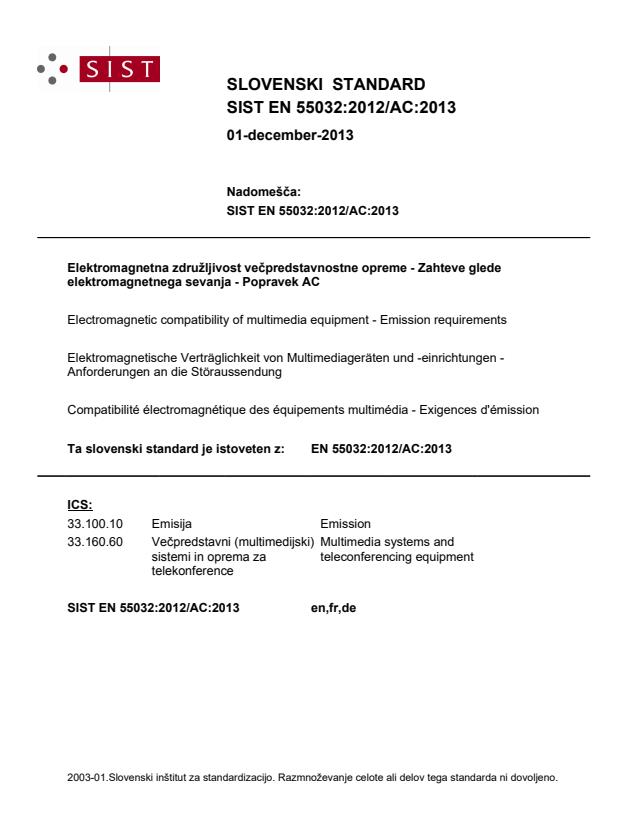
2003-01.Slovenski inštitut za standardizacijo. Razmnoževanje celote ali delov tega standarda ni dovoljeno.OHGHElektromagnetische Verträglichkeit von Multimediageräten und -einrichtungen - Anforderungen an die StöraussendungCompatibilité électromagnétique des équipements multimédia - Exigences d'émissionElectromagnetic compatibility of multimedia equipment - Emission requirements33.160.60WHOHNRQIHUHQFHMultimedia systems and teleconferencing equipment33.100.10EmisijaEmissionICS:Ta slovenski standard je istoveten z:EN 55032:2012/AC:2013SIST EN 55032:2012/AC:2013en,fr,de01-december-2013SIST EN 55032:2012/AC
...
Questions, Comments and Discussion
Ask us and Technical Secretary will try to provide an answer. You can facilitate discussion about the standard in here.
Loading comments...