

SIST ISO 21636-1:2024
(Main)Language coding - A framework for language varieties - Part 1: Vocabulary
General Information
- Abstract
The ISO 21636 series provides a framework for the identification and description of varieties of all individual human languages (see ISO 639).
It is applicable to sign languages.
It does not apply to:
- artificial means of communication with or between machines (such as programming languages);
- those means of human communication which are neither fully nor largely equivalent to human language (such as sets of individual symbols or gestures that each carry isolated meanings but cannot be freely combined into complex expressions).
This document defines the terms necessary to identify basic dimensions and sub-dimensions of linguistic variation and the resulting varieties, including major modalities of human communication.
- Status
- Published
- Publication Date
- 06-Oct-2024
- Technical Committee
- IDT - Information, documentation, language and terminology
- Current Stage
- 6060 - National Implementation/Publication (Adopted Project)
- Start Date
- 17-Sep-2024
- Due Date
- 22-Nov-2024
- Completion Date
- 07-Oct-2024

Overview
ISO 21636-1:2024 - Language coding - A framework for language varieties - Part 1: Vocabulary - defines the core terminology and conceptual framework for identifying and describing varieties of all individual human languages. It complements ISO 639 by focusing on linguistic variation, covering major modalities (spoken, written, signed, multimodal), dimensions and sub‑dimensions of variation, and key concepts such as idiolects, individual languages, language use events, registers and modalities. The document is applicable to sign languages and excludes formal programming languages and non‑combinatorial symbol systems.
Key topics and requirements
- Vocabulary and definitions: Standardized terms for language, individual language, idiolect, speaker, language use event, natural and constructed languages.
- Dimensions of variation: Concepts to identify basic dimensions and sub‑dimensions of linguistic variation (e.g., regional, social, modal), enabling consistent description of language varieties.
- Modalities and registers: Definitions for major communication modalities (spoken, written, signed, multimodal) and language registers (levels of formality and style).
- Documentation terminology: Terms related to language resources (LRs), metadata, and certainty levels used in LR description and exchange.
- Scope clarifications: Applicability to human languages, including sign languages, and explicit exclusions (programming/formal languages; non‑combinatorial symbol systems).
- Normative stance: Part 1 contains terms and definitions (no normative references), forming the foundation for subsequent parts of the ISO 21636 series.
Practical applications
ISO 21636-1 provides a consistent vocabulary to improve the discovery, exchange and reuse of language resources and metadata across sectors:
- Language technology (LT) development: Better metadata for training and evaluating speech recognition, machine translation and other LTs by specifying the exact language variety and modality.
- Archives and libraries: Harmonized descriptions of corpora and recordings to ensure long‑term accessibility and interoperability.
- Research and documentation: Standard terms for sociolinguistics, language documentation, and preservation projects.
- Public services and digital platforms: Tailoring eGovernment, eHealth, eLearning, eBusiness and accessibility solutions to specific language varieties and modalities.
- Media and content industries: Clear tagging of dialects, registers and modalities for localization and audience targeting.
Who should use this standard
- ICT and language‑technology developers
- Libraries, archives and data curators
- Linguists (sociolinguists, computational linguists)
- Language documentation and preservation projects
- Media, education and public‑service organizations dealing with multilingual content
Related standards
- ISO 639 (language identification) - ISO 21636 series is designed to complement ISO 639 by enabling more granular identification of language varieties.
- ISO/IEC Directives (editorial and development rules) - referenced in the foreword and applicable to maintenance and drafting.
Keywords: ISO 21636-1, language coding, language varieties, language metadata, linguistic variation, language modalities, ISO 639, language resources.
Frequently Asked Questions
SIST ISO 21636-1:2024 is a standard published by the Slovenian Institute for Standardization (SIST). Its full title is "Language coding - A framework for language varieties - Part 1: Vocabulary". This standard covers: The ISO 21636 series provides a framework for the identification and description of varieties of all individual human languages (see ISO 639). It is applicable to sign languages. It does not apply to: - artificial means of communication with or between machines (such as programming languages); - those means of human communication which are neither fully nor largely equivalent to human language (such as sets of individual symbols or gestures that each carry isolated meanings but cannot be freely combined into complex expressions). This document defines the terms necessary to identify basic dimensions and sub-dimensions of linguistic variation and the resulting varieties, including major modalities of human communication.
The ISO 21636 series provides a framework for the identification and description of varieties of all individual human languages (see ISO 639). It is applicable to sign languages. It does not apply to: - artificial means of communication with or between machines (such as programming languages); - those means of human communication which are neither fully nor largely equivalent to human language (such as sets of individual symbols or gestures that each carry isolated meanings but cannot be freely combined into complex expressions). This document defines the terms necessary to identify basic dimensions and sub-dimensions of linguistic variation and the resulting varieties, including major modalities of human communication.
SIST ISO 21636-1:2024 is classified under the following ICS (International Classification for Standards) categories: 01.040.01 - Generalities. Terminology. Standardization. Documentation (Vocabularies); 01.140.20 - Information sciences. The ICS classification helps identify the subject area and facilitates finding related standards.
SIST ISO 21636-1:2024 is available in PDF format for immediate download after purchase. The document can be added to your cart and obtained through the secure checkout process. Digital delivery ensures instant access to the complete standard document.
Standards Content (Sample)
SLOVENSKI STANDARD
01-november-2024
Jezikovno kodiranje - Ogrodje za jezikovne različice - 1. del: Slovar
Language coding — A framework for language varieties — Part 1: Vocabulary
Codage des langues — Identification et description des variétés de langues — Partie 1:
Vocabulaire
Ta slovenski standard je istoveten z: ISO 21636-1:2024
ICS:
01.040.01 Splošno. Terminologija. Generalities. Terminology.
Standardizacija. Standardization.
Dokumentacija (Slovarji) Documentation
(Vocabularies)
01.140.20 Informacijske vede Information sciences
2003-01.Slovenski inštitut za standardizacijo. Razmnoževanje celote ali delov tega standarda ni dovoljeno.
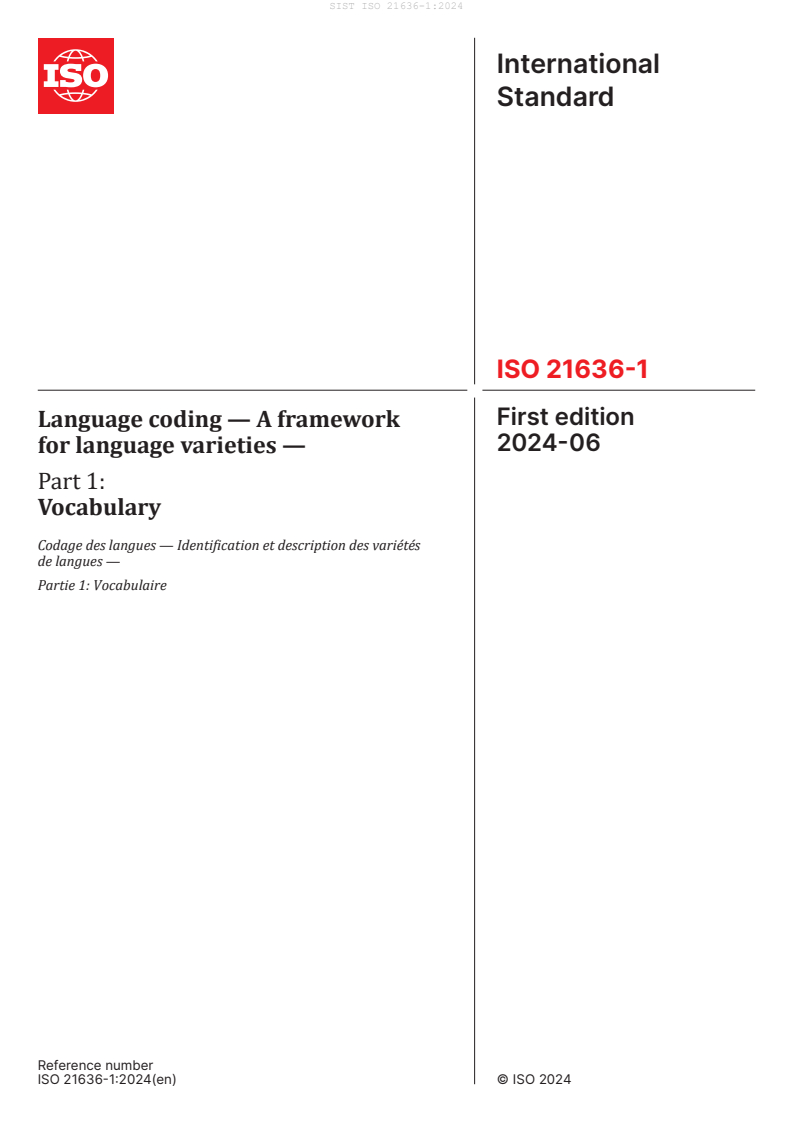
International
Standard
ISO 21636-1
First edition
Language coding — A framework
2024-06
for language varieties —
Part 1:
Vocabulary
Codage des langues — Identification et description des variétés
de langues —
Partie 1: Vocabulaire
Reference number
© ISO 2024
All rights reserved. Unless otherwise specified, or required in the context of its implementation, no part of this publication may
be reproduced or utilized otherwise in any form or by any means, electronic or mechanical, including photocopying, or posting on
the internet or an intranet, without prior written permission. Permission can be requested from either ISO at the address below
or ISO’s member body in the country of the requester.
ISO copyright office
CP 401 • Ch. de Blandonnet 8
CH-1214 Vernier, Geneva
Phone: +41 22 749 01 11
Email: copyright@iso.org
Website: www.iso.org
Published in Switzerland
ii
Contents Page
Foreword .iv
Introduction .v
1 Scope . 1
2 Normative references . 1
3 Terms and definitions . 1
3.1 Terms related to language and languages .1
3.2 Terms related to linguistic variation and language varieties .3
3.3 Terms related to dimensions of linguistic variation .4
3.4 Terms related to types of language varieties .5
3.5 Terms related to specific language modalities .8
3.6 Terms related to major language registers .11
3.7 Terms related to the documentation of language resources . 12
3.8 Terms related to certainty . 13
Bibliography . 14
Index .15
iii
Foreword
ISO (the International Organization for Standardization) is a worldwide federation of national standards
bodies (ISO member bodies). The work of preparing International Standards is normally carried out through
ISO technical committees. Each member body interested in a subject for which a technical committee
has been established has the right to be represented on that committee. International organizations,
governmental and non-governmental, in liaison with ISO, also take part in the work. ISO collaborates closely
with the International Electrotechnical Commission (IEC) on all matters of electrotechnical standardization.
The procedures used to develop this document and those intended for its further maintenance are described
in the ISO/IEC Directives, Part 1. In particular, the different approval criteria needed for the different types
of ISO document should be noted. This document was drafted in accordance with the editorial rules of the
ISO/IEC Directives, Part 2 (see www.iso.org/directives).
ISO draws attention to the possibility that the implementation of this document may involve the use of (a)
patent(s). ISO takes no position concerning the evidence, validity or applicability of any claimed patent
rights in respect thereof. As of the date of publication of this document, ISO had not received notice of (a)
patent(s) which may be required to implement this document. However, implementers are cautioned that
this may not represent the latest information, which may be obtained from the patent database available at
www.iso.org/patents. ISO shall not be held responsible for identifying any or all such patent rights.
Any trade name used in this document is information given for the convenience of users and does not
constitute an endorsement.
For an explanation of the voluntary nature of standards, the meaning of ISO specific terms and expressions
related to conformity assessment, as well as information about ISO’s adherence to the World Trade
Organization (WTO) principles in the Technical Barriers to Trade (TBT), see www.iso.org/iso/foreword.html.
This document was prepared by Technical Committee ISO/TC 37, Language and terminology, Subcommittee
SC 2, Terminology workflow and language coding.
A list of all parts of the ISO 21636 series can be found on the ISO website.
Any feedback or questions on this document should be directed to the user’s national standards body. A
complete listing of these bodies can be found at www.iso.org/members.html.
iv
Introduction
An increasing amount of digital language resources (LRs) are being created (including via retro-digitization),
archived, processed and analysed. Within this context, the detailed and exact characterization of language
varieties present in a given language use event is quickly gaining importance. Here, language use includes
all modalities such as written, spoken, or signed, and also new forms of language use supported by digital
technology (in social media and similar forms of digital communication). Such modalities demonstrate one
way in which languages vary internally. Others include, for instance, familiar regional (dialectal) and social
variation.
In the past, a primary goal of working with LRs was the archiving and preservation of LRs. However, new
goals have now emerged and are still emerging:
— Institutions and individuals need to exchange metadata (i.e. bibliographic description data and other
secondary information) for making the information on existing LRs widely available in a harmonized form.
— Researchers are identifying primary data (i.e. the LRs themselves) for various research purposes,
including research on linguistic variation.
— Researchers and developers need LRs for the development of more advanced language technologies (LTs)
and for testing purposes, because LTs, in particular those concerning speech recognition and language
analysis, are entering more dimensions of human communication.
In order to achieve the above-mentioned goals and purposes, along with others not outlined in the
ISO 21636 series, a standardized set of metadata for the identification of language varieties is important
for guaranteeing the frictionless exchange of secondary information. Well-organized metadata also help
to indicate the degree of interoperability (equalling re-usability and re-purposability of LRs), and the
applicability of LTs to different situations or LRs over time. These metadata are applicable in eBusiness,
eHealth, eGovernment, eInclusion, eLearning, smart environments, ambient assisted living (AAL), and
virtually all other information-rich applications which depend on information about LRs. A clear metadata
approach is also a prerequisite for the durability of LR archiving (in particular in the case of cultural heritage
and scientific research data).
ISO 639 provides a framework for identifying the individual languages used in an LR. The ISO 21636 series
presupposes and complements ISO 639 in that it extends the language coding framework in order to allow for
the identification of different types of language varieties (e.g. geographical, social, modal). The identification
of language varieties can then be included in general metadata, library metadata and archival metadata for
describing LRs (which may also include technical information, time and location of recording, and similar
general information, which are not included in the ISO 21636 series).
The conceptual framework developed in this document for dealing with linguistic variation respects the
major approaches represented in the linguistic literature without simply reproducing them. The framework
is closest though in general orientation and in a number of details, such as the role assigned to idiolects, to
[5]
work of a type represented by Lieb .
This document comprises:
— terms and definitions underlying a general conceptual framework to coherently deal with language-
internal linguistic variation;
— terms and definitions for a set of dimensions for identifying and describing language varieties.
Stakeholders include, but are not limited to:
— information and communication technologies (ICTs) industry (including LTs);
— libraries;
— the media industry (including entertainment);
— internet communities;
v
— people engaging in language documentation and preservation;
— language archivists;
— researchers (linguists, in particular sociolinguists, ethnologists, sociologists, etc.);
— people and institutions providing language training;
— emerging new user communities.
It is anticipated that these stakeholders will need to refer not only to a certain individual language, but also
to a certain language variety, for instance for oral human-computer interaction, or for tailoring a certain
LR or LT to the needs and specific environment of a target user group. An initial step towards achieving
the needed specificity involves the ability to identify the dimension(s) of linguistic variation internal to
individual languages involved, and the respective relevant language varieties. A conceptually sound uniform
framework of reference as developed in the ISO 21636 series is superior to the proliferation of different
individual ad-hoc solutions.
vi
International Standard ISO 21636-1:2024(en)
Language coding — A framework for language varieties —
Part 1:
Vocabulary
1 Scope
The ISO 21636 series provides a framework for the identification and description of varieties of all individual
human languages (see ISO 639).
It is applicable to sign languages.
It does not apply to:
— artificial means of communication with or between machines (such as programming languages);
— those means of human communication which are neither fully nor largely equivalent to human language
(such as sets of individual symbols or gestures that each carry isolated meanings but cannot be freely
combined into complex expressions).
This document defines the terms necessary to identify basic dimensions and sub-dimensions of linguistic
variation and the resulting varieties, including major modalities of human communication.
2 Normative references
There are no normative references in this document.
3 Terms and definitions
ISO and IEC maintain terminology databases for use in standardization at the following addresses:
— ISO Online browsing platform: available at https:// www .iso .org/ obp
— IEC Electropedia: available at https:// www .electropedia .org/
3.1 Terms related to language and languages
3.1.1
human language
means of communication characterized by a systematic use of sounds, visual-spatial signs, characters or
other written symbols or signs that can be combined to express or communicate meaning or a message
between humans
Note 1 to entry: Human language was originally developed for, and mainly used in, direct communication between
humans. Today its use is increasingly supported by information and communication technologies (ICTs).
Note 2 to entry: As the term “language” can represent different concepts, it is not listed as a synonym to the term
“human language”.
Note 3 to entry: Visual-spatial signs are indicated under signed modality (3.5.4).
3.1.2
idiolect
comprehensive set of all expressions of human language (3.1.1) with their meaning, characterized by a
coherent system of structural features, which is capable of coding complex facts and thoughts, potentially
used by a given individual person, in a given type of situation, at a given time, and in a given medium
Note 1 to entry: Typically, a person has command of several idiolects of an individual language (3.1.3), for instance
written and spoken idiolects (belonging to different language modalities; see 3.4.7 and 3.5), and idiolects for situations
with different degrees of formality (belonging to different language registers; see 3.4.8 and 3.6).
3.1.3
individual language
individual human language
largest set of idiolects (3.1.2), used by different speakers (3.1.5), which are all interconnected through
high mutual intelligibility, or through a chain of high mutual intelligibility, or which are sociopolitically
considered as a unit equivalent to such a largest set
Note 1 to entry: Individual languages also encompass constructed languages (3.1.10), but do not include formal
languages (as defined in ISO 1087:2019, 3.1.10).
Note 2 to entry: Usually, in other contexts, individual languages are simply called “languages”. However, the term
“language” has multiple meanings and connotations, which can cause confusion in the context of this document. Still,
when an attribute and possibly the plural clearly indicate that individual languages are meant, this document uses
only “language(s)”, as in “creole languages”, “Asian languages” or “living languages”.
EXAMPLE English, Guarani, LIBRAS (Língua Brasileira de Sinais/Brazilian Sign Language), Haitian Creole,
Esperanto.
3.1.4
individual sign language
individual language (3.1.3) whose basic modality (3.5.11) is the signed modality (3.5.4)
Note 1 to entry: Usually “sign language” is part of the name of the respective individual sign language.
EXAMPLE American Sign Language (ASL), langue des signes québécoise/Quebec Sign Language (LSQ).
Note 2 to entry: Individual sign languages differ from the “signed modality” (see 3.5.4), by which an individual
language can be expressed which is normally expressed in another language modality (3.4.7), such as by “Signing
Exact English” for expressing English. Therefore, the term “signed language” is not used as a synonym to the term
“individual sign language”.
3.1.5
speaker
person who is capable of making use of an idiolect (3.1.2)
Note 1 to entry: The term “speaker” covers the use of all language modalities (3.4.7), and is thus used to denote a
generic concept, “speaker”, also covering all specific concepts such as “writer”, “signer”, etc., which can be introduced
when needed. The alternative encompassing term “language user”, although technically closer to the intended generic
meaning, has proven to render the text much less accessible.
3.1.6
language use event
event of language use
event in which a speaker (3.1.5) expresses themselves by means of an idiolect (3.1.2)
Note 1 to entry: Language use events can belong to one of several language modalities (3.4.7). A case involving the
spoken modality (3.5.1) or the multimodal modality (3.5.2) is also called a “speech event”. In the case of the written
modality (see 3.5.3), it is a writing event or an event of producing a written text. In the case of the signed modality
(3.5.4), it is a signing or signed event, etc.
3.1.7
enhanced communicative functioning ability
enhanced ability of a speaker (3.1.5) during a language use event (3.1.6) where the speaker deviates from
average communicative functioning by some sort of enhancement
3.1.8
communicative functioning constraint
constraint of a speaker (3.1.5) during a language use event (3.1.6) where the speaker deviates from average
communicative functioning by being hampered by some limiting factor
Note 1 to entry: A communicative functioning constraint diagnosed as advanced or severe is usually identified as an
impairment in the form of a communication disorder affecting the speaker.
3.1.9
natural language
individual language (3.1.3) which is or was in active use in a language community, passed on from one
generation of speakers (3.1.5) to the next
EXAMPLE Bambara, English, Haitian Creole, Latin, LIBRAS (Língua Brasileira de Sinais/Brazilian Sign Language).
3.1.10
constructed language
individual language (3.1.3) whose rules are explicitly established prior to its use
EXAMPLE Esperanto, Volapük, Quenya, Na’vi.
Note 1 to entry: Constructed languages do not include reconstructed languages, computer programming languages,
mark-up languages or similar formal languages.
Note 2 to entry: Some constructed languages are based on one or several natural languages (3.1.9) and are therefore not
artificial. Therefore, the term “artificial language”, which is often used as a synonym, is not used in the ISO 21636 series.
3.2 Terms related to linguistic variation and language varieties
3.2.1
linguistic variation
language variation
differences within and between individual languages (3.1.3)
3.2.2
external criterion for linguistic variation
set of properties of idiolects (3.1.2) that are based on factors external to the linguistic features of the
idiolects’ systems
Note 1 to entry: External criteria for linguistic variation contain properties of idiolects that pertain to the speakers
(3.1.5) who use the idiolects, or to the language use event (3.1.6) in which the idiolects are used.
EXAMPLE “Being characteristic of speakers from East Anglia” is a property which is the only element of an
external criterion for linguistic variation [in this case, a criterion related to geographical space (see the example to
3.2.4), defining a certain dialect (3.4.1) of English].
3.2.3
structural criterion for linguistic variation
set of properties of idiolects (3.1.2) that are based on the linguistic features of the idiolects’ systems
Note 1 to entry: This set of properties includes in particular phonetic, phonological, morphological, syntactic, lexical,
semantic or pragmatic properties.
Note 2 to entry: Elements of the structural criterion for linguistic variation are also called “markers”, e.g. in
ISO/TR 20694. The term “structural criterion for linguistic variation” is preferred because it integrates better with
the framework for linguistic variation (3.2.1) developed in the ISO 21636 series.
3.2.4
dimension of linguistic variation
set of external criteria for linguistic variation (3.2.1) of the same kind which can serve to distinguish subsets
of individual languages (3.1.3)
Note 1 to entry: Criteria are “of the same kind” if they all refer to analogous properties of idiolects (3.1.2) (i.e. properties
of the same ontological domain) such as, for instance, properties related to a) geographical space, b) time or c) social
groups, etc.
Note 2 to entry: The dimensions assumed in the ISO 21636 series framework are listed in 3.3.
EXAMPLE The set of external criteria which all contain properties related to the geographical locations and
regions form a dimension of linguistic variation, in this case the space dimension (3.3.1), which distinguishes the
dialects (3.4.1) of individual languages (see the example to 3.2.2).
3.2.5
language variety
variety
largest subset of an individual language (3.1.3) that is internally consistent with regard
to both an external criterion for linguistic variation (3.2.2) and a structural criterion for linguistic variation
(3.2.3), and that can be identified and named
Note 1 to entry: Since terms such as “linguistic variation”, “language variation”, “linguistic variant”, “language
variant” or “linguistic variety” are also used to represent other concepts, only the term “language variety” is used in
the ISO 21636 series.
3.3 Terms related to dimensions of linguistic variation
3.3.1
space dimension
geographical space dimension
dimension of linguistic variation (3.2.4) that refers to geographical locations and regions
Note 1 to entry: Language varieties (3.2.5) which can be distinguished according to the space dimension comprise
dialects (3.4.1) and (supra-regional) standard varieties (3.4.2).
3.3.2
time dimension
dimension of linguistic variation (3.2.4) that refers to spans of time
Note 1 to entry: Language varieties (3.2.5) which can be distinguished according to the time dimension are in particular
historical language periods (3.4.3) and language epochs (3.4.4).
3.3.3
social group dimension
dimension of linguistic variation (3.2.4) that refers to social groups other than geographically defined groups
Note 1 to entry: Language varieties (3.2.5) which can be distinguished according to the social group dimension are in
particular sociolects (3.4.5) and technolects (3.4.6). There may be several distinct sociolects or technolects in a given
individual language (3.1.3).
3.3.4
medium dimension
dimension of linguistic variation (3.2.4) that refers to the medium used for communication
Note 1 to entry: Language varieties (3.2.5) which can be distinguished according to the medium dimension are language
modalities (3.4.7). Most of them are defined in 3.5.
3.3.5
situation dimension
dimension of linguistic variation (3.2.4) that refers to the type of situation, namely the social setting,
particularly different degrees of formality, in which a language use event (3.1.6) takes place
Note 1 to entry: Language varieties (3.2.5) which can be distinguished according to the situation dimension are
language registers (3.4.8). Some major language registers are defined in 3.6.
3.3.6
person dimension
individual speaker dimension
dimension of linguistic variation (3.2.4) that refers to the identity of the individual speaker (3.1.5)
Note 1 to entry: Language varieties (3.2.5) which can be distinguished according to the person dimension are personal
varieties (3.4.9). There is exactly one for each speaker of a given individual language (3.1.3).
Note 2 to entry: As stated in 3.1.5, Note 1 to entry, “speaker” is used generically in this document, including also the
terms “writer”, “signer”, etc.
3.3.7
proficiency dimension
dimension of linguistic variation (3.2.4) that refers to the proficiency of the speaker (3.1.5) in using the
individual language (3.1.3) in question
Note 1 to entry: Language varieties (3.2.5) which can be distinguished according to the proficiency dimension are in
particular learner varieties (3.4.10) and the native proficiency variety (3.4.11) for the individual language.
3.3.8
communicative functioning dimension
dimension of linguistic variation (3.2.4) that refers to the communicative functioning of speakers (3.1.5) when
using an individual language (3.1.3)
Note 1 to entry: Language varieties (3.2.5) which can be distinguished according to the communicative functioning
dimension are in particular the regular communicative functioning variety (3.4.14), enhanced communicative functioning
varieties (3.4.13) and constrained communicative functioning varieties (3.4.15).
3.4 Terms related to types of language varieties
3.4.1
dialect
language variety (3.2.5) specific to speakers (3.1.5) from a particular geographical location or region
Note 1 to entry: Dialects belong to the space dimension (3.3.1).
3.4.2
standard variety
language variety (3.2.5) recognized as standard or official by most speakers (3.1.5) across the geographical
area where the individual language (3.1.3) is spoken or used, or across a large part of that geographical area
where several dialects (3.4.1) are used
Note 1 to entry: Standard varieties belong to the space dimension (3.3.1).
Note 2 to entry: A standard variety of an individual language is typically used in official or public communication and
in communication between users of different language varieties.
Note 3 to entry: A standard variety is often characterized by a high degree of standardization or normalization.
3.4.3
language period
historical language period
historical period of a language
language variety (3.2.5) specific to a certain span of time which shows a higher degree of internal structural
homogeneity of the idiolects (3.1.2) belonging to it compared to other similarly long spans of time
Note 1 to entry: Historical language periods belong to the time dimension (3.3.2).
Note 2 to entry: The establishment of historical periods of an individual language (3.1.3) varies between different
experts or expert communities and depends on their interest or purpose. They usually range from a decade to a few
centuries.
Note 3 to entry: The linguistic term “period” used for temporal varieties differs from the general term “period” for a
time span. This is achieved by either using “(historical) language period” or by using “(historical) period” together
...
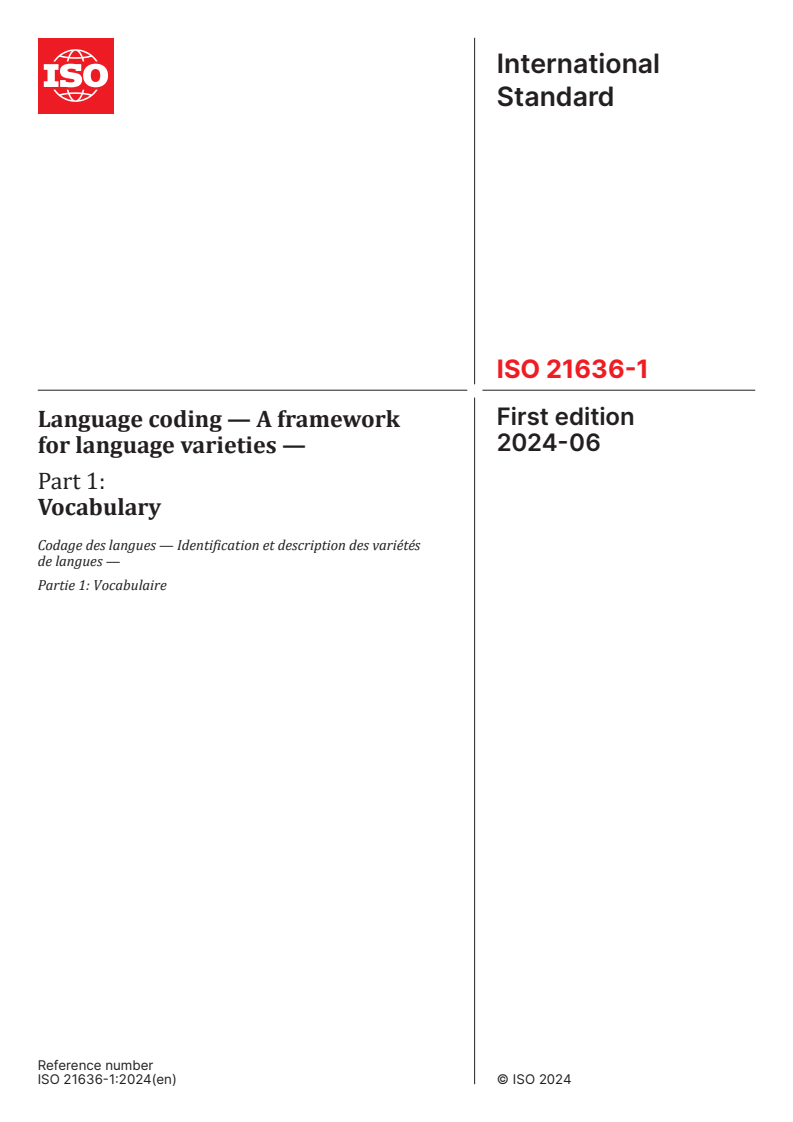
International
Standard
ISO 21636-1
First edition
Language coding — A framework
2024-06
for language varieties —
Part 1:
Vocabulary
Codage des langues — Identification et description des variétés
de langues —
Partie 1: Vocabulaire
Reference number
© ISO 2024
All rights reserved. Unless otherwise specified, or required in the context of its implementation, no part of this publication may
be reproduced or utilized otherwise in any form or by any means, electronic or mechanical, including photocopying, or posting on
the internet or an intranet, without prior written permission. Permission can be requested from either ISO at the address below
or ISO’s member body in the country of the requester.
ISO copyright office
CP 401 • Ch. de Blandonnet 8
CH-1214 Vernier, Geneva
Phone: +41 22 749 01 11
Email: copyright@iso.org
Website: www.iso.org
Published in Switzerland
ii
Contents Page
Foreword .iv
Introduction .v
1 Scope . 1
2 Normative references . 1
3 Terms and definitions . 1
3.1 Terms related to language and languages .1
3.2 Terms related to linguistic variation and language varieties .3
3.3 Terms related to dimensions of linguistic variation .4
3.4 Terms related to types of language varieties .5
3.5 Terms related to specific language modalities .8
3.6 Terms related to major language registers .11
3.7 Terms related to the documentation of language resources . 12
3.8 Terms related to certainty . 13
Bibliography . 14
Index .15
iii
Foreword
ISO (the International Organization for Standardization) is a worldwide federation of national standards
bodies (ISO member bodies). The work of preparing International Standards is normally carried out through
ISO technical committees. Each member body interested in a subject for which a technical committee
has been established has the right to be represented on that committee. International organizations,
governmental and non-governmental, in liaison with ISO, also take part in the work. ISO collaborates closely
with the International Electrotechnical Commission (IEC) on all matters of electrotechnical standardization.
The procedures used to develop this document and those intended for its further maintenance are described
in the ISO/IEC Directives, Part 1. In particular, the different approval criteria needed for the different types
of ISO document should be noted. This document was drafted in accordance with the editorial rules of the
ISO/IEC Directives, Part 2 (see www.iso.org/directives).
ISO draws attention to the possibility that the implementation of this document may involve the use of (a)
patent(s). ISO takes no position concerning the evidence, validity or applicability of any claimed patent
rights in respect thereof. As of the date of publication of this document, ISO had not received notice of (a)
patent(s) which may be required to implement this document. However, implementers are cautioned that
this may not represent the latest information, which may be obtained from the patent database available at
www.iso.org/patents. ISO shall not be held responsible for identifying any or all such patent rights.
Any trade name used in this document is information given for the convenience of users and does not
constitute an endorsement.
For an explanation of the voluntary nature of standards, the meaning of ISO specific terms and expressions
related to conformity assessment, as well as information about ISO’s adherence to the World Trade
Organization (WTO) principles in the Technical Barriers to Trade (TBT), see www.iso.org/iso/foreword.html.
This document was prepared by Technical Committee ISO/TC 37, Language and terminology, Subcommittee
SC 2, Terminology workflow and language coding.
A list of all parts of the ISO 21636 series can be found on the ISO website.
Any feedback or questions on this document should be directed to the user’s national standards body. A
complete listing of these bodies can be found at www.iso.org/members.html.
iv
Introduction
An increasing amount of digital language resources (LRs) are being created (including via retro-digitization),
archived, processed and analysed. Within this context, the detailed and exact characterization of language
varieties present in a given language use event is quickly gaining importance. Here, language use includes
all modalities such as written, spoken, or signed, and also new forms of language use supported by digital
technology (in social media and similar forms of digital communication). Such modalities demonstrate one
way in which languages vary internally. Others include, for instance, familiar regional (dialectal) and social
variation.
In the past, a primary goal of working with LRs was the archiving and preservation of LRs. However, new
goals have now emerged and are still emerging:
— Institutions and individuals need to exchange metadata (i.e. bibliographic description data and other
secondary information) for making the information on existing LRs widely available in a harmonized form.
— Researchers are identifying primary data (i.e. the LRs themselves) for various research purposes,
including research on linguistic variation.
— Researchers and developers need LRs for the development of more advanced language technologies (LTs)
and for testing purposes, because LTs, in particular those concerning speech recognition and language
analysis, are entering more dimensions of human communication.
In order to achieve the above-mentioned goals and purposes, along with others not outlined in the
ISO 21636 series, a standardized set of metadata for the identification of language varieties is important
for guaranteeing the frictionless exchange of secondary information. Well-organized metadata also help
to indicate the degree of interoperability (equalling re-usability and re-purposability of LRs), and the
applicability of LTs to different situations or LRs over time. These metadata are applicable in eBusiness,
eHealth, eGovernment, eInclusion, eLearning, smart environments, ambient assisted living (AAL), and
virtually all other information-rich applications which depend on information about LRs. A clear metadata
approach is also a prerequisite for the durability of LR archiving (in particular in the case of cultural heritage
and scientific research data).
ISO 639 provides a framework for identifying the individual languages used in an LR. The ISO 21636 series
presupposes and complements ISO 639 in that it extends the language coding framework in order to allow for
the identification of different types of language varieties (e.g. geographical, social, modal). The identification
of language varieties can then be included in general metadata, library metadata and archival metadata for
describing LRs (which may also include technical information, time and location of recording, and similar
general information, which are not included in the ISO 21636 series).
The conceptual framework developed in this document for dealing with linguistic variation respects the
major approaches represented in the linguistic literature without simply reproducing them. The framework
is closest though in general orientation and in a number of details, such as the role assigned to idiolects, to
[5]
work of a type represented by Lieb .
This document comprises:
— terms and definitions underlying a general conceptual framework to coherently deal with language-
internal linguistic variation;
— terms and definitions for a set of dimensions for identifying and describing language varieties.
Stakeholders include, but are not limited to:
— information and communication technologies (ICTs) industry (including LTs);
— libraries;
— the media industry (including entertainment);
— internet communities;
v
— people engaging in language documentation and preservation;
— language archivists;
— researchers (linguists, in particular sociolinguists, ethnologists, sociologists, etc.);
— people and institutions providing language training;
— emerging new user communities.
It is anticipated that these stakeholders will need to refer not only to a certain individual language, but also
to a certain language variety, for instance for oral human-computer interaction, or for tailoring a certain
LR or LT to the needs and specific environment of a target user group. An initial step towards achieving
the needed specificity involves the ability to identify the dimension(s) of linguistic variation internal to
individual languages involved, and the respective relevant language varieties. A conceptually sound uniform
framework of reference as developed in the ISO 21636 series is superior to the proliferation of different
individual ad-hoc solutions.
vi
International Standard ISO 21636-1:2024(en)
Language coding — A framework for language varieties —
Part 1:
Vocabulary
1 Scope
The ISO 21636 series provides a framework for the identification and description of varieties of all individual
human languages (see ISO 639).
It is applicable to sign languages.
It does not apply to:
— artificial means of communication with or between machines (such as programming languages);
— those means of human communication which are neither fully nor largely equivalent to human language
(such as sets of individual symbols or gestures that each carry isolated meanings but cannot be freely
combined into complex expressions).
This document defines the terms necessary to identify basic dimensions and sub-dimensions of linguistic
variation and the resulting varieties, including major modalities of human communication.
2 Normative references
There are no normative references in this document.
3 Terms and definitions
ISO and IEC maintain terminology databases for use in standardization at the following addresses:
— ISO Online browsing platform: available at https:// www .iso .org/ obp
— IEC Electropedia: available at https:// www .electropedia .org/
3.1 Terms related to language and languages
3.1.1
human language
means of communication characterized by a systematic use of sounds, visual-spatial signs, characters or
other written symbols or signs that can be combined to express or communicate meaning or a message
between humans
Note 1 to entry: Human language was originally developed for, and mainly used in, direct communication between
humans. Today its use is increasingly supported by information and communication technologies (ICTs).
Note 2 to entry: As the term “language” can represent different concepts, it is not listed as a synonym to the term
“human language”.
Note 3 to entry: Visual-spatial signs are indicated under signed modality (3.5.4).
3.1.2
idiolect
comprehensive set of all expressions of human language (3.1.1) with their meaning, characterized by a
coherent system of structural features, which is capable of coding complex facts and thoughts, potentially
used by a given individual person, in a given type of situation, at a given time, and in a given medium
Note 1 to entry: Typically, a person has command of several idiolects of an individual language (3.1.3), for instance
written and spoken idiolects (belonging to different language modalities; see 3.4.7 and 3.5), and idiolects for situations
with different degrees of formality (belonging to different language registers; see 3.4.8 and 3.6).
3.1.3
individual language
individual human language
largest set of idiolects (3.1.2), used by different speakers (3.1.5), which are all interconnected through
high mutual intelligibility, or through a chain of high mutual intelligibility, or which are sociopolitically
considered as a unit equivalent to such a largest set
Note 1 to entry: Individual languages also encompass constructed languages (3.1.10), but do not include formal
languages (as defined in ISO 1087:2019, 3.1.10).
Note 2 to entry: Usually, in other contexts, individual languages are simply called “languages”. However, the term
“language” has multiple meanings and connotations, which can cause confusion in the context of this document. Still,
when an attribute and possibly the plural clearly indicate that individual languages are meant, this document uses
only “language(s)”, as in “creole languages”, “Asian languages” or “living languages”.
EXAMPLE English, Guarani, LIBRAS (Língua Brasileira de Sinais/Brazilian Sign Language), Haitian Creole,
Esperanto.
3.1.4
individual sign language
individual language (3.1.3) whose basic modality (3.5.11) is the signed modality (3.5.4)
Note 1 to entry: Usually “sign language” is part of the name of the respective individual sign language.
EXAMPLE American Sign Language (ASL), langue des signes québécoise/Quebec Sign Language (LSQ).
Note 2 to entry: Individual sign languages differ from the “signed modality” (see 3.5.4), by which an individual
language can be expressed which is normally expressed in another language modality (3.4.7), such as by “Signing
Exact English” for expressing English. Therefore, the term “signed language” is not used as a synonym to the term
“individual sign language”.
3.1.5
speaker
person who is capable of making use of an idiolect (3.1.2)
Note 1 to entry: The term “speaker” covers the use of all language modalities (3.4.7), and is thus used to denote a
generic concept, “speaker”, also covering all specific concepts such as “writer”, “signer”, etc., which can be introduced
when needed. The alternative encompassing term “language user”, although technically closer to the intended generic
meaning, has proven to render the text much less accessible.
3.1.6
language use event
event of language use
event in which a speaker (3.1.5) expresses themselves by means of an idiolect (3.1.2)
Note 1 to entry: Language use events can belong to one of several language modalities (3.4.7). A case involving the
spoken modality (3.5.1) or the multimodal modality (3.5.2) is also called a “speech event”. In the case of the written
modality (see 3.5.3), it is a writing event or an event of producing a written text. In the case of the signed modality
(3.5.4), it is a signing or signed event, etc.
3.1.7
enhanced communicative functioning ability
enhanced ability of a speaker (3.1.5) during a language use event (3.1.6) where the speaker deviates from
average communicative functioning by some sort of enhancement
3.1.8
communicative functioning constraint
constraint of a speaker (3.1.5) during a language use event (3.1.6) where the speaker deviates from average
communicative functioning by being hampered by some limiting factor
Note 1 to entry: A communicative functioning constraint diagnosed as advanced or severe is usually identified as an
impairment in the form of a communication disorder affecting the speaker.
3.1.9
natural language
individual language (3.1.3) which is or was in active use in a language community, passed on from one
generation of speakers (3.1.5) to the next
EXAMPLE Bambara, English, Haitian Creole, Latin, LIBRAS (Língua Brasileira de Sinais/Brazilian Sign Language).
3.1.10
constructed language
individual language (3.1.3) whose rules are explicitly established prior to its use
EXAMPLE Esperanto, Volapük, Quenya, Na’vi.
Note 1 to entry: Constructed languages do not include reconstructed languages, computer programming languages,
mark-up languages or similar formal languages.
Note 2 to entry: Some constructed languages are based on one or several natural languages (3.1.9) and are therefore not
artificial. Therefore, the term “artificial language”, which is often used as a synonym, is not used in the ISO 21636 series.
3.2 Terms related to linguistic variation and language varieties
3.2.1
linguistic variation
language variation
differences within and between individual languages (3.1.3)
3.2.2
external criterion for linguistic variation
set of properties of idiolects (3.1.2) that are based on factors external to the linguistic features of the
idiolects’ systems
Note 1 to entry: External criteria for linguistic variation contain properties of idiolects that pertain to the speakers
(3.1.5) who use the idiolects, or to the language use event (3.1.6) in which the idiolects are used.
EXAMPLE “Being characteristic of speakers from East Anglia” is a property which is the only element of an
external criterion for linguistic variation [in this case, a criterion related to geographical space (see the example to
3.2.4), defining a certain dialect (3.4.1) of English].
3.2.3
structural criterion for linguistic variation
set of properties of idiolects (3.1.2) that are based on the linguistic features of the idiolects’ systems
Note 1 to entry: This set of properties includes in particular phonetic, phonological, morphological, syntactic, lexical,
semantic or pragmatic properties.
Note 2 to entry: Elements of the structural criterion for linguistic variation are also called “markers”, e.g. in
ISO/TR 20694. The term “structural criterion for linguistic variation” is preferred because it integrates better with
the framework for linguistic variation (3.2.1) developed in the ISO 21636 series.
3.2.4
dimension of linguistic variation
set of external criteria for linguistic variation (3.2.1) of the same kind which can serve to distinguish subsets
of individual languages (3.1.3)
Note 1 to entry: Criteria are “of the same kind” if they all refer to analogous properties of idiolects (3.1.2) (i.e. properties
of the same ontological domain) such as, for instance, properties related to a) geographical space, b) time or c) social
groups, etc.
Note 2 to entry: The dimensions assumed in the ISO 21636 series framework are listed in 3.3.
EXAMPLE The set of external criteria which all contain properties related to the geographical locations and
regions form a dimension of linguistic variation, in this case the space dimension (3.3.1), which distinguishes the
dialects (3.4.1) of individual languages (see the example to 3.2.2).
3.2.5
language variety
variety
largest subset of an individual language (3.1.3) that is internally consistent with regard
to both an external criterion for linguistic variation (3.2.2) and a structural criterion for linguistic variation
(3.2.3), and that can be identified and named
Note 1 to entry: Since terms such as “linguistic variation”, “language variation”, “linguistic variant”, “language
variant” or “linguistic variety” are also used to represent other concepts, only the term “language variety” is used in
the ISO 21636 series.
3.3 Terms related to dimensions of linguistic variation
3.3.1
space dimension
geographical space dimension
dimension of linguistic variation (3.2.4) that refers to geographical locations and regions
Note 1 to entry: Language varieties (3.2.5) which can be distinguished according to the space dimension comprise
dialects (3.4.1) and (supra-regional) standard varieties (3.4.2).
3.3.2
time dimension
dimension of linguistic variation (3.2.4) that refers to spans of time
Note 1 to entry: Language varieties (3.2.5) which can be distinguished according to the time dimension are in particular
historical language periods (3.4.3) and language epochs (3.4.4).
3.3.3
social group dimension
dimension of linguistic variation (3.2.4) that refers to social groups other than geographically defined groups
Note 1 to entry: Language varieties (3.2.5) which can be distinguished according to the social group dimension are in
particular sociolects (3.4.5) and technolects (3.4.6). There may be several distinct sociolects or technolects in a given
individual language (3.1.3).
3.3.4
medium dimension
dimension of linguistic variation (3.2.4) that refers to the medium used for communication
Note 1 to entry: Language varieties (3.2.5) which can be distinguished according to the medium dimension are language
modalities (3.4.7). Most of them are defined in 3.5.
3.3.5
situation dimension
dimension of linguistic variation (3.2.4) that refers to the type of situation, namely the social setting,
particularly different degrees of formality, in which a language use event (3.1.6) takes place
Note 1 to entry: Language varieties (3.2.5) which can be distinguished according to the situation dimension are
language registers (3.4.8). Some major language registers are defined in 3.6.
3.3.6
person dimension
individual speaker dimension
dimension of linguistic variation (3.2.4) that refers to the identity of the individual speaker (3.1.5)
Note 1 to entry: Language varieties (3.2.5) which can be distinguished according to the person dimension are personal
varieties (3.4.9). There is exactly one for each speaker of a given individual language (3.1.3).
Note 2 to entry: As stated in 3.1.5, Note 1 to entry, “speaker” is used generically in this document, including also the
terms “writer”, “signer”, etc.
3.3.7
proficiency dimension
dimension of linguistic variation (3.2.4) that refers to the proficiency of the speaker (3.1.5) in using the
individual language (3.1.3) in question
Note 1 to entry: Language varieties (3.2.5) which can be distinguished according to the proficiency dimension are in
particular learner varieties (3.4.10) and the native proficiency variety (3.4.11) for the individual language.
3.3.8
communicative functioning dimension
dimension of linguistic variation (3.2.4) that refers to the communicative functioning of speakers (3.1.5) when
using an individual language (3.1.3)
Note 1 to entry: Language varieties (3.2.5) which can be distinguished according to the communicative functioning
dimension are in particular the regular communicative functioning variety (3.4.14), enhanced communicative functioning
varieties (3.4.13) and constrained communicative functioning varieties (3.4.15).
3.4 Terms related to types of language varieties
3.4.1
dialect
language variety (3.2.5) specific to speakers (3.1.5) from a particular geographical location or region
Note 1 to entry: Dialects belong to the space dimension (3.3.1).
3.4.2
standard variety
language variety (3.2.5) recognized as standard or official by most speakers (3.1.5) across the geographical
area where the individual language (3.1.3) is spoken or used, or across a large part of that geographical area
where several dialects (3.4.1) are used
Note 1 to entry: Standard varieties belong to the space dimension (3.3.1).
Note 2 to entry: A standard variety of an individual language is typically used in official or public communication and
in communication between users of different language varieties.
Note 3 to entry: A standard variety is often characterized by a high degree of standardization or normalization.
3.4.3
language period
historical language period
historical period of a language
language variety (3.2.5) specific to a certain span of time which shows a higher degree of internal structural
homogeneity of the idiolects (3.1.2) belonging to it compared to other similarly long spans of time
Note 1 to entry: Historical language periods belong to the time dimension (3.3.2).
Note 2 to entry: The establishment of historical periods of an individual language (3.1.3) varies between different
experts or expert communities and depends on their interest or purpose. They usually range from a decade to a few
centuries.
Note 3 to entry: The linguistic term “period” used for temporal varieties differs from the general term “period” for a
time span. This is achieved by either using “(historical) language period” or by using “(historical) period” together
with “of”… (followed by either the expression “a language” or a concrete language name).
EXAMPLE Victorian English, 19th-century Portuguese.
3.4.4
language epoch
historical language epoch
language variety (3.2.5) specific to a long span of time, encompasses multiple historical language periods
(3.4.3), and shows a higher degree of internal structural homogeneity of the idiolects (3.1.2) belonging to it
compared to other similarly long spans of time
Note 1 to entry: Language epochs belong to the time dimensi
...