

SIST EN 1083-1:2025
(Main)Power-driven brushes - Part 1: Definitions and nomenclature
General Information
- Abstract
This document defines terms which are used to describe power-driven brushes and strip brushes and describes the designation system.
This document does not cover brushes for car wash sites, vacuum cleaners, carpet cleaning machines, sewer and street cleaning machines, dental brushes, brushes for sealing and stripping.
- Status
- Published
- Public Enquiry End Date
- 30-Dec-2023
- Publication Date
- 17-Mar-2025
- Technical Committee
- VSN - Safety of machinery
- Current Stage
- 6060 - National Implementation/Publication (Adopted Project)
- Start Date
- 30-Dec-2024
- Due Date
- 06-Mar-2025
- Completion Date
- 18-Mar-2025

Overview
SIST EN 1083-1:2025, developed by CEN, defines the key terms, definitions, and nomenclature for power-driven brushes and strip brushes used in industrial and manufacturing applications. This standard establishes a unified designation system, facilitating clear communication and product specification across manufacturers and end users throughout Europe. SIST EN 1083-1:2025 does not include brushes designed for car wash systems, vacuum cleaners, carpet cleaning machines, street or sewer cleaning equipment, dental use, or for sealing/stripping purposes.
Key Topics
- Definitions and Terminology: Establishes fundamental terms such as brush, brush body, filling material, knot, soul, working surface, and provides related symbols and parameters.
- Designation System: Introduces a structured, multi-block coding system for specifying power-driven brushes, including type, dimensions, materials, arrangement, and embedding of filling material.
- Brush Types and Codes: Covers a variety of brush types including cup brushes, wheel brushes (conical and straight), cylinder brushes, end brushes, disc brushes, tube brushes, head brushes, and strip brushes, each with specific codes.
- Material Classification: Specifies codes for common filling materials (steel, stainless steel, plastic fibers, animal bristles, brass, phosphor bronze, nickel silver, vegetable fibers) and for brush body composition.
- Arrangements and Embedding: Details how rows, segments, knots, and supporting rings are to be coded and included in the designation for precise identification.
- Symbol Use: Provides standardized symbols and their units to describe brush parameters such as diameter, width, filling shape, and arrangement.
Applications
SIST EN 1083-1:2025 is widely applicable in the following areas:
- Manufacturing and Engineering: Supports manufacturers of power-driven brushes in specifying and documenting products for metalworking, surface finishing, deburring, welding, and cleaning processes.
- Industrial Procurement: Enables purchasing and quality assurance departments to clearly identify and order the correct type of brush with required specifications.
- Product Standardization: Facilitates harmonization in technical documentation and labeling across the European brush industry, minimizing errors and misunderstandings.
- Design and Customization: Assists engineers and designers with clear parameters for selecting brushes best suited for specialized machinery or tasks.
- Quality Control: Provides a reference for checking compliance with brush nomenclature and properties in inspections and audits.
Related Standards
SIST EN 1083-1:2025 aligns with and references several important standards:
- EN 847-1:2017: Safety requirements for woodworking tools.
- ISO 525:2020: Shape types, designation, and marking for bonded abrasive products.
- ISO 6106: Grain size checking for superabrasives.
- ISO 8486-1 and ISO 8486-2: Determination and designation of grain size distribution in abrasives.
Related areas: Abrasive products, manufacturing engineering vocabularies, chipless working equipment.
Keywords: SIST EN 1083-1:2025, power-driven brushes, strip brushes, nomenclature, brush designation, CEN, brush material codes, manufacturing engineering, brush standardization, industrial brushes, brush specification, brush ordering system, product labeling, brush terminology, brush body material, filling material arrangement.
By unifying terminology and identification across the brush sector, SIST EN 1083-1:2025 ensures compatibility, reliability, and streamlined operations in manufacturing and industrial applications.
Relations
- Effective Date
- 28-Jan-2026
- Effective Date
- 28-Jan-2026
- Effective Date
- 28-Jan-2026
- Effective Date
- 20-Feb-2023
Get Certified
Connect with accredited certification bodies for this standard

DVS-ZERT GmbH
German welding certification society.
CARES (UK Certification Authority for Reinforcing Steels)
UK certification for reinforcing steels and construction.
EWF/IIW (European/International Welding Federation)
International welding personnel certification.
Sponsored listings
Frequently Asked Questions
SIST EN 1083-1:2025 is a standard published by the Slovenian Institute for Standardization (SIST). Its full title is "Power-driven brushes - Part 1: Definitions and nomenclature". This standard covers: This document defines terms which are used to describe power-driven brushes and strip brushes and describes the designation system. This document does not cover brushes for car wash sites, vacuum cleaners, carpet cleaning machines, sewer and street cleaning machines, dental brushes, brushes for sealing and stripping.
This document defines terms which are used to describe power-driven brushes and strip brushes and describes the designation system. This document does not cover brushes for car wash sites, vacuum cleaners, carpet cleaning machines, sewer and street cleaning machines, dental brushes, brushes for sealing and stripping.
SIST EN 1083-1:2025 is classified under the following ICS (International Classification for Standards) categories: 01.040.25 - Manufacturing engineering (Vocabularies); 25.100.70 - Abrasives; 25.120.01 - Chipless working equipment in general. The ICS classification helps identify the subject area and facilitates finding related standards.
SIST EN 1083-1:2025 has the following relationships with other standards: It is inter standard links to SIST EN 847-1:2018, SIST EN 2086:2005, SIST EN 1083-2:2025, SIST EN 1083-1:1997. Understanding these relationships helps ensure you are using the most current and applicable version of the standard.
SIST EN 1083-1:2025 is available in PDF format for immediate download after purchase. The document can be added to your cart and obtained through the secure checkout process. Digital delivery ensures instant access to the complete standard document.
Standards Content (Sample)
SLOVENSKI STANDARD
01-april-2025
Krtače na električni pogon - 1. del: Definicije in nomenklatura
Power-driven brushes - Part 1: Definitions and nomenclature
Kraftbetriebene Bürstwerkzeuge - Teil 1: Definitionen und Nomenklatur
Brosses entraînées par un moteur - Partie 1: Définitions et nomenclature
Ta slovenski standard je istoveten z: EN 1083-1:2024
ICS:
01.040.25 Izdelavna tehnika (Slovarji) Manufacturing engineering
(Vocabularies)
25.100.70 Brusiva Abrasives
25.120.01 Preoblikovalni stroji na Chipless working equipment
splošno in general
2003-01.Slovenski inštitut za standardizacijo. Razmnoževanje celote ali delov tega standarda ni dovoljeno.
EN 1083-1
EUROPEAN STANDARD
NORME EUROPÉENNE
December 2024
EUROPÄISCHE NORM
ICS 01.040.25; 25.100.70 Supersedes EN 1083-1:1997
English Version
Power-driven brushes - Part 1: Definitions and
nomenclature
Brosses entraînées par un moteur - Partie 1: Kraftbetriebene Bürstwerkzeuge - Teil 1: Definitionen
Définitions et nomenclature und Nomenklatur
This European Standard was approved by CEN on 25 November 2024.
CEN members are bound to comply with the CEN/CENELEC Internal Regulations which stipulate the conditions for giving this
European Standard the status of a national standard without any alteration. Up-to-date lists and bibliographical references
concerning such national standards may be obtained on application to the CEN-CENELEC Management Centre or to any CEN
member.
This European Standard exists in three official versions (English, French, German). A version in any other language made by
translation under the responsibility of a CEN member into its own language and notified to the CEN-CENELEC Management
Centre has the same status as the official versions.
CEN members are the national standards bodies of Austria, Belgium, Bulgaria, Croatia, Cyprus, Czech Republic, Denmark, Estonia,
Finland, France, Germany, Greece, Hungary, Iceland, Ireland, Italy, Latvia, Lithuania, Luxembourg, Malta, Netherlands, Norway,
Poland, Portugal, Republic of North Macedonia, Romania, Serbia, Slovakia, Slovenia, Spain, Sweden, Switzerland, Türkiye and
United Kingdom.
EUROPEAN COMMITTEE FOR STANDARDIZATION
COMITÉ EUROPÉEN DE NORMALISATION
EUROPÄISCHES KOMITEE FÜR NORMUNG
CEN-CENELEC Management Centre: Rue de la Science 23, B-1040 Brussels
© 2024 CEN All rights of exploitation in any form and by any means reserved Ref. No. EN 1083-1:2024 E
worldwide for CEN national Members.
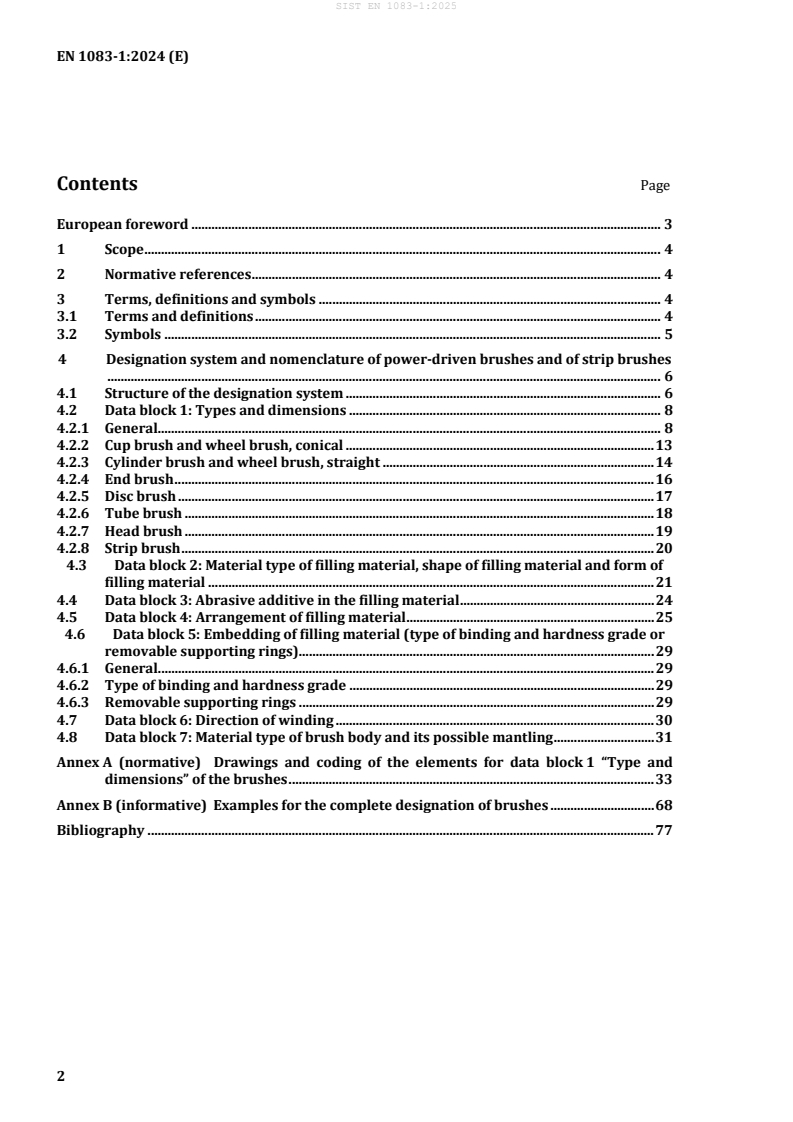
Contents Page
European foreword . 3
1 Scope . 4
2 Normative references . 4
3 Terms, definitions and symbols . 4
3.1 Terms and definitions . 4
3.2 Symbols . 5
4 Designation system and nomenclature of power-driven brushes and of strip brushes
..................................................................................................................................................................... 6
4.1 Structure of the designation system . 6
4.2 Data block 1: Types and dimensions . 8
4.2.1 General. 8
4.2.2 Cup brush and wheel brush, conical . 13
4.2.3 Cylinder brush and wheel brush, straight . 14
4.2.4 End brush . 16
4.2.5 Disc brush . 17
4.2.6 Tube brush . 18
4.2.7 Head brush . 19
4.2.8 Strip brush . 20
4.3 Data block 2: Material type of filling material, shape of filling material and form of
filling material . 21
4.4 Data block 3: Abrasive additive in the filling material . 24
4.5 Data block 4: Arrangement of filling material . 25
4.6 Data block 5: Embedding of filling material (type of binding and hardness grade or
removable supporting rings) . 29
4.6.1 General. 29
4.6.2 Type of binding and hardness grade . 29
4.6.3 Removable supporting rings . 29
4.7 Data block 6: Direction of winding . 30
4.8 Data block 7: Material type of brush body and its possible mantling . 31
Annex A (normative) Drawings and coding of the elements for data block 1 “Type and
dimensions” of the brushes . 33
Annex B (informative) Examples for the complete designation of brushes . 68
Bibliography . 77
European foreword
This document (EN 1083-1:2024) has been prepared by Technical Committee CEN/TC 143 “Machine
tools – Safety”, the secretariat of which is held by SNV.
This European Standard shall be given the status of a national standard, either by publication of an
identical text or by endorsement, at the latest by June 2025 and conflicting national standards shall be
withdrawn at the latest by June 2025.
Attention is drawn to the possibility that some of the elements of this document may be the subject of
patent rights. CEN shall not be held responsible for identifying any or all such patent rights.
This document will supersede EN 1083-1:1997.
This document includes the following significant technical changes with respect to EN 1083-1:1997:
a) The entire document has been updated with a new designation system to meet current needs of
manufacturers and end users.
b) New types of brushes and new materials have been added.
Any feedback and questions on this document should be directed to the users’ national standards body.
A complete listing of these bodies can be found on the CEN website.
According to the CEN-CENELEC Internal Regulations, the national standards organizations of the
following countries are bound to implement this European Standard: Austria, Belgium, Bulgaria, Croatia,
Cyprus, Czech Republic, Denmark, Estonia, Finland, France, Germany, Greece, Hungary, Iceland, Ireland,
Italy, Latvia, Lithuania, Luxembourg, Malta, Netherlands, Norway, Poland, Portugal, Republic of North
Macedonia, Romania, Serbia, Slovakia, Slovenia, Spain, Sweden, Switzerland, Türkiye and the United
Kingdom.
1 Scope
This document defines terms which are used to describe power-driven brushes and strip brushes and
describes the designation system.
This document does not cover brushes for car wash sites, vacuum cleaners, carpet cleaning machines,
sewer and street cleaning machines, dental brushes, brushes for sealing and stripping.
2 Normative references
The following documents are referred to in the text in such a way that some or all of their content
constitutes requirements of this document. For dated references, only the edition cited applies. For
undated references, the latest edition of the referenced document (including any amendments) applies.
EN 847-1:2017, Tools for woodworking — Safety requirements — Part 1: Milling tools, circular saw blades
ISO 525:2020, Bonded abrasive products — Shape types, designation and marking
ISO 6106, Abrasive products — Checking the grain size of superabrasives
ISO 8486-1, Bonded abrasives — Determination and designation of grain size distribution — Part 1:
Macrogrits F4 to F220
ISO 8486-2, Bonded abrasives — Determination and designation of grain size distribution — Part 2:
Microgrits F230 to F2000
3 Terms, definitions and symbols
3.1 Terms and definitions
For the purposes of this document, the terms and definitions given in EN 847-1:2017 and the following
apply.
ISO and IEC maintain terminology databases for use in standardization at the following addresses:
— ISO Online browsing platform: available at https://www.iso.org/obp/
— IEC Electropedia: available at https://www.electropedia.org/
3.1.1
brush
assembly consisting of the brush body, soul, clamping part and the filling material
3.1.2
brush body
component of a brush whose function is to keep the filling material together
3.1.3
filling material
material (wire, filament or similar), fixed into the brush body or into the soul, in order to form the brush
area and hence the working part of the brush
3.1.4
bundle
number of elements of the filling material
3.1.5
knot
bundle twisted to a knot
3.1.6
soul
wires winded to a spiral, which fix the filling material and form also the brush body
3.1.7
bound brush
binding
brush with filling material that is embedded into a binding in a way that only the tips of the filling material
are used during application
3.1.8
working surface
surface formed by the tips of the filling material, which contacts the workpiece
3.2 Symbols
For the purposes of this document, the symbols, definitions and units given in Table 1 apply.
Table 1 — Symbols, definitions und units
Symbol Definition Unit
α Orientation of the filling material towards the axis (nominal dimension) °
C
Nominal height of a strip brush mm
H
C
Nominal length of strip brushes mm
L
C
Nominal back width of strip brushes mm
W
Nominal outside diameter of the brush or of the working surface of an end
D mm
brush
D
Bore diameter mm
A
D
Maximum bore diameter of the brush body mm
AM
D
Maximum outside diameter of the brush body mm
C
D
Nominal diameter of the round filling material mm
F
D
Nominal diameter of the oval or rectangular filling material (higher value) mm
F1
D
Nominal diameter of the oval or rectangular filling material (lower value) mm
F2
D
Nominal inside diameter of the working surface mm
I
D
Diameter in the bore area mm
M
D
Outside diameter of the pilot mm
P
Symbol Definition Unit
Shank diameter of brushes with shank
D
Axis diameter of cylinder brushes mm
S
Soul diameter of tube brushes
D
Nominal thread diameter, e.g. M14 × 2 —
T
H Nominal total height (incl. parts for bore or thread and incl. shank) mm
L Nominal total length of end brushes (excl. pilot) and of tube brushes mm
L
Body length of head brushes mm
B
L
Length of soul at the head of tube brushes without filling material mm
H
L
Visible nominal length of pilot mm
P
Useable length of shank, total length of the clamping axis, usable length of
L
mm
S
thread
L
Nominal length of the filling material (free length of filling material) mm
T
N
Number of strips of cylinder brushes —
S
P
Pitch of winding of cylinder brushes and of strip brushes mm
W
W
Width of the brush body at the hole/at the thread mm
A
W
Mounting width, maximum width of the brush body mm
B
W
Nominal working width mm
F
4 Designation system and nomenclature of power-driven brushes and of strip
brushes
4.1 Structure of the designation system
The individual item block of power-driven brushes and of strip brushes is composed from up to seven
data blocks, depending on the brush type (see Table 2). The given sequence of the data blocks is
mandatory.
All data blocks shall be separated with hyphens and without blanks (see Example 1).
Table 2 — Designation system
Designation
Description Identity block
block
EN standard Individual item block
Data block 1 Data block 2 Data block 3 Data block 4 Data block 5 Data block 6 Data block 7
Designation EN 1083-1 Types and Material type Abrasive Arrangement of Embedding of Direction of Material type
dimensions of filling additive in filling material filling material winding of brush body
material, shape the filling (type of and its
of filling material binding and possible
material and hardness grade manteling
form of filling or removable
material supporting
rings)
Statement mandatory, if optional mandatory mandatory mandatory, if mandatory, if optional optional optional
standard filling filling material
reference is material with in form of rows,
not stated abrasive segments or
additive is knots is used
used
Clause
4.2 4.3 4.4 4.5 4.6 4.7 4.8
EXAMPLE 1 Designation of a wheel brush:
Wheel brush EN 1083-1- WID-B-150×38-50,8A-32×32-0,3×25 -IRCR -2 -S
Data block 1 – Types and dimensions
Data block 2 – Material type of filling
material, shape of filling material and
form of filling material
Data block 4 – Arrangement of filling
material
Data block 7 – Material type of brush
body
EXAMPLE 2 For additional examples, see Annex B.
4.2 Data block 1: Types and dimensions
4.2.1 General
Data block 1 is mandatory (see Table 2). For the structure of data block 1, different information about the
types and dimensions are necessary, depending on the brush type.
Table 3 gives the brush types, regardless of the type of mounting, with references on the relevant clause,
which gives the mandatory parameters. Annex A gives detailed explanations (e.g. on clamping type,
position of the indication of measurements) and drawings.
The structure of data block 1 is given in Figures 1 to 7, depending on the brush type. As separation between
the statements, the symbols “-“ and “×” shall be used, as defined in the following subclauses.
Statements in brackets in the columns “Dimensions” are optional and shall be included or left out only in
the whole. If the information in brackets shall be given, the brackets themselves shall not be included into
the designation system.
The filling material is shown in grey.
Table 3 — Type code
Type code Figure Designation Clause
CS cup brush, straight
α ≈ 0°
CF cup brush, flared
4.2.2
0° < α < 45°
WC wheel brush, conical
45° ≤ α < 90°
Type code Figure Designation Clause
CID cylinder brush, individual brush disc
CSS cylinder brush, strip straight
CSH cylinder brush, strip helical
4.2.3
CSW cylinder brush, strip wounded
CCP cylinder brush, core punched
W ≥ D
F
wheel brush (straight), individual
WID
brush disc
WSS wheel brush (straight), strip straight
4.2.3
WSH wheel brush (straight), strip helical
W < D
F
WSW wheel brush (straight), strip wounded
α ≈ 90°
WCP wheel brush (straight), core punched
ES end brush, solid working surface
EH end brush, hollow working surface
end brush, hollow working surface,
EP 4.2.4
with pilot
ER end brush, flared end (round)
EW end brush, flared end (square)
Type code Figure Designation Clause
DI disc brush, flat body 4.2.5
TT tube brush, 2 core wires
4.2.6
TF tube brush, 4 core wires
HS headbrush, square end
4.2.7
HR headbrush, round end
Type code Figure Designation Clause
SS strip brush, straight
4.2.8
strip brush as single ring (P = 0) or
W
SWO
wounded, filaments outside
Type code Figure Designation Clause
strip brush as single ring (P = 0) or
W
SWI
wounded, filaments inside
4.2.8
4.2.2 Cup brush and wheel brush, conical
Data block 1 “Types and dimensions” of cup brushes and wheel brushes, conical, consists of five elements. Figure 1 gives the elements with the possible statements and
two examples. Reference figures of the brushes and the location of the dimensions are specified in A.2.
* For type “B”, additional variants are possible (see Table A.2).
Figure 1 — Structure of data block 1: Cup brush and wheel brush, conical
4.2.3 Cylinder brush and wheel brush, straight
Data block 1 “Types and dimensions” of cylinder brushes and wheel brushes, straight, consists of six elements. Figure 2 gives the elements with the possible statements
and two examples. Reference figures of the brushes and the location of the dimensions are specified in A.3.
* For type “B”, additional variants are possible (see Table A.2).
Figure 2 — Structure of data block 1: Cylinder brush and wheel brush, straight
4.2.4 End brush
Data block 1 “Types and dimensions” of end brushes of six elements. Figure 3 gives the elements with the possible statements and two examples. Reference figures of the
brushes and the location of the dimensions are specified in A.4.
Figure 3 — Structure of data block 1: End brush
4.2.5 Disc brush
Data block 1 “Types and dimensions” of disc brushes consists of five elements. Figure 4 gives the elements with the possible statements and two examples. Reference
figures of the brushes and the location of the dimensions are specified in A.5.
* For type “B”, additional variants are possible (see Table A.2).
Figure 4 — Structure of data block 1: Disc brush
4.2.6 Tube brush
Data block 1 “Types and dimensions” of tube brushes consists of five elements. Figure 4 gives the elements with the possible statements and two examples. Reference
figures of the brushes and the location of the dimensions are specified in A.6.
Figure 5 — Structure data block 1: Tube brush
4.2.7 Head brush
Data block 1 “Types and dimensions” of head brushes consists of four elements. Figure 6 gives the elements with the possible statements and two examples. Reference
figures of the brushes and the location of the dimensions are specified in A.7.
Figure 6 — Structure of data block 1: Head brush
NOTE For head brushes, this document does not give statements regarding the mounting type and geometry.
4.2.8 Strip brush
Data block 1 “Types and dimensions” of strip brushes consists of four elements. Figure 7 gives the elements with the possible statements and two examples. Reference
figures of the brushes and the location of the dimensions are specified in A.8.
Figure 7 — Structure of data block 1: Strip brush
NOTE For strip brushes for the use in cylinder brushes, this document does not give statements regarding the mounting type.
4.3 Data block 2: Material type of filling material, shape of filling material and form of
filling material
4.3.1 Data block 2 consists of the following three mandatory elements, which shall be stated in this
sequence:
— Code for the material type of filling material according to Table 4;
— Code for the shape of filling material according to Table 5;
— Code for the form of filling material according to Table 6.
The three codes shall be stated in direct sequence without blanks. See Example 2.
An additional optional manufacturer specific information is given in 4.3.2.
The statement of the nominal dimension of the filling material D is mandatory, excluding for the filling
F
material codes A = Animal hair and bristle and V = Vegetable fibres according to Table 4. Single elements
of the geometry of the shape shall be separated by “×” without blanks. See Example 1.
EXAMPLE 1
— Round shape: …-D ×L -… → …-0,3×25-…
F T
— Oval or rectangular shape: …-D ×D ×L -… → …-0,5×1×30-…
F1 F2 T
Table 4 — Code for the material type of filling material
Code Material type of filling material
A Animal hair and bristles
B copper-zinc alloy (brass)
H copper-tin alloy (phosphor bronze)
N copper-nickel-zinc alloy (nickel silver)
I stainless steel (inox)
P plastic (synthetic fibre), with or without abrasives
S steel
V vegetable fibres
a
other filament materials
Y
a
If two or more materials are used (mixture), the code “Y” (other filament materials) shall be used.
Table 5 — Code for the shape of filling material
Code Shape of the filling material
C Rectangular
O Oval
R Round
T Triangluar
N Not defined
X X-profile
Table 6 — Code for the form of filling material
Code Form of the filling material
ST Straight
CW Cord wire
CR Crimped
N Not defined
EXAMPLE 2 Material type of filling material: steel wire (without manufacturer specific information); shape of
filling material: round; form of filling material: crimped
S R CR
Material type of filling
material
Shape of filling material
Form of filling material
4.3.2 A manufacturer specific information on the filling material is optional. This information may
consist of letters and numbers except letters and number which can lead to a misunderstanding in the
designation. The statement shall be specified after the code for the form of the filling material separated
by “×”.
See Examples 3 to 7.
EXAMPLE 3 Material type of filling material: steel wire with low tensile strength; shape of filling material:
square; form of filling material: straight
S C ST ×A
Material type of filling
material
Shape of filling material
Form of filling material
Manufacturer specific
information
EXAMPLE 4 Material type of filling material: steel wire with high tensile strength; filament shape: round;
filament form: crimped
S R CR ×H
Material type of filling
material
Shape of filling material
Form of filling material
Manufacturer specific
information
EXAMPLE 5 Material type of filling material: Polyamid 6.12; filament shape: X-profile; filament form: wounded
P X CW ×PA612
Material type of filling
material
Shape of filling material
Form of filling material
Manufacturer specific
information
EXAMPLE 6 Material type of filling material: horsehair; filament shape: round; filament form: not definded
A R N ×ROS
Material type of filling
material
Shape of filling material
Form of filling material
Manufacturer specific
information
EXAMPLE 7 Material type of filling material: stainless steel 1.4310; filament shape: round; filament form:
straight
I R ST ×4310
Material type of filling
material
Shape of filling material
Form of filling material
Manufacturer specific
information
4.4 Data block 3: Abrasive additive in the filling material
4.4.1 Data block 3 is mandatory, if abrasives are used in the filling material, and consists of the
following elements:
— Code for the abrasive material type according to Table 7;
— Grain size. For the grain size for bonded abrasives, ISO 8486-1 or ISO 8486-2 shall apply and for the
grain size for abrasives with diamond or cubic boron nitride, ISO 6106 shall apply.
The codes are specified without blanks. See Example 1.
Additional manufacturer specific information is given in 4.4.2.
Table 7 — Code for the abrasive material type
Code Designation
a
Aluminium oxide
A
a
Silicon carbide
C
a
Zirconia alumina
Z
b
Diamond
D
b
Cubic boron nitride
B
a
According to ISO 525:2020, Table 4.
b
According to ISO 6106.
EXAMPLE 1 Silicon carbide with grain size 180 (without manufacturer specific information):
C 180
Abrasive
material type
Grain size
4.4.2 A manufacturer specific designation of the abrasive material is optional. This designation may
consist of letters and figures. Excluded are letters or figures which can lead to a mix-up in the designation.
The statement is done manufacturer specific directly after the code for the abrasive additive in the filling
material, separated by “×”. See Example 2.
EXAMPLE 2 Aluminium oxide with grain size 120 with specification ceramic grain:
A 120 ×CO
Abrasive
material type
Grain size
Manufacturer
specific
designation
4.5 Data block 4: Arrangement of filling material
4.5.1 Data block 4 is mandatory, if filling material in form of rows, segments or knots is used and
consists of several elements, some of which are mandatory and some optional (see Table 8). The
sequence given there shall be followed.
All elements shall be given without blanks. The designation of the length of knotting of the visible length
of the filling material shall be stated following “/” and without blanks. See Example 1.
Table 8 — Elements for data block 4 “Arrangement of filling material”
Designation of the elements Statement Reference
Number of rows or segment optional —
Direction of knotting mandatory Table 9
Number of knots per segment mandatory —
Type of knotting optional Table 10
Length of knotting in % of the visible length of filling material
optional —
a
as integer value
Orientation of the arrangement of the filling material at disc
optional 4.5.2
brushes
a
Only for type of knotting “OK” (open knot).
Table 9 —Code for the direction of knotting
Code Direction of knotting
a
R
Right knotted (clockwise)
a
L
Left knotted (anti-clockwise)
C Changing direction of knotting
a
Direction of knotting, as seen in direction to the working surface.
Table 10 —Code for type of knotting
Code Type of knotting Figure
FK Full knot
OK Open knot
RK Rose knot
ZK Other knot —
EXAMPLE Two rows of filling material, right knotted, with 52 knots, open knot, with a knotting length of 75 %
of the visible length of the filling material.
2 R 52 OK /75
Number of rows
Direction of knotting
Number of knots
Type of knotting
Length of knotting at
the visible filament
length
4.5.2 The element “Orientation of the arrangement of the filling material at disc brushes” is optional.
The code for the orientation of the arrangement of the filling material (see Table 11) and the angle are
specified. The angle is specified in degrees without blank after the code for the orientation of the
arrangement of the filling material.
Table 11 — Code for the orientation of the arrangement of the filling material at disc brushes
Orientation of the arrangement of the
Code Figure
filling material at disc brushes
Brush with outside orientation of the
A
filling material
Brush with inside orientation of the
B
filling material
Orientation of the arrangement of the
Code Figure
filling material at disc brushes
Brush with clockwise orientation of the
C filling material, seen in the direction to
the working surface
Brush with anti-clockwise orientation of
D the filling material, seen in the direction
to the working surface
Brush with perpendicular orientation of
no statement
the filling material
Combination between A to D and for
X —
several angles
EXAMPLE Brush with outside orientation of the filling material with an angle of 15°:
A 15
Code for the
orientation
Angle
4.6 Data block 5: Embedding of filling material (type of binding and hardness grade or
removable supporting rings)
4.6.1 General
Data block 5 is optional. The embedding of the filling material is either the type of binding and hardness
grade (statements according to 4.6.2) or removable supporting rings (statements according to 4.6.3).
4.6.2 Type of binding and hardness grade
The type of binding and the hardness grade are specified with the code for the type of binding according
to Table 12 and with the hardness grade. The hardness grade is specified in Shore A or Shore D as natural
number without blank after the code for the type of binding without blank.
Table 12 — Code for the type of binding
Code Type of binding
BD Duroplast
BE Elastomer
BT Thermoplast
EXAMPLE Embedding with type of binding Elastomer (BE) with a hardness of 80° Shore A
BE 80
Code for the
type of binding
Hardness
4.6.3 Removable supporting rings
Removable supporting rings are specified with the code for the material according to Table 13 and the
number of the removable supporting rings without blank.
Table 13 — Code for material type of removable supporting rings
Code Material type
RS Steel
RI Stainless steel (inox)
RB Non ferrous metal (brass)
RP Plastic
RZ Others
EXAMPLE Embedding with three removable supporting rings of plastic (RP):
RP 3
Code for the material type of the removable
supporting rings
Number of the removable supporting rings
4.7 Data block 6: Direction of winding
Data block 6 is optional and shall be stated according to Table 14.
Table 14 — Code for the direction of winding
Direction of Figure using the example Figure using the example
Code
winding of a strip brush of a tube brush
R Right upward
Direction of Figure using the example Figure using the example
Code
winding of a strip brush of a tube brush
L Left upward
EXAMPLE Direction of winding right upward:
R
Direction of winding
4.8 Data block 7: Material type of brush body and its possible mantling
Data block 7 is optional and shall be specified according to Table 15.
Table 15 — Code for the material type of brush body and its possible mantling
Code Material type
S Steel
I Stainless steel (inox)
B Non ferrous metal (brass)
P Plastic
W Wood
Z Others
For combination of materials, the codes of all material types shall be specified in alphabetical order
without blanks. If the brush body is mantled, the relevant material shall be specified after the material
type of the brush body with “/” and without blanks. See Example 1 to Example 3.
An additional manufacturer specific designation on the material type of the brush body is optional. This
designation may consist of letters or numbers excluding letters of numbers which may lead to mix-ups in
the designation. The designation is specified after the code for the material type of the brush body,
separated by “×”. See Example 4.
EXAMPLE 1 Brush body of steel:
S
Material type of brush body
EXAMPLE 2 Plastic body with aluminium core:
PB
Material type of brush body
EXAMPLE 3 Steel body, mantled with plastics:
S /P
Material type of brush
body
Material type of mantling
EXAMPLE 4 Brush body of stainless steel:
I ×4301
Material type of brush
body
Manufacturer specific
designation
Annex A
(normative)
Drawings and coding of the elements for data block 1 “Type and
dimensions” of the brushes
A.1 Code for the mounting type (Element 2)
The code for the mounting type is relevant for the following brush types:
— cup brush and wheel brush, conical (4.2.2);
— cylinder brush and wheel brush, straight (4.2.3);
— end brush (4.2.4);
— disc brush (4.2.5);
— tube brush (4.2.6).
NOTE The code for the mounting type is not relevant for head brushes (4.2.7) and strip brushes (4.2.8).
The figures in Table A.1 are given only for the demonstration of Element 2 “Code for mounting type” of
the above mentioned brush types (see also Table 3) and are examples only.
For brushes with bore, the code for the bore type according to Table A.2 is specified after the bore
diameter (D ) without blank.
A
Table A.1 — Code for the mounting type (Element 2)
Code for the Description of the
Figure
mounting type type
With bore
NOTE Table A.2 is to
B
be taken into account.
With internal
ITI thread, located
inside
Code for the Description of the
Figure
mounting type type
With internal
ITO thread, located
outside
With full-length
internal thread,
ITD
located outside on
both sides
With external
ET
thread
Code for the Description of the
Figure
mounting type type
S With shank
E Bayonet connection
Code for the Description of the
Figure
mounting type type
Without additional
none
mounting
Table A.2 — Code for the bore type
Code Bore types
A Cylindrical bore without keyway
B Cylindrical bore with one or more keyways (for turtle bore see line D)
C Hexagon bore
D Turtle bore
Z Mounting type according to drawing, e.g. square bore, conical bore, X-LOCK
X-LOCK or equivalent are examples of suitable products available commercially. This information is given for the convenience of users of this document and
does not constitute an endorsement by CEN of these products.
EXAMPLE Wheel brush, straight, manufactured from segments (WID) with bore (B), nominal outside diameter 125 mm, nominal working width 25 mm, bore
diameter in the brush body 25,4 mm, with cylindrical bore without keyway (A), nominal dimension of the filling material 0,30 mm and nominal length of filling
material 40 mm.
WID-B −125 ×25 −25, A −0,3 ×40
4 0
Brush type (Element 1) und mounting
type (Element 2)
Nominal outside diameter D (Element 3)
Nominal working width W (Element 3)
F
Bore diameter in the brush body D
A
(Element 4)
Bore type
Nominal dimension of the filling material
(Element 5)
Nominal length of filling material (free
length of the filling material) (Element 5)
A.2 Cup brush and wheel brush, conical
A.2.1 Specification of basic dimensions (Element 3)
The figures in Table A.3 are given only for the demonstration of Element 3 “Basic dimensions” according to 4.2.2 and are examples only.
Table A.3 — Specification of basic dimensions
Figure Specification
D
NOTE The nominal internal diameter of the working surface D is not described.
I
A.2.2 Specification of dimensions of brush body (Element 4)
The figures in Table A.4 are given only for the demonstration of Element 4 “Dimensions of brush body” according to 4.2.2 and are examples only.
Table A.4 — Specification of dimensions of brush body (related to the code for the mounting type)
Code for the
Figure Specification
mounting type
D -(D × )H
B
A C
D -(D × )H
ITI
T C
D -(D × )H
ITO
T C
Code for the
Figure Specification
mounting type
D × L -(D × )H
ET
T S C
D × L -(D × )H
S
S S C
A.2.3 Specification of dimensions of filling material (Element 5)
The figures in Table A.5 are given only for the demonstration of Element 5 “Dimensions of filling material” according to 4.2.2 and are examples only.
Table A.5 — Specification of dimensions of filling material
Figure Specification
D × L
F T
A.3 Cylinder brush and wheel brush, straight
A.3.1 Type code (Element 1)
The type code consists of part 1 “Relation between nominal working width and nominal outside diameter” and Part 2 “Brush design”.
The figures in Table A.6 and Table A.7 are given only for the demonstration of the “Type code (Part 1)” and the “Type code (Part 2)” according to
4.2.3 and are examples only.
Table A.6 — Type code (Part 1) „Relation between nominal working width and nominal outside diameter”
Type code
Criterium Figure Designation
(part 1)
W < D
W… Wheel brush, straight
F
W ≥ D
C… Cylindrical brush
F
Table A.7 — Type code (Part 2) “Brush design”
Type code
Figure Designation
(part 2)
Brush manufactured with
…ID segments, segments of
brushes
…SS Stripes, straight
…SH Stripes helical
…SW Stripes wounded
Type code
Figure Designation
(part 2)
…CP Inserted
A.3.2 Specification of basic dimensions (Element 3)
The figures in Table A.8 are given only for the demonstration of Element 3 “Basic dimensions” according to 4.2.3 and are examples only.
Table A.8 — Specification of basic dimensions
Figure Specification
D × W
F
A.3.3 Specification of dimensions of brush body (Element 4)
The figures in Table A.9 are given only for the demonstration of Element 4 “Dimensions of brush body” according to 4.2.3 and are examples only.
Table A.9 — Specification of dimensions of brush body (related to the code for the mounting type)
Code for the
Figure Specification
mounting type
(-D )-D (/D ) (-W × W )
AM A M A B
B
D (-D )-D
C AM A
D (-W )
ITI
T B
Code for the
Figure Specification
mounting type
D (-H-W )
ITO
T B
D (-H-W )
ITD
T B
D × L -H( × W )
ET
T S B
Code for the
Figure Specification
mounting type
D × L -H( × W )
S S B
S
D (-D × L )
C S S
A.3.4 Specification of dimensions of brush type (Element 5)
The figures in Table A.10 are given only for the demonstration of Element 5 “Dimensions of brush type” according to 4.2.3 and are examples only.
Table A.10 — Specification of dimensions of brush type (related to Type code, part 2)
Type code
Figure Specification
(part 2)
ID none
C × C -N
SS
W H S
C × C -N -P
SH
W H S W
Type code
Figure Specification
(part 2)
C × C
W H
SW
(P = C )
W W
CP none
A.3.5 Specification of dimensions of filling material (Element 6)
The figures in Tab
...