

oSIST prEN 12457-4:2026
(Main)Granular waste materials, sludges, soil, soil-like materials and sediments - Leaching - Compliance test for leaching - Part 4: One-stage batch test a liquid-to-solid ratio of 10L/kg for materials with particle size below 10 mm (with or without size reduction)
- Abstract
This document in the series specifies a compliance test providing information on leaching of granular waste materials, sludges, soil, soil-like materials and sediments under the experimental conditions specified hereafter, and particularly a liquid to solid ratio of 10 L/kg dry matter. It applies to materials which have a particle size below 10 mm without or with size reduction.
This document has been developed to investigate the leaching of inorganic and non-volatile organic substances from granular waste materials, sludges, soil, soil-like materials and sediments. It does not take into account the consequences of microbiological processes in organic degradable materials.
The test procedure specified in this document produces an eluate which is subsequently characterized physically and chemically according to appropriate standard methods. This document includes two different procedures for eluate preparation prior to analysis, one procedure for non-volatile organic substances, inorganic substances and DOC and one for inorganic substances and DOC. When assessing only the leaching of inorganic substances and DOC, certain precautions needed when assessing the leaching of organic substances can in some cases be omitted.
This procedure cannot be applied to materials with a water content or such a water affinity that a good mixing of the solid with the predetermined quantity of liquid is not achievable.
This procedure does not apply to materials reacting with the leachant, leading, for example, to excessive gas emission, a solidifying effect or an excessive heat release. In that case, the material can be wetted prior to carrying out the leaching test.
This test cannot be used alone to determine the leaching behaviour of granular waste materials, sludges, soil, soil-like materials and sediments, as specified in EN 12920.
This document does not address issues related to health and safety.
- Status
- Not Published
- Public Enquiry End Date
- 02-Aug-2026
- Technical Committee
- KAT - Soil quality
- Current Stage
- 4020 - Public enquire (PE) (Adopted Project)
- Start Date
- 04-Jun-2026
- Due Date
- 22-Oct-2026
- Completion Date
- 24-Sep-2026
- Directive
- 99/31/EC - Landfill of waste
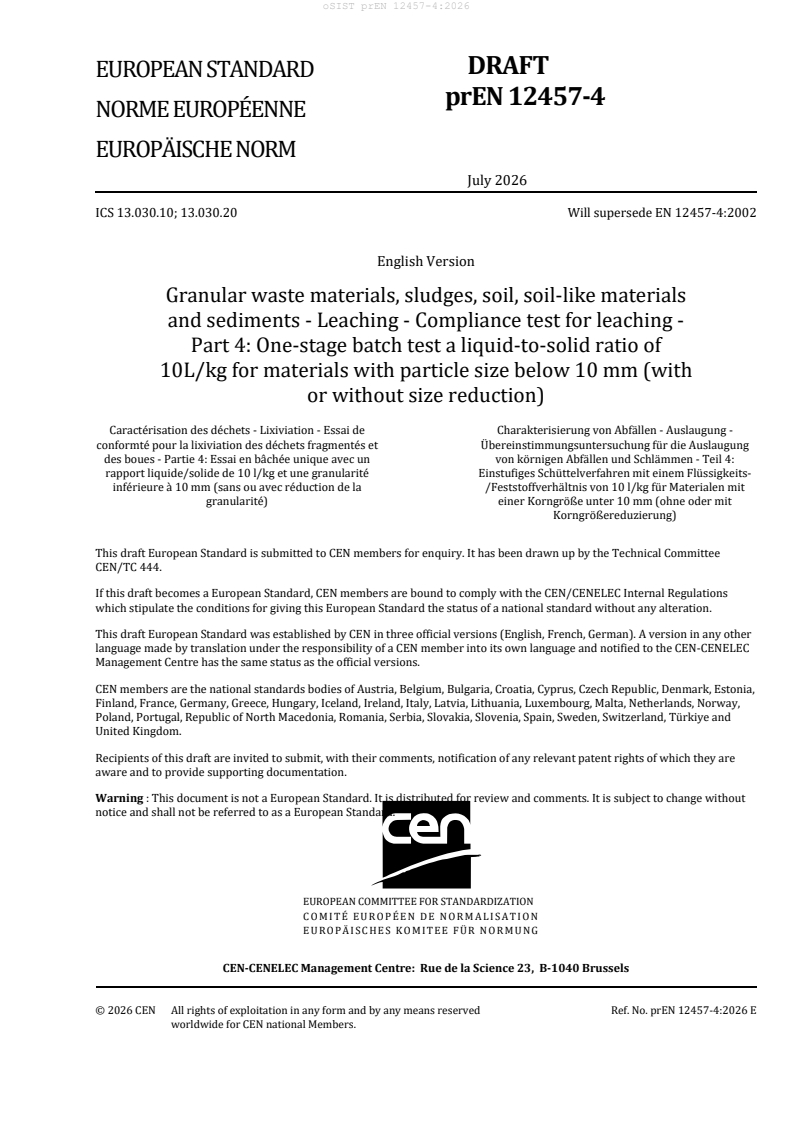
prEN 12457-4:2026 is a draft European Standard from CEN, listed on the SIST page, for a compliance leaching test on granular waste materials, sludges, soil, soil-like materials and sediments. It specifies a one-stage batch test at a liquid-to-solid ratio of 10 L/kg for materials with particle size below 10 mm, with or without size reduction. Laboratories, regulators and waste managers use it to prepare an eluate for physical and chemical characterization and to check compliance against reference values.
What does prEN 12457-4:2026 specify?
prEN 12457-4:2026 specifies a compliance test for leaching under fixed laboratory conditions. It is aimed at inorganic substances and non-volatile organic substances, and it includes two eluate-preparation routes so the same test can support different analytes, including dissolved organic carbon (DOC).
The scope is limited in a practical way. prEN 12457-4:2026 is not intended for materials that cannot be mixed properly with the set amount of liquid because of water content or water affinity, and it is not intended for materials that react with the leachant by releasing gas, solidifying or generating excessive heat. It also does not take microbiological processes in organic degradable materials into account, it is not a stand-alone way to determine overall leaching behaviour as addressed in EN 12920, and it does not address health and safety issues.
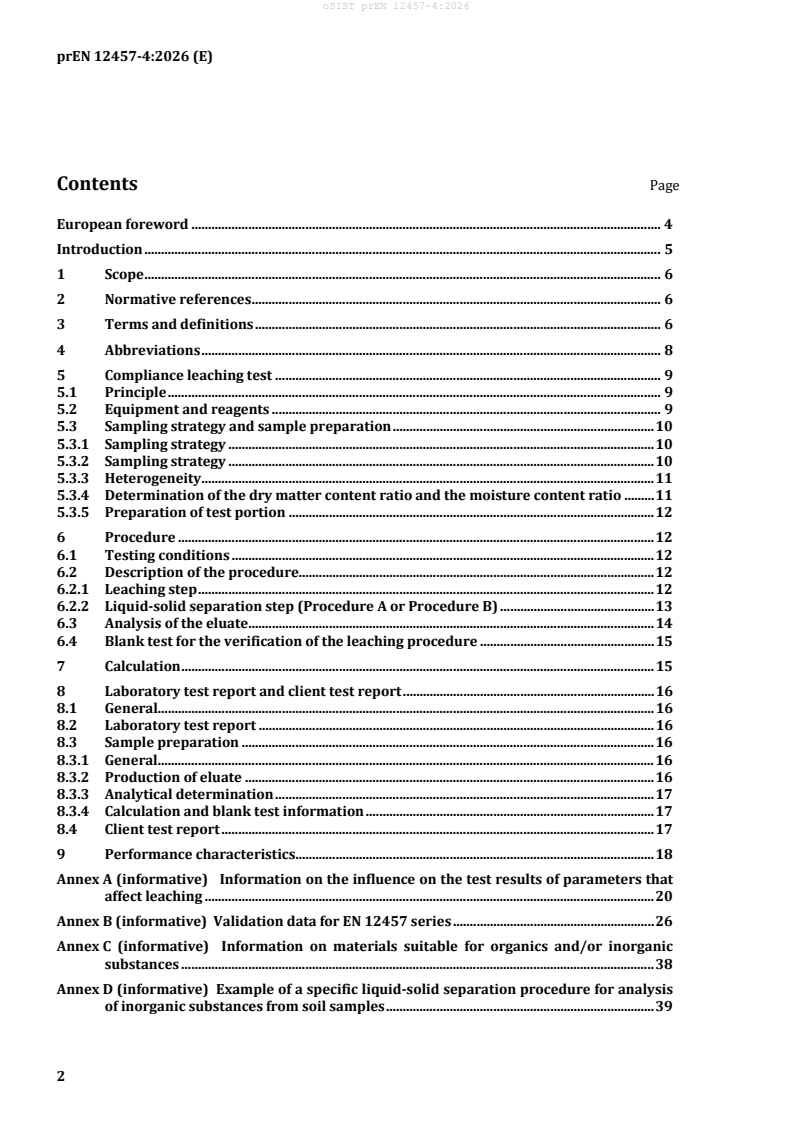
The document is organized into the main clauses for scope, references, terms, abbreviations, the compliance leaching test, procedure, calculation, reporting and performance characteristics.
| Annex | What it covers |
|---|---|
| Annex A | Factors that influence leaching, such as contact time, pH, redox conditions, size reduction, leachant, mixing and temperature |
| Annex B | Validation data for the EN 12457 series and related leaching methods |
| Annex C | Materials suitable for organics, inorganic substances and PFAS in equipment and containers |
| Annex D | Example of a specific liquid-solid separation procedure for inorganic substances from soil samples |
| Annex E | Test for determining whether waste is in the liquid state |
| Annex F | Calculation of centrifugation duration from speed and rotor dimensions |
What are the key requirements of prEN 12457-4:2026?
Sample preparation
prEN 12457-4:2026 requires representative sampling and controlled size reduction before leaching. The laboratory sample is to be large enough for proper splitting, and the test material is to be at least 95 % by mass below 10 mm; any oversized fraction above 5 % is to be crushed, but the material is not to be finely ground. That matters because particle size and fresh fracture surfaces can change what leaches out.
Clause 5.3 also requires non-crushable material, such as metallic pieces, to be separated and recorded. If the laboratory sample is too moist to sieve or crush, drying is allowed only in that case and at no more than 40 °C. This keeps the sample workable without changing it more than necessary.
Dry matter and moisture are measured on a separate portion before the leaching test, using EN ISO 11465:2025. The test portion for leaching is then prepared so that it contains 0.090 kg ± 0.005 kg of dry mass. In practice, this is how the method normalizes results to dry matter and sets the correct liquid volume.
Leaching and liquid-solid separation
Clause 6 requires the test to be run at room temperature, 19 °C to 25 °C, with water as the leachant. The test portion goes into an inert bottle with minimal headspace, and the bottle is rotated at 5 rpm to 10 rpm for 24 h ± 0.5 h. For PFAS only, a 6 h extraction can be used if degradation or other processes do not limit release and the report records that choice.
After leaching, prEN 12457-4:2026 uses two different separation routes. Procedure A is for organic substances, or for both organic and inorganic substances, and it uses centrifugation. Procedure B is for inorganic substances and DOC only, and it uses 0.45 µm filtration. This split matters because DOC measurement and organic analytes are sensitive to how the solid and liquid are separated.
Procedure A allows either 30 min at 20 000 g or 5 h at 2 000 g, with temperature control. Procedure B requires 0.45 µm filtration, and if filtration is too slow, a case-specific liquid-solid separation procedure has to be used and documented, without additives. When volatile substances are being analysed, vacuum filtration is not to be used.
Measurements, blank test and calculation
Clause 6 requires the eluate to be measured for pH and conductivity, and it also calls for turbidity, DOC and redox potential where relevant. These measurements are not just extra data - they help show whether the leaching result is behaving as expected and whether the separation step worked properly.
The document also requires a blank test for the leaching procedure. The blank uses leachant without the solid sample and is checked against the same analytical target substances. The blank is not subtracted from the test result; instead, it is used to confirm that contamination is low enough for the result to be valid.
Clause 7 converts the eluate concentration into a release value per kilogram of dry matter. In practice, this is the number used for comparison with limit values or specification criteria.
Reporting and performance
Clause 8 requires both a laboratory test report and a client test report. The reports need to identify the sample, the sample preparation and size reduction, the leaching setup, the separation method, the measured eluate properties, the analytical report and the blank-test information. That makes the result traceable and lets a client understand any deviations from the standard procedure.
Clause 9 gives indicative precision data from validation work. The performance section is a reminder that repeatability and reproducibility depend on the substance, the matrix and the degree of heterogeneity, so results from more difficult materials may vary more than the typical values.
What terms does prEN 12457-4:2026 define?
- Leaching test - A test in which a material is put in contact with a leachant so that some substances are extracted.
- Leachant - The liquid used for the leaching test; in this document, it is water.
- Eluate - The solution recovered after the leaching test.
- Single batch leaching test - A test where a fixed amount of material is leached in one step with a fixed amount of leachant.
- Liquid to solid ratio (L/S) - The ratio of the total liquid in contact with the waste to the dry mass of the sample, expressed in L/kg.
- Dry matter content ratio (DR) - The percentage ratio between the dry residue mass and the raw mass.
- Moisture content ratio (MC) - The percentage ratio between the water in the material and the dry residue mass.
- Dissolved organic carbon (DOC) - Organic carbon compounds in the eluate that pass a 0.45 µm filter.
Who uses prEN 12457-4:2026?
prEN 12457-4:2026 is used by laboratories that perform compliance leaching tests on waste, soil, sludge and sediments. It is also used by environmental consultants, regulators, waste producers, landfill operators and recycling or remediation organizations that need a pass/fail answer against a reference value.
In practice, these users apply the document to prepare test portions, run the extraction, separate the eluate, measure pH and conductivity, analyse the eluate for inorganic or organic substances, and document the result in a report. The standard is especially relevant where the organization setting the compliance rules needs a defined procedure for comparing different materials in a consistent way.
What changed in prEN 12457-4:2026 from the previous edition?
prEN 12457-4:2026 will supersede EN 12457-4:2002. The foreword states that it has been updated and elaborated on the basis of EN 12457-2:2002 and extended to address the leaching of non-volatile organic substances.
The foreword also says that the validation data used for this draft come from the original validation results for EN 12457-2:2002, corresponding fractions of EPA 1316, and validation results for inorganic and organic substances from DIN 19529. It is also described as having been developed primarily to support compliance testing within EU and EFTA countries.
Which standards are used with prEN 12457-4:2026?
| Standard | What it contributes |
|---|---|
| EN 12457-1, EN 12457-2, EN 12457-3 | The other compliance leaching procedures in the EN 12457 series, with different liquid-to-solid ratios and particle-size conditions |
| EN 12920 | The broader methodology for determining leaching behaviour under specified conditions, used when a full behavioural assessment is needed |
| EN ISO 11465:2025 | Determination of dry residue or water content and calculation of the dry matter fraction |
| EN ISO 5667-3:2018 | Guidance on the preservation and handling of samples and eluates |
| EN 15002 | Preparation of test portions from the laboratory sample |
| CEN/TR 16192 | Guidance on the analysis of eluates |
What does the prEN 12457-4:2026 document contain?
prEN 12457-4:2026 contains the test principle, equipment and reagents, sampling strategy, sample preparation, the leaching step, two liquid-solid separation routes, eluate analysis, blank testing, calculation rules and the reporting requirements for both laboratory and client use. It also includes performance characteristics derived from validation work.
The annexes add practical guidance that users often need in real testing. Annex A explains why results change with pH, redox conditions, leachant choice, agitation and size reduction. Annex B summarizes validation data across waste types and analytes. Annex C helps the user choose suitable container and filter materials for inorganic substances, organic substances and PFAS. Annex D gives an example separation procedure for soil samples, Annex E gives a liquid-state check, and Annex F helps calculate centrifugation time from rotor geometry and speed.
Relations
- Effective Date
- 01-Jul-2026
Get Certified
Connect with accredited certification bodies for this standard

CIS Institut d.o.o.
Personal Protective Equipment (PPE) certification body. Notified Body NB-2890 for EU Regulation 2016/425 PPE.

Kiwa BDA Testing
Building and construction product certification.
Kmetijski inštitut Slovenije
Agricultural Institute of Slovenia. Soil testing, plant health, agricultural product analysis.
Sponsored listings
Frequently Asked Questions
oSIST prEN 12457-4:2026 is a draft published by the Slovenian Institute for Standardization (SIST). Its full title is "Granular waste materials, sludges, soil, soil-like materials and sediments - Leaching - Compliance test for leaching - Part 4: One-stage batch test a liquid-to-solid ratio of 10L/kg for materials with particle size below 10 mm (with or without size reduction)". This standard covers: This document in the series specifies a compliance test providing information on leaching of granular waste materials, sludges, soil, soil-like materials and sediments under the experimental conditions specified hereafter, and particularly a liquid to solid ratio of 10 L/kg dry matter. It applies to materials which have a particle size below 10 mm without or with size reduction. This document has been developed to investigate the leaching of inorganic and non-volatile organic substances from granular waste materials, sludges, soil, soil-like materials and sediments. It does not take into account the consequences of microbiological processes in organic degradable materials. The test procedure specified in this document produces an eluate which is subsequently characterized physically and chemically according to appropriate standard methods. This document includes two different procedures for eluate preparation prior to analysis, one procedure for non-volatile organic substances, inorganic substances and DOC and one for inorganic substances and DOC. When assessing only the leaching of inorganic substances and DOC, certain precautions needed when assessing the leaching of organic substances can in some cases be omitted. This procedure cannot be applied to materials with a water content or such a water affinity that a good mixing of the solid with the predetermined quantity of liquid is not achievable. This procedure does not apply to materials reacting with the leachant, leading, for example, to excessive gas emission, a solidifying effect or an excessive heat release. In that case, the material can be wetted prior to carrying out the leaching test. This test cannot be used alone to determine the leaching behaviour of granular waste materials, sludges, soil, soil-like materials and sediments, as specified in EN 12920. This document does not address issues related to health and safety.
This document in the series specifies a compliance test providing information on leaching of granular waste materials, sludges, soil, soil-like materials and sediments under the experimental conditions specified hereafter, and particularly a liquid to solid ratio of 10 L/kg dry matter. It applies to materials which have a particle size below 10 mm without or with size reduction. This document has been developed to investigate the leaching of inorganic and non-volatile organic substances from granular waste materials, sludges, soil, soil-like materials and sediments. It does not take into account the consequences of microbiological processes in organic degradable materials. The test procedure specified in this document produces an eluate which is subsequently characterized physically and chemically according to appropriate standard methods. This document includes two different procedures for eluate preparation prior to analysis, one procedure for non-volatile organic substances, inorganic substances and DOC and one for inorganic substances and DOC. When assessing only the leaching of inorganic substances and DOC, certain precautions needed when assessing the leaching of organic substances can in some cases be omitted. This procedure cannot be applied to materials with a water content or such a water affinity that a good mixing of the solid with the predetermined quantity of liquid is not achievable. This procedure does not apply to materials reacting with the leachant, leading, for example, to excessive gas emission, a solidifying effect or an excessive heat release. In that case, the material can be wetted prior to carrying out the leaching test. This test cannot be used alone to determine the leaching behaviour of granular waste materials, sludges, soil, soil-like materials and sediments, as specified in EN 12920. This document does not address issues related to health and safety.
oSIST prEN 12457-4:2026 is classified under the following ICS (International Classification for Standards) categories: 13.030.10 - Solid wastes; 13.030.20 - Liquid wastes. Sludge. The ICS classification helps identify the subject area and facilitates finding related standards.
oSIST prEN 12457-4:2026 has the following relationships with other standards: It is inter standard links to SIST EN 12457-4:2004. Understanding these relationships helps ensure you are using the most current and applicable version of the standard.
oSIST prEN 12457-4:2026 is associated with the following European legislation: EU Directives/Regulations: 99/31/EC. When a standard is cited in the Official Journal of the European Union, products manufactured in conformity with it benefit from a presumption of conformity with the essential requirements of the corresponding EU directive or regulation.
oSIST prEN 12457-4:2026 is available in PDF format for immediate download after purchase. The document can be added to your cart and obtained through the secure checkout process. Digital delivery ensures instant access to the complete standard document.
Standards Content (Sample)
Contents
- Introduction
- 1 Scope
- 2 Normative references
- 3 Terms and definitions
- 3.1 leaching test
- 3.2 leachant
- 3.3 eluate
- 3.4 single batch leaching test
- 3.5 serial batch leaching test
- 3.6 liquid to solid ratio
- 3.7 liquid waste
- 3.8 sludge
- 3.9 monolithic waste
- 3.10 granular waste
- 3.11 dry matter content ratio
- 3.12 moisture content ratio
- 3.13 laboratory sample
- 3.14 test sample
- 3.15 test portion
- 4 Abbreviations
- 5 Compliance leaching test
- 5.1 Principle
- 5.2 Equipment and reagents
- 5.3 Sampling strategy and sample preparation
- 6 Procedure
- 6.1 Testing conditions
- 6.2 Description of the procedure
- 6.3 Analysis of the eluate
- 6.4 Blank test for the verification of the leaching procedure
- 7 Calculation
- 8 Laboratory test report and client test report
- 8.1 General
- 8.2 Laboratory test report
- 8.3 Sample preparation
- 8.4 Client test report
- 9 Performance characteristics
- Annex A
- Annex B
- Annex C
- Annex D
- Annex E
- Annex F
- Bibliography
Introduction
In the different European countries, tests have been developed to characterize and assess the substances which can be leached from granular waste materials, sludges, soil, soil-like materials and sediments. The release of soluble substances upon contact with water is regarded as a main mechanism of release which results in a potential risk to the environment during the reuse or disposal of soil, soil-like materials, sediments, granular waste materials and sludges. The intent of these tests is to identify the leaching properties of these materials. The complexity of the leaching process makes simplifications necessary. Not all of the relevant aspects of leaching behaviour can be addressed in one document. Tests to characterize waste materials and their behaviour can generally be divided into three categories:
a) “Basic Characterisation” tests are used to obtain information on the short and long term leaching behaviour and characteristics properties of waste materials, sludges, soil, soil-like materials and sediments. Liquid/solid (L/S) ratios, leachant composition, factors controlling leachability such as pH, redox potential, complexing capacity and physical parameters are addressed in these tests; b) “Compliance” tests are used to determine whether the granular waste materials, sludges, soil, soillike materials and sediments comply with specific reference values. The tests focus on key variables and leaching behaviour identified by basic characterization tests; c) “On-site verification” tests are used as a rapid check to confirm that the granular waste materials, sludges, soil, soil-like materials and sediments are the same as that which has been subjected to the compliance test(s).
The procedure described in this document falls in category 2: compliance tests. This document constitutes one of the four compliance leaching test procedures described below. The four European Standards are based on different liquid to solid (L/S) ratios and different particle sizes because these parameters, among others, play an important role in the leaching process:
- EN 12457-1, One stage batch test at a liquid to solid ratio of 2 l/kg for materials with high solid content and with particle size below 4 mm (without or with size reduction).
- EN 12457-2, One stage batch test at a liquid to solid ratio of 10 l/kg for materials with particle size below 4 mm (without or with size reduction).
- EN 12457-3, Two stage batch test at a liquid to solid ratio of 2 l/kg and 8 l/kg for materials with high solid content and with particle size below 4 mm (without or with size reduction).
- EN 12457-4, One stage batch test at a liquid to solid ratio of 10 l/kg for materials with particle size below 10 mm (without or with size reduction).
Each part specifies a distinct procedure. The specific features of each part are described in the scope and principle of each part. For given granular waste materials, sludges, soil, soil-like materials and sediments the results might be different for the different procedures. The choice of the procedure depends on the degree and type of information required for compliance testing. This choice is made by the organization establishing the compliance requirements.
Annexes A to F give background information on leaching, intercomparison validation results, guidance on materials suitable for inorganic substances, organic substances and PFAS, an example of reporting, and guidance on specific procedures and their limitations.
This document specifies a compliance test. For basic characterization, a methodology for the determination of the leaching behaviour of waste has been developed within CEN/TC 292 (now CEN/TC 444) and formulated in EN 12920, Methodology for the determination of the leaching behaviour of waste under specified conditions.
oSIST prEN 12457-4:2026 prEN 12457-4:2026 (E)
1 Scope
This document in the series specifies a compliance test providing information on leaching of granular waste materials, sludges, soil, soil-like materials and sediments under the experimental conditions specified hereafter, and particularly a liquid to solid ratio of 10 L/kg dry matter. It applies to materials which have a particle size below 10 mm without or with size reduction. This document has been developed to investigate the leaching of inorganic and non-volatile organic substances from granular waste materials, sludges, soil, soil-like materials and sediments. It does not take into account the consequences of microbiological processes in organic degradable materials. The test procedure specified in this document produces an eluate which is subsequently characterized physically and chemically according to appropriate standard methods. This document includes two different procedures for eluate preparation prior to analysis, one procedure for non-volatile organic substances, inorganic substances and DOC and one for inorganic substances and DOC. When assessing only the leaching of inorganic substances and DOC, certain precautions needed when assessing the leaching of organic substances can in some cases be omitted.
This procedure cannot be applied to materials with a water content or such a water affinity that a good mixing of the solid with the predetermined quantity of liquid is not achievable. This procedure does not apply to materials reacting with the leachant, leading, for example, to excessive gas emission, a solidifying effect or an excessive heat release. In that case, the material can be wetted prior to carrying out the leaching test.
This test cannot be used alone to determine the leaching behaviour of granular waste materials, sludges, soil, soil-like materials and sediments, as specified in EN 12920. This document does not address issues related to health and safety.
2 Normative references
The following documents are referred to in the text in such a way that some or all of their content constitutes requirements of this document. For dated references, only the edition cited applies. For undated references, the latest edition of the referenced document (including any amendments) applies. EN ISO 11465:2025, Sludge and solid environmental matrices - Determination of dry residue or water content and calculation of the dry matter fraction on a mass basis (ISO 11465:2025)
3 Terms and definitions
For the purposes of this document, the following terms and definitions apply. ISO and IEC maintain terminology databases for use in standardization at the following addresses:
- ISO Online browsing platform: available at https://www.iso.org/obp/
- IEC Electropedia: available at https://www.electropedia.org/
3.1 leaching test
test during which a material is put into contact with a leachant and some substances of the material are extracted
3.2 leachant
liquid used in a leaching test
oSIST prEN 12457-4:2026 prEN 12457-4:2026 (E) Note 1 to entry For the purpose of this document, the leachant is water as specified in 5.2.15
3.3 eluate
solution recovered from a leaching test
3.4 single batch leaching test
leaching test in which a fixed amount of material is leached in one step with a fixed amount of leachant
3.5 serial batch leaching test
leaching test for two or more subsequent extractions of the same portion of material with a fresh amount of leachant in each extraction
3.6 liquid to solid ratio
(L/S) ratio between the total amount of liquid (L in litres), which in a leaching test is in contact with the waste, and the dry mass of the sample (S in kg of dry matter) abbreviated L/S and expressed in L/kg
3.7 liquid waste
waste that completely flows out of a calibrated opening, down to the upper level of the opening within a limited period of time less than 8 hours (See Annex E, informative)
3.8 sludge
mixture of liquid and solids separated from various types of liquids as a result of natural or artificial processes Note 1 to entry In the field of water treatment, the prevailing standards (EN 1085 and EN 12880) use the word water instead of the word liquid.
3.9 monolithic waste
material which has certain minimum dimensions and physical and mechanical properties that ensure its integrity over a certain period of time
3.10 granular waste
waste that is neither monolithic, liquid, gas nor sludge
3.11 dry matter content ratio
DR ratio expressed in percent between the mass of the dry residue, determined according to EN ISO 11465:2025 for sludge, treated biowaste, soil and waste, and the corresponding raw mass
3.12 moisture content ratio
MC ratio expressed in percent between the mass of water contained in the material and the mass of the dry residue
oSIST prEN 12457-4:2026 prEN 12457-4:2026 (E) Note 1 to entry The basis for the calculation of the moisture content is the mass of the dry residue in this document. It is to be noted that in the context of environmental assessment, the water content is generally calculated on the basis of the raw mass.
3.13 laboratory sample
sample or sub-sample(s) sent to or received by the laboratory Note 1 to entry When the laboratory sample is further prepared (reduced) by subdividing, mixing, grinding or by combinations of these operations, the result is the test sample. When no preparation of the laboratory sample is required, the laboratory sample is the test sample. A test portion is removed from the test sample for the performance of the test or for analysis. The laboratory sample is the final sample from the point of view of sample collection, but it is the initial sample from the point of view of the laboratory. See EN 15002: 2015. Note 2 to entry Several laboratory samples can be prepared and sent to different laboratories or to the same laboratory for different purposes. When sent to the same laboratory, the set is generally considered as a single laboratory sample and is documented as a single sample.
[SOURCE: IUPAC]
3.14 test sample
sample, prepared from the laboratory sample, from which test portions are removed for testing or for analysis [SOURCE: IUPAC]
3.15 test portion
amount or volume of the test sample taken for analysis, usually of known weight or volume [SOURCE: IUPAC]
4 Abbreviations
DOC dissolved organic carbon FEP fluorinated ethylene propylene PA polyamide PAH polycyclic aromatic hydrocarbon PCB polychlorinated biphenyl PE polyethylene PFAS per- and polyfluoroalkyl substances PFA perfluoroalkoxy alkanes PP polypropylene PTFE polytetrafluorethylene PCTFE polychlorotrifluoroethylene HDPE high density polyethylene
oSIST prEN 12457-4:2026 prEN 12457-4:2026 (E)
5 Compliance leaching test
5.1 Principle
The sample material, which originally or after pre-treatment has a particle size at least below 4 mm as defined in Clause 4.3.2, is brought into contact with water (Clause 5.2.15) under defined conditions. The test equipment material is selected to ensure that it does not interfere with the leaching of the substances to be assessed. This document is based on the assumption that equilibrium or near-equilibrium is achieved between the liquid and solid phases during the test duration (see Clause 6.2.1). The eluate is separated from the solid residue either by centrifugation (Procedure A for measurement of non-volatile organic substances or both organic substances and inorganic substances) or by filtration (Procedure B for inorganic substances and DOC). The properties of the eluate are measured using methods developed for water analysis adapted to meet criteria for analysis of eluates (see CEN/TR 16192:2020). After the test the leaching conditions in terms of pH, conductivity, turbidity and optionally redox potential dictated by the waste are recorded.
NOTE These parameters often control the leaching behaviour of wastes and are therefore important for checking the leaching test.
5.2 Equipment and reagents
5.2.1 Containers of inert material that does not interfere with the substances to be measured in
accordance with EN ISO 5667-3. Rinsing is compulsory. Further information for materials suitable for organics and/or inorganics can be found in Annex C [Table C.1]. The volume of 1 l is selected in combination with the mass M of 90 g as specified in Clause 4.3.4 in order D to minimize head space. In case of material with low density, deviation from this requirement is necessary while still attempting to minimize headspace. This deviation shall be documented in the test report. 5.2.2 An end-over-end tumbler (5 rpm - 10 rpm) or roller-table inducing eccentric rotation of the bottle at about 10 rpm.
NOTE An eccentric roller-table ensures movement of solid through the leachant in two directions providing the same type of contact as an end-over-end tumbler. Roller tables without additional eccentric movement and horizontal shakers are not considered to provide equivalent agitation modus compared to the end-over-end tumbler.
5.2.3 Filtering apparatus, either a vacuum filtration device (between 30 kPa and 70 kPa) (300 – 700 mbar) or a high-pressure filtration apparatus (<0,5 MPa) (5 bar). Rinsing is compulsory. NOTE A water ejection pump generally operates in the vicinity of 50 kPa. When volatile components (e.g. mercury) are to be analysed, vacuum filtration shall not be used. 5.2.4 Pre-rinsed or similarly clean 0,45 μm membrane filters for filtration (e.g. rinsed with 0,1 mol/l HNO as described in 4.2.16 and water as described in 5.2.15).
Depending on the test requirements, PTFE filter material can be required. Filter made of PTFE are hydrophobic. Before filtration of eluate, they should be wetted using ethanol or methanol provided it doesn't influence the results of analysis.
5.2.5 Crushing equipment: jaw crusher or cutting device.
NOTE Due to crushing, contamination of the sample can occur to an extent which affects the leaching of some substances of concern e.g. cobalt and tungsten from tungsten carbide equipment or chromium, nickel and molybdenum from stainless steel equipment.
oSIST prEN 12457-4:2026 prEN 12457-4:2026 (E) 5.2.6 Sieving equipment with sieves of 10 mm nominal screen size. NOTE Due to sieving, contamination of the sample can occur to an extent which affects the leaching of some substances of concern, e.g. cobalt and tungsten from tungsten carbide equipment or chromium, nickel and molybdenum from stainless steel equipment.
5.2.7 A centrifuge, operating at 20 000 g to 30 000 g using centrifuge tubes of PFA (perfluoroalkoxy alkane), fluorinated ethylene propylene (FEP) or tubes of an alternative material which is inert with regard to the substances to be assessed (see Annex C) and suitable for high-speed centrifugation. NOTE Potential sorption of hydrophobic organic substances to the centrifuge tubes can be tested in preliminary experiments.
Alternatively, if a high-speed centrifuge is not available, a centrifuge operating at 2 000 g to 3 000 g may be used in combination with increased centrifugation time.
Cooling shall be applied if needed to maintain a temperature of 19 °C – 25 °C. 5.2.8 A device for measuring electrical conductivity.
5.2.9 A pH-meter according to EN 16192.
5.2.10 Two thermometers for air and leachant temperature measurement. 5.2.11 A redox potential meter (optional).
5.2.12 A balance with accuracy of at least 0,1 g.
5.2.13 Measuring cylinders for volume determination with 1 % accuracy. 5.2.14 A sample splitter or utensils for cone and quartering for sub-sampling of test samples (optional).
5.2.15 Distilled water, demineralized water, de-ionized water or water of equivalent purity
(5 < pH < 7,5) with a conductivity < 0,5 mS/m.
5.2.16 Nitric acid (HNO ) 0,1 mol/l (analytical grade).
5.3 Sampling strategy and sample preparation
5.3.1 Sampling strategy
Obtain a laboratory sample of at least 2 kg of the material. Use a sample splitter (5.2.14) or apply coning and quartering to split the sample into representative sub-samples according to EN 15002). Depending on the maximum grain size, the splitting can require size reduction of coarser particles to comply with the rules of sampling.
In some cases, especially for soil and sediments, a laboratory sample of less than 2 kg may be received by the laboratory e.g. due to limited availability of the material to be tested, provided the material is not too heterogeneous. For other types of solids, a larger sample size shall be required if necessary to take the relationship between maximum particle size and minimum sample volume into account.
5.3.2 Sampling strategy
The tests shall be made on material with a grain size of at least 95 % (mass) less than 10 mm. Therefore, the laboratory sample shall be sieved (Clause 5.2.6). If oversized material exceeds 5 % (mass) the entire oversized fraction shall be crushed with a crushing equipment (Clause 5.2.5). On no account shall the
oSIST prEN 12457-4:2026 prEN 12457-4:2026 (E) material be finely ground. Non-crushable material (e.g. metallic parts such as nuts, bolts, scrap) in the sample shall be separated and the weight and nature of the material shall be recorded. The method of size-reduction applied shall be documented and recorded in the test report. Irrespective of any necessary size reduction, the separate fractions with the exception of the non-crushable material and the material that may be used according to note under Clause 6.4, shall be mixed to constitute the test sample. If the laboratory sample cannot be crushed or sieved because of its moisture content, it is allowed, only in this case, to dry the laboratory sample. The drying temperature shall not exceed 40 C. NOTE 1 Fibrous materials and plastics can often be size-reduced after cryogenic treatment. NOTE 2 Be aware that any drying step can change other properties than the water content of the waste. In order to minimize a possible contamination during sieving, fragmentation and splitting, it is recommended, before preparing the test sample, to process a portion of the laboratory sample through the devices for sieving, fragmentation, splitting, and to discard such material thereafter. This recommendation does not cover the possible contamination described in the notes under Clause 5.2.5 and Clause 5.2.6.
NOTE 3 Important differences can occur in the leaching test results for a given material depending on the crushing procedure and the waste material being crushed. Particle size related differences can be made evident by determining the particle size distribution. Please note that in the case of very narrow size distribution, such differences in the leaching result might be enhanced especially in the upper part of the size range. As an example:
crushing creates new surfaces, which, when exposed, can lead to a change in leaching properties.
5.3.3 Heterogeneity
Some materials prove to be inherently heterogeneous, which means that in spite of all reasonable preparatory steps, the within-laboratory variability extends well beyond the specified performance as indicated in the standard. In a single step test, this aspect cannot be identified. NOTE Carrying out a duplicate or triplicate test for such potentially heterogeneous materials will provide insight in the level of inherent heterogeneity. As a guide: when the within-laboratory variability exceeds about two times the within-laboratory variability as specified in the document (RSDr > 20 %), the material can be considered heterogeneous.
A list of examples of materials known to exhibit this type of characteristic can provide the basis to make the decision to test in duplicate, triplicate or other type of decision (see Annex A).
...