

SIST EN 12457-2:2004
(Main)Characterisation of waste - Leaching - Compliance test for leaching of granular waste materials and sludges - Part 2: One stage batch test at a liquid to solid ratio of 10 l/kg for materials with particle size below 4 mm (without or with size reduction)
General Information
- Abstract
This part of the European Standard specifies a compliance test providing information on leaching of granular wastes and sludges under the experimental conditions specified hereafter, and particularly a liquid to solid ratio of 10 l/kg dry matter. It applies to waste which has a particle size below 4 mm without or with size reduction. The test procedure specified in this Standard produces an eluate which shall subsequently be characterised physically and chemically according to appropriate standard methods.
- Status
- Published
- Publication Date
- 31-Dec-2003
- Technical Committee
- KAT - Soil quality
- Current Stage
- 6060 - National Implementation/Publication (Adopted Project)
- Start Date
- 01-Jan-2004
- Due Date
- 01-Jan-2004
- Completion Date
- 01-Jan-2004
- Directive
- 99/31/EC - Landfill of waste

Overview
EN 12457-2:2002 (CEN) is a European compliance standard for the characterisation of waste by leaching. It defines a one‑stage batch leaching test for granular waste materials and sludges using a liquid-to-solid (L/S) ratio of 10 l/kg (dry matter) for materials with particle size below 4 mm (with or without size reduction). The procedure produces an eluate that is then characterised by established physical and chemical analytical methods to assess leaching behaviour under the specified test conditions.
Key topics and technical requirements
- Test principle: single‑step batch contact of waste with water (leachant) under controlled conditions to reach equilibrium or near‑equilibrium between solid and liquid phases.
- L/S ratio: fixed at 10 l/kg (dry matter) for this part.
- Particle size: applicable to wastes with particles < 4 mm, either as sampled or after defined size reduction.
- Sample preparation: sampling strategy, laboratory and test sample definitions, and pre-treatment are specified to ensure representativity.
- Separation and analysis: solid and liquid phases are separated (filtration); the eluate is analysed physically and chemically using referenced analytical methods (e.g., ENV 12506, ENV 13370, EN 12880, ISO 11465).
- Quality assurance: blank tests, documentation, calculations, and performance characteristics (validation and precision) are covered.
- Scope & limitations:
- Primarily developed for inorganic constituents.
- Not designed for non‑polar organic compounds or to account for microbiological degradation processes.
- Not suitable for materials that are liquid by definition, react violently with the leachant, solidify, emit excessive gas, or generate excessive heat.
- Crushing/size reduction may expose fresh surfaces and change leaching behaviour; this is noted in the standard.
Practical applications
- Regulatory compliance: assessing whether waste meets leaching-based acceptance criteria for disposal or reuse.
- Waste classification: supporting decisions on landfill acceptance, recovery or reuse routes.
- Environmental monitoring & risk assessment: providing eluate data for contaminant mobility evaluations.
- Quality control: checking consistency of treated wastes or residues from industrial processes and waste treatment plants.
Who uses this standard
- Environmental testing laboratories and accredited analytical facilities
- Waste management companies and landfill operators
- Environmental consultants and engineers
- Regulatory authorities and compliance auditors
- Research organisations studying contaminant release from wastes
Related standards
- EN 12457 series: Part 1, Part 3, Part 4 (other L/S ratios and particle sizes)
- ENV 12920 (basic characterisation methodology)
- ENV 12506, ENV 13370 (eluate analysis methods)
- EN 12880, ISO 11465 (water/dry matter determination)
Keywords: EN 12457-2:2002, characterisation of waste, leaching test, compliance test, one stage batch test, L/S 10 l/kg, granular waste, sludges, eluate analysis, CEN.
Relations
- Effective Date
- 25-Feb-2026
- Effective Date
- 25-Feb-2026
- Effective Date
- 28-Jan-2026
- Effective Date
- 28-Jan-2026
- Effective Date
- 28-Jan-2026
- Effective Date
- 28-Jan-2026
- Effective Date
- 28-Jan-2026
- Effective Date
- 28-Jan-2026
- Effective Date
- 09-Feb-2026
- Referred By
SIST EN 14735:2022 - Characterization of waste - Preparation of waste samples for ecotoxicity tests - Effective Date
- 28-Jan-2026
- Effective Date
- 28-Jan-2026
- Effective Date
- 28-Jan-2026
- Effective Date
- 28-Jan-2026
- Referred By
SIST EN 14735:2005 - Characterization of waste - Preparation of waste samples for ecotoxicity tests - Effective Date
- 28-Jan-2026
- Effective Date
- 28-Jan-2026
Get Certified
Connect with accredited certification bodies for this standard

CIS Institut d.o.o.
Personal Protective Equipment (PPE) certification body. Notified Body NB-2890 for EU Regulation 2016/425 PPE.

Kiwa BDA Testing
Building and construction product certification.
Kmetijski inštitut Slovenije
Agricultural Institute of Slovenia. Soil testing, plant health, agricultural product analysis.
Sponsored listings
Frequently Asked Questions
SIST EN 12457-2:2004 is a standard published by the Slovenian Institute for Standardization (SIST). Its full title is "Characterisation of waste - Leaching - Compliance test for leaching of granular waste materials and sludges - Part 2: One stage batch test at a liquid to solid ratio of 10 l/kg for materials with particle size below 4 mm (without or with size reduction)". This standard covers: This part of the European Standard specifies a compliance test providing information on leaching of granular wastes and sludges under the experimental conditions specified hereafter, and particularly a liquid to solid ratio of 10 l/kg dry matter. It applies to waste which has a particle size below 4 mm without or with size reduction. The test procedure specified in this Standard produces an eluate which shall subsequently be characterised physically and chemically according to appropriate standard methods.
This part of the European Standard specifies a compliance test providing information on leaching of granular wastes and sludges under the experimental conditions specified hereafter, and particularly a liquid to solid ratio of 10 l/kg dry matter. It applies to waste which has a particle size below 4 mm without or with size reduction. The test procedure specified in this Standard produces an eluate which shall subsequently be characterised physically and chemically according to appropriate standard methods.
SIST EN 12457-2:2004 is classified under the following ICS (International Classification for Standards) categories: 13.030.10 - Solid wastes; 13.030.20 - Liquid wastes. Sludge. The ICS classification helps identify the subject area and facilitates finding related standards.
SIST EN 12457-2:2004 has the following relationships with other standards: It is inter standard links to SIST ISO 11465:1996, SIST ISO 5725-5:2003, SIST-TP CEN/TR 16192:2020, SIST EN 14399-4:2005, SIST EN 24049:2000, SIST EN ISO 5667-3:2024, SIST EN ISO 11465:2026, SIST EN ISO 3696:1998, SIST EN 62561-7:2012, SIST EN 14735:2022, SIST-TS CEN/TS 17883:2023, SIST-TP CEN/TR 16110:2011, SIST EN 16457:2014, SIST EN 14735:2005, SIST-TS CEN/TS 17883:2024. Understanding these relationships helps ensure you are using the most current and applicable version of the standard.
SIST EN 12457-2:2004 is associated with the following European legislation: EU Directives/Regulations: 99/31/EC; Standardization Mandates: M/326. When a standard is cited in the Official Journal of the European Union, products manufactured in conformity with it benefit from a presumption of conformity with the essential requirements of the corresponding EU directive or regulation.
SIST EN 12457-2:2004 is available in PDF format for immediate download after purchase. The document can be added to your cart and obtained through the secure checkout process. Digital delivery ensures instant access to the complete standard document.
Standards Content (Sample)
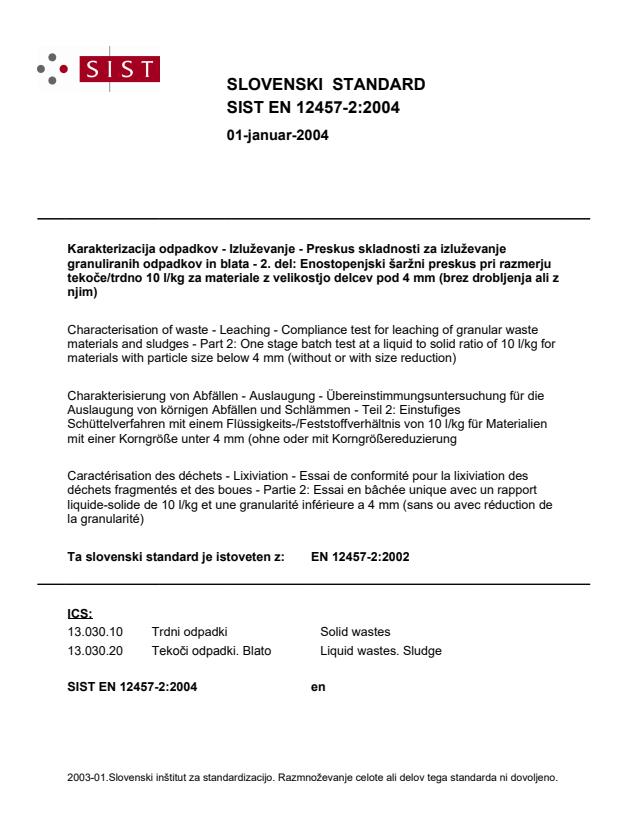
2003-01.Slovenski inštitut za standardizacijo. Razmnoževanje celote ali delov tega standarda ni dovoljeno.OXåHYDQMHQMLPCharakterisierung von Abfällen - Auslaugung - Übereinstimmungsuntersuchung für die Auslaugung von körnigen Abfällen und Schlämmen - Teil 2: Einstufiges Schüttelverfahren mit einem Flüssigkeits-/Feststoffverhältnis von 10 l/kg für Materialien mit einer Korngröße unter 4 mm (ohne oder mit KorngrößereduzierungCaractérisation des déchets - Lixiviation - Essai de conformité pour la lixiviation des déchets fragmentés et des boues - Partie 2: Essai en bâchée unique avec un rapport liquide-solide de 10 l/kg et une granularité inférieure a 4 mm (sans ou avec réduction de la granularité)Characterisation of waste - Leaching - Compliance test for leaching of granular waste materials and sludges - Part 2: One stage batch test at a liquid to solid ratio of 10 l/kg for materials with particle size below 4 mm (without or with size reduction)13.030.20Liquid wastes. Sludge13.030.10Trdni odpadkiSolid wastesICS:Ta slovenski standard je istoveten z:EN 12457-2:2002SIST EN 12457-2:2004en01-januar-2004SIST EN 12457-2:2004SLOVENSKI
STANDARD
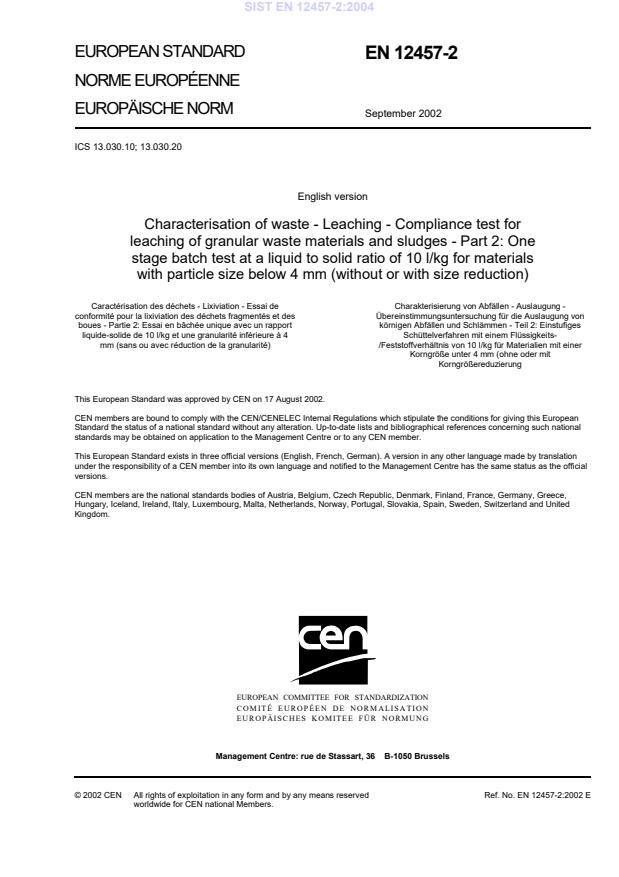
EUROPEAN STANDARDNORME EUROPÉENNEEUROPÄISCHE NORMEN 12457-2September 2002ICS 13.030.10; 13.030.20English versionCharacterisation of waste - Leaching - Compliance test forleaching of granular waste materials and sludges - Part 2: Onestage batch test at a liquid to solid ratio of 10 l/kg for materialswith particle size below 4 mm (without or with size reduction)Caractérisation des déchets - Lixiviation - Essai deconformité pour la lixiviation des déchets fragmentés et desboues - Partie 2: Essai en bâchée unique avec un rapportliquide-solide de 10 l/kg et une granularité inférieure à 4mm (sans ou avec réduction de la granularité)Charakterisierung von Abfällen - Auslaugung -Übereinstimmungsuntersuchung für die Auslaugung vonkörnigen Abfällen und Schlämmen - Teil 2: EinstufigesSchüttelverfahren mit einem Flüssigkeits-/Feststoffverhältnis von 10 l/kg für Materialien mit einerKorngröße unter 4 mm (ohne oder mitKorngrößereduzierungThis European Standard was approved by CEN on 17 August 2002.CEN members are bound to comply with the CEN/CENELEC Internal Regulations which stipulate the conditions for giving this EuropeanStandard the status of a national standard without any alteration. Up-to-date lists and bibliographical references concerning such nationalstandards may be obtained on application to the Management Centre or to any CEN member.This European Standard exists in three official versions (English, French, German). A version in any other language made by translationunder the responsibility of a CEN member into its own language and notified to the Management Centre has the same status as the officialversions.CEN members are the national standards bodies of Austria, Belgium, Czech Republic, Denmark, Finland, France, Germany, Greece,Hungary, Iceland, Ireland, Italy, Luxembourg, Malta, Netherlands, Norway, Portugal, Slovakia, Spain, Sweden, Switzerland and UnitedKingdom.EUROPEAN COMMITTEE FOR STANDARDIZATIONCOMITÉ EUROPÉEN DE NORMALISATIONEUROPÄISCHES KOMITEE FÜR NORMUNGManagement Centre: rue de Stassart, 36
B-1050 Brussels© 2002 CENAll rights of exploitation in any form and by any means reservedworldwide for CEN national Members.Ref. No. EN 12457-2:2002 ESIST EN 12457-2:2004
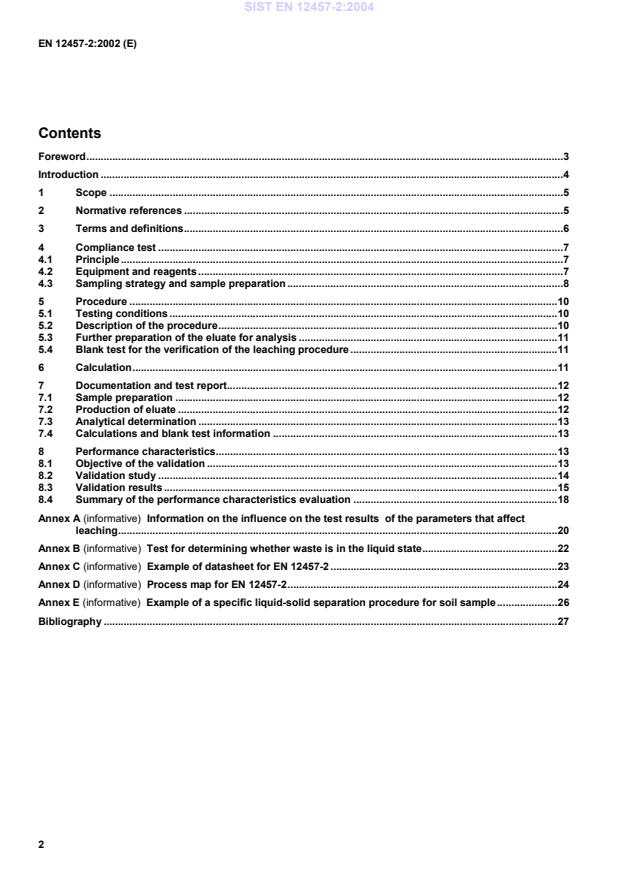
Information on the influence on the test results
of the parameters that affectleaching.20Annex B (informative)
Test for determining whether waste is in the liquid state.22Annex C (informative)
Example of datasheet for EN 12457-2.23Annex D (informative)
Process map for EN 12457-2.24Annex E (informative)
Example of a specific liquid-solid separation procedure for soil sample.26Bibliography.27SIST EN 12457-2:2004
The laboratorysample is the final sample from the point of view of sample collection but it is the initial sample from the point of view of thelaboratory.NOTE 2Several laboratory samples can be prepared and sent to different laboratories or to the same laboratory for differentpurposes.
When sent to the same laboratory, the set is generally considered as a single laboratory sample and is documentedas a single sample.3.14 test samplesample, prepared from the laboratory sample, from which test portions are removed for testing or for analysis( IUPAC definition )3.15 test portionamount or volume of the test sample taken for analysis, usually of known weight or volume ( IUPAC definition )4 Compliance test4.1 PrincipleThe sample material, which originally or after pre-treatment has a particle size below 4 mm as defined in 4.3.2, isbrought into contact with water (4.2.15) under defined conditions. This European Standard is based on theassumption that equilibrium or near-equilibrium is achieved between the liquid and solid phases during the testduration (see 5.2.1). The solid residue is separated by filtration. The properties of the eluate are measured usingmethods developed for water analysis adapted to meet criteria for analysis of eluates (ENV 12506, ENV 13370 andothers under development).After the test the leaching conditions in terms of pH, conductivity and optionally redox potential dictated by thewaste are recorded.NOTEThese parameters often control the leaching behaviour of wastes and are therefore important for checking theleaching test.4.2 Equipment and reagents4.2.1Glass or high density polyethylene(HDPE)/polypropylene(PP) bottles in accordance with EN ISO 5667-3,with a nominal volume of 1 litre, glass bottles having caps of inert material, for example PTFE(polytetrafluoroethylene). Rinsing is compulsory.NOTE 1For inorganic constituents HDPE/PP bottles are preferred, except for samples analysed for mercury.NOTE 2The volume of 1 litre is selected in combination with the mass MD of 90 gram as specified in 4.3.4 in order tominimise head space. In case of material with low density, deviation from this requirement can be necessary while stillattempting to minimise headspace. This deviation should be documented in the test report.4.2.2An end-over-end tumbler (5 rpm - 10 rpm) or roller-table inducing rotation of the bottle at about 10 rpm.SIST EN 12457-2:2004
5 °C according to ISO 11465 or for sludges according to EN 12880. Thisdetermination shall be made in parallel on a test portion different from the test portion for leaching. The dry mattercontent ratio is calculated as follows :DR = 100
MD/MW(1)whereDRis the dry matter content ratio (%) ;MDis the mass of the dried test portion (kg) ;Mwis the mass of undried test portion (kg).The moisture content ratio (MC in %) is calculated as follows :MC = 100
(MW - MD)/MD(2)NOTE 1The basis for the calculation of the moisture content is the mass of the dry residue in this European Standard, asspecified in ISO 11465 (for the determination of the water content of soil). It is to be noted that in EN 12880 (for thedetermination of water content of sludges), the water content is calculated on the basis of the raw mass.NOTE 2The above moisture content determination could be not accurate enough in some cases (e.g. large amount ofvolatile or unstable compounds). In such cases a direct determination of the true water content should be performed and themoisture content calculated accordingly.4.3.4 Preparation of test portionPrepare from the test sample a test portion with a total mass MW (measured with an accuracy of 0,1 g) containing0,090 kg
0,005 kg of dry mass (MD). Use a sample splitter (4.2.14) or apply coning and quartering to split thesample.MW = 100
MD/DR(3)SIST EN 12457-2:2004
5) °C.5.2 Description of the procedure5.2.1 Leaching step Place the test portion with the total mass Mw corresponding to 0,090 kg
0,005 kg of dry mass MD in a bottle(4.2.1). Add an amount of leachant (L) establishing a liquid to solid ratio (L/S) = 10 l/kg
2 % during the extraction.Care should be taken to obtain good mixing of solid and liquid.L = (10 – MC/100 )
MD(4)WhereLis the volume of leachant used (in l) ;MDis the dry mass of the test portion (in kg) ;MCis the moisture content ratio (in %). Place the capped bottle in an agitation device (4.2.2). Agitate for 24 h
0,5 h. During the extraction care should be taken to prevent settlement of solids in the bottle. Excessive abrasion leading to significant particle size reduction shall be avoided.NOTESome wastes generate gas when they are wetted. Examples are waste incineration fly ash and sand blasting wastewhich may contain metallic particles. If gas emission occurs, careful opening of the bottle a few times during the leaching canprevent too high pressure. Such opening should be documented in the test report.5.2.2 Liquid-solid separation step Allow the suspended solids to settle for 15 min
5 min. Filter the eluate almost completely over a 0,45 µm membrane filter using a vacuum or pressure filtration device(4.2.3). Rinsing of the filter with water or another solvent is not allowed after filtration.SIST EN 12457-2:2004
75 mS/cm) are leached, acidification of the eluatescan lead to precipitation of salts. This can be avoided by diluting such samples 5 to 10 times prior to acidification. This additionaldilution should be taken into account in the calculations. A quantity of the undiluted sample should be acidified and retained incase the 5 to 10 dilution takes the sample below the detection limit for some determinands. Such procedure should bedocumented in the test report.5.4 Blank test for the verification of the leaching procedureBlank tests shall be carried out. A 0,95 litre volume of leachant is submitted to the whole procedure (except thesieving step, the fragmentation step and the splitting step but including the eluate analysis step).The eluate of this blank test shall fulfill the following minimum requirements : in the eluate of the blank test, theconcentration of each considered element shall be less than 20 % of the concentration determined in the eluate ofthe tested waste or less than 20 % of the concentration in the eluate of a limit value to which the measurementresult is to be compared. The elements to be considered are all the elements which are to be determined in theeluate of the tested waste.If the above requirements are not fulfilled, it is necessary to reduce the contamination.The blank test results shall not be substracted from the results of the waste leaching test.NOTEThe above provisions for the blank test do not take into account the sieving step, the fragmentation step and thesplitting step. In order to minimise the possible contamination during these three steps, it is recommended to process a portionof the laboratory sample through the sieving device, the fragmentation device and through the splitting device before thepreparation of the test sample and to discard such material thereafter. This provision does not cover the situation described inthe notes under 4.2.5 and 4.2.6.6 CalculationThe analysis of the eluate(s) produced by the leaching test provides the concentrations of the constituents in theeluate(s), expressed in mg/l. The final results are expressed as the amount of constituent leached relative to thetotal mass of the sample, in mg/kg of dry matter.SIST EN 12457-2:2004
[(L/MD) + (MC/100)](5)WhereAis the release of a constituent at a L/S = 10 (in mg/kg of dry matter) ;Cis the concentration of a particular constituent in the eluate (in mg/l) (5.3.2) ;Lis the volume of leachant used (in l) ;MCis the moisture content ratio as defined in 3.12, expressed as a percentage of the drymass (4.3.2) andcalculated as in 4.3.3 ;MDis the dry mass of the test portion (in kg) (4.3.4).7 Documentation and test reportIn order to comply with this European Standard, the following information shall be documented in such a way thatthey are immediately available on request. In the following list, at least, the items marked with an asterisk (*) shallbe included in the test report. All the deviation from the minimum requirements of this European Standard shall alsobe documented in the test report7.1 Sample preparation reference to this European Standard* ; nature of the waste (e.g. granular waste, sludge)* ; reference of the laboratory sample* and of the accompanying documents* stipulated in the sampling standard ; date of reception in the laboratory of the laboratory sample* ; address of the laboratory and name(s) of the responsible person(s)* ; mass of the laboratory sample* ; date of the preparation of the test portion for the determination of the dry matter content ratio ; date of the preparation of the test portion for the leaching test ; storage conditions between the three above dates ; description of the preparation of the test portion with references to the paragraphs of this European Standardespecially : method of size reduction*, including the eventual drying, when required, fraction above 4 mm*,fraction of non-crushable material*, mode of splitting ; storage conditions between preparation of the test portion and the implementation of the leaching test.7.2 Production of eluate raw mass MW (kg) of the test portion* ; moisture content ratio MC (%) of the waste material* ; address of the laboratory and name(s) of the responsible person(s)* ;SIST EN 12457-2:2004
preparation of the testportion from the laboratory sample
before the leaching test); the leaching test itself and the experimental parameter variations as allowed by the tolerances;SIST EN 12457-2:2004
In the validation work of parts 1 and 3, only a selection from these 7 wastes were tested (detailedinformation can be found in the final report on the Validation study mentioned in the Bibliography).In the validation study the following starting points were used: The laboratory samples were all taken from one large batch of the different wastes according to the normalpractice. The normal size reduction and the normal repeated mixing were carried out as needed to obtainrepresentative laboratory samples from the large batch sample. However in the case of metallurgical slag, aseparate laboratory sample was provided to assess the difference between size reduction down to 4 mmperformed in the laboratory and size reduction down to 4 mm performed in the course of the preparation of thelaboratory samples. The experimental plan was designed by CEN/TC 292 WG 2 on the basis of each laboratory being given twolaboratory samples of each waste to be tested. This is in accordance with ISO 5725-5:1998, clause 5 dedicatedto heterogeneous material (e.g. sand or aggregate samples etc.). However, in order to verify the contribution ofthe analysis of the eluate to the overall variability of the leaching test, the participating laboratories were askedto perform a single complete leaching test on each laboratory sample and to analyse the eluates in duplicate. The wastes examined cover all the grain size classes to which the compliance leaching test applies: powderedwastes and sludges (0 µm to about 125 µm), fine-grained materials (0 mm to 4 mm) and coarse-grainedmaterials (0 mm to greater than 4 mm) after the required size reduction. Not only was testing carried out on familiar waste/component combinations (where considerable experiencewith the testing procedure has already been reported in the technical literature) but also on less familiar andpotentially difficult waste-component combinations. Wastes were chosen in this latter category where it wasexpected that one or more of the requirements would not be easily fulfilled (for example heterogeneity inmetallurgical slag, biological instability of sewage sludge). These combinations were applied in the validationtrial to give insight into the level of uncertainty that might arise for these matrices.Table 1 provides a list of the waste types chosen for testing and the selected components.SIST EN 12457-2:2004
EWC 19 01 05Sewage sludge (SEW)
EWC 19 08 05Contaminated soil (COS)
EWC 17 05 03Chemical sludge (CHS)
EWC 06 05 02Sand blasting waste (SBW)
EWC 12 01 16Incinerator bottom ash (MBA)
EWC 19 01 11Metallurgical slag (MES)
EWC 10 04 01 F, Cl, NO2*, Ba, Cr VICo, Ni, NH4*, TOC, SO4As, Pb, Co, Cd, NiCr VI, Cr, F*, Cl, Cd*Ba, Cu*, Mo F, ZnBa, Cu, Mo, Sb, SO4 2-Sb, Ba, B, As* , PbaThe components marked with * were analysed but were not included in the determination of the test performancecharacteristics for reasons justified in Table 2.8.3 Validation resultsThe statistical evaluation was conducted according to ISO 5725-5:1998, clause6 providing "robust methods fordata analysis": The average values, the repeatability standard deviation (sr test) and the reproducibility standarddeviation (sR) were obtained (Table 2). In order to compare and contrast the contribution of the analysis of theeluate to the overall uncertainty in the leaching test, Table 2 lists the repeatability standard deviation for the eluateanalysis sr,anal as obtained in the validation study.The repeatability is determined as an interval around a measurement result (i.e. "repeatability limit"). This intervalcorresponds to the maximum difference that can be expected
(with a 95% statistical confidence) between one testresult and another, both test results being obtained under the following conditions : The tests are performed inaccordance with all the requirements of the present standard by the same laboratory using its own facilities andtesting laboratory samples obtained from the same primary field sample and prepared under identical procedures.The repeatability limit was calculated using the relationship
:
r test = f
s r,test with the critical range factor f = 2.For instance, for the first line of Table 2, the repeatability limit around a measurement result of4,69 mg As/kg is ± 0,49 mg As/kg (i.e. ± 10,4 % of 4,69)NOTE 1The above relationship refers to the difference that may be found between two measurement results performed eachon two laboratory samples obtained under the same conditions. The value
f = 2 used in the factor f
2 corresponds to thetheoretical factor of 1,96 for a pure normal distribution at 95 % statistical confidence. Also, this value f = 2 corresponds to theusual value k = 2 of the coverage factor recommended in the Guide to the expression of Uncertainty in Measurement (GUM).However it can be necessary to use a larger value for f in situation as described below in 8.3 and 8.4.The reproducibility, like repeatibility is also determined as an interval around a measurement result (i.e."reproducibility limit"). This interval corresponds to the maximum difference that can be expected
(with a 95%statistical confidence) between one test result and another test result obtained by another laboratory, both testresults being obtained under the following conditions : The tests are performed in accordance with all therequirements of the present standard by two different laboratories using their own facilities and testing laboratorysamples obtained from the same primary field sample and prepared under identical procedures.The reproducibility limit was calculated using the relationship :
R = f
sR with the critical range factor f = 2.SIST EN 12457-2:2004
is ± 3,85 mg As/kg (i.e. ± 82,0 % of 4,69)NOTE 2The above relation
...