

oSIST prEN 12457-3:2026
(Main)Granular waste materials, sludges, soil, soil-like materials and sediments - Leaching - Compliance test for leaching - Part 3: Two-stage batch test at a liquid-to-solid ratio of 2 L/kg and 8 L/kg for materials with high solid content and with particle size below 4 mm (with or without size reduction)
- Abstract
This document in the series specifies a compliance test providing information on leaching of granular waste materials, sludges, soil, soil-like materials and sediments under the experimental conditions specified hereafter, and particularly a liquid to solid ratio of 2 L/kg dry matter in a first step and subsequently of 8 L/kg dry matter in a second step. It applies to materials which have a particle size below 4 mm without or with size reduction.
This document has been developed to investigate the leaching of inorganic and non-volatile organic substances from granular waste materials, sludges, soil, soil-like materials and sediments. It does not take into account the consequences of microbiological processes in organic degradable materials.
The test procedure specified in this document produces an eluate which is subsequently characterized physically and chemically according to appropriate standard methods. This document includes two different procedures for eluate preparation prior to analysis, one procedure for non-volatile organic substances, inorganic substances and DOC and one for inorganic substances and DOC. When assessing only the leaching of inorganic substances and DOC, certain precautions needed when assessing the leaching of organic substances can in some cases be omitted.
This procedure cannot be applied to materials with a water content or such a water affinity that a good mixing of the solid with the predetermined quantity of liquid is not achievable.
This procedure does not apply to materials reacting with the leachant, leading, for example, to excessive gas emission, a solidifying effect or an excessive heat release. In that case, the material can be wetted prior to carrying out the leaching test.
This test cannot be used alone to determine the leaching behaviour of granular waste materials, sludges, soil, soil-like materials and sediments, as specified in EN 12920.
This document does not address issues related to health and safety.
- Status
- Not Published
- Public Enquiry End Date
- 02-Aug-2026
- Technical Committee
- KAT - Soil quality
- Current Stage
- 4020 - Public enquire (PE) (Adopted Project)
- Start Date
- 04-Jun-2026
- Due Date
- 22-Oct-2026
- Completion Date
- 24-Sep-2026
- Directive
- 99/31/EC - Landfill of waste
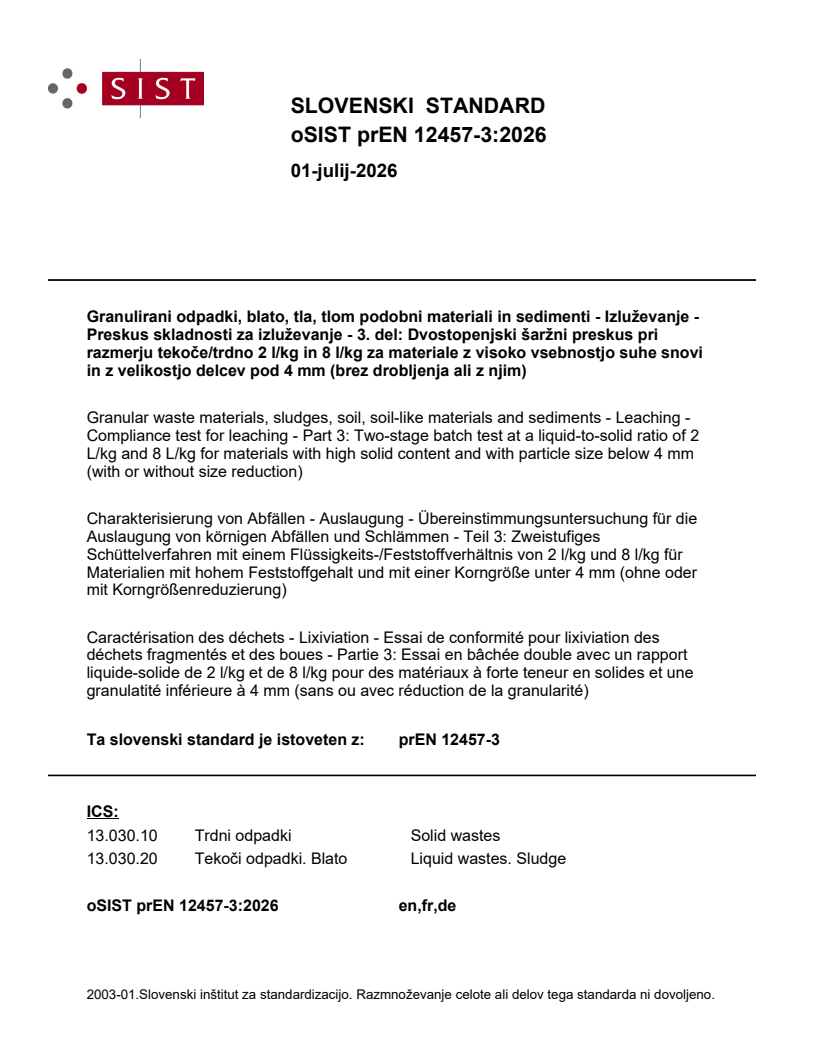
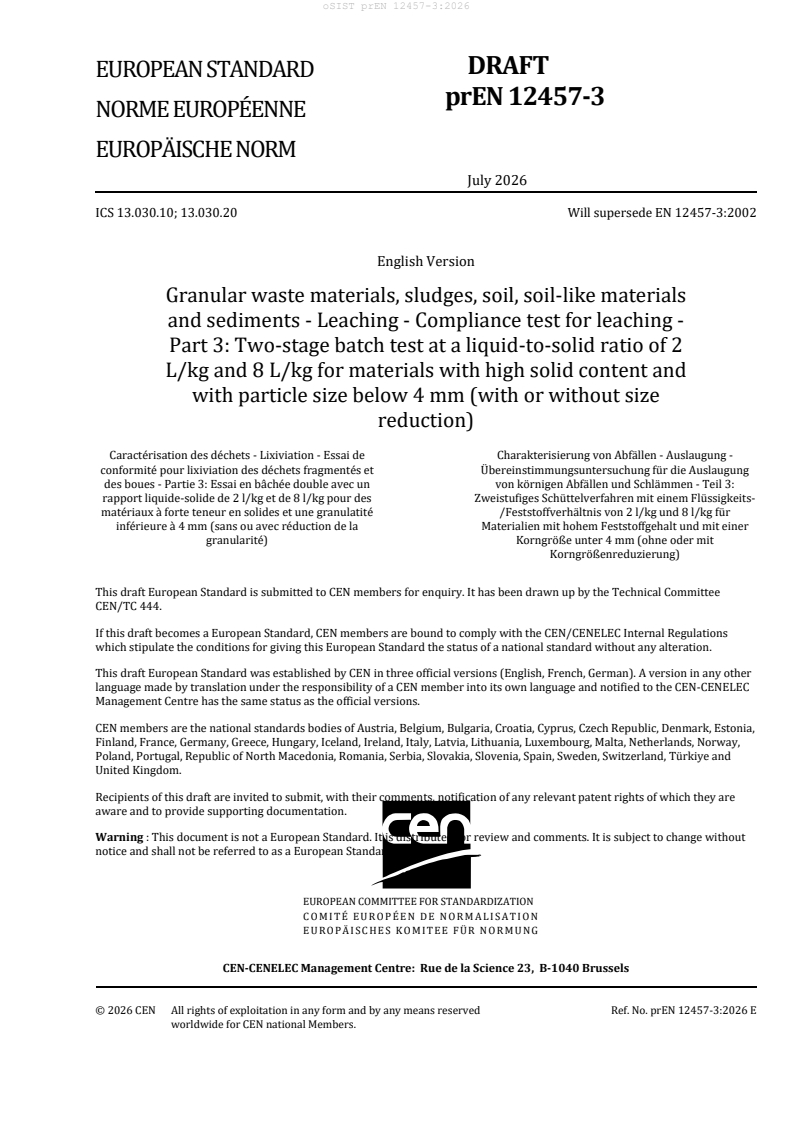
oSIST prEN 12457-3:2026 is the Slovene publication of draft European Standard prEN 12457-3, issued through SIST and CEN for a compliance leaching test on granular waste materials, sludges, soil, soil-like materials and sediments. It specifies a two-stage batch test using water at a liquid to solid ratio (L/S) of 2 L/kg in the first step and 8 L/kg in the second step for materials below 4 mm, with or without size reduction. The test is used to measure leaching of inorganic substances, non-volatile organic substances and dissolved organic carbon (DOC) for compliance decisions.
What does oSIST prEN 12457-3:2026 specify?
oSIST prEN 12457-3:2026 specifies one compliance leaching procedure and the way its eluate is prepared, analysed, calculated and reported. It is a test for comparison with reference values, not a full description of long-term leaching behaviour.
The document is organized into Clauses 1 to 9 and Annexes A to F.
| Annex | What it covers |
|---|---|
| Annex A | Factors that influence leaching and how they affect results |
| Annex B | Validation data for the EN 12457 series |
| Annex C | Materials suitable for organic and/or inorganic substances, including PFAS |
| Annex D | Example of a specific liquid-solid separation procedure for soil samples |
| Annex E | Test for determining whether waste is in the liquid state |
| Annex F | Calculations for centrifugation duration and rotor conditions |
The scope limits the method to materials that can be mixed properly with the set volume of water and that do not react with the leachant in a way that causes excessive gas, heat or solidification. It also states that the test is not sufficient on its own to determine leaching behaviour as described in EN 12920, and it does not address health and safety issues.
What are the key requirements of oSIST prEN 12457-3:2026?
oSIST prEN 12457-3:2026 focuses on controlled sample preparation, a defined two-step extraction, and documented separation and analysis. In practice, the result depends strongly on how the sample is reduced, mixed, separated and reported.
Sample preparation and suitability
The standard requires a representative laboratory sample, normally at least 2 kg, and the test material must be at least 95 % below 4 mm by mass. Oversize material above 5 % is crushed, but the material is not to be finely ground.
That matters because crushing can change the surface area and therefore the leaching result. If the sample is too moist to sieve or crush, drying is allowed only as an exception and at a temperature not above 40 °C.
Two-stage leaching
oSIST prEN 12457-3:2026 uses a serial batch leaching test with water as the leachant. The first step runs at L/S = 2 for 24 h at room temperature, and the second step runs at a cumulative L/S = 10 after an additional 18 h.
The procedure assumes near-equilibrium contact between solid and liquid. That means agitation quality, headspace, settling and abrasion control matter, because they influence how much substance enters the eluate.
For PFAS only, the first step can be shortened to 6 h if degradation or other processes do not limit release and the report records this choice.
Separation and eluate preparation
The standard gives two eluate-preparation routes. Procedure A uses centrifugation and is used for organic substances or for combined organic and inorganic analysis; Procedure B uses 0.45 µm filtration and is used for inorganic substances and DOC only.
This distinction matters because DOC measurement under Procedure A needs an extra 0.45 µm filtration step, while Procedure B already meets that condition. The standard also points to suitable container and filter materials in Annex C so that the equipment does not adsorb or release target substances.
Measurements made during the test
The eluate is checked for pH, conductivity and, where relevant, turbidity, DOC and redox potential. These values are not just paperwork - they help confirm whether the leaching test behaved as expected and whether the result may have been affected by pH, colloids or redox conditions.
Clause 6 also requires immediate measurement after separation, and it sets special cautions for volatile substances, alkaline eluates and samples that form a separate organic phase.
Blank test and calculation
A blank test is required to check contamination from the procedure itself. Its eluate must stay below the stated fraction of the waste result or the relevant limit value, and the blank result is not subtracted from the sample result.
Results are reported as substance concentration in the eluate and as release in mg/kg dry matter. The calculations use the dry matter content ratio (DR) and moisture content ratio (MC), so the parallel dry-matter determination is part of the method, not an optional extra.
Reporting and performance
The standard requires both a laboratory report and a client report. They must record the sample identity, preparation, size reduction, leachant volume, separation method, test conditions, measured eluate properties, analytical report details, calculations and deviations from the method.
Clause 9 and Annex B give performance information from validation work. In practice, this tells users that repeatability and reproducibility depend on both the substance and the matrix, especially for heterogeneous materials.
What terms does oSIST prEN 12457-3:2026 define?
oSIST prEN 12457-3:2026 defines the terms used to describe the test material, the extraction liquid and the reported result.
- Leaching test - a test in which a material is contacted with a leachant so that substances are extracted.
- Leachant - the liquid used in the leaching test; here it is water.
- Eluate - the solution recovered from the leaching test and analysed for released substances.
- Single batch leaching test - one extraction of a fixed amount of material with a fixed amount of leachant.
- Serial batch leaching test - two or more successive extractions of the same material with fresh leachant each time.
- Liquid to solid ratio (L/S) - the amount of liquid in contact with the dry mass of the sample, expressed in L/kg.
- Dry matter content ratio (DR) - the dry residue as a percentage of the raw mass.
- Moisture content ratio (MC) - the water in the material as a percentage of the dry residue.
Who uses oSIST prEN 12457-3:2026?
oSIST prEN 12457-3:2026 is used by laboratories that perform compliance leaching tests on waste, soil and sediment matrices. It is also used by organizations that set compliance requirements, because the standard says the choice of procedure depends on the information needed for the decision.
In practice, it supports waste producers, environmental consultants, regulators, and quality or purchasing teams that need a repeatable test for assessing whether a material meets a leaching limit for reuse, disposal or acceptance.
What changed in oSIST prEN 12457-3:2026 from the previous edition?
oSIST prEN 12457-3:2026 will supersede EN 12457-3:2002. The European foreword states that it has been updated and elaborated on the basis of EN 12457-2:2002 and extended to address non-volatile organic substances.
The foreword also says that the validation basis includes original EN 12457-2:2002 results, corresponding EPA 1316 fractions and validation results for inorganic and organic substances from DIN 19529. It was developed primarily to support compliance testing within the EU and EFTA countries.
Which standards are used with oSIST prEN 12457-3:2026?
The only normative reference listed is EN ISO 11465:2025, which provides the dry residue and water content determination used to calculate DR and MC.
Other standards named in the document support adjacent parts of the work:
- EN 15002 - preparation of test portions from the laboratory sample.
- EN ISO 5667-3 - preservation and handling of samples and suitable container guidance.
- CEN/TR 16192 - guidance for analysis of eluates.
- EN 12920 - overall framework for determining leaching behaviour; this compliance test is not a substitute for it.
- EN 12457-1, EN 12457-2 and EN 12457-4 - the other parts of the same leaching-test series, covering different L/S ratios and particle-size conditions.
What does the oSIST prEN 12457-3:2026 document contain?
oSIST prEN 12457-3:2026 contains the full test workflow from sample receipt to reporting. Clause 5 sets out the principle, equipment, reagents and sample preparation; Clause 6 gives the first and second leaching steps, liquid-solid separation and analysis; Clause 7 gives the calculation approach; and Clause 8 gives the reporting content.
It also contains validation and precision information in Clause 9 and Annex B, plus background guidance on leaching factors, material suitability, a soil separation example, a liquid-state check and centrifugation calculations in Annexes A to F. Annex F is especially useful when a laboratory needs to justify a centrifuge speed and time combination instead of using the example settings.
Relations
- Effective Date
- 01-Jul-2026
Get Certified
Connect with accredited certification bodies for this standard

CIS Institut d.o.o.
Personal Protective Equipment (PPE) certification body. Notified Body NB-2890 for EU Regulation 2016/425 PPE.

Kiwa BDA Testing
Building and construction product certification.
Kmetijski inštitut Slovenije
Agricultural Institute of Slovenia. Soil testing, plant health, agricultural product analysis.
Sponsored listings
Frequently Asked Questions
oSIST prEN 12457-3:2026 is a draft published by the Slovenian Institute for Standardization (SIST). Its full title is "Granular waste materials, sludges, soil, soil-like materials and sediments - Leaching - Compliance test for leaching - Part 3: Two-stage batch test at a liquid-to-solid ratio of 2 L/kg and 8 L/kg for materials with high solid content and with particle size below 4 mm (with or without size reduction)". This standard covers: This document in the series specifies a compliance test providing information on leaching of granular waste materials, sludges, soil, soil-like materials and sediments under the experimental conditions specified hereafter, and particularly a liquid to solid ratio of 2 L/kg dry matter in a first step and subsequently of 8 L/kg dry matter in a second step. It applies to materials which have a particle size below 4 mm without or with size reduction. This document has been developed to investigate the leaching of inorganic and non-volatile organic substances from granular waste materials, sludges, soil, soil-like materials and sediments. It does not take into account the consequences of microbiological processes in organic degradable materials. The test procedure specified in this document produces an eluate which is subsequently characterized physically and chemically according to appropriate standard methods. This document includes two different procedures for eluate preparation prior to analysis, one procedure for non-volatile organic substances, inorganic substances and DOC and one for inorganic substances and DOC. When assessing only the leaching of inorganic substances and DOC, certain precautions needed when assessing the leaching of organic substances can in some cases be omitted. This procedure cannot be applied to materials with a water content or such a water affinity that a good mixing of the solid with the predetermined quantity of liquid is not achievable. This procedure does not apply to materials reacting with the leachant, leading, for example, to excessive gas emission, a solidifying effect or an excessive heat release. In that case, the material can be wetted prior to carrying out the leaching test. This test cannot be used alone to determine the leaching behaviour of granular waste materials, sludges, soil, soil-like materials and sediments, as specified in EN 12920. This document does not address issues related to health and safety.
This document in the series specifies a compliance test providing information on leaching of granular waste materials, sludges, soil, soil-like materials and sediments under the experimental conditions specified hereafter, and particularly a liquid to solid ratio of 2 L/kg dry matter in a first step and subsequently of 8 L/kg dry matter in a second step. It applies to materials which have a particle size below 4 mm without or with size reduction. This document has been developed to investigate the leaching of inorganic and non-volatile organic substances from granular waste materials, sludges, soil, soil-like materials and sediments. It does not take into account the consequences of microbiological processes in organic degradable materials. The test procedure specified in this document produces an eluate which is subsequently characterized physically and chemically according to appropriate standard methods. This document includes two different procedures for eluate preparation prior to analysis, one procedure for non-volatile organic substances, inorganic substances and DOC and one for inorganic substances and DOC. When assessing only the leaching of inorganic substances and DOC, certain precautions needed when assessing the leaching of organic substances can in some cases be omitted. This procedure cannot be applied to materials with a water content or such a water affinity that a good mixing of the solid with the predetermined quantity of liquid is not achievable. This procedure does not apply to materials reacting with the leachant, leading, for example, to excessive gas emission, a solidifying effect or an excessive heat release. In that case, the material can be wetted prior to carrying out the leaching test. This test cannot be used alone to determine the leaching behaviour of granular waste materials, sludges, soil, soil-like materials and sediments, as specified in EN 12920. This document does not address issues related to health and safety.
oSIST prEN 12457-3:2026 is classified under the following ICS (International Classification for Standards) categories: 13.030.10 - Solid wastes; 13.030.20 - Liquid wastes. Sludge. The ICS classification helps identify the subject area and facilitates finding related standards.
oSIST prEN 12457-3:2026 has the following relationships with other standards: It is inter standard links to SIST EN 12457-3:2004. Understanding these relationships helps ensure you are using the most current and applicable version of the standard.
oSIST prEN 12457-3:2026 is associated with the following European legislation: EU Directives/Regulations: 99/31/EC. When a standard is cited in the Official Journal of the European Union, products manufactured in conformity with it benefit from a presumption of conformity with the essential requirements of the corresponding EU directive or regulation.
oSIST prEN 12457-3:2026 is available in PDF format for immediate download after purchase. The document can be added to your cart and obtained through the secure checkout process. Digital delivery ensures instant access to the complete standard document.
Standards Content (Sample)
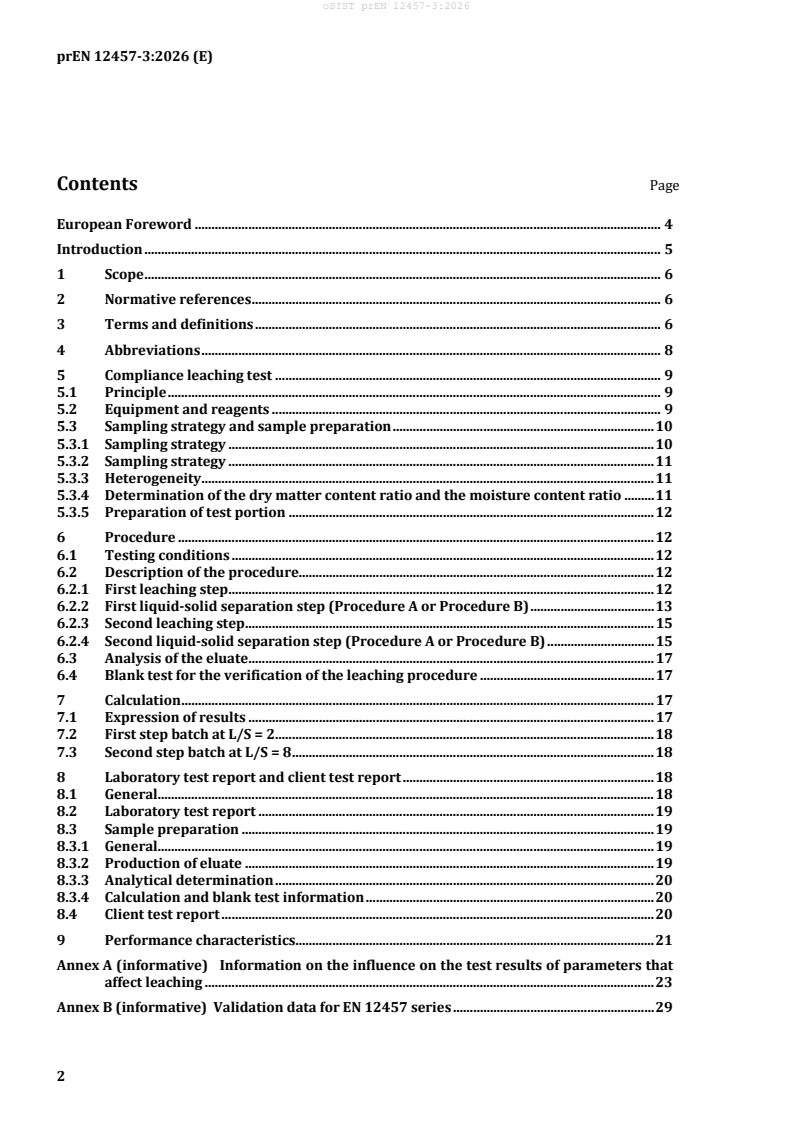
Contents
- Introduction
- 1 Scope
- 2 Normative references
- 3 Terms and definitions
- 3.1 leaching test
- 3.2 leachant
- 3.3 eluate
- 3.4 single batch leaching test
- 3.5 serial batch leaching test
- 3.6 liquid to solid ratio
- 3.7 liquid waste
- 3.8 sludge
- 3.9 monolithic waste
- 3.10 granular waste
- 3.11 dry matter content ratio
- 3.12 moisture content ratio
- 3.13 laboratory sample
- 3.14 test sample
- 3.15 test portion
- 4 Abbreviations
- 5 Compliance leaching test
- 5.1 Principle
- 5.2 Equipment and reagents
- 5.3 Sampling strategy and sample preparation
- 6 Procedure
- 6.1 Testing conditions
- 6.2 Description of the procedure
- 6.3 Analysis of the eluate
- 6.4 Blank test for the verification of the leaching procedure
- 7 Calculation
- 7.1 Expression of results
- 8 Laboratory test report and client test report
- 8.1 General
- 8.2 Laboratory test report
- 8.3 Sample preparation
- 8.4 Client test report
- 9 Performance characteristics
- Annex A
- Annex B
- Annex C
- Annex D
- Annex E
- Annex F
- Bibliography
Introduction
In the different European countries, tests have been developed to characterize and assess the substances which can be leached from granular waste materials, sludges, soil, soil-like materials and sediments. The release of soluble substances upon contact with water is regarded as a main mechanism of release which results in a potential risk to the environment during the reuse or disposal of soil, soil-like materials, sediments, granular waste materials and sludges. The intent of these tests is to identify the leaching properties of these materials. The complexity of the leaching process makes simplifications necessary. Not all of the relevant aspects of leaching behaviour can be addressed in one document. Tests to characterize waste materials and their behaviour can generally be divided into three categories:
a) “Basic Characterisation” tests are used to obtain information on the short and long term leaching behaviour and characteristics properties of waste materials, sludges, soil, soil-like materials and sediments. Liquid/solid (L/S) ratios, leachant composition, factors controlling leachability such as pH, redox potential, complexing capacity and physical parameters are addressed in these tests; b) “Compliance” tests are used to determine whether the granular waste materials, sludges, soil, soillike materials and sediments comply with specific reference values. The tests focus on key variables and leaching behaviour identified by basic characterization tests; c) “On-site verification” tests are used as a rapid check to confirm that the granular waste materials, sludges, soil, soil-like materials and sediments are the same as that which has been subjected to the compliance test(s).
The procedure described in this document falls in category 2: compliance tests. This document constitutes one of the four compliance leaching test procedures described below. The four European Standards are based on different liquid to solid (L/S) ratios and different particle sizes because these parameters, among others, play an important role in the leaching process:
- EN 12457-1, One stage batch test at a liquid to solid ratio of 2 l/kg for materials with high solid content and with particle size below 4 mm (without or with size reduction).
- EN 12457-2, One stage batch test at a liquid to solid ratio of 10 l/kg for materials with particle size below 4 mm (without or with size reduction).
- EN 12457-3, Two stage batch test at a liquid to solid ratio of 2 l/kg and 8 l/kg for materials with high solid content and with particle size below 4 mm (without or with size reduction).
- EN 12457-4, One stage batch test at a liquid to solid ratio of 10 l/kg for materials with particle size below 10 mm (without or with size reduction).
Each part specifies a distinct procedure. The specific features of each part are described in the scope and principle of each part. For given granular waste materials, sludges, soil, soil-like materials and sediments the results can be different for the different procedures. The choice of the procedure depends on the degree and type of information required for compliance testing. This choice is made by the organization establishing the compliance requirements.
Annexes A to F give background information on leaching, intercomparison validation results, guidance on materials suitable for inorganic substances, organic substances and PFAS, an example of reporting, and guidance on specific procedures and their limitations.
This document specifies a compliance test. For basic characterization, a methodology for the determination of the leaching behaviour of waste has been developed within CEN/TC 292 (now CEN/TC 444) and formulated in EN 12920, Methodology for the determination of the leaching behaviour of waste under specified conditions.
oSIST prEN 12457-3:2026 prEN 12457-3:2026 (E)
1 Scope
This document in the series specifies a compliance test providing information on leaching of granular waste materials, sludges, soil, soil-like materials and sediments under the experimental conditions specified hereafter, and particularly a liquid to solid ratio of 2 L/kg dry matter in a first step and subsequently of 8 L/kg dry matter in a second step. It applies to materials which have a particle size below 4 mm without or with size reduction.
This document has been developed to investigate the leaching of inorganic and non-volatile organic substances from granular waste materials, sludges, soil, soil-like materials and sediments. It does not take into account the consequences of microbiological processes in organic degradable materials. The test procedure specified in this document produces an eluate which is subsequently characterized physically and chemically according to appropriate standard methods. This document includes two different procedures for eluate preparation prior to analysis, one procedure for non-volatile organic substances, inorganic substances and DOC and one for inorganic substances and DOC. When assessing only the leaching of inorganic substances and DOC, certain precautions needed when assessing the leaching of organic substances can in some cases be omitted.
This procedure cannot be applied to materials with a water content or such a water affinity that a good mixing of the solid with the predetermined quantity of liquid is not achievable. This procedure does not apply to materials reacting with the leachant, leading, for example, to excessive gas emission, a solidifying effect or an excessive heat release. In that case, the material can be wetted prior to carrying out the leaching test.
This test cannot be used alone to determine the leaching behaviour of granular waste materials, sludges, soil, soil-like materials and sediments, as specified in EN 12920. This document does not address issues related to health and safety.
2 Normative references
The following documents are referred to in the text in such a way that some or all of their content constitutes requirements of this document. For dated references, only the edition cited applies. For undated references, the latest edition of the referenced document (including any amendments) applies. EN ISO 11465:2025, Sludge and solid environmental matrices - Determination of dry residue or water content and calculation of the dry matter fraction on a mass basis (ISO 11465:2025)
3 Terms and definitions
For the purposes of this document, the following terms and definitions apply. ISO and IEC maintain terminology databases for use in standardization at the following addresses:
- ISO Online browsing platform: available at https://www.iso.org/obp/
- IEC Electropedia: available at https://www.electropedia.org/
3.1 leaching test
test during which a material is put into contact with a leachant and some substances of the material are extracted
3.2 leachant
liquid used in a leaching test
oSIST prEN 12457-3:2026 prEN 12457-3:2026 (E) Note 1 to entry: For the purpose of this document, the leachant is water as specified in 5.2.15
3.3 eluate
solution recovered from a leaching test
3.4 single batch leaching test
leaching test in which a fixed amount of material is leached in one step with a fixed amount of leachant
3.5 serial batch leaching test
leaching test for two or more subsequent extractions of the same portion of material with a fresh amount of leachant in each extraction
3.6 liquid to solid ratio
(L/S) ratio between the total amount of liquid (L in litres), which in a leaching test is in contact with the waste, and the dry mass of the sample (S in kg of dry matter) abbreviated L/S and expressed in L/kg
3.7 liquid waste
waste that completely flows out of a calibrated opening, down to the upper level of the opening within a limited period of time less than 8 hours (See Annex E, informative)
3.8 sludge
mixture of liquid and solids separated from various types of liquids as a result of natural or artificial processes Note 1 to entry: In the field of water treatment, the prevailing standards (EN 1085 and EN 12880) use the word water instead of the word liquid.
3.9 monolithic waste
material which has certain minimum dimensions and physical and mechanical properties that ensure its integrity over a certain period of time
3.10 granular waste
waste that is neither monolithic, liquid, gas nor sludge
3.11 dry matter content ratio
DR ratio expressed in percent between the mass of the dry residue, determined according to EN ISO 11465:2025 for sludge, treated biowaste, soil and waste, and the corresponding raw mass
3.12 moisture content ratio
MC ratio expressed in percent between the mass of water contained in the material and the mass of the dry residue
oSIST prEN 12457-3:2026 prEN 12457-3:2026 (E) Note 1 to entry: The basis for the calculation of the moisture content is the mass of the dry residue in this document. It is to be noted that in the context of environmental assessment, the water content is generally calculated on the basis of the raw mass.
3.13 laboratory sample
sample or sub-sample(s) sent to or received by the laboratory Note 1 to entry: When the laboratory sample is further prepared (reduced) by subdividing, mixing, grinding or by combinations of these operations, the result is the test sample. When no preparation of the laboratory sample is required, the laboratory sample is the test sample. A test portion is removed from the test sample for the performance of the test or for analysis. The laboratory sample is the final sample from the point of view of sample collection, but it is the initial sample from the point of view of the laboratory. See EN 15002: 2015. Note 2 to entry: Several laboratory samples can be prepared and sent to different laboratories or to the same laboratory for different purposes. When sent to the same laboratory, the set is generally considered as a single laboratory sample and is documented as a single sample.
[SOURCE: IUPAC]
3.14 test sample
sample, prepared from the laboratory sample, from which test portions are removed for testing or for analysis [SOURCE: IUPAC]
3.15 test portion
amount or volume of the test sample taken for analysis, usually of known weight or volume [SOURCE: IUPAC]
4 Abbreviations
DOC dissolved organic carbon FEP fluorinated ethylene propylene PA polyamide PAH polycyclic aromatic hydrocarbon PCB polychlorinated biphenyl PE polyethylene PFAS per- and polyfluoroalkyl substances PFA perfluoroalkoxy alkanes PP polypropylene PTFE polytetrafluorethylene PCTFE polychlorotrifluoroethylene HDPE high density polyethylene
oSIST prEN 12457-3:2026 prEN 12457-3:2026 (E)
5 Compliance leaching test
5.1 Principle
The sample material, which originally or after pre-treatment has a particle size at least below 4 mm as defined in Clause 4.3.2, is brought into contact with water (Clause 5.2.15) under defined conditions. This test is a serial batch leaching test consisting of two steps. The test equipment material is selected to ensure that it does not interfere with the leaching of the substances to be assessed. This document is based on the assumption that equilibrium or near-equilibrium is achieved between the liquid and solid phases during the test duration (see Clause 6.2.1). The eluate is separated from the solid residue either by centrifugation (Procedure A for measurement of non-volatile organic substances or both organic substances and inorganic substances) or by filtration (Procedure B for inorganic substances and DOC). The properties of the eluate are measured using methods developed for water analysis adapted to meet criteria for analysis of eluates (see CEN/TR 16192:2020).
After the test the leaching conditions in terms of pH, conductivity, turbidity and optionally redox potential dictated by the waste are recorded.
NOTE These parameters often control the leaching behaviour of wastes and are therefore important for checking the leaching test.
5.2 Equipment and reagents
5.2.1 Containers of inert material that does not interfere with the substances to be measured in
accordance with EN ISO 5667-3. Rinsing is compulsory. Further information for materials suitable for organics and/or inorganics can be found in Annex C [Table C.1]. The volume of 500 ml is selected in combination with the mass M of 175 g as specified in Clause 4.3.4 D in order to minimize head space. A 2 l bottle is used for the second leaching step. In case of material with low density, deviation from this requirement is necessary while still attempting to minimize headspace. This deviation shall be documented in the test report.
5.2.2 An end-over-end tumbler (5 rpm - 10 rpm) or roller-table inducing eccentric rotation of the bottle at about 10 rpm.
NOTE An eccentric roller-table ensures movement of solid through the leachant in two directions providing the same type of contact as an end-over-end tumbler. Roller tables without additional eccentric movement and horizontal shakers are not considered to provide equivalent agitation modus compared to the end-over-end tumbler.
5.2.3 Filtering apparatus, either a vacuum filtration device (between 30 kPa and 70 kPa) (300 – 700 mbar) or a high-pressure filtration apparatus (<0,5 MPa) (5 bar). Rinsing is compulsory. NOTE A water ejection pump generally operates in the vicinity of 50 kPa. When volatile components (e.g. mercury) are to be analysed, vacuum filtration shall not be used. 5.2.4 Pre-rinsed or similarly clean 0,45 μm membrane filters for filtration (e.g. rinsed with 0,1 mol/l HNO as described in 4.2.16 and water as described in 5.2.15).
Depending on the test requirements, PTFE filter material can be required. Filter made of PTFE are hydrophobic. Before filtration of eluate, they should be wetted using ethanol or methanol provided it doesn't influence the results of analysis.
5.2.5 Crushing equipment: jaw crusher or cutting device.
oSIST prEN 12457-3:2026 prEN 12457-3:2026 (E) NOTE Due to crushing, contamination of the sample can occur to an extent which affects the leaching of some substances of concern e.g. cobalt and tungsten from tungsten carbide equipment or chromium, nickel and molybdenum from stainless steel equipment.
5.2.6 Sieving equipment with sieves of 4 mm nominal screen size. NOTE Due to sieving, contamination of the sample can occur to an extent which affects the leaching of some substances of concern, e.g. cobalt and tungsten from tungsten carbide equipment or chromium, nickel and molybdenum from stainless steel equipment.
5.2.7 A centrifuge, operating at 20 000 g to 30 000 g using centrifuge tubes of PFA (perfluoroalkoxy alkane), fluorinated ethylene propylene (FEP) or tubes of an alternative material which is inert with regard to the substances to be assessed (see Annex C) and suitable for high-speed centrifugation. NOTE Potential sorption of hydrophobic organic substances to the centrifuge tubes can be tested in preliminary experiments.
Alternatively, if a high-speed centrifuge is not available, a centrifuge operating at 2 000 g to 3 000 g may be used in combination with increased centrifugation time.
Cooling shall be applied if needed to maintain a temperature of 19 °C – 25 °C. 5.2.8 A device for measuring electrical conductivity.
5.2.9 A pH-meter according to EN 16192.
5.2.10 Two thermometers for air and leachant temperature measurement. 5.2.11 A redox potential meter (optional).
5.2.12 A balance with accuracy of at least 0,1 g.
5.2.13 Measuring cylinders for volume determination with 1 % accuracy. 5.2.14 A sample splitter or utensils for cone and quartering for sub-sampling of test samples (optional).
5.2.15 Distilled water, demineralized water, de-ionized water or water of equivalent purity
(5 < pH < 7,5) with a conductivity < 0,5 mS/m.
5.2.16 Nitric acid (HNO ) 0,1 mol/l (analytical grade).
5.3 Sampling strategy and sample preparation
5.3.1 Sampling strategy
Obtain a laboratory sample of at least 2 kg of the material. Use a sample splitter (5.2.14) or apply coning and quartering to split the sample into representative sub-samples according to EN 15002). Depending on the maximum grain size, the splitting can require size reduction of coarser particles to comply with the rules of sampling.
In some cases, especially for soil and sediments, a laboratory sample of less than 2 kg may be received by the laboratory e.g. due to limited availability of the material to be tested, provided the material is not too heterogeneous. For other types of solids, a larger sample size shall be required if necessary to take the relationship between maximum particle size and minimum sample volume into account.
oSIST prEN 12457-3:2026 prEN 12457-3:2026 (E)
5.3.2 Sampling strategy
The tests shall be made on material with a grain size of at least 95 % (mass) less than 4 mm. Therefore, the laboratory sample shall be sieved (Clause 5.2.6). If oversized material exceeds 5 % (mass) the entire oversized fraction shall be crushed with a crushing equipment (Clause 5.2.5). On no account shall the material be finely ground. Non-crushable material (e.g. metallic parts such as nuts, bolts, scrap) in the sample shall be separated and the weight and nature of the material shall be recorded. The method of size-reduction applied shall be documented and recorded in the test report. Irrespective of any necessary size reduction, the separate fractions with the exception of the non-crushable material and the material that may be used according to note under Clause 6.4, shall be mixed to constitute the test sample. If the laboratory sample cannot be crushed or sieved because of its moisture content, it is allowed, only in this case, to dry the laboratory sample. The drying temperature shall not exceed 40 C. NOTE 1 Fibrous materials and plastics can often be size-reduced after cryogenic treatment. NOTE 2 Be aware that any drying step can change other properties than the water content of the waste. In order to minimize a possible contamination during sieving, fragmentation and splitting, it is recommended, before preparing the test sample, to process a portion of the laboratory sample through the devices for sieving, fragmentation, splitting, and to discard such material thereafter. This recommendation does not cover the possible contamination described in the notes under Clause 5.2.5 and Clause 5.2.6.
NOTE 3 Important differences can occur in the leaching test results for a given material depending on the crushing procedure and the waste material being crushed. Particle size related differences can be made evident by determining the particle size distribution. Please note that in the case of very narrow size distribution, such differences in the leaching result might be enhanced especially in the upper part of the size range. As an example:
crushing creates new surfaces, which, when exposed, can lead to a change in leaching properties.
5.3.3 Heterogeneity
Some materials prove to be inherently heterogeneous, which means that in spite of all reasonable preparatory steps, the within-laboratory variability extends well beyond the specified performance as indicated in the standard. In a single step test, this aspect cannot be identified. NOTE Carrying out a duplicate or triplicate test for such potentially heterogeneous materials will provide insight in the level of inherent heterogeneity. As a guide: when the within-laboratory variability exceeds about two times the within-laboratory variability as specified in the document (RSDr > 20 %), the material can be considered heterogeneous.
A list of examples of materials known to exhibit this type of characteristic can provide the basis to make the decision to test in duplicate, triplicate or other type of decision (see Annex A).
...