

oSIST prEN 1090-5:2025
(Main)Execution of steel structures and aluminium structures - Part 5: Technical requirements for cold-formed structural aluminium elements and cold-formed structures for roof, ceiling, floor and wall applications
- Abstract
This document specifies requirements for the execution i.e. the manufacture and the installation of cold-formed structural aluminium profiled sheeting, and for the installation of structural members made of aluminium for roof, ceiling, floor, wall and cladding applications.
This document applies to structures designed according to the EN 1999 series.
This document applies to profiled sheeting to be designed according to EN 1999 1 4.
This document also specifies requirements for the execution i.e. the manufacture and the installation of structures made from cold-formed profiled sheeting for roof, ceiling, floor and wall applications under predominately static loading or seismic loading conditions and their documentation.
This document covers products of Structural Class I and II and structural profiled sheeting in Structural Class III according to EN 1999 1 4 used in structures.
NOTE 1 In National Annexes of EN 1999 1 4 specifications can be given regarding the use of the Structural Classes.
Structural profiled sheeting is understood here to be profiled sheet, such as trapezoidal or sinusoidal (Figure 1).
Perforated and micro profiled sheeting are also covered by this part.
This document also covers spacer constructions between the outer and inner or upper and lower skins as well as supporting members for roofs, walls and ceilings made from cold-formed profiled sheeting and the connections and attachments of the afore mentioned elements as long as they are involved in load transfer, it also covers connections and attachments of these elements (Figure 2).
A combination of steel and aluminium structural profiled sheeting are permitted, e.g. liner trays made of steel, stiffened by profiles made of aluminium. In this case, EN 1090 4 and this document apply.
This document also covers the deconstruction of structures made from cold-formed profiled sheeting and structural members for roof, ceiling, floor and wall applications.
This document does not cover the manufacturing of structural members of all structural classes according to EN 1999 1 4. These products are covered by EN 1090 3.
Welded sections are excluded from this part and are covered by EN 1090 3 except seal welding in low-stress areas.
Composite structural profiled sheeting where the interaction between dissimilar materials are an integral part of the structural behaviour such as sandwich panels and composite floors are not covered by this standard.
NOTE 2 The structures covered in this standard can be for example
- single- or multi-skin roofs, whereby the load-bearing structure (lower skin) as well as the actual roof covering (upper skin) or both consist of structural profiled sheeting;
- single- or multi-skin walls whereby the load-bearing structure (inner skin) as well as the actual cladding (outer skin) or both consist of structural profiled sheeting; or
- suspended ceilings for interior fitting.
- Status
- Not Published
- Public Enquiry End Date
- 27-Mar-2025
- Technical Committee
- KON - Structures
- Current Stage
- 4020 - Public enquire (PE) (Adopted Project)
- Start Date
- 29-Jan-2025
- Due Date
- 18-Jun-2025
- Completion Date
- 01-Aug-2025
oSIST prEN 1090-5:2025 is a Slovenian draft European standard published by SIST and identical to prEN 1090-5. It specifies technical requirements for the execution - manufacture, installation and deconstruction - of cold-formed structural aluminium elements and cold-formed structures for roof, ceiling, floor, wall and cladding applications. It is written for designers, manufacturers, installers, inspectors and quality managers working with aluminium structures designed to the EN 1999 series.
What does oSIST prEN 1090-5:2025 specify?
oSIST prEN 1090-5:2025 covers the execution of cold-formed structural aluminium profiled sheeting, structural members made of aluminium, and structures made from cold-formed profiled sheeting used in roof, ceiling, floor, wall and cladding applications. It applies to structures designed according to the EN 1999 series and to profiled sheeting designed according to EN 1999-1-4.
The part also covers spacer constructions, supporting members, connections and attachments that take part in load transfer, as well as deconstruction of these structures. It applies to products of Structural Class I and II and to structural profiled sheeting in Structural Class III according to EN 1999-1-4.
It excludes the manufacture of structural members covered by EN 1090-3, welded sections except seal welding in low-stress areas, and composite structural profiled sheeting such as sandwich panels and composite floors. Steel and aluminium structural profiled sheeting may be combined, and in that case EN 1090-4 and this part apply together.
| Annex | What it covers |
|---|---|
| A | Basic requirements for profiled sheeting |
| B | Additional design requirements for profiled sheeting |
| C | Installation records |
| D | Geometrical tolerances |
| E | Galvanic corrosion |
| F | Additional information |
What are the key requirements of oSIST prEN 1090-5:2025?
oSIST prEN 1090-5:2025 sets out a full execution workflow, from project documentation and product control through fabrication, fastening, installation, inspection and deconstruction. In practice, the standard asks the parties to define the work clearly, keep traceable records, control tolerances, and use fastening and corrosion-protection methods suited to the system.
Documentation, traceability and product control
- Clause 4 requires an execution specification, installation specification, layout drawings, geometrical tolerances and installation quality documentation. This matters because the work has to be built and checked against an agreed project definition, not by local habit.
- Clause 4.3 requires installation documentation and a completion statement, and Clause 4.4 requires traceability from purchase to installation. In practice, batches and installed parts must be identifiable after delivery and after the structure is finished.
Materials, manufacture and fire-related product requirements
- Clause 5 requires the constituent products to match the specified material provisions, with aluminium products supplied with an EN 10204 inspection document 3.1. Buyers and quality staff need this to verify the delivered metal, coating and batch information.
- Clause 5 also requires identification, inspection documents and labels that show the key product details, and it points thickness tolerances to EN 508-2. That means thickness and product identity are not optional site assumptions - they must be documented and checked.
- Clauses 5.10 to 5.14 connect the products to external fire performance, reaction to fire, resistance to fire, release of dangerous substances and lightning protection. For roofing and cladding jobs, this is where fire testing, classification and lightning interfaces are handled.
Fabrication, fastening and joints
- Clause 6 requires structural profiled sheeting to be cold formed from aluminium sheet or strip/coil, with no visible cracks in bent areas, and with cutting and holing carried out so that tolerances and edge quality are maintained. In practice, damaged edges, burrs or coating damage can become rejection points.
- Clause 7 allows site welding for joints, overlaps, attachments and penetrations when the welding method suits the material, and it requires the weld area to be cleaned, protected and visually checked. The clause treats these welds mainly as sealing welds in low-stress areas.
- Clause 8 governs screws and blind rivets, including tool control, matching fastener length and thread to the support thickness, and removing drilling swarf and broken mandrels. This matters because wrong fasteners or poor tool settings can reduce anchorage, watertightness and durability.
- Clause 8.5 gives the rules for connecting profiled sheeting to each other, including side-lap fixing and cases where a longitudinal edge connection may be omitted. That affects weather tightness, stiffness and diaphragm behaviour.
Site installation, geometry, inspection and end of life
- Clause 9 requires trained installation personnel, checked preceding works, correct tools, safe site conditions, proper storage and handling, immediate securing of laid sheets, and inspection after installation. For roof and wall works, the standard treats site safety and sequence of work as part of execution quality.
- Clause 9.17 requires diaphragms to be marked on the layout drawing and on the finished construction, with warnings about later changes. This matters because diaphragm areas are structurally sensitive and must stay recognizable during future work.
- Clause 10 requires corrosion protection measures and precautions against galvanic corrosion, with cleaning and maintenance according to the manufacturer’s instructions. Where different metals touch, the standard expects compatible material choices or barrier layers.
- Clauses 11 and 12 require essential and functional tolerances, planned inspection and testing, and correction of non-conforming products. Annex D gives the tolerance values, so QA teams know what to measure on profiled sheeting, members and punched holes.
- Annexes A and B add design checks for support width, roof pitch, overlapping, water ponding, thermal movement, cantilevers, openings, walkability and diaphragm use. Annex 13 then extends the same safety logic to deconstruction.
What terms does oSIST prEN 1090-5:2025 define?
- cassette profile - roll formed, press-braked or folded structural profiled sheeting, with or without stiffeners, used as substructures for walls and roofs.
- component I - the component facing the head of the fastener, or the swage head for a blind rivet.
- component II - the second component in the connection, usually the supporting member.
- decking - load-bearing profiled sheeting used to support insulation and an outer skin.
- edge stiffener - a supporting plate or profile at the longitudinal edge of a laying area that replaces the missing adjacent sheeting and stiffens the free edge.
- layout drawing - a drawing that shows the position of structural components and installation details.
- penetration - an opening in the decking made on-site.
- saddle washer - an oversized gasket matched to the profile shape, used when fixing profiled sheeting through its top flange.
Who uses oSIST prEN 1090-5:2025?
oSIST prEN 1090-5:2025 is used by designers, fabricators, installers, site supervisors, quality managers and inspection bodies working on aluminium roof, ceiling, floor, wall and cladding systems. Buyers and specifiers use it to define materials, coatings, documentation and tolerances, while maintenance and deconstruction teams use it for safe removal and traceable records.
What changed in oSIST prEN 1090-5:2025 from the previous edition?
The European foreword states that prEN 1090-5:2025 will supersede EN 1090-5:2017.
Which standards are used with oSIST prEN 1090-5:2025?
| Standard | What it contributes |
|---|---|
| EN 1090-1 | Conformity assessment, plus reaction to fire, resistance to fire and release of dangerous substances |
| EN 1090-3 | Technical requirements for aluminium structures where this part sends the work there |
| EN 1090-4 | Applies when steel and aluminium structural profiled sheeting are combined |
| EN 1999-1-1 | General rules for aluminium structures |
| EN 1999-1-4 | Design of cold-formed structural sheeting and Structural Classes |
| EN 10204 | Inspection documents for supplied metal products |
| EN 508-2 | Thickness tolerance classes for aluminium sheet and strip |
| CEN/TS 1187 | Test methods for external fire exposure to roofs |
| EN 13501-5 | Fire classification from external roof fire tests |
| EN 62305-3 | Lightning protection requirements for metal roofs and cladding |
| EN IEC 62561-1 | Requirements for lightning protection connection components |
| EN ISO 717-1, EN ISO 10140, EN ISO 11654 | Airborne sound insulation, laboratory sound insulation tests and sound absorption ratings |
| ISO 7976-1, ISO 7976-2, ISO 17123 | Measurement methods and instruments for building tolerances |
What does the oSIST prEN 1090-5:2025 document contain?
The document contains detailed clauses for specifications, product control, manufacturing, welding, mechanical fastening, installation, surface protection, tolerances, inspection, testing and deconstruction. It also includes figures for profiled sheeting, members, washers, cantilevers and openings, plus tables for side-lap spacing, roof pitch and overlap, and manufacturing tolerances.
Annex C gives recommended installation record items for site documentation. Annex D gives the geometric tolerance tables for profiled sheeting, members and punched holes, while Annex E gives the material-compatibility guidance for galvanic corrosion. Annex F lists the extra project information that has to be specified when the text calls for it.
Relations
- Effective Date
- 19-Jan-2023
- Effective Date
- 18-Jan-2023
- Effective Date
- 30-Nov-2022
Get Certified
Connect with accredited certification bodies for this standard

DIBt (Deutsches Institut für Bautechnik)
German Institute for Building Technology.
DIN CERTCO
DIN Group product certification.

Aboma Certification B.V.
Specialized in construction, metal, and transport sectors.
Sponsored listings
Frequently Asked Questions
oSIST prEN 1090-5:2025 is a draft published by the Slovenian Institute for Standardization (SIST). Its full title is "Execution of steel structures and aluminium structures - Part 5: Technical requirements for cold-formed structural aluminium elements and cold-formed structures for roof, ceiling, floor and wall applications". This standard covers: This document specifies requirements for the execution i.e. the manufacture and the installation of cold-formed structural aluminium profiled sheeting, and for the installation of structural members made of aluminium for roof, ceiling, floor, wall and cladding applications. This document applies to structures designed according to the EN 1999 series. This document applies to profiled sheeting to be designed according to EN 1999 1 4. This document also specifies requirements for the execution i.e. the manufacture and the installation of structures made from cold-formed profiled sheeting for roof, ceiling, floor and wall applications under predominately static loading or seismic loading conditions and their documentation. This document covers products of Structural Class I and II and structural profiled sheeting in Structural Class III according to EN 1999 1 4 used in structures. NOTE 1 In National Annexes of EN 1999 1 4 specifications can be given regarding the use of the Structural Classes. Structural profiled sheeting is understood here to be profiled sheet, such as trapezoidal or sinusoidal (Figure 1). Perforated and micro profiled sheeting are also covered by this part. This document also covers spacer constructions between the outer and inner or upper and lower skins as well as supporting members for roofs, walls and ceilings made from cold-formed profiled sheeting and the connections and attachments of the afore mentioned elements as long as they are involved in load transfer, it also covers connections and attachments of these elements (Figure 2). A combination of steel and aluminium structural profiled sheeting are permitted, e.g. liner trays made of steel, stiffened by profiles made of aluminium. In this case, EN 1090 4 and this document apply. This document also covers the deconstruction of structures made from cold-formed profiled sheeting and structural members for roof, ceiling, floor and wall applications. This document does not cover the manufacturing of structural members of all structural classes according to EN 1999 1 4. These products are covered by EN 1090 3. Welded sections are excluded from this part and are covered by EN 1090 3 except seal welding in low-stress areas. Composite structural profiled sheeting where the interaction between dissimilar materials are an integral part of the structural behaviour such as sandwich panels and composite floors are not covered by this standard. NOTE 2 The structures covered in this standard can be for example - single- or multi-skin roofs, whereby the load-bearing structure (lower skin) as well as the actual roof covering (upper skin) or both consist of structural profiled sheeting; - single- or multi-skin walls whereby the load-bearing structure (inner skin) as well as the actual cladding (outer skin) or both consist of structural profiled sheeting; or - suspended ceilings for interior fitting.
This document specifies requirements for the execution i.e. the manufacture and the installation of cold-formed structural aluminium profiled sheeting, and for the installation of structural members made of aluminium for roof, ceiling, floor, wall and cladding applications. This document applies to structures designed according to the EN 1999 series. This document applies to profiled sheeting to be designed according to EN 1999 1 4. This document also specifies requirements for the execution i.e. the manufacture and the installation of structures made from cold-formed profiled sheeting for roof, ceiling, floor and wall applications under predominately static loading or seismic loading conditions and their documentation. This document covers products of Structural Class I and II and structural profiled sheeting in Structural Class III according to EN 1999 1 4 used in structures. NOTE 1 In National Annexes of EN 1999 1 4 specifications can be given regarding the use of the Structural Classes. Structural profiled sheeting is understood here to be profiled sheet, such as trapezoidal or sinusoidal (Figure 1). Perforated and micro profiled sheeting are also covered by this part. This document also covers spacer constructions between the outer and inner or upper and lower skins as well as supporting members for roofs, walls and ceilings made from cold-formed profiled sheeting and the connections and attachments of the afore mentioned elements as long as they are involved in load transfer, it also covers connections and attachments of these elements (Figure 2). A combination of steel and aluminium structural profiled sheeting are permitted, e.g. liner trays made of steel, stiffened by profiles made of aluminium. In this case, EN 1090 4 and this document apply. This document also covers the deconstruction of structures made from cold-formed profiled sheeting and structural members for roof, ceiling, floor and wall applications. This document does not cover the manufacturing of structural members of all structural classes according to EN 1999 1 4. These products are covered by EN 1090 3. Welded sections are excluded from this part and are covered by EN 1090 3 except seal welding in low-stress areas. Composite structural profiled sheeting where the interaction between dissimilar materials are an integral part of the structural behaviour such as sandwich panels and composite floors are not covered by this standard. NOTE 2 The structures covered in this standard can be for example - single- or multi-skin roofs, whereby the load-bearing structure (lower skin) as well as the actual roof covering (upper skin) or both consist of structural profiled sheeting; - single- or multi-skin walls whereby the load-bearing structure (inner skin) as well as the actual cladding (outer skin) or both consist of structural profiled sheeting; or - suspended ceilings for interior fitting.
oSIST prEN 1090-5:2025 is classified under the following ICS (International Classification for Standards) categories: 91.010.30 - Technical aspects; 91.080.13 - Steel structures; 91.080.17 - Aluminium structures. The ICS classification helps identify the subject area and facilitates finding related standards.
oSIST prEN 1090-5:2025 has the following relationships with other standards: It is inter standard links to SIST EN 1090-5:2017, SIST EN 1090-5:2017, SIST EN 1090-5:2017. Understanding these relationships helps ensure you are using the most current and applicable version of the standard.
oSIST prEN 1090-5:2025 is available in PDF format for immediate download after purchase. The document can be added to your cart and obtained through the secure checkout process. Digital delivery ensures instant access to the complete standard document.
Standards Content (Sample)
SLOVENSKI STANDARD
01-marec-2025
Izvedba jeklenih in aluminijastih konstrukcij - 5. del: Tehnične zahteve za hladno
oblikovane konstrukcijske aluminijaste elemente in hladno oblikovane elemente
kot del strešnih, stropnih, talnih in stenskih konstrukcij
Execution of steel structures and aluminium structures - Part 5: Technical requirements
for cold-formed structural aluminium elements and cold-formed structures for roof,
ceiling, floor and wall applications
Ausführung von Stahltragwerken und Aluminiumtragwerken - Teil 5: Technische
Anforderungen an tragende, kaltgeformte Bauelemente aus Aluminium und tragende,
kaltgeformte Bauteile für Dach-, Decken-, Boden- und Wandanwendungen
Exécution des structures en acier et des structures en aluminium - Partie 5 : Exigences
techniques pour éléments et structures en aluminium formés à froid pour applications
structurales en toiture, couverture, plafond, paroi verticale et plancher
Ta slovenski standard je istoveten z: prEN 1090-5
ICS:
91.010.30 Tehnični vidiki Technical aspects
91.080.13 Jeklene konstrukcije Steel structures
91.080.17 Aluminijaste konstrukcije Aluminium structures
2003-01.Slovenski inštitut za standardizacijo. Razmnoževanje celote ali delov tega standarda ni dovoljeno.
DRAFT
EUROPEAN STANDARD
prEN 1090-5
NORME EUROPÉENNE
EUROPÄISCHE NORM
January 2025
ICS 91.080.13; 91.080.17 Will supersede EN 1090-5:2017
English Version
Execution of steel structures and aluminium structures -
Part 5: Technical requirements for cold-formed structural
aluminium elements and cold-formed structures for roof,
ceiling, floor and wall applications
Exécution des structures en acier et des structures en Ausführung von Stahltragwerken und
aluminium - Partie 5 : Exigences techniques pour Aluminiumtragwerken - Teil 5: Technische
éléments et structures en aluminium formés à froid Anforderungen an tragende, kaltgeformte Bauelemente
pour applications en toiture, plafond, paroi verticale et aus Aluminium und tragende, kaltgeformte Bauteile für
plancher Dach-, Decken-, Boden- und Wandanwendungen
This draft European Standard is submitted to CEN members for enquiry. It has been drawn up by the Technical Committee
CEN/TC 135.
If this draft becomes a European Standard, CEN members are bound to comply with the CEN/CENELEC Internal Regulations
which stipulate the conditions for giving this European Standard the status of a national standard without any alteration.
This draft European Standard was established by CEN in three official versions (English, French, German). A version in any other
language made by translation under the responsibility of a CEN member into its own language and notified to the CEN-CENELEC
Management Centre has the same status as the official versions.
CEN members are the national standards bodies of Austria, Belgium, Bulgaria, Croatia, Cyprus, Czech Republic, Denmark, Estonia,
Finland, France, Germany, Greece, Hungary, Iceland, Ireland, Italy, Latvia, Lithuania, Luxembourg, Malta, Netherlands, Norway,
Poland, Portugal, Republic of North Macedonia, Romania, Serbia, Slovakia, Slovenia, Spain, Sweden, Switzerland, Türkiye and
United Kingdom.
Recipients of this draft are invited to submit, with their comments, notification of any relevant patent rights of which they are
aware and to provide supporting documentation.
Warning : This document is not a European Standard. It is distributed for review and comments. It is subject to change without
notice and shall not be referred to as a European Standard.
EUROPEAN COMMITTEE FOR STANDARDIZATION
COMITÉ EUROPÉEN DE NORMALISATION
EUROPÄISCHES KOMITEE FÜR NORMUNG
CEN-CENELEC Management Centre: Rue de la Science 23, B-1040 Brussels
© 2025 CEN All rights of exploitation in any form and by any means reserved Ref. No. prEN 1090-5:2025 E
worldwide for CEN national Members.
prEN 1090-5:2025(E)
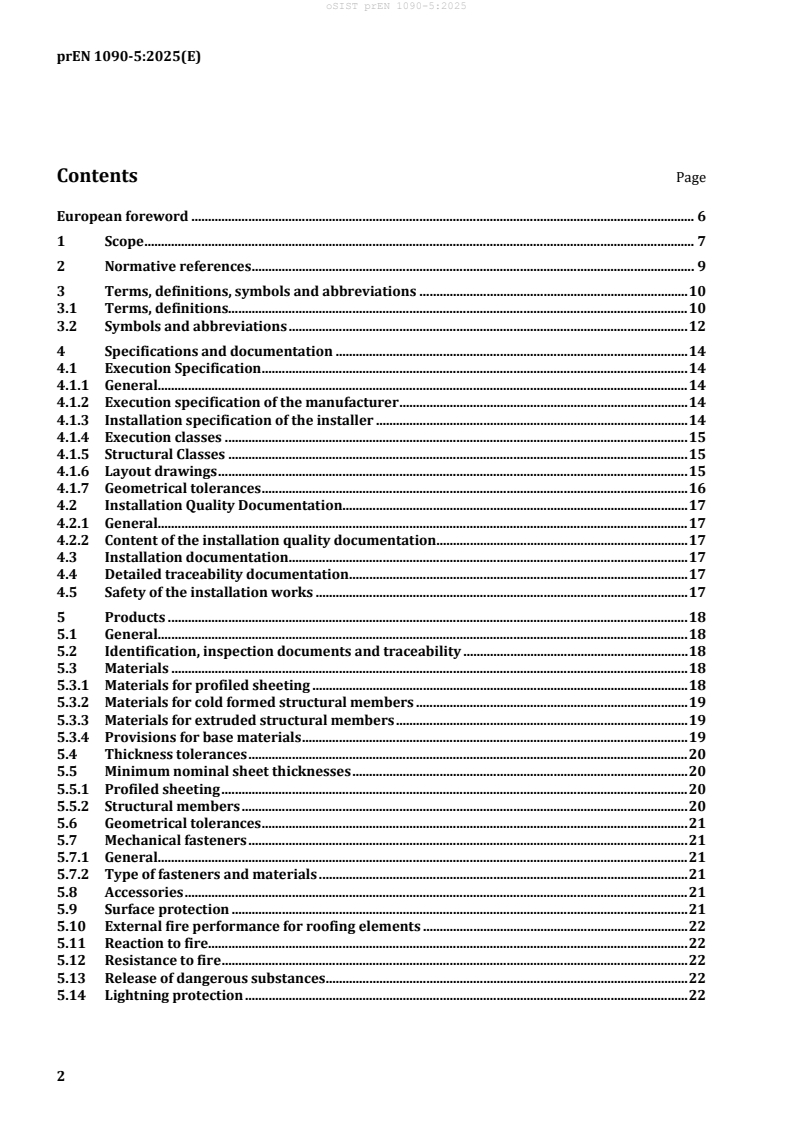
Contents Page
European foreword . 6
1 Scope . 7
2 Normative references . 9
3 Terms, definitions, symbols and abbreviations . 10
3.1 Terms, definitions. 10
3.2 Symbols and abbreviations . 12
4 Specifications and documentation . 14
4.1 Execution Specification . 14
4.1.1 General. 14
4.1.2 Execution specification of the manufacturer . 14
4.1.3 Installation specification of the installer . 14
4.1.4 Execution classes . 15
4.1.5 Structural Classes . 15
4.1.6 Layout drawings . 15
4.1.7 Geometrical tolerances . 16
4.2 Installation Quality Documentation. 17
4.2.1 General. 17
4.2.2 Content of the installation quality documentation. 17
4.3 Installation documentation . 17
4.4 Detailed traceability documentation . 17
4.5 Safety of the installation works . 17
5 Products . 18
5.1 General. 18
5.2 Identification, inspection documents and traceability . 18
5.3 Materials . 18
5.3.1 Materials for profiled sheeting . 18
5.3.2 Materials for cold formed structural members . 19
5.3.3 Materials for extruded structural members . 19
5.3.4 Provisions for base materials . 19
5.4 Thickness tolerances . 20
5.5 Minimum nominal sheet thicknesses . 20
5.5.1 Profiled sheeting . 20
5.5.2 Structural members . 20
5.6 Geometrical tolerances . 21
5.7 Mechanical fasteners . 21
5.7.1 General. 21
5.7.2 Type of fasteners and materials . 21
5.8 Accessories . 21
5.9 Surface protection . 21
5.10 External fire performance for roofing elements . 22
5.11 Reaction to fire. 22
5.12 Resistance to fire . 22
5.13 Release of dangerous substances . 22
5.14 Lightning protection . 22
prEN 1090-5:2025 (E)
6 Manufacturing. 22
6.1 General . 22
6.2 Identification . 22
6.3 Cold forming . 22
6.4 Cutting. 23
6.5 Holing . 23
6.5.1 General . 23
6.5.2 Execution of punching . 23
7 Welding at the construction site . 24
8 Mechanical Fastening . 24
8.1 General . 24
8.2 Use of self-tapping and self-drilling screws . 25
8.3 Use of blind rivets . 26
8.4 Attachment of cold-formed structural members and profiled sheeting to the supporting
member . 26
8.4.1 Types of connections and attachments. 26
8.4.2 Attachment of profiled sheeting to the supporting member transverse to the direction of
span. 26
8.4.3 Attachment of profiled sheeting to supports parallel to the direction of span . 28
8.4.4 Supporting member made of metal . 28
8.4.5 Supporting member made of timber or other wood-based materials . 29
8.4.6 Supporting member made of concrete or masonry . 29
8.5 Connecting profiled sheeting . 29
8.6 Edge and field spacings of fasteners for structural members and profiled sheeting . 31
8.6.1 General . 31
8.6.2 Edge spacings of webs of trapezoidal profiled sheeting and liner tray profiles . 31
9 Installation . 31
9.1 General . 31
9.2 Site conditions . 31
9.3 Training / instruction of installation personnel . 32
9.4 Inspection of preceding works . 32
9.5 Layout drawing . 32
9.6 Tools required . 32
9.7 Safety on site. 32
9.8 Inspection of packaging and contents . 33
9.9 Storage . 33
9.10 Damaged structural members and profiled sheeting and connecting devices . 33
9.11 Unloading, lifting gear / slings / straps . 33
9.12 Laying . 33
9.13 Direction of lay . 34
9.14 Maintaining the cover width / adherence to tolerances . 34
9.15 Condition after installation (swarf from drilling, fouling of surface, protective film wrap)
............................................................................................................................................................................. 34
9.16 Inspection after installation . 34
9.17 Diaphragms . 34
9.18 Protection against lightning . 35
10 Surface protection . 35
10.1 Corrosion protection . 35
10.2 Cleaning and maintenance . 35
11 Geometrical tolerances. 36
11.1 General . 36
prEN 1090-5:2025(E)
11.2 Tolerance types . 36
11.3 Essential tolerances . 37
11.3.1 General. 37
11.3.2 Manufacturing tolerances . 37
11.3.3 Installation tolerances . 37
11.4 Functional tolerances . 37
12 Inspection, testing and correction . 38
12.1 General. 38
12.2 Structural members, profiled sheeting and fasteners . 38
12.2.1 General. 38
12.2.2 Non-conforming products . 38
12.3 Manufacturing: geometrical dimensions of manufactured structural profiled sheeting . 38
12.3.1 General. 38
12.3.2 Profiled sheeting . 39
12.4 Welding at the construction site . 39
12.5 Inspection of fastening . 39
12.5.1 Self-tapping and self-drilling screws . 39
12.5.2 Blind rivets . 39
13 Deconstruction . 40
13.1 General. 40
13.2 Deconstruction process . 40
Annex A (normative) Basic requirements for profiled sheeting . 43
A.1 General. 43
A.2 Supporting members . 45
A.3 Edges of laying area. 45
A.3.1 Longitudinal edge stiffeners . 45
A.3.2 Weakening of the cross section . 45
A.3.3 Reinforcements and double layers . 46
A.3.4 Avoidance of ice damming . 46
A.4 Building physics requirements . 47
A.4.1 General. 47
A.4.2 Water permeability . 47
A.4.3 Thermal insulation . 47
A.4.4 Avoidance of condensation / moisture protection . 48
A.4.5 Airborne sound insulation (R ) . 48
w
A.4.6 Sound absorption (α ) . 48
w
A.4.7 Protection against lightning. 49
A.5 Roof drainage . 49
Annex B (normative) Additional design requirements for profiled sheeting . 51
B.1 General. 51
B.2 Serviceability . 51
B.3 Dimensions, widths of supports . 52
prEN 1090-5:2025 (E)
B.3.1 General . 52
B.3.2 Supporting members made of metal (steel / aluminium) . 52
B.3.3 Supporting members made of timber . 52
B.3.4 Supports made of concrete or masonry . 52
B.3.5 Shear forces / fixed points. 54
B.4 Stiffening of liner trays . 54
B.5 Walkability . 54
B.5.1 Walkability during installation . 54
B.5.2 Walkability and access after installation . 55
B.5.3 Test “Walkability” . 55
B.6 Rotational restraint . 56
B.7 Stressed skin design (diaphragms) . 56
B.8 Cantilevers . 57
B.9 Effective load width . 58
B.9.1 Effective load width for non-composite slabs under point or line loads . 58
B.9.2 Load dispersal by means of other structural members . 59
B.10 Openings in laying areas . 59
Annex C (informative) Installation records . 61
Annex D (normative) Geometrical tolerances . 62
D.1 General . 62
D.2 Essential and functional manufacturing tolerances – Cold-formed profiled sheeting . 63
D.3 Essential and functional manufacturing tolerances — Cold-formed members . 67
D.4 Essential manufacturing tolerances — Punched holes . 68
Annex E (normative) Galvanic corrosion . 69
Annex F (normative) Additional information . 70
F.1 List of required additional information . 70
F.2 List of additional information if not otherwise specified . 70
Bibliography . 72
prEN 1090-5:2025(E)
European foreword
This document (prEN 1090-5:2025) has been prepared by Technical Committee CEN/TC 135 “Execution
of steel structures and aluminium structures”, the secretariat of which is held by SN.
This document is currently submitted to the CEN Enquiry.
This document will supersede EN 1090-5:2017.
This document is part of the EN 1090 series, which comprises the following parts:
— EN 1090-1, Execution of steel structures and aluminium structures — Part 1: Assessment and
verification of constancy of performance for structural components
— EN 1090-2, Execution of steel structures and aluminium structures — Part 2: Technical
requirements for steel structures
— EN 1090-3, Execution of steel structures and aluminium structures — Part 3: Technical
requirements for aluminium structures
— EN 1090-4, Execution of steel structures and aluminium structures — Part 4: Technical
requirements for cold-formed structural steel elements and cold-formed structures for roof, ceiling,
floor and wall applications
— EN 1090-5, Execution of steel structures and aluminium structures — Part 5: Technical
requirements for cold-formed structural aluminium elements and cold-formed structures for roof,
ceiling, floor and wall applications
prEN 1090-5:2025 (E)
1 Scope
This document specifies requirements for the execution i.e. the manufacture and the installation of cold-
formed structural aluminium profiled sheeting, and for the installation of structural members made of
aluminium for roof, ceiling, floor, wall and cladding applications.
This document applies to structures designed according to the EN 1999 series.
This document applies to profiled sheeting to be designed according to EN 1999-1-4.
This document also specifies requirements for the execution i.e. the manufacture and the installation of
structures made from cold-formed profiled sheeting for roof, ceiling, floor and wall applications under
predominately static loading or seismic loading conditions and their documentation.
This document covers products of Structural Class I and II and structural profiled sheeting in Structural
Class III according to EN 1999-1-4 used in structures.
NOTE 1 In National Annexes of EN 1999-1-4 specifications can be given regarding the use of the Structural
Classes.
Structural profiled sheeting is understood here to be profiled sheet, such as trapezoidal or sinusoidal
(Figure 1).
Perforated and micro profiled sheeting are also covered by this part.
This document also covers spacer constructions between the outer and inner or upper and lower skins
as well as supporting members for roofs, walls and ceilings made from cold-formed profiled sheeting and
the connections and attachments of the afore mentioned elements as long as they are involved in load
transfer, it also covers connections and attachments of these elements (Figure 2).
A combination of steel and aluminium structural profiled sheeting are permitted, e.g. liner trays made of
steel, stiffened by profiles made of aluminium. In this case, EN 1090-4 and this document apply.
This document also covers the deconstruction of structures made from cold-formed profiled sheeting and
structural members for roof, ceiling, floor and wall applications.
This document does not cover the manufacturing of structural members of all structural classes
according to EN 1999-1-4. These products are covered by EN 1090-3.
Welded sections are excluded from this part and are covered by EN 1090-3 except seal welding in low-
stress areas.
Composite structural profiled sheeting where the interaction between dissimilar materials are an integral
part of the structural behaviour such as sandwich panels and composite floors are not covered by this
standard.
NOTE 2 The structures covered in this standard can be for example
— single- or multi-skin roofs, whereby the load-bearing structure (lower skin) as well as the actual roof covering
(upper skin) or both consist of structural profiled sheeting;
— single- or multi-skin walls whereby the load-bearing structure (inner skin) as well as the actual cladding (outer
skin) or both consist of structural profiled sheeting; or
— suspended ceilings for interior fitting.
prEN 1090-5:2025(E)
Figure 1 — Examples of profiled sheeting
a) roll formed, press braked, folded sections
b) extruded sections
Figure 2 — Examples of members
prEN 1090-5:2025 (E)
2 Normative references
The following documents are referred to in the text in such a way that some or all of their content
constitutes requirements of this document. For dated references, only the edition cited applies. For
undated references, the latest edition of the referenced document (including any amendments) applies.
CEN/TS 1187:2012, Test methods for external fire exposure to roofs
EN 508-2:2019, Roofing and cladding products from metal sheet - Specification for self-supporting products
of steel, aluminium or stainless steel sheet - Part 2: Aluminium
EN 755-7:2016, Aluminium and aluminium alloys - Extruded rod/bar, tube and profiles - Part 7: Seamless
tubes, tolerances on dimensions and form
EN 755-8:2016, Aluminium and aluminium alloys - Extruded rod/bar, tube and profiles - Part 8: Porthole
tubes, tolerances on dimensions and form
EN 755-9:2016, Aluminium and aluminium alloys - Extruded rod/bar, tube and profiles - Part 9: Profiles,
tolerances on dimensions and form
EN 1090-1:2009+A1:2011, Execution of steel structures and aluminium structures — Part 1: Requirements
for conformity assessment of structural elements
EN 1090-3:2019, Execution of steel structures and aluminium structures - Part 3: Technical requirements
for aluminium structures
EN 1994-1-1:2004 , Eurocode 4 — Design of composite steel and concrete structures — Part 1-1: General
rules and rules for buildings
EN 1995-1-1:2004 , Eurocode 5 — Design of timber structures — Part 1-1: General — Common rules and
rules for buildings
EN 1995-1-2:2004 , Eurocode 5 — Design of timber structures — Part 1-1: General — Common rules and
rules for buildings
EN 1999-1-1:2023, Eurocode 9 - Design of aluminium structures — Part 1-1: General rules
EN 1999-1-4:2023, Eurocode 9 — Design of aluminium structures — Part 1-4: Cold-formed structural
sheeting
EN 10204:2004, Metallic products - Types of inspection documents
EN 13501-5:2016, Fire classification of construction products and building elements - Part 5: Classification
using data from external fire exposure to roofs tests
EN 62305-3:2011, Protection against lightning - Part 3: Physical damage to structures and life hazard (IEC
62305-3:2010)
EN ISO 376:2011, Metallic materials - Calibration of force-proving instruments used for the verification of
uniaxial testing machines (ISO 376:2011)
As impacted by EN 1994-1-1:2004/AC:2009.
As impacted by EN 1995-1-1:2004/AC:2006, EN 1995-1-1:2004/A1:2008, EN 1995-1-1:2004/A2:2014.
As impacted by EN 1995-1-2:2004/AC:2009.
prEN 1090-5:2025(E)
EN ISO 717-1:2020, Acoustics — Rating of sound insulation in buildings and of building elements — Part 1:
Airborne sound insulation (ISO 717-1)
EN ISO 6507 (all parts), Metallic materials - Vickers hardness test (ISO 6507 (all parts))
EN ISO 10140 (all parts), Acoustics — Laboratory measurement of sound insulation of building elements
(ISO 10140 (all parts))
EN ISO 11654:1997, Acoustics - Sound absorbers for use in buildings - Rating of sound absorption (ISO
11654:1997)
EN IEC 62561-1, Lightning protection system components (LPSC) — Part 1: Requirements for connection
components (IEC 62561-1)
ISO 7976-1, Tolerances for building — Methods of measurement of buildings and building products - Part
1: Methods and instruments
ISO 7976-2, Tolerances for building — Methods of measurement of buildings and building products - Part
2: Position of measuring points
ISO 17123 (all parts), Optics and optical instruments — Field procedures for testing geodetic and surveying
instruments
3 Terms, definitions, symbols and abbreviations
3.1 Terms, definitions
For the purposes of this document, the following terms and definitions apply.
ISO and IEC maintain terminology databases for use in standardization at the following addresses:
— ISO Online browsing platform: available at https://www.iso.org/obp/
— IEC Electropedia: available at https://www.electropedia.org/
3.1.1
cassette profile
roll formed, press-braked or folded structural profiled sheeting with or without stiffeners used as
substructures for walls and roofs with a bigger variety in cross sections than liner trays
3.1.2
component I
component (usually the profiled sheeting) that is facing the head of the fastener (the swage head in the
case of blind rivets)
3.1.3
component II
second component of a connection (usually the supporting member)
3.1.4
decking
load bearing profiled sheeting to support
EXAMPLE insulation and outer skin.
prEN 1090-5:2025 (E)
3.1.5
edge stiffener
supporting plate or profile at the longitudinal edge of a laying area to replace the missing neighboured
profiled sheeting and stiffen the free edge
3.1.6
fastening
fastener and the process of fastening and the final connected components
3.1.7
flashing
non-load-bearing element, for example accessories and coverings in the areas of the skirting, eaves, gable
end, ridge and corners
3.1.8
layout drawing
drawing showing the position of structural components and installation details
3.1.9
liner
inner profiled sheeting of a double skin system
3.1.10
member
linear profiled cross sections (structural element with cross-sectional dimensions much smaller than its
length)
Note 1 to entry: This is a narrower definition of the term member than the one given in EN 1990.
3.1.11
penetration
opening in the decking made on-site
3.1.12
restraint
restriction of the lateral or rotational movement, or the torsional or warping deformation, of a member
or element, that increases its buckling resistance to the same extent as a rigid support
3.1.13
saddle washer
oversized gasket that is adapted to the respective profile shape, which is made of aluminium, steel or
stainless steel with a seal bonded to it and an adapted corrosion protection to that of the profiled sheeting
which can be used when profiled sheeting are connected via its top flange
Note 1 to entry: The corrosion protection is adapted to that of the profiled sheeting.
Note 2 to entry: Saddle washer can be used when attaching profiled sheeting via its top flange.
Note 3 to entry: As an example, a figure of a saddle washer is given in EN 1993-1-3:2024, Table 10.3.
3.1.14
structural aluminium component
load-bearing element made from aluminium sheet by cold rolling or press braking
prEN 1090-5:2025(E)
3.1.15
structural cold-formed profiled sheeting
part of a structure such as trapezoidal, sinusoidal, standing seam or cassette profile I
3.1.16
tolerance
difference between the upper limit of size and the lower limit of size
Note 1 to entry: Tolerance is an absolute value without sign.
[SOURCE: ISO 6707-1:2020, 3.1.1, Note 2 and 3 are deleted.]
3.1.16.1
essential tolerance
basic limit for a geometrical tolerance necessary to satisfy the design assumptions for structures in terms
of mechanical resistance and stability
3.1.16.2
functional tolerance
geometrical tolerance, which might be required to meet a function other than mechanical resistance and
stability, e.g. appearance or fit up
3.1.16.3
manufacturing tolerance
permitted range in the size of a dimension of a component resulting from component manufacture
3.1.17
trimmer
beam around an opening in a floor or roof or wall
3.2 Symbols and abbreviations
For the purposes of this document, the following symbols and abbreviations apply.
C corrosivity category
D edge waviness of the side lap
E modulus of elasticity
F force,
shear force of the fastener
I second moment of area
L span, distance
M bending moment
R end support reaction,
airborne sound insulation
T shear flow
V shear force of the structural component
a distance between a fastener and a web of a profiled sheet
b width,
prEN 1090-5:2025 (E)
width of spacing strip
d hole diameter,
nominal diameter of the fastener
e distance of hole from edge,
distance between fastener and centre line of flange of profiled sheet
distance between fasteners
f strength, yield stress
h depth of profile
l length of double layer
p distances between holes
r radius
t thickness of bare metal of the sheet,
hole pitch
α sound absorption
Δ deviation,
tolerance
δ deviation from straightness
φ inclination of the web of a profile
Indices
A end support
centre-to-centre distance of the penetration from the end support or from the point of zero
moment
B internal, intermediate support
I component 1, profiled sheeting
II component 2, supporting member / profiled sheeting
L longitudinal edge, left side
N nominal sheet thickness B + Δ
D
R rib edge, right side
S tensile force from constraints due to shear reinforcement
shear stiffness
cl clear span
f width of flange – theoretical requirement used for static calculations
i ideal distance between supports,
equal spacing of points of zero moment
k cantilever
lim limit
prEN 1090-5:2025(E)
n nominal hole diameter
obs observed (e.g. result) required
r rib
s stiffener at the web
t tensile force
u bottom flange
w web,
weighted value
4 Specifications and documentation
4.1 Execution Specification
4.1.1 General
The necessary information and technical requirements for execution of each part of the works
(manufacturing and installation) shall be agreed and complete before commencement of execution of
that part of the works.
There shall be procedures for making alterations to previously agreed execution specification.
4.1.2 Execution specification of the manufacturer
The execution specification shall consider such of the following items as are relevant:
a) additional information, as listed in Annex F;
b) execution classes, see 4.1.4;
c) structur
...