

SIST EN 50374:2004
(Main)Conductor cars
General Information
- Abstract
This European Standard applies to conductor cars which are used for driving (travelling) on conductors, shield wires or shield wires with integrated communication systems of overhead transmission lines.
- Status
- Published
- Publication Date
- 31-Aug-2004
- Technical Committee
- DPN - Live Working
- Current Stage
- 6060 - National Implementation/Publication (Adopted Project)
- Start Date
- 01-Sep-2004
- Due Date
- 01-Sep-2004
- Completion Date
- 01-Sep-2004
- Directive
- 98/37/EC - Machinery
- Ref Project
EN 50374:2004 - Conductor cars



Overview
SIST EN 50374:2004 is a European standard developed by CLC that specifies the requirements for conductor cars used on overhead transmission lines. These conductor cars are designed to travel along conductors, shield wires, or shield wires with integrated communication systems, serving as moveable workplaces for maintenance and inspection work on high-voltage power lines. The standard ensures the safety, reliability, and performance of conductor cars used in various utility and energy sectors.
Key Topics
Scope: Applies to conductor cars that travel on power line conductors and shield wires, including those with integrated communication systems. It covers cars operated manually, with ropes, or with built-in drive systems.
Mechanical Safety:
- Frames and chassis must have appropriate safety factors (minimum three times stress for frames; increased factors for lifting personnel).
- The chassis must prevent unintended tilting or falling.
- Brakes and locking devices must be redundant and effective to secure the car safely on conductors.
- Drive systems limited to a maximum speed of 6 km/h for built-in traction models.
Personnel Protection:
- Fall protection systems are mandatory for standing operators, including a spar, border, and structural elements preventing falls.
- Seating operators must have secured harness devices.
- The car must allow rescue and facilitate fall prevention during operation.
Design and Materials:
- Welded joints must conform to recognized European welding standards to assure structural integrity.
- Materials used must meet specified strength and durability requirements to withstand adverse conditions.
Operational Features:
- Operating devices must be user-friendly, protected against accidental activation, and clearly marked.
- Wheels and moving parts must not pose hazards to operators.
- Cables and hydraulic hoses must be protected from damage.
Identification and Instructions:
- Conductor cars are required to have durable identification plates with manufacturer info, load limits, conductor diameters, and safety details.
- Clear safety instruction plates and comprehensive user manuals are mandatory.
- A log-book must be maintained for recording inspections, tests, and usage data.
Electrical Properties:
- Cars must provide conductive bonding to the conductor or shield wire to prevent buildup of electrical potential, with resistance less than 100 milliohms.
Testing:
- Type tests verify mechanical, electrical, and safety features.
- Personnel protection tests simulate worst-case loading on harnesses and side protections.
- Test setups mimic real conductor conditions including spacers and inclinations.
Applications
SIST EN 50374:2004 is essential for manufacturers, suppliers, and users of conductor cars in the electrical power transmission sector. Key applications include:
- Maintenance and inspection of high-voltage overhead power lines.
- Safe transportation of personnel working on conductors and shield wires.
- Operations requiring movement along overhead lines with integrated communication cables.
- Emergency rescue and repair requiring stable, secure mobile platforms on live or de-energized overhead lines.
Compliance with EN 50374 ensures enhanced safety for electrical utility workers and improves reliability of conductor cars used in overhead line maintenance. It supports harmonized safety requirements throughout EU member states, fulfilling machinery directive 98/37/EC compliance for lifting and personnel-carrying devices.
Related Standards
SIST EN 50374:2004 references and aligns with several critical European and international standards to ensure comprehensive safety and quality:
- EN 292-2 (ISO 12100-2): General safety principles and risk assessment for machinery design.
- EN 354: Personal protective equipment against falls.
- EN 1011 series: Welding guidance for metallic materials.
- EN 30042: Arc-welded joint quality in aluminum alloys.
- EN 60204-1 (IEC 60204-1): Electrical equipment safety of machines.
- Machinery Directive 98/37/EC: European machinery safety regulations.
These standards provide normative references covering structural integrity, personal fall protection, welding quality, and electrical safety, which are integral to the design and testing of conductor cars.
By adhering to SIST EN 50374:2004, electrical utilities and equipment manufacturers ensure that conductor cars operate safely in demanding outdoor environments, reducing risks to personnel and preventing damage to overhead transmission lines. This promotes safer power line maintenance practices across Europe and supports reliable operation of critical energy infrastructure.
Relations
- Replaced By
SIST EN 50374:2025 - Conductor cars - Effective Date
- 01-Jun-2025
Get Certified
Connect with accredited certification bodies for this standard

TÜV Rheinland
TÜV Rheinland is a leading international provider of technical services.

TÜV SÜD
TÜV SÜD is a trusted partner of choice for safety, security and sustainability solutions.

DEKRA Certification Inc.
DEKRA US certification services.
Sponsored listings
Frequently Asked Questions
SIST EN 50374:2004 is a standard published by the Slovenian Institute for Standardization (SIST). Its full title is "Conductor cars". This standard covers: This European Standard applies to conductor cars which are used for driving (travelling) on conductors, shield wires or shield wires with integrated communication systems of overhead transmission lines.
This European Standard applies to conductor cars which are used for driving (travelling) on conductors, shield wires or shield wires with integrated communication systems of overhead transmission lines.
SIST EN 50374:2004 is classified under the following ICS (International Classification for Standards) categories: 43.120 - Electric road vehicles. The ICS classification helps identify the subject area and facilitates finding related standards.
SIST EN 50374:2004 has the following relationships with other standards: It is inter standard links to SIST EN 50374:2025. Understanding these relationships helps ensure you are using the most current and applicable version of the standard.
SIST EN 50374:2004 is associated with the following European legislation: EU Directives/Regulations: 98/37/EC. When a standard is cited in the Official Journal of the European Union, products manufactured in conformity with it benefit from a presumption of conformity with the essential requirements of the corresponding EU directive or regulation.
SIST EN 50374:2004 is available in PDF format for immediate download after purchase. The document can be added to your cart and obtained through the secure checkout process. Digital delivery ensures instant access to the complete standard document.
Standards Content (Sample)
SLOVENSKI SIST EN 50374:2004
STANDARD
september 2004
Vozički za delo na nadzemnih vodih
Conductor cars
ICS 43.120 Referenčna številka
© Standard je založil in izdal Slovenski inštitut za standardizacijo. Razmnoževanje ali kopiranje celote ali delov tega dokumenta ni dovoljeno
EUROPEAN STANDARD EN 50374
NORME EUROPÉENNE
EUROPÄISCHE NORM March 2004
ICS 43.120
English version
Conductor cars
Nacelles suspendues Leitungsfahrzeuge
This European Standard was approved by CENELEC on 2004-02-01. CENELEC members are bound to
comply with the CEN/CENELEC Internal Regulations which stipulate the conditions for giving this European
Standard the status of a national standard without any alteration.
Up-to-date lists and bibliographical references concerning such national standards may be obtained on
application to the Central Secretariat or to any CENELEC member.
This European Standard exists in three official versions (English, French, German). A version in any other
language made by translation under the responsibility of a CENELEC member into its own language and
notified to the Central Secretariat has the same status as the official versions.
CENELEC members are the national electrotechnical committees of Austria, Belgium, Cyprus, Czech
Republic, Denmark, Estonia, Finland, France, Germany, Greece, Hungary, Iceland, Ireland, Italy, Latvia,
Lithuania, Luxembourg, Malta, Netherlands, Norway, Poland, Portugal, Slovakia, Slovenia, Spain, Sweden,
Switzerland and United Kingdom.
CENELEC
European Committee for Electrotechnical Standardization
Comité Européen de Normalisation Electrotechnique
Europäisches Komitee für Elektrotechnische Normung
Central Secretariat: rue de Stassart 35, B - 1050 Brussels
© 2004 CENELEC - All rights of exploitation in any form and by any means reserved worldwide for CENELEC members.
Ref. No. EN 50374:2004 E
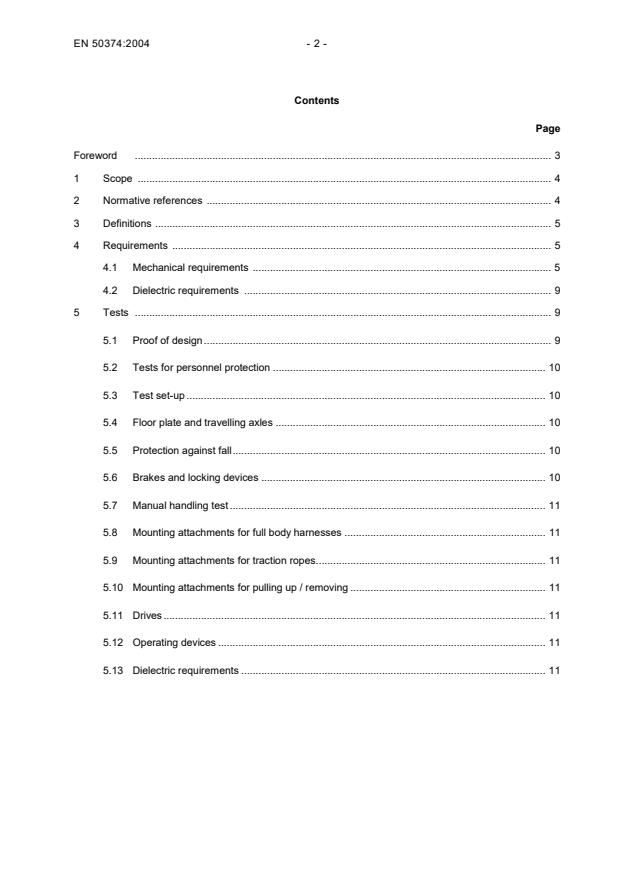
Contents
Page
Foreword . 3
1 Scope . 4
2 Normative references . 4
3 Definitions . 5
4 Requirements . 5
4.1 Mechanical requirements . 5
4.2 Dielectric requirements . 9
5 Tests . 9
5.1 Proof of design. 9
5.2 Tests for personnel protection . 10
5.3 Test set-up. 10
5.4 Floor plate and travelling axles . 10
5.5 Protection against fall. 10
5.6 Brakes and locking devices . 10
5.7 Manual handling test . 11
5.8 Mounting attachments for full body harnesses . 11
5.9 Mounting attachments for traction ropes. 11
5.10 Mounting attachments for pulling up / removing . 11
5.11 Drives. 11
5.12 Operating devices . 11
5.13 Dielectric requirements . 11
- 3 - EN 50374:2004
Foreword
This European Standard was prepared by CENELEC BTWG 93-1, Conductors cars. The text of the draft
was submitted to formal vote and was approved by CENELEC as EN 50374 on 2004-02-01.
The following dates were fixed:
- latest date by which the EN has to be implemented
at national level by publication of an identical
national standard or by endorsement (dop) 2005-02-01
- latest date by which the national standards conflicting
with the EN have to be withdrawn (dow) 2007-02-01
__________
1 Scope
This European Standard applies to conductor cars which are used for driving (travelling) on conductors,
shield wires or shield wires with integrated communication systems of overhead transmission lines.
2 Normative references
The following referenced documents are indispensable for the application of this document. For dated
references, only the edition cited applies. For undated references, the latest edition of the referenced
document (including any amendments) applies.
EN 292-2 Safety of machinery – Basic concepts, general principles for design
Part 2: Technical principles (ISO 12100-2)
EN 354 Personal protective equipment against falls from a height - Lanyards
EN 1011-1 Welding – recommendations for welding of metallic materials
Part 1: General guidance for arc welding
EN 1011-2 Welding – Recommendations for welding of metallic materials
Part 2: Arc welding of ferritic steels
EN 1011-3 Welding – Recommendations for welding of metallic materials
Part 3: Welding of stainless steels
EN 1011-4 Welding – Recommendations for welding of metallic materials
Part 4: Arc welding of aluminium and aluminium alloys
EN 1050 Safety of machinery - Principles of risk assessment (ISO 14121)
EN 1708-1 Welding – Basic weld joint details in steel - Part 1: Pressurised components
EN 1712 Non-destructive examination of welds - Ultrasonic examination of welded joints -
Acceptance levels
EN 30042 Arc-welded joints in aluminium and its weldable alloys – guidance on quality levels for
imperfections
EN 60204-1 Safety of machinery - Electrical equipment of machines
Part 1: General requirements (IEC 60204-1)
Conductor cars are covered by the Directive 98/37/EC of the European Parliament and the Council of
22 June 1998 on the approximation of the laws of the Member States relating to machinery. In the case of
conductor cars which are also used for lifting persons, the cars are devices covered by Annex IV of the
Directive.
Every manufacturer or his authorised representative established in the Community shall prove by a
conformity assessment procedure, that his conductor car complies with the requirements of the Directive.
Where this standard covers one or more of the essential safety requirements of the Directive, conductor
cars constructed in accordance with this standard shall be presumed to comply with the relevant essential
requirements.
- 5 - EN 50374:2004
3 Definitions
3.1
conductor cars
conductor cars covered by this standard are devices designed to be used as moveable workplaces on
overhead lines suspended by conductors or shield wires and which are moved manually, by pulling ropes
or built-in-traction.
In addition conductor cars may be designed to incorporate the raising of persons to the work position
3.2
brake
the brake is used for slowing down the conductor car to a standstill
3.3
locking device
the locking device is used for fixing the conductor car at a position on the conductor or shield wire
3.4
conductors (IEC 466-01-15)
a wire or combination of wires not insulated from one another, suitable for carrying an electric current.
The conductors are strung between two supports of overhead lines. They may be arranged as a single
conductor only or as a conductor bundle
3.5 Tests
3.5.1
type test (IEC 151-16-16)
conformity test made on one or more items representative of the production
3.5.2
routine test (IEC 151-16-17)
a periodical test defined by the manufacturer to which each individual device is subjected after
manufacture by the user to ascertain that it complies with certain criteria
3.6
permissible load
the permissible load is the maximum load defined by the designer with which the conductor car may be
loaded. The permissible load does not include the weight of the car
4 Requirements
4.1 Mechanical requirements
If conductor cars are designed to raise or lower persons a suitable safety factor shall be assigned, this is
usually double.
4.1.1 Frame
Frameparts which are relevant for safety shall have a calculated safety factor of at least three times the
stresses which may occur during the most unfavourable using condition with permissible load.
All materials have unique physical properties and will behave in different ways depending on the
conditions to which they are exposed. Therefore consideration should be given to raising of the safety
factor for special materials.
In case of emergency, i. e. if conductor car wheels inadvertently become detached from conductor, the
safety factor may be different than under normal using conditions.
The welding shall be carried out regarding the following European Standards e. g. EN 1011-1, EN 1011-2,
EN 1011-3 and EN 1011-4.
The welding shall at least meet the evaluation category BS-AL in accordance with EN 30042, Arc-welded
joints in aluminium and its weldable alloys - Guidance on quality levels for imperfections.
Other materials may be used if they fulfil the above mentioned requirements.
4.1.2 Chassis
The chassis must be equipped with a device which protects the car from unintended tilting or falling under
all operating and emergency conditions.
Conductor cars with built-in-traction shall be designed for a maximum speed of 6 km/h.
4.1.3 Brakes and locking device
4.1.3.1 Conductor cars shall be equipped with a brake and two locking devices independent from each
other. The brake can also work as a locking device. The brake and the locking device shall be rated in
accordance with 5.6.
4.1.3.2 The locking device shall fasten the conductor car directly to the conductor under all conditions.
In case of failure of the brake the locking device shall take over the function of the brake.
Locking devices of conductor cars shall affect at least two axles independent from each other.
4.1.3.3 For horizontally arranged conductors the brake shall have an effect on both conductors equally.
4.1.3.4 The lo
...