


kSIST FprEN IEC 60352-7:2025
(Main)Solderless connections - Part 7: Spring clamp connections - General requirements, test methods and practical guidance
Solderless connections - Part 7: Spring clamp connections - General requirements, test methods and practical guidance
IEC 60352-7:20205 is applicable to spring clamp connections made with stripped wire of the following types and sizes according to IEC 60228 or IEC 60189-3, without further preparation.
Lötfreie Verbindungen - Teil 7: Federklemmverbindungen - Allgemeine Anforderungen, Prüfverfahren und Anwendungshinweise
Connexions sans soudure - Partie 7: Connexions à ressort - Règles générales, méthodes d’essai et guide pratique
L'IEC 60352-7:20205 s’applique aux connexions à ressort réalisées avec du fil dénudé des types et tailles suivants, conformément à l’IEC 60228 ou à l’IEC 60189-3, sans autre préparation.
Spoji brez spajke - 7. del: Objemka vzmetnih spojk - Splošne zahteve, preskusne metode in praktični napotki
General Information
- Status
- Not Published
- Public Enquiry End Date
- 26-Sep-2024
- Technical Committee
- I11 - Imaginarni 11
- Current Stage
- 5020 - Formal vote (FV) (Adopted Project)
- Start Date
- 26-Aug-2025
- Due Date
- 14-Oct-2025
- Completion Date
- 27-Aug-2025
Relations
- Effective Date
- 26-Sep-2023
Overview
FprEN IEC 60352-7:2025 (Solderless connections - Part 7: Spring clamp connections) defines general requirements, test methods and practical guidance for spring clamp connections used in electrical connecting devices. Published as a CLC/CDV of IEC 60352-7 (Ed.3), the document addresses workmanship, materials, design features and a comprehensive set of mechanical, electrical and climatic tests to verify reliable, solderless spring-clamp terminations.
Key Topics and Requirements
The standard covers the full lifecycle of verification for solderless spring clamp connections, including:
- Design and materials
- Requirements for spring clamp terminations: materials, surface finishes, dimensions and key design features.
- Wire requirements: conductor materials, insulation, dimensions and acceptable surface finishes.
- Workmanship and tooling
- Expectations for manufacturing quality and recommended tools for installation and testing.
- Mechanical tests
- Tensile strength, wire deflection, vibration, and repeated connection/disconnection tests to confirm mechanical integrity.
- Electrical tests
- Contact resistance measurement and electrical load/temperature testing to validate current carrying capability and stability.
- Climatic and environmental tests
- Rapid temperature change, climatic sequences and mixed-gas corrosion testing to assess long-term performance in real-world environments.
- Test schedules and procedures
- Basic and full test schedules, preconditioning, recovery, specimen mounting and flow charts to guide test labs.
- Special Conditions
- Annex B (normative): tests for resiliency where contact pressure is transmitted via insulating material (CoPI).
- Practical guidance
- Annex A (informative): current-carrying capacity, stripping best practices, tooling information and termination guidance.
Applications
FprEN IEC 60352-7 is directly applicable to manufacturers, test laboratories and designers of solderless connecting devices that use spring-clamp terminations, such as terminal blocks and wire-to-board/wire-to-wire connectors. It supports product development, conformity assessment, quality assurance and supplier specifications by providing standardized test methods and practical installation guidance.
Who should use this standard
- Electrical connector and terminal block manufacturers
- Product design and test engineers
- Certification bodies and test laboratories
- Procurement and quality assurance teams specifying connector performance
- Installation and maintenance professionals seeking recommended practices
Related standards
- Part of the IEC 60352 series on solderless connections. (This document is the Part 7 entry specifically addressing spring clamp connections.)
Keywords: spring clamp connections, solderless connections, IEC 60352-7, test methods, contact resistance, tensile strength, wire deflection, climatic tests, connecting devices, terminal blocks.

Frequently Asked Questions
kSIST FprEN IEC 60352-7:2025 is a draft published by the Slovenian Institute for Standardization (SIST). Its full title is "Solderless connections - Part 7: Spring clamp connections - General requirements, test methods and practical guidance". This standard covers: IEC 60352-7:20205 is applicable to spring clamp connections made with stripped wire of the following types and sizes according to IEC 60228 or IEC 60189-3, without further preparation.
IEC 60352-7:20205 is applicable to spring clamp connections made with stripped wire of the following types and sizes according to IEC 60228 or IEC 60189-3, without further preparation.
kSIST FprEN IEC 60352-7:2025 is classified under the following ICS (International Classification for Standards) categories: 29.120.20 - Connecting devices; 31.220.10 - Plug-and-socket devices. Connectors. The ICS classification helps identify the subject area and facilitates finding related standards.
kSIST FprEN IEC 60352-7:2025 has the following relationships with other standards: It is inter standard links to SIST EN IEC 60352-7:2021. Understanding these relationships helps ensure you are using the most current and applicable version of the standard.
kSIST FprEN IEC 60352-7:2025 is available in PDF format for immediate download after purchase. The document can be added to your cart and obtained through the secure checkout process. Digital delivery ensures instant access to the complete standard document.
Standards Content (Sample)
SLOVENSKI STANDARD
oSIST prEN IEC 60352-7:2024
01-september-2024
Spoji brez spajke - 7. del: Objemka vzmetnih spojk - Splošne zahteve, preskusne
metode in praktični napotki
Solderless connections - Part 7: Spring clamp connections - General requirements, test
methods and practical guidance
Lötfreie Verbindungen - Teil 7: Federklemmverbindungen - Allgemeine Anforderungen,
Prüfverfahren und Anwendungshinweise
Connexions sans soudure - Partie 7: Connexions à ressort - Règles générales,
méthodes d’essai et guide pratique
Ta slovenski standard je istoveten z: prEN IEC 60352-7:2024
ICS:
29.120.20 Spojni elementi Connecting devices
oSIST prEN IEC 60352-7:2024 en
2003-01.Slovenski inštitut za standardizacijo. Razmnoževanje celote ali delov tega standarda ni dovoljeno.
oSIST prEN IEC 60352-7:2024
oSIST prEN IEC 60352-7:2024
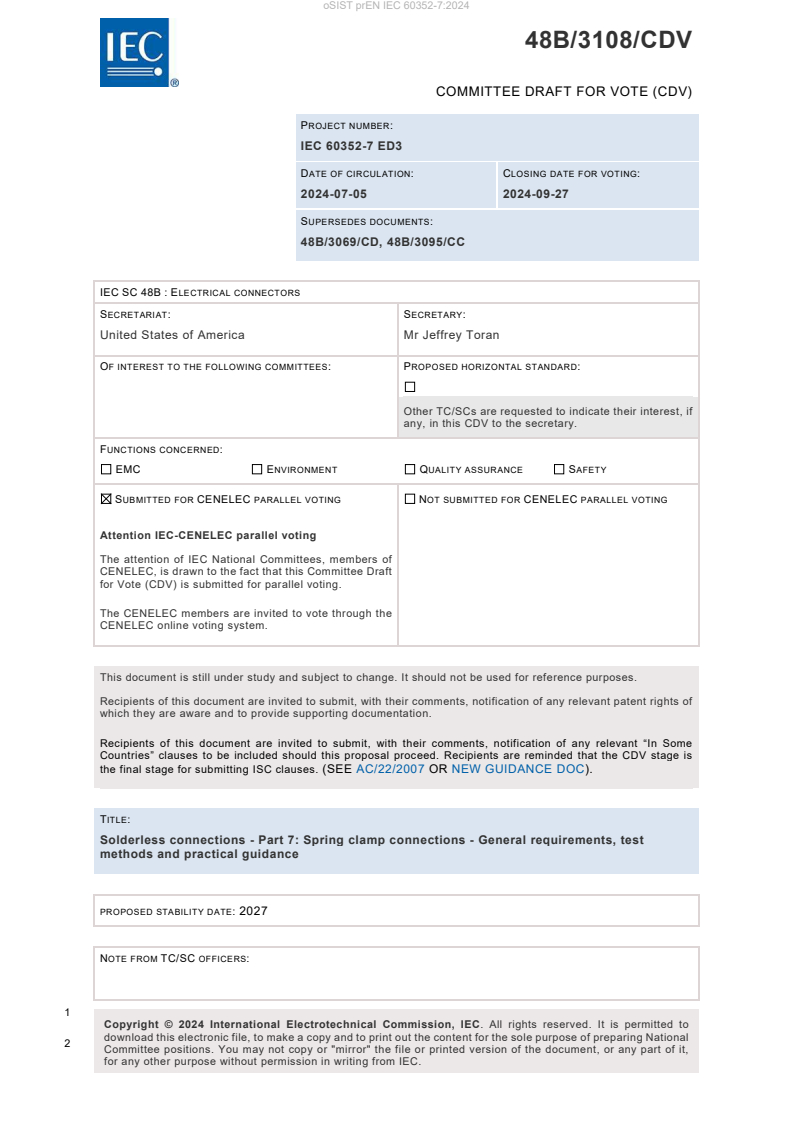
48B/3108/CDV
COMMITTEE DRAFT FOR VOTE (CDV)
PROJECT NUMBER:
IEC 60352-7 ED3
DATE OF CIRCULATION: CLOSING DATE FOR VOTING:
2024-07-05 2024-09-27
SUPERSEDES DOCUMENTS:
48B/3069/CD, 48B/3095/CC
IEC SC 48B : ELECTRICAL CONNECTORS
SECRETARIAT: SECRETARY:
United States of America Mr Jeffrey Toran
OF INTEREST TO THE FOLLOWING COMMITTEES: PROPOSED HORIZONTAL STANDARD:
Other TC/SCs are requested to indicate their interest, if
any, in this CDV to the secretary.
FUNCTIONS CONCERNED:
EMC ENVIRONMENT QUALITY ASSURANCE SAFETY
SUBMITTED FOR CENELEC PARALLEL VOTING NOT SUBMITTED FOR CENELEC PARALLEL VOTING
Attention IEC-CENELEC parallel voting
The attention of IEC National Committees, members of
CENELEC, is drawn to the fact that this Committee Draft
for Vote (CDV) is submitted for parallel voting.
The CENELEC members are invited to vote through the
CENELEC online voting system.
This document is still under study and subject to change. It should not be used for reference purposes.
Recipients of this document are invited to submit, with their comments, notification of any relevant patent rights of
which they are aware and to provide supporting documentation.
Recipients of this document are invited to submit, with their comments, notification of any relevant “In Some
Countries” clauses to be included should this proposal proceed. Recipients are reminded that the CDV stage is
the final stage for submitting ISC clauses. (SEE AC/22/2007 OR NEW GUIDANCE DOC).
TITLE:
Solderless connections - Part 7: Spring clamp connections - General requirements, test
methods and practical guidance
PROPOSED STABILITY DATE: 2027
NOTE FROM TC/SC OFFICERS:
download this electronic file, to make a copy and to print out the content for the sole purpose of preparing National
Committee positions. You may not copy or "mirror" the file or printed version of the document, or any part of it,
for any other purpose without permission in writing from IEC.
oSIST prEN IEC 60352-7:2024
– 2 – IEC CDV 60352-7 Ed. 3 © IEC 2024
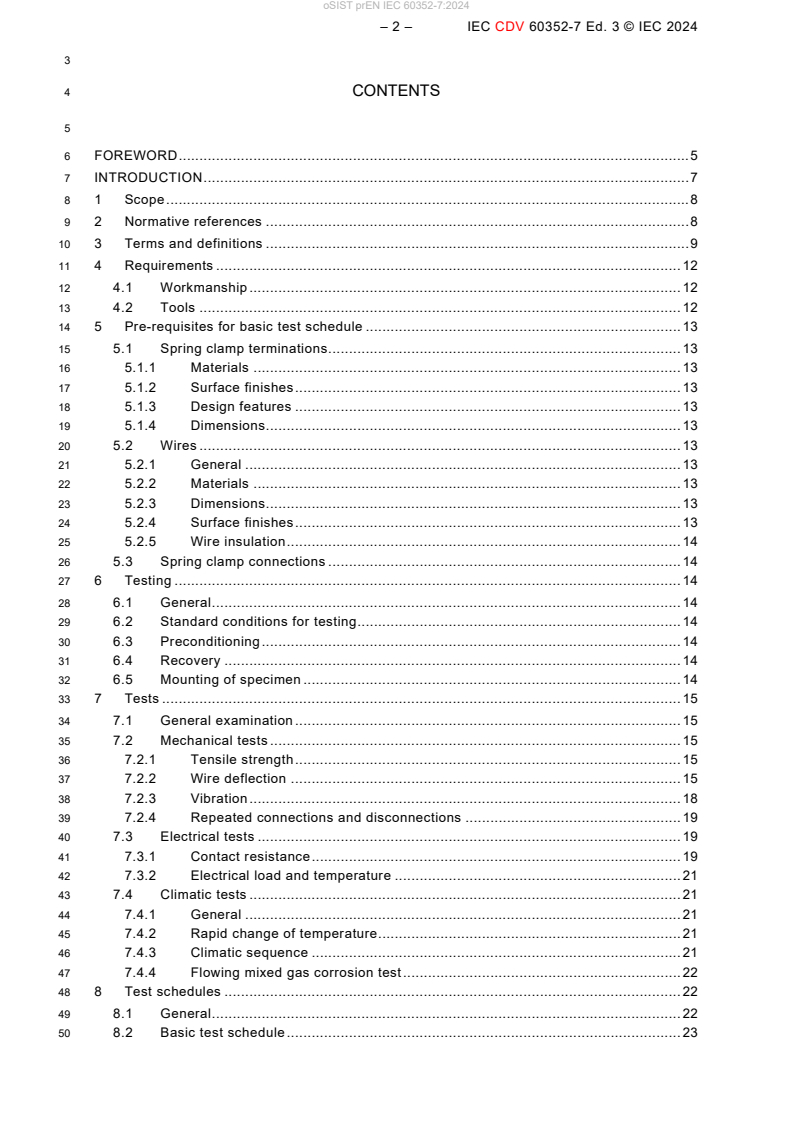
4 CONTENTS
6 FOREWORD . 5
7 INTRODUCTION . 7
8 1 Scope . 8
9 2 Normative references . 8
10 3 Terms and definitions . 9
11 4 Requirements . 12
12 4.1 Workmanship . 12
13 4.2 Tools . 12
14 5 Pre-requisites for basic test schedule . 13
15 5.1 Spring clamp terminations . 13
16 5.1.1 Materials . 13
17 5.1.2 Surface finishes . 13
18 5.1.3 Design features . 13
19 5.1.4 Dimensions . 13
20 5.2 Wires . 13
21 5.2.1 General . 13
22 5.2.2 Materials . 13
23 5.2.3 Dimensions . 13
24 5.2.4 Surface finishes . 13
25 5.2.5 Wire insulation . 14
26 5.3 Spring clamp connections . 14
27 6 Testing . 14
28 6.1 General . 14
29 6.2 Standard conditions for testing . 14
30 6.3 Preconditioning . 14
31 6.4 Recovery . 14
32 6.5 Mounting of specimen . 14
33 7 Tests . 15
34 7.1 General examination . 15
35 7.2 Mechanical tests . 15
36 7.2.1 Tensile strength . 15
37 7.2.2 Wire deflection . 15
38 7.2.3 Vibration . 18
39 7.2.4 Repeated connections and disconnections . 19
40 7.3 Electrical tests . 19
41 7.3.1 Contact resistance . 19
42 7.3.2 Electrical load and temperature . 21
43 7.4 Climatic tests . 21
44 7.4.1 General . 21
45 7.4.2 Rapid change of temperature . 21
46 7.4.3 Climatic sequence . 21
47 7.4.4 Flowing mixed gas corrosion test . 22
48 8 Test schedules . 22
49 8.1 General . 22
50 8.2 Basic test schedule . 23
oSIST prEN IEC 60352-7:2024
– 3 – IEC CDV 60352-7 Ed.3 © IEC 2024
51 8.2.1 General . 23
52 8.2.2 Initial examination. 23
53 8.2.3 Testing of spring clamp connections with spring clamp terminations with
54 and without a specified wire range . 23
55 8.3 Full test schedule . 23
56 8.3.1 General . 23
57 8.3.2 Initial examination. 24
58 8.3.3 Testing of spring clamp connections with and without a specified wire
59 range . 24
60 8.4 Flow charts . 25
61 Annex A (informative) Practical guidance . 28
62 A.1 Current-carrying capacity . 28
63 A.2 Tool information . 28
64 A.3 Termination information . 28
65 A.3.1 General . 28
66 A.3.2 Design features . 28
67 A.3.3 Materials . 29
68 A.3.4 Surface finishes . 29
69 A.4 Wire information . 29
70 A.4.1 General . 29
71 A.4.2 Materials . 29
72 A.4.3 Surface finishes . 30
73 A.4.4 Stripping information. 30
74 A.5 Connection information . 31
75 Annex B (normative) Tests for resiliency in metallic parts to compensate for any
76 shrinkage or yielding of insulating material with regards to contact pressure
77 transmitted via insulating material (CoPI) . 32
78 B.1 Ageing test sequence for connections with contact pressure via insulating
79 material . 32
80 B.1.1 Cold storage (preconditioning step 1) . 33
81 B.1.2 Dry heat storage (preconditioning step 2) . 34
82 B.1.3 Current cycling ageing test procedure . 34
83 Bibliography . 36
85 Figure 1 – Examples of spring clamp connections . 11
86 Figure 2 – Example of a spring clamp terminal . 11
87 Figure 3 – Example of a spring clamp connecting device with CoPI . 12
88 Figure 4 – Information for the wire deflection test . 18
89 Figure 5 – Test arrangement, vibration . 18
90 Figure 6 – Test arrangement, current method . 20
91 Figure 7 – Basic test schedule (see 8.2) . 26
92 Figure 8 – Full test schedule (see 8.3) . 27
93 Figure A.1 – Correctly stripped wire . 30
94 Figure A.2 – Examples of stripping faults . 31
95 Figure B.1 – Examples of spring clamp terminal with contact pressure via insulating
96 material with solid (left) and flexible wire (right) . 32
97 Figure B.2 – Test sequence CoPI . 33
98 Figure B.3 – Test assembly for the voltage-drop measurement . 33
99 Figure B.4 – Current cycling ageing test procedure . 35
oSIST prEN IEC 60352-7:2024
– 4 – IEC CDV 60352-7 Ed. 3 © IEC 2024
101 Table 1 – Values of tensile strength . 15
102 Table 2 – Value of force for wire deflection test . 17
103 Table 3 – Vibration, test severities . 19
104 Table 4 – Rated current of the wires, initial and final contact resistance. 20
105 Table 5 – Number of specimens required . 22
106 Table 6 – Test group P1 . 23
107 Table 7 – Test group P2 . 23
108 Table 8 – Test group A . 24
109 Table 9 – Test group B . 24
110 Table 10 – Test group C . 24
111 Table 11 – Test group D . 25
oSIST prEN IEC 60352-7:2024
– 5 – IEC CDV 60352-7 Ed.3 © IEC 2024
116 INTERNATIONAL ELECTROTECHNICAL COMMISSION
117 ____________
119 SOLDERLESS CONNECTIONS –
121 Part 7: Spring clamp connections – General requirements,
122 test methods and practical guidance
125 FOREWORD
126 1) The International Electrotechnical Commission (IEC) is a worldwide organization for standardization comprising
127 all national electrotechnical committees (IEC National Committees). The object of IEC is to promote international
128 co-operation on all questions concerning standardization in the electrical and electronic fields. To this end and
129 in addition to other activities, IEC publishes International Standards, Technical Specifications, Technical Reports,
130 Publicly Available Specifications (PAS) and Guides (hereafter referred to as “IEC Publication(s)”). Their
131 preparation is entrusted to technical committees; any IEC National Committee interested in the subject dealt with
132 may participate in this preparatory work. International, governmental and non-governmental organizations liaising
133 with the IEC also participate in this preparation. IEC collaborates closely with the International Organization for
134 Standardization (ISO) in accordance with conditions determined by agreement between the two organizations.
135 2) The formal decisions or agreements of IEC on technical matters express, as nearly as possible, an international
136 consensus of opinion on the relevant subjects since each technical committee has representation from all
137 interested IEC National Committees.
138 3) IEC Publications have the form of recommendations for international use and are accepted by IEC National
139 Committees in that sense. While all reasonable efforts are made to ensure that the technical content of IEC
140 Publications is accurate, IEC cannot be held responsible for the way in which they are used or for any
141 misinterpretation by any end user.
142 4) In order to promote international uniformity, IEC National Committees undertake to apply IEC Publications
143 transparently to the maximum extent possible in their national and regional publications. Any divergence between
144 any IEC Publication and the corresponding national or regional publication shall be clearly indicated in the latter.
145 5) IEC itself does not provide any attestation of conformity. Independent certification bodies provide conformity
146 assessment services and, in some areas, access to IEC marks of conformity. IEC is not responsible for any
147 services carried out by independent certification bodies.
148 6) All users should ensure that they have the latest edition of this publication.
149 7) No liability shall attach to IEC or its directors, employees, servants or agents including individual experts and
150 members of its technical committees and IEC National Committees for any personal injury, property damage or
151 other damage of any nature whatsoever, whether direct or indirect, or for costs (including legal fees) and
152 expenses arising out of the publication, use of, or reliance upon, this IEC Publication or any other IEC
153 Publications.
154 8) Attention is drawn to the Normative references cited in this publication. Use of the referenced publications is
155 indispensable for the correct application of this publication.
156 9) Attention is drawn to the possibility that some of the elements of this IEC Publication may be the subject of patent
157 rights. IEC shall not be held responsible for identifying any or all such patent rights.
158 IEC 60352-7 has been prepared by SC 48B: Electrical connectors, of IEC technical committee
159 48: Electrical connectors and mechanical structures for electrical and electronic equipment. It
160 is an International Standard.
161 This third edition cancels and replaces the second edition published in 2020. This edition
162 constitutes a technical revision.
163 This edition includes the following significant technical changes with respect to the previous
164 edition:
165 a) Addition of tests for resiliency in metallic parts to compensate for any shrinkage or yielding
166 of insulating material with regards to contact pressure transmitted via insulating material
167 (CoPI);
168 The text of International Standard is based on the following documents:
Draft Report on voting
48B/XX/FDIS 48B/XX/RVD
oSIST prEN IEC 60352-7:2024
– 6 – IEC CDV 60352-7 Ed. 3 © IEC 2024
170 Full information on the voting for its approval can be found in the report on voting indicated in
171 the above table.
172 The language used for the development of this International Standard is English.
173 This document was drafted in accordance with ISO/IEC Directives, Part 2, and developed in
174 accordance with ISO/IEC Directives, Part 1 and ISO/IEC Directives, IEC Supplement, available
175 at www.iec.ch/members_experts/refdocs. The main document types developed by IEC are
176 described in greater detail at www.iec.ch/publications.
177 A list of all parts in the IEC 60352 series, published under the general title Solderless
178 connections, can be found on the IEC website.
179 The committee has decided that the contents of this document will remain unchanged until the
180 stability date indicated on the IEC website under webstore.iec.ch in the data related to the
181 specific document. At this date, the document will be
182 • reconfirmed,
183 • withdrawn,
184 • replaced by a revised edition, or
185 • amended.
oSIST prEN IEC 60352-7:2024
– 7 – IEC CDV 60352-7 Ed.3 © IEC 2024
187 INTRODUCTION
188 This part of IEC 60352 covers spring clamp connections and includes requirements, tests and
189 practical guidance information.
190 Two test schedules are provided.
191 a) The basic test schedule applies to spring clamp connections which conform to all
192 requirements of Clause 5. These requirements are derived from experience with successful
193 applications of such spring clamp connections.
194 b) The full test schedule applies to spring clamp connections which do not fully conform to all
195 requirements of Clause 5, for example which are manufactured using materials or finishes
196 not included in Clause 5.
197 This approach permits cost and time effective performance verification using a limited basic
198 test schedule for established spring clamp connections and an expanded full test schedule for
199 spring clamp connections requiring more extensive performance validation.
200 The values given in this specification are minimum values, which are harmonized with other
201 IEC documents. Other standards may specify other values.
202 The test procedure for resiliency in metallic parts to compensate for any shrinkage or yielding
203 of insulating material with regards to contact pressure transmitted via insulating material (CoPI)
204 has been derived from of IEC 60947-7-4:2019.
oSIST prEN IEC 60352-7:2024
– 8 – IEC CDV 60352-7 Ed. 3 © IEC 2024
206 SOLDERLESS CONNECTIONS –
208 Part 7: Spring clamp connections – General requirements,
209 test methods and practical guidance
213 1 Scope
214 This part of IEC 60352 is applicable to spring clamp connections made with stripped wire of the
215 following types and sizes according to IEC 60228:2023 or IEC 60189-3, without further
216 preparation (later described “unprepared”):
217 – solid conductors (e.g. class 1 of IEC 60228:2023) of 0,32 mm to 3,7 mm nominal diameter
2 2
218 (0,08 mm to 10 mm cross-section), or
2 2
219 – stranded conductors (e.g. class 2 of IEC 60228:2023) of 0,08 mm to 10 mm cross-section,
220 or
2 2
221 – flexible conductors (e.g. class 5 or 6 of IEC 60228:2023) of 0,08 mm to 10 mm cross-
222 section,
223 for use in electrical and electronic equipment and components.
224 Information on materials and data from industrial experience is included in addition to the test
225 procedures to provide electrically stable connections under prescribed environmental
226 conditions.
227 The object of this document is to determine the suitability of spring clamp connections under
228 specified mechanical, electrical and atmospheric conditions.
229 NOTE IEC Guide 109 advocates the need to minimize the impact of a product on the natural environment throughout
230 the product life cycle. It is understood that some of the materials permitted in this document may have a negative
231 environmental impact. As technological advances lead to acceptable alternatives for these materials, they will be
232 eliminated from this document.
233 2 Normative references
234 The following documents are referred to in the text in such a way that some or all of their content
235 constitutes requirements of this document. For dated references, only the edition cited applies.
236 For undated references, the latest edition of the referenced document (including any
237 amendments) applies.
238 IEC 60050-581, International Electrotechnical Vocabulary (IEV) – Part 581: Electromechanical
239 components for electronic equipment
240 IEC 60068-1:2013, Environmental testing – Part 1: General and guidance
241 IEC 60189-3:2007, Low frequency cables and wires with PVC insulation and PVC sheath –
242 Part 3: Equipment wires with solid or stranded conductor, PVC insulated, in singles,
243 pairs and triples
244 IEC 60228:2023, Conductors of insulated cables
245 IEC 60512-1, Connectors for electronic equipment – Tests and measurements – Part 1: Generic
246 specification
247 IEC 60512-1-1, Connectors for electronic equipment – Tests and measurements – Part 1-1:
248 General examination – Test 1a: Visual examination
oSIST prEN IEC 60352-7:2024
– 9 – IEC CDV 60352-7 Ed.3 © IEC 2024
249 IEC 60512-1-2, Connectors for electronic equipment – Tests and measurements – Part 1-2:
250 General examination – Test 1b: Examination of dimension and mass
251 IEC 60512-2-1, Connectors for electronic equipment – Tests and measurements – Part 2-1:
252 Electrical continuity and contact resistance tests – Test 2a: Contact resistance – Millivolt level
253 method
254 IEC 60512-2-2, Connectors for electronic equipment – Tests and measurements – Part 2-2:
255 Electrical continuity and contact resistance tests – Test 2b: Contact resistance – Specified test
256 current method
257 IEC 60512-2-5, Connectors for electronic equipment – Tests and measurements – Part 2-5:
258 Electrical continuity and contact resistance tests – Test 2e: Contact disturbance
259 IEC 60512-6-4, Connectors for electronic equipment – Tests and measurements – Part 6-4:
260 Dynamic stress tests – Test 6d: Vibration (sinusoidal)
261 IEC 60512-9-2, Connectors for electronic equipment – Tests and measurements – Part 9-2:
262 Endurance tests – Test 9b: Electrical load and temperature
263 IEC 60512-9-5, Connectors for electrical and electronic equipment - Tests and measurements - Part
264 9-5: Endurance tests - Test 9e: Current loading, cyclic
265 IEC 60512-11-1, Connectors for electrical and electronic equipment – Tests and measurements
266 – Part 11-1: Climatic tests – Test 11a – Climatic sequence
267 IEC 60512-11-4, Connectors for electronic equipment – Tests and measurements – Part 11-4:
268 Climatic tests – Test 11d: Rapid change of temperature
269 IEC 60512-11-7, Connectors for electronic equipment – Tests and measurements – Part 11-7:
270 Climatic tests – Test 11g: Flowing mixed gas corrosion test
271 IEC 60512-11-9, Connectors for electronic equipment – Tests and measurements – Part 11-9:
272 Climatic tests – Test 11i: Dry heat
273 IEC 60512-11-10, Connectors for electronic equipment – Tests and measurements – Part 11-
274 10: Climatic tests – Test 11j: Cold
275 IEC 60512-16-20, Electromechanical components for electronic equipment – Basic testing
276 procedures and measuring methods – Part 16: Mechanical tests on contacts and terminations
277 – Section 20: Test 16t: Mechanical strength (wired termination of solderless connections)
278 IEC 61984:2008, Connectors – Safety requirements and tests
279 3 Terms and definitions
280 For the purposes of this document, the terms and definitions given in IEC 60050-581, IEC
281 60512-1 and the following apply.
282 ISO and IEC maintain terminology databases for use in standardization at the following
283 addresses:
284 • IEC Electropedia: available at https://www.electropedia.org/
285 • ISO Online browsing platform: available at https://www.iso.org/obp
286 3.1
287 spring clamp termination
288 part of the contact or terminal to which one single conductor only is connected by means of a
289 spring
oSIST prEN IEC 60352-7:2024
– 10 – IEC CDV 60352-7 Ed. 3 © IEC 2024
290 3.1.1
291 universal spring clamp termination
292 spring clamp termination intended to accept solid, stranded and flexible unprepared conductors
293 Note 1 to entry: For the meaning of solid, stranded and flexible, see IEC 60228 where conductors are classified as
294 class 1 (solid conductors), class 2 (stranded conductors), class 5 (flexible conductors) and class 6 (flexible
295 conductors which are more flexible than class 5).
296 3.1.2
297 non-universal spring clamp termination
298 spring clamp termination intended to accept conductors of one class only, for example solid
299 conductors only, or conductors of two classes only, for example solid and stranded but not
300 flexible
301 Note 1 to entry: For the meaning of solid, stranded and flexible, see IEC 60228 where conductors are classified as
302 class 1 (solid conductors), class 2 (stranded conductors), class 5 (flexible conductors) and class 6 (flexible
303 conductors which are more flexible than class 5).
304 3.1.3
305 push-in spring clamp termination
306 spring clamp termination in which the connection is made by pushing in a solid or stranded
307 conductor without the aid of a tool or of an actuating element
308 Note 1 to entry: For the meaning of solid and stranded, see IEC 60228 where solid conductors are classified as
309 class 1, stranded conductors are classified as class 2.
310 Note 2 to entry: Flexible conductor ends can become solid by e.g. a crimped ferrule or ultrasonic welding.
311 3.2
312 spring clamp connection
313 solderless connection achieved by clamping a conductor with a spring clamp termination, see
314 Figure 1
oSIST prEN IEC 60352-7:2024
– 11 – IEC CDV 60352-7 Ed.3 © IEC 2024
316 Figure 1a – Spring clamp connection, operated without a tool
318 Figure 1b – Spring clamp connection, operated with a tool
320 Figure 1c – Spring clamp connection, operated with an actuating element
322 Figure 1d – Spring clamp connections, with a push-in spring clamp termination, with solid wires
323 Figure 1 – Examples of spring clamp connections
324 3.3
325 spring clamp terminal
326 terminal designed to accept a conductor for the purpose of establishing a spring clamp
327 connection, see Figure 2
329 Figure 2 – Example of a spring clamp terminal
oSIST prEN IEC 60352-7:2024
– 12 – IEC CDV 60352-7 Ed. 3 © IEC 2024
330 3.4
331 spring clamp connecting device
332 device for the electrical connection of one or more conductors comprising one or more spring
333 clamp terminations and, if necessary, insulation and/or auxiliary parts
334 3.5
335 actuating element
336 part of a spring clamp termination or terminal to which an external force is to be applied.
337 Movement of the actuating element provides a means for activating or deactivating the spring
338 3.6
339 spring clamp connecting device with contact pressure transmitted via insulating
340 material
341 spring clamp connecting device with CoPI
342 spring clamp connecting device where the electrical connection of one or more conductors
343 depends on contact pressure transmitted via insulating material and/or auxiliary parts with
344 sufficient resiliency in the metallic parts to assure necessary contact pressure
345 Note 1 to entry: See Figure 3
347 Figure 3 – Example of a spring clamp connecting device with CoPI
348 4 Requirements
349 4.1 Workmanship
350 The connection shall be processed in a careful and workmanlike manner, in accordance with
351 good current practice. Annex A (informative) provides practical guidance and may constitute a
352 benchmark for the assessment of workmanship.
353 NOTE Some industry sectors (e.g. automotive, aerospace, marine, nuclear, military) use workmanship standards
354 which can be considered upon agreement between manufacturer and user.
355 4.2 Tools
356 Tools, if necessary, shall be used and inspected according to the instructions given by the
357 manufacturer.
oSIST prEN IEC 60352-7:2024
– 13 – IEC CDV 60352-7 Ed.3 © IEC 2024
358 5 Pre-requisites for basic test schedule
359 5.1 Spring clamp terminations
360 5.1.1 Materials
361 – Materials for the current-carrying parts:
362 suitable grades of copper or copper alloy shall be used.
363 – Materials for the spring clamp parts:
364 Suitable (according to manufacturer´s instructions) grades of copper alloy or steel shall
365 be used.
366 5.1.2 Surface finishes
367 The contact area of the current-carrying parts shall be plated with tin or tin-alloy.
368 The surface shall be free of detrimental contamination or corrosion.
369 5.1.3 Design features
370 Spring clamp terminations shall be designed so that the spring clamp parts establish a force to
371 connect the conductors which ensures that the necessary contact pressure is maintained.
372 In a spring clamp connecting device, each conductor shall be clamped individually.
373 The openings for use of a tool intended to assist the insertion or withdrawal of the conductor
374 shall be clearly distinguishable from the conductor’s entry hole.
375 5.1.4 Dimensions
376 The suitability of a spring clamp connection depends on the dimensions of the termination
377 together with the characteristics of the materials used.
378 The dimensions of the termination shall be chosen so as to be suitable for (i.e. able to accept)
379 the cross-sectional area of the conductor or the range of conductors for which the termination
380 is designed.
381 The suitability is verified by applying the test schedules given in Clause 8.
382 5.2 Wires
383 5.2.1 General
384 Wires with solid, stranded and flexible conductors according to IEC 60228 or IEC 60189-3 shall
385 be used depending on the type of spring clamp terminations.
386 5.2.2 Materials
387 The conductor used shall be made of annealed copper.
388 5.2.3 Dimensions
389 Wires with the following dimensions shall be used:
2 2
390 – solid wires of 0,32 mm to 3,7 mm nominal diameter (0,08 mm to 10 mm cross-section), or
2 2
391 – stranded wires of 0,08 mm to 10 mm cross-section, or
2 2
392 – flexible wires of 0,08 mm to 10 mm cross-section.
393 5.2.4 Surface finishes
394 The conductor shall be unplated or plated with tin or tin-alloy.
oSIST prEN IEC 60352-7:2024
– 14 – IEC CDV 60352-7 Ed. 3 © IEC 2024
395 The conductor surface shall be free of contamination and corrosion which degrades
396 performance.
397 5.2.5 Wire insulation
398 The insulation shall be capable of being readily stripped from the conductor without changing
399 the physical characteristics of the conductor or strands.
400 5.3 Spring clamp connections
401 a) The combination of conductor and spring clamp termination shall be compatible.
402 b) The wire shall be stripped to the correct length specified by the manufacturer. The stripped
403 part of the wire shall not be damaged and shall be clean and free from particles of insulation.
404 c) The conductor shall be correctly located in the spring clamp termination at the correct depth
405 specified by the manufacturer.
406 All strands of the wire shall be within the spring clamp termination.
407 6 Testing
408 6.1 General
409 As explained in the introduction, there are two test schedules which shall be applied according
410 to the following condition:
411 a) spring clamp connections which conform to all the requirements of Clause 5 shall be tested
412 in accordance with and meet the requirements of the basic test schedule, see 8.2;
413 b) spring clamp connections which do not fully conform to all the requirements of Clause 5, for
414 example which are made with different wire types and/or termination sizes and/or materials,
415 shall be tested and meet the requirements of the full test schedule given in 8.3;
416 c) spring clamp connections made with spring clamp terminations which have contact pressure
417 via insulating material (CoPI) shall be tested according to Annex B in addition to either the
418 basic test schedule as described in 8.2 or the full test schedule as described in 8.3.
419 6.2 Standard conditions for testing
420 Unless otherwise specified, all tests shall be carried out under standard conditions for testing
421 as specified in IEC 60512-1.
422 The ambient temperature and the relative humidity at which the measurements are made shall
423 be stated in the test report.
424 In case of dispute about test results, the test shall be repeated at one of the referred conditions
425 of IEC 60068-1.
426 6.3 Preconditioning
427 Where specified, the connections shall be preconditioned under standard conditions for testing
428 for a period of 24 h, in accordance with IEC 60512-1.
429 6.4 Recovery
430 Where specified, the specimen shall be allowed to recover under standard conditions for testing
431 for a period of 1 h to 2 h, after conditioning.
432 6.5 Mounting of specimen
433 a) When mounting is required in a test, the specimens shall be mounted using the normal
434 mounting method, unless otherwise specified.
435 b) Each test specimen shall consist of one spring clamp connection prepared as required in
436 the test schedules.
oSIST prEN IEC 60352-7:2024
– 15 – IEC CDV 60352-7 Ed.3 © IEC 2024
437 When more test specimens are required, they may be part of the same multipole spring
438 clamp connecting devices.
439 7 Tests
440 7.1 General examination
441 The examination shall be carried out in accordance with Test 1a of IEC 60512-1-1, and Test 1b
442 of IEC 60512-1-2. The visual examination test may be carried out with magnification up to
443 approximately five times.
444 All spring clamp terminations and wires shall be examined to ensure that the applicable
445 requirements of Clause 5 have been met.
446 7.2 Mechanical tests
447 7.2.1 Tensile strength
448 The test shall be carried out in accordance with Test 16t, method A, of IEC 60512-16-20.
449 Requirement:
450 The tensile strength of spring clamp connections shall be not less than specified in Table 1,
451 unless otherwise specified by the detail specification.
452 Table 1 – Values of tensile strength
Conductor cross- Values of tensile
section strength
N minimum
mm
0,08 up to 0,22
(not included)
0,22 10
0,34 15
0,5 20
0,75 30
1,0 35
1,5 40
2,5 50
4,0 60
6,0 80
10,0 90
454 7.2.2 Wire deflection
455 NOTE This test method is similar to the deflection test method for screwless terminals described in IEC 60884-1.
456 Spring clamp terminations shall be so designed that the inserted solid conductor remains
457 clamped, even when the conductor has been deflected during normal installation, for example,
458 during mounting in a box, and the deflecting stress is transferred to the spring clamp
459 termination.
460 Compliance is checked by the following test which is made on specimens which have not been
461 used for any other test.
462 a) Test apparatus
463 The test apparatus, the principle of which is shown in Figure 4, shall be so constructed that:
oSIST prEN IEC 60352-7:2024
– 16 – IEC CDV 60352-7 Ed. 3 © IEC 2024
464 – a specified conductor, properly inserted into a terminal, is allowed to be deflected in any
465 of the 12 directions differing from each other by 30°, with a tolerance referred to each
466 direction of ±5° and;
467 – the starting point can be varied by 10° and 20° from the original point.
468 A reference direction need not be specified.
469 The deflection of the conductor from its straight position to the testing positions shall be
470 effected by means of a suitable device applying a specified force to the conductor at
471 a certain distance from the terminal.
472 The deflecting device shall be so designed that:
473 – the force is applied in the direction perpendicular to the undeflected conductor;
474 – the deflection is attained without rotation or displacement of the conductor within the
475 clamping unit, and
476 – the force remains applied whilst the prescribed voltage drop measurement is made.
477 Provisions shall be made so that the voltage drop across the spring clamp termination under
478 test can be measured when the conductor is connected, as shown for example in Figure 3.
479 b) Test method
480 The specimen is mounted on the fixed part of the test apparatus in such a way that the
481 specified conductor inserted into the spring clamp termination under test can be freely
482 deflected.
483 The surface of the test conductor shall be free of detrimental contamination or corrosion.
484 NOTE 1 If necessary, the inserted conductor may be permanently bent around obstacles, so that these do not
485 influence the results of the test.
486 NOTE 2 In some cases, with the exception of the case of guidance for the conductors, it may be advisable to
487 remove those parts of the specimen which do not allow the deflection of the conductor corresponding to the force
488 to be applied.
489 A spring clamp termination is fitted as for normal use with a solid copper conductor having
490 the smallest cross-sectional area as specified by the manufacturer and is submitted to a
491 first test sequence; the same spring clamp termination is submitted to a second test
492 sequence using the conductor having the largest cross-sectional area, unless the first test
493 sequence has failed.
494 The force for deflecting the conductor is specified in Table 2, the distance of 100 mm being
495 measured from the extremity of the terminal, including the guidance for the conductor, if
496 any, to the point of application of the force to the conductor.
497 The test is made with continuous current (i.e. the current is not switched on and off during
498 the test); a suitable power supply should be used so that the current variations are kept
499 within ±5 % during the test.
oSIST prEN IEC 60352-7:2024
– 17 – IEC CDV 60352-7 Ed.3 © IEC 2024
501 Table 2 – Value of force for wire deflection test
Cross-section of the test conductor Force for deflecting the test
conductors
N
mm
0,5 up to 0,75 0,09
(not included)
0,75 0,16
1,0 0,25
1,5 0,5
2,5 1,0
4 2,0
6 3,5
10 7,0
The forces are chosen so that they stress the conductors close to the limit of
elasticity.
503 c) Test procedure
504 A tenth of the test current assigned to the wire according to Table 4 is passed through the
505 spring clamp connection under test. A force, according to Table 2, is applied to the test
506 conductor inserted in the spring clamp termination under test in the direction of one of the
507 12 directions shown in Figure 4 and the voltage drop across this spring clamp connection is
508 measured. The force is then removed.
509 The force is then applied successively in each of the remaining 11 directions shown in
510 Figure 4 following the same test procedure.
511 If at any of the 12 test directions the voltage drop is greater than 2,5 mV, the force is kept
512 applied in this direction until the voltage drop is reduced to a value belo
...
Questions, Comments and Discussion
Ask us and Technical Secretary will try to provide an answer. You can facilitate discussion about the standard in here.
Loading comments...