

SIST EN 16851:2017/KFprA1:2019
(Amendment)Cranes - Light crane systems
General Information
- Abstract
This document applies to:
- light crane systems, either suspended or free-standing systems, where the rated capacity of any single lifting device is 4 t or less;
- pillar and wall-mounted jib cranes, without an operator's cabin, and whose rated capacity is 10 t or less and the maximum slew radius of the load is 5 m or less.
NOTE For illustration of crane types, see Annex B.
Cranes not falling into the scope of this document should be covered either by another product specific crane standard, e.g. EN 15011 (regarding light crane and free-standing systems) or EN 14985 (regarding jib cranes) or by a combination of horizontal, subject specific crane standards, see Annex D.
This document is applicable to cranes and crane systems, whose structures are made of steel or aluminium, excluding aluminium structures containing welded joints.
This document gives requirements for all significant hazards, hazardous situations and events relevant to cranes, when used as intended and under conditions foreseen by the manufacturer (see Clause 4).
The specific hazards due to potentially explosive atmospheres, ionizing radiation, operation in electro-magnetic fields beyond the range of EN 61000-6-2 and operation in pharmacy or food industry are not covered by this document.
This document does not include requirements for the lifting of persons.
This document is applicable to cranes, which are manufactured after the date of approval by CEN of this European Standard.
- Status
- Not Published
- Public Enquiry End Date
- 30-Oct-2019
- Technical Committee
- DTN - Lift and transport appliances
- Current Stage
- 5020 - Formal vote (FV) (Adopted Project)
- Start Date
- 24-Aug-2020
- Due Date
- 12-Oct-2020
- Completion Date
- 14-Oct-2020

Overview
EN 16851:2017/FprA1 - Cranes: Light crane systems (CEN) defines safety, design and verification requirements for light crane systems and certain jib cranes. It covers suspended or free‑standing light crane systems where any single lifting device has a rated capacity of 4 t or less, and pillar or wall‑mounted jib cranes (no operator cabin) with rated capacity ≤ 10 t and a maximum slew radius of ≤ 5 m. The standard applies to steel and non‑welded aluminium structures and addresses all significant hazards when cranes are used as intended. Key exclusions include potentially explosive atmospheres, ionizing radiation, extreme electromagnetic fields, pharmaceutical/food‑specific operation and lifting of persons.
Key topics and requirements
- Scope & limits: Rated capacities and geometric limits for inclusion; exclusions and cross‑reference to other crane standards.
- Safety requirements: Identification and mitigation of significant hazards, design‑based protective measures and machine/component conformity.
- Referenced machinery/component standards: Mandatory alignment with standards such as EN 14492‑2 (hoists), EN 14238, EN 13157 and component standards for controls, markings and electrical equipment (e.g., EN 60204‑32).
- Design verification / proof of competence: Use of EN 13001 series for structural and component limit states (including bearings and hydraulic cylinders as added in Amendment A1).
- Verification methods: Prescribed verification types - Visual (V), Measurement (M), Testing (T), Calculation (C), Engineering assessment (EA) - and mapping of methods to specific clauses (e.g., track joints, trolleys, access, noise, guarding).
- Information for use: Manufacturer obligations such as specifying design life tied to duty classification, marking and user instructions (EN 12644 series).
Applications and users
Who benefits from EN 16851:
- Crane manufacturers and integrators designing light crane systems or jib cranes
- Safety and design engineers performing risk assessment, structural calculations or conformity checks
- Inspectors and testing bodies verifying compliance through visual, measurement or test methods
- Asset owners, maintenance teams and procurement specifying safe equipment, lifecycle/duty classes and documentation
Practical uses:
- Specifying compliant light crane systems for workshops, manufacturing cells, warehouses and assembly lines
- Ensuring component selection (hoists, controls, bearings) aligns with harmonized European requirements
- Preparing documentation for CE‑marking and Directive 2006/42/EC compliance pathways
Related standards
- EN 13001 series (general design, limit states)
- EN 14492‑2, EN 14238, EN 13157 (hoists and load handling)
- EN 12644‑1 / EN 12644‑2 (information and marking)
- EN 60204‑32 (electrical requirements)
- EN 15011 / EN 14985 (other light crane / jib crane product standards)
Keywords: EN 16851, light crane systems standard, jib crane requirements, crane safety, CEN crane standards, EN 13001.
Relations
- Consolidated By
SIST EN 16851:2017+A1:2021 - Cranes - Light crane systems - Effective Date
- 21-Oct-2020
- Effective Date
- 03-Apr-2019
Frequently Asked Questions
SIST EN 16851:2017/KFprA1:2019 is a draft published by the Slovenian Institute for Standardization (SIST). Its full title is "Cranes - Light crane systems". This standard covers: This document applies to: - light crane systems, either suspended or free-standing systems, where the rated capacity of any single lifting device is 4 t or less; - pillar and wall-mounted jib cranes, without an operator's cabin, and whose rated capacity is 10 t or less and the maximum slew radius of the load is 5 m or less. NOTE For illustration of crane types, see Annex B. Cranes not falling into the scope of this document should be covered either by another product specific crane standard, e.g. EN 15011 (regarding light crane and free-standing systems) or EN 14985 (regarding jib cranes) or by a combination of horizontal, subject specific crane standards, see Annex D. This document is applicable to cranes and crane systems, whose structures are made of steel or aluminium, excluding aluminium structures containing welded joints. This document gives requirements for all significant hazards, hazardous situations and events relevant to cranes, when used as intended and under conditions foreseen by the manufacturer (see Clause 4). The specific hazards due to potentially explosive atmospheres, ionizing radiation, operation in electro-magnetic fields beyond the range of EN 61000-6-2 and operation in pharmacy or food industry are not covered by this document. This document does not include requirements for the lifting of persons. This document is applicable to cranes, which are manufactured after the date of approval by CEN of this European Standard.
This document applies to: - light crane systems, either suspended or free-standing systems, where the rated capacity of any single lifting device is 4 t or less; - pillar and wall-mounted jib cranes, without an operator's cabin, and whose rated capacity is 10 t or less and the maximum slew radius of the load is 5 m or less. NOTE For illustration of crane types, see Annex B. Cranes not falling into the scope of this document should be covered either by another product specific crane standard, e.g. EN 15011 (regarding light crane and free-standing systems) or EN 14985 (regarding jib cranes) or by a combination of horizontal, subject specific crane standards, see Annex D. This document is applicable to cranes and crane systems, whose structures are made of steel or aluminium, excluding aluminium structures containing welded joints. This document gives requirements for all significant hazards, hazardous situations and events relevant to cranes, when used as intended and under conditions foreseen by the manufacturer (see Clause 4). The specific hazards due to potentially explosive atmospheres, ionizing radiation, operation in electro-magnetic fields beyond the range of EN 61000-6-2 and operation in pharmacy or food industry are not covered by this document. This document does not include requirements for the lifting of persons. This document is applicable to cranes, which are manufactured after the date of approval by CEN of this European Standard.
SIST EN 16851:2017/KFprA1:2019 is classified under the following ICS (International Classification for Standards) categories: 53.020.20 - Cranes. The ICS classification helps identify the subject area and facilitates finding related standards.
SIST EN 16851:2017/KFprA1:2019 has the following relationships with other standards: It is inter standard links to SIST EN 16851:2017+A1:2021, SIST EN 16851:2017. Understanding these relationships helps ensure you are using the most current and applicable version of the standard.
SIST EN 16851:2017/KFprA1:2019 is associated with the following European legislation: EU Directives/Regulations: 2006/42/EC; Standardization Mandates: M/396. When a standard is cited in the Official Journal of the European Union, products manufactured in conformity with it benefit from a presumption of conformity with the essential requirements of the corresponding EU directive or regulation.
SIST EN 16851:2017/KFprA1:2019 is available in PDF format for immediate download after purchase. The document can be added to your cart and obtained through the secure checkout process. Digital delivery ensures instant access to the complete standard document.
Standards Content (Sample)
SLOVENSKI STANDARD
SIST EN 16851:2017/oprA1:2019
01-oktober-2019
Žerjavi - Lahki žerjavni sistemi
Cranes - Light crane systems
Krane - Leichtkransysteme
Appareils de levage à charge suspendue - Systèmes de grue légère
Ta slovenski standard je istoveten z: EN 16851:2017/prA1
ICS:
53.020.20 Dvigala Cranes
SIST EN 16851:2017/oprA1:2019 en,fr,de
2003-01.Slovenski inštitut za standardizacijo. Razmnoževanje celote ali delov tega standarda ni dovoljeno.
SIST EN 16851:2017/oprA1:2019
SIST EN 16851:2017/oprA1:2019
DRAFT
EUROPEAN STANDARD
EN 16851:2017
NORME EUROPÉENNE
EUROPÄISCHE NORM
prA1
August 2019
ICS 53.020.20
English Version
Cranes - Light crane systems
Appareils de levage à charge suspendue - Systèmes de Krane - Leichtkransysteme
grue légère
This draft amendment is submitted to CEN members for enquiry. It has been drawn up by the Technical Committee CEN/TC 147.
This draft amendment A1, if approved, will modify the European Standard EN 16851:2017. If this draft becomes an amendment,
CEN members are bound to comply with the CEN/CENELEC Internal Regulations which stipulate the conditions for inclusion of
this amendment into the relevant national standard without any alteration.
This draft amendment was established by CEN in three official versions (English, French, German). A version in any other
language made by translation under the responsibility of a CEN member into its own language and notified to the CEN-CENELEC
Management Centre has the same status as the official versions.
CEN members are the national standards bodies of Austria, Belgium, Bulgaria, Croatia, Cyprus, Czech Republic, Denmark, Estonia,
Finland, France, Germany, Greece, Hungary, Iceland, Ireland, Italy, Latvia, Lithuania, Luxembourg, Malta, Netherlands, Norway,
Poland, Portugal, Republic of North Macedonia, Romania, Serbia, Slovakia, Slovenia, Spain, Sweden, Switzerland, Turkey and
United Kingdom.
Recipients of this draft are invited to submit, with their comments, notification of any relevant patent rights of which they are
aware and to provide supporting documentation.
Warning : This document is not a European Standard. It is distributed for review and comments. It is subject to change without
notice and shall not be referred to as a European Standard.
EUROPEAN COMMITTEE FOR STANDARDIZATION
COMITÉ EUROPÉEN DE NORMALISATION
EUROPÄISCHES KOMITEE FÜR NORMUNG
CEN-CENELEC Management Centre: Rue de la Science 23, B-1040 Brussels
© 2019 CEN All rights of exploitation in any form and by any means reserved Ref. No. EN 16851:2017/prA1:2019 E
worldwide for CEN national Members.
SIST EN 16851:2017/oprA1:2019
EN 16851:2017/prA1:2019 (E)
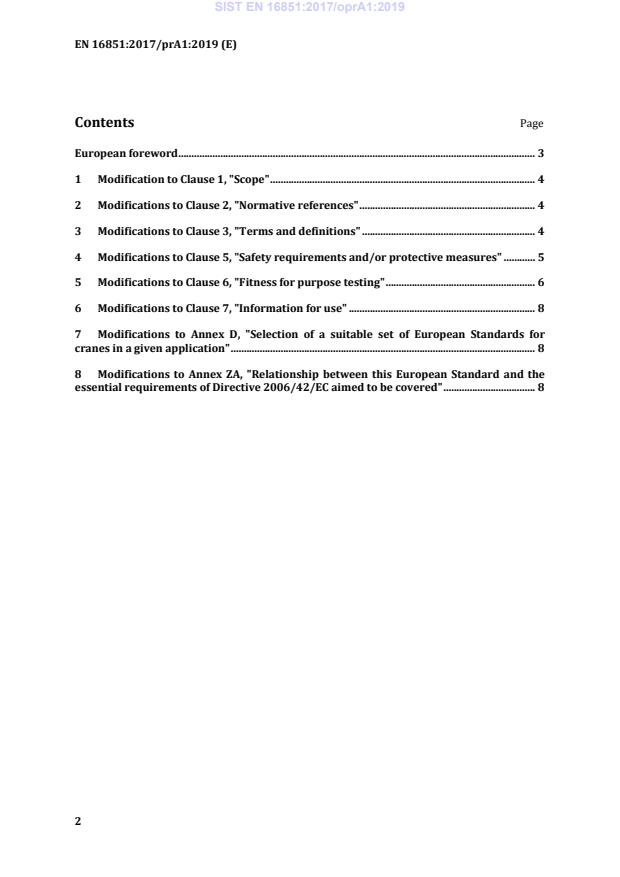
Contents Page
European foreword . 3
1 Modification to Clause 1, "Scope" . 4
2 Modifications to Clause 2, "Normative references" . 4
3 Modifications to Clause 3, "Terms and definitions" . 4
4 Modifications to Clause 5, "Safety requirements and/or protective measures" . 5
5 Modifications to Clause 6, "Fitness for purpose testing" . 6
6 Modifications to Clause 7, "Information for use" . 8
7 Modifications to Annex D, "Selection of a suitable set of European Standards for
cranes in a given application" . 8
8 Modifications to Annex ZA, "Relationship between this European Standard and the
essential requirements of Directive 2006/42/EC aimed to be covered" . 8
SIST EN 16851:2017/oprA1:2019
EN 16851:2017/prA1:2019 (E)
European foreword
This document (EN 16851:2017/prA1:2019) has been prepared by Technical Committee
CEN/TC 147 “Cranes - Safety”, the secretariat of which is held by BSI.
This document is currently submitted to the CEN Enquiry.
This document has been prepared under a mandate given to CEN by the European Commission
and the European Free Trade Association, and supports essential requirements of
EU Directive(s).
For relationship with EU Directive(s), see informative Annex ZA, which is an integral part of this
document.
SIST EN 16851:2017/oprA1:2019
EN 16851:2017/prA1:2019 (E)
1 Modification to Clause 1, "Scope"
Replace the entire clause with the following:
"This document applies to:
— light crane systems, either suspended or free-standing systems, where the rated capacity of
any single lifting device is 4 t or less;
— pillar and wall-mounted jib cranes, without an operator's cabin, and whose rated capacity is
10 t or less and the maximum slew radius of the load is 5 m or less.
NOTE For illustration of crane types, see Annex B.
Cranes not falling into the scope of this document should be covered either by another product
specific crane standard, e.g. EN 15011 (regarding light crane and free-standing systems) or
EN 14985 (regarding jib cranes) or by a combination of horizontal, subject specific crane
standards, see Annex D.
This document is applicable to cranes and crane systems, whose structures are made of steel or
aluminium, excluding aluminium structures containing welded joints.
This document gives requirements for all significant hazards, hazardous situations and events
relevant to cranes, when used as intended and under conditions foreseen by the manufacturer
(see Clause 4).
The specific hazards due to potentially explosive atmospheres, ionizing radiation, operation in
electro-magnetic fields beyond the range of EN 61000-6-2 and operation in pharmacy or food
industry are not covered by this document.
This document does not include requirements for the lifting of persons.
This document is applicable to cranes, which are manufactured after the date of approval by
CEN of this European Standard.".
2 Modifications to Clause 2, "Normative references"
Add the following references:
"EN 12644-2, Cranes — Information for use and testing — Part 2: Marking
EN 13001-3-4, Cranes — General design — Part 3-4: Limit states and proof of competence of
machinery — Bearings
EN 13001-3-6, Cranes — General design — Part 3-6: Limit states and proof of competence of
machinery — Hydraulic cylinders".
3 Modifications to Clause 3, "Terms and definitions"
In 3.5, replace the definition with the following:
"single track consisting of one or several sections, on which lifting devices or trolleys are
running
Note 1 to entry: Monorail together with lifting devices is a particular type of a light crane system.".
Delete the term and definition 3.6.
SIST EN 16851:2017/oprA1:2019
EN 16851:2017/prA1:2019 (E)
Add the following terms and definitions:
"3.6
pillar mounted jib crane
crane with a vertical pillar fixed on a floor, equipped with a slewing jib and lifting device(s)
3.7
wall mounted jib crane
crane fixed on a wall, equipped with a slewing jib and lifting device(s)
3.8
jib crane
generic term for both pillar mounted and wall mounted jib cranes
Note 1 to entry: This definition is different from that in ISO 4306-1.".
Change the following reference numbers as follows:
3.7 to 3.9
3.8 to 3.10
3.9 to 3.11
3.10 to 3.12
3.11 to 3.13
3.12 to
...