

SIST-TP CEN/CLC/TR 17602-70-23:2021
(Main)Space product assurance - Materials, mechanical parts and processes obsolescence management handbook
General Information
- Abstract
This Handbook provides guidelines to manage obsolescence of Materials, Mechanical Parts and Processes (in-house and sub-contracted).
It is useful for any actor of the European Space sector.
It covers Materials, Mechanical Parts and Processes (MMPP) used in flight hardware as well as ground support equipment (including test systems) and materials or tools used during process (not in the final product) and skills (knowhow).
It is not within the scope of this Handbook to address EEE components and software.
This document describes the general causes of obsolescences and introduces the concepts of proactive and reactive obsolescence management, depending of the programme phase.
- Status
- Published
- Public Enquiry End Date
- 14-Jul-2021
- Publication Date
- 14-Oct-2021
- Technical Committee
- I13 - Imaginarni 13
- Current Stage
- 6060 - National Implementation/Publication (Adopted Project)
- Start Date
- 13-Oct-2021
- Due Date
- 18-Dec-2021
- Completion Date
- 15-Oct-2021



Overview
CEN/CLC/TR 17602-70-23:2021 - Space product assurance: Materials, mechanical parts and processes obsolescence management handbook - is a European Technical Report that provides guidelines (not normative requirements) for managing obsolescence of Materials, Mechanical Parts and Processes (MMPP) in the space sector. It covers MMPP used in flight hardware, ground support equipment (GSE and test systems), process materials/tools and skills/know‑how. The handbook explicitly excludes EEE components and software. It explains root causes of obsolescence and introduces proactive and reactive obsolescence management approaches mapped to programme phases.
Key topics
- Causes of obsolescence: regulatory change (e.g., REACH), supplier changes, market dynamics, supplier bankruptcy, loss of skills, export controls (ITAR/EAR).
- Proactive vs Reactive strategies: anticipatory measures during design and procurement vs actions taken once discontinuance is confirmed.
- Obsolescence management team & network: roles (obsolescence manager, procurement, design, quality, production, environmental/EHS) and responsibilities for information collection, analysis and communication.
- Obsolescence management plan (OMP): planning, watch activities, risk assessment and mitigation integrated with programme lifecycle.
- Obsolescence risk analysis: prioritisation of MMPP by criticality, probability and impact; link to programme risk management.
- Data management: use of obsolescence databases, templates (Annex A), examples of database content (Annex B) and plan examples (Annex C).
- Regulatory guidance: practical information on REACH and legal implications for material selection and substitutes (Annex D).
- Best practices: supply chain management, declared lists (DML/DPL/DMPL), watch processes and substitute qualification.
Practical applications
This handbook helps organisations to:
- Ensure uninterrupted manufacturing and long-term maintenance of space systems.
- Avoid late-stage redesign and schedule/cost overruns caused by MMPP obsolescence.
- Implement an obsolescence watch, document mitigation actions and qualify substitutes.
- Maintain supply‑chain resilience and regulatory compliance (e.g., chemical restrictions).
- Reduce lifecycle risk for low‑volume, long‑lifetime space programmes that rely on heritage technologies.
Who should use this standard
- Space prime contractors and subsystem suppliers
- Programme and project managers
- Procurement and supply‑chain teams
- Quality, materials and processes engineers
- Production, AIT (assembly, integration and test) teams
- Obsolescence managers and R&D teams
Related standards
- EN 16602‑70 (ECSS-Q-ST-70) Space product assurance - Materials, mechanical parts and processes
- EN 16602‑70‑71 ECSS-Q-ST-70-71 (materials/process data selection)
- EN 16601‑10, EN 16601‑80 (project planning, risk management)
- EN 62402:2007 (Obsolescence management application guide)
- European REACH regulation (ECHA) - regulatory context and obligations
Keywords: obsolescence management, space product assurance, materials mechanical parts processes, MMPP, obsolescence risk analysis, REACH, obsolescence management plan, supply chain management.
Relations
- Effective Date
- 09-Feb-2026
Get Certified
Connect with accredited certification bodies for this standard

BSI Group
BSI (British Standards Institution) is the business standards company that helps organizations make excellence a habit.

Bureau Veritas
Bureau Veritas is a world leader in laboratory testing, inspection and certification services.

DNV
DNV is an independent assurance and risk management provider.
Sponsored listings
Frequently Asked Questions
SIST-TP CEN/CLC/TR 17602-70-23:2021 is a technical report published by the Slovenian Institute for Standardization (SIST). Its full title is "Space product assurance - Materials, mechanical parts and processes obsolescence management handbook". This standard covers: This Handbook provides guidelines to manage obsolescence of Materials, Mechanical Parts and Processes (in-house and sub-contracted). It is useful for any actor of the European Space sector. It covers Materials, Mechanical Parts and Processes (MMPP) used in flight hardware as well as ground support equipment (including test systems) and materials or tools used during process (not in the final product) and skills (knowhow). It is not within the scope of this Handbook to address EEE components and software. This document describes the general causes of obsolescences and introduces the concepts of proactive and reactive obsolescence management, depending of the programme phase.
This Handbook provides guidelines to manage obsolescence of Materials, Mechanical Parts and Processes (in-house and sub-contracted). It is useful for any actor of the European Space sector. It covers Materials, Mechanical Parts and Processes (MMPP) used in flight hardware as well as ground support equipment (including test systems) and materials or tools used during process (not in the final product) and skills (knowhow). It is not within the scope of this Handbook to address EEE components and software. This document describes the general causes of obsolescences and introduces the concepts of proactive and reactive obsolescence management, depending of the programme phase.
SIST-TP CEN/CLC/TR 17602-70-23:2021 is classified under the following ICS (International Classification for Standards) categories: 03.120.99 - Other standards related to quality; 49.140 - Space systems and operations. The ICS classification helps identify the subject area and facilitates finding related standards.
SIST-TP CEN/CLC/TR 17602-70-23:2021 has the following relationships with other standards: It is inter standard links to SIST EN IEC 62402:2019. Understanding these relationships helps ensure you are using the most current and applicable version of the standard.
SIST-TP CEN/CLC/TR 17602-70-23:2021 is associated with the following European legislation: Standardization Mandates: M/496. When a standard is cited in the Official Journal of the European Union, products manufactured in conformity with it benefit from a presumption of conformity with the essential requirements of the corresponding EU directive or regulation.
SIST-TP CEN/CLC/TR 17602-70-23:2021 is available in PDF format for immediate download after purchase. The document can be added to your cart and obtained through the secure checkout process. Digital delivery ensures instant access to the complete standard document.
Standards Content (Sample)
SLOVENSKI STANDARD
01-december-2021
Zagotavljanje kakovosti proizvodov v vesoljski tehniki - Priročnik za upravljanje
zastarelosti materialov, mehanskih delov in procesov
Space product assurance - Materials, mechanical parts and processes obsolescence
management handbook
Raumfahrtproduktsicherung - Handbuch für Obsoleszenzmanagement von Materialien,
mechanischen Bauteilen und Prozessen
Assurance produit des projets spatiaux - Manuel de gestion de l’obsolescence des
matériaux, des pièces mécaniques et des procédés
Ta slovenski standard je istoveten z: CEN/CLC/TR 17602-70-23:2021
ICS:
03.120.99 Drugi standardi v zvezi s Other standards related to
kakovostjo quality
49.140 Vesoljski sistemi in operacije Space systems and
operations
2003-01.Slovenski inštitut za standardizacijo. Razmnoževanje celote ali delov tega standarda ni dovoljeno.
TECHNICAL REPORT
CEN/CLC/TR 17602-70-
RAPPORT TECHNIQUE
TECHNISCHER BERICHT
October 2021
ICS 49.140
English version
Space product assurance - Materials, mechanical parts and
processes obsolescence management handbook
Assurance produit des projets spatiaux - Manuel de Raumfahrtproduktsicherung - Handbuch für
gestion de l'obsolescence des matériaux, des pièces Obsoleszenzmanagement von Materialien,
mécaniques et des procédés mechanischen Bauteilen und Prozessen
This Technical Report was approved by CEN on 16 August 2021. It has been drawn up by the Technical Committee CEN/CLC/JTC
5.
CEN and CENELEC members are the national standards bodies and national electrotechnical committees of Austria, Belgium,
Bulgaria, Croatia, Cyprus, Czech Republic, Denmark, Estonia, Finland, France, Germany, Greece, Hungary, Iceland, Ireland, Italy,
Latvia, Lithuania, Luxembourg, Malta, Netherlands, Norway, Poland, Portugal, Republic of North Macedonia, Romania, Serbia,
Slovakia, Slovenia, Spain, Sweden, Switzerland, Turkey and United Kingdom.
CEN-CENELEC Management Centre:
Rue de la Science 23, B-1040 Brussels
© 2021 CEN/CENELEC All rights of exploitation in any form and by any means Ref. No. CEN/CLC/TR 17602-70-23:2021 E
reserved worldwide for CEN national Members and for
CENELEC Members.
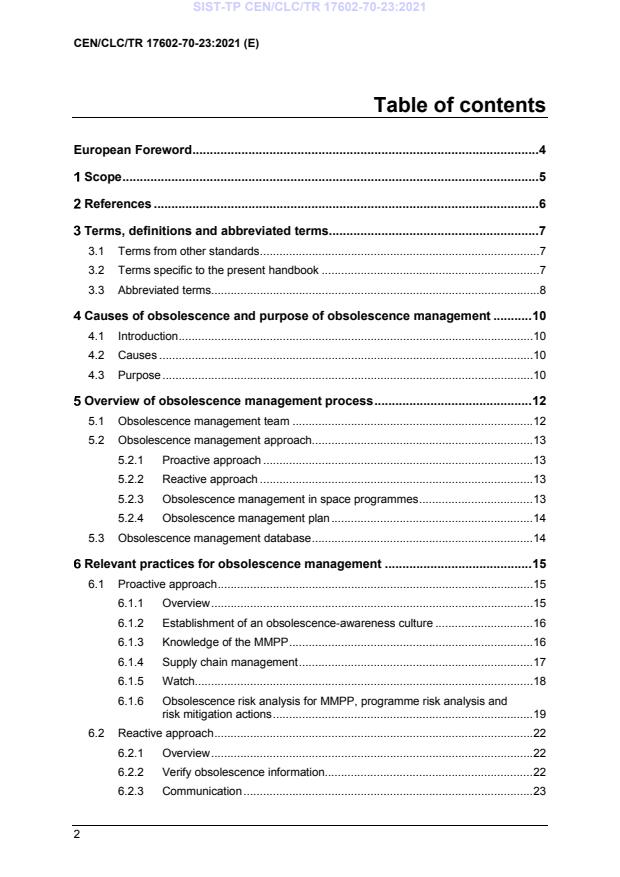
Table of contents
European Foreword . 4
Scope . 5
References . 6
Terms, definitions and abbreviated terms . 7
3.1 Terms from other standards . 7
3.2 Terms specific to the present handbook . 7
3.3 Abbreviated terms. 8
Causes of obsolescence and purpose of obsolescence management . 10
4.1 Introduction . 10
4.2 Causes . 10
4.3 Purpose . 10
Overview of obsolescence management process . 12
5.1 Obsolescence management team . 12
5.2 Obsolescence management approach . 13
5.2.1 Proactive approach . 13
5.2.2 Reactive approach . 13
5.2.3 Obsolescence management in space programmes . 13
5.2.4 Obsolescence management plan . 14
5.3 Obsolescence management database . 14
Relevant practices for obsolescence management . 15
6.1 Proactive approach . 15
6.1.1 Overview . 15
6.1.2 Establishment of an obsolescence-awareness culture . 16
6.1.3 Knowledge of the MMPP . 16
6.1.4 Supply chain management . 17
6.1.5 Watch. 18
6.1.6 Obsolescence risk analysis for MMPP, programme risk analysis and
risk mitigation actions . 19
6.2 Reactive approach . 22
6.2.1 Overview . 22
6.2.2 Verify obsolescence information. 22
6.2.3 Communication . 23
6.2.4 Application case analysis . 23
6.2.5 Obsolescence treatment . 23
Obsolescence data management . 25
7.1 In-house data management . 25
7.2 Network communication. 25
Annex A Obsolescence information template . 26
Annex B Example of content of obsolescence management database . 27
Annex C Example of obsolescence management plan . 28
Annex D Information about the REACH regulation . 29
Background . 29
D.1.1 Overview . 29
D.1.2 Definition of terms . 29
D.1.3 Relationship between substances, mixtures, and articles . 30
Technical consequences of REACH . 31
Additional information . 36
Figures
Figure 5-1: Obsolescence management versus space programme phases . 14
Figure 6-1: Proactive approach best practices scheme . 15
Figure 6-2: Reactive approach best practices scheme . 22
Tables
Table D-1 : Summary of legal obligations of industry, possible associated actions,
schedules as a function of regulatory step - Possibly long-term . 33
Table D-2 : Summary of legal obligations of industry, possible associated actions,
schedules as a function of regulatory step - Possibly mid-term . 34
Table D-3 : Summary of legal obligations of industry, possible associated actions,
schedules as a function of regulatory step - Imminent . 35
European Foreword
This document (CEN/CLC/TR 17602-70-23:2021) has been prepared by Technical Committee
CEN/CLC/JTC 5 “Space”, the secretariat of which is held by DIN.
It is highlighted that this technical report does not contain any requirement but only collection of data
or descriptions and guidelines about how to organize and perform the work in support of EN 16602-
70-23.
This Technical report (CEN/CLC/TR 17602-70-23:2021) originates from ECSS-Q-HB-70-23A.
Attention is drawn to the possibility that some of the elements of this document may be the subject of
patent rights. CEN [and/or CENELEC] shall not be held responsible for identifying any or all such
patent rights.
This document has been prepared under a mandate given to CEN by the European Commission and
the European Free Trade Association.
This document has been developed to cover specifically space systems and has therefore precedence
over any TR covering the same scope but with a wider domain of applicability (e.g.: aerospace).
Scope
This Handbook provides guidelines to manage obsolescence of Materials, Mechanical Parts and
Processes (in-house and sub-contracted).
It is useful for any actor of the European Space sector.
It covers Materials, Mechanical Parts and Processes (MMPP) used in flight hardware as well as
ground support equipment (including test systems) and materials or tools used during process (not in
the final product) and skills (know-how).
It is not within the scope of this Handbook to address EEE components and software.
This document describes the general causes of obsolescences and introduces the concepts of proactive
and reactive obsolescence management, depending of the programme phase.
References
EN Reference Reference in text Title
EN 16601-00-01 ECSS-S-ST-00-01 ECSS system – Glossary of terms
EN 16602-70 ECSS-Q-ST-70 Space product assurance – Materials, mechanical parts and
processes
EN 16602-70-71 ECSS-Q-ST-70-71 Space product assurance – Material, processes and their
data selection
EN 16601-10 ECSS-M-ST-10 Space project management – Project planning and
implementation
EN 16601-80 ECSS-M-ST-80 Space project management – Risk management
EN 62402:2007 Obsolescence management - Application guide
T. Rohr et al., ISMSE-12 Impact of REACH Legislation on European Space
ESTEC Noordwijk, The Programs
Netherlands, 2012
M. Chevalier et al., ISMSE- A method to customize qualification of substitutes in case
13 Pau, France, 2015 of material or process obsolescence
Terms, definitions and abbreviated terms
3.1 Terms from other standards
a. For the purpose of this document, the terms and definitions from ECSS-S-ST-00-01 apply, in
particular the following terms:
1. design
2. development
3. life cycle
4. lifetime
5. material
b. For the purpose of this document, the terms and definitions from ECSS-Q-ST-70 apply, in
particular the following term:
1. mechanical part
2. process
3.2 Terms specific to the present handbook
3.2.1 bill of MMPP
list of materials, processes or mechanical parts that are needed to manufacture or repair an end
product
NOTE This is reported in Declared Materials List (DML), Declared Processes
List (DPL) and Declared Mechanical Parts List (DMPL).
3.2.2 criticality
measure of severity of the consequences of MMPP obsolescence with regard to its use
3.2.3 obsolescence
transition from availability to unavailability of a material, mechanical part or process from the
manufacturer or supplier
NOTE The unavailability can be permanent or temporary.
3.2.4 obsolescence management network
network of persons in charge of collecting, transmitting and recording all the information concerning
obsolescence issues and responsible to implement risk mitigation actions and obsolescence treatment
actions
NOTE Members of the obsolescence network can represent different
functions (e.g. procurement, quality, production, and design office)
3.2.5 obsolescence manager
person in charge of coordinating and supervising obsolescence management at company level and
following up obsolescence treatment projects progress
3.2.6 obsolescence risk analysis
assessment of the probability and severity of the risk of obsolescence and prioritization of the
obsolescence risk
3.2.7 proactive obsolescence management
actions to anticipate obsolescence and to mitigate the risks linked to obsolescence issues
3.2.8 reactive obsolescence management
reactive strategy consists in reacting only when the obsolescence is proven
1 Obsolescence is considered as proven when a discontinuance date is
known.
2 The discontinuance date can be transmitted through a formal
document by the supplier or related to date of ban determined by a
regulation.
3.3 Abbreviated terms
For the purpose of this document, the following abbreviated terms apply:
Abbreviation Meaning
application for authorization
AfA
assembly, integration and test
AIT
Aerospace and Defense Industries Association of Europe
ASD
bill of material
BOM
Chemical Abstract Service Number
CAS Number
classification and labelling
C&L
classification, labelling and packaging
CLP
carcinogenic, mutagenic, reprotoxic
CMR
community rolling action plan
CoRAP
commercial off-the-shelf
COTS
declared materials list
DML
declared mechanical parts list
DMPL
Abbreviation Meaning
declared processes list
DPL
Export Administration Regulations
EAR
European Chemical Agency
ECHA
European Community number
EC Number
European Economic Area
EEA
electrical, electronic and electromechanical
EEE
environment, health and safety
EHS
European Union
EU
Groupement des industries françaises aéronautiques et
GIFAS
spatiales (French Aerospace Industries Association)
handbook
HB
harmonised classification and labelling
HCL
International Traffic in Arms Regulations
ITAR
materials, mechanical parts and processes
MMPP
materials and processes
M&P
Materials, Mechanical Parts and Processes Control Board
MPCB
Materials and Processes Technology Board
MPTB
member state
MS
ozone depleting substance
ODS
obsolescence management
OM
obsolescence management plan
OMP
Public Activities Coordination Tool
PACT
persistent, bioaccumulative and toxic
PBT
persistent organic pollutants
POP
research and development
R&D
Registration, Evaluation and Authorization of Chemicals
REACH
(European regulation)
risk management option analysis
RMOA
restriction of hazardous substances
RoHS
safety data sheet
SDS
substitute it now list
SIN List
substance of very high concern
SVHC
technology readiness level
TRL
very persistent and very bioaccumulative
vPvB
Causes of obsolescence and purpose of
obsolescence management
4.1 Introduction
Obsolescence can affect all space products throughout their lifecycle. Through obsolescence
management appropriate actions are put in place to minimise detrimental impact and costs
throughout the product life.
4.2 Causes
The main causes of obsolescence are:
a. Regulations and their evolution: Environmental regulations such as REACH, health and safety.
b. Import – export constraints: export control (e.g. ITAR), export licence, embargo.
c. Changes from suppliers such as
1. product evolution (formulation, raw material supply chain, packaging, product
properties, deviation from original specification),
2. manufacturing processes and means, streamlining of product ranges, manufacturing
stop, change of manufacturing location,
3. product designation, industrial re-organization.
d. Supplier force major circumstances: bankruptcies, industrial accidents (e.g. fire, explosion), loss
of know-how, natural disasters (e.g. flooding, storm, earthquake).
e. Market competitiveness such as too low volume of production, outdated technology, indirect
impact of environmental regulations.
NOTE Indirect impact of environmental regulations means that even if the
space sector is out of the scope (e.g. RoHS), the market availability is
driven by much larger actors that need to comply and drive
alternative product development.
f. Loss of employee specific skills and company know-how.
4.3 Purpose
The increasing number of obsolescence issues affects the space sector particularly due to the specific
characteristics of space programmes:
a. Long life cycles (especially for space transportation).
b. Low purchase volumes.
c. Long MMPP qualification time (e.g. high performance requirements, high safety standards,
complex interactions between systems, and multinational programmes).
d. Low production volumes.
e. Use of proven technologies (heritage).
f. Complex contractual supply chain.
Obsolescence management of MMPP is an added-value to limit impacts of obsolescence to:
a. Ensure undisrupted manufacturing and maintenance of the space hardware during the whole
programme life time.
b. Avoid redesign during a later stage of the space programme.
c. Minimise cost and planning time.
d. Meet customer requirements related to obsolescence management.
e. Guarantee quality and sustainability of the supply chain.
f. Avoid use a non-qualified MMPP.
Overview of obsolescence management
process
5.1 Obsolescence management team
The establishment of an obsolescence management team is key of success of obsolescence
management (OM), including the identification of a person devoted to centralize information. This
person is responsible for the control of information as follows:
a. Set up actions to get the information as soon as possible
b. Information analysis
c. Communication of the information within internal network
This person can rely on the obsolescence management-dedicated network. This network can be
composed of different representatives that include the following functions:
a. Programme and project management
b. Procurement
c. M&P support
d. Quality control
e. Production
f. Design
g. Environment, health and safety
h. Product stewardship (product management and regulation specialist)
i. Legal support (REACH, export control …)
It is important that within companies a reciprocal communication line between OM management team
and other company members is established.
The OM team manages the implementation and the follow-up of actions, e.g. preventing obsolescence,
mitigating risk, treating obsolescence. It is responsible for the communication of the obsolescence
information to other members of the company.
It is essential that the OM team members are clearly identified inside the company. By that, any
member of the company becoming aware of obsolescence issues, informs the obsolescence
management team in timely manner.
5.2 Obsolescence management approach
5.2.1 Proactive approach
The proactive OM approach consists of tracking any potential cause of obsolescence in order to
anticipate future obsolescence cases. It also aims at:
a. anticipating strategies in order to have a mitigation solution once obsolescence occurs.
b. not selecting obsolete or limited-life MMPP as alternative solution or as baseline in new
developments
The proactive approach is implemented at each step of the life of space products to meet product
lifetime requirements. It is important that the proactive approach is applied to all stages of a product
life-cycle, starting from the design phase.
This approach includes continuous monitoring for MMPP availability that allows identifying or
predicting their obsolescence date. This monitoring also allows assessing the risk of obsolescence
occurrence and its criticality for space hardware.
5.2.2 Reactive approach
Following the reactive strategy, actions are taken only when the obsolescence is confirmed, e.g.
identification of alternative solutions, stock-piling, no action.
5.2.3 Obsolescence management in space programmes
Obsolescence management involves implementing scheduled and coordinated actions in order to
secure the availability of a product during its entire life-cycle, through technical and economical
means (e.g. replacement, stockpiling). It can be implemented, as early as possible for better
anticipation, during all phases of a space programme such as design definition, development,
production, use, maintenance, spares and repairs.
Whenever possible, priority can be given to the proactive over reactive approach. A general scheme
describing the interaction between OM and space programme phases is shown in Figure 5-1.
Obsolescence management starts with the implementation of an obsolescence management plan. It
can start as early as the feasibility phase of space programmes by setting up an approach for
obsolescence management.
Implementation of proactive measures can start as soon as possible, for example from preliminary
definition, before bills of MMPP are available. A preliminary item list can be assessed in order to
identify obsolete or potential obsolete items. Also the manufacturer or supplier can be required to
inform the customer about the MMPP obsolescence status.
A detailed process to verify obsolescence issues can be typically implemented after PDR during the
detailed definition phase (phase C). During this stage, appropriate actions can be carried out in
accordance to the defined OM approach. A periodical review of obsolescence risks for products and
technologies can be managed at least at each design review throughout the whole programme.
It is important to perform communication between the OM team and other members of the company
in a continuous way, and is prerequisite for successful obsolescence management. It is also important
to collect, analyze, store and distribute information (knowledge management) to improve the
company OM process.
Space programme phases:
Preparatory phase Development phase Vehicle exploitation phase
Phase 0
Phase B Phase D Phase E
Phase C
Phase A Phase F
Mission Analysis /
Preliminary Qualification & Operation &
Needs Feasibility Detailed definition Disposal
definition Production Utilisation
identification
Obsolescence management:
Design for obsolescence
Implement proactive measures as early
as possible, preferably in the design
phase
Plan for obsolescence Check for new obsolescence&Act as planned
Develop obsolescence management
Check for new obsolescence to ensure early
approach in the framework of
reaction, consult the OM approach and apply an
product life cycle management
appropriate reactive option to handle occurred
obsolescence
Knowledge management
Communicating
[Based on ECSS-M-ST-10 and EN 62402:2007]
Figure 5-1: Obsolescence management versus space programme phases
5.2.4 Obsolescence management plan
Implementing an obsolescence management plan can be an effective way to mitigate obsolescence risk
especially for long-term space programmes. An example of the content of an obsolescence
management plan is provided in the Annex C. This plan is part of the proactive approach and can
complement the project risk management process.
5.3 Obsolescence management database
To anticipate and treat obsolescence, it is important to gather all the information in an obsolescence
management database independent of the considered OM approach (proactive or reactive). An
example of the content for an OM database is given in Annex B.
Relevant practices for obsolescence
management
6.1 Proactive approach
6.1.1 Overview
Proactive best practices are summarized in Figure 6-1. The steps coloured in orange are explained in
the present section 6.1.
Bill of
MMPP
- Knowledge of
MMPP
- Watch
- Supply chain
management
Establish
obsolescence
risk level for
each MMPP
Risk analysis
vs impact on
program
yes
Risk?
Risk
no
mitigation
actions
Monitoring
of
MMPP list
Manufacturing
Figure 6-1: Proactive approach best practices scheme
6.1.2 Establishment of an obsolescence-awareness culture
Establishing an obsolescence-awareness culture inside a company can constitute a change of mindset
in programme management, through communication and participation of all company employees. It
allows to anticipate obsolescence issues as integral part of project management. Obsolescence
management training can be an appropriate way to raise obsolescence awareness. It is important to
involve all members of the company, especially newcomers in such a training.
6.1.3 Knowledge of the MMPP
Prerequisite of obsolescence management is the knowledge of MMPP, this means to have the most
complete information about the composition of selected materials, mechanical parts and formulations
used during manufacturing processes. The detailed knowledge about MMPP allows the identification
of MMPP changes, including the identification of substances that are part of MMPP and face
obsolescence risks due to regulatory impact. The relevant information can be collected from suppliers
or sub-contractors or obtained in-house and be included in the obsolescence management database.
The following information can be collected:
a. Information from suppliers
1. Safety data sheets (SDS) analysis: The information relevant to be analyzed in SDSs are
CAS or EC numbers, changes to be checked and verified with supplier (change of CAS or
EC numbers, change of substance percentages, addition or removal of substances). It is
important to ask the supplier on a regular basis for an update of SDSs, especially for
products less frequently procured
2. Interviews of suppliers: Information about precursor or auxiliary substances,
intermediates, information about the supplier’s obsolescence risk management process
3. Request for procurement specification changes
4. Certificates of performance and associated test data
5. Supplier’s declarations, incl. REACH article 33 declarations
b. Information obtained in-house
Any change in performance and possibly composition can be tracked through incoming
inspections tests or monitoring of drift of process control parameters.
c. Information obtained from subcontractors
Information can be gathered through basic contractual documentation to be delivered to
customers, such as DML, DMPL and DPL. It is the responsibility of each customer in the supply
chain to ask its subcontractors to provide their obsolescence analysis. Such request can be done
e.g. during materials process control boards (MPCB), or even earlier during a preliminary
review milestone.
1 The MMPP lists do not provide the entire design information.
2 Performing MPCBs even for recurrent equipment, can be
recommended to track obsolescence issues.
d. Any other information
Information can also be found in literature, patents, and through networking. All the gathered
information can be systematically included in a dedicated tool for MMPP knowledge
management. It is important to maintain it up-to-date in order to facilitate subsequent risk
analysis.
6.1.4 Supply chain management
6.1.4.1 Overview
It is important to involve actively downstream supply chain actors in obsolescence management. It
can be done by specifying contractual obsolescence management requirements, through suppliers and
subcontractors monitoring, or by dedicated procurement specifications with suppliers.
6.1.4.2 Contractual obsolescence management requirements to supply
chain
Contractual clauses for obsolescence management can include:
a. notification modes, process how obsolescence is communicated, and schedules
b. possible consequences in case the notification deadline was not respected
c. stock constitution modes if relevant (minimum quantity)
The supplier or subcontractor can be asked to demonstrate how he continuously monitors the
availability of MMPP used in the design or manufacturing of the equipment. This can include but is
not be limited to:
a. having an obsolescence management system in place to identify early and to react to an
occurrence of MMPP obsolescence
b. making agreements with suppliers and subcontractors to provide early warning of supply
disruption or MMPP obsolescence
6.1.4.3 Supplier and subcontractor monitoring
To gain better knowledge of supplier products in addition to product changes (section 6.1.3), the
customer can perform supplier or subcontractor monitoring for obsolescence issues to track the
following changes:
a. Plans for production shut down
b. Change of production location or capacity
c. Change of minimum order volume
d. Company re-organization
e. Risk of bankruptcy
f. Design change
g. Loss of know-how
h. Technology development road map
i. Change of manufacturing means
The monitoring process can be performed through:
a. Audits
b. Regular exchanges (meetings, visits) whatever the frequency of orders.
c. Asking for notification letters
d. Financial analysis
e. Networking (outside the direct supply chain)
6.1.4.4 Procurement specification with the supplier
A procurement specification can be agreed with the supplier which can include:
a. A requirement to inform its customer of any change of its product or process used to
manufacture it at defined number of months before the implementation of change (early
warning of supply obsolescence or disruption)
NOTE It is important that the deadline for early warning covers the time to
ensure maintenance of the production capability of the hardware
b. Capacity to procure the MMPP in quantity necessary before switching to an alternative
solution. Stockpiling needs to cover the qualification period for new products or to allow
finalization of the production.
c. Detailed description of a product including composition and processes used.
6.1.5 Watch
Continuous survey of regulatory and market developments is necessary to gather obsolescence-
related information. This monitoring can involve all company employees as everybody can get
information and contribute to obsolescence anticipation. For efficient information exchange, a
dedicated network can be established (see section 5.1). The monitoring perimeter needs to be defined,
monitoring can be more or less active depending on the criticality of the products. More attention can
be paid to products that are more critical and less frequently ordered. The following aspects of
monitoring can be considered:
a. Regulation watch
1. Environmental regulations including RoHS, REACH, radiation protection regulation
(Directive 2003/122/Euratom), environmental national regulations, ODS, POP.
2. Export control including ITAR, EAR, and embargos.
3. Anticipation of environmental regulation developments including SIN list, REACH
CoRAP, REACH PACT.
NOTE For more details regarding the REACH regulation, the reader can
refer to the Annex D.
b. Market watch for products and market trends, existing and future technologies, alternative
technologies, information about supply-demand
1. Public information from the internet
2. Trade shows
3. Technology publications
4. Manufacturers and suppliers visits
c. Strategic materials watch
1. British Geological Survey (www.bgs.ac.uk)
2. Conflict materials (www.conflictfreesourcing.org)
d. Networking
Gathering and sharing experience with obsolescence issues with other organizations (external
communication) is a recommended approach. Information can be shared amongst organizations in
order to implement joint actions (consortium, professional groups). Examples of such groups for
space sector are the MPTB, ASD-Eurospace and other national associations (e.g. GIFAS in France).
6.1.6 Obsolescence risk analysis for MMPP, programme risk
analysis and risk mitigation actions
The first step of proactive obsolescence management is to establish for each MMPP an obsolescence
risk analysis. For this, some obsolescence risk indicators are presented in the Table 6-1. It is up to each
company to determine the relative weight of each obsolescence risk. Information about risk
management in space projects can be found in ECSS-M-ST-80.
Based on the output of this obsolescence risk analysis, higher risk rated MMPP are assessed regarding
their use and criticality in the programme. The result can be included in the programme risk matrix
and in the critical items list.
An action plan is triggered when the risk is higher than a certain level to be determined by each
company. According to the results of the risk analysis, following actions can be implemented to
decrease the programmatic risk (see Table 6-1).
Table 6-1: Examples of risk mitigation actions to be implemented as a function of
obsolescence risk type
Category Obsolescence Risk Factor Risk mitigation actions
• identify and possibly evaluate and qualify a
second source
Single source
• improve contractual relationship with the
supplier
• REACH authorization
• Analysis of alternative
• Clarify with supplier its position
Legislative impact (incl. environmental
• Exemption
regulation impact, for instance from
• Check the impact of restriction on the market
REACH or RoHS, and export control) and
• Identify non-Export Control sources
geopolitics constraints.
• Stockpiles (life time of MMPP to be
considered)
• Lobbying
• Stockpiles
Scarce (shortage such as for carbon fibres,
• Lobbying
strategic materials such rare-earth-based
materials, embargo, risk of counterfeit…)
• Having information about supply-demand
• improve contractual relationship with the
supplier
• search for another supplier
Long time for delivery (in case of non-
conformity of a lot)
• Buffer stockpile (periodical restocking?)
Procurement
• Implement some intermediate tests to ensure
that the lot will be compliant
• Find synergies with other companies
Low consumption level (risk of
o Lobbying
rationalization if Space sector is the only
user)
• Stockpile
Specific requirements (properties difficult Technical survey to adapt the specification to the
to obtain on the market) for non-COTS market
• Technical audit
• Contact directly the manufacturer
Lack of knowledge of the supply chain
• Avoid as far as possible intermediates in
(brokers) procurement
• Technical audits
• Improve procurement specification if
Recurrent quality problems with the
necessary
supplier or subcontractor
• Look for another supplier
No procurement agreement with the Improve contractual(or not) relationship with
supplier or manufacturer the supplier
Bad financial situation of the supplier Identify another supplier
Very small company Identify another supplier
Category Obsolescence Risk Factor Risk mitigation actions
Design driver (change in one MMPP
would induce a change in the whole Improve design robustness to allow the
design (for instance impact on mass), such substitutions of MMPP
as for beryllium case)
Design
• Strong R&D capability
Technology driver (for example, in the
case of the hydrazine and gallium
• Strong relationship with scientific
arsenide, MMPP too application-specific)
laboratories
Common MMPP, multiple company
Exhaustive mapping of all materials usages
usages
• Maintain skills through training
Scarce skills involved • Avoid single point failure
• Anticipate retirement
• Buffer stockpile
Used in end product that has a long
• Start obsolescence management at design
operational life (maintenance) and long
phase
life cycle (recurrent manufacturing, long
Application -
space programme from design to
• Select up-to-date technologies
manufacturing)
Manufacturing
• Anticipate manufacturing of spare parts
and AIT
• Anticipate procurement of spare parts for
(assembly
maintenance of machines
integration &
• Develop close relationship with the
Use of technology or process outdated
manufacturer of the machine
test)
(for example, machine maintenance more
and more difficult to ensure)
• Use second hand market for spare parts of
machines
• Evaluate an up-to-date technology
• Inform supplier of the targeted application
• Identify an alternative solution whose
MMPP not used according to the
function determined by supplier corresponds
application for which this MMPP has been
developed by the supplier to the application
• Improve design review process
• Design change
No viable alternative identified or
evaluated
• R&D
Availability of
alternatives • Design change
High cost of alternative
and • R&D
technology
• Stockpile
High cost and duration of qualification
readiness level compared to available budget and
• Take decision of procurement at an
schedule
intermediate milestone of the qualification
Collateral effects on higher level
assemblies (for example, the replacement
Exhaustive mapping of all higher level impacted
of a primer can induce requalification of
MMPP
paints, adhesive bonding used
subsequently)
Note 1: In case of stockpile, it can be useful to assess possibility to extent lifetime of the MMPP.
Note 2: Periodical restocking can be preferred to long term storage to maintain a certain monitoring on the
product, when it is possible.
6.2 Reactive approach
6.2.1 Overview
Reactive best practices are summarized in Figure 6-2. The steps coloured in orange are explained in
more detail in the present section 6.2.
Verifying if
yes
Application Program action
Used?
obsolescence is
cases analysis
plan
proven
no
No action
Obsolescence
treatment
Implementation
into
Manufacturing
Figure 6-2: Reactive approach best practices scheme
6.2.2 Verify obsolescence information
The first step for the reactive approach is to verify that the obsolescence is proven. As an example, it
can be determined through an official statement from the supplier or through regulatory decisions.
Gathering obsolescence information is necessary to adopt mitigation measures. The required
information can include (non-exhaustive list):
a. Definition of the obsolescence type: REACH, manufacturing stop, change of manufacturing site,
change of manufacturing process, export control regulations, reformulation of material or
mechanical part.
b. Date of the effectiveness of the obsolescence.
c. Possibility of last-buy order including quantity and date.
d. Proposal of alternative solution in the obsolescence notification (if available) and date of
availability of this alternative.
NOTE This information can be gathered in a template to ensure efficiency,
completeness and consistency of information (see Annex A).
In addition to an official statement, for understanding the consequences of obsolescence as well as
performance of proposed alternatives, other technical information can be collected. This can be done
by communication with product suppliers or manufacturers, through working groups, partners, and
sub-contractors. It is important to collect obsolescence related information from a wide range of
information sources to verify the use of the MMPP (in-house, at supplier or sub-contractor level).
6.2.3 Communication
It is important to disseminate obsolescence related information inside the company and flag this
information in dedicated tools to ensure that designers, procurement and product assurance are aware
of the obsolescence issue. It is also important to share the obsolescence information outside the
company with defined actors such as sub-contractors, customers, and other organizations (e.g. MPTB).
6.2.4 Application case analysis
To enable a consolidated MMPP application case (impact) analysis, it is important to collect at least
information about the MMPP uses, their applications, and programmes that are impacted. When an
obsolescence issue occurs, the following non-exhaustive list can be verified:
a. Analyze the time required to treat the obsolescence in line with the programme schedule
b. Check the possibility of stockpiling
c. Investigate availability of MMPP alternative
d. Verify the duration of the alternative MMPP qualification
e. Validate if the alternative MMPP is compliant with regulation or import-export constraints
f. Evaluate the possibility of change of technical specifications to accommodate the new
performance of alternative MMPP or to change the design
g. Assess the possibility to ensure regulation compliance (e.g. REACH authorization or
exemption)
With this application case analysis a programme action plan for obsolescence mitigation can be
implemented.
6.2.5 Obsolescence treatment
Several mitigation actions can be implemented (non-exhaustive list):
a. Prepare a stockpile of MMPP, where the feasibility depends on:
1. product availability from suppliers
2. last buy order
3. shelf life of the product
4. status of the product with regard to regulations
5. storage costs
b. Anticipate the production life-cycle and volume to manufacture stockpiles.
c. Evaluate and qualify an alternative MMPP solution such as:
1. new material or process
2. new supplier
3. new sub-contractor
4. new solution proposed by the supplier
d. Modify the design.
e. Change or prepare deviation of requirements (in early programme phase).
f. Take no actions, e.g. in case when the programme ends before the obsolescence date or for very
minor MMPP changes not imposing any tests. It is important to justify and record this decision.
1 Several of these actions can be managed in combination.
2 Several of these actions can be considered as a transitory solution,
giving time to qualify a permanent solution.
3 An example of methodology of obsolescence treatment can be found
in “A me
...