

SIST-TP CEN/TR 17602-30-03:2022
(Main)Space product assurance - Human dependability handbook
General Information
- Abstract
The handbook defines the principles and processes of human dependability as integral part of system safety and dependability. The handbook focuses on human behaviour and performance during the different operation situations as for example in a control centre such as handover to routine mission operation, routine mission operation, satellite maintenance or emergency operations.
This handbook illustrates the implementation of human dependability in the system life cycle, where during any project phase there exists the need to systematically include considerations of the:
- Human element as part of the space system,
- Impact of human behaviour and performance on safety and dependability.
Within this scope, the main application areas of the handbook are to support the:
a. Development and validation of space system design during the different project phases,
b. Development, preparation and implementation of space system operations including their support such as the organisation, rules, training etc.
c. Collection of human error data and investigation of incidents or accidents involving human error.
The handbook does not address:
- Design errors: The handbook intends to support design (and therefore in this sense, addresses design errors) regarding the avoidance or mitigation of human errors during operations. However, human error during design development are not considered.
- Quantitative (e.g. probabilistic) analysis of human behaviour and performance: The handbook does not address probabilistic assessment of human errors as input to system level safety and dependability analysis and consideration of probabilistic targets, and
- Intentional malicious acts and security related issues: Dependability and safety deals with "threats to safety and mission success" in terms of failures and human non malicious errors and for the sake of completeness includes "threats to safety and mission success" in terms of malicious actions, which are addressed through security risk analysis. However by definition "human dependability" as presented in this handbook excludes the consideration of "malicious actions" and security related issues i.e. considers only "non-malicious actions" of humans.
The handbook does not directly provide information on some disciplines or subjects, which only indirectly i.e. at the level of PSFs (see section 5) interface with "human dependability". Therefore the handbook does not provide direct support to "goals" such as:
- optimize information flux in control room during simulations and critical operations,
- manage cultural differences in a team,
- cope with negative group dynamics,
- present best practices and guidelines about team training needs and training methods,
- provide guidelines and best practices concerning planning of shifts,
- present basic theory about team motivation, and
- manage conflict of interests on a project.
1.2 Objectives
The objectives of the handbook are to support:
- Familiarization with human dependability (see section 5 "principles of human dependability"). For details and further reading see listed "references" at the end of each section of the handbook.
- Application of human dependability; (see section 6 "human dependability processes" and 7 "implementation of human dependability in system life cycle").
- Status
- Published
- Public Enquiry End Date
- 20-Oct-2021
- Publication Date
- 19-Dec-2021
- Technical Committee
- I13 - Imaginarni 13
- Current Stage
- 6060 - National Implementation/Publication (Adopted Project)
- Start Date
- 08-Dec-2021
- Due Date
- 12-Feb-2022
- Completion Date
- 20-Dec-2021

Overview
SIST-TP CEN/TR 17602-30-03:2022 - Space product assurance: Human dependability handbook is a non‑normative technical report that defines principles and processes for integrating human dependability into space system safety and dependability. Focused on human behaviour and performance in operational situations (e.g., control centre handovers, routine mission operations, satellite maintenance and emergency handling), the handbook explains how to systematically consider the human element throughout the system life cycle to prevent, mitigate and investigate non‑malicious human errors.
Key topics and technical content
- Principles of human dependability: conceptual framing of human roles, error types and the relationship between human performance and system safety.
- Human error taxonomy: error precursors (performance shaping factors, PSFs), error mitigators and basic error types used to inform design and operations.
- Human error analysis: objectives, principles and iterative processes for analysing human contribution to failure scenarios (informative examples and data models included).
- Reporting and investigation: structured processes for human error reporting, root‑cause investigation and data collection to support lessons learned.
- Life‑cycle implementation: recommended human dependability activities mapped to project phases (Feasibility → Preliminary → Detailed → Qualification & Production → Operations/Disposal).
- Supporting materials: annexes with example data, analysis forms and question sets to guide practical assessments.
- Interfaces with related disciplines such as human factors engineering and human‑system integration (references to ECSS and NASA guidance).
Note: the handbook excludes probabilistic quantification of human errors, development‑phase design errors (human error during design work), and intentional malicious acts or security issues.
Practical applications
- Embed human dependability into system design reviews, verification and validation to reduce operational human error risk.
- Structure mission operations procedures, training preparation and control‑room practices with human error mitigations in mind.
- Provide a framework for incident investigation teams to collect human error data and perform root‑cause analysis.
- Inform product assurance and safety activities that complement FMECA and hazard analysis by addressing human contributions to failures.
Who should use this standard
- Space system engineers, safety and dependability engineers
- Human factors and human‑systems integration specialists
- Mission operations planners, control‑centre managers and AIT/launch teams
- Product assurance, quality and incident investigation teams
Related standards and keywords
Related standards: ECSS‑Q‑ST‑30 (Dependability), ECSS‑Q‑ST‑40 (Safety), ECSS‑E‑ST‑10‑11C (Human factors engineering).
SEO keywords: human dependability, space product assurance, human error analysis, space system operations, performance shaping factors (PSFs), mission safety and dependability.
Get Certified
Connect with accredited certification bodies for this standard

BSI Group
BSI (British Standards Institution) is the business standards company that helps organizations make excellence a habit.

Bureau Veritas
Bureau Veritas is a world leader in laboratory testing, inspection and certification services.

DNV
DNV is an independent assurance and risk management provider.
Sponsored listings
Frequently Asked Questions
SIST-TP CEN/TR 17602-30-03:2022 is a technical report published by the Slovenian Institute for Standardization (SIST). Its full title is "Space product assurance - Human dependability handbook". This standard covers: The handbook defines the principles and processes of human dependability as integral part of system safety and dependability. The handbook focuses on human behaviour and performance during the different operation situations as for example in a control centre such as handover to routine mission operation, routine mission operation, satellite maintenance or emergency operations. This handbook illustrates the implementation of human dependability in the system life cycle, where during any project phase there exists the need to systematically include considerations of the: - Human element as part of the space system, - Impact of human behaviour and performance on safety and dependability. Within this scope, the main application areas of the handbook are to support the: a. Development and validation of space system design during the different project phases, b. Development, preparation and implementation of space system operations including their support such as the organisation, rules, training etc. c. Collection of human error data and investigation of incidents or accidents involving human error. The handbook does not address: - Design errors: The handbook intends to support design (and therefore in this sense, addresses design errors) regarding the avoidance or mitigation of human errors during operations. However, human error during design development are not considered. - Quantitative (e.g. probabilistic) analysis of human behaviour and performance: The handbook does not address probabilistic assessment of human errors as input to system level safety and dependability analysis and consideration of probabilistic targets, and - Intentional malicious acts and security related issues: Dependability and safety deals with "threats to safety and mission success" in terms of failures and human non malicious errors and for the sake of completeness includes "threats to safety and mission success" in terms of malicious actions, which are addressed through security risk analysis. However by definition "human dependability" as presented in this handbook excludes the consideration of "malicious actions" and security related issues i.e. considers only "non-malicious actions" of humans. The handbook does not directly provide information on some disciplines or subjects, which only indirectly i.e. at the level of PSFs (see section 5) interface with "human dependability". Therefore the handbook does not provide direct support to "goals" such as: - optimize information flux in control room during simulations and critical operations, - manage cultural differences in a team, - cope with negative group dynamics, - present best practices and guidelines about team training needs and training methods, - provide guidelines and best practices concerning planning of shifts, - present basic theory about team motivation, and - manage conflict of interests on a project. 1.2 Objectives The objectives of the handbook are to support: - Familiarization with human dependability (see section 5 "principles of human dependability"). For details and further reading see listed "references" at the end of each section of the handbook. - Application of human dependability; (see section 6 "human dependability processes" and 7 "implementation of human dependability in system life cycle").
The handbook defines the principles and processes of human dependability as integral part of system safety and dependability. The handbook focuses on human behaviour and performance during the different operation situations as for example in a control centre such as handover to routine mission operation, routine mission operation, satellite maintenance or emergency operations. This handbook illustrates the implementation of human dependability in the system life cycle, where during any project phase there exists the need to systematically include considerations of the: - Human element as part of the space system, - Impact of human behaviour and performance on safety and dependability. Within this scope, the main application areas of the handbook are to support the: a. Development and validation of space system design during the different project phases, b. Development, preparation and implementation of space system operations including their support such as the organisation, rules, training etc. c. Collection of human error data and investigation of incidents or accidents involving human error. The handbook does not address: - Design errors: The handbook intends to support design (and therefore in this sense, addresses design errors) regarding the avoidance or mitigation of human errors during operations. However, human error during design development are not considered. - Quantitative (e.g. probabilistic) analysis of human behaviour and performance: The handbook does not address probabilistic assessment of human errors as input to system level safety and dependability analysis and consideration of probabilistic targets, and - Intentional malicious acts and security related issues: Dependability and safety deals with "threats to safety and mission success" in terms of failures and human non malicious errors and for the sake of completeness includes "threats to safety and mission success" in terms of malicious actions, which are addressed through security risk analysis. However by definition "human dependability" as presented in this handbook excludes the consideration of "malicious actions" and security related issues i.e. considers only "non-malicious actions" of humans. The handbook does not directly provide information on some disciplines or subjects, which only indirectly i.e. at the level of PSFs (see section 5) interface with "human dependability". Therefore the handbook does not provide direct support to "goals" such as: - optimize information flux in control room during simulations and critical operations, - manage cultural differences in a team, - cope with negative group dynamics, - present best practices and guidelines about team training needs and training methods, - provide guidelines and best practices concerning planning of shifts, - present basic theory about team motivation, and - manage conflict of interests on a project. 1.2 Objectives The objectives of the handbook are to support: - Familiarization with human dependability (see section 5 "principles of human dependability"). For details and further reading see listed "references" at the end of each section of the handbook. - Application of human dependability; (see section 6 "human dependability processes" and 7 "implementation of human dependability in system life cycle").
SIST-TP CEN/TR 17602-30-03:2022 is classified under the following ICS (International Classification for Standards) categories: 03.120.99 - Other standards related to quality; 49.140 - Space systems and operations. The ICS classification helps identify the subject area and facilitates finding related standards.
SIST-TP CEN/TR 17602-30-03:2022 is associated with the following European legislation: Standardization Mandates: M/496. When a standard is cited in the Official Journal of the European Union, products manufactured in conformity with it benefit from a presumption of conformity with the essential requirements of the corresponding EU directive or regulation.
SIST-TP CEN/TR 17602-30-03:2022 is available in PDF format for immediate download after purchase. The document can be added to your cart and obtained through the secure checkout process. Digital delivery ensures instant access to the complete standard document.
Standards Content (Sample)
SLOVENSKI STANDARD
01-februar-2022
Zagotavljanje kakovosti proizvodov v vesoljski tehniki - Priročnik o človekovi
zanesljivosti
Space product assurance - Human dependability handbook
Raumfahrtproduktsicherung - Handbuch zur menschlichen Zuverlässigkeit
Assurance produit des projets spatiaux - Guide sur le facteur humain
Ta slovenski standard je istoveten z: CEN/TR 17602-30-03:2021
ICS:
03.120.99 Drugi standardi v zvezi s Other standards related to
kakovostjo quality
49.140 Vesoljski sistemi in operacije Space systems and
operations
2003-01.Slovenski inštitut za standardizacijo. Razmnoževanje celote ali delov tega standarda ni dovoljeno.
TECHNICAL REPORT CEN/TR 17602-30-03
RAPPORT TECHNIQUE
TECHNISCHER BERICHT
December 2021
ICS 49.140
English version
Space product assurance - Human dependability handbook
Assurance produit des projets spatiaux - Guide sur le Raumfahrtproduktsicherung - Handbuch zur
facteur humain menschlichen Zuverlässigkeit
This Technical Report was approved by CEN on 22 November 2021. It has been drawn up by the Technical Committee
CEN/CLC/JTC 5.
CEN and CENELEC members are the national standards bodies and national electrotechnical committees of Austria, Belgium,
Bulgaria, Croatia, Cyprus, Czech Republic, Denmark, Estonia, Finland, France, Germany, Greece, Hungary, Iceland, Ireland, Italy,
Latvia, Lithuania, Luxembourg, Malta, Netherlands, Norway, Poland, Portugal, Republic of North Macedonia, Romania, Serbia,
Slovakia, Slovenia, Spain, Sweden, Switzerland, Turkey and United Kingdom.
CEN-CENELEC Management Centre:
Rue de la Science 23, B-1040 Brussels
© 2021 CEN/CENELEC All rights of exploitation in any form and by any means Ref. No. CEN/TR 17602-30-03:2021 E
reserved worldwide for CEN national Members and for
CENELEC Members.
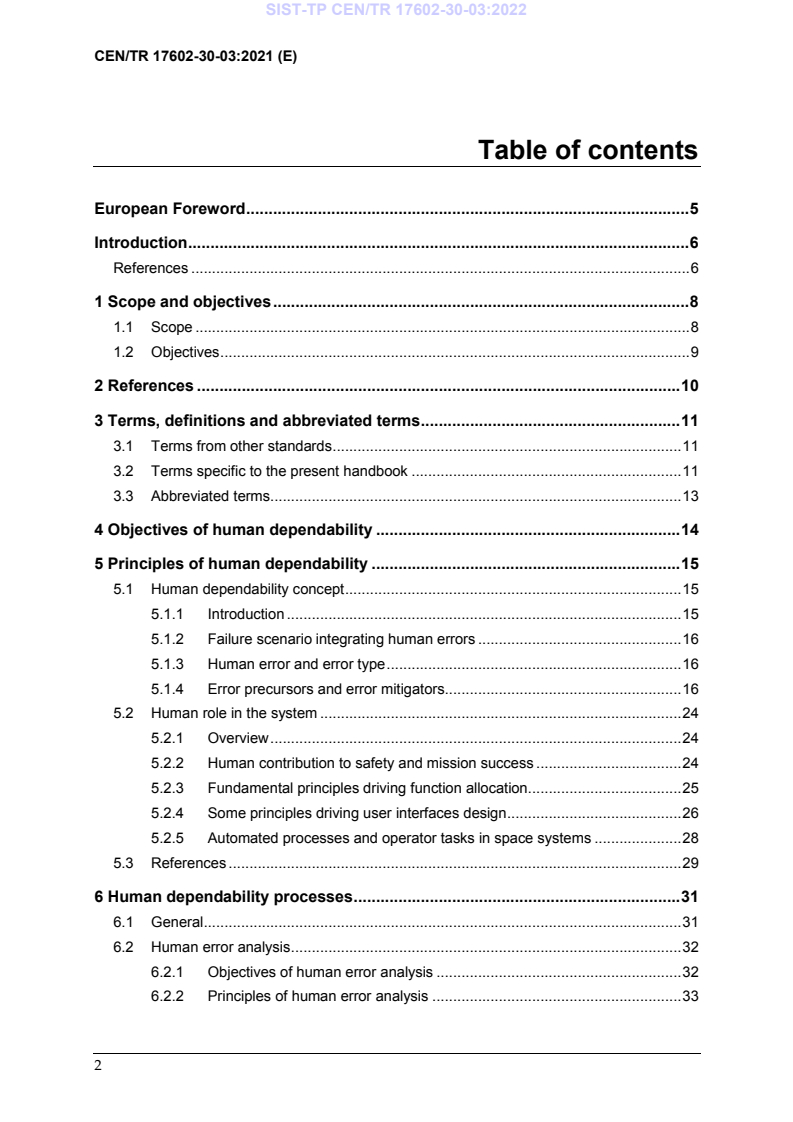
Table of contents
European Foreword . 5
Introduction . 6
References . 6
1 Scope and objectives . 8
1.1 Scope . 8
1.2 Objectives . 9
2 References . 10
3 Terms, definitions and abbreviated terms . 11
3.1 Terms from other standards . 11
3.2 Terms specific to the present handbook . 11
3.3 Abbreviated terms. 13
4 Objectives of human dependability . 14
5 Principles of human dependability . 15
5.1 Human dependability concept . 15
5.1.1 Introduction . 15
5.1.2 Failure scenario integrating human errors . 16
5.1.3 Human error and error type . 16
5.1.4 Error precursors and error mitigators. 16
5.2 Human role in the system . 24
5.2.1 Overview . 24
5.2.2 Human contribution to safety and mission success . 24
5.2.3 Fundamental principles driving function allocation. 25
5.2.4 Some principles driving user interfaces design . 26
5.2.5 Automated processes and operator tasks in space systems . 28
5.3 References . 29
6 Human dependability processes . 31
6.1 General . 31
6.2 Human error analysis . 32
6.2.1 Objectives of human error analysis . 32
6.2.2 Principles of human error analysis . 33
6.2.3 Human error analysis process . 37
6.3 Human error reporting and investigation . 41
6.3.1 Objectives of human error reporting and investigation . 41
6.3.2 Principles of human error reporting and investigation . 41
6.3.3 Human error reporting and investigation process . 43
6.4 References . 45
7 Implementation of human dependability in system life cycle . 46
7.1 General . 46
7.2 Human dependability activities in project phases . 47
7.2.1 Overview . 47
7.2.2 Phase A: Feasibility . 47
7.2.3 Phase B: Preliminary Definition . 48
7.2.4 Phase C: Detailed Definition . 49
7.2.5 Phase D: Qualification and Production . 50
7.2.6 Phases: E Operations/Utilization and F Disposal . 52
7.3 References . 53
Annex A (informative) Human error analysis data - examples . 54
A.1 Overview . 54
A.2 Examples of the Evolution of PSFs . 55
A.3 Examples of Human Error Scenario Data . 58
A.4 References . 58
Annex B (informative) Human error analysis documentation . 59
Annex C (informative) Human error analysis example questions . 61
C.1 Examples of questions to support a risk analysis on anomalies and human
error during operations . 61
C.2 References . 63
Annex D (informative) Human dependability in various domains . 64
D.1 Human dependability in industrial sectors . 64
D.2 References . 66
Bibliography . 68
Figures
Figure 5-1: Examples of human error in failure scenarios . 16
Figure 5-2: Error precursors, error mitigators and human error in failure scenarios . 17
Figure 5-3: HFACS model . 20
Figure 5-4: Levels of human performance . 21
Figure 5-5: Basic error types . 23
Figure 5-6: MABA-MABA principle . 25
Figure 5-7: Small portion of Chernobyl nuclear power plant control room (from
http://www.upandatom.net/Chernobyl.htm) . 26
Figure 5-8: Example of a computer-based, concentrated control room (Large Hadron
Collider at CERN) . 27
Figure 5-9. Example of a computer-based, concentrated user interface – the glass
cockpit (transition to glass cockpit for the Boeing 747) . 27
Figure 6-1: Human error reduction examples . 33
Figure 6-2: Human error analysis and reduction process . 37
Figure 6-3: Human error analysis iteration . 41
Figure 6-4: Human error reporting and investigation process . 44
Figure 7-1: Human dependability in system life cycle . 46
Tables
Table A-1 : SPAR_H PSF modelling considerations for MIDAS [57] . 55
Table B-1 : Example of an “Human Error Analysis Form sheet” . 60
Table D-1 : Examples of Comparable External Domains . 65
European Foreword
This document (CEN/TR 17602-30-03:2021) has been prepared by Technical Committee
CEN/CLC/JTC 5 “Space”, the secretariat of which is held by DIN.
It is highlighted that this technical report does not contain any requirement but only collection of data
or descriptions and guidelines about how to organize and perform the work in support of EN 16602-
30.
This Technical report (CEN/TR 17602-30-03:2021) originates from ECSS-Q-HB-30-03A.
Attention is drawn to the possibility that some of the elements of this document may be the subject of
patent rights. CEN [and/or CENELEC] shall not be held responsible for identifying any or all such
patent rights.
This document has been prepared under a mandate given to CEN by the European Commission and
the European Free Trade Association.
This document has been developed to cover specifically space systems and has therefore precedence
over any TR covering the same scope but with a wider domain of applicability (e.g.: aerospace).
Introduction
Space systems always have “human in the loop” such as spacecraft operators in a control centre, test
or maintenance staff on a ground or astronauts on board.
Human dependability complements disciplines that concern the interaction of the human element
with or within a complex sociotechnical system and its constituents and processes such as human
factors engineering (see ECSS-E-ST-10-11C “Human factors engineering” [1]), human systems
integration [2], human performance capabilities, human-machine interaction and human-computer
interaction in the space domain [3],[4].
Human dependability captures the emerging consensus and nascent effort in the space sector to
systematically include the considerations of “human behaviour and performance” in the design,
validation and operations of both crewed and un-crewed systems to take benefit of human capabilities
and to prevent human errors. Human behaviour and performance can be influenced by various
factors, also called precursors (e.g. performance shaping factors), resulting in human errors, or error
mitigators, limiting the occurrence or impact of human errors. Human errors can originate from
inadequate system design i.e. that ignores or does not properly account for human factor engineering
and system operation. Human errors can contribute to or be part of failure or accident scenarios
leading to undesirable consequences on a space mission such as loss of mission or as worst case loss of
life.
In the space domain, human dependability as a discipline first surfaced during contractor study and
policy work in the early 1990s in the product assurance, system safety and knowledge management
domain [5],[6] and concerned principles and practices to improve the safety and dependability of
space systems by focusing on human error, related design recommendations and root cause analysis
[7],[8].
The standards ECSS-Q-ST-30C “Dependability”[9] and ECSS-Q-ST-40C”Safety” [10] define principles
and requirements to assess and reduce safety and dependability risks and address aspects of human
dependability such as human error failure tolerance and human error analysis to complement FMECA
and hazard analysis. The objective of human error analysis is to identify, assess and reduce human
errors involved failure scenarios and their consequences. Human error analysis can be implemented
through an iterative process, with iterations being determined by the project progress through the
different project phases. Human error analysis is not to be seen as the conclusion of an investigation,
but rather as a starting point to ensure safety and mission operations success.
The main focus of the handbook is on human dependability associated with humans directly involved
in the operations of a space system (“humans” understood here as individual human operator or
astronaut or groups of humans i.e. e.g. a crew, a team or an organization including AIT (assembly,
integration and test)and launch preparation). This includes and concerns especially the activities
related to the planning and implementation of space system control and mission operations from
launch to disposal, and can be extended to cover operations such as AIT and launch preparation.
References
[1] ECSS-E-ST-10-11C - Space engineering - Human factors engineering, 31 July 2008 (Number of EN
version: EN 16603-10-11)
[2] Booher, Harold R. (Ed.) (2003) Handbook of Human Systems Integration. New York: Wiley.
[3] NASA (2010) Human Integration Design Handbook NASA/SP-2010-3407 (Baseline).
Washington, D.C.: NASA.
[4] NASA (2011) Space Flight Human-System Standard Vol. 2: Human Factors, Habitability, and
Environmental Health NASA-STD-3001,Vol. 2. Washington, D.C.: NASA.
[5] Atkins, R. K. (1990) Human Dependability Requirements, Scope and Implementation at the
European Space Agency. Proceedings of the Annual Reliability and Maintainability
Symposium, IEEE, pp. 85-89.
[6] Meaker, T. A. (1992) Future role of ESA R&M assurance in space flight operation. Proceedings
of the Annual Reliability and Maintainability Symposium, IEEE, pp. 241-242.
[7] Alenia Spazio (1994) Human Dependability Tools, Techniques and Guidelines: Human Error
Avoidance Design Guidelines and Root Cause Analysis Method (SD-TUN-AI-351, -353, -351).
Noordwijk: ESTEC.
[8] Cojazzi, G. (1993) Root Cause Analysis Methodologies: Selection Criteria and Preliminary
Evaluation, ISEI/IE/2443/93, JRC Ispra, Italy: Institute for System Engineering and Informatics.
[9] ECSS-Q-ST-30 – Space product assurance - Dependability, 6 March 2009 (Number of EN version:
EN 16602-30)
[10] ECSS-Q-ST-40 – Space product assurance - Safety, 6 March 2009 (Number of EN version:
EN 16602-40)
Scope and objectives
1.1 Scope
The handbook defines the principles and processes of human dependability as integral part of system
safety and dependability. The handbook focuses on human behaviour and performance during the
different operation situations as for example in a control centre such as handover to routine mission
operation, routine mission operation, satellite maintenance or emergency operations.
This handbook illustrates the implementation of human dependability in the system life cycle, where
during any project phase there exists the need to systematically include considerations of the:
Human element as part of the space system,
Impact of human behaviour and performance on safety and dependability.
Within this scope, the main application areas of the handbook are to support the:
a. Development and validation of space system design during the different project phases,
b. Development, preparation and implementation of space system operations including their
support such as the organisation, rules, training etc.
c. Collection of human error data and investigation of incidents or accidents involving human error.
The handbook does not address:
Design errors: The handbook intends to support design (and therefore in this sense, addresses
design errors) regarding the avoidance or mitigation of human errors during operations.
However, human error during design development are not considered.
Quantitative (e.g. probabilistic) analysis of human behaviour and performance: The handbook
does not address probabilistic assessment of human errors as input to system level safety and
dependability analysis and consideration of probabilistic targets, and
Intentional malicious acts and security related issues: Dependability and safety deals with
“threats to safety and mission success” in terms of failures and human non malicious errors and
for the sake of completeness includes “threats to safety and mission success” in terms of
malicious actions, which are addressed through security risk analysis. However by definition
“human dependability” as presented in this handbook excludes the consideration of “malicious
actions” and security related issues i.e. considers only “non-malicious actions” of humans.
The handbook does not directly provide information on some disciplines or subjects, which only
indirectly i.e. at the level of PSFs (see section 5) interface with “human dependability”. Therefore the
handbook does not provide direct support to “goals” such as:
optimize information flux in control room during simulations and critical operations,
manage cultural differences in a team,
cope with negative group dynamics,
present best practices and guidelines about team training needs and training methods,
provide guidelines and best practices concerning planning of shifts,
present basic theory about team motivation, and
manage conflict of interests on a project.
1.2 Objectives
The objectives of the handbook are to support:
Familiarization with human dependability (see section 5 “principles of human dependability”).
For details and further reading see listed “references” at the end of each section of the
handbook.
Application of human dependability; (see section 6 “human dependability processes“ and 7
“implementation of human dependability in system life cycle“).
References
Due to the structure of the document, each section includes at its end the references called in it.
The Bibliography at the end of this document contains a list of recommended literature.
Terms, definitions and abbreviated terms
3.1 Terms from other standards
a. For the purpose of this document, the terms and definitions from ECSS-S-ST-00-01 apply
b. For the purpose of this document, the terms and definitions from ECSS-Q-ST-40 apply, in
particular the following term:
1. operator error
3.2 Terms specific to the present handbook
3.2.1 automation
design and execution of functions by the technical system that can include functions resulting from
the delegation of user’s tasks to the system
3.2.2 error mitigator
set of conditions and circumstances that influences in a positive way human performance and the
occurrence of a human error
NOTE The conditions and circumstances are best described by the
performance shaping factors and levels of human performance.
3.2.3 error precursor
set of conditions and circumstances that influences in a negative way human performance and the
occurrence of a human error
3.2.4 human dependability
performance of the human constituent element and its influencing factors on system safety, reliability,
availability and maintainability
3.2.5 human error
inappropriate or undesirable observable human behaviour with potential impact on safety,
dependability or system performance
NOTE Human behaviour can be decomposed into perception, analysis,
decision and action.
3.2.6 human error analysis
systematic and documented process of identification and assessment of human errors, and analysis
activities supporting the reduction of human errors
3.2.7 human error reduction
elimination, or minimisation and control of existing or potential conditions for human errors
NOTE The conditions and circumstances are best described by the
performance shaping factors and levels of human performance.
3.2.8 human error type
classification of human errors into slips, lapses or mistakes
NOTE The types of human error are described in section 6.2 on the human
dependability concept.
3.2.9 level of human performance
categories of human performances resulting from human cognitive, perceptive or motor behaviour in
a given situation
NOTE 1 As an example, categories of human performances can be "skill
based", "rule based" and "knowledge based".
NOTE 2 The level of human performance results from the combination of the
circumstances and current situation (e.g. routine situation, trained
situation, novel situation) and the type of control of the human action
(e.g. consciously or automatically).
3.2.10 operator-centred design
approach to human-machine system design and development that focuses, beyond the other technical
aims, on making systems usable
3.2.11 performance shaping factor
specific error precursor or error mitigator that influences human performance and the likelihood of
occurrence of a human error.
NOTE 1 Performance shaping factors are either error precursors or error
mitigators appearing in a failure scenario and enhance or degrade
human performance.
NOTE 2 Different performances shaping factors are listed in section 5 of this
document.
3.2.12 resilience
ability to anticipate and adapt to the potential for “surprise and error” in complex sociotechnical
systems
NOTE Resilience engineering provides a framework for understanding and
addressing the context of failures i.e. as a symptom of more in-depth
structural problems of a system.
3.2.13 socio-technical system
holistic view of the system including the operators, the organization in which the operator is involved
and the technical system operated.
NOTE A socio-technical system is the whole structure including
administration, politics, economy and cultural ingredients of an
organisation or a project.
3.3 Abbreviated terms
For the purpose of this document, the following abbreviated terms apply:
Abbreviation Meaning
AIT assembly, integration and testing
FDIR failure detection, isolation and recovery
FMEA failure mode effect analysis
FMECA failure mode effect and criticality analysis
HET human error type
HFACS Human Factors Analysis and Classification System
HMI human-machine interface
HUDEP human dependability
LHP level of human performance
O&M organizational and management
PIF performance influencing factors
PSF performance shaping factor
RAMS reliability, availability, maintainability and safety
SRK skill, rule, knowledge
VACP visual, auditory, cognitive and psychomotor
Objectives of human dependability
Objectives of human dependability during the space system life cycle include:
Definition of the role and involvement of the human in the system, for example support
selection of an automation strategy, enhancement of system resilience due to operator
intervention to prevent incidents or accidents;
Definition and verification of human dependability requirements on a project such as human
error tolerance as part of overall failure tolerance;
Assessment of safety and dependability risks of a system from design to operation with respect
to human behaviour and performance, and identification of their positive and negative
contributions to safety and mission success;
Identification of failure scenarios involving human errors through “human error analysis” as
input to safety and dependability analysis and as basis of a “human error reduction”;
Definition of human error reduction means to drive the definition and implementation of, for
example system design and operation requirements, specifications, operation concepts,
operation procedures, and operator training requirements;
Support of the development of operation procedures for normal, emergency and other
conditions with respect to human performance and behaviour;
Collection and reporting of human error data; and
Support of the investigation of failure scenarios involving human errors.
Principles of human dependability
5.1 Human dependability concept
5.1.1 Introduction
Human dependability is based on the following concept. When a human operates a system, human
capabilities (skills and knowledge) are exploited. These capabilities have the potential to mitigate
expected and unexpected undesired system behaviour, however they can also introduce human errors
causing or contributing to failure scenarios of the system.
In a first step, for safety and dependability analysis at functional analysis level there is no need to
discriminate how functions are implemented i.e. using hardware, software or humans. Indeed
functional failures (loss or degradation of functions) are identified and the associated consequences
with their consequence severities are determined.
However, in further steps, at lower level of safety and dependability analysis such as FMECA on the
physical design the fact that the function is implemented by hardware or software is considered (see
section 6). Similarly, when operations are analysed, the interaction of the human with the rest of the
system is investigated.
Technical failures and human errors are inevitable in complex systems. The human performance and
the technical system can be seen as functioning as a joint cognitive system [11] with three human
relationships:
Human - environment (technical system),
Human - human (operating team), and
Human - itself (work orientation, motivation) and the associated outcome in terms of human
performance and the overall socio-technical system one.
In order to prevent or mitigate as much as possible human errors systems need to be designed taking
into account human factors engineering considerations (see ECSS-E-ST-10-11C “Human factors
engineering” [12]). Proper consideration of human error to achieve the design and operation of a safe
and dependable system is based on analysis of human performance and acknowledges the fact that
humans err.
Human error analysis addresses the systematic identification and assessment of human functions with
the aim of reducing and mitigating human errors. Such human error analyses are an integral part of
safety and dependability through the safety and dependability analysis process. However, human
dependability analysis has to consider both positive and negative aspects of the human contribution
to safety and mission success (as presented in section 5.2). The outcomes of these analyses will, on the
one hand, provide recommendations for reducing and mitigating human errors and on the other hand
provide recommendations to foster and encourage positive contributions.
Including in an explicit and possible systematic way both types of contributions in failure scenarios is
a mean of identifying recommendations for human error prevention, removal and tolerance.
NOTE More information about human error analysis data are provided in
the Annex A.
5.1.2 Failure scenario integrating human errors
Failure scenarios describe failures and human error in terms of event propagation from causes to
consequences, as shown at Figure 5-1 where the upper part presents for example a human error
causing an undesirable event leading to a consequence. The lower part of the Figure 5-1 describes a
technical failure followed by human error which leads to an undesirable event and a consequence.
Consequences are characterized by their severity.
Cause:
Undesirable Event Consequence
Human Error
Cause:
Human Error Undesirable Event Consequence
Technical Failure
Figure 5-1: Examples of human error in failure scenarios
Space systems with human operator in the loop need to be designed having in mind strengths of the
human (such as the mental capability to resolve problems in case of failures in the system) and
weaknesses of the human (in particular regarding human error and reaction to technical failures in the
system).
Human factors engineering (see ECSS-E-ST-10-11C“Human factors engineering” [12]) deals with the
specifics of human performance and how it can be improved. Ergonomics deals with the physical and
physiological aspects of the system design and operations while human-computer interaction
addresses presentation and interaction aspects when computers are included in the technical system.
5.1.3 Human error and error type
A human error is characterised by a type. For example: the human error event “pressing cancel button
inadvertently” can be categorised as the error type “slip”. Such categorization is meant to help the
analyst in identifying means for preventing their occurrence or mitigating their impact depending on
the objectives and levels of the analysis.
5.1.4 Error precursors and error mitigators
5.1.4.1 Overview
Human performance in complex systems is influenced by:
Performance Shaping Factors (PSF)
Levels of Human Performance (LHP)
The occurrence of human errors and their propagation in failure scenarios is influenced by error
precursors and error mitigators as shown at Figure 5-2. Precursors and mitigators of a human error
are the set of conditions and circumstances under which a human behaves and which influence the
human performance. They are best described in terms of PSFs and LHPs.
The PSFs and LHPs interfere with each other. For example, the PSF ”stress” might not be relevant
under “nominal operational conditions” (corresponding to the operations under LHP “skill”). The
stress-factor can become more significant when the “normal operational conditions” are changed to
“abnormal operation with limited time availability” (corresponding to the operations under LHP
“rule”) and might become even more important when no rules (e.g. a contingency procedure) are
defined for the specific abnormal situation (corresponding to the operations under LHP “knowledge”
as the operator has to employ his/her knowledge of the domain to define an operational rule to handle
the abnormal situation).
Precursor and Mitigator
influence
Human Cause:
Undesirable Event Consequence
Performance Human Error
Precursor and Mitigator
influence
Cause:
Human
Human Error Undesirable Event Consequence
Technical
Performance
Failure
Figure 5-2: Error precursors, error mitigators and human error in failure scenarios
5.1.4.2 Performance shaping factors
Performance shaping factors (PSFs) - sometimes referred as PIF (as Performance Influencing Factors) -
can affect human performance in a positive (“help performance”) or negative (“hinder performance”)
manner. It is important to note that some of the PSFs can be considered as meta-PSFs as they influence
other PSFs. This is the case, for instance, for the PSF “levels of automation” that influence vigilance,
trust, complacency, … as detailed below. PSFs can be broadly grouped into two types [13]:
External PSFs that are external to the operators divided in two groups: organizational and
management (O&M) factors and job factors,
Internal PSFs that can be part of operators’ internal characteristics, also called personal factors
Another classification of PSF has been proposed in [13] dividing them in “direct” and “indirect”.
Identifying PSFs according to this classification is important when predicting human error.
Direct PSFs Those PSFs, such as time to complete the task, that can be measured directly,
whereby there is a one-to-one relationship between the magnitude of the PSF and that which is
measured.
Indirect PSFs Those PSFs, such as fitness for duty, that cannot be measured directly, whereby
the magnitude of the PSF can only be determined multivariately or subjectively, or through
other measures or PSFs.
Typical external O&M PSFs are as follows:
a. Work or customer pressures (e.g. production vs. safety)
b. Workload (e.g. allocation of work and tasks for personal)
c. Level and nature of supervision and leadership
d. Organization complexity, multi-cultural issues with other partners
e. Communication, with colleagues, supervision, contractor, other
f. Turn-over and training management
g. Manning levels
h. Clarity of roles and responsibilities
i. Working environment (e.g. noise, heat, space, lighting, ventilation, hygiene care, catering)
j. Violations of procedures and rules (e.g. widespread violations)
k. Team or crew dynamics
l. Available staffing and resources
m. Effectiveness of organisational learning (learning from experiences)
n. Safety culture (e.g. everyone breaks the rules)
Typical external job PSFs are as follows:
a. Clarity of signs, signals, instructions and other information
b. System and equipment interface (labelling, alarms, error avoidance, error tolerance)
c. Difficulty and complexity of task
d. Routine or unusual
e. Divided attention
f. Procedures inadequate or inappropriate
g. Preparation for task (e.g. permits, risk assessments, checking)
h. Time available and time pressure
i. Training and experience Tools appropriate for task
j. Usability of the operator interfaces
k. Levels of automation (meta-PSF impacting many of others such as overconfidence,
complacency, vigilance)
Typical internal personal PSFs are as follows:
a. Physical capability and condition
b. Fatigue (acute from temporary situation, or chronic)
c. Vigilance
d. Complacency and over-attention
e. Trust or overconfidence and mistrust
f. Stress and morale
g. Peer pressure
h. individual behaviour and character (e.g. anti-authority, impulsiveness, invulnerability,
machismo, shyness , hoarding (no sharing of) knowledge)
i. Work overload or under-load (it can be caused also by inadequate personal organization)
j. Competence to deal with circumstances (inept or too skilled)
k. Motivation vs. other priorities
l. Deviation from procedures and rules.
Organizational and Management Factors (O&M) factors are important PSFs that are more and more
pointed out in human error prevention and reduction issues [14]. Carefully considering these factors
contributes to safety and mission success. To highlight them is a way to involve organizations and all
level of management in the process of human error reduction. The manager implication in human
error prevention and reduction is crucial because decision makers are most of the time in the best
position to argue and take remedial actions taking into account trade-off between finance and risks.
Symptoms on personal (e.g. operator) and management actions due to organizational issues are for
example:
a. Lack of personal (e.g. operator) commitment: widespread violations of routine procedures and
rules.
b. Lack of management commitment: management decisions that consistently put e.g.
“production” or “cost factors” before safety, or a tendency to focussing on the short-term and
being highly reactive. Postponing training due to crew resources scarcity is also a latent factor
for human error.
As illustrated in Figure 5-3 showing the “Human Factors Analysis and Classification System” HFACS
“organizational factors” can influence “management issues” (also referred to as “supervision”) which
in turn can influence “job and personal factors” (for further details see [15] or [16]).
Figure 5-3: HFACS model
Decisions of upper-level management can directly have an effect on lower-level managers or
supervisors practices as well as the conditions and actions of the rest of personnel. Consequently,
organizational influences can result in a system failure, human error or an unsafe situation. Three
categories of possible negative organizational influences can be considered:
a. Resource and acquisition management: this category refers to the management, allocation and
maintenance of organizational resources (human or monetary) and equipment/facilities.
b. Organizational climate: this category refers to a broad class of organizational variables that
influence worker performance and in general is the usual environment within the organization.
This category is related with the Safety Culture or the definition of policies and rules.
c. Organizational process: this category refers to the formal process by which things are done in
the organization and includes definition of operations and procedures and control of activities.
On the other hand, four major categories of negative management and supervisory influences can be
considered, as showed in Figure 5-3:
a. Inadequate management and supervision: this category refers to those times when management
results are inappropriate, improper or cannot occur at all.
b. Planned inappropriate operations: this category affects to the appropriate planning of
operational schedule or selection of operators.
c. Failure to correct a known problem: this category refers to deficiencies affecting personnel,
equipment, training or procedures that are “known” by the management, but yet they are
allowed to continue uncorrected.
d. Management and supervisory violations: this category refers to situations when managers
disregard existing rules and regulations.
Understanding these influences is useful for defining recommendations and mitigations means for
“O&M factors” (like for instance those indicated in section 5.1.2) that could lead to human errors.
Performance shaping factors can change during a failure scenario and influence how a failure scenario
develops. Three types of PSF modifications are considered:
a. Static Condition: PSFs remain constant across the events in a scenario,
b. Dynamic Progression: PSFs evolve across events in a scenario,
c. Dynamic Initiator: a sudden change in a scenario causes changes in the PSFs.
See Annex A for some examples of types of PSF modifications.
This HFACS process highlights Reason’s principle of latent and active failures [17]. Indeed, O&M
PSFs usually don’t play an active role in a human error but they provide the underlying foundations
for reducing or increasing human errors occurrence.
5.1.4.3 Level of human performance
5.1.4.3.1 Overview
To simplify the complex human cognitive behaviour three levels of human performance are described
as proposed by Jens Rasmussen in [18]:
• Skill Based Performance (S): requires little or no cognitive effort, which is acquired by
training or repetition of actions (e.g. changing gears while driving a car).
• Rule Based Performance (R): is driven by procedures or rules, which is already present in
the head of the operator (e.g. considering the traffic regulation).
• Knowledge Based Performance (K): requires problem-solving and decision-making that
produces new rules that are then executed as presented in rule based section (e.g.
identifying a new route to avoid traffic jam).
These levels of human performance (LHPs) can be associated with specific “situations” and “control
modes” as shown at Figure 5-4 (excerpt from [19]).
Control Modes
Conscious Mixed Automatic
Situations
Routine Skill
based
Trained for Rule
problems based
Knowledge
Novel
based
problems
Figure 5-4: Levels of human performance
The modes to control a situation can be further characterized as follows:
a. Conscious mode:
1. Laborious
2. Slow and sequential
3. Error-prone
4. Potentially very smart
b. Automatic mode:
1. Unconscious
2. Fast, parallel operation
3. Effortless
4. Highly specialized for routine events
The control mode “mixed” can be also referred to as “subconscious”.
Operators can switch from one mode to another one during the same task.
The spectrum of event situations covers:
a. Situations involving routine tasks,
b. Problem situations for which the operator is trained,
c. Situations with problems new to the operator.
5.1.4.3.2 Skill based performance
Skill Based Performance involves the ability to carry out a task using smooth, automated and highly
integrated patterns. Triggered by a specific event, the skill-based processing is normally performed
without conscious monitoring. During Skilled Based Performance human errors are often caused by
attentional slips and/or lapses of memory.
NOTE Skill-based behaviour is characterized by a quasi-instinctive respons
...