

SIST-TS ISO/TS 22003:2016
Food safety management systems -- Requirements for bodies providing audit and certification of food safety management systems
General Information
- Abstract
ISO/TS 22003:2013 defines the rules applicable for the audit and certification of a food safety management system (FSMS) complying with the requirements given in ISO 22000 (or other sets of specified FSMS requirements). It also provides the necessary information and confidence to customers about the way certification of their suppliers has been granted.
- Status
- Published
- Public Enquiry End Date
- 29-Mar-2016
- Publication Date
- 13-Mar-2016
- Technical Committee
- KŽP - Agricultural food products
- Current Stage
- 6060 - National Implementation/Publication (Adopted Project)
- Start Date
- 08-Mar-2016
- Due Date
- 13-May-2016
- Completion Date
- 14-Mar-2016
Buy Documents



ISO/TS 22003:2013 - Food safety management systems — Requirements for bodies providing audit and certification of food safety management systems Released:12/12/2013
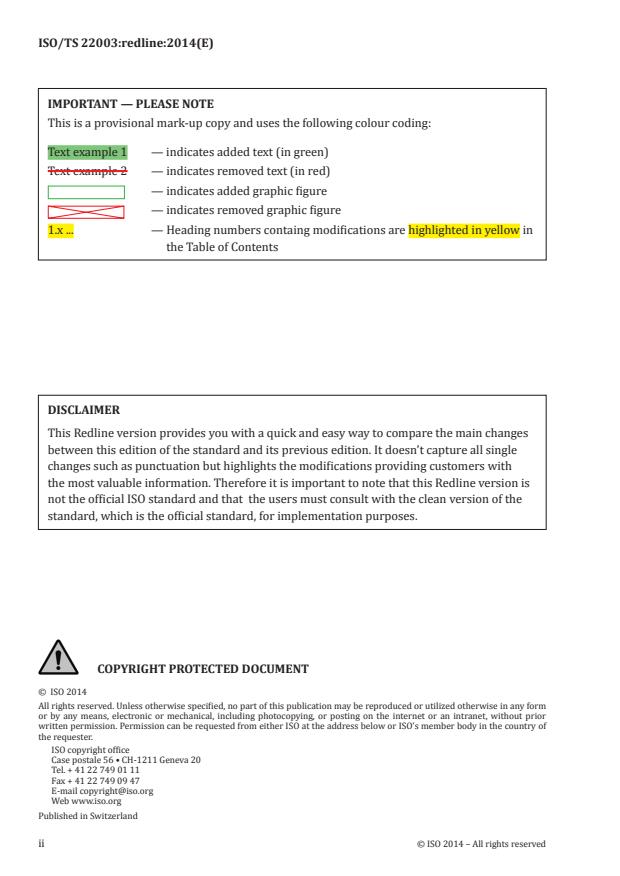
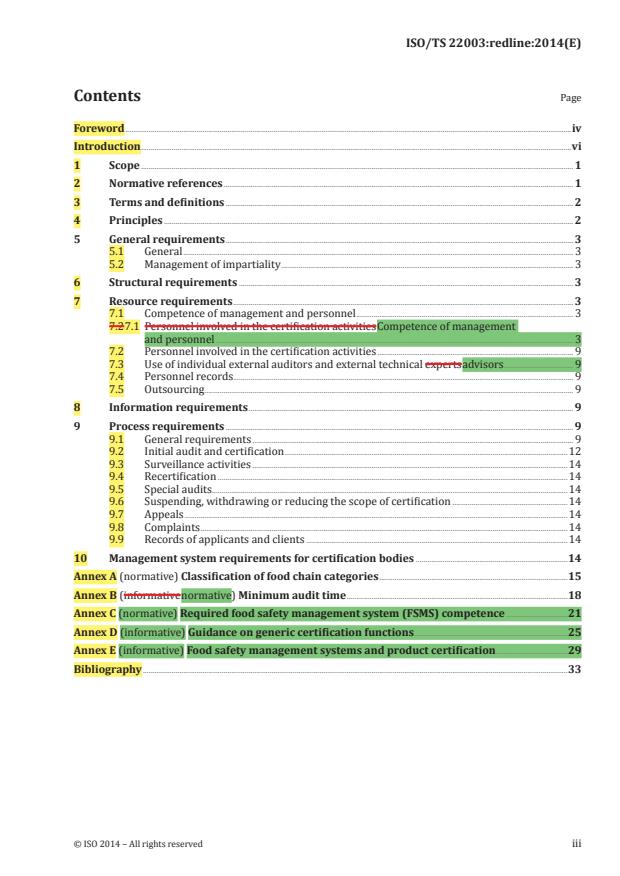
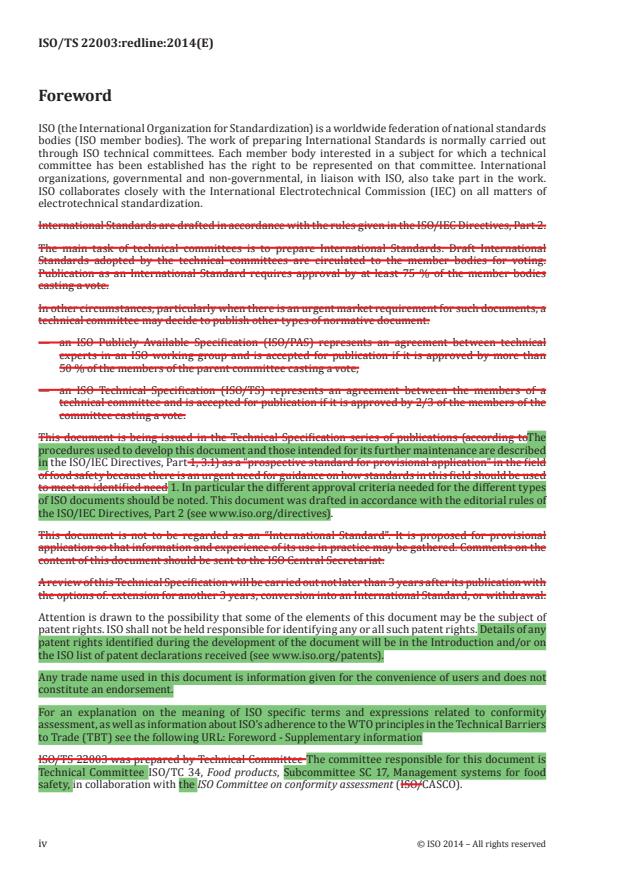
REDLINE ISO/TS 22003:2013 - Food safety management systems — Requirements for bodies providing audit and certification of food safety management systems Released:12/12/2013

ISO/TS 22003:2013 - Systemes de management de la sécurité des denrées alimentaires — Exigences pour les organismes procédant a l'audit et a la certification de systemes de management de la sécurité des denrées alimentaires Released:4/2/2014
ISO/TS 22003:2013 - Food safety management systems — Requirements for bodies providing audit and certification of food safety management systems Released:7/27/2015
Overview
SIST-TS ISO/TS 22003:2016 sets forth requirements for bodies that perform audits and certification of food safety management systems (FSMS). Developed by the International Organization for Standardization (ISO) and adopted by SIST, this technical specification ensures that auditors and certification bodies operate with competence, impartiality, and transparency when certifying organizations against ISO 22000 or other specified FSMS benchmarks. The goal is to provide confidence to customers and stakeholders that certification of suppliers’ food safety systems is carried out with recognized rigor and credibility throughout the food chain.
Key Topics
- Scope and Applicability: The standard covers third-party conformity assessments of FSMS, ensuring compliance with ISO 22000 or equivalent requirements.
- Competence of Certification Bodies: Defines necessary qualifications, training, and experience for personnel involved in FSMS audits and certification.
- Impartiality: Outlines measures to avoid conflicts of interest and maintain objectivity in all certification processes.
- Audit Process Requirements: Details procedures for initial certification, surveillance, recertification, special audits, handling of appeals and complaints, and suspension or withdrawal of certification.
- Management System Requirements: Certification bodies must establish a robust management system aligning with international best practices.
- FSMS Categories and Sectors: Specifies classification of food industry sectors to help certification bodies accurately define scopes.
- Documented Information: Defines information management and reporting requirements for transparency with clients and regulatory stakeholders.
Applications
Implementing the requirements of SIST-TS ISO/TS 22003:2016 delivers operational and reputational benefits across the food supply chain:
- For Certification Bodies: Ensures that the audit and certification services are recognized internationally for their consistency, reliability, and technical competence. This enhances market credibility and forms a basis for accreditation and mutual recognition.
- For Organizations Seeking Certification: Provides assurance that certification is granted through a structured, impartial, and technically sound process, increasing trust among partners, regulators, and consumers.
- For Customers and Regulators: Supplies confidence that certified suppliers meet rigorous food safety management criteria, supporting compliance with statutory and regulatory requirements.
- Across the Food Chain: Facilitates global trade by harmonizing certification processes, reducing the risk of food safety incidents, and ensuring alignment with market, legal, and customer expectations in areas ranging from production and processing to packaging and distribution.
Related Standards
Organizations and certification bodies implementing SIST-TS ISO/TS 22003:2016 should be familiar with the following related international standards to ensure a comprehensive approach to food safety management and conformity assessment:
- ISO 22000: Food safety management systems - Requirements for any organization in the food chain.
- ISO/IEC 17021: Conformity assessment - Requirements for bodies providing audit and certification of management systems.
- ISO/IEC 17000: Conformity assessment - Vocabulary and general principles.
- ISO 19011: Guidelines for auditing management systems.
- ISO/IEC 17065: Conformity assessment - Requirements for bodies certifying products, processes, and services.
Practical Value
- Compliance: Helps organizations demonstrate compliance with legal and market requirements for food safety certification.
- Trust and Market Access: Builds global trust in food products and helps organizations gain access to markets or maintain existing ones.
- Continuous Improvement: Encourages ongoing improvement of audit practices and FSMS certification.
- Risk Management: Enhances food safety and reduces risks of contamination, recalls, or non-compliance events.
By establishing clear and consistent requirements for the audit and certification of food safety management systems, SIST-TS ISO/TS 22003:2016 underpins the reliability and integrity of food safety certification on a global scale.
Relations
- Effective Date
- 01-Apr-2016
Buy Documents
ISO/TS 22003:2013 - Food safety management systems — Requirements for bodies providing audit and certification of food safety management systems Released:12/12/2013
REDLINE ISO/TS 22003:2013 - Food safety management systems — Requirements for bodies providing audit and certification of food safety management systems Released:12/12/2013
ISO/TS 22003:2013 - Systemes de management de la sécurité des denrées alimentaires — Exigences pour les organismes procédant a l'audit et a la certification de systemes de management de la sécurité des denrées alimentaires Released:4/2/2014
ISO/TS 22003:2013 - Food safety management systems — Requirements for bodies providing audit and certification of food safety management systems Released:7/27/2015
Get Certified
Connect with accredited certification bodies for this standard

BSI Group
BSI (British Standards Institution) is the business standards company that helps organizations make excellence a habit.

Bureau Veritas
Bureau Veritas is a world leader in laboratory testing, inspection and certification services.

DNV
DNV is an independent assurance and risk management provider.
Sponsored listings
Frequently Asked Questions
SIST-TS ISO/TS 22003:2016 is a technical specification published by the Slovenian Institute for Standardization (SIST). Its full title is "Food safety management systems -- Requirements for bodies providing audit and certification of food safety management systems". This standard covers: ISO/TS 22003:2013 defines the rules applicable for the audit and certification of a food safety management system (FSMS) complying with the requirements given in ISO 22000 (or other sets of specified FSMS requirements). It also provides the necessary information and confidence to customers about the way certification of their suppliers has been granted.
ISO/TS 22003:2013 defines the rules applicable for the audit and certification of a food safety management system (FSMS) complying with the requirements given in ISO 22000 (or other sets of specified FSMS requirements). It also provides the necessary information and confidence to customers about the way certification of their suppliers has been granted.
SIST-TS ISO/TS 22003:2016 is classified under the following ICS (International Classification for Standards) categories: 03.100.70 - Management systems; 03.120.20 - Product and company certification. Conformity assessment; 67.020 - Processes in the food industry. The ICS classification helps identify the subject area and facilitates finding related standards.
SIST-TS ISO/TS 22003:2016 has the following relationships with other standards: It is inter standard links to SIST-TS ISO/TS 22003:2011. Understanding these relationships helps ensure you are using the most current and applicable version of the standard.
SIST-TS ISO/TS 22003:2016 is available in PDF format for immediate download after purchase. The document can be added to your cart and obtained through the secure checkout process. Digital delivery ensures instant access to the complete standard document.
Standards Content (Sample)
SLOVENSKI STANDARD
01-april-2016
Sistemi vodenja varnosti živil - Zahteve za organe, ki izvajajo presoje in
certificiranje sistemov vodenja varnosti živil
Food safety management systems -- Requirements for bodies providing audit and
certification of food safety management systems
Systèmes de management de la sécurité des denrées alimentaires -- Exigences pour les
organismes procédant à l'audit et à la certification de systèmes de management de la
sécurité des denrées alimentaires
Ta slovenski standard je istoveten z: ISO/TS 22003:2013
ICS:
03.120.20 Certificiranje proizvodov in Product and company
podjetij. Ugotavljanje certification. Conformity
skladnosti assessment
67.020 Procesi v živilski industriji Processes in the food
industry
2003-01.Slovenski inštitut za standardizacijo. Razmnoževanje celote ali delov tega standarda ni dovoljeno.
TECHNICAL ISO/TS
SPECIFICATION 22003
Second edition
2013-12-15
Food safety management systems —
Requirements for bodies providing
audit and certification of food safety
management systems
Systèmes de management de la sécurité des denrées alimentaires —
Exigences pour les organismes procédant à l’audit et à la certification
de systèmes de management de la sécurité des denrées alimentaires
Reference number
©
ISO 2013
© ISO 2013
All rights reserved. Unless otherwise specified, no part of this publication may be reproduced or utilized otherwise in any form
or by any means, electronic or mechanical, including photocopying, or posting on the internet or an intranet, without prior
written permission. Permission can be requested from either ISO at the address below or ISO’s member body in the country of
the requester.
ISO copyright office
Case postale 56 • CH-1211 Geneva 20
Tel. + 41 22 749 01 11
Fax + 41 22 749 09 47
E-mail copyright@iso.org
Web www.iso.org
Published in Switzerland
ii © ISO 2013 – All rights reserved
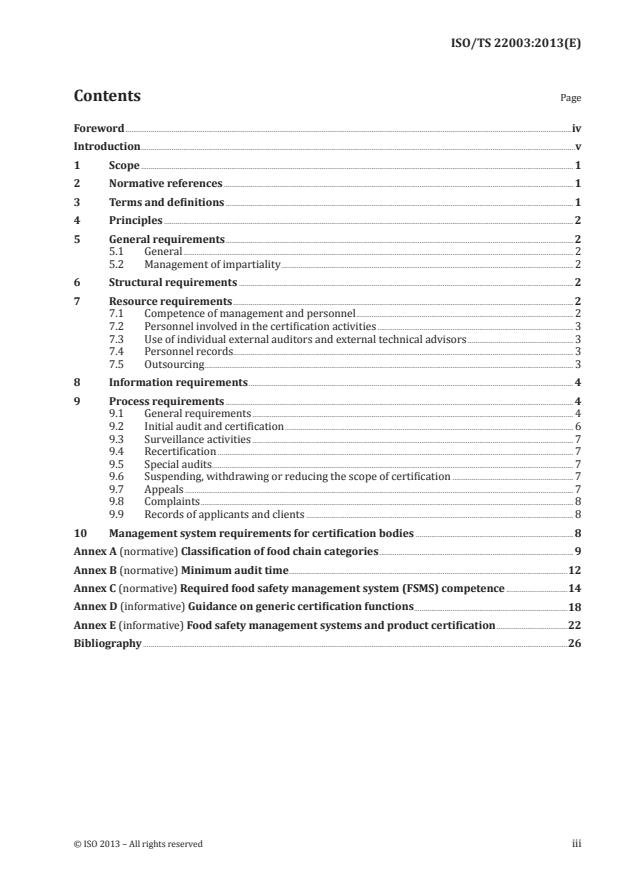
Contents Page
Foreword .iv
Introduction .v
1 Scope . 1
2 Normative references . 1
3 Terms and definitions . 1
4 Principles . 2
5 General requirements . 2
5.1 General . 2
5.2 Management of impartiality . 2
6 Structural requirements . 2
7 Resource requirements . 2
7.1 Competence of management and personnel . 2
7.2 Personnel involved in the certification activities . 3
7.3 Use of individual external auditors and external technical advisors . 3
7.4 Personnel records. 3
7.5 Outsourcing. 3
8 Information requirements . 4
9 Process requirements . 4
9.1 General requirements . 4
9.2 Initial audit and certification . 6
9.3 Surveillance activities . 7
9.4 Recertification . 7
9.5 Special audits . 7
9.6 Suspending, withdrawing or reducing the scope of certification . 7
9.7 Appeals . 7
9.8 Complaints . 8
9.9 Records of applicants and clients . 8
10 Management system requirements for certification bodies . 8
Annex A (normative) Classification of food chain categories . 9
Annex B (normative) Minimum audit time .12
Annex C (normative) Required food safety management system (FSMS) competence .14
Annex D (informative) Guidance on generic certification functions .18
Annex E (informative) Food safety management systems and product certification .22
Bibliography .26
Foreword
ISO (the International Organization for Standardization) is a worldwide federation of national standards
bodies (ISO member bodies). The work of preparing International Standards is normally carried out
through ISO technical committees. Each member body interested in a subject for which a technical
committee has been established has the right to be represented on that committee. International
organizations, governmental and non-governmental, in liaison with ISO, also take part in the work.
ISO collaborates closely with the International Electrotechnical Commission (IEC) on all matters of
electrotechnical standardization.
The procedures used to develop this document and those intended for its further maintenance are
described in the ISO/IEC Directives, Part 1. In particular the different approval criteria needed for the
different types of ISO documents should be noted. This document was drafted in accordance with the
editorial rules of the ISO/IEC Directives, Part 2 (see www.iso.org/directives).
Attention is drawn to the possibility that some of the elements of this document may be the subject of
patent rights. ISO shall not be held responsible for identifying any or all such patent rights. Details of any
patent rights identified during the development of the document will be in the Introduction and/or on
the ISO list of patent declarations received (see www.iso.org/patents).
Any trade name used in this document is information given for the convenience of users and does not
constitute an endorsement.
For an explanation on the meaning of ISO specific terms and expressions related to conformity
assessment, as well as information about ISO’s adherence to the WTO principles in the Technical Barriers
to Trade (TBT) see the following URL: Foreword - Supplementary information
The committee responsible for this document is Technical Committee ISO/TC 34, Food products,
Subcommittee SC 17, Management systems for food safety, in collaboration with the ISO Committee on
conformity assessment (CASCO).
This second edition cancels and replaces the first edition (ISO/TS 22003:2007), which has been
technically revised.
iv © ISO 2013 – All rights reserved
Introduction
Certification of the food safety management system (FSMS) of an organization is one means of providing
assurance that the organization has implemented a system for the management of food safety in line
with its policy.
Requirements for an FSMS can originate from a number of sources. This Technical Specification has
been developed to assist in the certification of FSMS that fulfil the requirements of ISO 22000. The
contents of this Technical Specification can also be used to support certification of FSMS that are based
on other sets of specified FSMS requirements.
This Technical Specification is intended for use by bodies that carry out audit and certification of FSMS
by providing generic requirements for such bodies. Such bodies are referred to as certification bodies.
This wording is not intended to be an obstacle to the use of this Technical Specification by bodies with
other designations that undertake activities covered by the scope of this Technical Specification. This
Technical Specification is intended to be used by anybody involved in the assessment of FSMS. It can also
be used to support other types of food safety certifications based on a combination of ISO/IEC 17021 and
ISO/IEC 17065.
Certification activities involve the audit of an organization’s FSMS. The form of attestation of conformity
of an organization’s FSMS to a specific FSMS standard (e.g. ISO 22000) or other specified requirements
is normally a certification document or a certificate.
It is for the organization being certified to develop its own management systems (e.g. FSMS in
accordance with ISO 22000, other sets of specified FSMS requirements, quality management systems,
environmental management systems or occupational health and safety management systems) and,
other than where relevant legislative requirements specify to the contrary, it is for the organization to
decide how the various components of these will be arranged. The degree of integration between the
various management system components will vary from organization to organization. It is therefore
appropriate for certification bodies that operate in accordance with this Technical Specification to
take into account the culture and practices of their clients with respect to the integration of their FSMS
within the wider organization.
TECHNICAL SPECIFICATION ISO/TS 22003:2013(E)
Food safety management systems — Requirements for
bodies providing audit and certification of food safety
management systems
1 Scope
This Technical Specification defines the rules applicable for the audit and certification of a food safety
management system (FSMS) complying with the requirements given in ISO 22000 (or other sets of
specified FSMS requirements). It also provides the necessary information and confidence to customers
about the way certification of their suppliers has been granted.
Certification of FSMS is a third-party conformity assessment activity (as described in ISO/IEC 17000:2004,
5.5), and bodies performing this activity are third-party conformity assessment bodies.
NOTE 1 In this Technical Specification, the terms “product” and “service” are used separately (in contrast with
the definition of “product” given in ISO/IEC 17000).
NOTE 2 This Technical Specification can be used as a criteria document for the accreditation or peer assessment
of certification bodies which seek to be recognized as being competent to certify that an FSMS complies with
ISO 22000. It is also intended to be used as a criteria document by regulatory authorities and industry consortia
which engage in direct recognition of certification bodies to certify that an FSMS complies with ISO 22000. Some of
its requirements could also be useful to other parties involved in the conformity assessment of such certification
bodies, and in the conformity assessment of bodies that undertake to certify the compliance of FSMS with criteria
additional to, or other than, those in ISO 22000.
FSMS certification does not attest to the safety or fitness of the products of an organization within
the food chain. However, ISO 22000 requires an organization to meet all applicable food-safety-related
statutory and regulatory requirements through its management system.
NOTE 3 Certification of an FSMS according to ISO 22000 is a management system certification, not a product
certification.
Other FSMS users can use the concepts and requirements of this Technical Specification provided that
the requirements are adapted as necessary.
2 Normative references
The following referenced documents, in whole or in part, are normatively referenced in this document
and are indispensable for its application. For dated references, only the edition cited applies. For undated
references, the latest edition of the referenced document (including any amendments) applies.
ISO 22000:2005, Food safety management systems — Requirements for any organization in the food chain
ISO/IEC 17000:2004, Conformity assessment — Vocabulary and general principles
ISO/IEC 17021:2011, Conformity assessment — Requirements for bodies providing audit and certification
of management systems
3 Terms and definitions
For the purposes of this document, the terms and definitions given in ISO/IEC 17000, ISO/IEC 17021,
ISO 22000 and the following apply.
3.1
hazard analysis and critical control point
HACCP
system which identifies, evaluates and controls hazards which are significant for food safety
[12]
[SOURCE: Codex Alimentarius Food Hygiene Basic Texts, modified]
3.2
food safety management system
FSMS
set of interrelated or interacting elements to establish policy and objectives and to achieve those
objectives, used to direct and control an organization with regard to food safety
Note 1 to entry: See ISO 9000:2005, 3.2.1, 3.2.2 and 3.2.3.
Note 2 to entry: In this Technical Specification, “food safety management system” replaces the term “management
system” used in ISO/IEC 17021.
3.3
competence
ability to apply knowledge and skills to achieve intended results
4 Principles
The principles of ISO/IEC 17021:2011, Clause 4, are the basis for the subsequent specific performance
and descriptive requirements in this Technical Specification. This Technical Specification does not give
specific requirements for all situations that can occur. These principles should be applied as guidance
for the decisions that may need to be made for unanticipated situations. Principles are not requirements.
NOTE Annex E has been included to address the needs of parties interested both in FSMS and food product
certification.
5 General requirements
5.1 General
The requirements of ISO/IEC 17021:2011, Clause 5, apply.
5.2 Management of impartiality
FSMS consultancy shall not be provided by either the certification body or any part of the same legal
entity.
6 Structural requirements
The requirements of ISO/IEC 17021:2011, Clause 6, apply.
7 Resource requirements
7.1 Competence of management and personnel
7.1.1 General considerations
The requirements of ISO/IEC 17021:2011, 7.1.1, apply.
2 © ISO 2013 – All rights reserved
The technical areas referred to in ISO/IEC 17021:2011, 7.1.1, shall be those categories identified in
Annex A. The functions of certification for which competence shall be identified are those given in
Annex C.
7.1.2 Determination of competence criteria
The requirements of ISO/IEC 17021:2011, 7.1.2, apply.
The competence criteria included in Annex C shall form the basis for the criteria developed for each
category. Competence criteria can be generic or specific. The competence criteria in ISO/IEC 17021:2011,
Annex A, shall be considered to be generic.
NOTE 1 The competence criteria identified in Annex C are food safety related criteria for certification body
personnel. The certification body can identify specific competences required for the identified categories and for
each certification function.
NOTE 2 Annex D provides guidance to the certification body on many of the generic certification functions
identified in ISO/IEC 17021:2011, Annex A, for which competence criteria need to be determined for personnel
involved in the audit and certification of an FSMS.
NOTE 3 Qualification(s) and experience can be used as part of the criteria; however, competence is not based on
these alone, as it is important to ensure that a person can demonstrate the ability to apply the specific knowledge
and skills that one would expect a person to have after completing a qualification or having a certain amount of
industry experience.
7.1.3 Evaluation processes
The requirements of ISO/IEC 17021:2011, 7.1.3, apply.
Evaluation processes shall evaluate, in particular, the individual’s knowledge relating to food safety,
including knowledge of specific prerequisite programmes (PRP) and food safety hazards related to the
categories within which the certification body personnel operate. These shall have been identified for
these categories under the requirements of 7.1.2.
NOTE ISO/IEC 17021:2011, 7.1.3, requires the certification body to demonstrate the effectiveness of the
evaluation methods used to evaluate personnel against identified competence criteria. ISO/IEC 17021:2011,
Annex B, contains five examples of methods of evaluation.
7.1.4 Other considerations
The requirements of ISO/IEC 17021:2011, 7.1.4, apply.
7.2 Personnel involved in the certification activities
The requirements of ISO/IEC 17021:2011, 7.2, apply.
7.3 Use of individual external auditors and external technical advisors
The requirements of ISO/IEC 17021:2011, 7.3, apply.
7.4 Personnel records
The requirements of ISO/IEC 17021:2011, 7.4, apply.
7.5 Outsourcing
The requirements of ISO/IEC 17021:2011, 7.5, apply.
8 Information requirements
The requirements of ISO/IEC 17021:2011, Clause 8, apply.
The certification documents shall identify in detail what activity is certified, referring to categories and
subcategories (see Table A.1).
9 Process requirements
9.1 General requirements
9.1.1 The certification body shall use Annex A to define the relevant scope for the organization applying
for certification. The certification body shall not exclude activities, processes, products or services from
the scope of certification when those activities, processes, products or services can have an influence on
the food safety of the end products as defined in the scope of certification.
9.1.2 The certification body shall have a process for choosing the audit day, time and season, so that
the audit team has the opportunity of auditing the organization operating on a representative number of
product lines, categories and subcategories covered by the scope of certification.
9.1.3 The requirements of ISO/IEC 17021:2011, 9.1.1 to 9.1.3, apply.
9.1.4 The requirements of ISO/IEC 17021:2011, 9.1.4, apply.
The certification body shall have documented procedures for determining audit time, and for each client,
the certification body shall determine the time needed to plan and accomplish a complete and effective
audit of the client’s FSMS. The audit time determined by the certification body, and the justification for
the determination, shall be recorded.
9.1.5 For the certification of multi-site organizations, 9.1.5.1 to 9.1.5.4 apply.
NOTE This subclause (9.1.5) is intended to apply only to operations directly affecting food safety, and not to
exclusively administrative sites.
9.1.5.1 A multi-site organization is an organization having an identified central function (hereafter
referred to as a central office – but not necessarily the headquarters of the organization) at which certain
FSMS activities are planned, controlled or managed, and a network of sites at which such activities are
fully or partially carried out. Examples of possible multi-site organizations are:
— organizations operating with franchises;
— a manufacturing company with one or more production sites and a network of sales offices;
— service organizations with multiple sites offering a similar service;
— organizations with multiple branches.
9.1.5.2 The certification body can certify a multi-site organization under one management system,
providing that the following conditions apply:
a) all sites are operating under one centrally controlled and administered FSMS as defined in
ISO 22000:2005, Clause 4, or equivalent for other FSMS;
b) an internal audit has been conducted on each site within one year prior to certification;
c) audit findings of the individual sites shall be considered indicative of the entire system and
correction shall be implemented accordingly.
4 © ISO 2013 – All rights reserved
9.1.5.3 The use of multi-site sampling is only possible for categories A, B, E, F and G (see Table A.1)
and for organizations with more than 20 sites operating similar processes within these categories. This
applies to the initial certification, to surveillance and to recertification audits. The certification body shall
justify its decision on sampling for multi-site certification.
Where multi-site sampling is permitted, following certification, the annual internal audit programme
shall include all sites of the organization.
NOTE Risk is another consideration when determining sampling and can increase the level of sample
indicated in Table 1.
9.1.5.4 Where the certification body offers multi-site sampling, the certification body shall utilize a
sampling programme to ensure an effective audit of the FSMS where the following apply.
a) For organizations with 20 sites or less, all sites shall be audited. The sampling for more than 20 sites
shall be at the ratio of 1 site per 5 sites. All sites shall be randomly selected and, after the audit, no
sampled sites may be nonconforming (i.e. not meeting certification thresholds for ISO 22000).
b) At least annually, an audit of the central office for the FSMS shall be performed by the certification
body.
c) At least annually, surveillance audits shall be performed by the certification body on the required
number of sampled sites.
d) Audit findings of the sampled sites shall be considered indicative of the entire system and correction
shall be implemented accordingly.
Table 1 gives examples of the number of sites to audit when sampling is used.
Table 1 — Examples of the number of sites to be audited when multi-site sampling is used
Total number of sites
Number
of sites to
be audited 21 22 23 24 25 26 27 28
between 1
and 20
Number of sites above 20 0 1 2 3 4 5 6 7 8
Additional number of sites to audit 0 1 1 1 1 1 2 2 2
Number of sites to be audited x 21 21 21 21 21 22 22 22
9.1.6 The requirements of ISO/IEC 17021:2011, 9.1.6 to 9.1.9, apply.
9.1.7 Audit report: the requirements of ISO/IEC 17021:2011, 9.1.10, apply.
9.1.8 The certification body shall provide a written report for each audit. The audit team may identify
opportunities for improvement, but shall not recommend specific solutions. Ownership of the audit
report shall be maintained by the certification body.
The report shall include information about PRP used by the organization, hazard analysis methodology
used, comments on the food safety team, and other issues relevant to the FSMS.
NOTE The stage 1 documented conclusions do not need to meet the full requirements of a report (see
ISO/IEC 17021:2011, 9.1.10).
9.1.9 The requirements of ISO/IEC 17021:2011, 9.1.11 to 9.1.15, apply.
9.2 Initial audit and certification
9.2.1 Application
The requirements of ISO/IEC 17021:2011, 9.2.1, apply.
The certification body shall require the applicant organization to provide detailed information
concerning process lines, HACCP studies and the number of shifts.
9.2.2 Application review
The requirements of ISO/IEC 17021:2011, 9.2.2, apply.
9.2.3 Initial certification audit
The initial certfication audit of an FSMS shall be conducted in two stages: stage 1 and stage 2.
9.2.3.1 Stage 1
9.2.3.1.1 The requirements of ISO/IEC 17021:2011, 9.2.3.1.1, apply.
9.2.3.1.2 The objectives of the stage 1 are to provide a focus for planning the stage 2 audit by gaining
an understanding of the organization’s FSMS and the organization’s state of preparedness for stage 2 by
reviewing the extent to which:
a) the organization has identified PRP that are appropriate to the business (e.g. regulatory, statutory,
customer and certification scheme requirements),
b) the FSMS includes adequate processes and methods for the identification and assessment of the
organization’s food safety hazards, and subsequent selection and categorization of control measures
(combinations),
c) relevant food safety legislation is implemented,
d) the FSMS is designed to achieve the organization’s food safety policy,
e) the FSMS implementation programme justifies proceeding to the audit (stage 2),
f) the validation of control measures, verification of activities and improvement programmes conform
to the requirements of the FSMS standard,
g) the FSMS documents and arrangements are in place to communicate internally and with relevant
suppliers, customers and interested parties, and
h) there is any additional documentation which needs to be reviewed and/or information which needs
to be obtained in advance.
Where an organization has implemented an externally developed combination of control measures, the
stage 1 shall review the documentation included in the FSMS to determine if the combination of control
measures
— is suitable for the organization,
— was developed in compliance with the requirements of ISO 22000, and
— is kept up to date.
The availability of relevant authorizations shall be checked when collecting the information regarding
the compliance to regulatory aspects.
6 © ISO 2013 – All rights reserved
9.2.3.1.3 For FSMS, the stage 1 shall be carried out at the client’s premises in order to achieve the
objectives stated above.
In exceptional circumstances, part of stage 1 can take place off-site and shall be fully justified. The
evidence demonstrating that stage 1 objectives are fully achieved shall be provided. Exceptional
circumstances can include very remote location, short seasonal production
9.2.3.1.4 The requirements of ISO/IEC 17021:2011, 9.2.3.1.2, apply.
The client shall be informed that the results of the stage 1 may lead to postponement or cancellation of
the stage 2.
9.2.3.1.5 Any part of the FSMS that is audited during the stage 1 audit, and determined to be fully
implemented, effective and in conformity with requirements, may not need to be re-audited during the
stage 2 audit. However, the certification body shall ensure that the already audited parts of the FSMS
continue to conform to the certification requirements. In this case, the audit report shall include these
findings and shall clearly state that conformity has been established during the stage 1 audit.
9.2.3.1.6 The requirements of ISO/IEC 17021:2011, 9.2.3.1.3, apply.
The interval between stage 1 and stage 2 shall not be longer than 6 months. Stage 1 shall be repeated if
a longer interval is needed.
9.2.3.2 Stage 2
The requirements of ISO/IEC 17021:2011, 9.2.3.2, apply.
9.2.4 Initial certification audit conclusions
The requirements of ISO/IEC 17021:2011, 9.2.4, apply.
9.2.5 Information for granting initial certification
The requirements of ISO/IEC 17021:2011, 9.2.5, apply.
9.3 Surveillance activities
The requirements of ISO/IEC 17021:2011, 9.3, apply.
9.4 Recertification
The requirements of ISO/IEC 17021:2011, 9.4, apply.
9.5 Special audits
The requirements of ISO/IEC 17021:2011, 9.5, apply.
9.6 Suspending, withdrawing or reducing the scope of certification
The requirements of ISO/IEC 17021:2011, 9.6, apply.
9.7 Appeals
The requirements of ISO/IEC 17021:2011, 9.7, apply.
9.8 Complaints
The requirements of ISO/IEC 17021:2011, 9.8, apply.
9.9 Records of applicants and clients
The requirements of ISO/IEC 17021:2011, 9.9, apply.
10 Management system requirements for certification bodies
The requirements of ISO/IEC 17021:2011, Clause 10, apply.
8 © ISO 2013 – All rights reserved
Annex A
(normative)
Classification of food chain categories
The certification body shall use Table A.1 for the following purposes:
a) to define the scope within which it wishes to operate;
b) to identify whether any technical qualification of its auditors is necessary for that particular
category;
c) to assess the auditor competence within a particular category;
d) to assess the audit team competence within a particular subcategory;
e) to define the audit duration in accordance with Annex B of this Technical Specification;
f) to identify the appropriate part of the ISO/TS 22002 series, if applicable, for the assessment of
compliance with ISO 22000:2005, 7.2;
g) to define the scope of certification document at subcategory level.
The scope of one specific client organization may cover more than one category or subcategory.
NOTE 1 When selecting appropriate PRP, reference is first made to the ISO/TS 22002 series; subsequently,
reference could be made to other sources, such as Codex Alimentarius Commission. See ISO 22000:2005, 7.2.3.
NOTE 2 Relevant activities within the “services” category: for operators in the food chain, there are many
different types of services that can be provided or called upon. Some of these services can fall outside the scope of
the FSMS. In order to determine which services are within the scope, the following two questions provide a useful
filter for determining the relevance to the FSMS:
— Is the organization/service susceptible to introduce a food safety hazard within the food chain?
— Has the organization/service provider decisive influence and authority on the food related processes?
If the answer is affirmative to at least one of the two questions above, the service provider and its operator(s) can
be considered within the scope.
Table A.1 — Food chain categories
a
Cluster Category Subcategory Examples of included activities
AI Raising animals (other than fish and seafood) used
for meat production, egg production, milk production
or honey production
Farming of Animals
for Meat/ Milk/ Eggs/
Growing, keeping, trapping and hunting (slaughtering
Honey
at point of hunting)
Farming of Ani-
A b
Associated farm packing and storage
mals
AII Raising fish and seafood used for meat production
Farming of Fish and Growing, trapping and fishing (slaughtering at point
Farming
Seafood of capture)
b
Associated farm packing and storage
BI Growing or harvesting of plants (other than grains
and pulses): horticultural products(fruits, vegetables,
Farming of Plants (other
spices, mushrooms, etc.) and hydrophytes for food
than grains and pulses)
B Farming of Plants b
Associated farm packing and storage
BII Growing or harvesting of grains and pulses for food
Farming of Grains and
Pulses
b
Associated farm packing and storage
CI Processing of perishable Production of animal products including fish and
animal products seafood, meat, eggs, dairy and fish products
CII Processing of perishable Production of plant products including fruits and
plant products fresh juices, vegetables, grains, nuts, and pulses
CIII Processing of perish- Production of mixed animal and plant products
Food Manufac-
able animal and plant including pizza, lasagne, sandwich, dumpling, ready-
C
turing
products(mixed prod- to-eat meals
ucts)
Food and feed process-
ing
CIV Production of food products from any source that are
Processing of ambient stored and sold at ambient temperature, including
stable products canned foods, biscuits, snacks, oil, drinking water,
beverages, pasta, flour, sugar, food-grade salt
DI Production of feed from a single or mixed food
Production of Feed
source, intended for food-producing animals
Animal Feed
D
Production
DII Production of feed from a single or mixed food
Production of Pet Food
source, intended for non-food producing animals
Preparation, storage and, where appropriate, delivery
Catering E Catering of food for consumption, at the place of preparation
or at a satellite unit
FI Provision of finished food products to a customer
Retail / Wholesale
(retail outlets, shops, wholesalers)
F Distribution FII Buying and selling food products on its own account
or as an agent for others
Food Broking / Trading
c
Associated packaging
Retail, transport and
GI Provision of Transport Storage facilities and distribution vehicles for the
storage
and Storage Services storage and transport of perishable food and feed
for Perishable Food and
c
Associated packaging
Provision of
Feed
G Transport and
GII Provision of Transport Storage facilities and distribution vehicles for the
Storage Services
and Storage Services storage and transport of ambient stable food and feed
for Ambient Stable Food
c
Associated packaging
and Feed
a
Clusters are intended to be used for accreditation scope of accredited
certification bodies, and for accreditation bodies witnessing certification bodies.
b
“Farm packing” means packaging without product modification and processing.
c
“Associated packaging” means packaging without product modification and processing and without altering the primary
packaging.
10 © ISO 2013 – All rights reserved
Table A.1 (continued)
a
Cluster Category Subcategory Examples of included activities
Provision of services related to the safe production
H Services of food, including water supply, pest control, cleaning
services, waste disposal.
Auxiliary services Production of Food Packaging and Packaging Production of food packaging material
I
Material
Production and development of food processing
J Equipment manufacturing
equipment and vending machines
Production of food and feed additives, vitamins,
minerals, bio-cultures, flavourings, enzymes and
Biochemical K Production of (Bio) Chemicals
processing aids
Pesticides, drugs, fertilizers, cleaning agents
a
Clusters are intended to be used for accreditation scope of accredited
certification bodies, and for accreditation bodies witnessing certification bodies.
b
“Farm packing” means packaging without product modification and processing.
c
“Associated packaging” means packaging without product modification and processing and without altering the primary
packaging.
Annex B
(normative)
Minimum audit time
B.1 General
In determining the audit time needed for each site, as required in 9.1.4, the certification body shall
consider the minimum on-site duration for initial certification given in Table B.1.
The minimum time includes stage 1 and stage 2 of the initial certification audit (see 9.2.3) but does not
include the time for preparation of the audit nor for writing the audit report.
In order to avoid duplication where another relevant management system is in place and certified by the
same certification body, additional time is not required (see Table B.1). In the case of a combined audit
involving the FSMS, a reduction of the audit time can be implemented if justified and documented.
NOTE 1 Relevant management system means a quality or food safety system which covers the same processes,
products and services.
The minimum audit time is established for the audit of an FSMS which includes only one HACCP study.
A HACCP study corresponds to a hazard analysis for a family of products/services with similar hazards
and similar production technology and, where relevant, similar storage technology.
The minimum time for on-site auditing of the product and/or service realization of the organization
shall be 50 % of the total minimum audit time (applies to all type of audits).
NOTE 2 Product and service realization processes do not include activities related to FSMS development,
training, control, audit, review and improvement.
The number of auditors per audit day shall take into consideration the effectiveness of the audit, the
resources of the organization being audited as well as the resources of the certification body.
Where additional meetings are necessary, e.g. review meetings, coordination, audit team briefing, an
increase in audit time may be required.
The number of employees involved in any aspect of food safety shall be expressed as the number of full-
time equivalent employees (FTE). When an organization deploys workers in shifts and the products
and/or processes are similar, the FTE number will be calculated based on employees on the main shift
(including seasonal workers) plus office workers.
Certain categories are subject to multi-site sampling (see 9.1.5.2) and this may be taken into account
when calculating the audit time.
Where sampling of sites is allowed, the sample of sites shall be selected before applying the audit
duration calculation. Therefore audit duration calculations shall be applied to each site in accordance
with the requirements of this annex and Table B.1.
If the scope of one specific client organization covers more than one category, the audit-time calculation
shall be taken from the highest recommended basic audit time. Additional time is required for each
HACCP study (i.e. a minimum of 0,5 audit day for each HACCP study).
Other factors may necessitate increasing the minimum audit time (e.g. number of product types, number
of product lines, product development, number of critical control points, number of operational pre-
requisites programmes, building area, infrastructure, in-house laboratory testing, need for a translator).
12 © ISO 2013 – All rights reserved
B.2 Calculation of minimum initial certification audit time
B.2.1 The minimum audit time for a single site, T , expressed in days, is calculated as follows:
s
T = (T + T + T + T )
s D H MS FTE
(B.1)
where
T is the basic on-site audit time, in days;
D
T is the number of audit days for additional HACCP studies;
H
T is the number of audit days for absence of relevant management system;
MS
T is the number of audit days per number of employees.
FTE
B.2.2 The audit time for each site in addition to the main site, is calculated according to Table B.1 with
a minimum of 1 audit day per site. When properly documented and justified, a reduction can be made for
a less complex organization measured by number of employees, size of the organization and/or product
volume or within categories having a T time of less than 1,5 audit days.
s
Table B.1 — Minimum initial certification audit time
Number of audit Number of audit days for
Basic on-site audit Number of audit days per
For each
days for each addi- absence of certified rel-
time, in audit days number of employees
a
Category additional site
tional HACCP study evant management system
visited
T T T T
D H MS FTE
A 0,75 0,25
1 to 19 = 0
B 0,75 0,25
20 to 49 = 0,5
C 1,50 0,50 50 to 79 = 1,0
D 1,50 0,50
80 to 199 = 1,5
E 1,00 0,50 200 to 499 = 2,0
50 % of minimum
F 1,00 0,50 0,25 500 to 899 = 2,5
on-site audit time
900 to 1 299 = 3,0
G 1,00 0,25
H 1,00 0,25 1 300 to 1 699 = 3,5
1 700 to 2 999 = 4,0
I 1,00 0.25
3 000 to 5 000 = 4,5
J 1,00 0,25
> 5 000 = 5,0
K 1,50 0,50
a
See Annex A.
B.3 Calculation of minimum surveillance and recertification audit time
The minimum surveillance audit time shall be one-third of the initial certification audit time, with a
minimum of 1 audit day (0,5 audit day for categories A and B). The minimum recertification audit time
shall be two-thirds of the initial certification audit time, with a minimum of 1 audit day (0,5 audit day
for categories A and B). When properly documented and justified, a reduction to the minimum can be
made in a less complex organization measured by number of employees, size of the organization and/or
product volume or within categories having an initial minimum audit time of less than 1,5 audit days.
Annex C
(normative)
Required food safety management system (FSMS) competence
Table C.1 specifies the FSMS competence for c
...
TECHNICAL ISO/TS
SPECIFICATION 22003
Second edition
2013-12-15
Food safety management systems —
Requirements for bodies providing
audit and certification of food safety
management systems
Systèmes de management de la sécurité des denrées alimentaires —
Exigences pour les organismes procédant à l’audit et à la certification
de systèmes de management de la sécurité des denrées alimentaires
Reference number
©
ISO 2013
© ISO 2013
All rights reserved. Unless otherwise specified, no part of this publication may be reproduced or utilized otherwise in any form
or by any means, electronic or mechanical, including photocopying, or posting on the internet or an intranet, without prior
written permission. Permission can be requested from either ISO at the address below or ISO’s member body in the country of
the requester.
ISO copyright office
Case postale 56 • CH-1211 Geneva 20
Tel. + 41 22 749 01 11
Fax + 41 22 749 09 47
E-mail copyright@iso.org
Web www.iso.org
Published in Switzerland
ii © ISO 2013 – All rights reserved
Contents Page
Foreword .iv
Introduction .v
1 Scope . 1
2 Normative references . 1
3 Terms and definitions . 1
4 Principles . 2
5 General requirements . 2
5.1 General . 2
5.2 Management of impartiality . 2
6 Structural requirements . 2
7 Resource requirements . 2
7.1 Competence of management and personnel . 2
7.2 Personnel involved in the certification activities . 3
7.3 Use of individual external auditors and external technical advisors . 3
7.4 Personnel records. 3
7.5 Outsourcing. 3
8 Information requirements . 4
9 Process requirements . 4
9.1 General requirements . 4
9.2 Initial audit and certification . 6
9.3 Surveillance activities . 7
9.4 Recertification . 7
9.5 Special audits . 7
9.6 Suspending, withdrawing or reducing the scope of certification . 7
9.7 Appeals . 7
9.8 Complaints . 8
9.9 Records of applicants and clients . 8
10 Management system requirements for certification bodies . 8
Annex A (normative) Classification of food chain categories . 9
Annex B (normative) Minimum audit time .12
Annex C (normative) Required food safety management system (FSMS) competence .14
Annex D (informative) Guidance on generic certification functions .18
Annex E (informative) Food safety management systems and product certification .22
Bibliography .26
Foreword
ISO (the International Organization for Standardization) is a worldwide federation of national standards
bodies (ISO member bodies). The work of preparing International Standards is normally carried out
through ISO technical committees. Each member body interested in a subject for which a technical
committee has been established has the right to be represented on that committee. International
organizations, governmental and non-governmental, in liaison with ISO, also take part in the work.
ISO collaborates closely with the International Electrotechnical Commission (IEC) on all matters of
electrotechnical standardization.
The procedures used to develop this document and those intended for its further maintenance are
described in the ISO/IEC Directives, Part 1. In particular the different approval criteria needed for the
different types of ISO documents should be noted. This document was drafted in accordance with the
editorial rules of the ISO/IEC Directives, Part 2 (see www.iso.org/directives).
Attention is drawn to the possibility that some of the elements of this document may be the subject of
patent rights. ISO shall not be held responsible for identifying any or all such patent rights. Details of any
patent rights identified during the development of the document will be in the Introduction and/or on
the ISO list of patent declarations received (see www.iso.org/patents).
Any trade name used in this document is information given for the convenience of users and does not
constitute an endorsement.
For an explanation on the meaning of ISO specific terms and expressions related to conformity
assessment, as well as information about ISO’s adherence to the WTO principles in the Technical Barriers
to Trade (TBT) see the following URL: Foreword - Supplementary information
The committee responsible for this document is Technical Committee ISO/TC 34, Food products,
Subcommittee SC 17, Management systems for food safety, in collaboration with the ISO Committee on
conformity assessment (CASCO).
This second edition cancels and replaces the first edition (ISO/TS 22003:2007), which has been
technically revised.
iv © ISO 2013 – All rights reserved
Introduction
Certification of the food safety management system (FSMS) of an organization is one means of providing
assurance that the organization has implemented a system for the management of food safety in line
with its policy.
Requirements for an FSMS can originate from a number of sources. This Technical Specification has
been developed to assist in the certification of FSMS that fulfil the requirements of ISO 22000. The
contents of this Technical Specification can also be used to support certification of FSMS that are based
on other sets of specified FSMS requirements.
This Technical Specification is intended for use by bodies that carry out audit and certification of FSMS
by providing generic requirements for such bodies. Such bodies are referred to as certification bodies.
This wording is not intended to be an obstacle to the use of this Technical Specification by bodies with
other designations that undertake activities covered by the scope of this Technical Specification. This
Technical Specification is intended to be used by anybody involved in the assessment of FSMS. It can also
be used to support other types of food safety certifications based on a combination of ISO/IEC 17021 and
ISO/IEC 17065.
Certification activities involve the audit of an organization’s FSMS. The form of attestation of conformity
of an organization’s FSMS to a specific FSMS standard (e.g. ISO 22000) or other specified requirements
is normally a certification document or a certificate.
It is for the organization being certified to develop its own management systems (e.g. FSMS in
accordance with ISO 22000, other sets of specified FSMS requirements, quality management systems,
environmental management systems or occupational health and safety management systems) and,
other than where relevant legislative requirements specify to the contrary, it is for the organization to
decide how the various components of these will be arranged. The degree of integration between the
various management system components will vary from organization to organization. It is therefore
appropriate for certification bodies that operate in accordance with this Technical Specification to
take into account the culture and practices of their clients with respect to the integration of their FSMS
within the wider organization.
TECHNICAL SPECIFICATION ISO/TS 22003:2013(E)
Food safety management systems — Requirements for
bodies providing audit and certification of food safety
management systems
1 Scope
This Technical Specification defines the rules applicable for the audit and certification of a food safety
management system (FSMS) complying with the requirements given in ISO 22000 (or other sets of
specified FSMS requirements). It also provides the necessary information and confidence to customers
about the way certification of their suppliers has been granted.
Certification of FSMS is a third-party conformity assessment activity (as described in ISO/IEC 17000:2004,
5.5), and bodies performing this activity are third-party conformity assessment bodies.
NOTE 1 In this Technical Specification, the terms “product” and “service” are used separately (in contrast with
the definition of “product” given in ISO/IEC 17000).
NOTE 2 This Technical Specification can be used as a criteria document for the accreditation or peer assessment
of certification bodies which seek to be recognized as being competent to certify that an FSMS complies with
ISO 22000. It is also intended to be used as a criteria document by regulatory authorities and industry consortia
which engage in direct recognition of certification bodies to certify that an FSMS complies with ISO 22000. Some of
its requirements could also be useful to other parties involved in the conformity assessment of such certification
bodies, and in the conformity assessment of bodies that undertake to certify the compliance of FSMS with criteria
additional to, or other than, those in ISO 22000.
FSMS certification does not attest to the safety or fitness of the products of an organization within
the food chain. However, ISO 22000 requires an organization to meet all applicable food-safety-related
statutory and regulatory requirements through its management system.
NOTE 3 Certification of an FSMS according to ISO 22000 is a management system certification, not a product
certification.
Other FSMS users can use the concepts and requirements of this Technical Specification provided that
the requirements are adapted as necessary.
2 Normative references
The following referenced documents, in whole or in part, are normatively referenced in this document
and are indispensable for its application. For dated references, only the edition cited applies. For undated
references, the latest edition of the referenced document (including any amendments) applies.
ISO 22000:2005, Food safety management systems — Requirements for any organization in the food chain
ISO/IEC 17000:2004, Conformity assessment — Vocabulary and general principles
ISO/IEC 17021:2011, Conformity assessment — Requirements for bodies providing audit and certification
of management systems
3 Terms and definitions
For the purposes of this document, the terms and definitions given in ISO/IEC 17000, ISO/IEC 17021,
ISO 22000 and the following apply.
3.1
hazard analysis and critical control point
HACCP
system which identifies, evaluates and controls hazards which are significant for food safety
[12]
[SOURCE: Codex Alimentarius Food Hygiene Basic Texts, modified]
3.2
food safety management system
FSMS
set of interrelated or interacting elements to establish policy and objectives and to achieve those
objectives, used to direct and control an organization with regard to food safety
Note 1 to entry: See ISO 9000:2005, 3.2.1, 3.2.2 and 3.2.3.
Note 2 to entry: In this Technical Specification, “food safety management system” replaces the term “management
system” used in ISO/IEC 17021.
3.3
competence
ability to apply knowledge and skills to achieve intended results
4 Principles
The principles of ISO/IEC 17021:2011, Clause 4, are the basis for the subsequent specific performance
and descriptive requirements in this Technical Specification. This Technical Specification does not give
specific requirements for all situations that can occur. These principles should be applied as guidance
for the decisions that may need to be made for unanticipated situations. Principles are not requirements.
NOTE Annex E has been included to address the needs of parties interested both in FSMS and food product
certification.
5 General requirements
5.1 General
The requirements of ISO/IEC 17021:2011, Clause 5, apply.
5.2 Management of impartiality
FSMS consultancy shall not be provided by either the certification body or any part of the same legal
entity.
6 Structural requirements
The requirements of ISO/IEC 17021:2011, Clause 6, apply.
7 Resource requirements
7.1 Competence of management and personnel
7.1.1 General considerations
The requirements of ISO/IEC 17021:2011, 7.1.1, apply.
2 © ISO 2013 – All rights reserved
The technical areas referred to in ISO/IEC 17021:2011, 7.1.1, shall be those categories identified in
Annex A. The functions of certification for which competence shall be identified are those given in
Annex C.
7.1.2 Determination of competence criteria
The requirements of ISO/IEC 17021:2011, 7.1.2, apply.
The competence criteria included in Annex C shall form the basis for the criteria developed for each
category. Competence criteria can be generic or specific. The competence criteria in ISO/IEC 17021:2011,
Annex A, shall be considered to be generic.
NOTE 1 The competence criteria identified in Annex C are food safety related criteria for certification body
personnel. The certification body can identify specific competences required for the identified categories and for
each certification function.
NOTE 2 Annex D provides guidance to the certification body on many of the generic certification functions
identified in ISO/IEC 17021:2011, Annex A, for which competence criteria need to be determined for personnel
involved in the audit and certification of an FSMS.
NOTE 3 Qualification(s) and experience can be used as part of the criteria; however, competence is not based on
these alone, as it is important to ensure that a person can demonstrate the ability to apply the specific knowledge
and skills that one would expect a person to have after completing a qualification or having a certain amount of
industry experience.
7.1.3 Evaluation processes
The requirements of ISO/IEC 17021:2011, 7.1.3, apply.
Evaluation processes shall evaluate, in particular, the individual’s knowledge relating to food safety,
including knowledge of specific prerequisite programmes (PRP) and food safety hazards related to the
categories within which the certification body personnel operate. These shall have been identified for
these categories under the requirements of 7.1.2.
NOTE ISO/IEC 17021:2011, 7.1.3, requires the certification body to demonstrate the effectiveness of the
evaluation methods used to evaluate personnel against identified competence criteria. ISO/IEC 17021:2011,
Annex B, contains five examples of methods of evaluation.
7.1.4 Other considerations
The requirements of ISO/IEC 17021:2011, 7.1.4, apply.
7.2 Personnel involved in the certification activities
The requirements of ISO/IEC 17021:2011, 7.2, apply.
7.3 Use of individual external auditors and external technical advisors
The requirements of ISO/IEC 17021:2011, 7.3, apply.
7.4 Personnel records
The requirements of ISO/IEC 17021:2011, 7.4, apply.
7.5 Outsourcing
The requirements of ISO/IEC 17021:2011, 7.5, apply.
8 Information requirements
The requirements of ISO/IEC 17021:2011, Clause 8, apply.
The certification documents shall identify in detail what activity is certified, referring to categories and
subcategories (see Table A.1).
9 Process requirements
9.1 General requirements
9.1.1 The certification body shall use Annex A to define the relevant scope for the organization applying
for certification. The certification body shall not exclude activities, processes, products or services from
the scope of certification when those activities, processes, products or services can have an influence on
the food safety of the end products as defined in the scope of certification.
9.1.2 The certification body shall have a process for choosing the audit day, time and season, so that
the audit team has the opportunity of auditing the organization operating on a representative number of
product lines, categories and subcategories covered by the scope of certification.
9.1.3 The requirements of ISO/IEC 17021:2011, 9.1.1 to 9.1.3, apply.
9.1.4 The requirements of ISO/IEC 17021:2011, 9.1.4, apply.
The certification body shall have documented procedures for determining audit time, and for each client,
the certification body shall determine the time needed to plan and accomplish a complete and effective
audit of the client’s FSMS. The audit time determined by the certification body, and the justification for
the determination, shall be recorded.
9.1.5 For the certification of multi-site organizations, 9.1.5.1 to 9.1.5.4 apply.
NOTE This subclause (9.1.5) is intended to apply only to operations directly affecting food safety, and not to
exclusively administrative sites.
9.1.5.1 A multi-site organization is an organization having an identified central function (hereafter
referred to as a central office – but not necessarily the headquarters of the organization) at which certain
FSMS activities are planned, controlled or managed, and a network of sites at which such activities are
fully or partially carried out. Examples of possible multi-site organizations are:
— organizations operating with franchises;
— a manufacturing company with one or more production sites and a network of sales offices;
— service organizations with multiple sites offering a similar service;
— organizations with multiple branches.
9.1.5.2 The certification body can certify a multi-site organization under one management system,
providing that the following conditions apply:
a) all sites are operating under one centrally controlled and administered FSMS as defined in
ISO 22000:2005, Clause 4, or equivalent for other FSMS;
b) an internal audit has been conducted on each site within one year prior to certification;
c) audit findings of the individual sites shall be considered indicative of the entire system and
correction shall be implemented accordingly.
4 © ISO 2013 – All rights reserved
9.1.5.3 The use of multi-site sampling is only possible for categories A, B, E, F and G (see Table A.1)
and for organizations with more than 20 sites operating similar processes within these categories. This
applies to the initial certification, to surveillance and to recertification audits. The certification body shall
justify its decision on sampling for multi-site certification.
Where multi-site sampling is permitted, following certification, the annual internal audit programme
shall include all sites of the organization.
NOTE Risk is another consideration when determining sampling and can increase the level of sample
indicated in Table 1.
9.1.5.4 Where the certification body offers multi-site sampling, the certification body shall utilize a
sampling programme to ensure an effective audit of the FSMS where the following apply.
a) For organizations with 20 sites or less, all sites shall be audited. The sampling for more than 20 sites
shall be at the ratio of 1 site per 5 sites. All sites shall be randomly selected and, after the audit, no
sampled sites may be nonconforming (i.e. not meeting certification thresholds for ISO 22000).
b) At least annually, an audit of the central office for the FSMS shall be performed by the certification
body.
c) At least annually, surveillance audits shall be performed by the certification body on the required
number of sampled sites.
d) Audit findings of the sampled sites shall be considered indicative of the entire system and correction
shall be implemented accordingly.
Table 1 gives examples of the number of sites to audit when sampling is used.
Table 1 — Examples of the number of sites to be audited when multi-site sampling is used
Total number of sites
Number
of sites to
be audited 21 22 23 24 25 26 27 28
between 1
and 20
Number of sites above 20 0 1 2 3 4 5 6 7 8
Additional number of sites to audit 0 1 1 1 1 1 2 2 2
Number of sites to be audited x 21 21 21 21 21 22 22 22
9.1.6 The requirements of ISO/IEC 17021:2011, 9.1.6 to 9.1.9, apply.
9.1.7 Audit report: the requirements of ISO/IEC 17021:2011, 9.1.10, apply.
9.1.8 The certification body shall provide a written report for each audit. The audit team may identify
opportunities for improvement, but shall not recommend specific solutions. Ownership of the audit
report shall be maintained by the certification body.
The report shall include information about PRP used by the organization, hazard analysis methodology
used, comments on the food safety team, and other issues relevant to the FSMS.
NOTE The stage 1 documented conclusions do not need to meet the full requirements of a report (see
ISO/IEC 17021:2011, 9.1.10).
9.1.9 The requirements of ISO/IEC 17021:2011, 9.1.11 to 9.1.15, apply.
9.2 Initial audit and certification
9.2.1 Application
The requirements of ISO/IEC 17021:2011, 9.2.1, apply.
The certification body shall require the applicant organization to provide detailed information
concerning process lines, HACCP studies and the number of shifts.
9.2.2 Application review
The requirements of ISO/IEC 17021:2011, 9.2.2, apply.
9.2.3 Initial certification audit
The initial certfication audit of an FSMS shall be conducted in two stages: stage 1 and stage 2.
9.2.3.1 Stage 1
9.2.3.1.1 The requirements of ISO/IEC 17021:2011, 9.2.3.1.1, apply.
9.2.3.1.2 The objectives of the stage 1 are to provide a focus for planning the stage 2 audit by gaining
an understanding of the organization’s FSMS and the organization’s state of preparedness for stage 2 by
reviewing the extent to which:
a) the organization has identified PRP that are appropriate to the business (e.g. regulatory, statutory,
customer and certification scheme requirements),
b) the FSMS includes adequate processes and methods for the identification and assessment of the
organization’s food safety hazards, and subsequent selection and categorization of control measures
(combinations),
c) relevant food safety legislation is implemented,
d) the FSMS is designed to achieve the organization’s food safety policy,
e) the FSMS implementation programme justifies proceeding to the audit (stage 2),
f) the validation of control measures, verification of activities and improvement programmes conform
to the requirements of the FSMS standard,
g) the FSMS documents and arrangements are in place to communicate internally and with relevant
suppliers, customers and interested parties, and
h) there is any additional documentation which needs to be reviewed and/or information which needs
to be obtained in advance.
Where an organization has implemented an externally developed combination of control measures, the
stage 1 shall review the documentation included in the FSMS to determine if the combination of control
measures
— is suitable for the organization,
— was developed in compliance with the requirements of ISO 22000, and
— is kept up to date.
The availability of relevant authorizations shall be checked when collecting the information regarding
the compliance to regulatory aspects.
6 © ISO 2013 – All rights reserved
9.2.3.1.3 For FSMS, the stage 1 shall be carried out at the client’s premises in order to achieve the
objectives stated above.
In exceptional circumstances, part of stage 1 can take place off-site and shall be fully justified. The
evidence demonstrating that stage 1 objectives are fully achieved shall be provided. Exceptional
circumstances can include very remote location, short seasonal production
9.2.3.1.4 The requirements of ISO/IEC 17021:2011, 9.2.3.1.2, apply.
The client shall be informed that the results of the stage 1 may lead to postponement or cancellation of
the stage 2.
9.2.3.1.5 Any part of the FSMS that is audited during the stage 1 audit, and determined to be fully
implemented, effective and in conformity with requirements, may not need to be re-audited during the
stage 2 audit. However, the certification body shall ensure that the already audited parts of the FSMS
continue to conform to the certification requirements. In this case, the audit report shall include these
findings and shall clearly state that conformity has been established during the stage 1 audit.
9.2.3.1.6 The requirements of ISO/IEC 17021:2011, 9.2.3.1.3, apply.
The interval between stage 1 and stage 2 shall not be longer than 6 months. Stage 1 shall be repeated if
a longer interval is needed.
9.2.3.2 Stage 2
The requirements of ISO/IEC 17021:2011, 9.2.3.2, apply.
9.2.4 Initial certification audit conclusions
The requirements of ISO/IEC 17021:2011, 9.2.4, apply.
9.2.5 Information for granting initial certification
The requirements of ISO/IEC 17021:2011, 9.2.5, apply.
9.3 Surveillance activities
The requirements of ISO/IEC 17021:2011, 9.3, apply.
9.4 Recertification
The requirements of ISO/IEC 17021:2011, 9.4, apply.
9.5 Special audits
The requirements of ISO/IEC 17021:2011, 9.5, apply.
9.6 Suspending, withdrawing or reducing the scope of certification
The requirements of ISO/IEC 17021:2011, 9.6, apply.
9.7 Appeals
The requirements of ISO/IEC 17021:2011, 9.7, apply.
9.8 Complaints
The requirements of ISO/IEC 17021:2011, 9.8, apply.
9.9 Records of applicants and clients
The requirements of ISO/IEC 17021:2011, 9.9, apply.
10 Management system requirements for certification bodies
The requirements of ISO/IEC 17021:2011, Clause 10, apply.
8 © ISO 2013 – All rights reserved
Annex A
(normative)
Classification of food chain categories
The certification body shall use Table A.1 for the following purposes:
a) to define the scope within which it wishes to operate;
b) to identify whether any technical qualification of its auditors is necessary for that particular
category;
c) to assess the auditor competence within a particular category;
d) to assess the audit team competence within a particular subcategory;
e) to define the audit duration in accordance with Annex B of this Technical Specification;
f) to identify the appropriate part of the ISO/TS 22002 series, if applicable, for the assessment of
compliance with ISO 22000:2005, 7.2;
g) to define the scope of certification document at subcategory level.
The scope of one specific client organization may cover more than one category or subcategory.
NOTE 1 When selecting appropriate PRP, reference is first made to the ISO/TS 22002 series; subsequently,
reference could be made to other sources, such as Codex Alimentarius Commission. See ISO 22000:2005, 7.2.3.
NOTE 2 Relevant activities within the “services” category: for operators in the food chain, there are many
different types of services that can be provided or called upon. Some of these services can fall outside the scope of
the FSMS. In order to determine which services are within the scope, the following two questions provide a useful
filter for determining the relevance to the FSMS:
— Is the organization/service susceptible to introduce a food safety hazard within the food chain?
— Has the organization/service provider decisive influence and authority on the food related processes?
If the answer is affirmative to at least one of the two questions above, the service provider and its operator(s) can
be considered within the scope.
Table A.1 — Food chain categories
a
Cluster Category Subcategory Examples of included activities
AI Raising animals (other than fish and seafood) used
for meat production, egg production, milk production
or honey production
Farming of Animals
for Meat/ Milk/ Eggs/
Growing, keeping, trapping and hunting (slaughtering
Honey
at point of hunting)
Farming of Ani-
A b
Associated farm packing and storage
mals
AII Raising fish and seafood used for meat production
Farming of Fish and Growing, trapping and fishing (slaughtering at point
Farming
Seafood of c
...
TECHNICAL ISO/TS
SPECIFICATION 22003
Redline version
compares second edition
to first edition
Food safety management systems —
Requirements for bodies providing
audit and certification of food safety
management systems
Systèmes de management de la sécurité des denrées alimentaires —
Exigences pour les organismes procédant à l’audit et à la certification
de systèmes de management de la sécurité des denrées alimentaires
Reference number
ISO/TS 22003:redline:2014(E)
©
ISO 2014
ISO/TS 22003:redline:2014(E)
IMPORTANT — PLEASE NOTE
This is a provisional mark-up copy and uses the following colour coding:
Text example 1 — indicates added text (in green)
Text example 2 — indicates removed text (in red)
— indicates added graphic figure
— indicates removed graphic figure
1.x . — Heading numbers containg modifications are highlighted in yellow in
the Table of Contents
DISCLAIMER
This Redline version provides you with a quick and easy way to compare the main changes
between this edition of the standard and its previous edition. It doesn’t capture all single
changes such as punctuation but highlights the modifications providing customers with
the most valuable information. Therefore it is important to note that this Redline version is
not the official ISO standard and that the users must consult with the clean version of the
standard, which is the official standard, for implementation purposes.
© ISO 2014
All rights reserved. Unless otherwise specified, no part of this publication may be reproduced or utilized otherwise in any form
or by any means, electronic or mechanical, including photocopying, or posting on the internet or an intranet, without prior
written permission. Permission can be requested from either ISO at the address below or ISO’s member body in the country of
the requester.
ISO copyright office
Case postale 56 • CH-1211 Geneva 20
Tel. + 41 22 749 01 11
Fax + 41 22 749 09 47
E-mail copyright@iso.org
Web www.iso.org
Published in Switzerland
ii © ISO 2014 – All rights reserved
ISO/TS 22003:redline:2014(E)
Contents Page
Foreword .iv
Introduction .vi
1 Scope . 1
2 Normative references . 1
3 Terms and definitions . 2
4 Principles . 2
5 General requirements . 3
5.1 General . 3
5.2 Management of impartiality . 3
6 Structural requirements . 3
7 Resource requirements . 3
7.1 Competence of management and personnel . 3
7.2 7.1 Personnel involved in the certification activities Competence of management
and personnel . 3
7.2 Personnel involved in the certification activities . 9
7.3 Use of individual external auditors and external technical experts advisors . 9
7.4 Personnel records. 9
7.5 Outsourcing. 9
8 Information requirements . 9
9 Process requirements . 9
9.1 General requirements . 9
9.2 Initial audit and certification .12
9.3 Surveillance activities .14
9.4 Recertification .14
9.5 Special audits .14
9.6 Suspending, withdrawing or reducing the scope of certification .14
9.7 Appeals .14
9.8 Complaints .14
9.9 Records of applicants and clients .14
10 Management system requirements for certification bodies .14
Annex A (normative) Classification of food chain categories .15
Annex B (informative normative) Minimum audit time .18
Annex C (normative) Required food safety management system (FSMS) competence .21
Annex D (informative) Guidance on generic certification functions .25
Annex E (informative) Food safety management systems and product certification .29
Bibliography .33
ISO/TS 22003:redline:2014(E)
Foreword
ISO (the International Organization for Standardization) is a worldwide federation of national standards
bodies (ISO member bodies). The work of preparing International Standards is normally carried out
through ISO technical committees. Each member body interested in a subject for which a technical
committee has been established has the right to be represented on that committee. International
organizations, governmental and non-governmental, in liaison with ISO, also take part in the work.
ISO collaborates closely with the International Electrotechnical Commission (IEC) on all matters of
electrotechnical standardization.
International Standards are drafted in accordance with the rules given in the ISO/IEC Directives, Part 2.
The main task of technical committees is to prepare International Standards. Draft International
Standards adopted by the technical committees are circulated to the member bodies for voting.
Publication as an International Standard requires approval by at least 75 % of the member bodies
casting a vote.
In other circumstances, particularly when there is an urgent market requirement for such documents, a
technical committee may decide to publish other types of normative document:
— an ISO Publicly Available Specification (ISO/PAS) represents an agreement between technical
experts in an ISO working group and is accepted for publication if it is approved by more than
50 % of the members of the parent committee casting a vote;
— an ISO Technical Specification (ISO/TS) represents an agreement between the members of a
technical committee and is accepted for publication if it is approved by 2/3 of the members of the
committee casting a vote.
This document is being issued in the Technical Specification series of publications (according toThe
procedures used to develop this document and those intended for its further maintenance are described
in the ISO/IEC Directives, Part 1, 3.1) as a “prospective standard for provisional application” in the field
of food safety because there is an urgent need for guidance on how standards in this field should be used
to meet an identified need 1. In particular the different approval criteria needed for the different types
of ISO documents should be noted. This document was drafted in accordance with the editorial rules of
the ISO/IEC Directives, Part 2 (see www.iso.org/directives).
This document is not to be regarded as an “International Standard”. It is proposed for provisional
application so that information and experience of its use in practice may be gathered. Comments on the
content of this document should be sent to the ISO Central Secretariat.
A review of this Technical Specification will be carried out not later than 3 years after its publication with
the options of: extension for another 3 years; conversion into an International Standard; or withdrawal.
Attention is drawn to the possibility that some of the elements of this document may be the subject of
patent rights. ISO shall not be held responsible for identifying any or all such patent rights. Details of any
patent rights identified during the development of the document will be in the Introduction and/or on
the ISO list of patent declarations received (see www.iso.org/patents).
Any trade name used in this document is information given for the convenience of users and does not
constitute an endorsement.
For an explanation on the meaning of ISO specific terms and expressions related to conformity
assessment, as well as information about ISO’s adherence to the WTO principles in the Technical Barriers
to Trade (TBT) see the following URL: Foreword - Supplementary information
ISO/TS 22003 was prepared by Technical Committee The committee responsible for this document is
Technical Committee ISO/TC 34, Food products, Subcommittee SC 17, Management systems for food
safety, in collaboration with the ISO Committee on conformity assessment (ISO/CASCO).
iv © ISO 2014 – All rights reserved
ISO/TS 22003:redline:2014(E)
This second edition cancels and replaces the first edition (ISO/TS 22003:2007), which has been
technically revised.
ISO/TS 22003:redline:2014(E)
Introduction
Certification of the food safety management system (FSMS) of an organization is one means of providing
assurance that the organization has implemented a system for the management of food safety in line
with its policy.
Requirements for FSMSsan FSMS can originate from a number of sources, and this. This Technical
Specification has been developed to assist in the certification of FSMSsFSMS that fulfil the requirements
of ISO 22000, Food safety management systems — Requirements for any organization in the food chain.
The contents of this Technical Specification maycan also be used to support certification of FSMSsFSMS
that are based on other sets of specified FSMS requirements.
This Technical Specification is intended for use by bodies that carry out audit and certification of
FSMSs. It givesFSMS by providing generic requirements for such certification bodies performing audit
and certification in the field of food safety management systemsbodies. Such bodies are referred to as
certification bodies. This wording should notis not intended to be an obstacle to the use of this Technical
Specification by bodies with other designations that undertake activities covered by the scope of this
document. Indeed, this Technical Specification should be usable by any bodyTechnical Specification.
This Technical Specification is intended to be used by anybody involved in the assessment of FSMSs.
FSMS. It can also be used to support other types of food safety certifications based on a combination of
ISO/IEC 17021 and ISO/IEC 17065.
Certification activities involve the audit of an organization’s FSMS. The form of attestation of conformity
of an organization’s FSMS to a specific FSMS standard (for examplee.g. ISO 22000) or other specified
requirements is normally a certification document or a certificate.
It is for the organization being certified to develop its own management systems (includinge.g. ISO 22000
FSMSFSMS in accordance with ISO 22000, other sets of specified FSMS requirements, quality management
systems, environmental management systems or occupational health and safety management systems)
and, other than where relevant legislative requirements specify to the contrary, it is for the organization
to decide how the various components of these will be arranged. The degree of integration between the
various management system components will vary from organization to organization. It is therefore
appropriate for certification bodies that operate in accordance with this Technical Specification to take
into account the culture and practices of their clients with respect to the integration of their FSMSsFSMS
within the wider organization.
vi © ISO 2014 – All rights reserved
TECHNICAL SPECIFICATION ISO/TS 22003:redline:2014(E)
Food safety management systems — Requirements for
bodies providing audit and certification of food safety
management systems
1 Scope
This Technical Specification defines the rules applicable for the audit and certification of a food safety
management system (FSMS) complying with the requirements given in ISO 22000 (or other sets of
specified FSMS requirements). It also provides the necessary information and confidence to customers
about the way certification of their suppliers has been granted.
— defines the rules applicable for the audit and certification of a food safety management system
(FSMS) complying with the requirements given in ISO 22000 (or other sets of specified FSMS
requirements), and
— provides the necessary information and confidence to customers about the way certification of
their suppliers has been granted.
Certification of FSMSs (named “certification” in this Technical Specification)FSMS is a third-party
conformity assessment activity (seeas described in ISO/IEC 17000:2004, 5.5). Bodies, 5.5), and bodies
performing this activity are therefore third-party conformity assessment bodies (named “certification
body/bodies” in this Technical Specification).
NOTE 1 Certification of an FSMS is sometimes also called “registration”, and certification bodies are sometimes
called “registrars”In this Technical Specification, the terms “product” and “service” are used separately (in
contrast with the definition of “product” given in ISO/IEC 17000).
NOTE 2 A certification body can be non-governmental or governmental (with or without regulatory authority).
NOTE 3 2 This Technical Specification is primarily intended tocan be used as a criteria document for the
accreditation or peer assessment of certification bodies which seek to be recognized as being competent to certify
that an FSMS complies with ISO 22000. It is also intended to be used as a criteria document by regulatory authorities
and industry consortia which engage in direct recognition of certification bodies to certify that an FSMS complies
with ISO 22000. Some of its requirements could also be found useful by anyuseful to other parties involved in the
conformity assessment of such certification bodies, and in the conformity assessment of any bodies that undertake
to certify the compliance of FSMSsFSMS with criteria additional to, or other than, those in ISO 22000.
FSMS certification does not attest to the safety or fitness of the products of an organization within
the food chain. However, ISO 22000 requires an organization to meet all applicable food-safety-related
statutory and regulatory requirements through its management system.
It is important to note that certification of an FSMS according to ISO 22000 is a management system
certification and not a product certification.
NOTE 3 Certification of an FSMS according to ISO 22000 is a management system certification, not a product
certification.
Other FSMS users can use the concepts and requirements of this Technical Specification provided that
the requirements are adapted as necessary.
2 Normative references
The following referenced documents are indispensable for the application of this document, in whole or
in part, are normatively referenced in this document and are indispensable for its application. For dated
ISO/TS 22003:redline:2014(E)
references, only the edition cited applies. For undated references, the latest edition of the referenced
document (including any amendments) applies.
ISO 19011:2002, Guidelines for quality and/or environmental management systems auditing
ISO 22000:2005, Food safety management systems — Requirements for any organization in the food chain
ISO/IEC 17000:2004, Conformity assessment — Vocabulary and general principles
ISO/IEC 17021:2006 2011, Conformity assessment — Requirements for bodies providing audit and
certification of management systems
3 Terms and definitions
For the purposes of this document, the terms and definitions given in ISO/IEC 17000, ISO/IEC 17021,
ISO 22000 and the following apply.
NOTE In this Technical Specification, the terms “product” and “service” are used separately, which is not in
accordance with the definition of product given in ISO/IEC 17000.
3.1
hazard analysis and critical control point
HACCP
system which identifies, evaluates and controls hazards which are significant for food safety [SOURCE:
[12]
Codex Alimentarius Food Hygiene Basic Texts, modified]
Note 1 to entry: Adapted from Reference [8].
3.2
food safety management system
FSMS
set of interrelated or interacting elements to establish policy and objectives and to achieve those
objectives, used to direct and control an organization with regard to food safety
Note 1 to entry: See 3.2.1, 3.2.2 and 3.2.3 of ISO 9000:2005ISO 9000:2005, 3.2.1, 3.2.2 and 3.2.3.
Note 2 to entry: In this Technical Specification, “food safety management system” replaces the term “management
system” used in ISO/IEC 17021.
3.3
competence
ability to apply knowledge and skills to achieve intended results
4 Principles
The principles given inof ISO/IEC 17021:2011, Clause 4 of ISO/IEC 17021:2006Clause 4, are the basis
for the subsequent specific performance and descriptive requirements in this Technical Specification.
This Technical Specification does not give specific requirements for all situations that can occur. These
principles should be applied as guidance for the decisions that may need to be made for unanticipated
situations. Principles are not requirements.
The term “management system” used in ISO/IEC 17021 shall be replaced by “food safety management
system” in the context of this Technical Specification.
NOTE Annex E has been included to address the needs of parties interested both in FSMS and food product
certification.
2 © ISO 2014 – All rights reserved
ISO/TS 22003:redline:2014(E)
5 General requirements
5.1 General
All the requirements given inThe requirements of ISO/IEC 17021:2011, Clause 5 of
ISO/IEC 17021:2006Clause 5, apply.
5.2 Management of impartiality
The certification body andFSMS consultancy shall not be provided by either the certification body or any
part of the same legal entity shall not offer or provide hazard analysis consultancy, FSMS consultancy or
management system consultancy.
The fact that the organization employing the auditor is known to have provided hazard analysis
consultancy, FSMS consultancy or management system consultancy on the management system, within
two years following the end of the consultancy, is likely to be considered as a high threat to impartiality.
The term “management system consultancy” mentioned in 5.2 of ISO/IEC 17021:2006 shall be replaced
in the context of this Technical Specification by “hazard analysis consultancy, FSMS consultancy or
management system consultancy”.
6 Structural requirements
All the requirements given inThe requirements of ISO/IEC 17021:2011, Clause 6 of
ISO/IEC 17021:2006Clause 6, apply.
7 Resource requirements
7.1 Competence of management and personnel
All the requirements given in 7.1 of ISO/IEC 17021:2006 apply.
Additionally, the certification body shall have processes to ensure that personnel have appropriate
knowledge relevant to the categories (see Annex A) in which it operates.
7.2 7.1 Personnel involved in the certification activities Competence of management
and personnel
7.2.1 7.1.1 General considerations
All the requirements given in 7.2 of ISO/IEC 17021:2006 apply.
The requirements of ISO/IEC 17021:2011, 7.1.1, apply.
The certification body shall ensure that all personnel involved in the audit and certification activities
possess the following personal attributes. The personnel shall be
a) ethical (i.e. fair, truthful, sincere, honest and discreet),
b) open-minded (i.e. willing to consider alternative ideas or points of view),
c) diplomatic (i.e. tactful in dealing with people),
d) observant (i.e. actively aware of physical surroundings and activities),
e) perceptive (i.e. instinctively aware of and able to understand situations),
ISO/TS 22003:redline:2014(E)
f) versatile (i.e. adjust readily to different situations),
g) tenacious (i.e. persistent, focused on achieving objectives),
h) decisive (i.e. reach timely conclusions based on logical reasoning and analysis), and
i) self-reliant (i.e. act and function independently while interacting effectively with others).
The technical areas referred to in ISO/IEC 17021:2011, 7.1.1, shall be those categories identified in
Annex A. The functions of certification for which competence shall be identified are those given in
Annex C.
7.2.2 Personnel carrying out contract review
7.2.2.1 Education
The certification body shall ensure that personnel carrying out contract review have the knowledge
corresponding to a secondary education.
7.2.2.2 Food safety training
The certification body shall ensure that personnel carrying out contract review have successfully
completed training in
a) hazard analysis and critical control point (HACCP) principles, hazard assessment and hazard analysis,
b) food safety management principles including prerequisite programmes (PRPs), and
c) relevant FSMS standards (e.g. ISO 22000).
7.2.2.3 Audit training
The certification body shall ensure that personnel carrying out contract review have successfully
completed training in audit processes based on the guidance given in ISO 19011.
NOTE It is not mandatory for personnel carrying out contract review to have or to maintain audit experience.
7.2.2.4 Competences
The certification body shall ensure that personnel carrying out contract review demonstrate the ability
to apply knowledge and skills in the following areas:
a) classification of applicants in food chain categories and sectors;
b) assessment of applicant products, processes and practices;
c) deployment of FSMS auditor competences and requirements;
d) determination of audit time (see Annex B) and duration requirements;
e) certification body’s policies and procedures related to contract review.
7.2.3 Personnel granting certification
7.2.3.1 General
The certification body shall ensure that the personnel who take the decision on granting certification
have the same education, food safety training, audit training and work experience as required for an
auditor in one category (see Annex A).
NOTE It is not mandatory for personnel granting certification to have or to maintain audit experience.
4 © ISO 2014 – All rights reserved
ISO/TS 22003:redline:2014(E)
7.2.3.2 Competences
The certification body shall ensure that personnel granting certification demonstrate the ability to
apply knowledge and skills in the following areas:
a) current principles of HACCP;
b) understanding of PRPs;
c) identification of food safety hazards;
d) implementation and management of food safety hazards, critical control points (CCPs) and the
ability to assess the effectiveness of selected control measures;
e) corrections and corrective actions to be taken with regards to food safety matters;
f) assessment of potential food safety hazards linked to the food supply chain;
g) laws and regulations relevant to food safety, in order to be able to conduct an effective audit of the FSMS;
h) products, processes and practices;
i) relevant food safety management system requirements;
j) relevant standards;
k) assessment and review of an audit report for accuracy and completeness;
l) assessment and review of the effectiveness of corrective actions;
m) the certification process.
7.2.4 7.1.2 Auditors Determination of competence criteria
7.2.4.1 Education
The certification body shall ensure that auditors have the knowledge corresponding to a post-secondary
education that includes general microbiology and general chemistry.
The certification body shall also ensure that auditors have the knowledge corresponding to a post-secondary
education that includes courses in the food chain industry category in which they conduct FSMS audits.
a) For the food industry (Categories C, D, E, F, G and H in Table A.1): food microbiology, food processing
fundamentals and food chemistry including food analysis.
b) For farming (plants) (Category B in Table A.1): crop production.
c) For farming (animals) (Categories A and F in Table A.1): animal production.
d) For packaging/food machine/engineering industry (Categories I to M in Table A.1): science/engineering
courses related to the discipline.
The requirements of ISO/IEC 17021:2011, 7.1.2, apply.
7.2.4.2 Food safety training
The certification body shall ensure that auditors have successfully completed training in
a) HACCP principles, hazard assessment and hazard analysis, and
b) food safety management principles including PRPs.
ISO/TS 22003:redline:2014(E)
The training course(s) should be recognized by the industry (and its stakeholders) as being appropriate
and relevant. The approval or certification of the training courses by an independent body with the
relevant expertise can provide some assurance that the course meets specified criteria.
The competence criteria included in Annex C shall form the basis for the criteria developed for each
category. Competence criteria can be generic or specific. The competence criteria in ISO/IEC 17021:2011,
Annex A, shall be considered to be generic.
7.2.4.3 Audit training
The certification body shall ensure that auditors have successfully completed training in
a) audit techniques based on ISO 19011, and
b) relevant FSMS standards (e.g. ISO 22000).
NOTE 1 The competence criteria identified in Annex C are food safety related criteria for certification body
personnel. The certification body can identify specific competences required for the identified categories and for
each certification function.
7.2.4.4 Work experience
For a first qualification of an auditor in one or more categories, the certification body shall ensure that
the auditor has a minimum of five years of full-time work experience in the food-chain-related industry,
including at least two years of work in quality assurance or food safety functions within food production
or manufacturing, retailing, inspection or enforcement, or the equivalent.
The number of years of total work experience may be reduced by one year if the auditor has completed
appropriate post-secondary education.
NOTE 2 Annex D provides guidance to the certification body on many of the generic certification functions
identified in ISO/IEC 17021:2011, Annex A, for which competence criteria need to be determined for personnel
involved in the audit and certification of an FSMS.
7.2.4.5 Audit experience
For a first qualification, the certification body shall ensure that within the last three years the auditor
has performed at least twelve FSMS audit days in at least four organizations under the leadership of a
qualified auditor.
NOTE FSMS audit days include audit days dealing with ISO 9001 in the food industry or other FSMS audits.
For extension to a new category, the certification body shall demonstrate that the auditor has the
required competences through relevant education as required in 7.2.4.1, food-safety-related training in
the new category, and either
— six months of work experience in the new category, or
— four FSMS audits under the supervision of a qualified auditor in the new category.
For maintaining the qualification of the auditor, the certification body shall ensure that auditors have
performed either
— a minimum of five external audits per year, including at least two FSMS audits, or
— a minimum of four FSMS on-site external audits or ten FSMS audit days per year.
NOTE 3 Qualification(s) and experience can be used as part of the criteria; however, competence is not based on
these alone, as it is important to ensure that a person can demonstrate the ability to apply the specific knowledge
and skills that one would expect a person to have after completing a qualification or having a certain amount of
industry experience.
6 © ISO 2014 – All rights reserved
ISO/TS 22003:redline:2014(E)
7.2.4.6 Competences
The competences of auditors shall be recorded [see 5.5 c) of ISO 19011:2002] for each category and
sector (see Annex A). The certification body shall provide evidence of a successful evaluation.
The certification body shall ensure that auditors demonstrate the ability to apply knowledge and skills in
the following areas.
a) Audit principles, procedures and techniques: to enable the auditor to apply those appropriate to
different audits and to ensure that audits are conducted in a consistent and systematic manner. An
auditor shall be able
— to apply audit principles, procedures and techniques,
— to plan and organize the work effectively,
— to conduct the audit within the agreed time schedule,
— to prioritize and focus on matters of significance,
— to collect information through effective interviewing, listening, observing and reviewing
documents, records and data,
— to understand the appropriateness and consequences of using sampling techniques for auditing,
— to verify the accuracy of collected information,
— to confirm the sufficiency and appropriateness of audit evidence to support audit findings
and conclusions,
— to assess those factors that can affect the reliability of the audit findings and conclusions,
— to use work documents to record audit activities,
— to prepare audit reports,
— to maintain the confidentiality and security of information, and
— to communicate effectively, either through personal linguistic skills or through an interpreter.
b) Management system and reference documents: to enable the auditor to comprehend the scope of the
audit and apply audit criteria. Knowledge and skills in this area shall cover
— the application of management systems to different organizations,
— interaction between the components of the management system,
— food safety management system standards, applicable procedures or other management system
documents used as audit criteria,
— recognizing differences between, and the priority of, the reference documents,
— application of the reference documents to different audit situations, and
— information systems and technology for authorization, security, distribution and control of
documents, data and records.
c) Organizational situations: to enable the auditor to comprehend the organization’s operational
context. Knowledge and skills in this area shall cover
— organizational size, structure, functions and relationships,
— general business processes and related terminology, and
ISO/TS 22003:redline:2014(E)
— cultural and social customs of the auditee.
d) Applicable laws, regulations and other requirements relevant to the discipline: to enable the auditor
to work within, and be aware of, the requirements that apply to the organization being audited.
Knowledge and skills in this area shall cover
— local, regional and national codes, laws and regulations,
— contracts and agreements,
— international treaties and conventions, and
— other requirements to which the organization subscribes.
The certification body shall ensure that auditors demonstrate the ability to apply terminology, knowledge
and skills in the following food safety specific areas:
a) current principles of HACCP;
b) relevant PRPs for the considered category(ies) (see Annex A);
c) identification of food safety hazards;
d) methodologies used for determination, implementation and management of control measures (PRPs,
operational PRPs and CCPs) and the ability to assess the effectiveness of selected control measures;
e) corrections and corrective actions to be taken with regards to food safety matters;
f) assessment of potential food safety hazards linked to the food supply chain;
g) evaluation of the relevance of the applicable PRPs, including establishing or selecting an appropriate
evaluation method or guide for these PRPs for the category(ies) considered (see Annex A);
h) laws and regulations relevant to food safety in order to be able to conduct an effective audit of the FSMS;
i) products, processes and practices of the specific sector(s) (see Annex A);
j) relevant food safety management system requirements;
k) relevant food safety standards.
7.2.5 7.1.3 Technical experts Evaluation processes
7.2.5.1 Education
The certification body shall ensure that technical experts have the knowledge corresponding to a post-
secondary education in the food chain industry sector being audited, in the processes being audited or
in the food safety hazards applicable to the sector.
The requirements of ISO/IEC 17021:2011, 7.1.3, apply.
7.2.5.2 Work experience
The certification body shall ensure that technical experts have work experience in their technical area.
Evaluation processes shall evaluate, in particular, the individual’s knowledge relating to food safety,
including knowledge of specific prerequisite programmes (PRP) and food safety hazards related to the
categories within which the certification body personnel operate. These shall have been identified for
these categories under the requirements of 7.1.2.
8 © ISO 2014 – All rights reserved
ISO/TS 22003:redline:2014(E)
7.2.5.3 Competences
The certification body shall ensure that technical experts demonstrate the ability to provide expertise
in their technical area.
NOTE ISO/IEC 17021:2011, 7.1.3, requires the certification body to demonstrate the effectiveness of the
evaluation methods used to evaluate personnel against identified competence criteria. ISO/IEC 17021:2011,
Annex B, contains five examples of methods of evaluation.
7.2.6 7.1.4 Selection of the audit team Other considerations
The certification body shall ensure that the FSMS audit team have competences in the application of
PRPsrequirements of ISO/IEC 17021:2011 and HACCP in the specific sector required by the audit (see ,
7.1.4, applyAnnex A).
7.2 Personnel involved in the certification activities
The requirements of ISO/IEC 17021:2011, 7.2, apply.
7.3 Use of individual external auditors and external technical experts advisors
All the requirements given inThe requirements of ISO/IEC 17021:2011, 7.3 of ISO/IEC 17021:20067.3, apply.
7.4 Personnel records
All the requirements given inThe requirements of ISO/IEC 17021:2011, 7.4 of ISO/IEC 17021:20067.4, apply.
7.5 Outsourcing
All the requirements given inThe requirements of ISO/IEC 17021:2011, 7.5 of ISO/IEC 17021:20067.5, apply.
8 Information requirements
All the requirements given inThe requirements of ISO/IEC 17021:2011, Clause 8 of
ISO/IEC 17021:2006Clause 8, apply.
The certification documents shall identify in detail what activity is certified, referring to sectorscategories
and subcategories (see AnnexTable A.1).
9 Process requirements
9.1 General requirements
9.1.1 The certification body shall precisely defineuse Annex A the scope of certification in terms of
levels of the food chain (e.g. primary production, food processing, packaging material production),
category(ies) and sectors according to to define the relevant scope for the organization applying for
certificationAnnex A. The certification body shall not exclude part of theactivities, processes, sectors,
products or services from the scope of certification when those activities, processes, sectors, products or
services can have an influence on the food safety of the end products as defined in the scope of certification.
9.1.2 The certification body shall have a process for choosing the audit day, time and season, so that
the audit team has the opportunity of auditing the organization operating on a representative number of
product lines, categories and sectorssubcategories covered by the scope of certification.
9.1.3 All the requirements given inThe requirements of ISO/IEC 17021:2011, 9.1.1 to 9.1.3 of
ISO/IEC 17021:20069.1.1 to 9.1.3, apply.
ISO/TS 22003:redline:2014(E)
9.1.4 The requirements of ISO/IEC 17021:2011, 9.1.4, apply.
The certification body shall have documented procedures for determining audit time, and for each client,
the certification body shall determine the time needed to plan and accomplish a complete and effective
audit of the client’s FSMS. The audit time determined by the certification body, and the justification
for the determination, shall be recorded. In determining the audit time, the certification body should
consider Annex B and shall consider, among other things, the following aspects:
a) requirements of the relevant FSMS standard;
b) size and complexity of the organization;
c) technological and regulatory context;
d) any outsourcing of any activities included in the scope of the FSMS;
e) results of any prior audits;
f) number of sites and multi-site considerations.
9.1.5 For the certification of multi-site organizations, the requirements given in 9.1.5.1 and 9.5.1.3to
9.1.5.4 apply.
NOTE This subclause (9.1.5) is intended to apply only to operations directly affecting food safety, and not to
exclusively administrative sites.
9.1.5.1 A multi-site organization is an organization having an identified central function (hereafter
referred to as a central office – but not necessarily the headquarters of the organization) at which certain
FSMS activities are planned, controlled or managed, and a network of sites at which such activities are
fully or partially carried out. Examples of possible multi-site organizations are:
— organizations operating with franchises;
— a manufacturing company with one or more production sites and a network of sales offices;
— service organizations with multiple sites offering a similar service;
— organizations with multiple branches.
9.1.5.2 Where theThe certification body is certifyingcan certify a multi-site organization under one
certificate,management system, providing that the following conditions apply:
a) all sites are of the same activity and are located within the same country;
b a) all sites are operating under one centrally controlled and administered FSMS as defined in Clause 4
of ISO 22000:2005, Clause 4, or equivalent for other FSMSsFSMS;
c b) an internal audit has been conducted on each site within the three yearsone year prior to certification;
d) following certification, an internal audit shall be carried out on each site within the certification period;
e) the internal audits of all sites shall comply with ISO 22000 or equivalent;
f c) audit findings of the individual sites shall be considered indicative of the entire system and
correction shall be implemented accordingly.
9.1.5.2 9.1.5.3 The use of multi-site sampling is only possible for organizations with more than 20 sites
and only for categories A, B, G, H and JE, F and G (see Table A.1) and for organizations with more than
20 sites operating similar processes within these categories. This applies both to the initial certification,
10 © ISO 2014 – All rights reserved
ISO/TS 22003:redline:2014(E)
to surveillance and to surveillance audits.recertification audits. The certification body shall justify its
decision on sampling for multi-site certification.
Where multi-site sampling is permitted, following certification, the annual internal audit programme
shall include all sites of the organization.
NOTE Risk is another consideration when determining sampling and can increase the level of sample
indicated in Table 1.
9.1.5.3 9.1.5.4 Where the certification body offers multi-site certificationsampling, the certification body
shall utilize a sampling programme to ensure an effective audit of the FSMS where the following apply.
a) theFor organizations with 20 sites or less, all sites shall be audited. The sampling for more than
20 sites shall be at the ratio of 1 site per 5 sites with a minimum of 20. All sites shall be randomly
selected and, after the audit, no sampled sites may be nonconforming (i.e. not meeting certification
thresholds for ISO 22000),.
b) evaluation of the audit findings of the sampled sites shall be deemed equivalent to the internal audit
findings of the same sites of the organization,
...
SPÉCIFICATION ISO/TS
TECHNIQUE 22003
Deuxième édition
2013-12-15
Systèmes de management de la
sécurité des denrées alimentaires —
Exigences pour les organismes
procédant à l’audit et à la certification
de systèmes de management de la
sécurité des denrées alimentaires
Food safety management systems — Requirements for bodies
providing audit and certification of food safety management systems
Numéro de référence
©
ISO 2013
DOCUMENT PROTÉGÉ PAR COPYRIGHT
© ISO 2013
Droits de reproduction réservés. Sauf indication contraire, aucune partie de cette publication ne peut être reproduite ni utilisée
sous quelque forme que ce soit et par aucun procédé, électronique ou mécanique, y compris la photocopie, l’affichage sur
l’internet ou sur un Intranet, sans autorisation écrite préalable. Les demandes d’autorisation peuvent être adressées à l’ISO à
l’adresse ci-après ou au comité membre de l’ISO dans le pays du demandeur.
ISO copyright office
Case postale 56 • CH-1211 Geneva 20
Tel. + 41 22 749 01 11
Fax + 41 22 749 09 47
E-mail copyright@iso.org
Web www.iso.org
Version française parue en 2014
Publié en Suisse
ii © ISO 2013 – Tous droits réservés
Sommaire Page
Avant-propos .iv
Introduction .v
1 Domaine d’application . 1
2 Références normatives . 1
3 Termes et définitions . 2
4 Principes . 2
5 Exigences générales . 2
5.1 Généralités . 2
5.2 Gestion de l’impartialité . 2
6 Exigences structurelles . 2
7 Exigences relatives aux ressources . 3
7.1 Compétence de la direction et du personnel. 3
7.2 Personnel intervenant dans les activités de certification . 3
7.3 Intervention d’auditeurs et d’experts techniques externes individuels . 3
7.4 Enregistrements relatifs au personnel . 4
7.5 Externalisation . 4
8 Exigences relatives aux informations . 4
9 Exigences relatives aux processus . 4
9.1 Exigences générales . 4
9.2 Évaluation et certification initiales . 6
9.3 Activités de surveillance . 7
9.4 Renouvellement de la certification . 7
9.5 Audits particuliers . 8
9.6 Suspension, retrait ou réduction du périmètre de la certification . 8
9.7 Appels . 8
9.8 Plaintes . 8
9.9 Enregistrements relatifs aux demandeurs et aux clients . 8
10 Exigences relatives au système de management des organismes de certification .8
Annexe A (normative) Classification des catégories de la chaîne alimentaire .9
Annexe B (normative) Durée minimale de l’audit .12
Annexe C (normative) Compétences requises en matière de systèmes de management de la
sécurité des denrées alimentaires (SMSDA) .15
Annexe D (informative) Recommandations relatives aux fonctions de certification génériques .19
Annexe E (informative) Systèmes de management de la sécurité des denrées alimentaires et
certification de produits .23
Bibliographie .28
Avant-propos
L’ISO (Organisation internationale de normalisation) est une fédération mondiale d’organismes
nationaux de normalisation (comités membres de l’ISO). L’élaboration des Normes internationales est
en général confiée aux comités techniques de l’ISO. Chaque comité membre intéressé par une étude
a le droit de faire partie du comité technique créé à cet effet. Les organisations internationales,
gouvernementales et non gouvernementales, en liaison avec l’ISO participent également aux travaux.
L’ISO collabore étroitement avec la Commission électrotechnique internationale (CEI) en ce qui concerne
la normalisation électrotechnique.
Les procédures utilisées pour élaborer le présent document et celles destinées à sa mise à jour sont
décrites dans les Directives ISO/CEI, Partie 1. Il convient, en particulier de prendre note des différents
critères d’approbation requis pour les différents types de documents ISO. Le présent document a été
rédigé conformément aux règles de rédaction données dans les Directives ISO/CEI, Partie 2 (voir www.
iso.org/directives).
L’attention est appelée sur le fait que certains des éléments du présent document peuvent faire l’objet de
droits de propriété intellectuelle ou de droits analogues. L’ISO ne saurait être tenue pour responsable
de ne pas avoir identifié de tels droits de propriété et averti de leur existence. Les détails concernant les
références aux droits de propriété intellectuelle ou autres droits analogues identifiés lors de l’élaboration
du document sont indiqués dans l’Introduction et/ou sur la liste ISO des déclarations de brevets reçues
(voir www.iso.org/brevets).
Les éventuelles appellations commerciales utilisées dans le présent document sont données pour
information à l’intention des utilisateurs et ne constituent pas une approbation ou une recommandation.
Pour une explication de la signification des termes et expressions spécifiques de l’ISO liés à l’évaluation
de la conformité, aussi bien que pour des informations au sujet de l’adhésion de l’ISO aux principes de
l’OMC concernant les obstacles techniques au commerce (OTC) voir le lien suivant: Avant-propos —
Informations supplémentaires.
Le comité chargé de l’élaboration du présent document est l’ISO/TC 34, Produits alimentaires, sous-
comité SC 17, Systèmes de management pour la sécurité des denrées alimentaires, en collaboration avec le
Comité ISO pour l’évaluation de la conformité (CASCO).
Cette seconde édition annule et remplace la première édition (ISO/TS 22003:2007), qui a fait l’objet
d’une révision technique.
iv © ISO 2013 – Tous droits réservés
Introduction
La certification du système de management de la sécurité des denrées alimentaires (SMSDA) d’une
organisation est l’un des moyens permettant d’assurer que l’organisation a mis en œuvre un SMSDA
conforme à sa politique.
Les exigences applicables à un SMSDA peuvent émaner d’un certain nombre de sources et la présente
Spécification technique a été élaborée pour apporter une aide à la certification des SMSDA qui satisfont
aux exigences de l’ISO 22000. Le contenu de la présente Spécification technique peut également servir
à accompagner la certification des SMSDA qui sont fondés sur d’autres ensembles d’exigences spécifiées
en la matière.
La présente Spécification technique est destinée à l’usage des organismes qui auditent et qui certifient
des SMSDA en fournissant des exigences génériques applicables à ces organismes. Ces organismes
sont appelés organismes de certification. Ce libellé n’est pas destiné à faire obstacle à l’utilisation de
la présente Spécification technique par des organismes désignés différemment qui entreprennent des
activités couvertes par le domaine d’application décrit dans cette Spécification technique. La présente
Spécification technique est destinée à être utilisée par tout organisme impliqué dans l’évaluation de
SMSDA. Elle peut également servir à accompagner d’autres types de certifications en matière de sécurité
des denrées alimentaires fondées sur une combinaison de l’ISO/CEI 17021 et de l’ISO/CEI 17065.
Les activités de certification comprennent l’audit du SMSDA d’une organisation. La manière d’attester
la conformité de ce système à une norme spécifique de SMSDA (par exemple ISO 22000) ou à d’autres
exigences spécifiées prend généralement la forme d’un document de certification ou d’un certificat.
Il incombe à l’organisation soumise à la procédure de certification de mettre au point ses propres
systèmes de management (par exemple un SMSDA conforme à l’ISO 22000, d’autres ensembles d’exigences
spécifiées en la matière, des systèmes de management de la qualité, des systèmes de management
environnemental ou des systèmes de management de l’hygiène et de la sécurité au travail) et, sauf
spécifications contraires dans les exigences réglementaires applicables, il appartient à l’organisation de
décider de l’agencement des divers composants desdits systèmes. Le degré d’intégration entre les divers
composants des systèmes de management variera d’une organisation à l’autre. Il est donc approprié
pour les organismes de certification qui opèrent conformément à la présente Spécification technique
de prendre en compte la culture et les pratiques de leurs clients, eu égard à l’intégration de leur SMSDA
dans un cadre plus large.
SPÉCIFICATION TECHNIQUE ISO/TS 22003:2013(F)
Systèmes de management de la sécurité des denrées
alimentaires — Exigences pour les organismes procédant à
l’audit et à la certification de systèmes de management de
la sécurité des denrées alimentaires
1 Domaine d’application
La présente Spécification technique définit les règles applicables à l’audit et à la certification d’un système
de management de la sécurité des denrées alimentaires (SMSDA) conforme aux exigences données dans
l’ISO 22000 (ou à d’autres ensembles d’exigences spécifiées en la matière). Elle fournit également aux
clients les informations nécessaires sur la manière de procéder à la certification de leurs fournisseurs et
leur donne ainsi confiance dans cette certification.
La certification des SMSDA est une activité d’évaluation de la conformité par tierce partie (tel que décrit
dans le 5.5 de l’ISO/CEI 17000:2004) et les organismes exerçant cette activité sont des organismes
d’évaluation de la conformité par tierce partie.
NOTE 1 Dans la présente Spécification technique, les termes «produit» et «service» sont employés séparément
(contrairement à la définition de «produit» donnée dans l’ISO/CEI 17000).
NOTE 2 La présente Spécification technique peut être utilisée comme référentiel pour l’accréditation
ou l’évaluation par des tiers des organismes de certification qui cherchent à se faire reconnaître comme
étant compétents pour certifier qu’un SMSDA est conforme à l’ISO 22000. Elle est également destinée à être
utilisée comme référentiel par des autorités réglementaires et des consortiums industriels qui procèdent à la
reconnaissance directe des organismes de certification qui certifient qu’un SMSDA est conforme à l’ISO 22000.
Certaines de ses exigences pourraient aussi être utiles pour toute autre partie susceptible d’être impliquée dans
l’évaluation de la conformité de tels organismes de certification et dans l’évaluation de la conformité de tout
organisme qui réalise la certification de la conformité des SMSDA à des critères complémentaires à l’ISO 22000
ou différents de ceux énoncés dans cette dernière.
La certification d’un SMSDA n’atteste pas la sécurité ou l’aptitude à l’emploi des produits d’une
organisation appartenant à la chaîne alimentaire. Cependant, l’ISO 22000 exige qu’une organisation
satisfasse à l’ensemble des exigences législatives et réglementaires en vigueur liées à la sécurité des
denrées alimentaires au travers de son système de management.
NOTE 3 La certification d’un SMSDA conforme à l’ISO 22000 est une certification de système de management,
non une certification de produits.
D’autres utilisateurs de SMSDA peuvent utiliser les concepts et les exigences de la présente Spécification
technique, à condition d’adapter les exigences selon les besoins.
2 Références normatives
Les documents ci-après, dans leur intégralité ou non, sont des références normatives indispensables
à l’application du présent document. Pour les références datées, seule l’édition citée s’applique. Pour
les références non datées, la dernière édition du document de référence (y compris les éventuels
amendements) s’applique.
ISO 22000:2005, Systèmes de management de la sécurité des denrées alimentaires — Exigences pour tout
organisme appartenant à la chaîne alimentaire
ISO/CEI 17000:2004, Évaluation de la conformité — Vocabulaire et principes généraux
ISO/CEI 17021:2011, Évaluation de la conformité — Exigences pour les organismes procédant à l’audit et à
la certification de systèmes de management
3 Termes et définitions
Pour les besoins du présent document, les termes et définitions donnés dans l’ISO/CEI 17000,
l’ISO/CEI 17021 et l’ISO 22000 ainsi que les suivants s’appliquent.
3.1
analyse des dangers et points critiques pour leur maîtrise
HACCP
système qui identifie, évalue et maîtrise les dangers
significatifs au regard de la sécurité des denrées alimentaires
[12]
[SOURCE: Codex Alimentarius Food Hygiene Basic Texts, modifié]
3.2
système de management de la sécurité des denrées alimentaires
SMSDA
ensemble d’éléments corrélés ou interactifs permettant d’établir une politique et des objectifs et
d’atteindre ces objectifs, utilisé pour orienter et maîtriser une organisation en matière de sécurité des
denrées alimentaires
Note 1 à l’article: Voir 3.2.1, 3.2.2 et 3.2.3 de l’ISO 9000:2005.
Note 2 à l’article: Dans la présente Spécification technique, l’expression «système de management de la sécurité
des denrées alimentaires» remplace l’expression «système de management» utilisée dans l’ISO/CEI 17021.
3.3
compétence
aptitude à mettre en pratique des connaissances et un savoir-faire pour obtenir les résultats escomptés
4 Principes
Les principes de l’Article 4 de l’ISO/CEI 17021:2011 servent de base pour les exigences spécifiques de
performance et les exigences descriptives données dans la présente Spécification technique. Cette
Spécification technique ne fournit pas d’exigences spécifiques applicables à toutes les situations
susceptibles de survenir. Il convient de considérer ces principes comme des recommandations à
appliquer en cas de décisions à prendre dans des situations imprévues. Ces principes ne constituent pas
des exigences.
NOTE L’Annexe E a été incluse pour traiter les besoins des parties intéressées à la fois par le SMSDA et la
certification des produits alimentaires.
5 Exigences générales
5.1 Généralités
Les exigences de l’Article 5 de l’ISO/CEI 17021:2011 s’appliquent.
5.2 Gestion de l’impartialité
L’organisme de certification et toute autre partie de la même entité juridique ne doivent pas fournir des
prestations de conseil en matière de SMSDA.
6 Exigences structurelles
Les exigences de l’Article 6 de l’ISO/CEI 17021:2011 s’appliquent.
2 © ISO 2013 – Tous droits réservés
7 Exigences relatives aux ressources
7.1 Compétence de la direction et du personnel
7.1.1 Considérations générales
Les exigences du paragraphe 7.1.1 de l’ISO/CEI 17021:2011 s’appliquent.
Les secteurs techniques cités au paragraphe 7.1.1 de l’ISO/CEI 17021:2011 doivent correspondre aux
catégories identifiées à l’Annexe A. Les fonctions de certification pour lesquelles une compétence doit
être identifiée sont celles énoncées à l’Annexe C.
7.1.2 Détermination des critères de compétence
Les exigences du paragraphe 7.1.2 de l’ISO/CEI 17021:2011 s’appliquent.
Les critères de compétences fixés à l’Annexe C doivent servir de base aux critères développés pour
chaque catégorie. Les critères de compétence peuvent être génériques ou spécifiques. Les critères de
compétence énoncés à l’Annexe A de l’ISO/CEI 17021:2011 doivent être considérés comme génériques.
NOTE 1 Les critères de compétence identifiés à l’Annexe C sont des critères relatifs à la sécurité des denrées
alimentaires à l’attention du personnel de l’organisme de certification. L’organisme de certification peut identifier
des compétences spécifiques requises pour les catégories identifiées et pour chaque fonction de certification.
NOTE 2 L’Annexe D fournit des recommandations à l’organisme de certification sur la plupart des fonctions
de certification génériques identifiées à l’Annexe A de l’ISO/CEI 17021:2011 et pour lesquelles il est nécessaire de
déterminer des critères de compétence des membres du personnel impliqués dans la réalisation des audits et de
la certification d’un SMSDA.
NOTE 3 La ou les qualifications et l’expérience peuvent faire partie des critères; toutefois, la compétence ne
repose pas uniquement sur ces caractéristiques, car il est important de s’assurer qu’une personne peut démontrer
son aptitude à mettre en œuvre les connaissances spécifiques et le savoir-faire que l’on attendrait d’une personne
ayant obtenu une qualification ou possédant une certaine expérience dans le secteur.
7.1.3 Processus d’évaluation
Les exigences du paragraphe 7.1.3 de l’ISO/CEI 17021:2011 s’appliquent.
Les processus d’évaluation doivent en particulier évaluer les connaissances de l’individu en matière
de sécurité des denrées alimentaires, y compris ses connaissances des programmes prérequis (PRP)
spécifiques et des dangers liés à la sécurité des denrées alimentaires concernant les catégories qui
entrent dans le périmètre d’action du personnel de l’organisme de certification. Ils doivent être identifiés
pour les catégories relevant des exigences du 7.1.2.
NOTE Le paragraphe 7.1.3 de l’ISO/CEI 17021:2011 exige que l’organisme de certification démontre l’efficacité
des méthodes d’évaluation utilisées pour évaluer le personnel par rapport à des critères de compétence identifiés.
L’Annexe B de l’ISO/CEI 17021:2011 contient cinq exemples de méthodes d’évaluation.
7.1.4 Autres considérations
Les exigences du paragraphe 7.1.4 de l’ISO/CEI 17021:2011 s’appliquent.
7.2 Personnel intervenant dans les activités de certification
Les exigences du paragraphe 7.2 de l’ISO/CEI 17021:2011 s’appliquent.
7.3 Intervention d’auditeurs et d’experts techniques externes individuels
Les exigences du paragraphe 7.3 de l’ISO/CEI 17021:2011 s’appliquent.
7.4 Enregistrements relatifs au personnel
Les exigences du paragraphe 7.4 de l’ISO/CEI 17021:2011 s’appliquent.
7.5 Externalisation
Les exigences du paragraphe 7.5 de l’ISO/CEI 17021:2011 s’appliquent.
8 Exigences relatives aux informations
Les exigences de l’Article 8 de l’ISO/CEI 17021:2011 s’appliquent.
Les documents de certification doivent identifier en détail quelle activité est certifiée, en faisant
référence aux catégories et aux sous-catégories (voir Tableau A.1).
9 Exigences relatives aux processus
9.1 Exigences générales
9.1.1 L’organisme de certification doit utiliser l’Annexe A pour définir le domaine d’application
pertinent pour l’organisation émettant une demande de certification. L’organisme de certification ne
doit pas exclure d’activités, de procédés, de produits ou de services du domaine d’application de la
certification lorsque ces derniers peuvent influer sur la sécurité sanitaire des produits finis telle que
définie dans le domaine d’application de la certification.
9.1.2 L’organisme de certification doit disposer d’un processus pour choisir la date, la durée et la
saison de l’audit pour que l’équipe d’audit ait l’occasion d’auditer l’organisation en fonctionnement sur un
nombre représentatif de lignes de produits, de catégories et de sous-catégories couverts par le domaine
d’application de la certification.
9.1.3 Les exigences des paragraphes 9.1.1 à 9.1.3 de l’ISO/CEI 17021:2011 s’appliquent.
9.1.4 Les exigences du paragraphe 9.1.4 de l’ISO/CEI 17021:2011 s’appliquent.
L’organisme de certification doit disposer de procédures documentées pour la détermination de la
durée de l’audit et pour chaque client, l’organisme de certification doit déterminer le temps nécessaire
à la planification et à la réalisation d’un audit complet et efficace du SMSDA du client. Le temps imparti
déterminé par l’organisme de certification ainsi que les justifications correspondantes doivent être
enregistrés.
9.1.5 Pour les organisations multisites, les paragraphes 9.1.5.1 et 9.1.5.4 s’appliquent.
NOTE Ce paragraphe (9.1.5) est destiné à s’appliquer uniquement aux opérations qui affectent directement la
sécurité des denrées alimentaires, et non aux sites exclusivement administratifs.
9.1.5.1 Une organisation multisite est une organisation comportant une fonction centralisée identifiée
(ci-après désignée «bureau central», mais pas nécessairement le siège social de l’organisation) au niveau
de laquelle certaines activités du SMSDA sont planifiées, maîtrisées ou gérées; ainsi qu’un réseau de
sites au niveau desquels ces activités sont entièrement ou partiellement réalisées. Des exemples
d’organisations multisites possibles sont:
— les organisations opérant avec des franchises;
— une entreprise manufacturière disposant d’un ou de plusieurs sites de production et d’un réseau de
bureaux de vente;
— les organisations de services disposant de plusieurs sites offrant un service similaire;
— les organisations comportant plusieurs filiales.
4 © ISO 2013 – Tous droits réservés
9.1.5.2 L’organisme de certification peut certifier une organisation multisite dans le cadre d’un seul
système de management dans la mesure où les conditions suivantes s’appliquent:
a) tous les sites opèrent sous un seul SMSDA contrôlé et administré de façon centralisée, tel que défini
à l’Article 4 de l’ISO 22000:2005 ou dans des normes équivalentes pour d’autres SMSDA;
b) un audit interne a été réalisé sur chaque site dans l’année précédant la certification;
c) les constats d’audit issus des sites individuels doivent être considérés comme indicatifs de l’ensemble
du système et une correction doit être apportée en conséquence.
9.1.5.3 L’utilisation d’un échantillonnage multisite n’est possible que pour les catégories A, B, E, F et G
(voir Tableau A.1) pour les organisations de plus de 20 sites opérant des processus similaires dans ces
catégories. Cela s’applique à la certification initiale, aux audits de surveillance et de renouvellement de la
certification. L’organisme de certification doit justifier sa décision de recourir à un échantillonnage pour
la certification multisite.
À la suite de la certification, lorsqu’un échantillonnage multisite est autorisé, le programme d’audit
interne annuel doit inclure tous les sites de l’organisation.
NOTE Le risque est un autre élément à prendre en compte lors de la détermination de l’échantillonnage et
doit augmenter le niveau d’échantillon indiqué dans le Tableau 1.
9.1.5.4 Lorsque l’organisme de certification propose un échantillonnage multisite, il doit utiliser un
programme d’échantillonnage afin de garantir un audit efficace du SMSDA dans lequel les critères suivants
s’appliquent.
a) Pour les organisations comportant 20 sites ou moins, tous les sites doivent être audités.
L’échantillonnage au-delà de 20 sites doit porter sur 1 site sur 5. Tous les sites doivent être
sélectionnés au hasard et une fois l’audit réalisé, aucun site échantillonné ne peut être non conforme
(c’est-à-dire ne pas satisfaire aux seuils de certification de l’ISO 22000).
b) un audit du bureau central concernant le SMSDA doit être réalisé au moins une fois par an par
l’organisme de certification.
c) des audits de surveillance doivent être réalisés au moins une fois par an par l’organisme de
certification sur le nombre de sites échantillonnés requis.
d) les constats d’audit issus des sites échantillonnés doivent être considérés comme indicatifs de
l’ensemble du système et une correction doit être apportée en conséquence.
Le Tableau 1 donne des exemples du nombre de sites à auditer lorsque l’échantillonnage est utilisé.
Tableau 1 — Exemples du nombre de sites à auditer lorsque l’échantillonnage multisite
est utilisé
Nombre total de sites
Nombre de
sites à audi-
21 22 23 24 25 26 27 28
ter entre 1
et 20
Nombre de sites au delà de 20 0 1 2 3 4 5 6 7 8
Nombre supplémentaire de sites à
0 1 1 1 1 1 2 2 2
auditer
Nombre de sites à auditer x 21 21 21 21 21 22 22 22
9.1.6 Les exigences des paragraphes 9.1.6 à 9.1.9 de l’ISO/CEI 17021:2011 s’appliquent.
9.1.7 Rapport d’audit: les exigences du paragraphe 9.1.10 de l’ISO/CEI 17021:2011 s’appliquent.
9.1.8 L’organisme de certification doit fournir un rapport écrit pour chaque audit. L’équipe d’audit peut
également identifier des opportunités d’amélioration, mais elle ne doit pas recommander des solutions
spécifiques. Le rapport d’audit demeure la propriété de l’organisme de certification.
Le rapport doit inclure des informations sur les PRP utilisés par l’organisation, la méthodologie d’analyse
des dangers utilisée, les commentaires sur l’équipe de sécurité des denrées alimentaires et d’autres
questions en rapport avec le SMSDA.
NOTE Il n’est pas nécessaire que les conclusions documentées de l’étape 1 satisfassent à toutes les exigences
d’un rapport (voir 9.1.10 de l’ISO/CEI 17021:2011).
9.1.9 Les exigences des paragraphes 9.1.11 à 9.1.15 de l’ISO/CEI 17021:2011 s’appliquent.
9.2 Évaluation et certification initiales
9.2.1 Demande de certification
Les exigences du paragraphe 9.2.1 de l’ISO/CEI 17021:2011 s’appliquent.
L’organisme de certification doit exiger de l’organisation candidate qu’elle fournisse des informations
détaillées concernant les lignes de production, les études HACCP et le nombre d’équipes.
9.2.2 Revue de la demande
Les exigences du paragraphe 9.2.2 de l’ISO/CEI 17021:2011 s’appliquent.
9.2.3 Audit de certification initiale
L’audit de certification initiale d’un SMSDA doit être mené en deux étapes: étape 1 et étape 2.
9.2.3.1 Étape 1
9.2.3.1.1 Les exigences du paragraphe 9.2.3.1.1 de l’ISO/CEI 17021:2011 s’appliquent.
9.2.3.1.2 L’étape 1 a pour objectif de préparer la planification de l’audit d’étape 2 en appréhendant
le SMSDA de l’organisation et son degré de préparation pour l’étape 2, en passant en revue dans quelle
mesure:
a) l’organisation a identifié les PRP qui sont appropriés à l’entreprise (par exemple les exigences
réglementaires, législatives, relatives aux clients et à la certification),
b) le SMSDA inclut des processus et des méthodes adéquats pour l’identification et l’évaluation des
dangers liés à la sécurité des denrées alimentaires spécifiques de l’organisation, et ainsi que pour la
sélection et la catégorisation ultérieures des mesures de maîtrise et de leurs combinaisons,
c) la législation applicable en matière de sécurité des denrées alimentaires est en place,
d) le SMSDA est conçu pour accomplir la politique de sécurité sanitaire de l’organisation,
e) le programme de mise en œuvre du SMSDA justifie le passage à l’audit (étape 2),
f) la validation des mesures de maîtrise, la vérification des activités et les programmes d’amélioration
sont conformes aux exigences de la norme relative au SMSDA,
g) les documents et les dispositions du SMSDA sont en place afin de communiquer en interne et avec
des fournisseurs, des clients et des parties intéressées pertinents, et
h) il existe une documentation supplémentaire qu’il est nécessaire de revoir et/ou des informations
qu’il est nécessaire d’acquérir au préalable.
6 © ISO 2013 – Tous droits réservés
Lorsqu’une organisation a mis en œuvre une combinaison de mesures de maîtrise développée en
externe, l’étape 1 doit passer en revue la documentation incluse dans le SMSDA afin de déterminer si la
combinaison de mesures de maîtrise
— convient à l’organisation,
— a été élaborée conformément aux exigences de l’ISO 22000,
— est tenue à jour.
Il doit être vérifié que les autorisations pertinentes sont disponibles lors de la collecte des informations
concernant la conformité aux aspects réglementaires.
9.2.3.1.3 Pour le SMSDA, l’étape 1 doit être menée dans les locaux du client afin d’atteindre les objectifs
cités ci-dessus.
Dans des cas exceptionnels qui doivent être entièrement justifiés, une partie de l’étape 1 peut être
réalisée en dehors du site. Les preuves démontrant que les objectifs de l’étape 1 sont entièrement atteints
doivent être fournies. Les cas exceptionnels peuvent inclure un emplacement très éloigné ou une courte
production saisonnière.
9.2.3.1.4 Les exigences du paragraphe 9.2.3.1.2 de l’ISO/CEI 17021:2011 s’appliquent.
Le client doit être informé que les résultats de l’étape 1 peuvent conduire à reporter ou à annuler l’étape 2.
9.2.3.1.5 Toute partie du SMSDA auditée au cours de l’audit d’étape 1 et qui est considérée comme
étant entièrement mise en œuvre, efficace et conforme aux exigences, peut ne pas être ré-auditée au
cours de l’audit d’étape 2. Toutefois, l’organisme de certification doit s’assurer que les parties déjà
auditées du SMSDA continuent à être conformes aux exigences de certification. Dans ce cas, le rapport
d’audit doit inclure ces constats et indiquer clairement que la conformité a été établie au cours de l’audit
d’étape 1.
9.2.3.1.6 Les exigences du paragraphe 9.2.3.1.3 de l’ISO/CEI 17021:2011 s’appliquent.
L’intervalle entre l’étape 1 et l’étape 2 ne doit pas dépasser 6 mois. L’étape 1 doit être répétée si un
intervalle plus long est requis.
9.2.3.2 Étape 2
Les exigences du paragraphe 9.2.3.2 de l’ISO/CEI 17021:2011 s’appliquent.
9.2.4 Conclusions de l’audit de certification initiale
Les exigences du paragraphe 9.2.4 de l’ISO/CEI 17021:2011 s’appliquent.
9.2.5 Informations pour la délivrance d’une certification initiale
Les exigences du paragraphe 9.2.5 de l’ISO/CEI 17021:2011 s’appliquent.
9.3 Activités de surveillance
Les exigences du paragraphe 9.3 de l’ISO/CEI 17021:2011 s’appliquent.
9.4 Renouvellement de la certification
Les exigences du paragraphe 9.4 de l’ISO/CEI 17021:2011 s’appliquent.
9.5 Audits particuliers
Les exigences du paragraphe 9.5 de l’ISO/CEI 17021:2011 s’appliquent.
9.6 Suspension, retrait ou réduction du périmètre de la certification
Les exigences du paragraphe 9.6 de l’ISO/CEI 17021:2011 s’appliquent.
9.7 Appels
Les exigences du paragraphe 9.7 de l’ISO/CEI 17021:2011 s’appliquent.
9.8 Plaintes
Les exigences du paragraphe 9.8 de l’ISO/CEI 17021:2011 s’appliquent.
9.9 Enregistrements relatifs aux demandeurs et aux clients
Les exigences du paragraphe 9.9 de l’ISO/CEI 17021:2011 s’appliquent.
10 Exigences relatives au système de management des organismes de certifica-
tion
Les exigences de l’Article 10 de l’ISO/CEI 17021:2011 s’appliquent.
8 © ISO 2013 – Tous droits réservés
Annexe A
(normative)
Classification des catégories de la chaîne alimentaire
L’organisme de certification doit se servir du Tableau A.1 pour:
a) définir le domaine d’application dans lequel il souhaite œuvrer;
b) identifier si une quelconque qualification technique de ses auditeurs est requise pour la catégorie
considérée;
c) évaluer les compétences de l’auditeur dans une catégorie particulière;
d) évaluer les compétences de l’équipe d’audit dans une sous-catégorie particulière;
e) définir la durée de l’audit conformément à l’Annexe B de la présente Spécification technique;
f) identifier, le cas échéant, la partie appropriée de la série de normes ISO/TS 22002 pour l’évaluation
de la conformité au paragraphe 7.2 de l’ISO 22000:2005;
g) définir le domaine d’application du document de certification au niveau de la sous-catégorie.
Le domaine d’application d’une organisation cliente spécifique peut couvrir plusieurs catégories ou
sous-catégories.
NOTE 1 Pour sélectionner les PRP appropriés, on se référera en premier lieu à la série ISO/TS 22002; il est
ensuite possible de se reporter à d’autres sources, telles que la Commission du Codex Alimentarius. Voir le 7.2.3
de l’ISO 22000:2005.
NOTE 2 Activités pertinentes dans la catégorie «services»: les opérateurs appartenant à la chaîne alimentaire
peuvent fournir ou faire appel à de nombreux types de services différents. Certains de ces services peuvent se
trouver en dehors du domaine d’application du SMSDA. Afin de déterminer quels services peuvent être inclus dans
le domaine d’application d’un SMSDA pertinent, les deux questions suivantes fournissent un filtre utile:
— l’organisation/le service est-il/elle susceptible d’introduire un danger lié à la sécurité des denrées alimentaires
dans la chaîne alimentaire ?
— l’organisation/le prestataire de service exerce-t-elle/il une influence décisive et une autorité sur les processus
relatifs aux denrées alimentaires ?
Si la réponse à au moins l’une des deux questions ci-dessus est affirmative, le prestataire de services et son ou ses
opérateurs peuvent être pris en compte dans le domaine d’application.
Tableau A.1 — Catégories de la chaîne alimentaire
a
Groupe Catégorie Sous-catégorie Exemples d’activités incluses
AI Élevage d’animaux (autres que les poissons et les
fruits de mer) utilisés pour la production de viande,
la production d’œufs, la production laitière ou
l’apiculture
Productions animales:
viande, lait, œufs, miel Élevage, garde, piégeage et chasse (abattage sur le
point de chasse)
b
Conditionnement et/ou stockage associés à la
Productions
A
ferme
animales
AII Élevage de poissons et de fruits de mer utilisés pour
la production de viande
Élevage de poissons et de Élevage, piégeage et pêche (abattage au point de
produits de la mer capture)
Agriculture
b
Conditionnement et/ou stockage associés à la
ferme
BI Culture ou récolte de plantes (autres que les céréales
et les oléagineux et protéagineux): produits horti-
Productions végétales
coles (fruits, légumes, épices, champignons, etc.) et
(autres que les céréales,
hydrophytes pour les denrées alimentaires
oléagineux et protéagi-
neux)
b
Conditionnement et/ou stockage associés à la
Productions
B
ferme
végétales
BII Culture ou récolte de céréales et d’oléagineux et de
Productions de céréales,
protéagineux pour les denrées alimentaires
d’oléagineux et de protéa-
b
Conditionnement et/ou stockage associés à la
gineux
ferme
CI Transformation de den- Transformation de denrées d’origine animale y com-
rées périssables d’origine pris poissons, fruits de mer, viande, œufs, produits
animale laitiers
CII Transformation de den- Transformation de denrées d’origine végétale y
rées périssables d’origine compris fruits, légumes, jus de fruit et légumes frais,
végétale céréales, oléagineux, protéagineux, fruits à coque
Fabrication de
CIII Transformation de den- Transformation de denrées mixtes d’origine animale
C denrées alimen-
rées périssables d’origine et végétale y compris, pizzas, lasagnes, sandwichs,
taires
animale et végétale boulettes (pâte et viande), plats cuisinés
(denrées mixtes)
Transformation de
CIV Fabrication de denrées alimentaires toutes sources
denrées alimentaires
Transformation de den- confondues, conservées et commercialisées à tem-
et d’aliments pour
rées stables à tempéra- pérature ambiante, y compris conserves, biscuits,
animaux
ture ambiante en-cas, huile, eau potable, boissons, pâtes, farine,
sucre, sel de qualité alimentaire
DI Transformation d’aliments pour animaux à partir
Transformation d’ali- d’une seule source ou d’une source mixte d’aliments,
ments pour animaux destinés aux animaux producteurs de denrées
Fabrication
alimentaires
D d’aliments pour
DII Transformation d’aliments pour animaux à partir
animaux
Transformation d’ali-
d’une seule source ou d’une source mixte d’aliments,
ments pour animaux de
destinés aux animaux non producteurs de denrées
compagnie
alimentaires
Préparation, stockage et, le cas échéant, distribution
de denrées alimentaires destinées à la consomma-
Restauration E Restauration
tion, sur le lieu de préparation ou dans une unité
satellite
a
Les groupes sont destinés à être utilisés pour le domaine d’accréditation des organismes de certification et pour les
organismes d’accréditation chargés d’observer les organismes de certification.
b
«conditionnement à la ferme» signifie conditionnement sans modification ni traitement du produit.
c
«emballage associé» signifie emballage sans modification ni traitement du produit et sans altération de l’emballage
primaire.
10 © ISO 2013 – Tous droits réservés
Tableau A.1 (suite)
a
Groupe Catégorie Sous-catégorie Exemples d’activités incluses
FI Fourniture de produits alimentaires finis à un client
Vente au détail/en gros
(vente au détail, magasins, grossistes)
F Distribution FII Achat et vente de denrées alimentaires pour son
Courtage/négoce de
propre compte ou en tant qu’agent pour des tiers
denrées alimentaires
c
Emballage associé
GI Prestations de services Entrepôts et véhicules de livraison pour le stockage
de transport et de stoc- et le transport de denrées alimentaires et d’aliments
Vente au détail, trans-
kage de denrées alimen- pour animaux périssables
port et stockage
taires et d’aliments pour
c
Emballage associé
Prestations
animaux périssables
de services de
G
GII Prestations de services Entrepôts et véhicules de livraison pour le stockage
transport et de
de transport et de et le transport de denrées alimentaires et aliments
stockage
stockage de denrées ali- pour animaux stables à température ambiante
mentaires et d’aliments
c
Emballage associé
pour animaux stables à
température ambiante
Prestations de services liés à la production sûre de
denrées alimentaires, y compris alimentation en
H Services
eau, maîtrise des nuisibles, services de nettoyage,
élimination des déchets.
Services auxiliaires Production d’emballages destinés aux denrées Production de matériaux d’emballage destinés aux
I
alimentaires et de matériaux d’emballage denrées alimentaires
Production et mise au point d’équipements de trans-
J Fabrication d’équipements formation de denrées alimentaires et de distribu-
teurs automatiques
Production d’additifs, de vitamines, minéraux,
biocultures, arômes, enzymes et adjuvants de fabri-
cation pour denrées alimentaires et aliments pour
Produits biochimiques K Production de produits (bio)chimiques
animaux
Pesticides, médicaments, matières fertilisantes,
agents de nettoyage
a
Les groupes sont destinés à être utilisés pour le domaine d’accréditation des organismes de certification et pour les
organismes d’accréditation chargés d’observer les organismes de certification.
b
«conditionnement à la ferme» signifie conditionnement sans modification ni traitement du produit.
c
«emballage associé» signifie emballage sans modification ni traitement du produit et sans altération de l’emballage
primaire.
Annexe B
(normative)
Durée minimale de l’audit
B.1 Généralités
Lors de la détermination de la durée de l’audit requise pour chaque site, exigée en 9.1.4, l’organisme de
certification doit considérer la durée minimale sur site pour une certification initiale donnée dans le
Tableau B.1.
La durée minimale inclut l’étape 1 et l’étape 2 de l’audit de certification initiale (voir 9.2.3), mais n’inclut
pas le temps nécessaire à la préparation de l’audit et à la rédaction du rapport d’audit.
Afin d’éviter les doublons lorsqu’un autre système de management pertinent est en place et certifié par
le même organisme de certification, aucune durée supplémentaire n’est nécessaire (voir Tableau B.1).
En cas d’audit combiné impliquant le SMSDA, une réduction de la durée de l’audit peut être appliquée si
elle est justifiée et documentée.
NOTE 1 «système de management pertinent» désigne un système qualité ou de sécurité des denrées
alimentaires qui couvre les mêmes processus, produits et services.
La durée minimale de l’audit est établie pour l’audit d’un SMSDA q
...
ТЕХНИЧЕСКИЕ ISO/TS
УСЛОВИЯ 22003
Второе издание
2013-12-15
Системы менеджмента безопасности
пищевых продуктов. Требования к
органам, проводящим аудит и
сертификацию систем менеджмента
безопасности пищевых продуктов
Food safety management systems – Requirement for bodies providing
audit and certification of food safety management systems
Ответственность за подготовку русской версии несёт GOST R
(Российская Федерация) в соответствии со статьёй 18.1 Устава ISO
Ссылочный номер
SO/TS 22003:2013(R)
©
ISO 2013
Отказ от ответственности при работе в PDF
Настоящий файл PDF может содержать интегрированные шрифты. В соответствии с условиями лицензирования, принятыми
фирмой Adobe, этот файл можно распечатать или вывести на экран, но его нельзя изменить, пока не будет получена
лицензия на загрузку интегрированных шрифтов в компьютер, на котором ведется редактирование. В случае загрузки
настоящего файла заинтересованные стороны принимают на себя ответственность за соблюдение лицензионных условий
фирмы Adobe. Центральный секретариат ISO не несет никакой ответственности в этом отношении.
Adobe торговый знак фирмы Adobe Systems Incorporated.
Подробности, относящиеся к программным продуктам, использованным для создания настоящего файла PDF, можно найти в
рубрике General info файла; параметры создания PDF были оптимизированы для печати. Были приняты во внимание все
меры предосторожности с тем, чтобы обеспечить пригодность настоящего файла для использования комитетами-членами
ISO. В редких случаях возникновения проблемы, связанной со сказанным выше, просьба проинформировать Центральный
секретариат по адресу, приведенному ниже
ДОКУМЕНТ ЗАЩИЩЕН АВТОРСКИМ ПРАВОМ
© ISO 2013
Все права сохраняются. Если не указано иное, никакую часть настоящей публикации нельзя копировать или использовать в
какой-либо форме или каким-либо электронным или механическим способом, включая фотокопии и микрофильмы, без
предварительного письменного согласия ISO по соответствующему адресу, указанному ниже, или комитета-члена ISO в стране
заявителя.
ISO copyright office
Case postale 56 • CH-1211 Geneva 20
Tel. + 41 22 749 01 11
Fax + 41 22 749 09 47
E-mail copyright@iso.org
Web www.iso.org
Опубликовано в Швейцарии
ii © ISO 2013 – Все права сохраняются
Содержание Cтраница
Предисловие .iv
Введение .v
1 Область применения .1
2 Нормативные ссылки .1
3 Термины и определения .2
4 Принципы.2
5 Общие требования .3
5.1 Общие положения .3
5.2 Контроль беспристрастности .3
6 Структурные требования.3
7 Требования к ресурсам .3
7.1 Компетентность руководства и персонала .3
7.2 Персонал, участвующий в деятельности по сертификации.4
7.3 Использование сторонних аудиторов и технических экспертов .4
7.4 Записи о персонале.4
7.5 Аутсорсинг.4
8 Информационные требования .4
9 Требования к процессам.4
9.1 Общие требования.4
9.2 Первоначальный аудит и сертификация .6
9.3 Деятельность по инспекционному контролю.8
9.4 Повторная сертификация.8
9.5 Специальные аудиты.8
9.6 Приостановление, отмена действия сертификата или сужение области
сертификации .8
9.7 Апелляции.8
9.8 Жалобы .8
9.9 Записи о заявителях и заказчиках.8
10 Требования к системе менеджмента для органов по сертификации .8
Приложение А (нормативное) Классификация категорий в цепи создания пищевой
продукции .9
Приложение В (информативное) Минимальная продолжительность аудита.12
Приложение С (нормативное) Требуемая компетентность по системе менеджмента
безопасности пищевой продукции (FSMS).14
Приложение D (информативное) Руководство по основным сертификационным
мероприятиям .18
Приложение Е (информативное) Системы менеджмента безопасности пищевой продукции
сертификация продукции .22
Библиография.26
Предисловие
Международная организация по стандартизации (ISO) всемирная федерация национальных органов
по стандартизации (комитеты-члены ISO). Работа по подготовке международных стандартов обычно
ведется через технические комитеты ISO. Каждый комитет-член ISO, проявляющий интерес к
тематике, по которой учрежден технический комитет, имеет право быть представленным в этом
комитете. Международные организации, государственные и негосударственные, имеющие связи с ISO,
также принимают участие в работе. ISO тесно сотрудничает с Международной электротехнической
комиссией (IEC) по всем вопросам стандартизации в области электротехники.
Процедуры, используемые для разработки данного документа, и процедуры, предусмотренные для его
дальнейшего ведения, описаны в Директивах ISO/IEC Directives, Part 1. В частности, следует отметить
различные критерии утверждения, требуемые для различных типов документов ISO. Проект данного
документа был разработан в соответствии с редакционными правилами Директив ISO/IEC Directives,
Part 2. www.iso.org/directives .
Необходимо обратить внимание на возможность того, что ряд элементов данного документа могут
быть предметом патентных прав. Международная организация ISO не должна нести ответственность
за идентификацию таких прав, частично или полностью. Сведения о патентных правах,
идентифицированных при разработке документа, будут указаны во Введении и/или в перечне
полученных ISO объявлениях о патентном праве. www.iso.org/patents.
Любое торговое название, использованное в данном документе, является информацией,
предоставляемой для удобства пользователей, а не свидетельством в пользу того или иного товара
или той или иной компании.
Для пояснения значений конкретных терминов и выражений ISO, относящихся к оценке соответствия, а
также информация о соблюдении Международной организацией ISO принципов ВТО по техническим
барьерам в торговле (TБT), см. следующий унифицированный локатор ресурса (URL): Foreword -
Supplementary information
Технический комитет, несущий ответственность за данный документ, ISO/TC 34, Пищевые продукты,
Подкомитет SC 17, Системы менеджмента безопасности пищевых продуктов в сотрудничестве
с Комитетом ISO по оценке соответствия (CASCO).
Настоящее второе издание отменяет и заменяет первое издание (ISO/TS 22003:2007) после
технического пересмотра.
iv © ISO 2013 – Все права сохраняются
Введение
Сертификация системы менеджмента безопасности пищевых продуктов (FSMS) проводится в
заданной организации для получения гарантии, что эта организация реализовала систему для
менеджмента безопасности пищевых продуктов согласно своей политике.
Требования для систем FSMS могут быть получены из нескольких источников, и настоящие
технические условия разработаны, чтобы помочь в сертификации систем FSMS, которые выполняют
требования ISO 22000. Содержание этих технических условий можно также использовать для
содействия сертификации систем FSMS, которые основаны на некоторых других установленных
требованиях к FSMS.
Эти технические условия предназначены для использования органами, которые проводят аудит и
сертификацию систем FSMS. Они дают общие требования для органов по сертификации,
выполняющих аудит и сертификацию в области систем менеджмента безопасности пищевых
продуктов. Такие органы называют органами по сертификации. Эта формулировка не должна быть
препятствием к использованию данных технических условий организациями, предназначенными для
других целей, которые занимаются деятельностью, относящейся к области применения этого
документа. В действительности эти технические условия годятся для всех органов, занимающихся
оценкой систем FSMS. Их также можно использовать для поддержки других типов сертификации
безопасности пищевых продуктов на основе сочетания ISO/IEC 17021 и ISO/IEC 17065.
Деятельность по сертификации включает аудит FSMS в какой-либо организации. Форма аттестации
соответствия FSMS в организации конкретному стандарту на системы FSMS (например, ISO 22000)
или другим установленным требованиям обычно является сертификационным документом или
сертификатом.
Организация, в которой проводится сертификация, разрабатывает свои собственные системы
менеджмента (включая FSMS по ISO 22000, ряд других установленных требований для FSMS, системы
менеджмента качества, системы менеджмента окружающей среды или системы менеджмента гигиены
труда и техники безопасности), и, кроме случаев, когда имеются противоположные законодательные
требования, именно организация должна решать, как будут устроены различные компоненты этих
систем. Степень интеграции различных компонентов систем менеджмента будет разной в разных
организациях. Поэтому уместно, чтобы органы по сертификации, которые работают согласно
настоящим техническим условиям, учитывали культуру и практику работы своих клиентов
относительно интеграции их систем FSMS внутри более крупной организации.
ТЕХНИЧЕСКИЕ УСЛОВИЯ ISO/TS 22003:2013(R)
Системы менеджмента безопасности пищевых продуктов.
Требования к органам, проводящим аудит и сертификацию
систем менеджмента безопасности пищевых продуктов
1 Область применения
Настоящие технические условия определяют правила, применяемые для аудита и сертификации
системы менеджмента безопасности пищевых продуктов (FSMS), соответствующие требованиям,
данным в ISO 22000 (или ряду других установленных требований для FSMS). Они также обеспечивают
необходимую информацию и доверие заказчиков к полученным их поставщиками сертификатам.
Сертификация систем FSMS является деятельностью третьей стороны по оценке соответствия
(см. ISO/IEC 17000:2004, 5.5). Органы, выполняющие эту деятельность, являются, следовательно,
органами по оценке соответствия третьей стороной.
ПРИМЕЧАНИЕ 1 В данных Технических условиях термины “продукция” и “услуга” используются по отдельности
(по контрасту с определением “продукция”, данным в ISO/IEC 17000).
ПРИМЕЧАНИЕ 2 Эти технические условия можно использовать в качестве документа, устанавливающего
критерии для аккредитации или взаимооценки органов по сертификации, которые хотят получить признание своей
компетентности для сертификации соответствия систем FSMS стандарту ISO 22000. Эти технические условия
также предназначены для использования в качестве критериев органами по техническому регулированию и
промышленными консорциумами, которые занимаются непосредственным признанием органов по сертификации,
устанавливающих соответствие системы FSMS стандарту ISO 22000. Некоторые из указанных требований могли
бы также быть полезными и другим сторонам, участвующим в оценке соответствия таких органов по
сертификации и в оценке соответствия всех органов, которые проводят сертификацию соответствия систем FSMS
критериям, дополнительным или не указанным в ISO 22000.
Сертификация систем FSMS не удостоверяет безопасность или пригодность продукции организации в
цепи создания пищевой продукции. В то же время, ISO 22000 требует, чтобы организация
удовлетворяла всем применяемым законодательным и нормативным требованиям, связанным с
безопасностью пищевых продуктов, посредством своей системы менеджмента.
ПРИМЕЧАНИЕ 3 Сертификация FSMS согласно ISO 22000 является сертификацией системы менеджмента, а не
сертификацией продукции.
Другие пользователи систем FSMS могут применять концепции и требования данных технических
условий, при условии адаптации требований, когда необходимо.
2 Нормативные ссылки
Следующие ссылочные нормативные документы являются обязательными при применении данного
документа. Для жестких ссылок применяется только цитированное издание документа. Для плавающих
ссылок необходимо использовать самое последнее издание нормативного ссылочного документа
(включая любые изменения).
ISO 22000:2005, Системы менеджмента безопасности пищевых продуктов. Требования ко всем
организациям цепи производства и потребления пищевых продуктов
ISO/IEC 17000:2004, Оценка соответствия. Словарь и общие принципы
ISO/IEC 17021:2011, Оценка соответствия. Требования к органам, обеспечивающим аудит и
сертификацию систем менеджмента
3 Термины и определения
В данном документе используются термины и определения, приведенные в ISO/IEC 17000,
ISO/IEC 17021, ISO 22000, а также следующие.
ПРИМЕЧАНИЕ В этих технических условиях термины “продукт” и “услуга” используются отдельно, что не
соответствует определению продукта, данному в ISO/IEC 17000.
3.1
анализ рисков и критические контрольные точки
ХАССП
hazard analysis and critical control point
HACCP
система, которая идентифицирует, оценивает и контролирует опасности, являющиеся значимыми для
безопасности пищевой продукции
[ИСТОЧНИК: Основные тексты Кодекса Алиментариус по гигиене пищевой продукции (Codex Alimentarius Food
[12]
Hygiene Basic Texts с изменениями].
3.2
система менеджмента безопасности пищевой продукции
food safety management system
FSMS
совокупность взаимосвязанных или взаимодействующих элементов для установления политики и
целей и для достижения этих целей, используемых для руководства и управления организацией в
области безопасности пищевой продукции
ПРИМЕЧАНИЕ 1 к статье См. 3.2.1, 3.2.2 и 3.2.3 в ISO 9000:2005.
ПРИМЕЧАНИЕ 2 к статье В данных Технических условиях “система менеджмента безопасности пищевой
продукции” заменяет термин “система менеджмента”, используемый в ISO/IEC 17021.
3.3
компетентность
competence
способность применять знания и опыт для достижения намеченных результатов
4 Принципы
Принципы, приведенные в Разделе 4 в ISO/IEC 17021:2011, являются основой для последующих
конкретных функциональных и описательных требований в этих технических условиях. Настоящие
технические условия не дают конкретных требований для всех ситуаций, которые могут возникнуть.
Эти принципы следует применять как руководство для принятия нужных решений в непредвиденных
ситуациях. Принципы не являются требованиями.
ПРИМЕЧАНИЕ Приложение Е включено для рассмотрения потребностей сторон, заинтересованных как в
FMSM, так и в сертификации пищевой продукции.
2 © ISO 2013 – Все права сохраняются
5 Общие требования
5.1 Общие положения
Применяются требования, приведенные в Разделе 5 в ISO/IEC 17021:2011.
5.2 Контроль беспристрастности
Орган по сертификации или любая часть одного и того же юридического лица не должны оказывать
консультационные услуги по системе FSMS.
6 Структурные требования
Применяются требования, приведенные в Разделе 6 в ISO/IEC 17021:2011.
7 Требования к ресурсам
7.1 Компетентность руководства и персонала
7.1.1 Общие вопросы
Применяются требования, приведенные в 7.1.1, ISO/IEC 17021:2011.
Технические области, на которые ссылается 7.1.1 в ISO/IEC 17021:2011, должны соответствовать
категориям, определенным в Приложении А. Функции сертификации, для которых должна быть
идентифицирована компетентность, приводятся в Приложении С.
7.1.2 Определение критериев компетентности
Применяются требования, описанные в 7.1.2, ISO/IEC 17021:2011.
Критерии компетентности, включенные в Приложение А, должны формировать основу критериев,
разработанных для каждой категории. Критерии компетентности могут быть общими или конкретными.
Критерии компетентности, указанные в ISO/IEC 17021:2011, Приложение А, должны рассматриваться
как общие.
ПРИМЕЧАНИЕ 1 Критерии компетентности, идентифицированные в Приложении С, относятся к критериям,
связанным с безопасностью пищевой продукции, для персонала органа по сертификации. Орган по сертификации
может идентифицировать конкретную компетентность, необходимую для определенных категорий и для каждой
функции сертификации.
ПРИМЕЧАНИЕ 2 В Приложении D представлено руководство для органа по сертификации по большинству
основных функций сертификации, идентифицированных в Приложении А ISO/IEC 17021:2011, для которых
критерии компетентности требуется определить для персонала, выполняющего аудит и сертификацию систем
FSMS.
ПРИМЕЧАНИЕ 3 Как часть критериев можно использовать квалификацию и опыт; в то же время, компетентность
основана не только на этом, поскольку важно обеспечить возможность для работника продемонстрировать свою
способность применять конкретное знание и опыт, которыми он должен обладать по освоении специальности или
получении определенного опыта работы в промышленности.
7.1.3 Процессы оценивания
Применяются требования, описанные в 7.1.3, ISO/IEC 17021:2011.
Процессы оценивания должны, в частности, оценивать знания работника, связанные с безопасностью
пищевой продукции, включая знания конкретных программ обязательных предварительных
мероприятий (PRP) и опасности, связанные с пищевой продукцией, относящиеся к областям, в которых
работает персонал органа по сертификации. Эти процессы также должны быть идентифицированы для
этих областей в соответствии с требованиями 7.1.2.
ПРИМЕЧАНИЕ ISO/IEC 17021:2011, 7.1.3 требует от органа по сертификации продемонстрировать
результативность методов оценивания, используемых в отношении персонала, по идентифицированным
критериям компетентности. В Приложении В, ISO/IEC 17021:2011 даны пять примеров методов оценивания.
7.1.4 Другие вопросы
Применяются требования, описанные в 7.1.4, ISO/IEC 17021:2011.
7.2 Персонал, участвующий в деятельности по сертификации
Применяются требования 7.2, ISO/IEC 17021:2011.
7.3 Использование сторонних аудиторов и технических экспертов
Применяются требования, приведенные в 7.3, ISO/IEC 17021:2011.
7.4 Записи о персонале
Применяются требования, приведенные в 7.4, ISO/IEC 17021:2011.
7.5 Аутсорсинг
Применяются требования, приведенные в 7.5, ISO/IEC 17021:2011.
8 Информационные требования
Применяются требования, приведенные в Разделе 8, ISO/IEC 17021:2011.
Сертификационная документация должна подробно указать, какая деятельность сертифицируется
относительно секторов и подсекторов (см. Таблицу A.1).
9 Требования к процессам
9.1 Общие требования
9.1.1 Орган по сертификации должен, пользуясь Приложением А, определить соответствующую
область, в которой будет сертифицироваться организация, подавшая заявление на сертификацию.
Орган по сертификации не должен исключать деятельность, процессы, продукцию или услуги из
области сертификации, если эта деятельность, процессы, продукция или услуги могут повлиять на
пищевую безопасность конечных продуктов, как определено в области сертификации.
9.1.2 У органа по сертификации должен иметься процесс, с помощью которого выбирают день,
время и сезон для проведения аудита, так чтобы аудиторская группа имела возможность выполнять
проверку функционирования организации на представительном количестве производственных линий,
категорий и секторов, охватываемых областью сертификации.
9.1.3 Применяются требования, приведенные в 9.1.1 – 9.1.3, ISO/IEC 17021:2011.
9.1.4 Применяются требования, приведенные в 9.1.4, ISO/IEC 17021:2011
4 © ISO 2013 – Все права сохраняются
Орган по сертификации должен иметь документально подтвержденные процедуры для определения
времени аудита, и для каждого клиента орган по сертификации должен определить время,
необходимое для планирования и полного выполнения эффективного аудита клиентской системы
FSMS. Время аудита, определенное органом по сертификации, и обоснование этого определения
должны быть записаны.
9.1.5 Для организаций, имеющих несколько объектов, применяются требования, приведенные в
9.1.5.1 и 9.5.1.4.
ПРИМЕЧАНИЕ Подраздел (9.1.5) применяется только к операциям, непосредственно влияющим на
безопасность пищевой продукции, а не исключительно к административным площадкам.
9.1.5.1 Многообъектная организация – это организация, имеющая идентифицированную главную
площадку (далее называемый главным офисом, но это необязательно главное (административное)
управление организации), где планируется деятельность определенной системы FSMS,
осуществляется ее контроль и управление системой, и сеть площадок (объектов), на которых эта
деятельность полностью или частично осуществляется. Примерами возможных многообъектных
организаций служат следующие:
⎯ организации, работающие по франшизе;
⎯ производственная компания с одной или несколькими производственными площадками и сетью
коммерческих представительств;
⎯ сервисные организации, имеющие сеть площадок, предоставляющих одинаковые услуги;
⎯ организация, имеющая несколько филиалов.
9.1.5.2 Орган по сертификации может сертифицировать многообъектную организацию с одной
системой менеджмента, при условии применения следующих условий:
a) все объекты функционируют под централизованным контролем и управлением одной системы
FSMS в соответствии с Разделом 4 в ISO 22000:2005 или эквивалентными документами на другие
системы FSMS;
b) внутренний аудит проводился на каждом объекте в течение одного года до сертификации;
c) данные аудитов отдельных объектов должны считаться ориентировочными для всей системы, и
должна вводиться соответствующая поправка.
9.1.5.3 Использование выборочного контроля многообъектной организации возможно только для
категорий A, B, E, F и G (см. Таблицу A.1) и для организаций, имеющих более 20 объектов,
использующих схожие процессы в пределах этих категорий. Это относится к первоначальной
сертификации, надзору и к аудитам повторных сертификаций. Орган по сертификации должен
обосновать свое решение по выборочному контролю многообъектной сертификации.
Если допускается многообъектный выборочный контроль с последующей сертификацией, то
ежегодная программа внутреннего аудита должна включать все объекты организации.
ПРИМЕЧАНИЕ Риск является другой проблемой при определении выборочного контроля и может увеличить
размер выборки, указанный в Таблице 1.
9.1.5.4 Там где орган по сертификации предлагает выборочный контроль многообъектной
организации, он должен пользоваться программой выборочного контроля, чтобы обеспечить
эффективный аудит системы FSMS, где применяют следующее:
a) Для организаций, имеющих 20 объектов или меньше аудиту подлежат все площадки (объекты).
Выборочный контроль для более 20 объектов должен осуществляться в соотношении 1 объект из
5 . Все объекты должны выбираться случайным образом, и после аудита ни один из выбранных
объектов не может оказаться несоответствующим (т.е. не удовлетворяющим пределам
сертификации, установленным в ISO 22000),
b) Как минимум ежегодно орган по сертификации должен проводить аудит системы FSMS главного
офиса.
c) Как минимум ежегодно органом по сертификации должен проводить надзорную проверку
требуемого числа объектов.
d) Полученные данные аудита выбранных объектов должны считаться показательными для всей
системы, и должны проводиться соответствующие корректирующие действия.
В Таблице 1 даются примеры количества объектов, для которых должен проводиться аудит при
использовании выборочного контроля.
Таблица 1 – Примеры количества объектов, подлежащих проверке (аудиту) при использовании
многообъектного выборочного контроля
Общее число объектов
Число
объектов
21 22 23 24 25 26 27 28
для аудита
от 1 до 20
Число объектов выше 20 0 1 2 3 4 5 6 7 8
Дополнительное число объектов
0 1 1 1 1 1 2 2 2
для аудита
Число объектов для аудита x 21 21 21 21 21 22 22 22
9.1.6 Применяются требования, приведенные в 9.1.6 – 9.1.9 в ISO/IEC 17021:2011.
9.1.7 Отчет по аудиту: применяются требования, приведенные в 9.1.10 в ISO/IEC 17021:2011.
9.1.8 Орган по сертификации должен предоставить письменный отчет по каждому аудиту.
Аудиторская группа может идентифицировать возможности для улучшения, но не должна
рекомендовать конкретные решения. Право собственности на аудиторский отчет должен сохранять за
собой орган по сертификации.
Отчет должен включать информацию по программе PRP, используемой организацией, используемую
методологию анализа ХACCП, комментарии по деятельности группы безопасности пищевой продукции
и другие вопросы, относящиеся к системе FSMS.
ПРИМЕЧАНИЕ Документально подтвержденные заключения на этапе 1 не должны удовлетворять всем
требованиям отчета (см. ISO/IEC 17021:2011, 9.1.10).
9.1.9 Применяются требования, приведенные в 9.1.11 – 9.1.15, ISO/IEC 17021:2011.
9.2 Первоначальный аудит и сертификация
9.2.1 Заявка
Применяются требования, приведенные в 9.2.1, ISO/IEC 17021:2011.
Орган по сертификации должен потребовать от организации-заявителя предоставить подробную
информацию о технологических линиях, изучениях ХACCП и количестве рабочих смен.
6 © ISO 2013 – Все права сохраняются
9.2.2 Анализ заявки
Применяются требования, приведенные в 9.2.2, ISO/IEC 17021:2011.
9.2.3 Первоначальный сертификационный аудит
Первоначальный сертификационный аудит системы FSMS должен проводиться в два этапа: этап 1 и этап 2.
9.2.3.1 Этап 1 аудита
9.2.3.1.1 Применяются требования, приведенные в 9.2.3.1.1, ISO/IEC 17021:2011.
9.2.3.1.2 Цели этапа 1 аудита должны обеспечить ясную картину для планирования этапа 2 аудита
на основе полученного представления о системе FSMS организации и состоянии готовности
организации к этапу 2 посредством определения степени, в которой
a) организация идентифицировала программы PRP, которые годятся для производства (например,
нормативные и законодательные требования, требования заказчика и схемы сертификации),
b) система FSMS включает адекватные процессы и методы для идентификации и оценки угроз для
безопасности пищевых продуктов в организации и последующего выбора и классификации мер
контроля (комплексы мер),
c) действует законодательство по пищевой безопасности,
d) разработана система FSMS для проведения политики организации по безопасности пищевой продукции,
e) программа реализации FSMS оправдывает переход к аудиту (этап 2),
f) программы по валидации мер контроля, верификации деятельности и улучшению соответствуют
требованиям стандарта на системы FSMS,
g) документы и соглашения по системам FSMS имеются в наличии для связи внутри организации и с
соответствующими поставщиками, покупателями и заинтересованными сторонами и
h) необходим пересмотр дополнительной документации и/или знания должны быть получены заранее.
Там где организация внедрила разработанную вовне комплекс мер контроля, на этапе 1 необходимо
проанализировать документацию, включенную в систему FSMS, чтобы определить,
⎯ подходит ли этот комплекс для данной организации;
⎯ разработан ли этот комплекс в соответствии с требованиями ISO 22000, и
⎯ насколько он отвечает времени.
При сборе информации, касающейся соответствия нормативам, необходимо проверить наличие
соответствующих полномочий.
9.2.3.1.3 Для системы FSMS аудит на этапе 1 должен проводиться на предприятиях клиента для
достижения целей, указанных выше.
В исключительных обстоятельствах часть этапа 1 может проводиться вне площадки, что должно быть полностью
обосновано. Необходимо представить доказательство, что цели этапа 1 полностью достигнуты. Исключительные
обстоятельства могут включать большую удаленность объектов, краткосрочное сезонное производство.
9.2.3.1.4 Применяются требования, приведенные в 9.2.3.1.2, ISO/IEC 17021:2011.
Клиент должен быть информирован, что результаты этапа 1 аудита могут привести к отсрочке или
отмене этапа 2 аудита.
9.2.3.1.5 Любая часть системы FSMS, которая прошла этап 1 аудита и определена как полностью
реализованная, эффективная и соответствующая требованиям, не нуждается в повторном аудите на
этапе 2. Однако орган по сертификации должен гарантировать, что уже проверенные части системы
FSMS продолжают соответствовать требованиям сертификации. В этом случае аудиторский отчет
должен включить эти данные и ясно указать, что соответствие установлено на этапе 1 аудита.
9.2.3.1.6 Применяются требования, приведенные в 9.2.3.1.3, ISO/IEC 17021:2006.
Обычно интервал между этапом 1 и этапом 2 аудита не превышает 6 месяцев. Если интервал более
продолжителен, то этап 1 необходимо повторить.
9.2.3.2 Этап 2 аудита
Применяются требования, приведенные в 9.2.3.2, ISO/IEC 17021:2011.
9.2.4 Выводы первоначального сертификационного аудита
Применяются требования, приведенные в 9.2.4, ISO/IEC 17021:2011.
9.2.5 Информация для предоставления первоначальной сертификации
Применяются требования, приведенные в 9.2.5 в ISO/IEC 17021:2011.
9.3 Деятельность по инспекционному контролю
Применяются требования, приведенные в 9.3, ISO/IEC 17021:2011.
9.4 Повторная сертификация
Применяются требования, приведенные в 9.4, ISO/IEC 17021:2011.
9.5 Специальные аудиты
Применяются требования, приведенные в 9.5, ISO/IEC 17021:2011.
9.6 Приостановление, отмена действия сертификата или сужение области сертификации
Применяются требования, приведенные в 9.6, ISO/IEC 17021:2011.
9.7 Апелляции
Применяются требования, приведенные в 9.7, ISO/IEC 17021:2011.
9.8 Жалобы
Применяются требования, приведенные в 9.8, ISO/IEC 17021:2011.
9.9 Записи о заявителях и заказчиках
Применяются требования, приведенные в 9.9, ISO/IEC 17021:2011.
10 Требования к системе менеджмента для органов по сертификации
Применяются требования, приведенные в Разделе 10 в ISO/IEC 17021:2011.
8 © ISO 2013 – Все права сохраняются
Приложение А
(нормативное)
Классификация категорий в цепи создания пищевой продукции
Орган по сертификации должен использовать Таблицу A.1
a) для определения области, в которой он желает действовать,
b) для идентификации необходимости технической квалификации аудиторов для конкретной
категории,
c) для оценки компетентности аудиторов в пределах конкретной категории,
d) для оценки компетентности аудиторской группы в пределах конкретной подкатегории,
e) для определения продолжительности аудита в соответствии с Приложением В данных
Технический условий;
f) для идентификации соответствующей части серии ISO/TS 22002, если применимо, для оценки
соответствия ISO 22000:2005, 7.2;
g) для определения сферы действия сертификата на уровне подкатегории.
Область применения для одной конкретной клиентской организации может включать несколько
категорий или подкатегорий.
ПРИМЕЧАНИЕ 1 При выборе подходящей программы PRP в первую очередь ссылаются на серию стандартов ISO/TS
22002, а затем можно сослаться на другие источники, например, Комиссию Кодекса Алиментариус. См. ISO 22000:2005,
7.2.3.
ПРИМЕЧАНИЕ 2 Соответствующая деятельность в пределах категории «услуги»: для операторов в цепи
создания пищевой продукции существует множество различных типов услуг, которые могут быть предоставлены
или заказаны. Некоторые из услуг могут выпасть из области применения системы FSMS. Чтобы определить, какие
услуги входят в сферу применения, следующие два вопроса могут создать нужный фильтр для определения
соответствия системе FSMS:
⎯ Является ли организация/услуга восприимчивой к вводу угрозы безопасности пищевой продукции в цепи ее
создания?
⎯ Обладает ли провайдер организации/услуги решающим влиянием на процессы, связанные с пищевой
продукцией, и облечен ли он соответствующими полномочиями?
Если ответ хотя бы на один из двух вопросов окажется утвердительным, то провайдер услуг и его оператор(ы)
могут считаться попавшими в границы области применения.
Таблица A.1 – Категории в цепи создания пищевой продукции
а
Кластер Категория Подкатегория Примеры деятельности
Сельское хозяйство АI Разведение животных (кроме рыбы и морских
животных), используемых для производства мяса,
Животноводство, яиц, молока или меда
Мясное/ Молочное
Выращивание, содержание, отлов, охота (забой в
/Яйца/Мед
местах охоты)
b
Сопутствующее первичное упаковывание и хранение
A
Животноводство
АII Разведение рыб и Разведение рыбы и морских животных,
морских животных используемых для производства мяса
Выращивание, отлов и рыболовство (первичная
переработка в месте отлова)
b
Сопутствующее первичное упаковывание и хранение
ВI Выращивание и сбор растений (кроме зерновых и
зернобобовых), садоводство и огородничество (фрукты,
Растениеводство
овощи, специи, грибы и т.д.), выращивание и сбор
(кроме зерновых и
гидрофитов для производства пищевой продукции
зернобобовых)
B
Растениеводство
b
Сопутствующее первичное упаковывание и хранение
ВII Выращивание Выращивание и сбор зерновых и зернобобовых
зерновых и
b
Сопутствующее первичное упаковывание и хранение
зернобобовых
Производство Производство СI Производство Производство продукции животного
пищевой продукции и пищевой скоропортящейся происхождения, включая рыбу и морепродукты,
кормов продукции продукции животного мясо, яйца, молочную и рыбную продукцию
происхождения
СII Производство Производство продукции растительного
скоропортящейся происхождения, включая фрукты и свежевыжатые
продукции растительного соки, овощи, семечки, орехи и бобовые
происхождения
C
CIII Производство скоропортя- Производство смешанной продукции (животного и
щейся продукции животного и растительного происхождения (включая пиццу,
растительного происхожде- лазанью, сэндвичи, несладкое тесто, готовую к
ния (смешанная продукция) употреблению еду)
CIV Производство Производство пищевой продукции из любых
продукции, источников, которую можно хранить и продавать
хранящейся при при окружающей температуре, включая консервы,
температуре печенья, сухие завтраки, масло, питьевую воду,
окружающей среды напитки, пасту, муку, сахар, столовую соль
Производство DI Производство кормов Производство кормов из источника отдельного
кормов для или смешанных пищевых продуктов,
D
животных предназначенных для животных, используемых
для производства пищевой продукции
DII Производство кормов Производство кормов из источника отдельного или смешанных
для домашних пищевых продуктов, предназначенных для животных,
животных используемых для производства непищевой продукции
a
Кластеры предполагается использовать для аккредитации органов по сертификации и для органов по аккредитации,
подтверждающих органы по сертификации.
b
“первичное упаковывание” означает упаковывание без изменения и обработки продукции.
c
“сопутствующее упаковывание” означает упаковывание без изменения и обработки и без изменения первичной упаковки.
10 © ISO 2013 – Все права сохраняются
Таблица A.2 (продолжение)
а
Кластер Категория Подкатегория Примеры деятельности
Приготовление, хранение и, в зависимости от
рассматриваемого случая, поставка пищевой
Организация
E Организация питания продукции для потребления в месте
питания
приготовления или на вспомогательном
предприятии
FI Предложение готовой пищевой продукции
Розничная/ Оптовая
потребителю (розничные торговые точки,
торговля
магазины, оптовая торговля))
FII Брокерская и Покупка и продажа пищевой продукции от своего
F Распределение
торговая имени или в качестве посредника (агента)
деятельность,
c
Сопутствующее упаковывание
связанная с
пищевой
продукцией
GI Предоставление Складские помещения и развозные автомобили
Розничная
транспортных и для хранения и перевозок скоропортящихся
торговля,
складских услуг для пищевых продуктов и кормов
транспортирование
скоропортящихся
и хранение
c
Сопутствующее упаковывание
пищевых продуктов
Предоставление
и кормов
транспортных
GII Предоставление Складские помещения и развозные автомобили
G услуг и
транспортных и для хранения и перевозок пищевых продуктов и
складских
складских услуг для кормов, хранящихся при окружающей
помещений
пищевых продуктов температуре
и кормов, которые
c
Сопутствующее упаковывание
хранятся при
окружающей
температуре
Предоставление услуг, связанных с безопасным
производством пищевой продукции, включая
H Услуги
подачу воды, защиту от вредителей, услуги по
уборке, размещение отходов.
Дополнительные
услуги
Производство упаковочного материала и Производство упаковочного материала
I
упаковки (тары)
Производство и разработка оборудования для
J Производство оборудования пищевой промышленности и торговых
автоматов
Производство пищевых добавок в пищевые
продукты и корма, витаминов, минералов,
биокультур, вкусовых добавок, ферментов и
Биохимия K Производство (био) химических веществ
технологических добавок
Пестициды, лекарственные препараты,
удобрения, моющие средства
a
Кластеры предполагается использовать для аккредитации органов по сертификации и для органов по аккредитации,
подтверждающих органы по сертификации.
b
“первичное упаковывание” означает упаковывание без изменения и обработки продукции.
c
“сопутствующее упаковывание” означает упаковывание без изменения и обработки и без изменения первичной упаковки.
Приложение В
(информативное)
Минимальная продолжительность аудита
B.1 Общие положения
При определении минимальной продолжительности аудита, необходимого для каждого объекта,
согласно 9.1.4, орган по сертификации должен рассмотреть минимальную продолжительность на
объекте для первоначальной сертификации, приведенную в Таблице B.1.
Это минимальное время включает этап 1 и этап 2 первоначального сертификационного аудита (см. 9.2.3), но
не включает время для подготовки аудита, так же как и для написания аудиторского отчета.
Чтобы избежать дублирования, когда имеется другая система менеджмента, которую сертифицирует
тот же самый орган по сертификации, дополнительного времени не требуется (см. Таблицу В.1). В
случае комбинированного аудита, включая систему FSMS, сокращение продолжительности аудита
можно производить, если это обосновано и подтверждено документально.
ПРИМЕЧАНИЕ 1 Соответствующая система менеджмента означает систему качества или систему безопасности
пищевой продукции, которая охватывает те же самые процессы, продукцию и услуги.
Минимальное время аудита, устанавливаемое для FSMS, включает только изучение ХАССП. Изучение
ХАССП соответствует анализу опасностей для семейства продуктов/услуг с аналогичными
опасностями и аналогичными технологиями производства и, где соответствует, с аналогичной
технологией хранения.
Минимальное инспекционное время аудита реализации организацией продукции и/или услуг на
площадке должно составлять 50 % от общей минимальной продолжительности аудита (применяется
ко всем типам аудита).
ПРИМЕЧАНИЕ 2 Процессы реализации продуктов и услуг не включают деятельность, связанную с разработкой
системы FSMS, обучением, проверками, аудитом, анализом и улучшением.
Число аудиторов на день аудита должно браться с учетом результативности аудита, ресурсов
проверяемой организации, а также ресурсов органа по сертификации.
Там где требуются дополнительные совещания, например, обзорные совещания, координационные,
брифинги аудиторской группы, может потребоваться увеличение продолжительности аудита.
Число работников, заняты в любом аспекте безопасности пищевой продукции, должно выражаться в
пересчете на работников полной занятости (FTE). Когда организация использует посменную работу
при аналогичной продукции и/или процессах, количество работников FTE будут рассчитываться на
основе работников, занятых в основной смене (включая сезонных рабочих) плюс офисные работники.
Определенные категории подлежат многообъектному выборочному контролю (см. 9.1.5.2), что можно
учесть при расчете продолжительности аудита.
Если допускается выборочный контроль объектов, выборка объектов должна производиться до
применения расчета продолжительности аудита. Поэтому такие расчеты должны применяться к
каждому объекту в соответствии с требованиями данного приложения и Таблицы В.1.
Если область применения одной конкретной клиентской организации охватывает более одной
категории, расчет продолжительности аудита должен производиться на основе максимально
рекомендованной базовой продолжительности аудита. Требуется дополнительное время для каждого
изучения ХАССП (т.е. минимум 0,5 аудито-дня для каждого изучения ХАССП.
12 © ISO 2013 – Все права сохраняются
Другие факторы также могут вызвать необходимость в увеличении минимальной продолжительности
аудита (например, количество типов продукции и производственных линий, разработка продукции,
число критических контрольных точек (CCP) и рабочих программ (PRP), площадь под застройку,
инфраструктура, лабораторное испытание в помещении, необходимость в переводчике).
B.2 Вычисление минимального времени первоначального сертификационного аудита
B.2.1 Минимальное время аудита для одного объекта, T рассчитывают следующим образом:
S
T = (Т + T
...