


SIST EN 13001-2:2011/AC:2012
(Corrigendum)Crane safety - General design - Part 2: Load actions
Crane safety - General design - Part 2: Load actions
This European Standard is to be used together with Part 1 and series of Part 3 and as such they specify general conditions, requirements and methods to prevent hazards of cranes by design and theoretical verification.
NOTE Specific requirements for particular types of crane are given in the appropriate European Standard for the particular crane type.
The following is a list of significant hazardous situations and hazardous events that could result in risks to persons during normal use and foreseeable misuse. Clause 4 is necessary to reduce or eliminate the risks associated with the following hazards:
a) rigid body instability of the crane or its parts (tilting and shifting);
b) exceeding the limits of strength (yield, ultimate, fatigue);
c) elastic instability of the crane or its parts (buckling, bulging);
d) exceeding temperature limits of material or components;
e) exceeding the deformation limits.
This European Standard is applicable to cranes which are manufactured after the date of approval by CEN of this standard and serves as reference base for the European Standards for particular crane types.
Kransicherheit - Konstruktion allgemein - Teil 2: Lasteinwirkungen
Sécurité des appareils de levage à charge suspendue - Conception générale - Partie 2: Effets de charge
Varnost žerjava - Konstrukcija, splošno - 2. del: Učinki obremenitev
Ta evropski standard je namenjen uporabi skupaj s 1. delom in serijo 3. dela in kot tak opredeljuje splošne pogoje, zahteve in metode za preprečevanje nevarnosti pri dvigalih (žerjavih) z načrtovanjem in teoretičnim preverjanjem.
OPOMBA: Posebne zahteve za določene vrste dvigal (žerjavov) so navedene v ustreznem evropskem standardu za določeno vrsto dvigala (žerjava).
Spodaj sledi seznam bistvenih nevarnih situacij in nevarnih dogodkov, ki lahko povzročijo tveganje oseb med normalno uporabo in predvidljivo napačno uporabo. Točka 4 je potrebna za zmanjševanje ali odpravo tveganj, povezanih z naslednjimi nevarnostmi:
a) nestabilnost togega telesa dvigala (žerjava) ali njegovih delov (nagibanje in premikanje);
b) preseganje mejnih vrednosti trdnosti (napetosti, končne trdnosti, utrujenosti);
c) elastična nestabilnost dvigala (žerjava) ali njegovih delov (uklanjanje, izbočenje);
d) preseganje temperaturnih omejitev materiala ali komponent;
e) preseganje omejitev deformacije.
Ta evropski standard velja za dvigala (žerjave), izdelana po datumu, ko je CEN ta standard odobril, in se uporablja kot referenčna podlaga za evropske standarde za nekatere vrste dvigal (žerjavov).
General Information
- Status
- Withdrawn
- Publication Date
- 17-Jun-2012
- Withdrawal Date
- 13-Aug-2014
- Technical Committee
- DTN - Lift and transport appliances
- Current Stage
- 9900 - Withdrawal (Adopted Project)
- Start Date
- 14-Aug-2014
- Due Date
- 06-Sep-2014
- Completion Date
- 14-Aug-2014
- Directive
- 98/37/EC - Machinery
Relations
- Effective Date
- 01-Oct-2014
- Effective Date
- 01-Jul-2012


Frequently Asked Questions
SIST EN 13001-2:2011/AC:2012 is a corrigendum published by the Slovenian Institute for Standardization (SIST). Its full title is "Crane safety - General design - Part 2: Load actions". This standard covers: This European Standard is to be used together with Part 1 and series of Part 3 and as such they specify general conditions, requirements and methods to prevent hazards of cranes by design and theoretical verification. NOTE Specific requirements for particular types of crane are given in the appropriate European Standard for the particular crane type. The following is a list of significant hazardous situations and hazardous events that could result in risks to persons during normal use and foreseeable misuse. Clause 4 is necessary to reduce or eliminate the risks associated with the following hazards: a) rigid body instability of the crane or its parts (tilting and shifting); b) exceeding the limits of strength (yield, ultimate, fatigue); c) elastic instability of the crane or its parts (buckling, bulging); d) exceeding temperature limits of material or components; e) exceeding the deformation limits. This European Standard is applicable to cranes which are manufactured after the date of approval by CEN of this standard and serves as reference base for the European Standards for particular crane types.
This European Standard is to be used together with Part 1 and series of Part 3 and as such they specify general conditions, requirements and methods to prevent hazards of cranes by design and theoretical verification. NOTE Specific requirements for particular types of crane are given in the appropriate European Standard for the particular crane type. The following is a list of significant hazardous situations and hazardous events that could result in risks to persons during normal use and foreseeable misuse. Clause 4 is necessary to reduce or eliminate the risks associated with the following hazards: a) rigid body instability of the crane or its parts (tilting and shifting); b) exceeding the limits of strength (yield, ultimate, fatigue); c) elastic instability of the crane or its parts (buckling, bulging); d) exceeding temperature limits of material or components; e) exceeding the deformation limits. This European Standard is applicable to cranes which are manufactured after the date of approval by CEN of this standard and serves as reference base for the European Standards for particular crane types.
SIST EN 13001-2:2011/AC:2012 is classified under the following ICS (International Classification for Standards) categories: 53.020.20 - Cranes. The ICS classification helps identify the subject area and facilitates finding related standards.
SIST EN 13001-2:2011/AC:2012 has the following relationships with other standards: It is inter standard links to SIST EN 13001-2:2014, SIST EN 13001-2:2011. Understanding these relationships helps ensure you are using the most current and applicable version of the standard.
SIST EN 13001-2:2011/AC:2012 is associated with the following European legislation: EU Directives/Regulations: 2006/42/EC, 98/37/EC; Standardization Mandates: M/396. When a standard is cited in the Official Journal of the European Union, products manufactured in conformity with it benefit from a presumption of conformity with the essential requirements of the corresponding EU directive or regulation.
SIST EN 13001-2:2011/AC:2012 is available in PDF format for immediate download after purchase. The document can be added to your cart and obtained through the secure checkout process. Digital delivery ensures instant access to the complete standard document.
Standards Content (Sample)
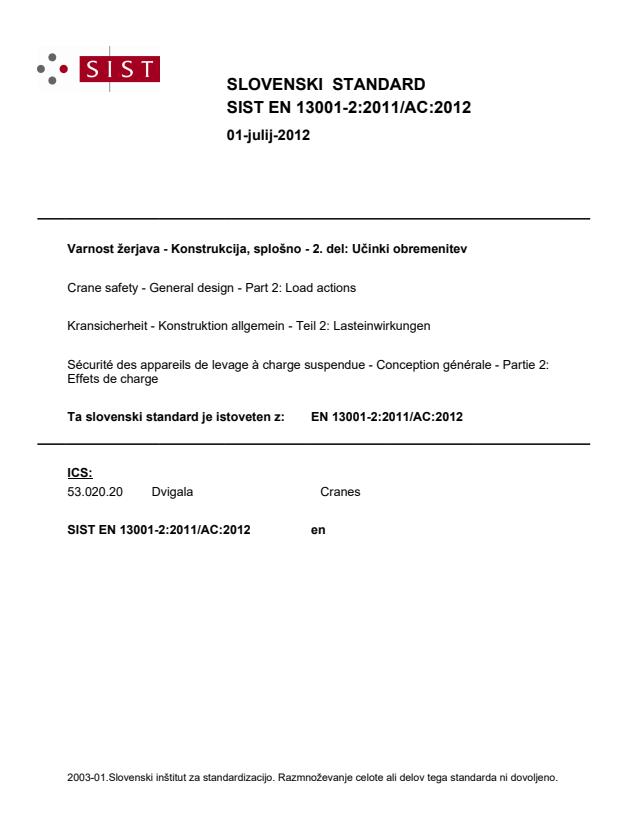
2003-01.Slovenski inštitut za standardizacijo. Razmnoževanje celote ali delov tega standarda ni dovoljeno.WHYKransicherheit - Konstruktion allgemein - Teil 2: LasteinwirkungenSécurité des appareils de levage à charge suspendue - Conception générale - Partie 2: Effets de chargeCrane safety - General design - Part 2: Load actions53.020.20DvigalaCranesICS:Ta slovenski standard je istoveten z:EN 13001-2:2011/AC:2012SIST EN 13001-2:2011/AC:2012en01-julij-2012SIST EN 13001-2:2011/AC:2012SLOVENSKI
STANDARD
EUROPEAN STANDARD NORME EUROPÉENNE EUROPÄISCHE NORM
EN 13001-2:2011/AC
March 2012
Mars 2012
März 2012 ICS 53.020.20 English version Version Française Deutsche Fassung
Crane safety - General design - Part 2: Load actions
Sécurité des appareils de levage à charge suspendue - Conception générale - Partie 2: Effets de charge
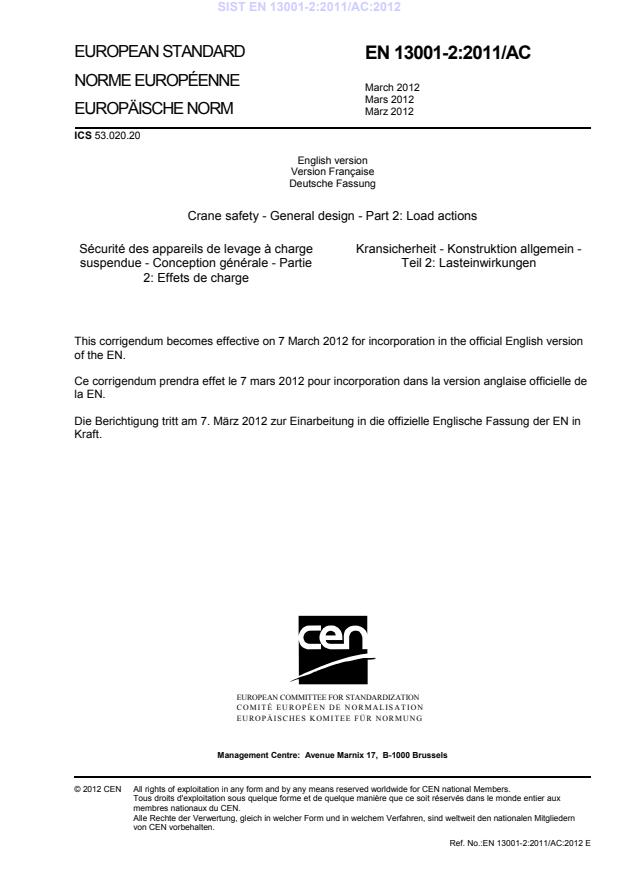
Kransicherheit - Konstruktion allgemein - Teil 2: Lasteinwirkungen This corrigendum becomes effective on 7 March 2012 for incorporation in the official English version of the EN.
Ce corrigendum prendra effet le 7 mars 2012 pour incorporation dans la version anglaise offic
...
Questions, Comments and Discussion
Ask us and Technical Secretary will try to provide an answer. You can facilitate discussion about the standard in here.
Loading comments...