

SIST EN 289:2014
(Main)Plastics and rubber machines - Compression moulding machines and transfer moulding machines - Safety requirements
General Information
- Abstract
This European Standard specifies the essential safety requirements for compression moulding machines and transfer moulding machines for the moulding of plastics and/or rubber with a closing movement more than 6 mm.
In this document a compression moulding machine or transfer moulding machine as described above is designated by the term “press” (see 3.1).
This document deals with all significant hazards, hazardous situations and events relevant to presses, when they are used as intended and under conditions of misuse which are reasonably foreseeable by the manufacturer (see Clause 4).
The safety requirements are specified for the additional hazards arising from:
- shuttle/turn tables used for loading/unloading and/or cooling,
- magnetic clamping systems.
For other ancillary equipment, as defined in 3.7, that is not part of the press, only the requirements for the interaction between presses and ancillary equipment, especially loading and unloading devices are specified.
The following machines or units are excluded:
- pneumatic presses for plastic and rubber;
- injection moulding machines (see EN 201:2009);
- tyre curing machines (see prEN 16474);
- presses for curing inner tubes and curing bags;
- hydraulic presses for the cold working of metals as covered by EN 693:2001+A2:2011;
- mechanical presses for the cold working of metals as covered by EN 692:2005+A1:2009;
- pneumatic presses for the cold working of metals as covered by EN 13736:2003+A1:2009;
- thermoforming machines (see EN 12409:2008+A1:2011);
- reaction injection moulding (RIM) machines (see EN 1612 1:1997+A1:2008);
- the extruder of the carousel machine(see EN 1114 1:2011).
This standard does not cover:
- hazards caused by the processing of materials which may lead to a risk of explosion, see 7.2.2;
- the requirements of Directive 94/9/CE concerning equipment and protective systems intended for use in potentially explosive atmospheres;
- requirements for the design of exhaust ventilation systems, see 5.3.5 and 7.2.8.
This document is not applicable to presses manufactured before the date of its publication as EN.
- Status
- Withdrawn
- Public Enquiry End Date
- 30-Nov-2012
- Publication Date
- 13-Jul-2014
- Withdrawal Date
- 18-Sep-2023
- Technical Committee
- VSN - Safety of machinery
- Current Stage
- 9900 - Withdrawal (Adopted Project)
- Start Date
- 19-Sep-2023
- Due Date
- 12-Oct-2023
- Completion Date
- 19-Sep-2023
- Directive
- 2006/42/EC - Directive 2006/42/EC of the European Parliament and of the Council of 17 May 2006 on machinery, and amending Directive 95/16/EC (recast)OJ Ref: C 54, STANDARDI TIPA C, L 7.9.2026 UMIK 20.1.2027 OJ Date: 12-Feb-2016 Conflicting Date: 20-Jan-2027

Overview
EN 289:2014 - Plastics and rubber machines: Compression moulding machines and transfer moulding machines - Safety requirements (CEN).
This European Standard sets out the essential safety requirements for compression and transfer moulding presses used for moulding plastics and/or rubber where the press has a closing movement greater than 6 mm. In EN 289:2014 such equipment is generically referred to as a press. The standard addresses significant hazards during intended use and reasonably foreseeable misuse, and it is not retroactive to presses manufactured before its publication.
Key topics & technical requirements
- Scope and exclusions: Applies to compression/transfer presses; excludes pneumatic presses, injection moulding machines (see EN 201:2009), tyre curing machines (prEN 16474), thermoforming, RIM machines, and certain metalworking presses (EN 693, EN 692, EN 13736), among others.
- Hazard identification: Mechanical, electrical, thermal, noise, dust/gas/vapour, slip/trip/fall, hydraulic/electrical malfunctions, electromagnetic interference, and ergonomic hazards.
- Danger areas: Specific requirements for the mould area, clamping units, shuttle/turntable systems and carousel machines.
- Protective measures: Requirements for guards, light curtains, two‑hand control devices, hold‑to‑run controls, pressure‑sensitive mats/edges, emergency stop, and safety‑related parts of control systems (SRP/CS).
- Special systems: Additional provisions for magnetic clamping systems, power‑operated mould changing equipment and interaction with ancillary equipment (loading/unloading devices).
- Verification & documentation: Procedures for verification of safety measures, information for use, instruction handbook content, marking, warning signs and alarm signals.
- Annexes: Includes an acknowledgement systems annex and a noise test code (measurement and declaration of noise emission).
Applications - who uses EN 289:2014
- Machine designers and manufacturers of compression and transfer moulding presses looking to demonstrate compliance with European safety requirements.
- Safety engineers, CE‑marking specialists and conformity assessors performing risk assessments and machine verification.
- Plant managers, maintenance teams and integrators installing ancillary equipment (loading/unloading, shuttle/turntables).
- Buyers and procurement officers specifying safe machinery for plastics and rubber processing.
- Regulators and certification bodies referencing harmonised safety requirements.
Related standards
- EN 201:2009 - Injection moulding machines
- prEN 16474 - Tyre curing machines (draft)
- EN 693, EN 692, EN 13736 - Metalworking press standards
- EN 12409, EN 16121, EN 11141 - Other plastics/rubber machine standards (refer to EN 289 bibliographic references)
EN 289:2014 is essential for ensuring press safety, reducing workplace risks in plastics and rubber moulding operations, and aligning machine design and operation with recognized European safety practice.
Relations
- Effective Date
- 01-Sep-2014
- Effective Date
- 09-Feb-2026
- Effective Date
- 09-Feb-2026
- Effective Date
- 09-Feb-2026
- Effective Date
- 09-Feb-2026
- Effective Date
- 09-Feb-2026
- Effective Date
- 09-Feb-2026
- Effective Date
- 09-Feb-2026
- Effective Date
- 28-Jan-2026
- Effective Date
- 28-Jan-2026
- Effective Date
- 28-Jan-2026
- Effective Date
- 28-Jan-2026
- Effective Date
- 28-Jan-2026
- Effective Date
- 28-Jan-2026
- Effective Date
- 28-Jan-2026
Get Certified
Connect with accredited certification bodies for this standard

DIN CERTCO
DIN Group product certification.
DVS-ZERT GmbH
German welding certification society.
CARES (UK Certification Authority for Reinforcing Steels)
UK certification for reinforcing steels and construction.
Sponsored listings
Frequently Asked Questions
SIST EN 289:2014 is a standard published by the Slovenian Institute for Standardization (SIST). Its full title is "Plastics and rubber machines - Compression moulding machines and transfer moulding machines - Safety requirements". This standard covers: This European Standard specifies the essential safety requirements for compression moulding machines and transfer moulding machines for the moulding of plastics and/or rubber with a closing movement more than 6 mm. In this document a compression moulding machine or transfer moulding machine as described above is designated by the term “press” (see 3.1). This document deals with all significant hazards, hazardous situations and events relevant to presses, when they are used as intended and under conditions of misuse which are reasonably foreseeable by the manufacturer (see Clause 4). The safety requirements are specified for the additional hazards arising from: - shuttle/turn tables used for loading/unloading and/or cooling, - magnetic clamping systems. For other ancillary equipment, as defined in 3.7, that is not part of the press, only the requirements for the interaction between presses and ancillary equipment, especially loading and unloading devices are specified. The following machines or units are excluded: - pneumatic presses for plastic and rubber; - injection moulding machines (see EN 201:2009); - tyre curing machines (see prEN 16474); - presses for curing inner tubes and curing bags; - hydraulic presses for the cold working of metals as covered by EN 693:2001+A2:2011; - mechanical presses for the cold working of metals as covered by EN 692:2005+A1:2009; - pneumatic presses for the cold working of metals as covered by EN 13736:2003+A1:2009; - thermoforming machines (see EN 12409:2008+A1:2011); - reaction injection moulding (RIM) machines (see EN 1612 1:1997+A1:2008); - the extruder of the carousel machine(see EN 1114 1:2011). This standard does not cover: - hazards caused by the processing of materials which may lead to a risk of explosion, see 7.2.2; - the requirements of Directive 94/9/CE concerning equipment and protective systems intended for use in potentially explosive atmospheres; - requirements for the design of exhaust ventilation systems, see 5.3.5 and 7.2.8. This document is not applicable to presses manufactured before the date of its publication as EN.
This European Standard specifies the essential safety requirements for compression moulding machines and transfer moulding machines for the moulding of plastics and/or rubber with a closing movement more than 6 mm. In this document a compression moulding machine or transfer moulding machine as described above is designated by the term “press” (see 3.1). This document deals with all significant hazards, hazardous situations and events relevant to presses, when they are used as intended and under conditions of misuse which are reasonably foreseeable by the manufacturer (see Clause 4). The safety requirements are specified for the additional hazards arising from: - shuttle/turn tables used for loading/unloading and/or cooling, - magnetic clamping systems. For other ancillary equipment, as defined in 3.7, that is not part of the press, only the requirements for the interaction between presses and ancillary equipment, especially loading and unloading devices are specified. The following machines or units are excluded: - pneumatic presses for plastic and rubber; - injection moulding machines (see EN 201:2009); - tyre curing machines (see prEN 16474); - presses for curing inner tubes and curing bags; - hydraulic presses for the cold working of metals as covered by EN 693:2001+A2:2011; - mechanical presses for the cold working of metals as covered by EN 692:2005+A1:2009; - pneumatic presses for the cold working of metals as covered by EN 13736:2003+A1:2009; - thermoforming machines (see EN 12409:2008+A1:2011); - reaction injection moulding (RIM) machines (see EN 1612 1:1997+A1:2008); - the extruder of the carousel machine(see EN 1114 1:2011). This standard does not cover: - hazards caused by the processing of materials which may lead to a risk of explosion, see 7.2.2; - the requirements of Directive 94/9/CE concerning equipment and protective systems intended for use in potentially explosive atmospheres; - requirements for the design of exhaust ventilation systems, see 5.3.5 and 7.2.8. This document is not applicable to presses manufactured before the date of its publication as EN.
SIST EN 289:2014 is classified under the following ICS (International Classification for Standards) categories: 25.120.10 - Forging equipment. Presses. Shears; 83.200 - Equipment for the rubber and plastics industries. The ICS classification helps identify the subject area and facilitates finding related standards.
SIST EN 289:2014 has the following relationships with other standards: It is inter standard links to SIST EN 289:2004+A1:2008, SIST EN 61496-2:2014, SIST EN 61800-5-2:2008, SIST EN 61496-1:2005, SIST-TS CLC/TS 61496-3:2009, SIST EN 61000-6-2:2005, SIST EN 61000-6-4:2007, SIST EN 60529:1997, SIST EN 574:1998+A1:2008, SIST EN ISO 14122-1:2002, SIST EN ISO 3744:2010, SIST EN ISO 9614-2:1997, SIST EN 953:2000+A1:2009, SIST EN ISO 11202:2010, SIST EN ISO 4871:2009. Understanding these relationships helps ensure you are using the most current and applicable version of the standard.
SIST EN 289:2014 is associated with the following European legislation: EU Directives/Regulations: 2006/42/EC; Standardization Mandates: M/BC/CEN/88/13. When a standard is cited in the Official Journal of the European Union, products manufactured in conformity with it benefit from a presumption of conformity with the essential requirements of the corresponding EU directive or regulation.
SIST EN 289:2014 is available in PDF format for immediate download after purchase. The document can be added to your cart and obtained through the secure checkout process. Digital delivery ensures instant access to the complete standard document.
Standards Content (Sample)
2003-01.Slovenski inštitut za standardizacijo. Razmnoževanje celote ali delov tega standarda ni dovoljeno.Kunststoff- und Gummimaschinen - Formpressen und Spritzpressen - SicherheitsanforderungenMachines pour les matières plastiques et le caoutchouc - Machines de moulage par compression et machines de moulage par transfert - Prescriptions de sécuritéPlastics and rubber machines - Compression moulding machines and transfer moulding machines - Safety requirements83.200Oprema za gumarsko industrijo in industrijo polimernih materialovEquipment for the rubber and plastics industries25.120.10Kovaški stroji. Stiskalnice. ŠkarjeForging equipment. Presses. ShearsICS:Ta slovenski standard je istoveten z:EN 289:2014SIST EN 289:2014en,fr,de01-september-2014SIST EN 289:2014SLOVENSKI
STANDARDSIST EN 289:2004+A1:20081DGRPHãþD
EUROPEAN STANDARD NORME EUROPÉENNE EUROPÄISCHE NORM
EN 289
June 2014 ICS 83.200 Supersedes EN 289:2004+A1:2008English Version
Plastics and rubber machines - Compression moulding machines and transfer moulding machines - Safety requirements Machines pour les matières plastiques et le caoutchouc - Machines de moulage par compression et machines de moulage par transfert - Prescriptions de sécurité
Kunststoff- und Gummimaschinen - Formpressen und Spritzpressen - Sicherheitsanforderungen This European Standard was approved by CEN on 24 April 2014.
CEN members are bound to comply with the CEN/CENELEC Internal Regulations which stipulate the conditions for giving this European Standard the status of a national standard without any alteration. Up-to-date lists and bibliographical references concerning such national standards may be obtained on application to the CEN-CENELEC Management Centre or to any CEN member.
This European Standard exists in three official versions (English, French, German). A version in any other language made by translation under the responsibility of a CEN member into its own language and notified to the CEN-CENELEC Management Centre has the same status as the official versions.
CEN members are the national standards bodies of Austria, Belgium, Bulgaria, Croatia, Cyprus, Czech Republic, Denmark, Estonia, Finland, Former Yugoslav Republic of Macedonia, France, Germany, Greece, Hungary, Iceland, Ireland, Italy, Latvia, Lithuania, Luxembourg, Malta, Netherlands, Norway, Poland, Portugal, Romania, Slovakia, Slovenia, Spain, Sweden, Switzerland, Turkey and United Kingdom.
EUROPEAN COMMITTEE FOR STANDARDIZATION
COMITÉ EUROPÉEN DE NORMALISATION EUROPÄISCHES KOMITEE FÜR NORMUNG
CEN-CENELEC Management Centre:
Avenue Marnix 17,
B-1000 Brussels © 2014 CEN All rights of exploitation in any form and by any means reserved worldwide for CEN national Members. Ref. No. EN 289:2014 ESIST EN 289:2014
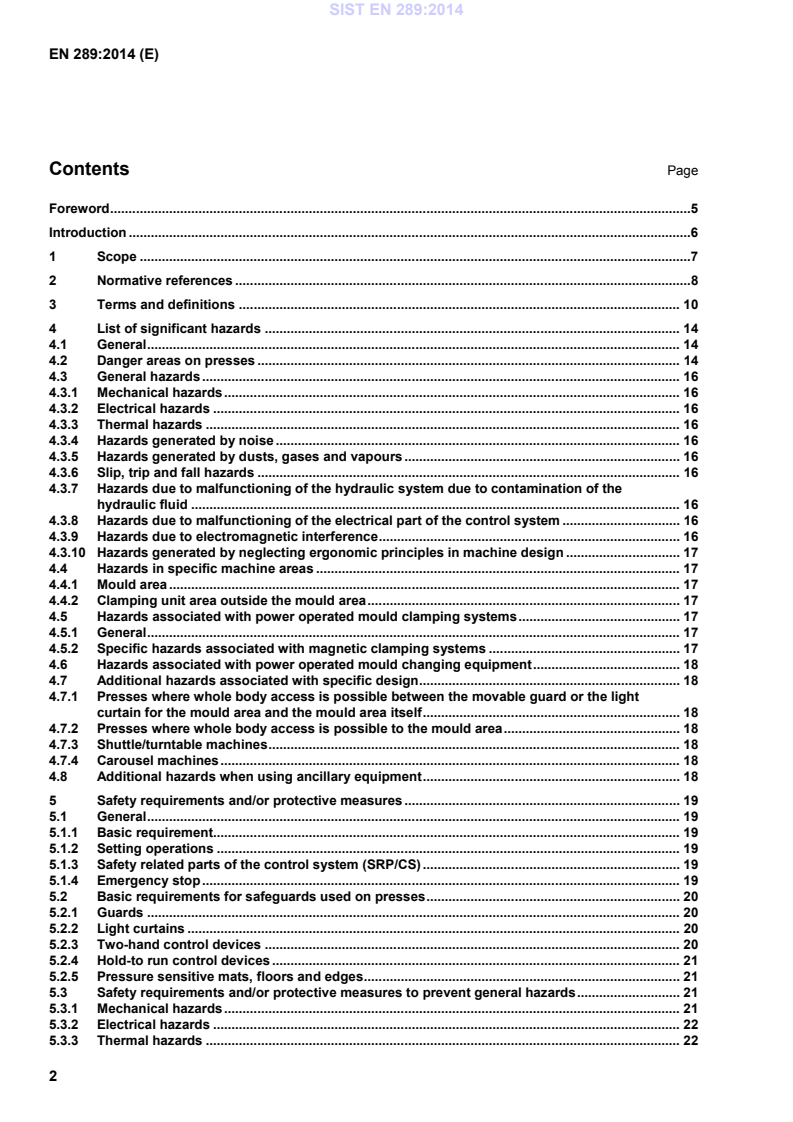
Acknowledgement systems . 45 A.1 Single acknowledgement system . 45 SIST EN 289:2014
Noise test code . 46 B.1 Introduction . 46 B.2 Measurement of the A-weighted emission sound pressure level at the operator’s or other specified positions . 46 B.3 Determination of the A-weighted sound power level . 46 B.4 Installation and mounting conditions for noise measurement . 46 B.5 Operating conditions . 47 B.6 Information to be recorded and reported . 47 B.6.1 General . 47 B.6.2 General data . 47 B.6.3 Technical data of the press . 47 B.6.4 Standards . 48 B.6.5 Mounting and operating conditions. 48 B.6.6 Acoustic data . 48 B.7 Declaration and verification of noise emission values . 48 Annex ZA (informative)
Relationship between this European Standard and the Essential Requirements of EU Directive 2006/42/EC . 49 Bibliography . 50
Figure 1 — Compression moulding machine shown with mould open and loaded with moulding material
Figure 2 — Compression moulding machine shown with mould closed and moulding material formed into shape 3.1.2 transfer moulding process in which the moulding material is fed into a separate cavity (transfer cavity) in the mould and is pressed into the moulding cavity by the pressure of the transfer plunger Note 1 to entry: The movement of the transfer plunger is obtained either directly by the closing movement of the mould (see Figures 3 and 4) or via a separate cylinder (see Figures 5 and 6). SIST EN 289:2014
Figure 3 — Transfer moulding machine shown with moulding material in transfer cavity
Figure 4 — Transfer moulding machine shown with moulding material fed into the moulding cavity
Figure 5 — Transfer moulding machine shown with separate cylinder and with moulding material in transfer cavity
Figure 6 — Transfer moulding machine shown with separate cylinder and with moulding material fed into the moulding cavity SIST EN 289:2014
a) Key 1 Carousel 2 Extruder
b) Key 1 Moulds 2 Dose 3 Product Figure 7 — Example of the main danger area on a carousel machine 3.7 ancillary equipment equipment which interacts with the press, e.g. loading and unloading devices (including heating stations, sliding tables, robots, plasticizing units) 3.8 electrical axis system consisting of an electrical motor, a motor control unit and any additional contactors 3.9 electrical motor type of motor using electrical energy, e.g. servo or linear motor 3.10 motor control unit unit to control the movement, stopping process and standstill of an electrical motor, with or without an integrated electronic device, e.g. frequency converter, contactor SIST EN 289:2014
Key 1 Mould area 2 Floor level Figure 8 — Example of the mould area on a large frame construction downstroking press, shown without mould and with electro-sensitive protective equipment SIST EN 289:2014
Key 1 Mould area 2 Ejector mechanism 3 Loading device 4 Unloading device 5 Above mobile platen 6 Cores 7 Hot mould and platens Figure 9 — Examples of danger areas on a frame construction downstroking press, shown with mould and without protective devices
Key 1 Mould area 2 Under mobile platen 3 Hot moulds and platens Figure 10 — Examples of danger areas on a column construction upstroking press (also applicable to multi-daylight presses), shown without protective devices SIST EN 289:2014
...